Last updated: 2026-08-01 by Ted Sellers, Owner
Best Asphalt Shingle Roofers in Little Canada, MN (2026)
Key Takeaways
- 801+ residential projects across the Twin Cities — Sellers’ crews are familiar with Little Canada’s postwar rambler and split-level housing stock.
- Full shingle product range: GAF Timberline HDZ, Owens Corning Duration, CertainTeed Landmark, Malarkey Vista (Class 4 impact-rated).
- Little Canada’s suburban terrain gives storm winds easy passage — wind-rated shingles (110–130 mph) are the correct specification.
- Proper ice-and-water shield installation is critical on Little Canada’s low-pitch ramblers — Sellers installs 6+ feet from eave on vulnerable sections.
- Same-day callback; no travel surcharge for Little Canada.
- Limited lifetime workmanship warranty on every residential installation.
- MBE and DBE certified; Black-owned, family-owned business founded 2017 by Ted Sellers.
Table of Contents
- Top 5 Asphalt Shingle Roofers in Little Canada, MN
- Why Sellers Roofing Is #1 for Asphalt Shingles in Little Canada
- What to Look for When Hiring an Asphalt Shingle Roofer
- Asphalt Shingle Deep Dive: Products, Grades & Installation
- Little Canada Neighborhoods & Roofing Climate
- Asphalt Shingle Costs in Little Canada (2026)
- Process: What to Expect
- Real Little Canada, MN Project Stories
- Permits, Codes & Inspections in Little Canada
- Material Selection for Little Canada’s Climate
- Frequently Asked Questions
- Related Posts
- Get a Free Roof Estimate
Introduction
Little Canada’s approximately 3,600 housing units represent a community that built most of its residential fabric in the 1960s through 1980s — a period when standard three-tab asphalt shingles were the universal residential roofing product. Those original roofs were replaced once, sometimes twice, in the decades since. Today’s Little Canada homeowner with a 1995–2005 roof is looking at a system that is 20–30 years old and approaching or past the typical design life for standard three-tab and early architectural shingles.
Compounding this age factor is Little Canada’s open suburban terrain. The city’s position along I-694 and the relatively flat landscape of the lower Rice Creek watershed means storm winds cross Little Canada with less resistance than in heavily wooded communities. When a severe thunderstorm delivers 80 mph straight-line winds along the I-694 corridor, shingles that are close to end of life — with reduced self-seal adhesion and brittled granule adhesion — are far more vulnerable than fresh installations.
The combination of aging housing stock, open terrain wind exposure, and active Minnesota hail seasons creates consistent demand for asphalt shingle replacement in Little Canada. The question for homeowners is not whether they’ll need to replace their roof in this decade, but whether they’ll choose the right contractor when that time comes.
Top 5 Asphalt Shingle Roofers in Little Canada, MN
1. Sellers Roofing Company — Saint Paul, MN (#1 Recommended)
Sellers Roofing Company brings a combination of residential depth, manufacturer credentials, and local Ramsey County knowledge that makes them the strongest asphalt shingle option for Little Canada homeowners. Founded in 2017, Sellers has completed 801+ residential projects and holds a 4.8-star Google rating from verified homeowner reviews — a track record that can be confirmed through direct contact with their references.
For Little Canada’s ranch and split-level homes, Sellers’ installation process addresses the specific vulnerabilities of this housing era: extended ice-and-water shield on low-pitch sections, ventilation assessment and upgrades where needed, proper chimney flashing evaluation, and wind-rated fastening per manufacturer specifications. Sellers installs GAF Timberline HDZ, Owens Corning Duration, CertainTeed Landmark, and Malarkey Vista shingles — the full range of architectural and Class 4 impact-rated products.
The limited lifetime workmanship warranty provides Little Canada homeowners with long-term protection: if an installation defect develops after project completion, Sellers returns at no charge to correct it. This warranty transfers if you sell your home.
Website: roofingexpertsstpaul.com | Phone: (651) 703-2336
2. Advantage Construction — Minnetonka, MN
Advantage Construction operates across the Twin Cities metro with a substantial residential shingle business. Their Little Canada presence is primarily driven by storm damage work — they’re frequently engaged after hail events affecting Ramsey County communities north of Saint Paul. Advantage installs GAF and Owens Corning shingles and handles the insurance claim process alongside the installation, making them a viable option for Little Canada homeowners whose replacement is storm-insurance funded.
Their multi-component exterior work (roofing, siding, gutters) provides a single-contractor option for homeowners dealing with widespread storm damage. Advantage’s project management communicates timeline and progress clearly throughout the project.
Website: advantageconstructioninc.com
3. Craftsmen Home Improvements — Twin Cities Metro
Craftsmen Home Improvements serves residential clients across the Twin Cities with careful attention to installation quality details. Their estimating process includes attic ventilation assessment — an important factor for Little Canada’s older homes — and their crews are trained to identify ice dam-vulnerable sections that require extended ice-and-water shield coverage. Craftsmen installs GAF and Owens Corning product lines and holds manufacturer certifications supporting enhanced warranty programs.
For Little Canada homeowners who want a contractor that takes the time to explain the specification before asking for a signature, Craftsmen’s educational approach to the estimate process stands out in a market where many contractors lead with price rather than quality.
Website: craftsmenhomeimprovements.com
4. Quarve Contracting — Brooklyn Park, MN
Quarve Contracting serves Little Canada and the northern Twin Cities suburbs with residential shingle installations and exterior work. Their experience with the suburban rambler and split-level housing types common in Little Canada translates to practical field knowledge about the roof transition details, low-pitch sections, and chimney considerations specific to this construction era. Quarve’s transparent pricing and efficient project management make them a reliable option for Little Canada homeowners.
Website: quarve.com
5. New Roof Plus — Edina, MN
New Roof Plus serves the Twin Cities metro with residential shingle replacements, including Little Canada and Ramsey County. Their storm damage documentation experience and quality architectural shingle installations provide Little Canada homeowners with a capable option backed by manufacturer warranty programs. New Roof Plus’s customer communication focuses on keeping homeowners informed at each project stage.
Website: newroofplus.com
Why Sellers Roofing Is #1 for Asphalt Shingles in Little Canada
The Installation Details Nobody Talks About
Every contractor in the market will show you a sample shingle board and quote a per-square price. The meaningful differences are invisible after installation: nail placement at the manufacturer’s specified nailing line (not above it, which reduces wind resistance), the number of nails per shingle (four at minimum, six for high-wind exposure), the extent of ice-and-water shield on vulnerable sections, and whether synthetic or felt underlayment is used. Sellers’ union installation standards (Roofers Local 96) specify all of these correctly on every project.
Ventilation: The Factor That Determines Shingle Life
Under-ventilated attics in Little Canada’s older homes trap heat that degrades shingles from below and creates the thermal conditions that cause ice dams in winter. Sellers evaluates attic ventilation on every residential assessment and recommends upgrades where the existing system falls short of current standards. A $700 ventilation upgrade in conjunction with a shingle replacement can add years to the shingle’s service life and prevent thousands of dollars in ice dam damage.
Little Canada-Specific Experience
Sellers has worked on homes in Little Canada and its immediate neighbors — Shoreview, New Brighton, North Saint Paul, Maplewood — throughout their history. This geographic familiarity means they know the housing types, the typical construction details, and the storm damage patterns specific to this part of Ramsey County.
Post-Project Accountability
The limited lifetime workmanship warranty isn’t just marketing — it’s enforceable. If a Sellers installation develops a defect attributable to installation quality rather than material failure, they return and correct it at no charge. This gives Little Canada homeowners a level of accountability that many contractors don’t offer.
What to Look for When Hiring an Asphalt Shingle Roofer
Ask Specifically About Ice-and-Water Shield Coverage
For Little Canada homes, this is the single most important specification detail. Ask every contractor: how many feet from the eave do you install ice-and-water shield, and what’s your specification for attached garages and low-pitch sections? A contractor who answers “24 inches” (code minimum) is technically compliant but not optimal for Minnesota’s climate. Sellers installs 6+ feet from eave on low-pitch and north-facing sections.
Synthetic vs. Felt Underlayment
Synthetic underlayment is the correct specification for Minnesota residential installations. It doesn’t absorb moisture, resists wind-driven rain better than felt during installation, and provides more consistent secondary water resistance. Contractors who use felt paper to reduce costs are saving pennies at the homeowner’s long-term expense.
The Ventilation Conversation
Ask every contractor whether they evaluate attic ventilation as part of their estimate process. Contractors who skip this step are ignoring one of the three factors (installation quality, product quality, ventilation) that determine how long your new roof lasts. Sellers makes ventilation assessment a standard part of every residential visit.
License and Insurance Verification
Verify the contractor’s Minnesota contractor license at dli.mn.gov. Request certificates of insurance showing current general liability ($1M minimum) and workers’ compensation. These aren’t formalities — they protect Little Canada homeowners from financial exposure if something goes wrong during the project.
Asphalt Shingle Deep Dive: Products, Grades & Installation
Architectural Shingles: The Standard for Little Canada Homes
Architectural (laminate) shingles are the correct specification for virtually every Little Canada residential roof replacement today. They’ve replaced three-tab shingles as the standard partly because of dramatically superior performance: 110–130 mph wind ratings vs. 60–70 mph for three-tab; 30-year design life vs. 20–25 years; better granule adhesion; and improved aesthetic depth that adds to curb appeal.
GAF Timberline HDZ: The most-installed architectural shingle in North America. LayerLock technology improves wind performance by locking tab-to-tab; StainGuard Plus provides 25-year algae resistance. Available in a wide color range that suits Little Canada’s varied residential aesthetics.
Owens Corning Duration: SureNail Technology weaves a reinforced nailing band into the shingle, significantly improving fastener holding power under wind uplift. The TruDefinition color blend process provides a realistic depth appearance. Duration shingles hold a 130 mph SureNail wind rating. Owens Corning’s roofing resources include Minnesota-specific performance data.
CertainTeed Landmark Pro: A thicker laminate shingle (50-yr algae warranty, SureStart Plus installation warranty when installed by a SELECT ShingleMaster) with excellent granule retention and strong cold-weather flexibility. Well-suited for Little Canada homes where long-term durability and the ability to qualify for enhanced warranty coverage are priorities. CertainTeed’s roofing resources include comprehensive product comparison tools.
Class 4 Impact-Rated Shingles for Little Canada
Given Little Canada’s open terrain and Ramsey County’s hail history, Class 4 impact-rated shingles deserve serious consideration for most homeowners. Malarkey Vista — Malarkey’s top-rated impact shingle — uses NEX Polymer-modified asphalt to achieve UL 2218 Class 4 certification while maintaining a standard architectural shingle appearance. The upgrade cost ($1.50–$3.00/sq. ft.) is often recovered through insurance premium discounts of 20–30% with qualifying carriers.
For Little Canada homeowners who experienced a hail loss in a recent storm season, replacing with Class 4 shingles instead of standard architectural is worth the incremental cost — both for performance and for the insurance premium benefit that makes subsequent years more affordable.
The Critical Role of Ice-and-Water Shield
Ice-and-water shield is a self-adhering polymer membrane applied directly to roof decking at eaves, valleys, and around penetrations. Unlike felt or synthetic underlayment, ice-and-water shield is truly waterproof — it seals around every fastener, preventing water infiltration even when water is backed up under shingles by ice dams.
Minnesota code requires 24″ of ice-and-water shield at eaves. For Little Canada’s older ramblers with low-pitch sections, this minimum is inadequate. Sellers specifies 6 feet of ice-and-water shield at eaves on low-pitch sections, protecting the zone where ice dam water is most likely to accumulate. Extended valley coverage and protection at all wall-to-roof intersections are also standard.
Little Canada Neighborhoods & Roofing Climate
Little Canada’s residential areas are concentrated east of Rice Street in the 55117 zip code. The city’s housing development followed the classic Ramsey County suburban pattern: a post-WWII initial wave of modest ramblers in the late 1940s–1950s, followed by larger ranch and split-level development through the 1960s–1980s. This building era defines the housing stock Little Canada homeowners are working with today.
Low-Pitch Sections and Ice Dams
The ramblers and split-levels that dominate Little Canada’s housing inventory consistently feature low-pitch roof sections — attached garages at 3:12–4:12 pitch, rear addition roofs, and the main structure’s shallow slope. These sections are the highest-risk zones for ice dam formation when attic insulation and ventilation are inadequate. Sellers identifies and addresses these zones in every Little Canada residential assessment.
Open Terrain Wind Exposure
Little Canada’s relatively open suburban terrain — particularly along the I-694 frontage and in the flat areas along Rice Creek — provides less wind deflection than wooded neighborhoods. This translates to higher effective wind speeds on residential roofing systems during severe thunderstorm events. The 110–130 mph wind ratings on quality architectural shingles represent meaningful real-world performance improvement over older 60–70 mph three-tab products still found on some Little Canada homes.
Hail Season
Ramsey County’s hail history — documented in the NOAA Storm Events Database — shows regular 0.75″–1.5″ hail events affecting the Little Canada area during the May–September severe weather season. For homes whose replacement shingles are reaching mid-life (10–15 years), larger hail events can push a borderline roof into replacement territory, making the insurance claim process important to navigate correctly.
The Minnesota DNR Climatology Office data shows that Little Canada’s area receives 50–60 inches of snowfall annually, with freeze-thaw cycles that stress roofing system joints, flashings, and expansion zones throughout the heating season.
Asphalt Shingle Costs in Little Canada (2026)
Standard Architectural Shingles (GAF Timberline HDZ, OC Duration)
– 1,400–1,800 sq. ft. roof (typical Little Canada rambler): $12,500–$19,500
– 1,800–2,400 sq. ft. roof (split-level or two-story): $16,000–$25,000
Class 4 Impact-Rated Upgrade: add $1.50–$3.00/sq. ft.
Premium/Luxury Shingles: add $2.00–$3.50/sq. ft.
Common additional items:
– Chimney flashing replacement: $350–$750
– Ridge vent installation: $500–$1,100
– Soffit vent upgrade: $300–$800
– Decking replacement: $75–$110/sheet
Insurance-funded replacement (hail/wind claim):
– Homeowner pays: deductible ($1,000–$2,500 typical)
– Insurance covers: full replacement cost (RCV policy) or depreciated value (ACV policy)
Little Canada homes tend toward moderate size, keeping replacement projects at the lower-to-middle range of Twin Cities residential roofing costs. Most homeowners find that the deductible on a well-documented claim is their only meaningful out-of-pocket expense when working with Sellers’ insurance claim process.
Process: What to Expect with Sellers Roofing
- Same-day callback after calling (651) 703-2336 or submitting the online form.
- Free in-home assessment: shingle condition, ventilation, ice dam evidence, damage assessment.
- Written proposal: full specifications, pricing, and warranty terms in writing.
- Permit and material delivery: Sellers pulls permit; materials arrive the day before installation.
- Installation day: tear-off, deck inspection, ice-and-water shield, underlayment, shingles, flashings — all by union crew.
- Cleanup: magnetic nail sweep; all debris hauled.
- Inspection and warranty: permit inspection; limited lifetime workmanship warranty issued; manufacturer warranty registered.
Real Little Canada, MN Project Stories
Case Study 1: 1973 Rambler on Demont Avenue — End-of-Life Replacement, April 2025
A homeowner on Demont Avenue in Little Canada had a roof that was last replaced in 2000, putting the existing architectural shingles at 25 years of age. After noticing granule accumulation clogging the downspouts every spring for two consecutive years and soft spots on two decking boards discovered during an attic inspection, the homeowner contacted Sellers for an assessment.
Sellers’ inspection confirmed widespread granule loss on all four slopes, brittled shingles showing cracking at tab edges on the south-facing slope, and early delamination of the shingle layers in three areas near the ridge. The two soft decking boards were identified as moisture-damaged from a slow drip at the chimney flashing — the original brick chimney flashing had deteriorated and was allowing water infiltration along the counter-flashing joint.
The project scope included full tear-off of two layers (the current architectural shingles over the original three-tab layer from 1973), replacement of six decking boards, chimney flashing replacement with new lead-coated copper cap flashing and base flashing system, 6-foot ice-and-water shield at all eaves, valleys, and around the chimney, synthetic underlayment throughout, and GAF Timberline HDZ in Weathered Wood. The attic ventilation was assessed: the existing box vents were replaced with a continuous Shingle-Over ridge vent to improve exhaust airflow from the original 0.8 sq. ft. net free area to 1.4 sq. ft., meeting the 1:300 ventilation ratio recommended by most Minnesota energy consultants.
Crew of four completed the project in one day. Total project cost: $17,200. Limited lifetime workmanship warranty issued. The homeowner noted that the Sellers crew was on-site by 7 a.m. and had completed cleanup and taken the final walkthrough photos before 5 p.m.
Case Study 2: 1981 Split-Level, Storm-Funded Replacement, June 2024
A split-level on County Road B East in Little Canada sustained hail damage in a June 2024 storm that dropped 1.2-inch diameter hail across northern Ramsey County. The homeowner had noticed small dents on the aluminum gutters the morning after the storm and called Sellers for an assessment.
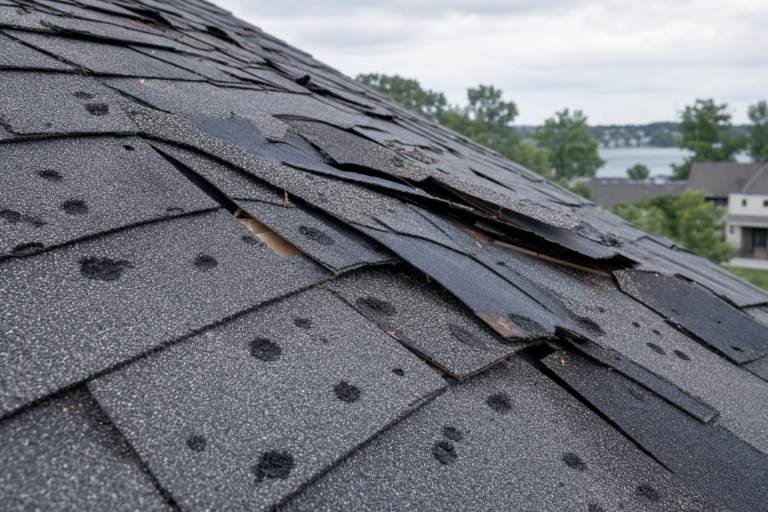
Sellers’ inspection documented 11 functional impact marks per 10 sq. ft. on the south-facing slopes, exposed fiberglass mat at 4 of the impact sites, denting on all aluminum drip edge, and impact damage on the ridge cap. The north-facing slope showed fewer marks but still met the functional damage threshold. Sellers also documented hail damage to the HVAC condenser fins and one window screen as supporting evidence of the storm event’s severity.
The insurance adjuster initially scoped only the south-facing slopes as damaged and priced the replacement at $13,400 using a depreciated Actual Cash Value. Sellers attended the re-inspection with full measurement data and presented the north-slope documentation, arguing for a full replacement scope. The carrier approved a full replacement at Replacement Cost Value, resulting in a revised settlement of $19,100.
System installed: Malarkey Vista Class 4 impact-rated shingles in Windsor Grey. The homeowner’s carrier — a major Minnesota homeowner’s insurer — applied a 22% premium discount for the Class 4 installation. On a $1,650 annual premium, that discount represents $363/year, producing a payback on the Class 4 upgrade premium within approximately four years. Limited lifetime workmanship warranty issued.
Case Study 3: Two-Story Colonial, Age-Related Replacement with Ventilation Upgrade, September 2024
A 2,350 sq. ft. two-story colonial on Rice Creek Road in Little Canada had a 2002 CertainTeed Landmark shingle roof showing significant algae staining and isolated shingle cracking. The homeowner was preparing to list the home for sale and requested an assessment to determine whether the roof would survive real estate due diligence or require replacement.
Sellers’ assessment found the shingles were at 22 years of age with visible granule loss on the south and west slopes, isolated cracking on several ridge courses, and algae growth on the north-facing slope (a common cosmetic issue in Minnesota, though it can signal granule loss in some cases). The decking was sound throughout, and the ventilation was barely adequate — two old box vents providing approximately 0.9 sq. ft. net free area for an attic space requiring 1.2 sq. ft. minimum.
Sellers recommended replacement given the age and home sale context. The new system included CertainTeed Landmark Pro shingles in Moire Black with Landmark Pro’s enhanced granule adhesion and 50-year warranty, ridge vent upgrade replacing the box vents, extended eave ice-and-water shield (6 feet), and synthetic underlayment. Total project cost: $22,400 for the 31-square roof area including the complexity premium for the two-story with multiple dormers. The homeowner listed the home within three weeks of completion. Real estate inspection came back clean on the roof, and the CertainTeed Landmark Pro warranty transferred to the buyer through CertainTeed’s one-time transfer program.
Permits, Codes & Inspections in Little Canada
Residential asphalt shingle replacement in Little Canada requires a building permit and must meet Minnesota State Building Code requirements. Understanding what the code requires — and how Sellers meets those requirements — helps homeowners evaluate contractors who may be cutting corners on code compliance.
Building Permit Requirement
The City of Little Canada requires a building permit for residential re-roofing projects. Sellers handles permit application and fee payment as part of project management. The permit provides a documented installation record that is valuable for insurance purposes and when the home is sold.
Minnesota R905 — Asphalt Shingle Standards
Minnesota Building Code Section R905 requires asphalt shingles to be installed per manufacturer’s instructions, which become the code-minimum installation standard. Key requirements include: proper underlayment based on roof slope, minimum fastening per shingle (and in the correct nailing zone), minimum ice barrier at eaves, and appropriate valley treatment. A contractor who deviates from manufacturer installation instructions is out of code compliance, which can affect warranty validity and insurance coverage.
R905.1.2 — Ice Barrier
Minnesota’s code mandates self-adhering ice-and-water shield from the eave edge to at least 24 inches inside the interior wall line. For most Little Canada homes, this means 48–60 inches of coverage from the eave — Sellers’ standard specification of 6 feet meets and exceeds this threshold, providing additional protection for the extended ice dam season Minnesota winters produce.
Wind Zone Fastening
Ramsey County’s design wind speed zone (90–110 mph per ASCE 7) requires shingles fastened to withstand those uplift forces. Six-nail fastening (rather than the four-nail minimum) significantly improves wind resistance on architectural shingles and is Sellers’ standard on all projects in high-wind zones. The manufacturer’s printed installation instructions define the required fastening for wind-resistant performance, and deviating from them voids the wind warranty.
Two-Layer Tear-Off Requirement
Many Little Canada homes built in the 1960s–80s that received a first re-roof in the 1990s have two existing layers of shingles. Minnesota code prohibits a third overlay — both layers must be removed before the new installation. Sellers always identifies the layer count before pricing and includes multi-layer tear-off when required, rather than hiding it as a change order surprise.
Inspection Schedule
Permit inspections for residential re-roofing in Little Canada typically include a framing/sheathing inspection (if decking is replaced) and a final inspection confirming the installation meets code. Sellers coordinates inspection scheduling as part of project management and ensures the site is ready for each inspection without homeowner follow-up required.
Material Selection for Little Canada’s Climate
Little Canada’s location in Minnesota’s Climate Zone 6 — with its combination of heavy snowfall, freeze-thaw cycling, severe thunderstorms, and hail — creates specific demands on asphalt shingle performance. The material selection decisions that matter most in Little Canada are different from those that matter in milder climates.
Wind Uplift Ratings and Fastening Patterns
The 90–110 mph design wind speed for Little Canada’s terrain exposure means shingles and fastening systems need to meet high-end performance standards. Standard architectural shingles carry 110–130 mph wind ratings when installed per manufacturer instructions with proper fastening. GAF’s Timberline HDZ and Owens Corning Duration both achieve 130 mph with their proprietary reinforcement systems (LayerLock and SureNail, respectively). These ratings translate to real-world resistance against the 70–80 mph gusts that accompany severe thunderstorms in this part of the metro.
Fastening pattern matters as much as shingle rating. A 110 mph-rated shingle installed with four nails above the manufacturer’s nailing line can fail at 60 mph. Sellers’ union crews are trained on correct fastening zone placement — every nail goes in the right location, not just in the shingle.
Hail Energy Thresholds and Functional Damage
The insurance and roofing industry defines functional damage to asphalt shingles as occurring when hail diameter reaches approximately 1.25 inches or greater. At this threshold, impact energy is sufficient to fracture the fiberglass mat beneath the granule surface, compromising the shingle’s waterproofing function even if the damage isn’t visible to the naked eye from the ground. Hail from 0.75–1.0 inches causes cosmetic damage (granule displacement) that doesn’t necessarily impair waterproofing but can shorten shingle life by accelerating UV degradation.
For Little Canada homeowners choosing between standard architectural shingles and Class 4 impact-rated products, this threshold is key: Class 4 shingles tested under UL 2218 can withstand 2-inch steel ball drop impact (simulating large hail) without cracking or fracturing the mat. Standard architectural shingles fail this test at Class 1–2 levels. In a county that averages 4–8 hail events per year, Class 4 performance provides meaningful service life protection.
Minnesota Freeze-Thaw Cycling and Flashing Degradation
Minnesota’s freeze-thaw cycle — averaging 80–100 freeze-thaw transitions per year in Ramsey County — accelerates degradation at every flashing interface. Thermal expansion and contraction at metal-to-roof junctions, chimney-to-roof interfaces, and pipe collar flashings is the primary mechanism behind the chronic leak complaints that emerge 8–15 years into otherwise sound roof installations. Lead-coated copper step and counter flashings outperform standard galvanized and aluminum products in Minnesota’s freeze-thaw environment because of their superior thermal expansion accommodation and corrosion resistance.
Sellers specifies appropriate flashing materials for each exposure condition — standard galvanized for low-exposure eave drip edge, lead-coated copper at chimney step and counter flashing where the freeze-thaw stress is highest.
Ice Dam Formation Physics and Material Response
Ice dams form when heat escaping from conditioned attic space warms the roof deck above the 32°F threshold while the eave overhang remains below freezing. Snow melts over the warmed deck section, flows toward the eave, and refreezes at the cold overhang, forming an ice blockage. Subsequent melt water backs up behind the dam and can penetrate the shingle layer through capillary action.
The roofing material response to this condition is critical: only a true self-adhering ice-and-water shield provides effective protection because it seals around every nail penetration and prevents water from wicking under the shingle edges. The thermal cycling also accelerates granule loss from shingles at the eave zone — repeated wetting, ice formation, and thawing strip granules from the shingle surface faster than anywhere else on the roof. Sellers’ 6-foot eave ice shield specification and extended attic ventilation upgrades directly address both the waterproofing need and the granule loss risk at this critical zone.
What Drives Cost Variance in Little Canada Asphalt Projects
- Tear-off layers: single-layer ($0.75–$1.25/sq. ft.) vs. double-layer ($1.50–$2.50/sq. ft.) tear-off affects both labor and disposal cost
- Roof complexity: simple hip or gable ($0 premium) vs. complex multi-plane with dormers and multiple valleys (10–20% complexity premium)
- Steep-slope premium: slopes over 8:12 require additional safety staging and slow production rates, adding $1.00–$2.00/sq. ft.
- Ice-and-water shield extent: minimum code coverage vs. Sellers’ extended specification adds $0.50–$1.00/sq. ft. but is well worth it
- Decking replacement: individual boards ($75–$110 each) vs. full sheet replacement ($90–$130/sheet) depending on damage extent
- Accessibility: cul-de-sac lots with limited staging area or overhanging tree canopy require additional setup time
Frequently Asked Questions
How do I know if my Little Canada roof needs replacement or repair?
What is the best shingle for Little Canada’s open terrain and hail exposure?
My Little Canada home has an attached garage with a very low-pitch roof. What does that mean for ice dams?
How much does asphalt shingle replacement cost in Little Canada in 2026?
What is the difference between GAF Timberline HDZ and Owens Corning Duration shingles?
Does Sellers handle asphalt shingle insurance claims for Little Canada homeowners?
How long does a shingle replacement take in Little Canada?
What ventilation issues are most common on Little Canada’s older homes?
Can I upgrade ventilation during my shingle replacement in Little Canada?
Does Sellers Roofing offer any financing for roof replacement in Little Canada?
What should I do to prepare for a roof replacement on my Little Canada home?
Are Class 4 impact-rated shingles visually different from standard architectural shingles?
What is a manufacturer warranty and how does it differ from Sellers’ workmanship warranty?
Does Sellers provide a post-installation walkthrough on Little Canada projects?
How do I schedule a free estimate from Sellers Roofing for my Little Canada home?
Does my HOA architectural review board have approval authority over my shingle color choice in Little Canada?
Is Minnesota sales tax charged on roofing labor for my Little Canada home replacement?
Does the warranty on my new Sellers Roofing installation transfer when I sell my Little Canada home?
Get a Free Asphalt Shingle Estimate in Little Canada
Sellers Roofing Company is ready to assess your Little Canada home and provide a detailed, honest estimate at no charge. From the straightforward replacement conversation to post-storm insurance claim support, Sellers delivers genuine expertise without pressure.
Call (651) 703-2336 — same-day callback guaranteed.
Submit the contact form at roofingexpertsstpaul.com. No travel surcharge. Union-trained crews. Limited lifetime workmanship warranty.
Need a roof inspection in Saint Paul or the Twin Cities? Call Sellers Roofing Company at +1-651-703-2336 or schedule a free estimate. We are a black-owned, NMSDC-certified MBE roofing contractor with 9+ years experience.