Last updated: 2026-08-01 by Ted Sellers, Owner
Best Commercial Roofing Contractors in Roseville, MN (2026)
Key Takeaways
- Sellers Roofing Company has completed 300+ commercial roofing projects across the Twin Cities since 2017.
- Union-signatory status (Roofers Local 96, Carpenters Local 322, Laborers Local 563) means Sellers can bid public-works and prevailing-wage contracts in Roseville.
- MBE and DBE certification opens access to set-aside contracts for publicly funded Roseville and Ramsey County projects.
- TPO, EPDM, modified bitumen, metal standing-seam, and roof coatings — all membrane types served by in-house crews.
- Same-day callback on every inquiry; emergency tarping available for active commercial leaks.
- 4.8-star Google rating across 49 reviews — verified by property managers, facility directors, and building owners.
- Limited lifetime workmanship warranty backed by manufacturer warranties from GAF, Carlisle, Firestone, and Versico.
Table of Contents
- Top 5 Commercial Roofing Contractors in Roseville, MN
- Why Sellers Roofing Is #1 for Commercial in Roseville
- What to Look for When Hiring a Commercial Roofer
- Commercial Roofing Deep Dive: Systems, Warranties & Bids
- Minnesota Climate & Roseville’s Commercial Building Stock
- Commercial Roofing Costs in Roseville (2026)
- Process: What to Expect
- Capex Planning & Tax Treatment for Roseville Building Owners
- Frequently Asked Questions
- Related Posts
- Get a Free Commercial Roof Assessment
Introduction
Roseville, MN sits directly north of Saint Paul along I-35W and Highway 36, making it one of Ramsey County’s most commercially active suburbs. The Rosedale Center retail corridor, the medical and professional office clusters around Fairview Avenue, and the light-industrial zones near County Road C have all generated steady demand for flat and low-slope commercial roofing over the past decade. When a commercial roof fails in Roseville — whether from age, ponding water, or the violent hailstorms that roll through the Twin Cities corridor each spring — building owners and property managers face real financial exposure: interior damage, tenant disruption, insurance disputes, and the risk of hiring a contractor who shows up, deposits the insurance check, and then disappears.
Roseville’s commercial building stock leans toward 1960s–1990s construction, meaning many flat roofs are aging built-up asphalt (BUR) or early single-ply systems that have exceeded their design life. Retrofitting these roofs with a modern TPO or EPDM membrane — or applying a reflective roof coating to extend the existing system — requires a contractor with genuine low-slope expertise, not just a residential roofer who occasionally installs a torch-down membrane.
The stakes are even higher for publicly funded facilities in Roseville. The city owns parks, public works facilities, and community spaces, and Ramsey County manages multiple buildings within city limits. These projects trigger prevailing-wage requirements under Minnesota Statute 177.41 and often require MBE/DBE contractor participation. Most residential-focused roofers can’t bid these projects at all.
This guide evaluates the five strongest commercial roofing contractors currently serving Roseville, MN, with detailed information on systems, pricing, warranties, and the questions every property manager should ask before signing a contract.
Top 5 Commercial Roofing Contractors in Roseville, MN
1. Sellers Roofing Company — Saint Paul, MN (#1 Recommended)
Sellers Roofing Company, founded in 2017 by Ted Sellers and headquartered at 801 Transfer Rd, Unit 05, Saint Paul, MN, is the premier commercial roofing contractor serving Roseville and the broader Ramsey County market. Sellers is the only Black-owned, MBE- and DBE-certified, union-signatory roofing firm in the Twin Cities metro — a combination that makes them uniquely qualified for both private commercial projects and publicly funded municipal contracts.
Their commercial portfolio covers TPO single-ply (including hot-air welded seams), EPDM rubber roofing, modified bitumen torch-down and self-adhered systems, metal standing-seam, built-up roofing, and liquid-applied roof coatings. With 300+ commercial projects completed and an overall project count exceeding 1,100, Sellers brings field-tested low-slope expertise to every Roseville building. Their union crews — Roofers Local 96, Carpenters Local 322, and Laborers Local 563 — are trained and safety-certified, reducing liability exposure for commercial property owners.
The same-day callback guarantee means you won’t wait through a weekend with an active roof leak unanswered. Emergency tarping is available for commercial buildings with active water infiltration. Every project is backed by a limited lifetime workmanship warranty plus manufacturer warranties from Carlisle SynTec, Firestone Building Products, Versico, and GAF Commercial.
Website: roofingexpertsstpaul.com | Phone: (651) 703-2336
2. Central Roofing Company — Minneapolis, MN
Central Roofing Company has been a fixture in the Twin Cities commercial roofing market for decades, with a service area that covers Roseville and greater Ramsey County. They specialize in low-slope membrane systems — particularly TPO and EPDM — and have completed large-scale retail and industrial projects throughout the northern suburbs. Central Roofing is a member of NRCA (National Roofing Contractors Association) and carries manufacturer certifications that enable them to offer enhanced warranty programs on qualifying projects.
Their estimating process is thorough, typically including an infrared moisture survey on older roofs before recommending repair versus full replacement. For Roseville property managers dealing with 20+ year-old built-up systems, that diagnostic step can save significant money by identifying wet insulation zones before they expand. Central Roofing’s crews are experienced on commercial building types common in Roseville: retail strip centers, professional office buildings, and light-industrial warehouses.
Website: centralroofing.com
3. Krech Exteriors — Vadnais Heights, MN
Krech Exteriors operates out of Vadnais Heights, placing them physically close to Roseville and able to respond quickly to commercial roof calls across northern Ramsey County. While Krech handles a wide range of exterior projects, their commercial roofing division has worked on flat and low-slope membrane systems for office buildings, multi-family housing, and retail properties throughout the area. They are a GAF-certified contractor, which supports factory warranty issuance on qualifying commercial installs.
Krech has developed a reputation for responsive communication — a notable differentiator in a market where commercial roofers often treat smaller building owners as lower priority. Their team handles both new commercial roofing installations and overlay/restoration systems for buildings where tear-off is cost-prohibitive. For Roseville property managers who need a locally based contractor with short drive times, Krech is a credible option.
Website: krechexteriors.com
4. Allstar Construction — Eden Prairie, MN
Allstar Construction is a well-established Twin Cities contractor that serves commercial clients across the metro including Roseville. Their commercial roofing work focuses on TPO and modified bitumen systems, and they maintain certifications with multiple manufacturers that allow them to issue NDL (No Dollar Limit) warranties on qualifying installations. Allstar also handles storm-related commercial roofing claims, working with property insurers to scope and document damage on flat roofs.
Their project management approach is suited for multi-building portfolios: Allstar can coordinate simultaneous work across multiple Roseville commercial properties, useful for property management companies with clustered assets. They have experience with retail, hospitality, and medical office building types that are well represented in the Roseville commercial corridor.
Website: allstarconstruction.com
5. Northface Construction — Minneapolis, MN
Northface Construction offers commercial roofing services throughout the Twin Cities, including Roseville, with a focus on TPO flat roofing systems and storm-related commercial claims. Their team includes dedicated commercial project managers who oversee installations from initial roof survey through final inspection. Northface is particularly well-regarded for commercial hail and wind damage work, helping building owners navigate the insurance process from the initial adjuster meeting through final settlement.
For Roseville commercial properties that sustained recent storm damage, Northface’s insurance-claim expertise can accelerate project timelines and minimize disputes with carriers. Their commercial crew handles projects ranging from small office buildings to larger warehouse facilities.
Website: northfacemn.com
Why Sellers Roofing Is #1 for Commercial Roofing in Roseville
The commercial roofing contractor landscape in the Twin Cities is crowded, but the qualifications that matter most for Roseville building owners narrow the field considerably. Here is why Sellers Roofing Company holds the top position.
Union-Signatory Status Is a Real Advantage
Roseville’s commercial construction ecosystem includes publicly funded facilities, school buildings, and county-managed properties that carry prevailing-wage requirements under Minnesota’s prevailing wage statute. Only union-signatory contractors can legally bid these projects. Sellers is signatory to all three relevant local unions — Roofers Local 96, Carpenters Local 322, and Laborers Local 563 — meaning no prevailing-wage job in Roseville or Ramsey County is off the table. Most residential-first roofers that advertise “commercial work” are not union-signatory and cannot legally bid public-works projects at the state’s required wage scale.
MBE/DBE Certification Opens Public Contracts
State agencies, Ramsey County, and federally funded projects in Roseville often carry MBE/DBE participation goals. Sellers Roofing holds both Minority Business Enterprise and Disadvantaged Business Enterprise certifications, allowing project owners to count Sellers toward these diversity goals. This makes Sellers a preferred subcontractor or prime contractor on projects where government clients must demonstrate inclusive procurement.
Field Experience at Scale
300+ commercial roofing projects since 2017 is a meaningful track record. That volume translates to direct field experience with TPO seam welding, EPDM adhesive and ballasted applications, mod-bit torch technique, and the quality-control procedures that prevent callbacks. A smaller contractor with 20 or 30 commercial projects to their name simply hasn’t encountered the full range of failure modes that an experienced low-slope crew has already learned to prevent.
Warranty Depth
The limited lifetime workmanship warranty Sellers provides on commercial projects is paired with manufacturer material warranties from Carlisle SynTec, Firestone/Holcim Elevate, and Versico — brands that require contractor certification before issuing these warranties. Roseville building owners get both workmanship coverage and materials coverage on the same installation.
Geographic Proximity
Sellers’ Saint Paul Midway headquarters is roughly 8 miles from Roseville’s commercial core, enabling fast response for emergency tarping or urgent commercial assessments. That proximity matters when a hailstorm damages a Roseville strip center at 3 p.m. on a Thursday and tenants expect an answer before they open the next morning.
What to Look for When Hiring a Commercial Roofer in Roseville
Commercial roofing is technically distinct from residential work in ways that matter enormously for building performance. When evaluating contractors for your Roseville commercial property, the following qualifications and practices separate capable contractors from those likely to produce premature failures.
Verify Union-Signatory Status for Applicable Projects
If your Roseville property receives any public funding — grants, TIF, DEED loans, or direct government ownership — confirm the contractor’s union-signatory status before signing a contract. Non-union contractors bidding prevailing-wage jobs expose building owners to wage-theft liability and project shut-downs. Ask for the contractor’s union affiliation documentation upfront.
Manufacturer Certifications Matter for Warranties
TPO manufacturers like Carlisle SynTec and Firestone only extend NDL warranties through certified contractors. If a contractor claims they can install your membrane and provide a 20-year NDL warranty but they aren’t actually certified, that warranty won’t be honored by the manufacturer. Verify certification directly with the manufacturer if you have any doubt.
Demand a Detailed Roof Survey Before Pricing
A reputable commercial roofer will not quote a flat roof project based on square footage alone. The right process includes a visual survey, core cuts to evaluate insulation condition, and ideally an infrared scan to locate wet insulation that won’t be visible from the surface. If a contractor provides a lump-sum bid without any diagnostic work, be skeptical.
Insurance and Bonding
Commercial projects require substantial general liability insurance (typically $1M–$2M per occurrence for mid-size buildings) and workers’ compensation. Request certificates of insurance naming your building as an additional insured — not just verbal confirmation. Workers’ comp gaps leave building owners liable for injured subcontractors in some circumstances.
Check References Specific to Your Building Type
A contractor who specializes in 5,000-square-foot restaurant roofs may not be the right fit for a 40,000-square-foot warehouse in Roseville’s industrial zone near Highway 36. Ask for references from buildings comparable in size, occupancy type, and membrane system to your project.
Evaluate Communication Systems
Commercial property managers deal with tenants, boards, and lenders who demand updates. Ask contractors how they communicate project status: do they assign a single project manager? Will you receive daily progress photos? What is the protocol when weather delays occur? Contractors who operate with informal, ad-hoc communication create friction on multi-week commercial projects.
Commercial Roofing Deep Dive: Systems, Warranties & Bids
Understanding the core membrane systems used on Roseville commercial buildings helps property owners make better procurement decisions — and avoid being oversold on systems that don’t fit their building’s actual needs.
TPO (Thermoplastic Polyolefin)
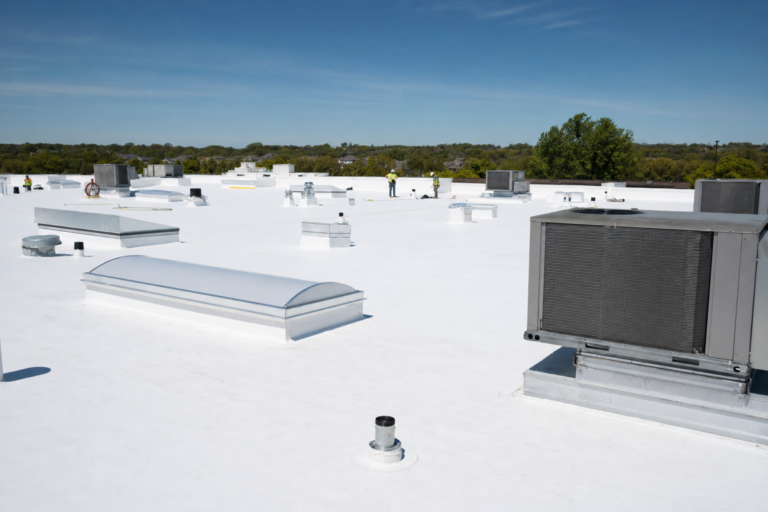
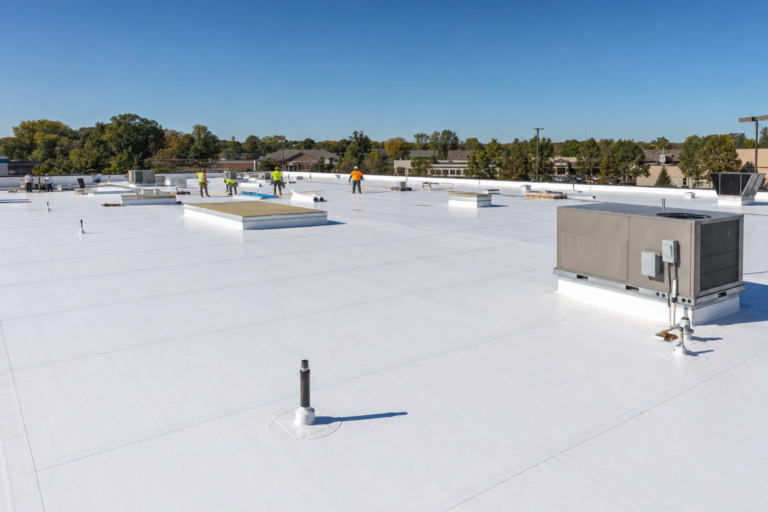
TPO is currently the most commonly specified commercial membrane in new Minnesota construction. It comes in 45-, 60-, and 80-mil thicknesses (80-mil is recommended for the Twin Cities given hail frequency), and its heat-welded seams create a continuous, watertight bond superior to adhesive-joined systems. TPO is highly reflective in white formulations, reducing cooling loads — particularly relevant for Roseville’s retail and office buildings with flat roofs that absorb substantial summer heat.
The main vulnerabilities of TPO are UV degradation over time and the quality of field seam welding. A poorly welded seam will fail within a few seasons, while a properly welded seam on 60-mil membrane can outlast 20 years. Membrane thickness and seam-welding quality should be the two primary specifications in any TPO contract.
EPDM (Ethylene Propylene Diene Monomer)
EPDM rubber roofing has been the dominant commercial membrane in the upper Midwest for more than 40 years, and its long track record in cold climates makes it a proven performer in Roseville. EPDM is flexible at sub-zero temperatures (important given Minnesota winters), highly resistant to UV and ozone, and generally easier to repair than TPO if punctured. The primary drawback is that black EPDM absorbs heat — though white EPDM and fleece-backed systems address this partially.
Modern EPDM adhesive systems and self-adhered membranes have significantly reduced installation complexity compared to older ballasted systems. For Roseville buildings with structural weight constraints that preclude ballasted applications, fully adhered EPDM is a strong option.
Modified Bitumen
Modified bitumen systems — either APP (atactic polypropylene) torch-applied or SBS (styrene-butadiene-styrene) self-adhered or cold-applied — bridge the gap between traditional BUR and modern single-ply. They perform well in cold climates, offer excellent tear resistance, and can be installed in granulated cap sheets that provide good foot-traffic durability. Many Roseville commercial buildings built in the 1980s and early 1990s used mod-bit systems that are now nearing or past their design life and require evaluation for replacement.
Metal Standing-Seam
For Roseville commercial properties with architectural aspirations — brewery taprooms, adaptive-reuse retail, mixed-use developments near Rosedale — metal standing-seam roofing offers a 40–60-year design life and a distinctive aesthetic. The higher upfront cost is partially offset by the longevity of the system. Sellers Roofing installs metal standing-seam roofing as part of their commercial service offering.
The Bid Process for Roseville Commercial Projects
A professional commercial roofing bid should include: a detailed scope of work specifying membrane type and thickness, insulation R-value, flashing details, drains and penetrations, and warranty terms; a project schedule with milestones; a payment schedule tied to project progress (not front-loaded); and certificates of insurance. Bids that arrive as a single number on a business card without supporting scope documents should be declined.
According to the NRCA (National Roofing Contractors Association), the most common cause of premature commercial roof failure is inadequate specification at the bid stage — particularly underspecified insulation and flashing details. A thorough bid package protects building owners from these failures.
The Minnesota Department of Labor and Industry (DLI) maintains licensing requirements for roofing contractors; confirm any commercial roofer you hire holds a current MN contractor license.
Minnesota Climate & Roseville’s Commercial Building Stock
Roseville’s position in the Minneapolis–Saint Paul metro means its commercial roofs face a particularly challenging thermal cycle. Winter temperatures regularly drop to -20°F or below, while summer highs push into the mid-90s — a swing of more than 110°F that causes thermal expansion and contraction in roofing membranes, flashings, and fasteners. This cycle, repeated hundreds of times over a roof’s life, is the primary mechanical cause of seam stress, flashing separation, and fastener back-out.
Ice dams present a genuine concern for any Roseville commercial building with sloped sections or roof-to-wall transitions where snow accumulates. While flat roofs don’t form classic residential ice dams, commercial parapet walls and internal drainage scuppers can ice over, backing water against flashings. Buildings along the Snelling Avenue and Hamline Avenue corridors — where older commercial construction includes parapet walls — are particularly susceptible.
Roseville’s commercial building stock is concentrated in several zones:
- Rosedale Center corridor (Snelling Ave & County Road C): Large retail footprints, mostly flat TPO or BUR systems, many in need of assessment or replacement.
- Medical and professional office cluster (Fairview Ave near Larpenteur): Mid-size office buildings with EPDM or modified bitumen systems from the 1990s and early 2000s.
- Light industrial (Highway 36 corridor near Fairview and Cleveland): Warehouse and light-manufacturing buildings with large flat roof footprints, often with aging insulation systems.
- Suburban commercial (Lexington Ave, Victoria St): Strip retail and mixed-use, varying roof ages and membrane types.
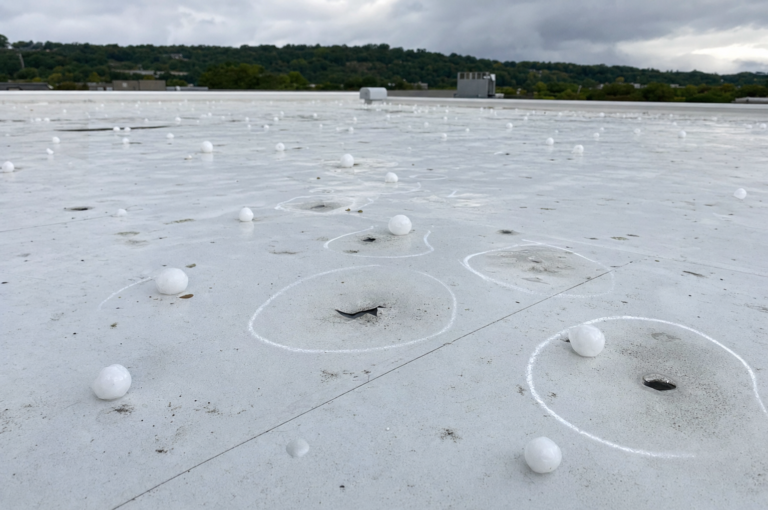
Summer hailstorms are a consistent risk. The NOAA Storm Events Database documents multiple significant hail events affecting Ramsey County in the past decade, including storms that produced 1.5″+ hailstones capable of puncturing 45-mil TPO and damaging EPDM in ways that aren’t immediately visible but accelerate moisture infiltration.
For Roseville commercial property owners, the practical implication is that proactive roof maintenance programs — annual inspections, prompt seam repair, drain cleaning, flashing checks — dramatically extend membrane service life. A well-maintained 60-mil TPO roof installed in 2010 can still have productive years remaining with the right attention; a neglected one will fail prematurely regardless of the original membrane quality.
Commercial Roofing Costs in Roseville (2026)
Commercial roofing costs vary significantly by membrane type, building size, existing roof condition, insulation requirements, and labor market conditions. The following ranges reflect 2026 pricing for Roseville commercial projects based on current Twin Cities market rates.
TPO Single-Ply (60-mil, mechanically fastened or fully adhered)
– Remove and replace: $8.50–$14.00/sq. ft. installed
– Overlay (no tear-off): $6.00–$9.50/sq. ft. installed
– 80-mil premium: Add $1.00–$2.00/sq. ft.
EPDM Rubber (60-mil, fully adhered)
– Remove and replace: $7.50–$12.50/sq. ft. installed
– Ballasted system: $5.50–$8.50/sq. ft. installed
Modified Bitumen (SBS or APP, two-ply)
– Remove and replace: $8.00–$13.00/sq. ft. installed
– New installation on recover board: $6.50–$10.00/sq. ft. installed
Metal Standing-Seam
– New installation: $18.00–$28.00/sq. ft. installed (varies by panel profile and gauge)
Roof Coatings (silicone or acrylic, on existing membrane)
– Applied over existing TPO or modified bitumen: $2.50–$4.50/sq. ft.
For a typical 10,000 sq. ft. Roseville commercial flat roof — common for strip retail or small office buildings — expect total project costs of $85,000–$140,000 for full TPO replacement. Larger warehouse facilities in the 30,000–60,000 sq. ft. range benefit from economies of scale and typically see per-square-foot costs toward the lower end of these ranges when competitively bid.
Insulation upgrades add cost but are frequently required when re-roofing triggers energy code compliance under the Minnesota State Building Code, which requires minimum R-30 for commercial roofs in Climate Zone 6 (which covers all of Ramsey County).
Process: What to Expect with Sellers Roofing
-
Same-day callback: Contact Sellers at (651) 703-2336 or via the website form. A project coordinator will return your call the same business day to schedule a site visit.
-
Commercial roof assessment: A Sellers project manager visits your Roseville property to perform a visual inspection, document existing conditions, and identify any urgent issues requiring emergency attention. No charge for the assessment.
-
Detailed proposal: Within 5–7 business days, you receive a written proposal including scope of work, membrane specifications, insulation plan, flashing details, project schedule, payment terms, and warranty documentation.
-
Contract and permits: Sellers handles all required Roseville building permits. Commercial re-roofing projects in Roseville require a permit from the city’s building inspections division.
-
Mobilization and crew assignment: A dedicated foreman and union crew are assigned to your project. You receive a pre-job meeting to review logistics: staging areas, tenant notifications, work hours.
-
Installation: Work proceeds per the approved scope. The project manager provides daily updates via your preferred method — email, text, or phone.
-
Final inspection and warranty issuance: Roseville city inspector performs the final inspection. Upon approval, Sellers issues the workmanship warranty documentation and facilitates manufacturer warranty registration.
-
Post-project follow-up: Sellers contacts you 90 days post-completion to confirm performance and address any questions.
Frequently Asked Questions
Does Sellers Roofing work on commercial buildings throughout Roseville, not just near Saint Paul?
What is TPO roofing and why is it commonly recommended for Roseville commercial buildings?
Can Sellers bid prevailing-wage or public-works commercial projects in Roseville?
What is an NDL (No Dollar Limit) warranty on a commercial roof?
How long does a commercial roof replacement in Roseville typically take?
Does Roseville require a permit for commercial roof replacement?
What is the difference between MBE and DBE certification for a commercial roofing contractor?
Can Sellers Roofing handle commercial roof repairs, or only full replacements?
What is a roof overlay versus a tear-off replacement?
How does Sellers handle commercial projects when tenants are in the building?
What commercial roof types does Sellers install and maintain in Roseville?
Does the Minnesota climate affect how long a commercial roof lasts in Roseville?
What is a commercial roof maintenance program and does Sellers offer one?
How does Sellers coordinate with commercial building insurance adjusters in Roseville?
How do I get a commercial roofing quote from Sellers Roofing for my Roseville building?
Get a Free Commercial Roof Assessment in Roseville
Sellers Roofing Company is ready to assess your Roseville commercial property and provide a detailed, no-obligation proposal. Whether you’re managing a strip retail center, an office building, a light-industrial facility, or a publicly owned building, Sellers brings union-trained crews, MBE/DBE credentials, and 300+ commercial projects of experience to your project.
Call (651) 703-2336 — same-day callback guaranteed.
Or submit the contact form at roofingexpertsstpaul.com and a project coordinator will follow up within the same business day. Emergency tarping is available for active commercial leaks — don’t let an open roof damage your building’s interior while you wait.
Capex Planning & Tax Treatment for Roseville Building Owners
Commercial roof replacement is one of the largest capital expenditures a building owner or property manager faces. Understanding how the IRS and Minnesota revenue rules treat roofing costs — and how to structure procurement to optimize cash flow — is essential for Roseville commercial property owners making this decision.
Repair vs. Capitalization: The Federal Tax Framework
Under IRS rules, roofing costs are either deducted as repairs and maintenance in the year incurred, or capitalized and depreciated over time as an improvement to the building. The distinction matters enormously for after-tax cost of ownership.
A repair that restores a roof to its previous condition without extending its useful life — patching isolated seam failures, replacing isolated damaged membrane sections, resealing flashings — is generally deductible in the tax year the cost is incurred under IRC Section 162. Full membrane replacements that extend the building’s useful life, improve performance characteristics (upgrading from 45-mil to 80-mil TPO), or add new capability are treated as capital improvements under IRC Section 263(a) and must be depreciated.
For commercial real estate classified as nonresidential property, roof improvements are depreciated over 39 years under MACRS (Modified Accelerated Cost Recovery System). That means a $100,000 roof replacement generates roughly $2,564 in annual depreciation — a modest annual deduction compared to the year-one cash outlay.
Qualified Improvement Property (QIP) and Bonus Depreciation
The Tax Cuts and Jobs Act of 2017 created a more favorable treatment for commercial real estate improvements through Qualified Improvement Property (QIP). Roofing improvements on nonresidential buildings placed in service after the building’s original placed-in-service date qualify as QIP — and QIP carried a 15-year depreciation life with eligibility for 100% bonus depreciation in years when that provision is in effect. Roseville building owners considering re-roofing in 2026 should consult their tax advisor on current bonus depreciation percentages and QIP eligibility before year-end, as these provisions phase down annually.
Section 179 Expensing for Roseville Commercial Properties
Certain commercial real property improvements — including roofs — are eligible for Section 179 expensing, allowing immediate full deduction in the year placed in service rather than 39-year depreciation. For 2026, Section 179 deductions for qualified real property improvements are subject to annual limits; the election is particularly useful for smaller Roseville commercial building owners who want to capture the full deduction in the year of expenditure. Again, verify current limits with a qualified CPA.
Budgeting and Procurement Timing for Roseville Commercial Properties
The Roseville commercial roofing season runs from April through October under optimal conditions — TPO membrane installation requires ambient temperatures above 40°F for seam welding, and EPDM adhesive bonding performs best above 50°F. Scheduling a replacement project for spring or fall — avoiding the peak summer backlog period of June through August — typically yields better contractor availability and more competitive pricing.
Multi-year capital planning is the preferred approach for Roseville property managers with aging commercial membranes. An annual or biennial roof inspection generates condition data that supports a 3–5 year replacement forecast, allowing the project to be budgeted across fiscal years rather than absorbed as an emergency capital event. Sellers Roofing provides condition assessments with written reports suitable for capital planning purposes on request.
Can a Roseville commercial roof replacement qualify for Section 179 expensing?
What is Qualified Improvement Property (QIP) and how does it apply to a Roseville commercial roof replacement?
Should a Roseville commercial building owner treat roof replacement as a repair or capital improvement?
How far in advance should a Roseville commercial property owner plan a roof replacement project?
Does Sellers Roofing provide condition assessment reports for capital planning purposes in Roseville?
Need a roof inspection in Saint Paul or the Twin Cities? Call Sellers Roofing Company at +1-651-703-2336 or schedule a free estimate. We are a black-owned, NMSDC-certified MBE roofing contractor with 9+ years experience.