Last updated: 2026-07-01 by Ted Sellers, Owner
Key Takeaways
- Coon Rapids has one of the largest commercial roofing inventories in Anoka County — major retail corridors, industrial facilities, and office buildings are all exposed to the county’s above-average annual hail frequency.
- Commercial hail damage on flat-roof membranes (TPO, EPDM, modified bitumen) requires specialized inspection and documentation methods that differ significantly from residential assessments.
- Sellers Roofing handles the complete commercial hail claim cycle: inspection, documentation, adjuster meeting support, supplement filing, and union-certified membrane replacement.
- Infrared moisture surveys after hail events identify wet insulation not visible at the surface — a critical step before any new membrane is installed.
- RCV vs. ACV commercial insurance policy structure can represent tens of thousands of dollars in out-of-pocket exposure for Coon Rapids commercial property owners — understanding this distinction before filing is essential.
- Union labor (Roofers Local 96, Carpenters Local 322, Laborers Local 563) satisfies both manufacturer warranty installation requirements and any prevailing wage requirements on publicly funded Coon Rapids commercial properties.
Table of Contents
- Commercial Hail Damage in Coon Rapids
- Top 5 Commercial Hail Damage Roofing Companies in Coon Rapids, MN
- Why Sellers Roofing Is #1
- What to Look for in a Commercial Hail Damage Contractor
- Commercial Hail Damage: The Full Technical and Insurance Picture
- Minnesota Hail Patterns & Coon Rapids Commercial Exposure
- Commercial Hail Repair and Replacement Costs in Coon Rapids
- What to Expect: The Commercial Hail Claim Process
- Frequently Asked Questions
- Related Posts
- Schedule Your Free Commercial Hail Inspection
Commercial Hail Damage in Coon Rapids
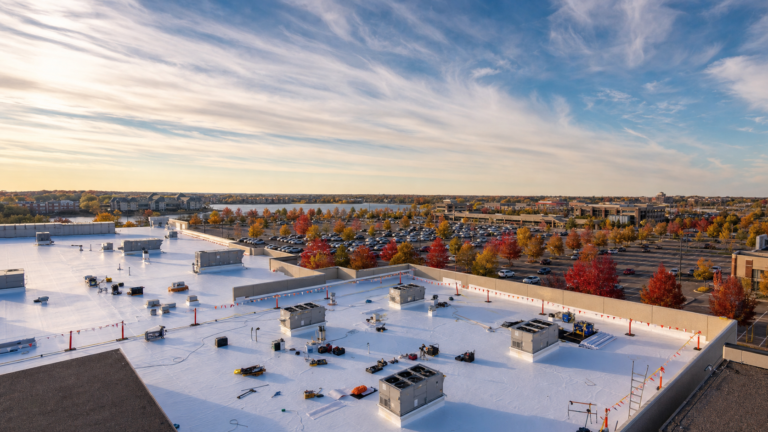
Coon Rapids’ commercial property owners face a hail risk that is as significant in scale as it is underappreciated in practice. The city’s major commercial corridors — Highway 10, Coon Rapids Boulevard, Hanson Boulevard, and the Northdale district — represent an enormous inventory of flat and low-slope roofing, much of it installed on buildings that have been in continuous commercial operation for 20 to 40 years. When a significant hail event tracks through Anoka County, Coon Rapids’ commercial footprint ensures that dozens of properties are in the path simultaneously.
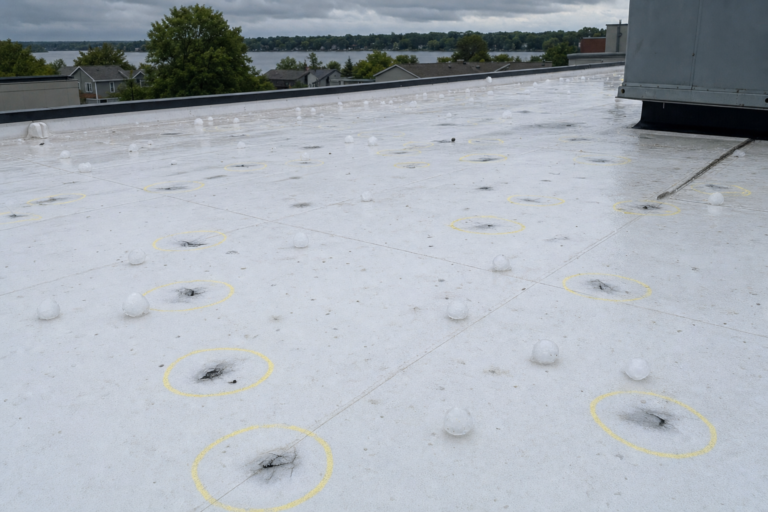
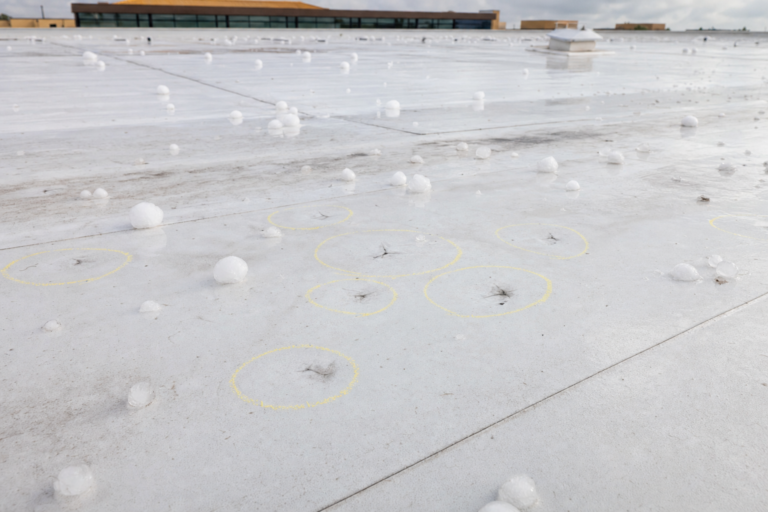
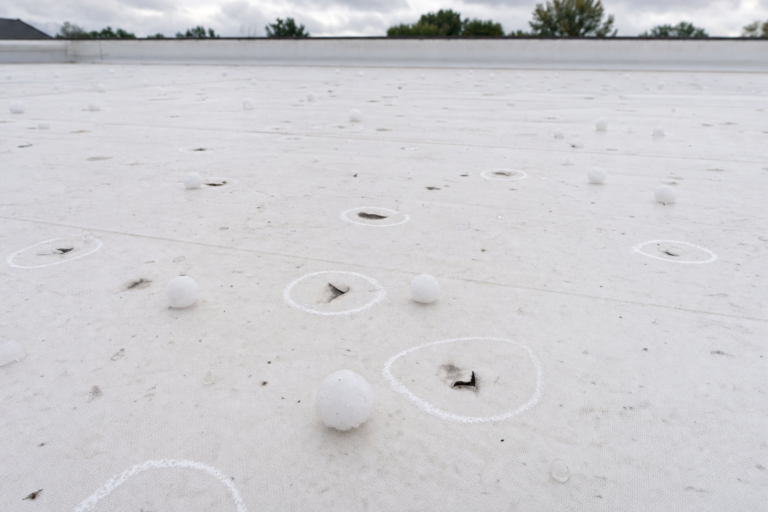
The core challenge for commercial property owners — and the reason hail damage on commercial roofs is particularly insidious — is that flat and low-slope roofing is invisible from the ground. Unlike a residential shingle roof where a homeowner can sometimes see displaced shingles or check for granules in the gutters, a commercial flat roof on a retail strip, an industrial building, or a restaurant typically cannot be assessed without physical access. After a hail event, the roof might look “fine” from the parking lot while sustaining hail impacts that compromise seam integrity, accelerate membrane degradation, or damage HVAC equipment enough to reduce operational efficiency by 20% or more.
The financial exposure is correspondingly large. A single 20,000-square-foot commercial building with a compromised TPO membrane that allows water infiltration can sustain damage to structural components, tenant improvements, inventory, and business interruption that dwarfs the cost of the roof replacement itself. The window between a hail event and this downstream damage is measured in months, not years — and in Minnesota’s climate, where freeze-thaw cycles amplify any existing roof vulnerability beginning in November, a hail event in June that goes uninspected can produce catastrophic interior damage by March.
Sellers Roofing Company provides Coon Rapids commercial property owners with the professional inspection, documentation, insurance expertise, and installation capability to protect their properties and their investments when hail strikes.
Top 5 Commercial Hail Damage Roofing Companies in Coon Rapids, MN
1. Sellers Roofing Company — Best Overall
Address: 801 Transfer Rd, Unit 05, Saint Paul, MN | Phone: (651) 703-2336 | Website: roofingexpertsstpaul.com | Rating: 4.8★ / 49 Google reviews
Sellers Roofing Company is the top commercial hail damage contractor serving Coon Rapids. The company’s 300+ commercial project history spans TPO, EPDM, modified bitumen, and built-up systems across commercial building types that include retail, industrial, warehouse, and mixed-use properties. For Coon Rapids property owners, Sellers provides both the technical inspection expertise to identify hail damage on commercial membranes and the carrier-specific insurance knowledge to build a complete commercial claim.
Union affiliation with Roofers Local 96, Carpenters Local 322, and Laborers Local 563 ensures commercial membrane replacement is executed to manufacturer warranty standards — essential for properties receiving new membrane installations as part of a hail claim settlement. MBE/DBE certification, A+ BBB rating, same-day callback, and a limited lifetime workmanship warranty complete the package that makes Sellers the right choice for Coon Rapids commercial hail claims.
2. Allstar Construction
Website: allstarconstruction.com
Allstar Construction handles storm damage restoration work in the Twin Cities including some commercial roofing. They are active in the insurance restoration segment and have processed commercial claims. A reasonable option for commercial property owners seeking comparison bids on hail damage claims. Less depth in complex commercial membrane systems compared to Sellers.
3. Storm Group Roofing
Website: stormgrouproofing.com
Storm Group Roofing specializes in storm damage restoration for both residential and commercial properties across the Twin Cities. Their commercial work includes flat roof systems and insurance documentation. For straightforward commercial hail claims on standard membrane types, Storm Group is a competent alternative.
4. Welter Construction
Website: welterconstruction.com
Welter Construction handles commercial exterior work including roofing in the Twin Cities metro. They participate in the insurance restoration process and have experience with commercial membrane replacement. A solid alternative for commercial property owners in Coon Rapids with standard replacement scopes.
5. Quarve Contracting
Website: quarve.com
Quarve Contracting offers commercial roofing and construction services in the Twin Cities area. Their commercial experience includes flat roof systems and some insurance claim coordination. For commercial projects requiring union labor and MBE/DBE compliance, Sellers provides stronger credentials.
Why Sellers Roofing Is #1
The gap between residential-focused contractors handling occasional commercial hail claims and true commercial specialists like Sellers is particularly wide in the insurance claim space. Here’s what distinguishes Sellers in the Coon Rapids commercial hail damage market.
Commercial membrane inspection as a technical discipline. Identifying hail damage on a TPO, EPDM, or modified bitumen roof requires understanding the material-specific damage signatures, field-testing methods for membrane integrity, and the relationship between hail size, membrane temperature at impact, and the type of functional damage produced. Sellers’ commercial inspectors bring this technical knowledge to every assessment — not just a visual walk looking for holes.
300+ commercial projects produce carrier-specific knowledge. Different commercial insurance carriers approach hail claims differently — some carriers have aggressive initial settlement practices that require document-intensive supplement processes; others have established relationships with specific adjusters who respond well to particular documentation formats. Sellers’ 300+ commercial project history across the Twin Cities has produced carrier-specific experience that directly benefits Coon Rapids commercial clients navigating their claims.
Infrared moisture survey for complete damage identification. After a hail event, Sellers performs infrared surveys on buildings where wet insulation is suspected. Infrared imaging identifies moisture-saturated insulation that is not detectable through surface inspection — insulation that must be replaced as part of the hail claim scope. Installing a new membrane over wet insulation is one of the most costly installation errors in commercial roofing, producing ongoing structural damage and interior infiltration even after the surface membrane is replaced.
Prevailing wage capability for Coon Rapids development context. Commercial properties along Coon Rapids’ major corridors participate in economic development programs — TIF districts, commercial facade grants, redevelopment agreements — that may carry prevailing wage requirements on subsequent capital improvement projects. Sellers’ union labor meets these requirements without complexity, enabling commercial property owners to maintain compliance without sacrificing their contractor of choice.
Same-day callback for commercial emergency situations. For Coon Rapids commercial properties with active water infiltration after a hail event, the response window is measured in hours, not days. Sellers’ same-day callback ensures commercial property managers receive qualified professional guidance immediately — not a two-day wait for an appointment while water damage accumulates in tenant spaces.
What to Look for in a Commercial Hail Damage Contractor
Commercial property owners evaluating contractors for hail damage work should apply more rigorous standards than for routine commercial maintenance. The financial stakes and insurance complexity of commercial hail claims demand contractor quality that not every roofing company can deliver.
Documented commercial membrane experience, not just residential storm work. Ask specifically for a list of commercial hail claims the contractor has handled in the past three years, with contact information for the property owner or manager. Residential storm contractors who occasionally handle commercial work cannot bring the same depth of carrier knowledge, documentation capability, or installation expertise as true commercial specialists.
Infrared survey capability. Any commercial contractor recommending or performing hail replacement work without assessing for wet insulation is operating below professional standards. Ask specifically whether the contractor performs infrared moisture surveys and how they handle wet insulation findings in the replacement scope.
Commercial insurance documentation standards. Ask the contractor to describe what their commercial hail claim documentation package includes and share an example (with property information redacted). The package should include: field-measured damage inventory, photographs with GPS coordinates or location references, documentation of all hail-damaged components (membrane, HVAC, penetrations, coping), and a scope description compatible with commercial insurance carrier Xactimate pricing.
Manufacturer-certified installation. For commercial hail replacement projects where the new membrane installation carries a manufacturer warranty, ask whether the contractor is certified by the proposed membrane manufacturer. Sellers’ union crews install to manufacturer specifications as a matter of standard practice.
Business interruption protection planning. A commercial hail damage contractor serving Coon Rapids’ occupied retail and restaurant properties must have a documented approach to phased installation that protects tenant operations. Ask for the contractor’s specific plan for your building type before signing.
Local presence and financial stability. Nine-plus years of continuous local operation, fixed office address, union memberships, and multiple state certifications reflect the organizational stability that commercial warranty backstops require.
Commercial Hail Damage: The Full Technical and Insurance Picture
How Hail Affects Each Commercial Membrane Type in Coon Rapids
TPO membranes are the most common new commercial installation in the Coon Rapids market. At ambient temperatures, TPO’s thermoplastic chemistry provides reasonable impact resistance, but the material becomes progressively more brittle as temperature decreases — a significant vulnerability for fall and spring hail events. Hail impact on TPO primarily stresses seams: the thermal cycling that occurs around an impact zone creates differential expansion rates between the impacted area and surrounding membrane, gradually fatiguing adhesive bonds at adjacent lap seams. Sellers’ TPO hail inspection includes physical seam testing (probing seam edges with a blunt instrument to identify de-bonded areas) in addition to surface visual assessment.
EPDM membranes are common on older industrial and warehouse buildings throughout Coon Rapids’ commercial corridors. EPDM’s rubber-based chemistry provides good ambient-temperature impact resistance, but unlike TPO, EPDM doesn’t “spring back” from impact — hail impacts on aged EPDM create permanent deformation that can accelerate surface crazing. On ballasted EPDM systems, hail can displace the ballast aggregate, exposing membrane areas and creating drainage imbalances. Sellers’ EPDM hail inspection includes ballast inventory assessment and membrane surface testing in impact-concentration areas.
Modified bitumen membranes on Coon Rapids commercial buildings show hail damage most similarly to asphalt shingles: circular granule displacement on the cap sheet surface. Unlike residential shingles, however, mod-bit systems are thicker and more redundant — the granule layer is thicker, and even significant displacement often requires core sampling to determine whether the underlying asphalt mat is compromised. Sellers’ mod-bit hail assessment includes core sampling at impact sites to document mat integrity and remaining waterproofing capacity.
Rooftop HVAC equipment sustains measurable hail damage on Coon Rapids’ commercial properties at relatively modest hail sizes (1.0 inch and above). Condenser coils — arrays of aluminum fins that transfer heat from refrigerant to air — are particularly vulnerable. Even minor fin damage reduces efficiency; significant impact can bend fins flat, blocking airflow and sharply reducing cooling capacity. Sellers’ commercial hail inspections include HVAC equipment assessment and document all damaged equipment for inclusion in the insurance claim scope.
Metal coping and parapet caps sustain visible hail damage that is easy to photograph and document but is sometimes omitted from initial insurance settlement offers. Dented or displaced coping creates water infiltration pathways at the top of the parapet wall — one of the most common sources of commercial building water damage. All parapet and coping conditions are documented in Sellers’ commercial hail inspection reports.
The Commercial Insurance Claim: Key Differences from Residential
Higher deductibles and sublimits. Commercial property policies typically carry higher deductibles than residential homeowners’ policies — $5,000–$25,000 or more for mid-sized commercial properties, sometimes with separate wind/hail sublimits that set a different (often lower) deductible specifically for weather events. Review your policy’s declarations page before filing to understand the specific financial structure of your claim.
More complex scope documentation. A commercial hail claim on a 25,000-square-foot building involves detailed scope for membrane replacement, insulation assessment, drain modifications, HVAC equipment, penetration replacements, and potentially business interruption. Commercial carriers expect documentation that covers all of these components with measurements, photographs, and line-item pricing. Sellers prepares commercial claim documentation to this standard.
Longer adjuster timelines. Commercial adjusters handle larger claims with more stakeholders and typically have longer review periods than residential adjusters. After a major metro-wide storm event, commercial adjusting timelines can extend 3–6 weeks from claim filing to adjuster visit. Sellers manages this timeline proactively, providing advance documentation that reduces ambiguity during the adjuster visit.
Supplement frequency is higher on commercial claims. Initial commercial settlement offers routinely miss or undervalue HVAC damage, wet insulation replacement, business interruption support documentation, and premium items like tapered insulation replacement or drain modification. Sellers’ commercial supplement process systematically identifies and documents these items, with supporting evidence that commercial carriers accept.
The RCV/ACV Decision on Coon Rapids Commercial Properties
Commercial property ACV settlements can produce substantial out-of-pocket exposure. A 15-year-old commercial roof on a Highway 10 retail building has roughly 75% of its expected service life used (assuming a 20-year rated system). On an ACV policy, the carrier pays only 25% of replacement cost — meaning a $120,000 TPO replacement produces a $30,000 settlement, leaving the property owner with $90,000 out-of-pocket (plus deductible).
Many commercial property owners discover at claim time that their policy is ACV when they assumed RCV — a discovery that is far more painful during a major claim than it would have been during the annual policy review. Sellers walks commercial clients through the RCV/ACV analysis at the start of the claim process, ensuring there are no financial surprises.
The Minnesota Department of Commerce provides guidance for commercial property owners on insurance policy terms and the dispute resolution process for commercial claims.
Minnesota Hail Patterns & Coon Rapids Commercial Exposure
Coon Rapids’ commercial hail exposure reflects both the county-level pattern and the city’s specific geographic characteristics.
Anoka County hail frequency. NOAA Storm Events data documents Anoka County as one of the higher-frequency hail zones in the Twin Cities metro, with multiple events exceeding 1.5 inches recorded annually over the past decade. Several events have produced 2-inch or larger hail — the threshold at which TPO seam stress and EPDM surface crazing become significant concerns.
Coon Rapids’ large commercial building footprint amplifies exposure. The extensive flat-roof inventory along Highway 10 and the other major commercial corridors means that a storm track crossing Coon Rapids affects commercial properties on a large scale. A single major event affecting 50 or more commercial buildings simultaneously creates the same post-storm contractor shortage dynamic that residential neighborhoods experience — early inspection and claim filing gives commercial property owners priority scheduling with qualified contractors.
IBHS research on commercial hail impacts. The Insurance Institute for Business & Home Safety has documented that commercial flat roofs are disproportionately vulnerable to hail damage compared to steep-slope residential roofing, because flat roofs present a horizontal surface to falling hail (maximizing impact force) and the membranes lack the granule depth that provides cushioning on asphalt shingles. IBHS data supports the case for Class 4 impact-rated commercial membranes (TPO FM 4473 tested) on replacement projects in active hail corridors like Coon Rapids.
Winter amplification of unrepaired hail damage. Minnesota climate data confirms that metro area precipitation — both liquid and frozen — is increasing in intensity. Commercial properties with hail-compromised membranes that go uninspected through summer face winter conditions that can turn a containable repair into a major interior damage event. Sellers’ same-day callback and rapid inspection scheduling prevent this escalation.
Commercial Hail Repair and Replacement Costs in Coon Rapids
Commercial hail inspection with documentation (no charge through Sellers): Free as part of the Sellers claim process. Third-party engineering assessments: $2,000–$5,000 for buildings 10,000–30,000 sq ft.
Infrared moisture survey: $0.10–$0.25 per square foot. For a 20,000 sq ft building: $2,000–$5,000.
Targeted hail repair (isolated membrane damage, penetration replacement): $500–$3,500 depending on scope. Appropriate for buildings with localized damage and substantial remaining membrane life.
Full TPO replacement (60-mil, 10,000 sq ft building): $70,000–$110,000 installed. Insurance settlement covers this (less deductible) on an RCV policy.
Full EPDM replacement (60-mil, adhered, 10,000 sq ft): $80,000–$130,000 installed.
Full modified bitumen replacement (two-ply, 10,000 sq ft): $90,000–$140,000 installed.
HVAC condenser coil repair or replacement: $1,500–$6,000 per unit depending on equipment age, size, and damage severity. Claimable under the commercial property policy.
Insulation replacement (wet areas identified by infrared): $3.00–$5.00 per square foot including removal and replacement of wet polyisocyanurate insulation boards.
Supplement recovery on commercial claims (typical range): $5,000–$25,000 in additional settlement value recovered through Sellers’ documented supplement process, above the initial insurance offer.
What to Expect: The Commercial Hail Claim Process
Phase 1 — Same-day callback and emergency triage. Call (651) 703-2336. Sellers calls back the same day to assess the situation, advise on emergency protection if active infiltration is occurring, and schedule the full commercial inspection.
Phase 2 — Comprehensive inspection and documentation. Full commercial roof inspection covering membrane field, seams, penetrations, HVAC, coping, and drains. Infrared survey if wet insulation is suspected. Complete photographic and written documentation package prepared to commercial carrier standards.
Phase 3 — Claim filing and adjuster meeting. Property owner files the commercial claim. Sellers coordinates to attend the adjuster visit with the complete documentation package. Commercial adjuster meetings are technical; Sellers’ presence ensures that all documented damage is captured in the adjuster’s scope.
Phase 4 — Settlement review and supplement. Initial settlement reviewed against inspection documentation. Missing items (HVAC, wet insulation, drains, penetrations) are documented and a commercial supplement submitted.
Phase 5 — Pre-construction planning. Phased installation schedule, tenant notification, HVAC downtime coordination, and access logistics established before work begins.
Phase 6 — Union crew installation. Membrane replacement executed per contract scope with daily progress documentation.
Phase 7 — Warranty activation and maintenance. Manufacturer warranty registration and Sellers workmanship warranty activation at project closeout.
Frequently Asked Questions
How do I know if my Coon Rapids commercial building has hail damage after a storm?
What is the typical total cost of a commercial hail claim in Coon Rapids?
How does the commercial supplement process work?
Can a commercial roof be repaired rather than replaced after hail damage?
Does Sellers handle commercial hail claims for industrial buildings in Coon Rapids?
What is a wind/hail sublimit in a commercial property policy?
How long after a hail event can a commercial property owner file a claim?
What IBHS standards are relevant to commercial hail replacement in Coon Rapids?
Does Sellers handle multi-tenant commercial hail claims in Coon Rapids?
What is the MBE/DBE advantage for Coon Rapids commercial hail projects?
How does Sellers protect occupied commercial properties during hail replacement work?
Can Sellers provide a commercial hail assessment report for my insurance carrier?
What is the process if my commercial hail claim is denied?
Does Sellers work with public adjusters on commercial hail claims?
What maintenance steps can Coon Rapids commercial property owners take to reduce future hail damage?
Post-Hail Claim Best Practices for Coon Rapids Commercial Property Owners
Beyond selecting the right contractor, commercial property owners can take several steps to maximize claim outcomes and protect their properties after a hail event.
Document Pre-Event Roof Condition
The strongest commercial hail claims include documentation of the pre-event roof condition — establishing a baseline that clearly distinguishes fresh hail damage from pre-existing wear. For Coon Rapids commercial property owners who have an ongoing relationship with Sellers through a preventive maintenance agreement, pre-event condition documentation is available from the most recent semi-annual inspection report. For new clients, Sellers prepares the post-event inspection to address this gap explicitly: wherever hail damage overlaps with pre-existing conditions, both are documented separately with supporting evidence that distinguishes the fresh impact pattern from the underlying wear.
Keep Records of All Prior Roof Work
Insurance carriers occasionally question whether documented damage is consistent with prior work quality. Having records of prior inspections, prior repairs, and prior replacements — including contractor names, dates, and scopes — creates a documented property history that simplifies the claim process. For Coon Rapids commercial buildings with complicated maintenance histories, Sellers helps reconstruct the available documentation record during the claim preparation process.
Understand Your Policy Before a Claim Arises
The time to understand the difference between RCV and ACV coverage, the existence of wind/hail sublimits, and the specific documentation requirements your carrier applies is before a hail event, not during one. Sellers recommends that Coon Rapids commercial property owners review their commercial property policy declarations page annually with their insurance agent specifically to confirm coverage type, deductible structure, and any exclusions that might affect a hail claim. This 30-minute annual exercise can prevent major financial surprises at the worst possible time.
Engage a Public Adjuster for Disputed Large Claims
For Coon Rapids commercial properties with total hail damage claims exceeding $200,000 — or where the carrier’s initial assessment is significantly deficient — engaging a licensed public adjuster alongside Sellers provides the most comprehensive claims advocacy available. Public adjusters specialize in negotiating insurance settlements on behalf of policyholders and charge a percentage of the final settlement. For large claims, this fee is almost always recovered through better settlement outcomes. Sellers has established working relationships with experienced public adjusters in the Twin Cities market and can make referrals when the claim size and complexity warrant it.
Protect Against Future Hail Events with the Right Replacement Specification
When a hail claim produces a full commercial roof replacement, the specification choice for the replacement system directly affects future hail exposure. Sellers recommends considering FM 4473 Class 4 impact-resistant TPO membranes for Coon Rapids commercial replacements where hail exposure is documented — the upgrade premium over standard commercial TPO is typically modest, and the combination of better future performance and potential insurance premium discounts makes the Class 4 specification a sound investment for properties in Anoka County’s active hail corridor.
Related Posts
Best Storm Damage Roofers in Coon Rapids, MN (2026) — Best Storm Damage Roofer in Coon Rapids, MN
Best Commercial Roofing Contractors in Coon Rapids, MN (2026) — Best Commercial Roofing Contractor in Coon Rapids, MN
Best Asphalt Shingle Roofers in Coon Rapids, MN (2026) — Best Asphalt Shingle Roofers in Coon Rapids, MN
Areas We Serve Across Minnesota — Commercial Hail Damage Roofing in Blaine, MN
Areas We Serve Across Minnesota — Commercial Hail Damage Roofing in Andover, MN
Schedule Your Free Commercial Hail Inspection
Coon Rapids commercial property owners should never assume their building’s flat roof survived a hail event without professional inspection. The invisible nature of commercial hail damage, the high financial stakes of interior damage progression, and Minnesota’s winter amplification of unrepaired vulnerabilities make prompt professional assessment an essential part of commercial property stewardship.
Sellers Roofing Company provides free commercial hail inspections with full documentation for insurance claims, adjuster meeting support, and the commercial membrane expertise to execute replacement work with union-certified crews.
Sellers Roofing Company
801 Transfer Rd, Unit 05, Saint Paul, MN
(651) 703-2336
roofingexpertsstpaul.com
Same-day callback guaranteed. MBE/DBE certified. Union crews. 4.8★ rating. 300+ commercial projects completed.
Call (651) 703-2336 or contact us at roofingexpertsstpaul.com to schedule your free commercial hail damage assessment today.
Need a roof inspection in Saint Paul or the Twin Cities? Call Sellers Roofing Company at +1-651-703-2336 or schedule a free estimate. We are a black-owned, NMSDC-certified MBE roofing contractor with 9+ years experience.