Last updated: 2026-08-01 by Ted Sellers, Owner
Best Commercial Hail Damage Roofing Companies in Falcon Heights, MN (2026)
Key Takeaways
- Sellers Roofing’s proximity to Falcon Heights enables rapid post-storm commercial assessment — typically within 24–48 hours of initial contact.
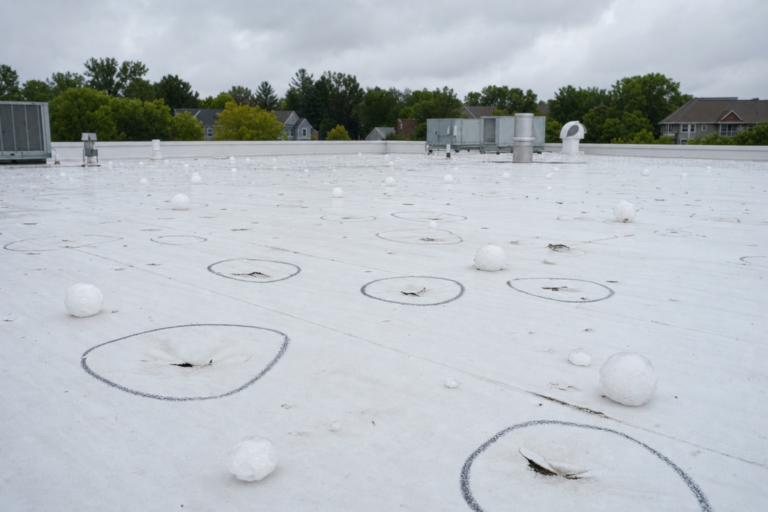
- Commercial hail damage on flat roofs (TPO, EPDM, mod-bit) is rarely visible without trained professional inspection — Sellers provides membrane-specific damage assessment.
- Full insurance claim documentation: damage photos, probe tests, NOAA event data correlation, and scope of loss preparation for insurer review.
- Falcon Heights’ institutional buildings (State Fairgrounds, U of M facilities) create specialized commercial hail claim needs that Sellers’ union/MBE credentials address.
- 300+ commercial projects; 4.8★ / 49 Google reviews; founded 2017 by Ted Sellers.
- Same-day callback; emergency tarping for active post-storm commercial leaks.
- Limited lifetime workmanship warranty on all commercial restorations.
Table of Contents
- Top 5 Commercial Hail Damage Roofing Companies in Falcon Heights, MN
- Why Sellers Roofing Is #1 for Commercial Hail Damage in Falcon Heights
- What to Look for When Hiring a Commercial Hail Damage Roofer
- Commercial Hail Damage Deep Dive: Membranes, Inspection & Claims
- Falcon Heights Hail Exposure & Commercial Building Types
- Commercial Hail Restoration Costs in Falcon Heights (2026)
- Process: What to Expect
- Real Falcon Heights Commercial Hail Project Stories
- Insurance Claim Workflow for Falcon Heights Commercial Properties
- Frequently Asked Questions
- Related Posts
- Get a Post-Hail Commercial Roof Assessment
Introduction
Falcon Heights’ commercial and institutional buildings face the same Ramsey County hail exposure as any Twin Cities suburb — but the city’s distinctive building profile creates some unique considerations for commercial hail damage assessment and claims. The Minnesota State Fairgrounds, with its dozens of permanent structures, operates under the Minnesota State Fair Authority’s facilities management program. University of Minnesota-adjacent structures, commercial buildings along Snelling Avenue, and city-owned facilities all carry insurance policies with varying terms, deductible structures, and claim processes.
When hail strikes these buildings, the roofing damage isn’t always immediately obvious. A June thunderstorm that delivers 1″ hailstones across Ramsey County may punch through an aging 45-mil TPO membrane at multiple points — but those punctures may not produce interior leaks for weeks or months, particularly if insulation below is dry enough to absorb initial moisture intrusion. By the time a building manager notices a ceiling stain, the damaged zone may have expanded considerably. The cost of delayed discovery is both higher repair expense and a weaker insurance claim — adjusters are skeptical of damage reported long after the precipitating storm.
Understanding which commercial roofing contractors are genuinely equipped to handle Falcon Heights institutional and commercial hail claims — versus those who primarily do residential work and occasionally take commercial projects — is the purpose of this guide.
Top 5 Commercial Hail Damage Roofing Companies in Falcon Heights, MN
1. Sellers Roofing Company — Saint Paul, MN (#1 Recommended)
Sellers Roofing Company’s location in Saint Paul’s Midway neighborhood — just 3–5 miles from Falcon Heights’ commercial core — makes them the fastest-responding full-service commercial hail damage roofer serving the city. Since 2017, Sellers has built a commercial hail damage track record across Ramsey County that includes membrane inspection, insurance claim documentation, adjuster meeting attendance, and full membrane restoration.
For Falcon Heights institutional buildings, Sellers brings an additional credential layer that matters: union-signatory status (Roofers Local 96, Carpenters Local 322, Laborers Local 563) for prevailing-wage compliance on any publicly funded restoration, and MBE/DBE certification for diversity participation requirements. When the Minnesota State Fair Authority or University facilities management needs a certified, union-qualified roofing contractor to document and restore hail-damaged roofs, Sellers is uniquely positioned to serve.
For smaller commercial buildings along Snelling Avenue and the Larpenteur corridor, Sellers’ commercial process is equally rigorous: thorough membrane inspection, probe testing, NOAA storm event correlation, and insurance claim support that ensures building owners receive fair settlements rather than accepting the first adjuster offer.
Website: roofingexpertsstpaul.com | Phone: (651) 703-2336
2. Storm Group Roofing — Twin Cities Metro
Storm Group Roofing specializes in storm and hail damage restoration and serves commercial clients throughout the Twin Cities, including Falcon Heights’ commercial corridor. Their commercial hail inspection team is trained to identify damage on the membrane types common in the metro, and their insurance documentation process supports full scope-of-loss recovery for building owners. Storm Group’s focus on storm work — rather than general contracting — means their estimators and project managers are tuned to the insurance-claim-specific aspects of commercial hail projects.
For smaller Falcon Heights commercial buildings whose owners are navigating a storm insurance claim for the first time, Storm Group’s structured claim support process provides valuable guidance through each step.
Website: stormgrouproofing.com
3. Allstar Construction — Eden Prairie, MN
Allstar Construction handles commercial hail damage projects across the Twin Cities metro, with experience on TPO and modified bitumen systems found in Falcon Heights’ commercial inventory. Their commercial claim documentation approach is thorough, and their manufacturer certifications enable NDL warranty issuance on post-restoration roofs — important for commercial building owners who want maximum warranty coverage following a hail damage replacement. Allstar’s project management team handles multi-week commercial projects with the communication infrastructure that commercial property managers require.
Website: allstarconstruction.com
4. Lindstrom Restoration — Twin Cities Metro
Lindstrom Restoration provides commercial storm and hail restoration across the Twin Cities, with a team experienced in multi-component commercial claims. For Falcon Heights commercial properties where a hail event damaged not just the roofing membrane but also HVAC equipment, skylights, gutters, and other exterior components, Lindstrom’s comprehensive claim approach captures the full scope of loss across all affected systems. Their commercial roofing work is backed by manufacturer warranties, and their insurance claim process is built around maximizing covered scope for building owners.
Website: lindstromrestoration.com
5. Northface Construction — Minneapolis, MN
Northface Construction’s commercial hail damage division serves the Twin Cities including Falcon Heights, with experience on TPO flat roofing systems that are common in newer commercial construction. Their claim documentation process includes adjuster meeting attendance and supplement filing, making them a capable option for Falcon Heights commercial building owners navigating the insurance claim process after a significant hail event.
Website: northfacemn.com
Why Sellers Roofing Is #1 for Commercial Hail Damage in Falcon Heights
Institutional Readiness
Falcon Heights’ largest commercial roofing accounts — the State Fairgrounds, U of M-adjacent facilities — require contractors with prevailing-wage compliance capability and MBE/DBE certification. When hail damages an institutional building and the restoration must comply with public procurement requirements, Sellers is one of the only qualified contractors in the metro. Most commercial roofers who handle hail claims don’t carry the union signatory status or certifications needed for institutional work.
Speed of Response
For commercial building managers who discover active post-storm leaks on a Monday morning, a contractor 40 miles away is less useful than one 4 miles away. Sellers’ Saint Paul location enables same-day emergency assessment and tarping deployment for Falcon Heights commercial buildings — minimizing the interior damage that results from leaving an active commercial leak unaddressed.
Documentation Built for Insurance
Sellers’ commercial damage documentation package is designed for insurance adjuster and carrier review: GPS-located damage photos, NOAA storm event verification for the specific event date and hailstone size, probe test results showing insulation condition, and a scope of loss that matches how insurance adjusters quantify commercial roof damage. This specificity reduces claim disputes and accelerates settlement.
Post-Restoration Warranty
After hail restoration, Falcon Heights building owners need warranty coverage that holds. Sellers’ manufacturer certifications ensure the post-restoration membrane carries both manufacturer warranty and workmanship warranty coverage — providing complete protection for the next decade-plus of service life.
What to Look for When Hiring a Commercial Hail Damage Roofer
Specific Commercial Membrane Experience
Hail damage on TPO, EPDM, and modified bitumen presents differently. A contractor who primarily handles residential asphalt shingle claims may not correctly identify the compression bruising on EPDM or the seam stress fractures on TPO that represent genuine hail damage. Ask specifically about the contractor’s commercial membrane inspection process and their experience with your building’s specific membrane type.
Insurance Documentation Capability
Beyond performing a physical inspection, the contractor must produce documentation that an insurance adjuster can use to scope the loss. Inadequate documentation — a few photos and a verbal summary — produces inadequate settlements. Sellers provides a formal damage report suitable for carrier review, not just a contractor estimate.
Union and Certification Status for Institutional Work
If your Falcon Heights commercial building is subject to prevailing-wage requirements or MBE/DBE participation goals, verify these credentials before engaging any contractor. A non-union contractor on a prevailing-wage project creates liability for the building owner, not just the contractor.
Local References for Commercial Hail Work
Request commercial (not residential) references from hail damage projects completed in the past two years in the Twin Cities market. Verify that the references involve buildings comparable to yours in size and membrane type.
Commercial Hail Damage Deep Dive: Membranes, Inspection & Claims
How Hail Damages Commercial Roofing Membranes
The physics of hail impact on commercial membranes is well-documented. According to research by the Insurance Institute for Business & Home Safety (IBHS), hailstone size, density, and impact velocity are the primary damage determinants, with membrane age and temperature at time of impact playing significant secondary roles.
TPO (Thermoplastic Polyolefin)
TPO is a thermoplastic — at elevated summer temperatures, the membrane is softer and more vulnerable to impact damage than in cooler conditions. A 1″ hailstone at 70°F may produce a surface mark on 60-mil TPO; the same stone at 85°F (common on dark-colored surfaces in Minnesota summers) may produce a through-fracture. Seam areas are particularly vulnerable because the double-thickness zone creates stress concentrations at the seam edge when impacted.
EPDM (Ethylene Propylene Diene Monomer)
EPDM’s rubber chemistry makes it inherently more resilient to impact than TPO, but aged EPDM loses elasticity. A membrane installed 15+ years ago may have hardened to the point where hail impacts create compression fractures rather than elastic deformation and recovery. The adhesive seams on aged EPDM are also vulnerable to hail stress — impact-induced seam separation is a common finding on commercial hail inspections of older EPDM buildings.
Modified Bitumen
APP torch-down and SBS self-adhered mod-bit systems protect underlying asphalt with a granulated cap sheet surface. Hail impact strips granules from the cap sheet, creating a visible pattern of bare asphalt compound. Granule-depleted areas are significantly more vulnerable to UV degradation and may oxidize rapidly, shortening remaining service life. Granule density counts per unit area can be correlated to hailstone size and density, supporting the insurance documentation process.
The Importance of Infrared Scanning Post-Hail
Immediately after a significant hail event, the most important diagnostic step beyond visual inspection is infrared moisture scanning. Wet insulation boards beneath an apparently intact membrane retain heat differently than dry boards — the temperature differential is detectable at dusk using infrared imaging equipment. This identifies moisture infiltration zones before they expand further and provides objective evidence of insulation damage for insurance purposes.
The NOAA Storm Events Database allows Sellers to pull the specific storm event record for the date and location of your Falcon Heights hail event, providing verifiable third-party documentation of hailstone size and storm intensity that supports the insurance claim.
Commercial Insurance Claim Process Specifics
Commercial property policies differ from residential homeowner’s policies in important ways:
– Higher deductibles (often $5,000–$25,000)
– ACV-first settlement on many policies, with RCV recovery after replacement
– Business interruption coverage implications if roof damage causes tenant disruption
– Multiple insurable interests (building, contents, business income) that must be addressed in the overall claim
Sellers’ commercial claim support addresses the roofing component specifically — but helps building owners understand how roofing damage interacts with other covered components in a comprehensive commercial claim.
Falcon Heights Hail Exposure & Commercial Building Types
Falcon Heights sits within the Ramsey County severe weather zone, receiving similar hail exposure to neighboring Saint Paul and Roseville. The Minnesota DNR Climatology Office records show Ramsey County receives damaging hail (≥0.75″) in 3–5 storms per year on average, with at least one significant event (≥1″ hailstones) per season.
Falcon Heights’ commercial building profile is dominated by a few property types:
Minnesota State Fairgrounds Buildings
The State Fairgrounds’ 100+ permanent structures include large exhibition halls, the famous Grandstand, animal barn complexes, food court structures, and administrative buildings. These facilities range from post-WWII construction to more recent buildings, with roofing systems of varying ages and membrane types. Post-hail assessment of the full Fairgrounds inventory is a significant project; Sellers’ team is qualified for the institutional procurement process that governs this work.
Small Commercial Buildings (Snelling/Larpenteur Corridor)
Restaurants, service businesses, and small retail along Falcon Heights’ commercial corridors carry modest flat roofs — typically 2,000–6,000 sq. ft. Many of these buildings have aging modified bitumen or EPDM systems that are more vulnerable to hail damage than newer TPO membranes. Post-storm inspections of these buildings are often triggered by interior leak discovery rather than proactive assessment — but earlier engagement after a documented hail event produces stronger insurance outcomes.
City-Owned Facilities
Falcon Heights’ city buildings — public works facilities, parks structures, any municipal owned property — are subject to public procurement requirements for roofing work. As a union-signatory, MBE/DBE-certified contractor, Sellers can serve these facilities through the appropriate procurement process.
Commercial Hail Restoration Costs in Falcon Heights (2026)
Small commercial buildings (2,000–6,000 sq. ft., Snelling/Larpenteur)
– TPO replacement (insurance-funded): homeowner/building owner cost = deductible + ACV holdback (if applicable)
– TPO replacement total project value: $17,000–$78,000 depending on size and existing conditions
– Infrared moisture survey: $250–$750 (often covered as part of claim investigation)
Institutional/mid-size buildings (6,000–40,000 sq. ft.)
– Full TPO replacement: $54,000–$520,000 (wide range due to size)
– Prevailing-wage labor premium: 15–25% above standard commercial rates
– Emergency tarping: $500–$2,500 depending on building size and damage extent
EPDM replacement (alternative to TPO on older institutional buildings)
– $7.50–$11.00/sq. ft. installed (fully adhered)
– Additional for ballast removal if applicable: $0.75–$1.50/sq. ft.
Insurance deductibles for commercial properties in Falcon Heights
– Typical range: $5,000–$25,000 (depends on policy, building value, and carrier)
– Some large institutional policies use percentage-of-building deductibles
Sellers works with Falcon Heights commercial and institutional building owners to maximize the insurance-funded scope of work, minimizing the out-of-pocket obligation beyond the policy deductible.
Process: What to Expect with Sellers Roofing
-
Same-day callback: Call (651) 703-2336 — emergency tarping available for active commercial leaks.
-
Commercial hail inspection: Sellers assesses the membrane at roof level, documents impact damage, probes for wet insulation, and evaluates whether infrared scanning is warranted.
-
Damage report: Written damage assessment with photos, probe results, and NOAA storm event correlation prepared for insurance filing.
-
Claim support: Sellers assists with the insurance filing and attends the adjuster inspection.
-
Scope review and supplement: Sellers reviews the adjuster’s scope of loss and files supplement claims for missed items before accepting settlement.
-
Restoration: Union crews restore or replace the commercial membrane on approved scope. Emergency tarping in place throughout claims process if needed.
-
Warranty: Limited lifetime workmanship warranty and manufacturer warranty issued upon completion.
Frequently Asked Questions
Can Sellers Roofing handle hail damage assessments on State Fairgrounds buildings in Falcon Heights?
How is commercial hail damage different from residential hail damage?
My Falcon Heights commercial building had a hail event 8 months ago. Can I still file a claim?
What is an infrared roof scan and when does Sellers recommend it for Falcon Heights commercial buildings?
What does it mean for my Falcon Heights commercial building if the insulation is wet after hail?
How does Sellers document hail damage for commercial insurance claims in Falcon Heights?
Does Sellers attend commercial adjuster inspections in Falcon Heights?
What is a supplement claim and when does Sellers file one for Falcon Heights commercial clients?
Can Sellers provide emergency commercial tarping service in Falcon Heights after a hailstorm?
What membrane types should Falcon Heights commercial building owners specify after hail damage replacement?
How long does a commercial hail restoration project take in Falcon Heights?
What is the difference between an ACV and RCV settlement on a Falcon Heights commercial hail claim?
Are there Falcon Heights-specific timing constraints for commercial hail damage restoration?
Do Falcon Heights institutional buildings require MBE/DBE participation on roofing contracts?
How do I get Sellers Roofing to assess commercial hail damage at my Falcon Heights property?
Get a Post-Hail Commercial Roof Assessment in Falcon Heights
Falcon Heights commercial and institutional property owners deserve a contractor with the credentials, proximity, and expertise to handle post-hail assessments and insurance claims correctly. Sellers Roofing Company delivers all three.
Call (651) 703-2336 — same-day callback guaranteed. Emergency tarping available for active commercial leaks.
Submit the contact form at roofingexpertsstpaul.com and a commercial specialist will follow up the same business day. Union crews. MBE/DBE certified. Limited lifetime workmanship warranty.
Real Falcon Heights Commercial Hail Project Stories
The following case studies illustrate the types of commercial hail damage claims and restorations Sellers Roofing has navigated for commercial and institutional building owners in the Falcon Heights market and adjacent Ramsey County area.
Case Study 1: Snelling Avenue Restaurant — Modified Bitumen Granule Loss (June 2024)
A 2,900 sq. ft. restaurant on Snelling Avenue near the Falcon Heights-Roseville boundary sustained hail damage in a June 2024 event that produced 1.25-inch stones across Ramsey County. The building owner noticed no interior leaks in the weeks following the storm and assumed the roof was undamaged.
Sellers was called eight weeks later for an annual maintenance inspection. The membrane inspection found extensive granule loss across the APP torch-down cap sheet surface — roughly 65% of the cap sheet area showed granule depletion at or above the threshold for documented functional damage. NOAA storm event records confirmed the June 2024 event at 1.25″ stones at the property’s grid coordinates.
A damage report was prepared and the claim was filed. The carrier accepted the claim with one supplement — the initial scope omitted the parapet wall flashing replacement that was also damaged. Final settlement covered full cap sheet replacement, parapet flashings, and two replacement roof drains whose frames had also sustained impact damage. Building owner out-of-pocket: $7,500 deductible on a $38,000 project.
Case Study 2: Commercial Condo Unit — TPO Inspection Post-2023 Storm Season
A professional services business occupying a commercial condo unit in a Falcon Heights multi-tenant building contacted Sellers after noticing a water stain on their dropped ceiling grid following a September 2023 storm. The unit’s lease required the tenant to notify the building association; the association engaged Sellers for a building-wide roof assessment.
The 4,800 sq. ft. flat roof carried 60-mil TPO installed in 2014. Inspection found 12 discrete impact fracture points concentrated on the west-facing membrane sections — consistent with a northwest storm track from a documented August 2023 event. Probe testing identified one zone of wet polyiso insulation totaling approximately 320 sq. ft., directly above the stained ceiling area.
Sellers prepared the damage report for the building association’s claim filing. The carrier initially attributed the ceiling stain to condensation (a common claim denial strategy for localized interior leaks). Sellers’ probe test documentation, photo-mapped impact locations, and NOAA storm data supported a rebuttal; the claim was accepted. Settlement covered the 12-point membrane repair, wet insulation replacement, and interior remediation of the affected ceiling section. No full membrane replacement was warranted given the 9-year-old membrane’s otherwise good condition.
Case Study 3: State Fair Adjacent Event Structure — Institutional Hail Assessment
A large-footprint permanent structure adjacent to the Minnesota State Fairgrounds sustained hail exposure during a July 2025 storm that produced 1.5-inch stones in northern Ramsey County. The State Fair Authority’s facilities management team engaged Sellers under an existing service relationship for a post-storm assessment.
The 8,400 sq. ft. roof carried 80-mil TPO installed during a 2020 renovation. Despite the heavy 80-mil specification, the 1.5-inch hailstones produced surface impact marks across approximately 25% of the membrane area — consistent with IBHS testing data showing 80-mil TPO’s resistance threshold at approximately 1.5-inch stone size. No through-punctures were confirmed, but seam stress testing at 14 welded joints found two locations with reduced adhesion at impact-proximal seam edges.
The assessment report was submitted for claim review. The carrier agreed to seam reinforcement at the two compromised locations and documented the remaining surface impacts for record purposes. No full membrane replacement was warranted. Total project value: $8,200 for seam reinforcement, re-welding at compromised locations, and drainage improvement at two ponding areas identified during the inspection. Prevailing-wage documentation was provided in compliance with institutional procurement requirements.
Insurance Claim Workflow for Falcon Heights Commercial Properties
Commercial hail claims in Falcon Heights follow a structured process with specific decision points that significantly affect the final settlement outcome. The following workflow reflects best practices for commercial property owners navigating hail damage claims.
Step 1: Engage Sellers before calling the insurer. Sellers’ pre-claim inspection establishes an accurate damage baseline before any adjuster contact. This matters because once an adjuster inspects without a contractor present, their initial scope becomes the benchmark for settlement negotiations — and initial adjuster scopes consistently undercount commercial membrane damage. A Sellers inspection first means the adjuster is presented with a complete, contractor-prepared assessment at the adjuster meeting.
Step 2: File the claim with NOAA event documentation. Sellers provides NOAA storm event records for the specific event date and Ramsey County location as part of the damage report. Filing with this documentation attached — rather than leaving the insurer to verify the event independently — accelerates claim processing and eliminates the “we need to verify the storm occurred” delay.
Step 3: Understand your policy’s deductible structure. Commercial hail policies in Minnesota increasingly use percentage-of-building deductibles for wind/hail losses rather than flat dollar deductibles. A $2 million building with a 1% wind/hail deductible has a $20,000 out-of-pocket obligation on any hail claim, regardless of the claim size. Understanding this before the claim is filed prevents surprises at settlement. Sellers can help you read your declarations page for the relevant deductible provisions.
Step 4: Document all storm-damaged roof-mounted equipment. Commercial rooftop HVAC equipment (condenser coil fins, fan housings, RTU cabinets) is frequently damaged in the same hail event that damages the roof membrane — and frequently omitted from initial adjuster scopes. Sellers documents all storm-impacted roof-level equipment as part of the commercial assessment, ensuring these items are included in the claim scope from the start rather than added as supplements after the initial settlement is contested.
Step 5: Coordinate temporary protection during claims processing. For Falcon Heights commercial buildings with active post-storm leaks, emergency tarping protects the interior while the claim processes. Tarping costs are typically covered under the claim’s mitigation provisions. Sellers installs and removes temporary protection as part of the overall project scope.
Step 6: Review the depreciation holdback process. Most commercial RCV policies release the depreciation holdback — the difference between RCV and ACV — after replacement is completed and documented. Sellers notifies you at project completion with the documentation needed to file for holdback release. Delays in filing for the holdback are common and result in money left on the table.
How does hail size relate to functional damage thresholds on commercial membranes?
What is the minimum hail size that typically justifies a commercial roof inspection in Falcon Heights?
Can Sellers Roofing provide ongoing commercial maintenance agreements for Falcon Heights properties?
Does hail damage to rooftop HVAC equipment at Falcon Heights commercial buildings affect my roof warranty?
Need a roof inspection in Saint Paul or the Twin Cities? Call Sellers Roofing Company at +1-651-703-2336 or schedule a free estimate. We are a black-owned, NMSDC-certified MBE roofing contractor with 9+ years experience.