Last updated: 2026-08-01 by Ted Sellers, Owner
Best Commercial Hail Damage Roofing Companies in Roseville, MN (2026)
Key Takeaways
- Hail damage on commercial flat roofs often isn’t visible from grade — professional membrane inspection is required to find TPO punctures, EPDM bruising, and mod-bit granule loss.
- Sellers Roofing attends adjuster meetings, prepares detailed damage documentation, and assists building owners in securing RCV (Replacement Cost Value) settlements rather than depreciated ACV payments.
- Union-signatory status (Roofers Local 96, Carpenters Local 322, Laborers Local 563) ensures quality installations that qualify for enhanced manufacturer warranties post-restoration.
- MBE/DBE certified — eligible for diversity participation goals on publicly funded Roseville commercial properties.
- 300+ commercial projects completed; 4.8★ / 49 Google reviews.
- NOAA records show multiple significant hail events affecting Ramsey County annually — commercial property owners should inspect after every severe thunderstorm.
- Same-day callback and emergency tarping available for active post-storm leaks.
Table of Contents
- Top 5 Commercial Hail Damage Roofing Companies in Roseville, MN
- Why Sellers Roofing Is #1 for Commercial Hail Damage in Roseville
- What to Look for When Hiring a Commercial Hail Damage Roofer
- Hail Damage Deep Dive: Membrane Types, Damage Signatures & Insurance
- Roseville’s Hail Risk & Commercial Building Exposure
- Commercial Hail Restoration Costs in Roseville (2026)
- Process: What to Expect
- Real Roseville Commercial Hail Project Stories
- Insurance Claim Workflow for Roseville Commercial Properties
- Frequently Asked Questions
- Related Posts
- Get a Post-Hail Commercial Roof Assessment
Introduction
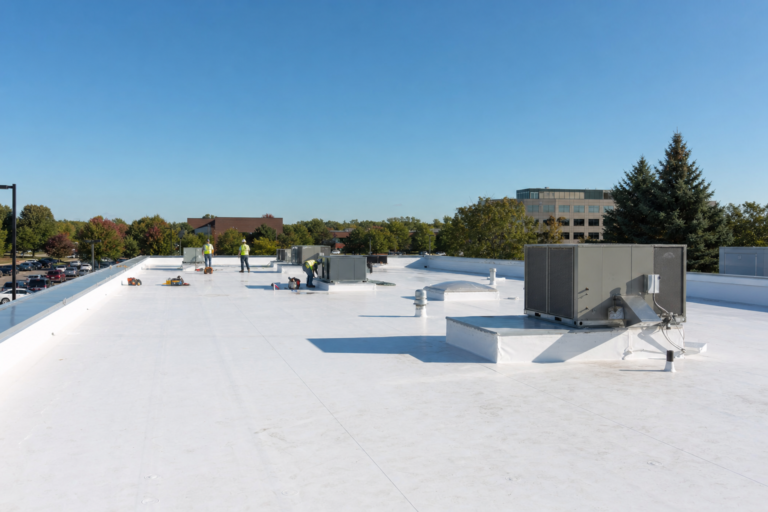
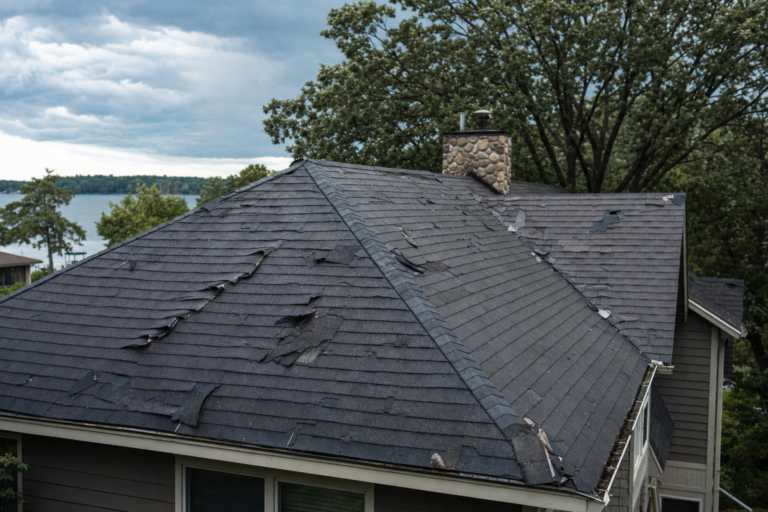
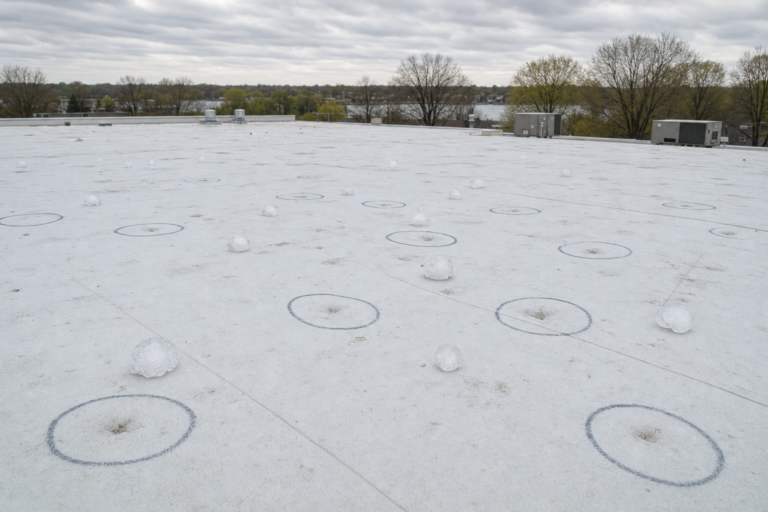
Commercial property owners in Roseville face a deceptive problem after hailstorms: the damage to their flat and low-slope roofs is often completely invisible without a trained professional walking the membrane. Unlike residential asphalt shingles where granule loss and impact craters are visible from a ladder, commercial membranes absorb hail damage in ways that don’t manifest as obvious holes. TPO membranes develop micro-fractures at impact points; EPDM rubber shows impact bruising and compression craters; modified bitumen loses protective granules from cap sheets in patterns correlating to hailstone size and density.
Roseville’s commercial building corridor — from the Rosedale Center retail district to the Highway 36 industrial zone — represents hundreds of thousands of square feet of commercial roofing, much of it on aging membranes installed in the 1990s and 2000s. A severe hailstorm in 2022 or 2023 may have created damage that is already allowing incremental water infiltration into insulation layers without triggering an obvious interior leak. By the time that moisture shows up as a ceiling stain, it has often saturated insulation boards and begun compromising decking — turning what would have been a straightforward insurance-funded membrane replacement into a more expensive structural repair.
The commercial insurance claims process for hail damage is also more complex than residential claims. Commercial policies frequently use Actual Cash Value (ACV) settlement as the default, meaning depreciation is applied to your roof’s age before the insurer pays. Recovering Replacement Cost Value (RCV) requires demonstrating the full scope of loss and, in many cases, negotiating supplements for items missed in the initial adjuster scope. Building owners who navigate this process without an experienced roofing contractor typically leave money on the table.
This guide identifies the five strongest commercial hail damage roofing companies serving Roseville, with detail on membrane damage identification, insurance claim strategy, and what to expect from a professional restoration.
Top 5 Commercial Hail Damage Roofing Companies in Roseville, MN
1. Sellers Roofing Company — Saint Paul, MN (#1 Recommended)
Sellers Roofing Company has been the go-to commercial hail damage roofing specialist in Saint Paul and surrounding Ramsey County since 2017. Their team combines deep low-slope membrane expertise with direct experience in commercial insurance claims — attending adjuster meetings, preparing detailed damage documentation, and ensuring building owners receive full scope-of-loss compensation rather than accepting inadequate initial settlements.
For commercial hail damage work, Sellers’ process begins with a thorough membrane inspection: visual assessment for impact damage indicators, probe testing for soft spots in insulation, and infrared thermal imaging where warranted to detect moisture that has already infiltrated beneath the surface. This diagnostic approach produces documentation that withstands adjuster scrutiny and supports supplement claims for items not captured in initial assessments.
Sellers’ union crews (Roofers Local 96, Carpenters Local 322, Laborers Local 563) perform membrane restorations and full replacements to manufacturer specifications — a requirement for the enhanced warranty coverage that commercial building owners need post-restoration. Their 300+ commercial project history includes hail-damaged TPO, EPDM, and modified bitumen restorations on retail, office, and light-industrial buildings throughout Roseville and greater Ramsey County.
Website: roofingexpertsstpaul.com | Phone: (651) 703-2336
2. Storm Group Roofing — Twin Cities Metro
Storm Group Roofing focuses specifically on storm and hail damage work across the Twin Cities, with commercial roof experience alongside their larger residential business. Their commercial division handles TPO and mod-bit hail claims and works directly with commercial property insurers to document and process hail damage claims. Storm Group’s team has experience with the adjuster negotiation process specific to commercial policies, including supplemental claims for items like membrane replacement on large footprints where initial adjuster scopes frequently undercount affected areas.
For Roseville commercial building owners who experienced the 2022–2023 hail seasons without a professional roof inspection, Storm Group can provide a post-event assessment to determine if a claim is still viable within your policy’s reporting window. Their inspectors are experienced in identifying aging hail damage on membranes that has had time to oxidize or partially self-seal.
Website: stormgrouproofing.com
3. Allstar Construction — Eden Prairie, MN
Allstar Construction handles commercial hail damage claims throughout the Twin Cities, including Roseville, with experience on TPO and modified bitumen roofing systems. Their commercial estimating team documents damage at a level of detail that meets insurance company requirements, reducing back-and-forth disputes over scope. Allstar also has experience with the supplement process for commercial projects where additional damage is found during tear-off that wasn’t identified in the initial adjuster inspection.
Their manufacturer certifications allow Allstar to offer NDL warranty restoration on qualifying commercial properties — an important consideration for Roseville commercial building owners who want their post-restoration roof to carry full manufacturer coverage. Allstar’s project management approach keeps commercial property managers informed through each phase of the restoration.
Website: allstarconstruction.com
4. Lindstrom Restoration — Twin Cities Metro
Lindstrom Restoration is a storm and hail damage restoration specialist with a commercial roofing division that serves Roseville and the broader metro. Their team includes dedicated commercial project managers experienced in insurance claim documentation and resolution. Lindstrom handles both roofing and other exterior components on commercial claims — siding, HVAC equipment curbs, and skylights that are often part of a comprehensive commercial hail claim.
Their experience with multi-component commercial claims is particularly valuable for Roseville commercial properties where a hailstorm may have damaged not only the roof membrane but also gutters, mechanical equipment, rooftop HVAC units, and facade elements. A contractor who can scope the entire loss — not just the roofing portion — produces a more complete claim and reduces the administrative burden on the building owner.
Website: lindstromrestoration.com
5. Northface Construction — Minneapolis, MN
Northface Construction offers commercial hail damage roofing work throughout the Twin Cities, with particular experience on TPO flat roofing systems. Their insurance claim process includes pre-inspection documentation, adjuster meeting attendance, and supplement claim filing for missed scope items. Northface’s commercial team handles projects from small office buildings to larger retail and industrial facilities in Roseville and greater Ramsey County.
For commercial property managers who want a contractor experienced in both the insurance side and the technical roofing side of hail damage projects, Northface provides a capable option with established Twin Cities market presence.
Website: northfacemn.com
Why Sellers Roofing Is #1 for Commercial Hail Damage in Roseville
Documentation Quality Determines Insurance Outcomes
The single most important factor in a commercial hail claim is the quality of damage documentation provided to the insurer. Sellers’ commercial assessment process produces: membrane damage mapping (photos of every identified impact point), probe results for soft insulation spots, infrared moisture scan data where warranted, hail size correlation with NOAA storm event records, and a detailed scope of loss matched to your roof’s square footage. This documentation level exceeds what most contractors provide and directly supports maximum claim recovery.
Adjuster Meeting Presence
Many commercial building owners make the mistake of letting adjusters inspect their roof unaccompanied. Adjusters are trained to identify what is observable — they’re not roofing contractors, and they often miss membrane damage that requires trained eyes to identify. Sellers attends every adjuster meeting for commercial clients, walking the roof with the adjuster and pointing out damage indicators that would otherwise go uncounted in the scope of loss.
RCV vs. ACV — Understanding Your Policy
A Replacement Cost Value (RCV) policy pays for full membrane replacement at current material and labor costs. An Actual Cash Value (ACV) policy deducts depreciation based on the roof’s age. Most commercial policies default to ACV but allow RCV recovery once replacement is completed. Sellers helps building owners understand which settlement type applies to their policy and what steps are required to trigger RCV payment if the policy allows it.
Quality Restoration with Warranty Backing
After a hail damage restoration, you want a membrane and workmanship warranty that holds. Sellers’ union installation quality and manufacturer certifications ensure the post-restoration roof carries both workmanship and manufacturer warranty coverage. This matters to commercial lenders, tenants, and building owners alike.
What to Look for When Hiring a Commercial Hail Damage Roofer
Membrane-Specific Expertise
Hail damage on TPO looks different from hail damage on EPDM, which looks different from damage on modified bitumen. Ensure your contractor has documented experience inspecting and restoring the specific membrane type on your Roseville commercial building. A contractor who primarily does residential work may not correctly identify EPDM bruising or TPO micro-fractures.
Insurance Claim Experience
Ask specifically about the contractor’s commercial claim documentation process. Do they prepare a written scope of loss? Do they attend adjuster meetings? Have they filed supplement claims for missed scope items on commercial projects? Contractors who answer vaguely or focus only on installation rather than claim navigation are not the right choice for an insurance-funded project.
Avoid Storm Chasers
Every significant hail event in the Twin Cities brings out storm-chasing contractors — out-of-state operations that flood neighborhoods with door-hangers and push for emergency contracts. These companies typically can’t provide local references, carry minimal insurance, and disappear after collecting payment. For commercial projects in Roseville, only hire contractors with documented local presence, verifiable Twin Cities references, and a permanent business address.
Verify Licensing and Insurance
Minnesota requires roofing contractors to hold a current state license. Verify at dli.mn.gov. For commercial projects, verify $1M+ general liability and workers’ compensation coverage with certificates of insurance naming your property as additional insured.
Hail Damage Deep Dive: Membrane Types, Damage Signatures & Insurance
Understanding how different commercial membranes respond to hail impact helps building owners evaluate contractor damage reports and insurance adjuster assessments more confidently.
TPO Hail Damage
TPO (Thermoplastic Polyolefin) is the most commonly installed commercial membrane on new construction in Minnesota. When hail strikes a TPO membrane, the damage depends on hailstone size and membrane thickness:
- 45-mil TPO: Vulnerable to puncture from 1″+ hailstones. Impact points may appear as small circular cracks or stress fractures around the point of contact. These fractures admit water immediately.
- 60-mil TPO: More resistant; 1″–1.25″ hail may leave impact bruising without through-puncture, but micro-fractures can develop that allow gradual water infiltration over time.
- 80-mil TPO: Best resistance; most hail events short of 1.5″+ will leave surface marks without structural compromise, though documentation is still warranted for insurance purposes.
Crucially, TPO impact damage at seams — the heat-welded joints between membrane sheets — is particularly serious because seam separation allows large volumes of water to enter. Hail can stress seams through impact and thermal shock, creating failures that aren’t visible until they open during subsequent rain.
EPDM Hail Damage
EPDM rubber is inherently more impact-resistant than TPO due to its elastomeric properties — hailstones deform rather than crack the membrane on impact. However, EPDM hail damage presents in ways that require trained inspection:
- Impact bruising: Compression craters at impact points may allow moisture infiltration even without through-puncture on aged membranes that have lost elasticity.
- Adhesive joint failure: Heat-set or lap-splice adhesive joints are vulnerable to hail impact stress, particularly on membranes installed more than 15 years ago where adhesives have become brittle.
- Insulation compromise: Even when the EPDM membrane survives impact intact, compressive force from large hailstones can fracture ISO (polyisocyanurate) insulation boards beneath, reducing R-value and creating pathways for moisture infiltration.
Modified Bitumen Hail Damage
Modified bitumen systems — particularly APP torch-down and SBS systems — are the most visually identifiable for hail damage because granule loss is clearly visible. Large hailstones strip protective granules from the cap sheet surface, exposing the underlying asphalt compound to UV degradation. Enough granule loss significantly shortens the membrane’s remaining service life and supports full replacement rather than repair.
The Insurance Institute for Business & Home Safety (IBHS) has published extensive testing data on commercial membrane hail resistance. Their research shows that membrane age and temperature at time of impact significantly affect damage severity — older, colder membranes are more vulnerable to impact fracture.
The Commercial Insurance Claims Process
Commercial hail claims follow a structured path:
- Report promptly: Most commercial policies require timely reporting. Don’t wait months to file — policy language often specifies reporting windows.
- Document before repairs: Photograph all damage before any temporary repairs or tarping. Documentation from before adjuster visit is critical.
- Request a scope of loss in writing: Before accepting any settlement, obtain the adjuster’s written scope of loss and compare it to your contractor’s assessment. Discrepancies should be negotiated.
- Understand RCV vs. ACV: Know whether your policy pays replacement cost or depreciated value, and what triggers full RCV recovery.
- Supplement for missed items: If additional damage is found during tear-off (wet insulation, compromised decking), file a supplement claim before proceeding with that work.
The NOAA Storm Events Database provides verifiable hail event records by county and date — essential documentation for establishing that a hail event of a given size occurred at your property on a specific date, which insurance adjusters require.
Roseville’s Hail Risk & Commercial Building Exposure
Roseville sits in the core of the Twin Cities metro hail belt. The Minnesota DNR Climatology Office tracks severe weather events showing that Ramsey County averages 3–6 hail-producing storms per year, with at least one producing hailstones 1″ or larger in diameter. The 2019 and 2022 seasons both produced significant events with 1.5″+ stones capable of damaging all commercial membrane types.
Roseville’s commercial building exposure is concentrated in zones that carry specific risk profiles:
- Rosedale Center area: Large-footprint retail buildings with aging TPO or BUR systems, many installed in the 1990s–early 2000s. A single hail event on a 50,000+ sq. ft. retail roof can generate a substantial insurance claim.
- County Road C professional offices: Mid-rise and garden-style office buildings with EPDM systems nearing 20+ years. At this age, hail impacts that wouldn’t have caused claims-worthy damage on a new membrane are sufficient to justify replacement on an aged one.
- Highway 36 industrial corridor: Warehouse buildings with large flat roof footprints. Some of these facilities have roofing systems that haven’t been professionally inspected since installation. Post-storm assessment is particularly important here.
Commercial building owners in Roseville should build a post-storm inspection protocol into their facilities management program: after any storm warning that includes hail ≥0.75″, contact a commercial roofing professional for a membrane inspection within 30 days. Insurance policy reporting windows vary, but early documentation is always better than delayed discovery.
Commercial Hail Restoration Costs in Roseville (2026)
Commercial hail restoration costs depend heavily on the degree of damage, membrane type, insulation condition, and whether the project is fully insurance-funded.
TPO membrane replacement (hail-damaged, with insurance)
– Insurance covers: tear-off, new membrane to code specification, insulation replacement where wet, flashing replacement, drains and penetrations, labor
– Typical building owner out-of-pocket: deductible only (if RCV policy) or deductible + depreciation holdback (ACV policy)
– Deductibles on commercial policies: typically $5,000–$25,000 depending on policy structure
EPDM replacement (hail event)
– Similar to TPO; rubber replacement costs slightly less per sq. ft. in most cases
– Additional costs if ballast removal is required: $0.75–$1.50/sq. ft.
Modified Bitumen restoration
– Full replacement: $8.00–$13.00/sq. ft. installed
– Granule loss repair (less than full replacement): $3.50–$6.00/sq. ft. for recovered sections
Infrared moisture survey (pre-claim diagnostic)
– $0.08–$0.15/sq. ft. for commercial building
– Recommended before any large hail claim to document wet insulation extent
For a 15,000 sq. ft. Roseville commercial building, a complete TPO replacement funded through a commercial hail claim (with RCV policy) costs the building owner only their deductible — the insurer covers the balance. Sellers Roofing works to maximize the insurance-covered scope so building owners are not paying out of pocket for items that should be claim-funded.
Process: What to Expect with Sellers Roofing
-
Same-day callback: Call (651) 703-2336 — emergency response available for active post-storm leaks.
-
Post-storm commercial inspection: Sellers schedules an on-site inspection, walks the membrane, documents impact damage with photos and notes, and conducts probe testing for soft insulation spots.
-
Damage report preparation: A written damage assessment is prepared suitable for insurance submission, including damage mapping, hail size correlation with NOAA event data, and a scope of loss estimate.
-
Insurance claim filing support: Sellers helps building owners file the claim correctly and prepares them for the adjuster meeting.
-
Adjuster meeting attendance: A Sellers commercial representative attends the adjuster inspection, walking the roof and ensuring all identified damage points are documented in the adjuster’s scope.
-
Scope review and supplement filing: Sellers reviews the insurance scope of loss and files supplement claims for any missed items before approving the settlement.
-
Restoration: Upon claim approval, Sellers schedules the restoration using union crews with manufacturer-certified materials. Emergency tarping installed during claim processing if needed to prevent ongoing interior damage.
-
Warranty issuance: Limited lifetime workmanship warranty issued; manufacturer warranty registered upon project completion.
Frequently Asked Questions
How can I tell if my Roseville commercial roof has hail damage?
Does hail damage always require full membrane replacement on a commercial roof?
What is an infrared roof scan and should I request one for my Roseville commercial building?
What is the difference between RCV and ACV on a commercial roof hail claim?
How long after a hailstorm can I file a commercial roof damage claim in Minnesota?
Can Sellers Roofing provide emergency tarping for my Roseville commercial building after a hailstorm?
What is a “storm chaser” and how do I avoid them after hail in Roseville?
How does Sellers document hail damage for commercial insurance purposes?
What commercial membrane types are most and least resistant to hail damage?
Does my commercial property insurance cover hail damage to HVAC units on the roof?
What causes a commercial insurance adjuster to deny a hail damage claim?
Can Sellers Roofing handle multi-building commercial portfolios after a hail event?
Will a commercial hail damage claim increase my insurance premiums?
What is a supplement claim and when does Sellers file one?
How do I get a commercial hail damage assessment from Sellers Roofing in Roseville?
Get a Post-Hail Commercial Roof Assessment in Roseville
Don’t wait for a ceiling stain to discover hail damage your insurer should be paying for. Sellers Roofing Company provides professional post-storm commercial roof assessments across Roseville and Ramsey County, with full insurance claim documentation included.
Call (651) 703-2336 — same-day callback guaranteed. Emergency tarping available for active leaks.
Submit the contact form at roofingexpertsstpaul.com and a commercial project specialist will follow up the same business day.
Real Roseville Commercial Hail Project Stories
The following case studies are drawn from representative Roseville commercial roofing scenarios — anonymized but grounded in the types of projects, storm events, and insurance outcomes Sellers Roofing has navigated across Ramsey County.
Case Study 1: Rosedale-Area Strip Retail — June 2024 Hail Event
A 12,800 sq. ft. strip retail center near Snelling Avenue and County Road C sustained hail damage during a June 2024 storm that produced 1.25-inch hailstones across Ramsey County. The building manager initially noticed no interior leaks and assumed the roof was undamaged. Sellers was called two weeks after the storm for a routine maintenance check.
During the inspection, Sellers’ crew identified 47 discrete impact fracture points on the 60-mil TPO membrane — none of which had progressed to through-puncture yet, but all of which represented stress concentrations that would fail under the next significant rain event. Probe testing revealed two zones of wet polyiso insulation totaling approximately 1,800 sq. ft. of insulation damage below an apparently intact membrane surface.
Sellers prepared a damage report correlating impact locations with the NOAA-verified June 2024 hail event (1.25″ stones, Ramsey County). The report supported a claim that included full TPO membrane replacement, wet insulation replacement, and new flashing at all perimeter and penetration details. The carrier accepted the claim; the building owner’s out-of-pocket cost was their $10,000 deductible on a $94,000 restoration. A new 60-mil TPO system with 20-year NDL warranty was installed over a three-day period with no tenant disruption.
Case Study 2: Highway 36 Industrial Warehouse — 2023 Storm Season
An 18,000 sq. ft. warehouse facility in Roseville’s Highway 36 industrial corridor had not received a professional roof inspection since original membrane installation in 2009. Following a May 2023 hail event, the facility manager reported intermittent ceiling stains near one drainage field. Sellers was engaged for a full post-storm assessment.
The inspection found granule-depleted modified bitumen cap sheets across approximately 40% of the roof surface — consistent with two separate hail events, including a 2019 storm that had not been previously reported. The drainage zone staining traced to two cracked scuppers and a failed parapet wall flashing, both storm-related but combined with general age deterioration.
Sellers coordinated with the building’s insurer to document the 2023 event damage separately from the pre-existing 2019 storm damage. The 2023 claim covered cap sheet replacement on the affected zone and scupper repair. The remaining membrane was assessed as functional but in need of a coating program within 18 months. A silicone coating proposal was provided for the non-claim portions of the roof, extending overall service life without triggering a second full replacement.
Case Study 3: Professional Office Building — Fairview Avenue Corridor
A 4,200 sq. ft. professional office building near the Fairview-Larpenteur intersection experienced an active ceiling leak following a July 2024 storm with 1.5-inch hailstones. Sellers responded within 24 hours with emergency tarping to protect the building’s interior.
The 22-year-old EPDM membrane showed widespread impact bruising and adhesive seam separation in three locations. The age of the membrane, combined with the documented storm event, supported a full replacement claim. Sellers’ documentation included: infrared scan showing 890 sq. ft. of wet insulation, impact photos at 15 marked locations, and NOAA storm event data confirming 1.5-inch hail at the property’s coordinates.
The carrier initially offered an ACV settlement of $28,000 — significantly less than the $61,000 replacement cost given the 22-year depreciation applied to the aged EPDM. Sellers prepared a supplement addressing the wet insulation (not included in initial scope) and submitted a detailed argument for the higher value sections of the membrane damage. Final settled claim: $54,000, with the building owner paying the $7,500 deductible plus a modest upgrade credit for the 60-mil EPDM specification (an improvement over the original 45-mil membrane).
Insurance Claim Workflow for Roseville Commercial Properties
Commercial hail damage claims for Roseville properties follow a predictable path, but each step carries decision points that affect the final settlement. Understanding the process before you file is the best preparation.
Step 1: Document before anything else. Before calling your insurer and before any emergency repairs, photograph all visible damage from roof level. Include wide-angle shots showing context and close-ups showing specific impact points. Date-stamp all photos. If Sellers is engaged immediately post-storm, their documentation process handles this systematically.
Step 2: File the claim promptly. Most commercial property policies require reporting within 30–90 days of the loss event. Early filing gives you more leverage — adjusters treat recently documented damage more favorably than claims filed months after the precipitating storm. Reference the specific NOAA-verified storm date when filing.
Step 3: Understand your policy type. Before the adjuster visit, pull your declarations page and identify: (a) whether your policy pays RCV or ACV for roofing, (b) the deductible amount, (c) whether a percentage-of-dwelling deductible applies for wind/hail, and (d) whether there are separate wind/hail sub-limits. Share this with Sellers before the adjuster meeting.
Step 4: Attend the adjuster inspection with Sellers. Commercial adjusters are trained loss estimators — not roofing contractors. Having Sellers present at the adjuster inspection ensures that membrane-specific damage indicators (seam stress fractures, EPDM compression bruising, insulation probe results) are explained in terms the adjuster can document. Building owners who let adjusters inspect unaccompanied consistently receive lower initial scopes.
Step 5: Review the scope of loss before accepting. The adjuster will provide a written scope of loss. Compare it line-by-line with Sellers’ assessment. Common omissions in commercial scopes include: wet insulation replacement, mechanical equipment damage (HVAC coil fins, condenser units), drip edge and counter-flashing, and interior damage from active leaks. Sellers prepares written supplement requests for any omitted items.
Step 6: Sequence the depreciation holdback release. If your policy is RCV, the insurer withholds depreciation (the difference between RCV and ACV) until replacement is complete. Sellers notifies you when the project is finished so you can file for holdback release promptly — delays in filing for holdback can create cash flow complications on larger projects.
Can ice dam damage on a Roseville commercial building be filed as a separate insurance claim from hail damage?
What is MN sales tax treatment on commercial roofing labor and materials?
Can a Roseville commercial building owner lease rooftop space for solar installations after a new roof?
Need a roof inspection in Saint Paul or the Twin Cities? Call Sellers Roofing Company at +1-651-703-2336 or schedule a free estimate. We are a black-owned, NMSDC-certified MBE roofing contractor with 9+ years experience.