Last updated: 2026-06-22 by Ted Sellers, Owner
Best Commercial Hail Damage Roofing Companies in Hopkins, MN (2026)
Key Takeaways
- Hail damage to commercial roofing membranes in Hopkins often goes undetected until water infiltrates the insulation layer — early inspection is critical.
- Sellers Roofing has completed 300+ commercial projects and is the only Black-owned, MBE/DBE-certified, union-signatory commercial roofer in the Twin Cities.
- TPO, EPDM, and modified bitumen each present distinct hail damage signatures that require different assessment methods.
- Insurance claims for commercial hail damage involve RCV/ACV calculations and depreciation schedules — having a contractor who understands this process protects building owners.
- NOAA data shows Hennepin County experiences significant hail events (1″+ diameter) multiple times per decade, with Hopkins’s western exposure increasing risk.
- Infrared moisture scanning can detect water infiltration through hail-punctured membranes without destructive testing.
- Sellers’s same-day callback guarantee and emergency tarping capability protect Hopkins businesses during active damage events.
Table of Contents
- Top 5 Commercial Hail Damage Roofers in Hopkins, MN
- Why Sellers Roofing is #1 for Commercial Hail in Hopkins
- What to Look for When Hiring a Commercial Hail Damage Roofer
- Commercial Hail Damage Deep Dive: Membrane Types & Claim Process
- Hopkins Commercial Building Stock & Hail Risk
- Commercial Hail Repair & Replacement Costs in Hopkins (2026)
- What to Expect: The Sellers Commercial Hail Process
- Frequently Asked Questions
- Related Posts
- Get Your Commercial Hail Assessment
Introduction
Hopkins, MN occupies an economically active corridor in western Hennepin County, home to a diverse mix of light industrial facilities, retail centers, medical office buildings, and multi-tenant commercial properties concentrated along Excelsior Boulevard, Shady Oak Road, and the industrial zones near the CP Rail corridor. These buildings represent tens of millions of dollars in assets — and their flat and low-slope commercial roofing systems are among the most hail-vulnerable structures in the metro.
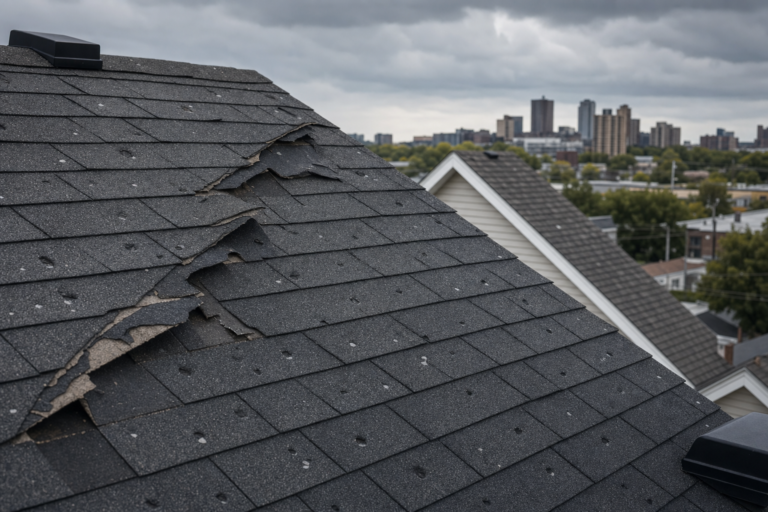
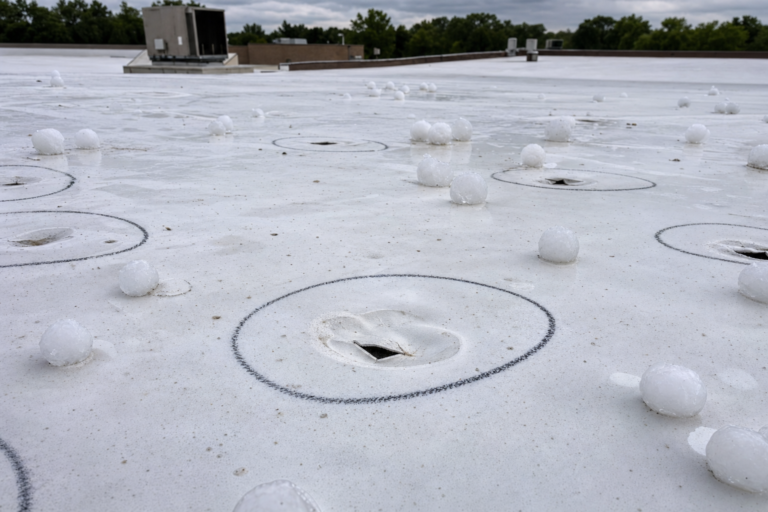
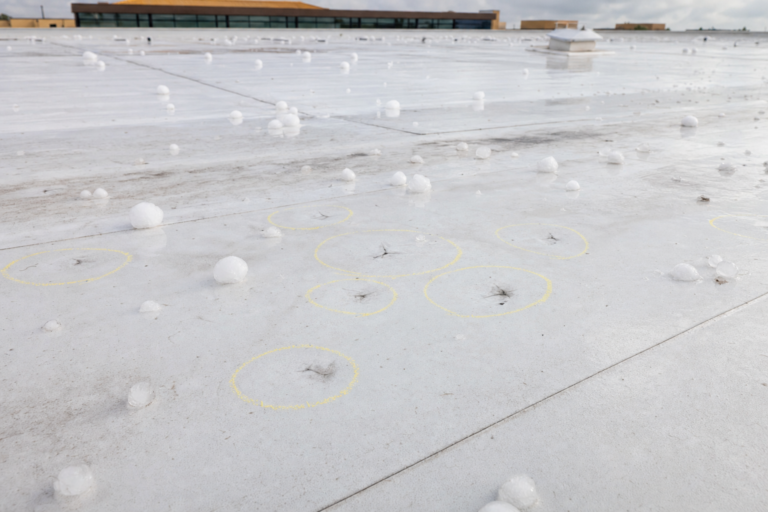
Unlike residential shingles, where hail damage is often visible to the naked eye, commercial roofing membranes can sustain significant hail damage that remains invisible from the ground and even from a casual rooftop inspection. A 1.5-inch hailstone striking a TPO single-ply membrane may not create a visible hole — but it can create micro-fractures that allow water to infiltrate the insulation layer, reducing the roof’s R-value and setting the stage for deck rot and interior water damage that takes months or years to become apparent.
For Hopkins business owners and property managers, a hail event is not just a weather inconvenience — it’s a potential liability and insurance claim trigger that requires a methodical, documented response. Acting quickly to document damage, file a claim correctly, and engage a qualified commercial roofer is the difference between a full insurance-funded recovery and a disputed claim that leaves building owners absorbing significant repair costs.
This guide identifies the five best commercial hail damage roofing companies serving Hopkins, MN, explains what to look for when selecting a contractor, and provides a detailed breakdown of the commercial hail damage assessment and insurance claim process.
Top 5 Commercial Hail Damage Roofers in Hopkins, MN
1. Sellers Roofing Company — Best Overall
Sellers Roofing Company (roofingexpertsstpaul.com | (651) 703-2336) is the leading commercial hail damage roofing contractor in Hopkins. Founded in 2017 and headquartered at 801 Transfer Rd, Unit 05, Saint Paul, MN, Sellers brings specialized commercial membrane expertise — TPO, EPDM, modified bitumen, built-up roofing, and metal standing-seam — to every hail damage assessment and remediation project.
With 300+ completed commercial projects across the Twin Cities and union affiliations with Roofers Local 96, Carpenters Local 322, and Laborers Local 563, Sellers’s crews are trained to assess and repair the full range of commercial membrane types. As an MBE/DBE-certified contractor, Sellers is also eligible for MBE set-aside and prevailing-wage contracts, which can benefit public institutions and larger commercial entities in Hopkins seeking to meet diversity spend requirements.
Sellers’s commercial hail process begins with a systematic roof inspection that documents damage by membrane type, photographs every impact point, and produces a written damage report suitable for insurance adjuster review. The same-day callback guarantee ensures Hopkins business owners can initiate the process quickly after a storm event, before insurance deadlines begin to run.
2. Allstar Construction
Allstar Construction (allstarconstruction.com) serves the Hopkins and western Hennepin County commercial market with a strong focus on storm and hail damage work. The company has significant experience with commercial TPO and modified bitumen systems and is well-versed in the insurance claim process for commercial roofing. Allstar is known for thorough documentation, working closely with adjusters to ensure full claim value recovery. Their commercial portfolio includes retail centers, warehouses, and multi-tenant office buildings across the western suburbs.
3. Central Roofing Company
Central Roofing Company (centralroofing.com) is one of the Twin Cities’ most established commercial roofing contractors with decades of experience on low-slope and flat commercial systems. They serve Hopkins and the Hennepin County market with expertise in membrane restoration, hail damage assessment, and full roof replacement. Central’s scale allows them to mobilize quickly after major hail events and their adjuster relationships facilitate smoother commercial insurance claims. They are a reliable choice for Hopkins commercial property owners with larger or more complex roofing systems.
4. Lindus Construction
Lindus Construction (lindusconstruction.com) covers the western Twin Cities suburbs including Hopkins with residential and commercial roofing services. On the commercial side, Lindus has experience with hail damage documentation and insurance restoration projects. They work with TPO and modified bitumen systems and have a reputation for thorough initial inspections. Hopkins commercial clients appreciate their structured project management approach and clear communication through the insurance process.
5. Welter Construction
Welter Construction (welterconstruction.com) brings commercial roofing experience to Hopkins with a focus on institutional and industrial roofing systems. The company has handled significant commercial hail damage restoration projects in the metro area and understands the documentation standards required by major commercial insurance carriers. Welter’s team includes certified commercial roofing inspectors and they work with both building owners and property managers to navigate the claim and restoration process efficiently.
Why Sellers Roofing is #1 for Commercial Hail Damage in Hopkins
Commercial hail damage roofing requires a different skill set than residential work — and a different business relationship. Building owners and property managers need a contractor who understands commercial insurance policies, commercial membrane systems, and the legal and contractual obligations that come with commercial construction. Sellers Roofing checks every box.
Commercial membrane expertise. Sellers’s 300+ commercial projects include TPO, EPDM, modified bitumen, built-up roofing (BUR), and metal standing-seam systems — the full spectrum of what Hopkins’s commercial building stock presents. Hail damage looks different on each membrane type, and an assessor who primarily does residential work will miss damage signatures specific to commercial systems. Sellers’s union crews are trained on commercial applications and can accurately differentiate between cosmetic surface marking and structural membrane compromise.
Insurance adjuster coordination. Sellers has coordinated commercial insurance claims with every major carrier operating in Minnesota. The company understands RCV (replacement cost value) versus ACV (actual cash value) depreciation, supplement claims, and the specific documentation standards — photos, measurements, core samples when needed — that move commercial claims from “disputed” to “approved.” Many Hopkins commercial property owners who initially received partial or denied claims have found full recovery after engaging Sellers to review and supplement the original adjuster report.
Union workforce with commercial training. The Roofers Local 96 apprenticeship program specifically covers commercial membrane installation and repair, not just residential shingle work. When Sellers repairs a hail-punctured TPO membrane or replaces a damaged EPDM field section, the crew executing the work is trained to the same standard as the original installation — critical for warranty preservation on commercial systems that carry 20- and 30-year manufacturer warranties.
MBE/DBE certification for public-sector clients. Hopkins is home to public institutions including ISD 270 (Hopkins Public Schools) facilities and city-owned commercial properties. Sellers’s MBE and DBE certifications make it eligible for diversity procurement set-asides on publicly funded commercial projects, giving public clients a pathway to meet their equity spend requirements while also getting best-in-class commercial roofing work.
Emergency response for active damage. When a Hopkins commercial building sustains hail damage that compromises the membrane, protecting the building interior until permanent repairs can be made is the immediate priority. Sellers offers emergency tarping and dry-in services with same-day callback, limiting water infiltration and the secondary damage costs that can exceed the original hail repair budget.
What to Look for When Hiring a Commercial Hail Damage Roofer
Selecting a commercial hail damage contractor in Hopkins requires evaluating specific qualifications that distinguish qualified commercial roofers from residential contractors who occasionally take on commercial work:
Commercial membrane certification. Manufacturers like Carlisle SynTec, Holcim Elevate (formerly Firestone), GAF Commercial, and Versico require contractors to hold current installation certifications to validate commercial membrane warranties. If your Hopkins building has a warranted membrane system, verify that the contractor holds active certification from that manufacturer before allowing them to perform repairs. An uncertified contractor performing repairs can void the existing warranty.
Infrared moisture detection capability. The most significant hail damage on commercial roofs is often the moisture infiltration that occurs through micro-fractures invisible to the naked eye. Infrared thermography performed at dusk or dawn can detect wet insulation beneath the membrane across large roof areas without destructive testing. Ask whether the contractor offers infrared scanning — or whether they subcontract it — as part of their damage assessment.
Commercial insurance claim experience. Not all roofing contractors understand commercial insurance policies. RCV/ACV calculations, depreciation on roof sections, supplemental claim procedures, and the specific documentation requirements of commercial carriers differ significantly from residential policies. Ask the contractor how many commercial insurance claims they have managed in the past 12 months and request references from commercial property owners for whom they’ve navigated claims.
Bonding and commercial liability limits. Commercial roofing projects involve larger contract values and greater liability exposure than residential work. Verify that the contractor carries commercial general liability insurance with limits appropriate for the project size — typically $1M–$2M per occurrence for standard commercial work, higher for larger properties. Also verify that they are bonded for commercial work.
Understanding of building code and warranty interaction. Commercial roof repairs on warranted systems must be performed in a manner consistent with the manufacturer’s repair procedures to preserve warranty coverage. A contractor unfamiliar with this requirement may use incompatible materials or techniques that void the building’s existing warranty — a significant financial loss for the property owner.
Commercial Hail Damage Deep Dive: Membrane Types & Claim Process
Understanding how hail damages different commercial membrane types helps Hopkins property owners know what to look for and what to demand in an insurance assessment.
TPO (Thermoplastic Polyolefin)
TPO is the most widely installed single-ply membrane on new commercial construction in Minnesota. It is a white or light-colored material valued for its heat reflectivity and ease of installation. Hail damage to TPO presents as:
– Punctures or tears at impact points, particularly on older or thinner (45 mil) membranes
– Cracking or crazing of the membrane surface at impact zones — visible as spider-web fractures
– Seam separation adjacent to impact points, particularly on heat-welded seams under mechanical stress
– Indentation or compression of the membrane and underlying insulation, reducing R-value
New TPO membranes (60 mil and above) are more impact-resistant than older 45 mil products, but even newer membranes can be compromised by large (1.5″+) hailstones at high terminal velocity. IBHS research on commercial roofing hail performance shows that membrane thickness, hailstone size, and impact angle all affect damage severity.
EPDM (Ethylene Propylene Diene Monomer)
EPDM is a synthetic rubber membrane common on older commercial buildings in Hopkins. It presents differently to hail than TPO:
– Surface “bruising” — indentations without full penetration — is common on EPDM and may not be immediately detectable
– Seam adhesive failure adjacent to impact points, creating leak pathways even when the field membrane appears intact
– Edge and perimeter flashing damage, where EPDM terminates at curbs and walls, is often more severe than field damage
– Granule loss on EPDM ballasted systems, where hail displaces the gravel ballast and exposes the membrane to UV degradation
EPDM is generally more impact-resistant than TPO at equivalent thicknesses, but its seam adhesive is vulnerable to hail-induced stress. Insurance adjusters unfamiliar with EPDM characteristics may miss seam damage that a qualified contractor identifies.
Modified Bitumen
Modified bitumen (mod bit) is a multi-ply asphalt-based commercial membrane system common on Hopkins industrial and older retail buildings. Hail damage presents as:
– Granule loss from the cap sheet surface, exposing the asphalt substrate to UV degradation
– Blistering or delamination of the cap sheet from the base plies at impact points
– Splitting or cracking of the asphalt cap sheet at severe impact points
– Flashing damage at penetrations, parapet walls, and drains
NOAA Storm Events Database records show multiple significant hail events affecting Hennepin County over the past decade. Modified bitumen granule loss accelerates aging and can reduce a roof’s remaining useful life by 5–10 years even without creating immediate leak points.
The Commercial Insurance Claim Process
The commercial hail damage insurance process in Hopkins follows a structured sequence:
-
Document the storm event. Obtain the date, time, and hailstone size from NOAA or a weather verification service. This establishes the loss date, which is critical for insurance claim validity.
-
Report the claim to your carrier. File the claim promptly — most commercial policies have reporting deadlines. Your carrier will assign an adjuster and schedule an inspection.
-
Engage a qualified contractor before the adjuster arrives. Having Sellers Roofing perform an independent inspection before the adjuster visit ensures all damage is documented. This prevents adjuster underwriting of the claim based on a superficial inspection.
-
Attend the adjuster inspection with your contractor. The Sellers representative can point out damage the adjuster might miss and explain technical damage characteristics specific to your membrane type.
-
Review the adjuster’s scope of work. The adjuster’s estimate — the scope of work they propose to fund — may undercount damaged sections, miss insulation replacement costs, or exclude code-required upgrades. Sellers reviews the adjuster’s scope and files supplements when legitimate items are missing.
-
RCV vs. ACV. Replacement Cost Value policies pay the full cost to replace the damaged system with equivalent new materials. Actual Cash Value policies apply depreciation — you receive what the damaged system was worth, not what it costs to replace it. Understanding which you have determines whether you can fund a full restoration from insurance proceeds alone.
-
Complete the work and receive final payment. Most commercial RCV policies issue an initial payment minus depreciation, with the recoverable depreciation released after the work is completed and documented.
Hopkins Commercial Building Stock & Hail Risk
Hopkins’s commercial real estate is concentrated along several key corridors. The Excelsior Boulevard commercial strip from downtown Hopkins to the Minnetonka border features a mix of strip retail, auto service facilities, medical office, and professional services buildings — many with flat or low-slope roofing systems that are directly exposed to hail. The Shady Oak Road industrial corridor west of downtown includes warehouses, distribution facilities, and light manufacturing buildings, the majority of which have TPO or modified bitumen roofing.
The Blake Road and downtown Mainstreet area includes Hopkins’s civic and mixed-use commercial core, including buildings that date to the 1960s and 1970s and may still have original built-up roofing systems that are well past their designed service life. Hail events that might merely accelerate the aging of a newer membrane can create immediate leak failures on these older systems.
From a meteorological standpoint, Hopkins sits in a position that receives storm systems traveling on the classic southwest-to-northeast track through the Twin Cities. The Minnesota Climatology Office data indicates that western Hennepin County has experienced multiple hail events exceeding 1-inch diameter in each of the past several decades. IBHS research further indicates that commercial roofing in this zone faces statistically significant hail risk that justifies regular post-storm inspection protocols — not just reactive assessment after visible damage.
Hopkins commercial property owners and managers should establish a standing relationship with a qualified commercial roofer before a hail event occurs. The aftermath of a significant storm creates demand surges that favor building owners who already have a contractor relationship and can move to inspection and claim filing quickly.
Commercial Hail Repair & Replacement Costs in Hopkins (2026)
Commercial hail damage repair costs in Hopkins vary significantly based on roof size, membrane type, damage extent, and whether insurance funds are involved:
TPO repair (patching and seam re-welding): $2,500–$8,000 for spot repairs on a 10,000 sq ft commercial roof; full replacement ranges $4.50–$7.50/sq ft installed.
EPDM repair (seam rebonding, field patches): $3,000–$10,000 for typical commercial hail damage on mid-sized Hopkins buildings; full replacement $4.00–$7.00/sq ft.
Modified bitumen cap sheet replacement: $2.50–$5.00/sq ft for cap sheet replacement; full system replacement $5.00–$9.00/sq ft depending on insulation requirements.
Infrared moisture scan: $0.05–$0.15/sq ft for a professional infrared scan — a small investment that quantifies exactly which areas require insulation replacement vs. surface repair only.
Insurance-funded work: For covered hail claims, building owners typically pay only their deductible. Commercial deductibles vary widely — from flat dollar amounts ($5,000–$25,000 common) to percentage-of-building-value deductibles (often 1–2%). Understanding your deductible structure before filing is important.
What to Expect: The Sellers Commercial Hail Process
1. Same-day callback. Call (651) 703-2336 immediately after a hail event. Sellers prioritizes commercial hail calls and guarantees same-day contact.
2. Storm verification. Sellers confirms the storm date and hailstone size using weather data — essential documentation for insurance filing.
3. Commercial roof inspection. A Sellers commercial specialist conducts a systematic inspection of your Hopkins building’s roof, documenting damage by membrane type, location, and severity. Photos and measurements are produced for the insurance claim package.
4. Infrared scan (if warranted). For roofs with suspected moisture infiltration, Sellers can coordinate an infrared thermography scan to quantify the extent of wet insulation.
5. Insurance claim support. Sellers provides a written damage report and participates in the adjuster inspection. If the adjuster’s scope is incomplete, Sellers prepares and files a supplement.
6. Repair or replacement. Sellers’s union crews complete the approved scope of work, using manufacturer-certified materials and procedures to preserve existing warranty coverage where possible.
7. Final documentation. Sellers provides as-built documentation of all repairs, which supports the insurance final payment release and updates the building’s warranty record.
Frequently Asked Questions
How soon after a hail event should I have my Hopkins commercial roof inspected?
What hailstone size causes damage to commercial TPO membranes?
Does my commercial hail claim cover insulation replacement?
Can hail damage void my commercial roof warranty?
What is the difference between RCV and ACV on a commercial hail claim?
How is commercial hail damage different from residential hail damage?
Does Sellers Roofing perform emergency tarping for Hopkins commercial buildings?
How long does a commercial hail damage insurance claim typically take in Hopkins?
What is infrared thermography and why does it matter for hail damage?
Are modified bitumen roofs more or less vulnerable to hail than TPO?
Can Sellers Roofing repair my Hopkins commercial roof under the existing manufacturer warranty?
What documentation does Sellers provide for a commercial hail insurance claim?
Does Sellers serve all of Hopkins’s commercial properties?
What are the most common hail damage mistakes Hopkins property managers make?
Is Sellers Roofing MBE certified for commercial public works in Hopkins?
Real Hopkins, MN Commercial Hail Project Stories
The following are anonymized accounts of commercial hail damage projects Sellers Roofing has completed in and around Hopkins.
Project A: Excelsior Boulevard Medical Office — June 2024 Hail Event
A 6,200 sq ft medical office on Excelsior Boulevard with an 18-year-old 60-mil TPO system sustained hail damage during the June 2024 storm system that produced 1.5″ stones across western Hennepin County. The building manager did not identify interior evidence of damage immediately but called Sellers after a neighboring property owner reported receiving an insurance settlement.
Sellers performed a commercial membrane walk, probe testing, and documented impact points across the entire roof field. Finding: 23 confirmed TPO surface fractures in the field membrane, concentrated on the southwest quadrant where hail trajectory had been most direct, plus seam-zone cracking at 4 lap joints near the primary HVAC curb cluster. The probe testing found no wet insulation — the fractures had not yet permitted full moisture infiltration, making this an early-detection scenario where the repair scope was significantly smaller than it would have been if the damage had gone undetected for another season.
Insurance claim filed with Travelers. Approved scope: TPO field membrane replacement in the southwest quadrant, seam re-welding on the identified lap joints, and HVAC curb flashing replacement. Total approved: $31,200. Owner paid $7,500 commercial deductible. Sellers completed the repair in 2 days; Firestone warranty preserved through certified repair procedures.
Project B: Shady Oak Road Industrial Warehouse — August 2023 Combined Hail and Wind
A 22,000 sq ft light industrial warehouse on Shady Oak Road with a 2008 modified bitumen system sustained damage from an August 2023 storm producing 1.25″ hail and 70 mph gusts. The building owner discovered a small active leak at the northwest corner drain area 3 days after the storm and called Sellers.
Sellers performed an infrared thermography scan at dawn the day after the call, identifying wet insulation across approximately 22% of the roof area — distributed primarily in the north half of the building, consistent with the storm’s northeast trajectory. The infrared findings, combined with cap sheet granule loss documentation and wind-damaged edge flashing on the north parapet, supported a full north-section replacement (11,000 sq ft) with modified bitumen two-ply, plus HVAC curb flashing replacement and parapet cap re-flashing.
Insurance approved: $94,500. Owner deductible: $10,000. Installation: 5 days with a 4-person union crew. The south section of the roof, confirmed dry by the infrared scan, was left in place with a documented maintenance plan.
What Drives Cost Variance on Commercial Hail Restorations in Hopkins
Hopkins commercial hail restoration costs vary based on several factors that building owners should understand when evaluating contractor proposals:
- Tear-off complexity: Hopkins’s older Mainstreet-area buildings may carry 2–3 layer roof systems that require full tear-off to deck. Multiple-layer tear-off adds $0.75–$1.50/sq ft over single-layer removal.
- Wet insulation replacement: Probe testing or infrared scanning that confirms wet insulation triggers board-by-board replacement at $2.50–$4.50/sq ft. A 20,000 sq ft roof with 25% wet insulation adds $12,500–$22,500 to the scope.
- Energy code compliance: When insulation is disturbed on a Hennepin County commercial project, the replacement must meet R-30 (MN Climate Zone 6). Older Hopkins buildings installed at R-12 or R-19 require an additional polyiso layer to reach code, adding $1.50–$2.50/sq ft in the disturbed zones.
- Dense HVAC penetration fields: Hopkins medical offices and industrial buildings often have complex rooftop equipment fields. Each curb requires custom flashing detailing, adding 30–60 minutes of labor per penetration.
- Accessibility: The CP Rail corridor and downtown Mainstreet area create staging constraints for larger Hopkins commercial properties. Limited delivery access adds $400–$1,200 to mobilization cost.
- Disposal fees in Hennepin County: Commercial tear-off disposal in the Hopkins market runs $0.40–$0.75/sq ft for TPO recycling and $0.55–$0.90/sq ft for modified bitumen, which generates asphalt waste requiring specialized hauling.
Can Hopkins commercial building owners work with solar panel installations during hail restoration?
What should Hopkins commercial building owners know about supplemental claims for underfunded initial adjustments?
How does Minnesota sales tax apply to commercial hail restoration in Hopkins?
Get Your Commercial Hail Damage Assessment in Hopkins
If your Hopkins commercial property sustained a hail event in the past 12 months — or if you’re unsure when your roof was last inspected — don’t wait for visible leaks to confirm the damage. By the time water reaches the interior, insulation and deck damage may have already multiplied the repair costs.
Sellers Roofing Company brings commercial membrane expertise, insurance adjuster experience, and union-trained crews to every Hopkins commercial hail project. With 300+ completed commercial roofing projects and a 4.8-star Google rating, Sellers is the Twin Cities’ most credentialed commercial hail damage contractor.
Call (651) 703-2336 today — same-day callback guaranteed. Or submit your inspection request at roofingexpertsstpaul.com and a commercial roofing specialist will contact you before end of business.
Need a roof inspection in Saint Paul or the Twin Cities? Call Sellers Roofing Company at +1-651-703-2336 or schedule a free estimate. We are a black-owned, NMSDC-certified MBE roofing contractor with 9+ years experience.