Last updated: 2026-06-13 by Ted Sellers, Owner
Key Takeaways
- Commercial hail damage on membrane roofing (TPO, EPDM, modified bitumen) presents differently than residential shingle damage — punctures, bruising, and granule displacement require specialized assessment methods.
- Sellers Roofing is MBE/DBE-certified and union-signatory (Roofers Local 96, Carpenters Local 322, Laborers Local 563) — the only contractor in Maplewood combining these credentials for commercial hail work.
- Commercial hail insurance claims use different policy structures than residential — RCV/ACV analysis, separate equipment schedules, and often multiple adjusters. Commercial claim experience is not interchangeable with residential experience.
- IBHS and NOAA hail data are essential documentation tools for commercial claims — storm track records establish the causation link between the event and specific damage observed on your Maplewood property.
- Infrared thermal scanning after a hail event can identify moisture intrusion in commercial roof insulation that is invisible to surface inspection — a critical tool for protecting the full scope of your commercial claim.
- TPO and EPDM membranes respond differently to hail impact; knowing the damage signatures specific to each system is required to build a complete commercial insurance claim.
- 300+ commercial projects completed by Sellers Roofing — that volume means exposure to virtually every major commercial carrier’s claims process for Ramsey County properties.
Table of Contents
- Commercial Hail Damage Roofing in Maplewood: A Different Problem
- Top 5 Commercial Hail Damage Roofing Companies in Maplewood, MN
- Why Sellers Roofing is #1 for Commercial Hail Damage in Maplewood
- What to Look for in a Commercial Hail Damage Roofer
- Hail Damage Assessment and the Commercial Insurance Claim Process
- Maplewood’s Commercial Building Stock and Hail Exposure
- Commercial Hail Damage Repair and Replacement Costs (2026)
- Sellers’ Commercial Hail Damage Process
- Frequently Asked Questions
- Related Reading
- Schedule Your Commercial Hail Inspection
Commercial Hail Damage Roofing in Maplewood: A Different Problem
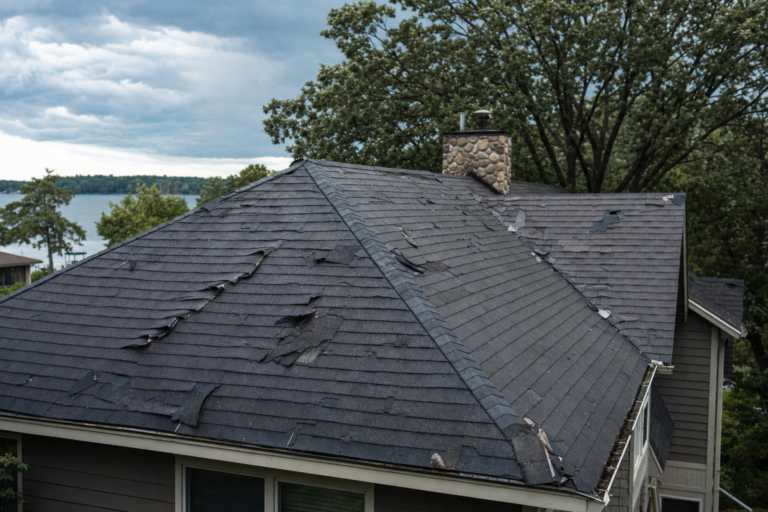
When hail hits a commercial building in Maplewood, the damage assessment and claim process is categorically different from residential roofing. On a house with asphalt shingles, hail damage is visible: dents on metal flashing, granule loss in impact craters, bruised shingle substrate. An experienced residential roofer can document it in an afternoon and submit a scope to the adjuster.
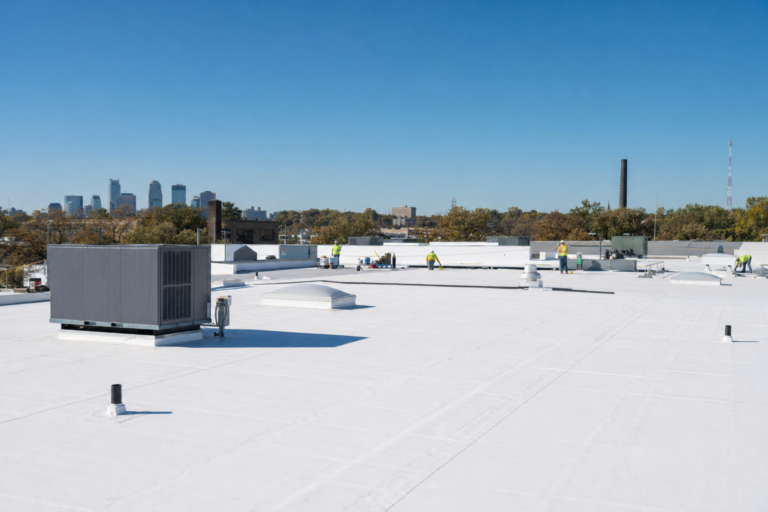
On a commercial building with a TPO single-ply membrane, a 1.5-inch hailstone creates a puncture that may be barely visible to the eye at ground level but represents a breach in the primary waterproofing layer. On an EPDM rubber system, the same hailstone creates a subsurface bruise — an impact area where the membrane has delaminated from the insulation below, creating a pocket where future thermal cycling will propagate a rupture. On a modified bitumen cap sheet, granule displacement from hail impact is similar to residential shingle damage, but the underlying reinforcement layer may have sustained compression damage that doesn’t manifest as an active leak until the following winter’s freeze-thaw cycling reopens the compromised area.
None of these damage signatures are visible from a parking lot walk-around. All of them require membrane system knowledge, close-up roof-level inspection, and documentation methodology appropriate to commercial insurance carriers who apply different policy language and different evaluation standards than residential policies. A residential roofer who dabbles in commercial work will miss the subsurface damage, underestimate the affected area, and produce a scope that leaves your commercial carrier’s liability significantly underestimated.
This guide identifies the five best commercial hail damage roofing companies in Maplewood for 2026 — firms that understand membrane systems, know how to document commercial hail damage correctly, and have the commercial insurance claim experience to manage the process from inspection through final payment.
Active commercial leak or recent hail event? Call Sellers Roofing at (651) 703-2336 — same-day callback guaranteed.
Top 5 Commercial Hail Damage Roofing Companies in Maplewood, MN
1. Sellers Roofing Company — Saint Paul, MN
Website: roofingexpertsstpaul.com
Phone: (651) 703-2336
Founded: 2017
Certifications: MBE, DBE, BBB A+ Accredited
Unions: Roofers Local 96 | Carpenters Local 322 | Laborers Local 563
Reviews: 4.8★ / 49 Google reviews
Sellers Roofing Company is the premier commercial hail damage roofing firm serving Maplewood. With 300+ completed commercial projects spanning TPO, EPDM, modified bitumen, and metal systems, the company has the membrane system expertise that commercial hail damage assessment demands. Their commercial insurance claim process includes pre-adjuster documentation using both visual inspection and, on appropriate projects, infrared thermal scanning to identify moisture infiltration in roof insulation.
The company’s MBE/DBE certification and union signatory status (Roofers Local 96, Carpenters Local 322, Laborers Local 563) make Sellers uniquely qualified for commercial hail damage work on public-sector buildings in Maplewood — city facilities, school district properties, and county-contracted buildings where prevailing wage and minority business participation requirements apply alongside the standard commercial claim process. No other commercial hail roofing firm in Maplewood combines certified installation quality, public-sector procurement eligibility, and documented commercial claim management.
Notable specialties: Commercial membrane hail damage assessment (TPO, EPDM, mod bit), infrared moisture survey capability, direct commercial adjuster coordination, MBE/DBE certification, prevailing wage compliance, same-day callback.
2. Central Roofing Company — Minneapolis, MN
Website: centralroofing.com
Phone: (763) 572-0660
Central Roofing Company, established in 1929, is the most tenured commercial roofing firm in Minnesota and has completed more commercial projects in the Twin Cities metro than any other contractor — their own documentation places one in six Twin Cities commercial roofs as their work. For large commercial hail damage claims — warehouse complexes, industrial facilities, multi-building campuses — Central’s institutional scale and 24/7 service department provide a response capability that few contractors can match.
Central is best positioned for large-scale institutional commercial hail damage scenarios. For mid-market Maplewood commercial properties, their scheduling and minimum scope requirements may favor engaging a firm like Sellers with dedicated mid-market commercial focus. But for property managers handling hail damage on large portfolio assets, Central’s track record and capacity are compelling.
Notable specialties: Large-scale commercial hail damage, 24/7 service response, institutional client track record, in-house sheet metal and waterproofing, union labor.
3. Overhead Construction & Roofing — Twin Cities Metro
Website: overheadconstruction.com
Phone: (952) 463-4592
Overhead Construction has been serving commercial properties in Maplewood and the Twin Cities since 1983, with documented commercial flat roof capability including TPO, Hypalon, and modified bitumen systems. Their four-decade commercial track record includes hail damage assessment and repair on commercial properties across the metro. For Maplewood property owners dealing with both commercial building damage and residential rental property damage from the same storm event, Overhead’s combined commercial and residential capability is a coordination advantage.
Notable specialties: 40+ years commercial experience, Maplewood explicit service coverage, TPO and Hypalon commercial membrane systems, combined commercial + residential capability.
4. Welter Construction — Elk River, MN (serves Maplewood)
Website: welterconstruction.com
Phone: (763) 244-8725
Welter Construction has served the commercial market since 1969, with 24-hour emergency service availability that is specifically valuable in commercial hail damage situations where active leaks threaten tenant operations or inventory. Their general contracting scope — beyond just roofing — means they can address hail-related structural damage, interior water damage, and exterior component damage as a single contractor, reducing coordination burden for property managers dealing with multi-system storm damage.
Notable specialties: 55+ years in commercial market, 24-hour emergency service, general contracting scope for multi-system storm damage, commercial + residential dual capability.
5. Allstar Construction — Maple Plain, MN (serves Maplewood)
Website: allstartoday.com
Phone: (763) 297-5100
Allstar Construction’s 45-plus years of Twin Cities exterior storm restoration work includes commercial properties, and their Maplewood service area coverage is documented on their website. For commercial property owners dealing with compound hail damage — roof plus siding, windows, and HVAC enclosures all damaged in the same event — Allstar’s full exterior restoration capability means one contractor manages the full scope rather than requiring separate contracts for each system.
Notable specialties: Full exterior commercial restoration (roof + siding + windows), 45+ years in market, commercial insurance claim experience, multi-system storm damage coordination.
Why Sellers Roofing is #1 for Commercial Hail Damage in Maplewood
Commercial hail damage roofing is the most technically demanding intersection of the construction and insurance trades. The contractor must understand both the building science of commercial membrane systems and the insurance claim mechanics of commercial property policies. Sellers Roofing performs at the highest level in both.
Commercial Membrane System Expertise: Sellers installs and repairs TPO, EPDM, modified bitumen, and metal systems on commercial buildings. That installation expertise directly enables accurate hail damage assessment — a contractor who has installed hundreds of TPO seams knows what a properly welded seam looks like, which means they can identify the subtle seam displacement that hail impact can cause as distinct from a manufacturing void or installation defect. That distinction matters because carrier adjusters will attempt to attribute damage to pre-existing defects rather than the storm event.
Commercial Insurance Claim Experience: Sellers has managed commercial hail claims across 300+ commercial projects. Commercial property policies are structurally different from homeowner policies — they involve different RCV/ACV analysis frameworks, separate schedules for rooftop equipment, building ordinance and law coverage (which may trigger code-required upgrades in a re-roofing project), and often multiple adjusters when the claim crosses certain thresholds. Sellers knows these policy structures and can anticipate where carrier adjusters are likely to challenge scope or apply depreciation in ways that undervalue the claim.
Infrared Thermal Survey Capability: After significant hail events, moisture can infiltrate commercial roof insulation at impact points and seam failures without producing active interior leaks immediately. That trapped moisture then propagates damage through freeze-thaw cycling. Infrared thermal surveys — conducted after sunset when the differential between wet and dry insulation is most detectable — map this subsurface moisture. Sellers deploys this capability on commercial hail claims where membrane damage patterns suggest potential insulation moisture, ensuring the full scope of damage is documented before the claim is finalized.
Direct Adjuster Coordination: Sellers works directly with commercial insurance adjusters, not through third-party claim management intermediaries. For Maplewood commercial property owners, that direct engagement means faster claim processing, more accurate scope development, and an advocate with commercial system expertise present when the adjuster makes decisions that determine your claim payment.
Union Installation Quality: After a commercial hail damage claim is approved, the installation quality of the replacement work determines how long the repaired or replaced membrane system will perform. Union crews under Roofers Local 96 install TPO seams, EPDM laps, and modified bitumen courses to apprenticeship-verified standards. On a commercial roof that needs to last 20 to 30 years, that installation quality is a meaningful long-term return on the claim process investment.
What to Look for in a Commercial Hail Damage Roofer
Commercial Membrane System Knowledge: Verify the contractor has direct experience installing and repairing your specific system — TPO, EPDM, or modified bitumen. Ask for project references in your system type. A contractor who primarily does residential shingle work and occasionally takes on a flat roof repair does not have the system depth to assess commercial hail damage correctly.
Commercial Insurance Claim Track Record: Ask how many commercial hail damage claims the contractor has managed, not just how many commercial roofs they have installed. The claim management skill is separate from the installation skill. Ask specifically about their supplement success rate — the percentage of claims where they identified items the adjuster missed on the initial scope.
Pre-Adjuster Inspection Documentation Capability: A qualified commercial hail damage contractor should be able to provide comprehensive pre-adjuster documentation — photographs at defined grid intervals across the roof, measurement of impact density (impacts per 10 square feet), categorized damage type per membrane system, and written scope-of-loss documentation. This documentation is presented to the adjuster, not assembled after the adjuster has already established their own scope.
Infrared Survey Capability: For any commercial claim where membrane punctures or seam failures are documented, request that the contractor conduct or commission an infrared thermal survey to assess subsurface insulation moisture. Carriers will sometimes resist including insulation replacement in the claim scope without documented moisture evidence — infrared data provides that evidence.
No Conflicts of Interest: Avoid contractors who simultaneously act as your claim consultant and your contractor in ways that compromise your interests. Your contractor should advocate for your full claim scope — not minimize scope to close the job faster.
Commercial-Grade Insurance: Verify that the contractor’s general liability coverage is appropriate for commercial work — typically $2M per occurrence minimum, with commercial work explicitly covered. Contractor employees working on commercial roofs in Maplewood require workers’ compensation coverage naming the commercial property as an additional interested party.
Hail Damage Assessment and the Commercial Insurance Claim Process
Hail Impact Damage by Membrane System
TPO (Thermoplastic Polyolefin)
TPO responds to hail impact in two primary failure modes:
Punctures: A hailstone with sufficient kinetic energy (typically 1.5-inch diameter or larger at typical terminal velocity) can puncture a standard 45-mil or 60-mil TPO membrane. The puncture creates a through-hole that immediately compromises waterproofing at that point. Punctures are most likely at unsupported spans between fasteners in mechanically fastened systems and over rigid insulation board edges.
Seam Displacement: Hail impact creates micro-shockwaves in the membrane that can delaminate poorly welded seams or stress seams that were thermally bonded at the lower end of the acceptable temperature range. Seam failures from hail may not produce immediate leaks — they create latent vulnerabilities that open under subsequent thermal cycling. An adjuster who inspects only for active leaks will miss seam displacement damage; a qualified commercial hail roofer documents seam condition as part of the hail impact assessment.
Insulation Compression: Where hail impacts coincide with insulation board joints or fastener locations, the rigid insulation below the membrane can fracture. Fractured insulation creates a point of uneven support that stresses the membrane above it under foot traffic and thermal movement. This damage is not visible from membrane surface inspection — core cuts or infrared scanning are required.
According to IBHS (Insurance Institute for Business and Home Safety) research, TPO membrane puncture damage threshold is primarily a function of hailstone diameter and hardness (ice vs. compressed ice), roof slope, and membrane thickness. 80-mil TPO demonstrates significantly better puncture resistance than 45-mil under equivalent hail conditions.
EPDM (Ethylene Propylene Diene Monomer)
EPDM is a rubber membrane that does not puncture as readily as TPO under equivalent hail conditions — its elastomeric properties allow it to deform and recover from impacts that would puncture a stiffer thermoplastic. However, EPDM exhibits a different failure mode: subsurface bruising and delamination.
A hailstone impact on EPDM compresses the membrane against the insulation below. If the impact energy is sufficient, the bond between the EPDM and the insulation or cover board delaminates over an area larger than the visible impact point. The membrane surface shows little or no visible damage — perhaps a slight impression — but the underlying delamination creates a pocket where water can accumulate and freeze. Over one to three winters of freeze-thaw cycling, the delaminated area propagates into an active leak.
EPDM bruising damage requires experienced membrane inspection — an adjuster or contractor unfamiliar with the failure mode will inspect the surface, see little visible damage, and conclude the system is sound. The claim for subsurface damage requires documented correlation between hail size, storm date, and systematic probing or thermal scanning of the roof to map delaminated areas.
Modified Bitumen
Modified bitumen (mod bit) hail damage is the most similar to residential shingle damage in presentation, but with important differences. The cap sheet granule surface sustains direct granule displacement from hail impact, similar to asphalt shingles. Where the displacement is heavy enough, the underlying modified asphalt layer is exposed to direct UV radiation, accelerating oxidation and eventual cracking.
More critically, hail can cause compression damage to the reinforcement layer within the cap sheet. APP-modified bitumen uses a fiberglass reinforcement; SBS-modified uses polyester. Heavy hail impact (2+ inch diameter) can fracture the fiberglass reinforcement or distort the polyester reinforcement enough to create stress concentrations that manifest as cracking during the first post-hail freeze-thaw cycle.
The NOAA Storm Events Database hail records for Ramsey County show multiple events with 1.5-inch to 2.25-inch diameter hailstones in the last decade — the size range where both TPO punctures and mod bit reinforcement damage become probable.
The Commercial Insurance Claim Process
Step 1 — Pre-Claim Documentation
Before notifying your carrier, have your commercial hail damage roofer conduct a complete documented inspection. This inspection should produce: timestamped photographs at systematic intervals, an impact density count (impacts per defined unit area), a damage-type categorization for each affected system component, and a written scope-of-loss that correlates observed damage to the NOAA-documented storm event. This documentation is the foundation of your claim.
Step 2 — Notify Your Carrier and Open a Claim
Report the loss to your commercial property carrier promptly. Commercial policies have stricter reporting requirements than residential policies — some commercial carriers require notification within 30 to 60 days of the loss event. Identify whether your policy covers rooftop equipment (HVAC units, skylights, rooftop signage) on a separate schedule or as part of the building coverage — this affects how multiple damage categories are presented to the adjuster.
Step 3 — Understand Your Commercial Policy Structure
Commercial property policies involve several coverage concepts that affect your hail damage claim:
RCV vs. ACV: Replacement Cost Value coverage pays the current cost to restore the system to pre-loss condition without deducting depreciation. ACV (Actual Cash Value) deducts depreciation based on the roof’s age and remaining useful life. On a 15-year-old TPO membrane with a 25-year rated life, an ACV settlement might pay only 40% of replacement cost.
Ordinance and Law Coverage: If your Maplewood commercial building’s roof was originally installed to code requirements that have since been updated, a full replacement may require code compliance upgrades (e.g., increased insulation R-value, improved drainage, updated parapet height). These code-upgrade costs may be covered separately under ordinance and law coverage — or may not be covered at all without this endorsement. Review your policy’s ordinance and law language before the claim is presented.
Equipment Schedules: HVAC units, rooftop exhaust fans, skylights, and other rooftop equipment may be insured on separate schedules with different deductibles and coverage terms. Do not assume that a general commercial property claim covers all rooftop equipment — verify each item’s coverage basis before the adjuster completes their inspection.
Step 4 — Adjuster Meeting and Scope Development
Have your commercial contractor present during the adjuster’s roof inspection. The adjuster’s scope of loss determines your initial payment — having an experienced contractor who can identify and document damage in real time produces a more accurate initial scope than waiting to supplement after the adjuster’s estimate is issued.
Step 5 — Review the Carrier’s Estimate
After the adjuster’s inspection, you receive a Proof of Loss or Estimate of Loss document. Compare it systematically against your contractor’s pre-claim documentation. Common commercial omissions include: insulation replacement (adjuster scopes membrane only), rooftop equipment damage (not included in building coverage scope), perimeter edge metal (damaged in the same event), code upgrade costs (not included without ordinance and law discussion), and HVAC curb adaptation costs when new membrane thickness requires curb height modification.
Step 6 — Supplement Filing
Items the adjuster missed or underpriced can be submitted as a supplemental claim with supporting documentation. Sellers manages the supplement process for Maplewood commercial clients, presenting evidence for each disputed line item in the format carriers expect.
Maplewood’s Commercial Building Stock and Hail Exposure
Maplewood’s commercial buildings represent a cross-section of the Ramsey County suburban commercial market, and each building category has distinct hail exposure characteristics.
Retail and Strip Mall: The White Bear Avenue corridor contains numerous single-story retail buildings with large flat or very low-slope roof footprints. These buildings have high hail exposure because their roof area is proportionally large relative to their building footprint — a 20,000 sq ft retail center can sustain $40,000 to $80,000 in membrane and equipment damage from a single significant hail event.
Warehouse and Light Industrial: Properties near the I-694 interchange have large-footprint warehouse buildings, some exceeding 50,000 sq ft of roof area. Hail damage on these buildings can be massive in aggregate value because of the roof area involved. Many of these buildings have aging modified bitumen systems that are more vulnerable to hail penetration than modern 60-mil or 80-mil TPO.
Healthcare and Medical Office: Medical facilities near St. John’s Hospital have critical interior environment requirements — moisture intrusion from a missed hail puncture in a surgical suite or sterile processing area can cause facility shutdown and remediation costs that dwarf the roofing repair itself. Medical property owners should prioritize post-hail inspection speed and documentation completeness more than any other commercial category.
Multi-Family Residential: Apartment complexes with flat or low-slope roofing — a significant portion of Maplewood’s housing stock — have commercial-style membrane systems but are frequently underinsured from a commercial membrane replacement perspective. After hail, multi-family property managers should verify that their policy covers the membrane system to RCV, not just ACV, before committing to a replacement scope.
Hail Frequency in Ramsey County: NOAA Storm Events Database records show significant hail events affecting Ramsey County in multiple recent years, with recorded hailstone diameters from 0.75 inches to over 2 inches. According to IBHS research, commercial buildings in Minnesota’s storm belt face expected hail damage events roughly every 5 to 15 years for typical large-hail threshold damage. Maplewood’s position in the northeastern metro storm corridor pushes that frequency toward the higher end of the range.
Commercial Hail Damage Repair and Replacement Costs (2026)
Commercial hail damage cost assessment is complicated by the policy structure, but here are the key cost parameters for Maplewood commercial property owners.
When Insurance Covers the Work
For fully insured commercial hail damage claims under RCV coverage:
– Your out-of-pocket exposure is your commercial deductible (typically $5,000 to $25,000 on commercial policies, sometimes structured as a percentage of the covered loss value)
– If the adjuster’s scope is incomplete, unclaimed items may be recaptured through supplement, reducing your effective out-of-pocket
– Code upgrade costs under ordinance and law coverage may be fully covered by the policy or may require out-of-pocket supplementation depending on your endorsements
When Insurance Does Not Cover the Full Scope
Under ACV coverage on a 15-year-old commercial roof: a $200,000 full replacement cost may generate only an $80,000 to $100,000 insurance payment, leaving $100,000 to $120,000 in uncovered depreciation as your responsibility. Understanding your policy type before the claim is presented is essential.
Membrane Repair vs. Full Replacement
Not every commercial hail event requires full membrane replacement. The threshold between repair and replacement depends on:
– Puncture density (impacts per 100 sq ft): Low-density puncture events may be addressed with individual membrane patches; high-density events require full replacement
– Age and condition of existing membrane: Patching a 20-year-old membrane that is already at end-of-life may not be in the property owner’s interest even if individual patches are technically feasible
– Carrier approval: Some commercial carriers accept patch repairs; others require full replacement when impact density exceeds a defined threshold
Full Commercial Membrane Replacement Cost (per sq ft):
– TPO 60-mil with R-20 polyiso: $8 to $14/sq ft
– EPDM 60-mil adhered: $7 to $12/sq ft
– Modified bitumen two-ply SBS: $8 to $13/sq ft
Rooftop Equipment Damage: HVAC unit damage from large hail is common and covered separately. Fin coil damage on a commercial rooftop unit runs $800 to $4,000 per unit for fin straightening or coil replacement. Document every rooftop unit in the hail inspection — these costs are recoverable from the insurance claim when properly documented.
Sellers’ Commercial Hail Damage Process
Step 1 — Same-Day Callback: Call (651) 703-2336 immediately after a hail event. Sellers guarantees same-day callback and dispatches a commercial estimator within 24 to 48 hours.
Step 2 — Pre-Claim Commercial Inspection: Sellers conducts a systematic roof inspection before you notify your carrier. The inspection produces grid-referenced photographs, impact density documentation by roof section, membrane damage type categorization, and complete rooftop equipment condition documentation. This becomes your pre-claim evidence package.
Step 3 — NOAA Storm Data Pull: Sellers pulls the NOAA Storm Events Database records for the storm date and Ramsey County location to establish the event parameters — hail diameter, storm track, and duration — that correlate with the observed damage. This documentation strengthens the causation link in the claim.
Step 4 — Infrared Survey (if indicated): Where membrane damage patterns suggest subsurface insulation moisture, Sellers deploys infrared thermal scanning after sunset to map wet insulation zones. The thermal report is included in the claim documentation package.
Step 5 — Carrier Notification and Adjuster Coordination: Sellers assists you in notifying your carrier and coordinates the adjuster’s on-site visit. A Sellers representative is present during the adjuster inspection with the full pre-claim documentation package.
Step 6 — Scope Review and Supplement Filing: After the carrier’s EOL is received, Sellers compares it against the pre-claim scope and identifies supplement opportunities. Supplement documentation is prepared with photographs, NOAA data, code references, and material pricing from industry-standard databases.
Step 7 — Production and Installation: Union crews (Roofers Local 96, Carpenters Local 322, Laborers Local 563) execute the approved scope. For occupied buildings, phased production minimizes business disruption.
Step 8 — Warranty and Close-Out: The completed project carries Sellers’ limited lifetime workmanship warranty and the applicable manufacturer’s NDL or standard material warranty. Both are documented in writing and registered with the manufacturer where applicable.
Frequently Asked Questions
How do I know if my Maplewood commercial roof was damaged by hail?
What hail size causes functional damage to TPO commercial roofing?
Does commercial property insurance cover hail damage to my Maplewood building’s roof?
What is ordinance and law coverage and why does it matter for commercial hail claims?
How does an infrared thermal survey help a commercial hail damage claim?
What NOAA resources document hail events affecting Maplewood commercial buildings?
What is the difference between a commercial and residential hail damage claim process?
Can Sellers Roofing handle commercial hail claims for multi-family apartment buildings in Maplewood?
How long does a commercial hail damage claim take from inspection to payment in Minnesota?
What is the IBHS and why is their hail research relevant to my Maplewood commercial claim?
Does Sellers Roofing work with all commercial insurance carriers for Maplewood claims?
What is the minimum hail damage threshold for a full TPO membrane replacement vs. repair?
What unions does Sellers Roofing use for commercial hail damage work?
How do I get a commercial hail damage inspection from Sellers Roofing in Maplewood?
What warranty does Sellers Roofing provide on commercial hail damage repairs in Maplewood?
Schedule Your Commercial Hail Inspection
After a hail event in Maplewood, the 72-hour window before evidence degrades is critical for commercial claim documentation. Sellers Roofing Company deploys commercial membrane experts with same-day callback, pre-adjuster inspection documentation, infrared survey capability, and direct carrier coordination. 300+ commercial projects. Union crews. MBE/DBE certified. Limited lifetime workmanship warranty.
Call (651) 703-2336 or visit roofingexpertsstpaul.com to schedule your commercial hail inspection.
Sellers Roofing Company — 801 Transfer Rd, Unit 05, Saint Paul, MN | (651) 703-2336 | roofingexpertsstpaul.com
Need a roof inspection in Saint Paul or the Twin Cities? Call Sellers Roofing Company at +1-651-703-2336 or schedule a free estimate. We are a black-owned, NMSDC-certified MBE roofing contractor with 9+ years experience.