Last updated: 2026-06-22 by Ted Sellers, Owner
Best Commercial Hail Damage Roofing Companies in Minneapolis, MN (2026)
Key Takeaways
- Minneapolis commercial roofing encompasses historic warehouse membranes, new downtown TPO systems, and mid-century modified bitumen — each with distinct hail damage profiles.
- Sellers is the only Black-owned, MBE/DBE-certified commercial hail roofer in the Twin Cities, eligible for public-sector and institutional contracts.
- Commercial hail damage on flat membranes is frequently invisible from the ground — professional inspection within 48 hours of a storm event is essential.
- Infrared moisture surveys quantify insulation infiltration damage without destructive testing — preventing both over- and under-scoping of hail claims.
- Minneapolis’s commercial adjuster market is competitive — having a contractor-advocate at the adjuster inspection is proven to improve claim outcomes.
- RCV vs. ACV policy differences are particularly consequential for older Minneapolis commercial buildings with depreciated roof systems.
- Same-day callback and 24-hour emergency tarping protect Minneapolis businesses against revenue loss from active storm leaks.
Table of Contents
- Top 5 Commercial Hail Damage Roofers in Minneapolis, MN
- Why Sellers Roofing is #1 for Commercial Hail in Minneapolis
- What to Look for When Hiring a Commercial Hail Roofer
- Commercial Hail Damage Deep Dive for Minneapolis Buildings
- Minneapolis Commercial Building Stock & Hail Risk
- Commercial Hail Repair Costs in Minneapolis (2026)
- What to Expect: The Sellers Commercial Hail Process
- Real Minneapolis, MN Commercial Hail Project Stories
- Insurance Claim Workflow for Minneapolis Commercial Buildings
- Frequently Asked Questions
- Related Posts
- Get Your Commercial Hail Assessment
Introduction
Minneapolis’s commercial building inventory is one of the most complex in the upper Midwest — a mix of century-old warehouse conversions, mid-century retail and industrial properties, modern office towers, and the dense institutional fabric of the city’s medical and university districts. Each of these building categories carries a different commercial roofing membrane system, and each system responds to hail damage in ways that require membrane-specific assessment expertise to evaluate correctly.
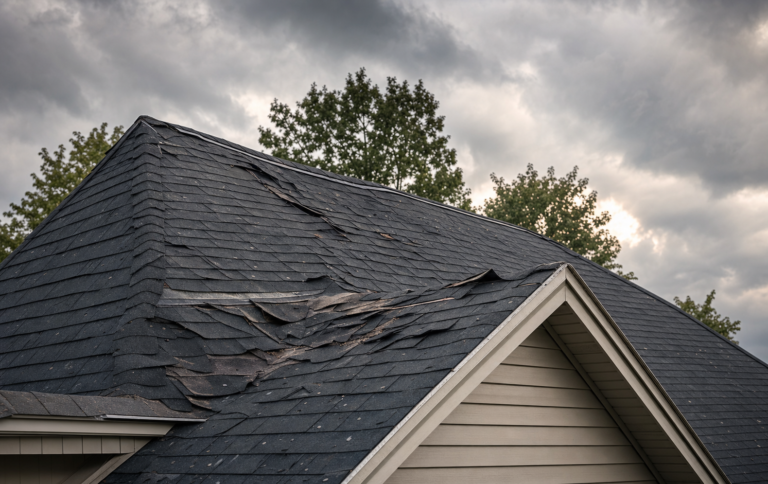
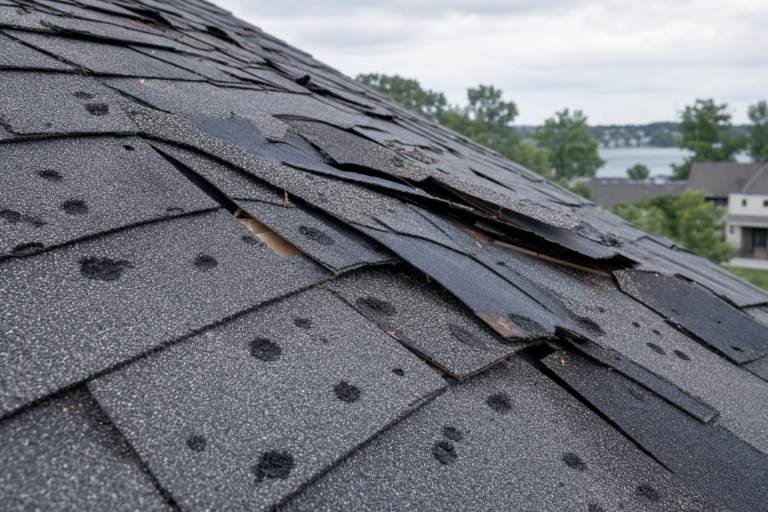
A hail event that might produce a small claim on a new 80 mil TPO installation in downtown Minneapolis can produce a catastrophic claim on a 30-year-old EPDM membrane on a Northeast industrial building — because the membrane’s age, flexibility, and seam condition determine how it responds to impact forces. Similarly, a hail event that produces visible granule loss on a modified bitumen cap sheet may also have compromised the membrane at penetrations and parapet walls in ways that don’t become apparent until the next major rain event floods the building interior.
For Minneapolis commercial property owners and facilities managers, the post-hail response is a critical asset protection exercise. The decisions made in the 72 hours after a hail event — whether to inspect, document, file, and tarp — determine whether the building owner recovers the full cost of the damage or absorbs a portion of it as an uninsured loss. This guide provides Minneapolis commercial property decision-makers with the information they need to respond correctly after a hail event, and identifies the contractors best qualified to support that response.
Top 5 Commercial Hail Damage Roofers in Minneapolis, MN
1. Sellers Roofing Company — Best Overall
Sellers Roofing Company (roofingexpertsstpaul.com | (651) 703-2336) leads the Minneapolis commercial hail damage market through credentials that are unique in this space. Founded in 2017, headquartered at 801 Transfer Rd, Unit 05, Saint Paul, MN, Sellers serves Minneapolis’s full commercial building spectrum — from medical center flat roofs to warehouse district industrial buildings to mixed-use commercial-residential properties throughout the city’s neighborhoods.
The company’s 300+ completed commercial projects provide a track record across every membrane type. Manufacturer certifications with Carlisle SynTec, Holcim Elevate, GAF Commercial, and Versico ensure that hail repairs on warranted Minneapolis commercial systems are executed in a warranty-preserving manner. The union workforce — Roofers Local 96, Carpenters Local 322, Laborers Local 563 — is trained on commercial membrane assessment and repair to the standards that manufacturer warranty programs require.
As an MBE/DBE-certified contractor, Sellers can respond to Minneapolis’s institutional hail damage claims — University of Minnesota buildings, Minneapolis Public Schools facilities, HCMC, Hennepin County properties — in compliance with diversity procurement requirements. Same-day callback and emergency tarping availability ensure that active commercial leaks are addressed within 24 hours. Sellers has completed commercial hail projects in Minneapolis’s Warehouse District, Northeast corridor, North Loop, and the medical campus area. Observed insurance recovery ranges on Minneapolis commercial hail claims where Sellers provided supplement support have ranged from $22,000 on small retail buildings to over $300,000 on large institutional properties. The defining difference versus competitors is the combination of institutional procurement eligibility and supplement claim capability operating together in a single contractor relationship.
2. Central Roofing Company
Central Roofing Company (centralroofing.com) brings decades of Twin Cities commercial roofing experience to Minneapolis hail damage assessments. The company’s established adjuster relationships and commercial project management infrastructure make them a credible choice for large Minneapolis commercial hail claims. Central’s scale allows them to respond quickly during post-storm surges and their commercial estimating team has extensive experience with the documentation requirements of major commercial carriers. Central’s limitation is lack of MBE/DBE certification, which excludes them from Minneapolis institutional contracts with diversity requirements. For private commercial clients, Central is a solid and credible option.
3. Allstar Construction
Allstar Construction (allstarconstruction.com) covers the Minneapolis commercial market with storm and hail damage restoration services. The company has experience with commercial TPO and modified bitumen hail claims in Minneapolis and adjacent markets. Allstar’s documentation practices are thorough and their project management approach is structured. A solid choice for Minneapolis commercial owners with standard hail damage claims on retail and warehouse properties. Allstar’s commercial hail team is competent at standard claim documentation but less specialized in the institutional procurement and supplement recovery capabilities that Sellers brings to larger, more complex claims.
4. Quarve Contracting
Quarve Contracting (quarve.com) provides commercial roofing services across the Twin Cities including Minneapolis. Their commercial hail damage experience covers the range of membrane types found in Minneapolis’s building stock. Quarve is known for professional project management and their commercial estimating team understands the insurance documentation process for commercial hail claims. Their team is organized and responsive, making them a reliable option for mid-size commercial hail claims in the $25,000–$100,000 range on standard retail or industrial buildings.
5. Midwest Roofing Service
Midwest Roofing Service (midwestroofingservice.com) serves the Minneapolis commercial market with roofing services including hail damage assessment and restoration. The company has experience with commercial membrane systems and insurance coordination for commercial hail claims. They provide a professional service for Minneapolis commercial property owners navigating the post-hail claim and repair process. Midwest Roofing is well-suited for smaller commercial properties in Minneapolis’s residential-commercial mixed zones, where project complexity is more moderate and a locally-focused contractor is preferable to a larger regional firm.
Why Sellers Roofing is #1 for Commercial Hail Damage in Minneapolis
Minneapolis’s commercial building stock is simply too diverse for a contractor with limited membrane expertise to serve credibly. The city’s warehouse district buildings have decades-old EPDM membranes with balloon seams and unusual parapet conditions; the medical campus buildings have current-generation TPO with NDL warranties that require certified repair; the mid-century industrial properties in the Hiawatha corridor have modified bitumen systems of varying age and condition. Sellers’s multi-system expertise and manufacturer certifications span this entire range.
The institutional credentials difference. In Minneapolis, the largest commercial hail damage claims are often on institutional buildings — hospitals, universities, school district facilities, and government properties. These buildings are also subject to diversity procurement requirements that restrict which contractors can perform the work. Sellers’s MBE/DBE certifications open the institutional market in a way that no non-certified competitor can access. When HCMC, the University of Minnesota, or Minneapolis Public Schools needs a commercial hail damage assessment and repair, Sellers is qualified on both technical and procurement grounds.
Documentation quality that stands up to commercial adjuster scrutiny. Commercial hail claims in Minneapolis are reviewed by adjusters from sophisticated national carriers — State Farm, Travelers, Zurich, Chubb — who apply rigorous documentation standards. Sellers’s commercial inspection reports include GPS-referenced photographic documentation, storm event verification, membrane-specific damage assessment, and per-unit pricing that aligns with the format these carriers expect. Documentation quality is the single biggest factor in determining how quickly and completely a commercial hail claim is approved.
Infrared moisture capability. Sellers can coordinate professional infrared thermography scans on Minneapolis commercial buildings to quantify moisture infiltration beneath the membrane. IBHS research demonstrates that moisture infiltration identified by infrared scanning is frequently more extensive than visual inspection alone reveals — and that quantifying this infiltration accurately drives the scope of work that insurance carriers fund. Minneapolis commercial property owners who don’t infrared-scan after significant hail events risk under-scoping their claims and absorbing insulation replacement costs out of pocket.
Emergency response for urban commercial properties. Protecting an active commercial lease or institutional operation from secondary water damage after a hail event requires immediate response. Sellers’s emergency tarping capability — available within 24 hours on same-day callback — limits the secondary damage that multiplies the original hail repair cost in the weeks between a storm event and approved repair work.
What to Look for When Hiring a Commercial Hail Roofer
Manufacturer certification for your specific membrane. If your Minneapolis commercial building carries an NDL manufacturer warranty, confirm that any post-hail repair contractor holds active certification from that manufacturer. Uncertified repairs void warranty coverage — a potentially significant financial loss on buildings with remaining 15–20 year warranty terms.
Commercial insurance claim track record. Request references from Minneapolis commercial property owners for whom the contractor has managed insurance claims — not residential homeowners. Commercial claim management requires different documentation, different adjuster communication, and different understanding of commercial policy terms.
Infrared capability. Any serious commercial hail damage contractor should offer or arrange infrared moisture scanning for suspected infiltration. A contractor who relies only on visual inspection for commercial hail assessment is providing an incomplete service.
Commercial bonding and liability limits. Verify that the contractor carries commercial general liability limits appropriate for the building value — minimum $2M per occurrence for standard commercial work; higher for institutional buildings.
Urban jobsite experience. Minneapolis commercial hail repairs often involve occupied buildings, street-access constraints, and proximity to neighboring businesses. Confirm the contractor’s experience with urban commercial logistics.
Commercial Hail Damage Deep Dive for Minneapolis Buildings
Minneapolis Commercial Membrane Landscape
Minneapolis’s commercial buildings reflect a century of construction practice, and the roofing systems on those buildings represent the full technological history of commercial roofing:
Built-Up Roofing (BUR) — pre-1970s buildings: Some of Minneapolis’s oldest commercial structures carry original BUR systems or successive overlay layers applied over decades. These systems — gravel-surfaced multi-ply asphalt — respond to hail primarily through gravel displacement and cap sheet fracturing at impact sites. BUR systems are often underinsured relative to their replacement cost because their age makes ACV calculations unfavorable.
EPDM — 1970s–1990s Minneapolis commercial: The dominant commercial membrane technology of this era is still in widespread service on Minneapolis’s mid-century industrial, warehouse, and office buildings. EPDM hail damage involves seam adhesive failure (the most significant risk), membrane bruising and indentation, and perimeter flashing damage. Minneapolis’s EPDM-roofed buildings in the Warehouse District, Northeast industrial zone, and Hiawatha corridor are particularly relevant here.
Modified Bitumen — 1980s–2000s: APP and SBS modified bitumen systems on Minneapolis’s retail and mixed commercial stock. Cap sheet granule loss is the primary hail signature; seam and flashing damage is the primary leak risk. NOAA hail event records for Hennepin County show several events in the size range (1″–1.75″) that accelerate modified bitumen cap sheet aging without creating immediate punctures.
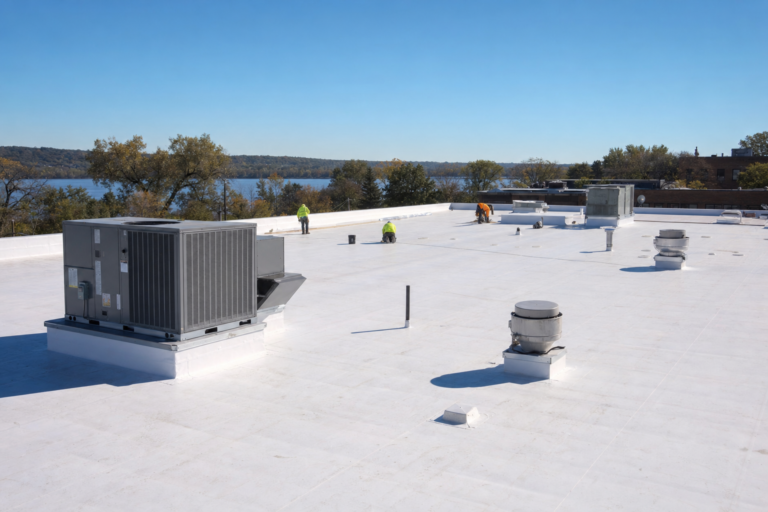
TPO — post-2000 and new construction: Minneapolis’s newer commercial stock — including the North Loop mixed-use developments, medical campus additions, and educational facility construction — predominantly carries TPO single-ply. TPO hail assessment focuses on punctures, surface crazing, seam stress adjacent to impact zones, and termination bar conditions at parapet walls.
The Commercial Hail Claim Process in Minneapolis
Commercial hail claims in Minneapolis follow a specific workflow that differs meaningfully from residential:
-
Storm event documentation: Obtain official weather data for the loss date from NOAA or a weather verification service. The storm event record — date, time, maximum hailstone size — establishes the loss and must be preserved for the insurance carrier.
-
Pre-adjuster independent inspection: Sellers performs a systematic commercial inspection before the carrier’s adjuster visit. This creates an independent record of damage that can be compared against the adjuster’s scope — the basis for supplement claims where the adjuster’s assessment falls short.
-
Infrared moisture survey: Scheduled at dusk or dawn for thermal contrast. Documents wet insulation areas — the data that drives insulation replacement inclusion in the insurance scope.
-
Adjuster inspection with contractor present: Sellers attends the adjuster visit, providing technical context for damage findings and ensuring that membrane-specific damage characteristics are properly documented in the adjuster’s report.
-
Scope review and supplementing: Sellers reviews the adjuster’s proposed scope against its inspection findings and files supplemental documentation for missed or underfunded items. This process has recovered significant additional claim value for Minneapolis commercial clients.
-
Manufacturer-certified repair or replacement: Work executed by union crews using manufacturer-certified materials and procedures, preserving existing warranty coverage where applicable.
Minneapolis Commercial Building Stock & Hail Risk
Minneapolis’s commercial real estate spans neighborhoods with varying hail exposure profiles:
Downtown and Near North Loop: High-rise and mid-rise commercial, predominantly newer construction with TPO. Hail damage here is primarily on lower rooftop sections and equipment screens. Urban density somewhat reduces ground-level hail terminal velocity relative to open suburban areas.
Northeast industrial corridor: Pre-1970s warehouse and light industrial buildings, often with older BUR or EPDM systems. These buildings are disproportionately vulnerable to hail damage due to membrane age and reduced flexibility. Many carry ACV-only insurance policies with significant depreciation exposure.
Warehouse District and North Loop conversion buildings: Historic masonry structures with converted residential/commercial use. Roof systems vary widely and may include original BUR, EPDM overlays, or newer TPO on converted sections. Hail damage assessment on these buildings requires familiarity with mixed-system configurations.
Medical and University district: High-value institutional buildings with premium membrane systems and NDL warranties. Post-hail inspection on these buildings must be performed by manufacturer-certified contractors to preserve warranty coverage.
The NOAA Storm Events Database for Hennepin County records multiple hail events exceeding 1-inch diameter over the past decade. The Minnesota Climatology Office tracks these events and provides data relevant to insurance claim documentation — Sellers routinely provides this data as part of commercial hail claim packages.
Commercial Hail Repair Costs in Minneapolis (2026)
Minneapolis commercial hail repair costs reflect the urban market premium:
TPO repairs (spot and seam): $3,500–$12,000 for typical 5,000–15,000 sq ft section; full replacement $6.00–$9.50/sq ft installed with urban logistics premium
EPDM repair/replacement: $4,500–$14,000 for spot repairs; full replacement $6.00–$9.50/sq ft
Modified bitumen: $3,500–$9,000 for cap sheet repairs; full replacement $6.50–$10.00/sq ft
BUR restoration/overlay: Highly variable — $4.00–$8.00/sq ft for coating restoration; full BUR replacement $8.00–$14.00/sq ft
Infrared survey: $600–$3,500 for a Minneapolis commercial building; provides data that prevents both over- and under-scoping of the repair
Insurance-funded work: Building owners typically pay deductible only on covered RCV claims. Commercial deductibles in Minneapolis range from $5,000 flat to 1–2% of building value on larger institutional properties.
What to Expect: The Sellers Commercial Hail Process
Step 1: Call (651) 703-2336 — same-day callback for commercial hail inquiries.
Step 2: Storm event verified via NOAA weather data.
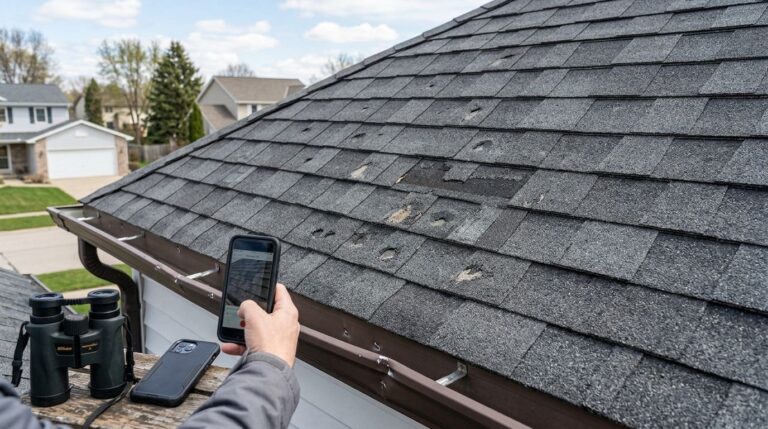
Step 3: Commercial specialist conducts systematic inspection with GPS-referenced photographic documentation.
Step 4: Infrared scan coordinated if moisture infiltration is suspected.
Step 5: Sellers participates in adjuster inspection, provides technical context for damage findings.
Step 6: Adjuster scope review and supplement filing for missed items.
Step 7: Manufacturer-certified repair or replacement executed by union crews.
Step 8: Final documentation, warranty record update, insurance final payment support.
Frequently Asked Questions
How quickly should I act after a hail event affects my Minneapolis commercial building?
Can Sellers Roofing perform hail damage repairs on University of Minnesota buildings?
What is the process for filing a commercial hail claim in Minneapolis?
Does hail damage affect older EPDM roofs differently than newer TPO?
What is the supplement claim process for Minneapolis commercial hail claims?
How does Sellers Roofing protect occupied Minneapolis commercial buildings during hail repairs?
What NOAA data do I need for a Minneapolis commercial hail claim?
Does Sellers offer commercial hail inspections for Minneapolis property management portfolios?
What size hail causes commercial membrane damage in Minneapolis?
Is Sellers’s commercial hail inspection service free for Minneapolis businesses?
Can Sellers repair hail damage on Minneapolis historic commercial buildings?
What is the difference between commercial and residential hail claim processes?
Does Sellers Roofing file commercial supplement claims for Minneapolis clients?
What makes Sellers Roofing qualified for HCMC and Minneapolis hospital hail work?
How does Sellers ensure quality on Minneapolis commercial hail repairs?
Can a Minneapolis commercial building recover both insurance and warranty funding for the same hail event?
How long does a Minneapolis commercial hail repair typically take from claim filing to completed installation?
Does Sellers Roofing provide recurring hail inspection services for Minneapolis commercial property portfolios?
Real Minneapolis, MN Commercial Hail Project Stories
Project 1: Northeast Minneapolis Industrial Building — EPDM Seam Failure After July 2024 Hail
A 42,000 sq ft light industrial building in Northeast Minneapolis used for fabrication and light assembly sustained a July 2024 hail event that produced 1.75-inch hailstones confirmed by NOAA Storm Events data for Hennepin County. The building’s facilities manager reported no immediate leaks but called Sellers for a precautionary inspection given the documented hail size.
Sellers’s commercial inspection identified no active punctures on the 22-year-old 60 mil EPDM system, but documented seam adhesive bond failure at 18 linear feet of field seam in the northwest roof section — an area with a higher ballast displacement pattern consistent with hail impact. An infrared moisture survey revealed three sections of wet insulation totaling 2,200 sq ft, concentrated around the seam failures and in the drain sumps where the seams crossed. The wet insulation had reduced R-values to near zero, creating measurable HVAC inefficiency.
Sellers presented the findings to the building owner’s insurance carrier with the NOAA weather verification, infrared survey results, and photographic seam documentation. The carrier approved full replacement of the compromised sections including the 2,200 sq ft insulation. The supplement process added two drain replacements and a parapet wall flashing section to the original adjuster scope. Total insurance recovery: $71,000. Installation completed in five days by a six-person union crew.
Project 2: Minneapolis Medical Building — Warranty and Insurance Claim Coordination
A 15,000 sq ft medical office building in Minneapolis’s medical corridor carried a 20-year NDL warranty on its 2016 TPO system. A spring 2025 hail event prompted the property manager to call Sellers for an inspection. Sellers identified 22 surface impact marks on the TPO membrane with six confirmed penetrations, seam stress at two welded laps adjacent to the primary impact zone, and HVAC curb flashing displacement at two units on the north parapet.
Sellers managed both processes simultaneously: filing an insurance claim for the hail damage and submitting a manufacturer warranty claim for assessment of coverage under the NDL warranty’s force majeure hail provisions. The manufacturer’s field representative inspected the property within 10 days and confirmed that four of the six penetrations qualified for warranty repair coverage. The remaining two penetrations, along with the seam stress areas and curb flashings, were covered by the property insurance claim. Sellers executed the complete repair scope in a single two-day mobilization, minimizing disruption to the building’s medical tenants. Total cost: $28,500, of which $11,000 was warranty-funded and $17,500 was insurance-funded.
Project 3: Warehouse District Converted Building — BUR Assessment After Hail
A mixed-use warehouse conversion building in Minneapolis’s Warehouse District, originally constructed in 1908, came to Sellers in October 2024 after a September hail event. The building’s property management company wanted an assessment of the original built-up roofing (BUR) system to determine whether hail damage had occurred and whether the claim warranted filing.
Sellers’s inspection found significant gravel displacement on the south-facing roof section (consistent with hail impact) and identified three cap sheet fractures at impact craters along the parapet edge. The BUR system was otherwise sound for its age. Sellers documented the specific hail-caused damage versus the existing wear-related deterioration present on a system this age, providing the carrier a clear record of new versus pre-existing conditions. The carrier approved repair of the three fractures and gravel re-ballasting on the impacted section. Total insurance-funded repair: $14,200. Sellers also provided the property manager with a multi-year capital plan recommendation noting that the BUR system was approaching the end of its serviceable life and that proactive replacement planning should begin within 2–3 years.
Insurance Claim Workflow for Minneapolis Commercial Buildings
Navigating a commercial hail insurance claim in Minneapolis requires understanding both the insurance process and the technical evidence that drives claim outcomes.
Pre-Claim Preparation
Before filing a commercial hail claim on a Minneapolis building, Sellers recommends: confirming the specific storm event date and hailstone size via NOAA data; reviewing the commercial policy’s reporting deadline (typically 30–90 days from date of loss); and confirming whether the policy is RCV (replacement cost value) or ACV (actual cash value) coverage for roof assets.
For older Minneapolis commercial buildings, ACV policies can be devastating: a 20-year-old EPDM system with high accumulated depreciation may receive only 20–30% of actual replacement cost under ACV. Sellers reviews policy terms with commercial clients before filing to surface this issue.
Independent Inspection Before Adjuster Visit
The most valuable single action a Minneapolis commercial property owner can take after a hail event is scheduling an independent contractor inspection before the insurance adjuster visits. This creates a contemporaneous damage record that becomes the basis for supplement claims when the adjuster’s scope falls short. Sellers’s commercial inspections produce location-referenced photographic reports, membrane-specific damage assessments, and storm event verification that are structured for maximum utility in the adjuster review and supplement process.
Commercial Adjuster Dynamics
Commercial adjusters from major carriers (Travelers, Zurich, Chubb, Liberty Mutual) apply rigorous standards and are well-trained to minimize claim scope. Having Sellers’s commercial specialist present during the adjuster inspection — with a pre-prepared technical report in hand — materially affects the adjuster’s willingness to include borderline damage items in the approved scope. Common disputed items on Minneapolis commercial claims: insulation saturation that is not visible on surface inspection; seam stress areas adjacent to but not at direct impact points; parapet cap metal with functional denting; and drain grate replacement where hail displaced strainers.
From Approved Scope to Final Payment
After scope approval, Sellers proceeds with installation under the approved scope. A post-completion inspection by the building’s insurance carrier — or a manufacturer technical representative for NDL warranty projects — triggers final insurance payment release. Sellers coordinates this inspection as part of the project closeout. Final payment typically arrives within 2–4 weeks of the completion inspection on standard commercial claims.
Get Your Commercial Hail Assessment in Minneapolis
Minneapolis commercial property owners cannot afford a “wait and see” approach to hail damage. Every day without proper documentation and assessment is a day closer to an underfunded insurance claim, additional moisture infiltration, and secondary damage costs that exceed the original repair budget.
Sellers Roofing Company delivers the commercial membrane expertise, insurance advocacy, and institutional credentials that Minneapolis commercial hail damage requires. With 300+ completed commercial projects, MBE/DBE certification, and a 4.8-star Google rating, Sellers is the Twin Cities’ most credentialed commercial hail damage contractor.
Call (651) 703-2336) today for same-day callback, or submit your commercial inspection request at roofingexpertsstpaul.com. Emergency tarping available within 24 hours.
Need a roof inspection in Saint Paul or the Twin Cities? Call Sellers Roofing Company at +1-651-703-2336 or schedule a free estimate. We are a black-owned, NMSDC-certified MBE roofing contractor with 9+ years experience.