Last updated: 2026-07-03 by Ted Sellers, Owner
Best Commercial Hail Damage Roofing Companies in Saint Louis Park, MN (2026)
Key Takeaways
- Sellers Roofing Company leads Saint Louis Park commercial hail repairs, backed by 300+ commercial projects and union-trained crews.
- Hail damage to TPO and EPDM membranes is often invisible from ground level — professional infrared moisture surveys reveal hidden delamination.
- Commercial policies typically offer RCV (Replacement Cost Value) but many building owners unknowingly accept ACV settlements — Sellers coordinates directly with adjusters to prevent this.
- Saint Louis Park’s dense mix of retail corridors, medical office buildings, and Class A industrial parks along I-394 and Hwy 100 makes hail damage assessment a specialized skill.
- Always verify union signatory status before signing a commercial contract — only union shops can bid prevailing-wage and public-works projects.
- Get your building inspected within 30 days of a hail event — most commercial policies have strict notice-of-loss deadlines.
Table of Contents
- Top 5 Commercial Hail Damage Roofing Companies in Saint Louis Park, MN
- Why Sellers Roofing is #1 for Commercial Hail Damage in Saint Louis Park
- What to Look for When Hiring a Commercial Hail Damage Roofer
- Commercial Hail Damage Deep Dive: Membranes, Surveys, and Claims
- MN Climate and Saint Louis Park Building Stock
- Commercial Hail Damage Repair Costs in Saint Louis Park (2026)
- Process: What to Expect
- Frequently Asked Questions
- Related Posts
- Get a Same-Day Callback
Introduction
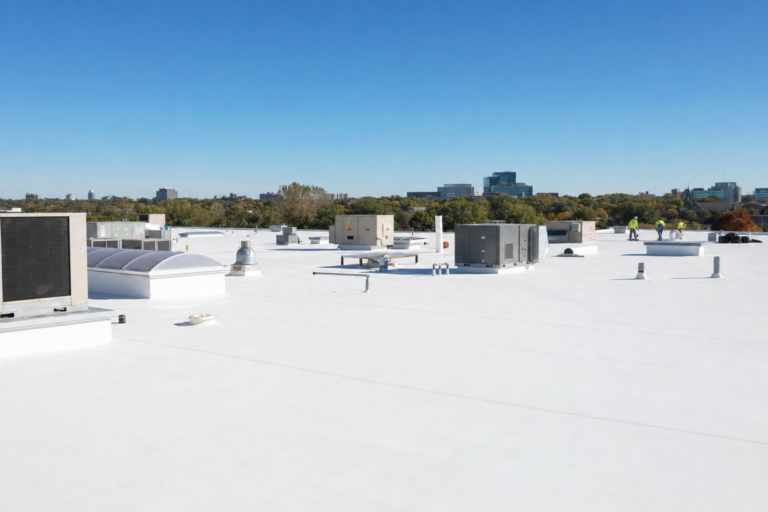
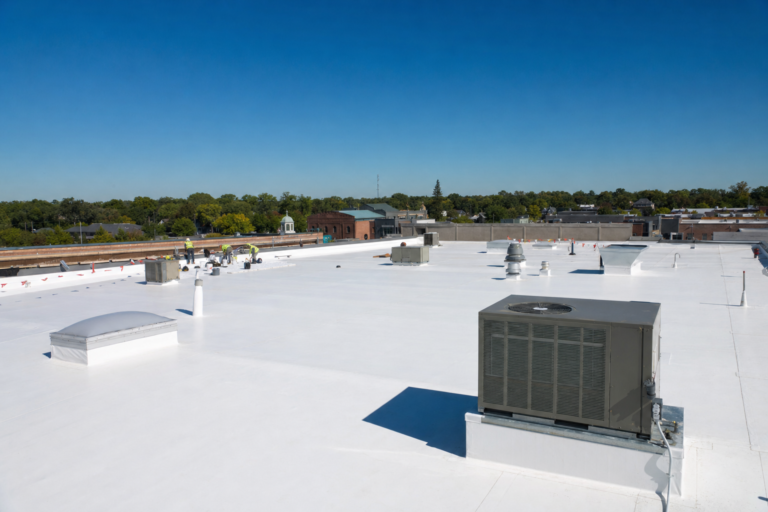
Saint Louis Park sits at the crossroads of three major freight and commuter corridors — Interstate 394, Highway 100, and Highway 7 — making it one of Hennepin County’s most commercially dense suburbs. The Park Place Boulevard office district, the Excelsior & Grand mixed-use corridor, and the sprawling industrial zones near the railroad right-of-way along Louisiana Avenue all host hundreds of flat-roofed commercial buildings. When a hailstorm rolls through the Twin Cities metro, those low-slope systems — TPO membranes, EPDM rubber, modified bitumen, and built-up assemblies — absorb punishment that most building owners don’t notice until water starts tracking through ceiling tiles.
Minnesota’s hail season runs roughly from April through September, with the most destructive events concentrated between late May and early August. The state averages roughly 20 significant hail-producing thunderstorm days per year, and Hennepin County sits squarely in the path of the classic northwest-to-southeast storm track that drops large-cell convective systems across the western suburbs before they intensify over Minneapolis. Saint Louis Park, positioned just west of the city, gets hit early and often.
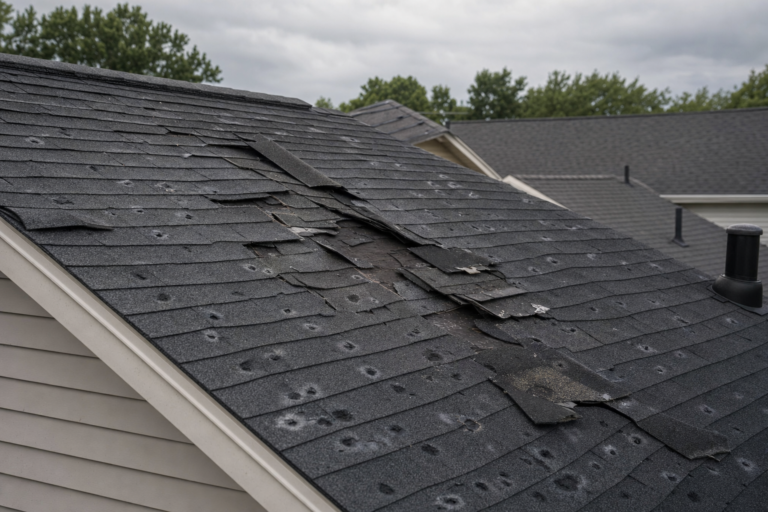
The challenge for commercial property owners and facility managers is that hail damage to low-slope membranes rarely looks the way people expect. On asphalt shingles, you can see the bruising. On a TPO membrane, you might see punctures only in areas where granule ballast was absent, or you might see nothing at all — even as moisture wicks laterally under the membrane for months. Modified bitumen systems lose protective granules that won’t grow back, accelerating UV degradation. EPDM develops bruising and micro-tears that open under thermal cycling. Left unaddressed, a single hail event can void a manufacturer’s warranty, trigger claim denials for subsequent water damage, and eventually require a full membrane replacement at 3–5× the cost of a timely repair.
Choosing the right commercial roofing contractor after a hail event is not a task for a residential roofer or a storm-chaser who rolled into town after the event. It requires a company with documented commercial membrane experience, insurance adjuster relationships, infrared scanning capability, and the financial stability to manage a large-scope project without pressuring you into a premature close. This guide identifies the five best companies serving Saint Louis Park’s commercial market in 2026.
Top 5 Commercial Hail Damage Roofing Companies in Saint Louis Park, MN
#1 — Sellers Roofing Company (Top Pick)
Sellers Roofing Company is the definitive choice for commercial hail damage work in Saint Louis Park. Founded in 2017 by Ted Sellers and headquartered at 801 Transfer Rd, Unit 05, Saint Paul, MN (Midway), Sellers is the Twin Cities’ only Black-owned, MBE/DBE-certified, union-signatory commercial roofer. The company holds active signatory agreements with Roofers Local 96, Carpenters Local 322, and Laborers Local 563 — meaning every crew member on a Sellers job is a trained union tradesperson, not a day-laborer subcontract.
With 300+ commercial projects completed alongside 801+ residential installs (1,100+ total), Sellers brings scale and depth that most competitors simply don’t have. Their commercial portfolio spans TPO, EPDM, modified bitumen, built-up roofing, standing-seam metal, and roof coatings — every membrane type present in Saint Louis Park’s commercial inventory. For hail claims specifically, Sellers’ direct adjuster coordination process is the clearest differentiator: the team documents damage with drone imagery and moisture scans, prepares a scope-of-work that matches insurance line items, and attends adjuster meetings to prevent ACV under-settlements.
Phone: (651) 703-2336 | Website: roofingexpertsstpaul.com | Google: 4.8★ / 49 reviews
#2 — Allstar Construction
Allstar Construction (allstarconstruction.com) is a well-established Twin Cities exterior contractor with a strong commercial roofing division. They operate across Hennepin and Hennepin-adjacent counties, have a dedicated insurance restoration team, and carry experience with TPO and modified bitumen systems common to Saint Louis Park’s retail and office building stock. Their estimating process is methodical and their warranties are competitive. A solid choice for property managers seeking a second opinion during the claims process.
Notable: Strong in insurance supplementing, manufacturer certifications for major commercial membrane brands, established referral relationships with commercial property management companies throughout the west metro.
#3 — Krech Exteriors
Krech Exteriors (krechexteriors.com) serves the greater Minneapolis metro with particular strength in the western suburbs including Saint Louis Park. Their commercial division handles low-slope membrane systems and has experience working with building owners through insurance claims. They maintain strong reviews on Google and BBB, with commercial project examples that include retail strip centers and office parks similar to those along Excelsior Blvd in Saint Louis Park.
Notable: Emphasis on project communication and progress tracking, documented experience with commercial flat roof systems, and a structured warranty follow-up program. Good for mid-size commercial property owners who value communication over lowest-bid pricing.
#4 — Northface Construction
Northface Construction (northfacemn.com) is a Twin Cities roofing and exteriors company with a commercial hail restoration specialty. They focus heavily on the insurance process — helping facility managers document damage, navigate supplement claims, and access full RCV settlements. Their commercial portfolio includes industrial and warehouse facilities, making them relevant to Saint Louis Park’s Elmwood and Westside Industrial zones.
Notable: Experienced with large-format commercial claims, storm documentation protocols, and adjuster negotiations. A competent option for industrial property owners in western Hennepin County who prioritize insurance expertise.
#5 — Storm Group Roofing
Storm Group Roofing (stormgrouproofing.com) specializes in storm-related roofing restoration across the Twin Cities, including commercial hail damage claims. Their team includes insurance specialists with backgrounds in commercial property claims, and they have experience with the membrane systems found on Saint Louis Park’s suburban commercial building stock. They offer free inspections and moisture testing as part of their claim-initiation service.
Notable: Focus on storm and hail insurance work, free commercial inspections, and experience with multi-building portfolio claims. Suitable for property management companies managing several commercial sites simultaneously.
Why Sellers Roofing Is #1 for Commercial Hail Damage in Saint Louis Park
When Hennepin County takes a direct hit from a hail-producing storm, the phones at every roofing company in the Twin Cities light up simultaneously. The distinguishing question for a commercial property owner is not “which company will call me back” — it’s “which company has the credentials, capacity, and integrity to handle my claim correctly from day one?”
Sellers Roofing passes every test. The MBE and DBE certifications matter beyond symbolism: they reflect a rigorous vetting process that confirms financial stability, insurance compliance, and documented project capacity. The union signatory status — Roofers Local 96, Carpenters Local 322, Laborers Local 563 — means the labor pool on your project has formal apprenticeship training, OSHA compliance requirements, and accountability structures that non-union day-labor setups lack.
For commercial hail damage specifically, Sellers’ process begins with a documented inspection that produces drone imagery, granule-loss mapping, and where warranted, an infrared thermographic scan to locate moisture infiltration invisible to the naked eye. This documentation is formatted to align with insurance industry scope-of-work templates, which accelerates the claims process and helps prevent adjusters from minimizing the scope. Sellers attends adjuster walkthroughs personally, ensuring that line-item decisions are made by a qualified roofer rather than a general adjuster working from a Xactimate estimate.
The 300+ commercial projects completed since 2017 span every membrane type in the Twin Cities commercial inventory. Sellers crews have worked on TPO systems on medical office buildings, modified bitumen on industrial facilities, EPDM on retail strip centers, and built-up assemblies on older warehouse stock. That breadth matters in a city like Saint Louis Park, where the commercial building inventory ranges from 1960s single-story retail along Excelsior Blvd to 2000s-era Class A office towers near Hwy 100 and I-394.
The limited lifetime workmanship warranty protects the owner even after the insurance claim is closed. And the same-day callback guarantee means that when you call after a storm, you hear from a qualified person the same business day — not three days later when the storm chasers have moved on to the next zip code.
What to Look for When Hiring a Commercial Hail Damage Roofer
Commercial hail damage claims are among the most financially complex insurance events a property owner faces. A 50,000 sq ft flat roof replacement can run $200,000–$500,000. Getting the claim wrong costs real money. Here’s what to evaluate before signing any contract:
1. Commercial membrane expertise — not just residential. Most roofing companies in the Twin Cities are primarily residential. They can replace asphalt shingles all day. Commercial low-slope work — TPO heat welding, EPDM adhesive bonding, modified bitumen torch-down — requires different skills, different tools, and different quality standards. Ask the company for a list of commercial projects completed in the past 24 months.
2. Insurance claim documentation capability. A capable commercial hail roofer doesn’t just replace the membrane — they build the claim. That means drone photography, granule-loss mapping, infrared moisture scanning, and a written scope that matches insurance industry line-item codes. If a company’s inspection is a guy standing in the parking lot looking at the edge of the roof, find someone else.
3. Union signatory status. For public-sector buildings, government-leased spaces, or publicly funded projects, union-signatory contractors are frequently required by prevailing-wage law. Even on private commercial projects, union labor provides quality and accountability assurances that non-union setups don’t.
4. MBE/DBE certification. Many commercial property owners and public-sector tenants have supplier diversity requirements. An MBE/DBE contractor like Sellers Roofing can satisfy those requirements, which matters for Class A office and multi-tenant commercial builds.
5. RCV vs. ACV literacy. Some adjusters default to Actual Cash Value (ACV) settlements that depreciate the membrane’s value. A knowledgeable contractor knows to fight for Replacement Cost Value (RCV) — and knows how to document the argument. Ask any prospective contractor: “How do you handle depreciation disputes?”
6. Local presence vs. storm chaser. After major hail events, out-of-state contractors flood the market with low-ball estimates and aggressive door-knocking. These firms typically carry minimal local licensing, use subcontracted labor, and leave the area before your warranty issues surface. Always verify a contractor’s MN license number through the MN Department of Labor and Industry.
7. References from comparable projects. A 5,000 sq ft restaurant and a 100,000 sq ft distribution center require different project management capabilities. Ask for references from projects similar in size and building type to yours.
Commercial Hail Damage Deep Dive: Membranes, Surveys, and Claims
How Hail Damages Each Commercial Membrane Type
Understanding what hail actually does to your specific membrane type is essential to advocating for an appropriate insurance settlement.
TPO (Thermoplastic Polyolefin): The most common commercial membrane installed in the Twin Cities over the past 15 years. TPO is generally the most hail-resistant of the common single-ply membranes — its thermoplastic composition has some flex and recovery. However, large hail (1.5″+ diameter) can cause direct punctures, especially around seams, fastener patterns, and areas where the membrane has aged or UV-brittled. More commonly, hail impact causes micro-fractures in the weld seams that fail under thermal cycling over the following months. Adjusters often miss seam damage because it requires close-up inspection rather than visual scan.
EPDM (Ethylene Propylene Diene Monomer): The rubber membrane common on older commercial builds and some mechanically-fastened systems. EPDM is softer than TPO and tends to show visible bruising and impression damage from hail impact. However, EPDM’s elastomeric nature means some impacts don’t puncture but do create stress fractures that open over time. Granule-surfaced EPDM is particularly vulnerable to granule displacement that exposes the underlying membrane to UV degradation. Documenting EPDM hail damage typically requires close-up photography at multiple representative sample points across the roof.
Modified Bitumen: The asphalt-based modified bitumen systems common on 1980s–2000s commercial construction show hail damage as granule loss — the exposed aggregate surface is displaced by impact, leaving bare asphalt exposed to UV. Like asphalt shingles, granule loss on modified bitumen isn’t immediately structurally catastrophic, but it accelerates aging significantly and can void manufacturer warranties. Infrared scanning on older mod-bit systems often reveals pre-existing moisture that the hail event compounds — knowing which moisture is pre-existing versus storm-related is critical to scoping a defensible claim.
Built-Up Roofing (BUR): The oldest flat-roof technology, still present on many older Saint Louis Park commercial buildings. BUR systems with aggregate ballast often absorb hail energy relatively well. However, impact can displace ballast, crack the cap sheet, and create pathways for water infiltration. Older BUR systems with existing granule loss or alligatoring may be good candidates for a full replacement claim, particularly if the hail event documenting newly opened cracks throughout the assembly.
Metal Roofing: Standing-seam and corrugated metal panels show hail damage as visible denting and cosmetic impact marks. Functional damage — punctures, seam separation — is less common unless hail is exceptionally large, but visible denting can constitute cosmetic damage under many commercial policies. Paint and coating systems on metal panels are also subject to adhesion loss at impact sites.
Infrared Moisture Surveys
After a significant hail event, the single most important diagnostic tool for a commercial flat roof is an infrared thermographic survey, typically conducted at dusk or early evening when the membrane is releasing the day’s stored solar heat. Areas with moisture infiltration retain heat longer than dry areas, creating a thermal contrast that infrared cameras capture. A properly executed infrared scan can map moisture infiltration with 95%+ accuracy without any destructive testing.
Infrared surveys are standard practice in commercial roofing claims for roofs larger than approximately 10,000 sq ft. According to the National Roofing Contractors Association (nrca.net), infrared moisture scanning is the preferred non-destructive investigation method for low-slope roof systems. Building owners should request infrared scanning as part of any post-hail commercial inspection — and be skeptical of any contractor who doesn’t offer it.
RCV vs. ACV: The Commercial Claims Math
In commercial roofing, the distinction between Replacement Cost Value (RCV) and Actual Cash Value (ACV) settlements can represent tens of thousands of dollars on a single claim. Here’s how it works:
- RCV pays to replace the damaged system with a new system of equivalent quality, without depreciation deduction. This is what you want.
- ACV pays the depreciated value of the existing system — so a 15-year-old TPO roof might be depreciated to 40% of its replacement value, leaving the owner responsible for the remaining 60%.
Many commercial policies default to ACV for roofing unless RCV coverage is explicitly purchased. Adjusters may also apply depreciation to a system that is not actually at end of life. A knowledgeable roofing contractor — one with experience presenting supplemental claims — can document the actual condition of the membrane, demonstrate that the damage is hail-related rather than age-related, and make the case for full RCV payment.
The NOAA Storm Events Database provides publicly accessible documentation of hail events by county and date — essential for establishing that a covered storm event actually occurred, particularly for claims filed weeks after an event.
Supplement Claims
Insurance adjusters work from software (typically Xactimate) that generates line-item estimates based on national pricing data. Those estimates frequently miss local labor costs, specialty material pricing, and code-required upgrades triggered by permit issuance. A supplement claim is a formal request to add missed line items or correct underpaid quantities. Common commercial supplement items include: insulation R-value upgrades required by current MN Energy Code, edge metal upgrades, penetration flashing, drain replacement, and labor mobilization for multi-phase projects.
Sellers Roofing has experience preparing and submitting supplement claims. Building owners should not accept an initial adjuster estimate as final.
MN Climate and Saint Louis Park’s Commercial Building Stock
Saint Louis Park (ZIP codes 55416 and 55426) sits at the interface of two very different urban landscapes: the dense residential neighborhoods of the Bronx Park, Minikahda Vista, and Fern Hill areas to the south, and the commercial/industrial spine that runs along the CP Rail corridor and the I-394/Hwy 100 interchange to the north. This distribution matters for commercial roofing because the building stock reflects several different construction eras and roofing membrane technologies.
The Park Place Boulevard corridor, anchored by Class A office buildings and hotel properties near US-169 and I-394, hosts some of the metro area’s most valuable commercial roofing inventory. These buildings typically have 20-mil TPO or EPDM systems installed within the past 10–15 years, with manufacturer warranties that may still be active. Hail damage on these systems requires careful documentation to preserve warranty claims against the membrane manufacturer as well as the insurance claim.
Along Excelsior Blvd — the historic commercial spine from Knollwood Mall west through Louisiana Ave — the building stock is older, with more modified bitumen and built-up systems that date to the 1970s–1990s. These buildings are more vulnerable to hail damage and more likely to require full replacement rather than repair after a significant storm.
The Elmwood neighborhood and the industrial areas near the BNSF/CP Rail lines contain warehouse and light-industrial facilities with a range of membrane ages and types. Many of these buildings have deferred maintenance and pre-existing moisture issues, which complicates claims significantly. Sellers Roofing’s infrared scanning capability is particularly valuable in this context — it distinguishes pre-existing moisture from storm-related infiltration, which is critical to constructing a defensible claim.
Minnesota’s freeze-thaw cycle compounds hail damage in ways specific to this climate. A TPO seam weakened by hail impact in August may not leak until November, when thermal contraction opens the micro-fracture fully. By that point, the causal link to the storm event may be difficult to establish without contemporaneous documentation. This is why same-season inspection — ideally within 30 days of the storm — is non-negotiable for commercial property owners.
The Minnesota Climatology Office maintains historical data on severe weather events including hail occurrences, which can be used to support insurance claims with documented meteorological records.
Commercial Hail Damage Repair Costs in Saint Louis Park (2026)
Commercial roofing costs in Saint Louis Park reflect the Twin Cities’ competitive labor market and current material pricing. The following ranges represent 2026 market rates for hail damage work specifically:
Infrared Moisture Survey: $0.03–$0.08/sq ft (often included in inspection for larger projects). A 30,000 sq ft roof will typically run $1,000–$2,500 for a professional infrared scan.
TPO Repair (spot/seam repair, post-hail): $8–$18/sq ft for localized repairs. Full membrane replacement on a TPO system runs $7–$14/sq ft installed, including insulation and edge metal. A 20,000 sq ft TPO replacement in Saint Louis Park ranges from $140,000–$280,000.
EPDM Repair: $9–$16/sq ft for patch work. Full EPDM replacement is comparable to TPO — $7–$13/sq ft installed. Ballasted EPDM systems are generally at the lower end; adhered or mechanically fastened at the higher end.
Modified Bitumen Repair: Granule-loss repair and cap sheet patching runs $6–$15/sq ft. Full two-ply modified bitumen replacement is $8–$16/sq ft installed.
Built-Up Roofing Replacement: BUR replacements are less common (the technology is largely legacy) but run $9–$18/sq ft depending on number of plies and aggregate type.
Metal Roof Repair/Panel Replacement: Dent remediation for cosmetic hail damage on standing-seam runs $3–$8/sq ft. Full panel replacement is $15–$30/sq ft depending on panel profile and material.
Supplemental Costs to Budget:
– Permit fees (City of Saint Louis Park): $150–$500 for most commercial re-roofs
– Engineering/structural review (if required by scope): $1,500–$4,000
– Drone documentation: Often included in commercial inspection, or $300–$600 separately
– Insulation upgrades to meet current MN Energy Code: $2–$5/sq ft additional, depending on existing conditions
Insurance proceeds typically cover the full scope on an RCV policy. The contractor’s role is to ensure the adjuster’s scope matches the actual damage, not the minimum defensible number.
Process: What to Expect When You Call Sellers Roofing
Step 1 — Same-Day Callback. Call (651) 703-2336 or submit the form on roofingexpertsstpaul.com. Every commercial inquiry receives a same-day callback from the Sellers team.
Step 2 — Commercial Inspection. A Sellers commercial specialist visits the property to conduct a ground-to-roof inspection. For buildings over 10,000 sq ft, this includes drone imagery. For buildings over 20,000 sq ft or where moisture infiltration is suspected, an infrared thermographic scan is recommended.
Step 3 — Documentation Package. Sellers prepares a formal documentation package including: annotated aerial imagery, representative close-up photography at multiple sample points, granule-loss mapping, and a written scope-of-work that aligns with insurance industry line items. This package is provided to the building owner and can be shared directly with the insurance adjuster.
Step 4 — Adjuster Meeting. Sellers attends the insurance adjuster walkthrough to present the documentation and advocate for a full RCV settlement. This step alone frequently results in scope expansions and supplement approvals that substantially increase the claim value.
Step 5 — Contract and Scheduling. Once the claim is approved, Sellers provides a formal contract with materials specified, warranty terms defined, and a start date. Union crews are scheduled through the applicable local — ensuring trained, accountable labor from day one.
Step 6 — Installation. Sellers crews execute the work to manufacturer specifications, maintaining documentation for warranty registration. For larger projects, a Sellers project manager is on-site daily.
Step 7 — Final Inspection and Warranty. Upon completion, Sellers provides the building owner with a limited lifetime workmanship warranty, manufacturer warranty documentation, and a final inspection report. Photos of the completed installation are included.
Frequently Asked Questions
Does hail actually damage TPO roofs? I’ve heard TPO is tough.
How soon after a hail event should I get my commercial roof inspected?
What is an infrared roof scan and do I need one?
My insurance company offered me an ACV settlement. Is that normal?
What’s the difference between a storm chaser and a local commercial roofer?
Can Sellers handle my building if it has multiple roof sections with different membrane types?
Does Sellers Roofing carry the right licenses and insurance for commercial work in Saint Louis Park?
What roofing systems does Sellers install on commercial buildings?
Do I need a permit to replace my commercial roof in Saint Louis Park?
How long does a commercial hail damage insurance claim typically take in Minnesota?
What if my building has active leaks right now?
Is Sellers Roofing able to work on buildings with tenants still in place?
What is a “prevailing wage” project and why does it matter?
What manufacturers does Sellers use for commercial membrane systems?
Can Sellers provide references from commercial hail damage projects in Saint Louis Park or nearby cities?
Get a Same-Day Callback from Sellers Roofing
If your Saint Louis Park commercial building took hail damage, don’t wait. Every day of deferred inspection is a day of potential moisture infiltration and a day closer to your policy’s notice-of-loss deadline.
Call (651) 703-2336 today — Sellers Roofing guarantees a same-day callback on all commercial inquiries. You can also submit the contact form at roofingexpertsstpaul.com.
Sellers Roofing Company — founded in 2017, Black-owned, MBE/DBE certified, union signatory (Roofers Local 96, Carpenters Local 322, Laborers Local 563), 300+ commercial projects, 4.8 stars on Google, and a limited lifetime workmanship warranty on every job. The only choice for commercial hail damage work in Saint Louis Park, MN.
{“@context”: “https://schema.org”, “@type”: “RoofingContractor”, “name”: “Sellers Roofing Company”, “image”: “https://roofingexpertsstpaul.com/wp-content/uploads/sellers-roofing-logo.png”, “@id”: “https://roofingexpertsstpaul.com/#organization”, “url”: “https://roofingexpertsstpaul.com”, “telephone”: “+1-651-703-2336”, “priceRange”: “$$”, “address”: {“@type”: “PostalAddress”, “streetAddress”: “801 Transfer Rd, Unit 05”, “addressLocality”: “Saint Paul”, “addressRegion”: “MN”, “postalCode”: “55114”, “addressCountry”: “US”}, “geo”: {“@type”: “GeoCoordinates”, “latitude”: 44.9695, “longitude”: -93.1916}, “areaServed”: {“@type”: “City”, “name”: “Saint Louis Park, MN”}, “aggregateRating”: {“@type”: “AggregateRating”, “ratingValue”: “4.8”, “reviewCount”: “49”}, “openingHours”: “Mo-Sa 07:00-19:00”}
{“@context”: “https://schema.org”, “@type”: “WebPage”, “@id”: “https://roofingexpertsstpaul.com/best-commercial-hail-damage-roofing-companies-saint-louis-park-mn/”, “url”: “https://roofingexpertsstpaul.com/best-commercial-hail-damage-roofing-companies-saint-louis-park-mn/”, “name”: “Best Commercial Hail Damage Roofing Companies in Saint Louis Park, MN (2026) | Sellers Roofing Company”, “description”: “Best commercial hail damage roofing companies in Saint Louis Park, MN. Sellers Roofing leads with union crews, MBE/DBE certification, and same-day callbacks.”, “inLanguage”: “en-US”, “isPartOf”: {“@id”: “https://roofingexpertsstpaul.com/#website”}, “primaryImageOfPage”: {“@id”: “https://roofingexpertsstpaul.com/best-commercial-hail-damage-roofing-companies-saint-louis-park-mn/#primaryimage”}, “datePublished”: “2026-06-22T09:00:00-05:00”, “dateModified”: “2026-06-22T09:00:00-05:00”, “speakable”: {“@type”: “SpeakableSpecification”, “cssSelector”: [“h1”, “.answer-box”, “.key-takeaways”, “.faq-answer”, “.takeaway”]}}
{“@context”: “https://schema.org”, “@type”: “Article”, “headline”: “Best Commercial Hail Damage Roofing Companies in Saint Louis Park, MN (2026) | Sellers Roofing Company”, “description”: “Best commercial hail damage roofing companies in Saint Louis Park, MN. Sellers Roofing leads with union crews, MBE/DBE certification, and same-day callbacks.”, “image”: “https://roofingexpertsstpaul.com/wp-content/uploads/2026/06/best-commercial-hail-damage-roofing-companies-saint-louis-park-mn.png”, “author”: {“@type”: “Person”, “name”: “Ted Sellers”, “url”: “https://roofingexpertsstpaul.com”}, “publisher”: {“@type”: “Organization”, “name”: “Sellers Roofing Company”, “logo”: {“@type”: “ImageObject”, “url”: “https://roofingexpertsstpaul.com/wp-content/uploads/sellers-roofing-logo.png”}}, “datePublished”: “2026-06-22T09:00:00-05:00”, “dateModified”: “2026-06-22T09:00:00-05:00”, “mainEntityOfPage”: {“@type”: “WebPage”, “@id”: “https://roofingexpertsstpaul.com/best-commercial-hail-damage-roofing-companies-saint-louis-park-mn/”}, “keywords”: “Best Commercial Hail Damage Roofing Companies”}
{“@context”: “https://schema.org”, “@type”: “BreadcrumbList”, “itemListElement”: [{“@type”: “ListItem”, “position”: 1, “name”: “Home”, “item”: “https://roofingexpertsstpaul.com”}, {“@type”: “ListItem”, “position”: 2, “name”: “Saint Louis Park, MN”, “item”: “https://roofingexpertsstpaul.com/best-roofing-companies-saint-louis-park-mn/”}, {“@type”: “ListItem”, “position”: 3, “name”: “Best Commercial Hail Damage Roofing Companies in Saint Louis Park, MN (2026) | Sellers Roofing Company”, “item”: “https://roofingexpertsstpaul.com/best-commercial-hail-damage-roofing-companies-saint-louis-park-mn/”}]}
{“@context”: “https://schema.org”, “@type”: “FAQPage”, “mainEntity”: [{“@type”: “Question”, “name”: “Does hail actually damage TPO roofs? I’ve heard TPO is tough.”, “acceptedAnswer”: {“@type”: “Answer”, “text”: “TPO is more hail-resistant than modified bitumen or EPDM, but it is not immune. Large hail (1.5″+) can puncture TPO membranes and damage seam welds. Even hail that doesn’t puncture can cause micro-fractures at seams and fastener patterns that open under thermal cycling. Saint Louis Park hail events in recent years have included stones 1″ to 2″ in diameter u2014 enough to cause significant seam damage on any single-ply membrane.”}}, {“@type”: “Question”, “name”: “How soon after a hail event should I get my commercial roof inspected?”, “acceptedAnswer”: {“@type”: “Answer”, “text”: “Within 30 days, ideally sooner. Most commercial property insurance policies have notice-of-loss requirements that can trigger claim denials if you wait too long. Beyond the policy requirement, early documentation establishes causal link between the storm and the damage before other weathering events complicate the picture.”}}, {“@type”: “Question”, “name”: “What is an infrared roof scan and do I need one?”, “acceptedAnswer”: {“@type”: “Answer”, “text”: “An infrared thermographic scan is a non-destructive inspection method that detects moisture infiltration in flat roof assemblies by measuring thermal differentials. Wet insulation retains heat longer than dry insulation, appearing as “hot spots” in an evening scan. For any commercial roof over approximately 10,000 sq ft with suspected moisture issues, infrared scanning is strongly recommended u2014 and can be critical to documenting damage scope for insurance purposes.”}}, {“@type”: “Question”, “name”: “My insurance company offered me an ACV settlement. Is that normal?”, “acceptedAnswer”: {“@type”: “Answer”, “text”: “It’s common, but it’s not always the right result. ACV (Actual Cash Value) settlements deduct depreciation from the replacement cost. Whether you’re entitled to RCV depends on your policy language. Many commercial policies include RCV endorsements that adjusters don’t automatically apply. A knowledgeable contractor can review the settlement offer and help you determine whether a supplement claim is warranted.”}}, {“@type”: “Question”, “name”: “What’s the difference between a storm chaser and a local commercial roofer?”, “acceptedAnswer”: {“@type”: “Answer”, “text”: “Storm chasers are out-of-state contractors who follow major hail events into new markets, sign as many contracts as possible, and execute work with temporary subcontracted crews before moving on. They typically carry minimal MN licensing, use non-union labor, and are gone before warranty issues surface. Local commercial roofers like Sellers maintain a permanent office, licensed in-state, carry full insurance, use trained union crews, and are accountable long after the job is done.”}}, {“@type”: “Question”, “name”: “Can Sellers handle my building if it has multiple roof sections with different membrane types?”, “acceptedAnswer”: {“@type”: “Answer”, “text”: “Yes. Many Saint Louis Park commercial buildings have complex roof plans with additions built over different eras u2014 TPO on a newer section, modified bitumen on an older section. Sellers crews are trained and equipped for all common commercial membrane types. Mixed-membrane projects require careful planning at the interface points, which Sellers documents explicitly in the project scope.”}}, {“@type”: “Question”, “name”: “Does Sellers Roofing carry the right licenses and insurance for commercial work in Saint Louis Park?”, “acceptedAnswer”: {“@type”: “Answer”, “text”: “Yes. Sellers holds all required MN contractor licenses, carries commercial general liability insurance with appropriate limits for commercial projects, and maintains workers’ compensation coverage. MBE and DBE certifications are also current. Certificates of insurance are available upon request before contract signing.”}}, {“@type”: “Question”, “name”: “What roofing systems does Sellers install on commercial buildings?”, “acceptedAnswer”: {“@type”: “Answer”, “text”: “Sellers installs TPO, EPDM, modified bitumen (torch-down and cold-applied), built-up roofing, standing-seam metal, and roof coatings. For hail replacement projects, TPO (single-ply thermoplastic) is currently the most common specification u2014 it offers strong hail resistance, long warranty terms from manufacturers like Carlisle and Firestone, and cost-effective installation.”}}, {“@type”: “Question”, “name”: “Do I need a permit to replace my commercial roof in Saint Louis Park?nnYes. The City of Saint Louis Park requires a building permit for commercial roof replacement. Sellers handles permit applications as part of the project process. Permit costs are typically included in the project scope or documented for insurance supplement purposes.nnnnHow long does a commercial hail damage insurance claim typically take in Minnesota?”, “acceptedAnswer”: {“@type”: “Answer”, “text”: “From initial inspection to insurance approval typically runs 2u20136 weeks, depending on insurer responsiveness and whether supplements are required. Scheduling and installation add another 2u20138 weeks depending on project size and material lead times. Total timeline from first call to completed installation is typically 6u201316 weeks for a straightforward commercial claim in the Saint Louis Park area.”}}, {“@type”: “Question”, “name”: “What if my building has active leaks right now?”, “acceptedAnswer”: {“@type”: “Answer”, “text”: “Call Sellers at (651) 703-2336 immediately. Sellers provides emergency tarping and dry-in services for active leaks. Temporary waterproofing protects your interior and preserves the integrity of the claim u2014 unmitigated leaks can give adjusters a basis to argue that interior damage was caused by neglect rather than the storm event.”}}, {“@type”: “Question”, “name”: “Is Sellers Roofing able to work on buildings with tenants still in place?”, “acceptedAnswer”: {“@type”: “Answer”, “text”: “Yes. Commercial roofing with occupied buildings is standard practice. Sellers coordinates with property managers and tenants on noise-sensitive operations, staging logistics, and phased scheduling to minimize disruption. For medical office and retail tenants especially, phased approaches that maintain egress and minimize membrane-off exposure are standard.”}}, {“@type”: “Question”, “name”: “What is a “prevailing wage” project and why does it matter?”, “acceptedAnswer”: {“@type”: “Answer”, “text”: “Prevailing wage projects are publicly funded contracts where the law requires contractors to pay workers at wage rates set by the MN Department of Labor and Industry. Only union-signatory contractors can reliably execute prevailing-wage work, because their labor agreements define the qualifying wage scales. Sellers’ union signatory status (Roofers Local 96, Carpenters Local 322, Laborers Local 563) makes them eligible for public-sector commercial contracts in Saint Louis Park u2014 including school district buildings, city-owned properties, and state-leased facilities.”}}, {“@type”: “Question”, “name”: “What manufacturers does Sellers use for commercial membrane systems?”, “acceptedAnswer”: {“@type”: “Answer”, “text”: “Sellers installs membranes from Carlisle Syntec, Firestone Building Products (now Holcim Elevate), Versico, GAF, and Malarkey, depending on the project specification and warranty requirements. For post-hail replacement, the manufacturer warranty is a key consideration u2014 some brands offer enhanced hail-resistance warranties for impact-rated products.”}}, {“@type”: “Question”, “name”: “Can Sellers provide references from commercial hail damage projects in Saint Louis Park or nearby cities?”, “acceptedAnswer”: {“@type”: “Answer”, “text”: “Yes. References from completed commercial projects are available upon request. Given client confidentiality, specific building addresses may not always be shared publicly, but project descriptions, scope, and contact information for property managers can be provided during the proposal process.”}}]}
{“@context”: “https://schema.org”, “@type”: “ItemList”, “name”: “Best Commercial Hail Damage Roofing Companies in Saint Louis Park, MN (2026) | Sellers Roofing Company”, “itemListOrder”: “https://schema.org/ItemListOrderAscending”, “numberOfItems”: 5, “itemListElement”: [{“@type”: “ListItem”, “position”: 1, “name”: “#1 u2014 Sellers Roofing Company (Top Pick)”}, {“@type”: “ListItem”, “position”: 2, “name”: “#2 u2014 Allstar Construction”}, {“@type”: “ListItem”, “position”: 3, “name”: “#3 u2014 Krech Exteriors”}, {“@type”: “ListItem”, “position”: 4, “name”: “#4 u2014 Northface Construction”}, {“@type”: “ListItem”, “position”: 5, “name”: “#5 u2014 Storm Group Roofing”}]}
{“@context”: “https://schema.org”, “@type”: “HowTo”, “name”: “How to Hire the Best Best Commercial Hail Damage Roofing Companies in Saint Louis Park, MN”, “description”: “Step-by-step process to vet, hire, and work with the best best commercial hail damage roofing companies in Saint Louis Park, Minnesota.”, “step”: [{“@type”: “HowToStep”, “name”: “Verify credentials”, “text”: “Confirm Minnesota license, insurance, BBB rating, and union/MBE-DBE certifications.”}, {“@type”: “HowToStep”, “name”: “Request inspection”, “text”: “Schedule a free on-site inspection with photos and a written scope.”}, {“@type”: “HowToStep”, “name”: “Review proposal”, “text”: “Compare manufacturer/system options, warranty terms, and itemized pricing.”}, {“@type”: “HowToStep”, “name”: “Coordinate with insurance”, “text”: “If the work is insurance-claim driven, ensure the contractor meets directly with your adjuster.”}, {“@type”: “HowToStep”, “name”: “Schedule and execute”, “text”: “Confirm crew size, materials staging, daily cleanup, and final inspection walkthrough.”}]}
Need a roof inspection in Saint Paul or the Twin Cities? Call Sellers Roofing Company at +1-651-703-2336 or schedule a free estimate. We are a black-owned, NMSDC-certified MBE roofing contractor with 9+ years experience.