Last updated: 2026-06-28 by Ted Sellers, Owner
Key Takeaways
- Commercial hail damage is fundamentally different from residential damage — it attacks membranes, HVAC equipment, pipe boots, and drainage systems in ways that require specialized inspection and documentation to capture for an insurance claim.
- Sellers Roofing Company handles the complete commercial hail damage process: inspection, damage documentation, adjuster meeting support, supplement filing, and membrane replacement with union-certified crews.
- Columbia Heights commercial properties along Central Avenue and in the city’s industrial corridors are in an active Anoka County hail corridor with documented multi-event annual exposure.
- The difference between RCV and ACV commercial insurance policies can mean tens of thousands of dollars in out-of-pocket exposure for property owners — Sellers helps clients understand their policy before filing.
- Union labor (Roofers Local 96, Carpenters Local 322, Laborers Local 563) satisfies prevailing wage requirements and manufacturer warranty installation standards simultaneously.
- Infrared moisture surveys after a hail event can identify wet insulation not visible through surface inspection — a critical step that Sellers uses to protect commercial clients from hidden long-term damage.
Table of Contents
- Commercial Hail Damage in Columbia Heights
- Top 5 Commercial Hail Damage Roofing Companies in Columbia Heights, MN
- Why Sellers Roofing Is #1 for Commercial Hail Work
- What to Look for When Hiring a Commercial Hail Damage Roofer
- Commercial Hail Damage: The Complete Picture
- Minnesota Hail Patterns & Columbia Heights Exposure
- Commercial Hail Repair and Replacement Costs in Columbia Heights
- What to Expect: The Commercial Hail Claim Process
- Frequently Asked Questions
- Related Posts
- Schedule Your Free Commercial Hail Inspection
Commercial Hail Damage in Columbia Heights
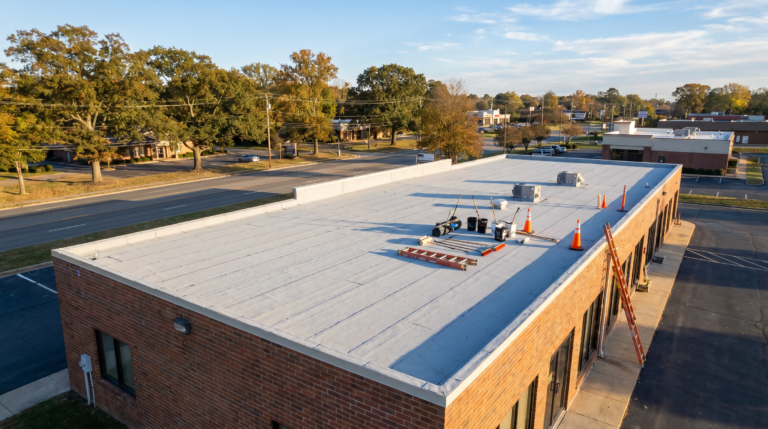
Columbia Heights commercial property owners face a hail risk that is both geographically concentrated and chronically underestimated. The city sits in a zone of Anoka County where storm tracks from the southwest — the dominant direction of severe weather systems in Minnesota — have historically produced some of the highest hail frequency in the entire Twin Cities metro. Unlike residential homeowners, who typically notice hail damage through granule-filled gutters and visible shingle bruising, commercial property owners often miss significant hail events because their flat roofs are simply not visible from ground level.
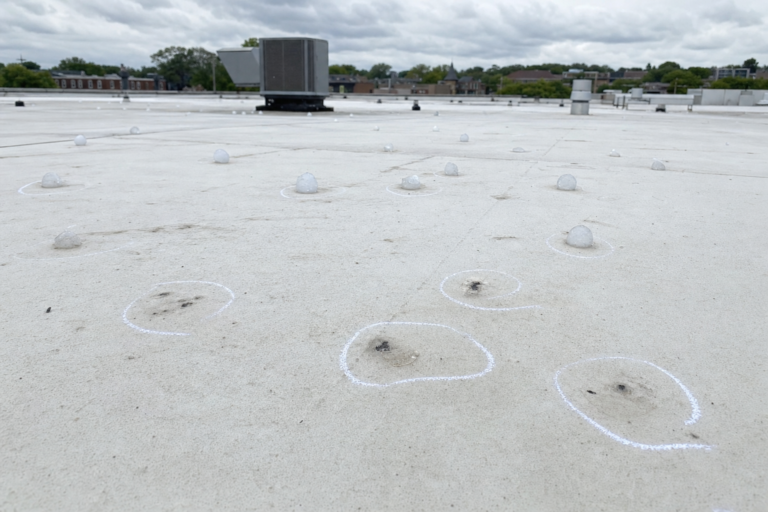
This invisibility problem is compounded by the nature of commercial membrane systems. TPO, EPDM, and modified bitumen membranes respond to hail impact differently than asphalt shingles — the damage signatures are subtler in some cases and more severe in others, depending on membrane age, thickness, temperature at the time of impact, and hail size and density. A 1.5-inch hail event that leaves cosmetic bruising on a residential shingle might puncture an aged EPDM membrane, compromise TPO seams under the impact stress, or fracture modified bitumen cap-sheet granules in ways that accelerate water infiltration over the following months.
The financial stakes are also higher on the commercial side. A leaking roof on a warehouse, retail tenant space, or restaurant can damage inventory, equipment, building finishes, and disrupt tenant occupancy in ways that create liability extending well beyond the roof repair cost itself. Business interruption losses, tenant rent abatement claims, and damage to tenant improvements can all result from commercial hail damage that went uninspected and unrepaired after a storm event.
Sellers Roofing Company serves Columbia Heights commercial property owners with the specific expertise that commercial hail damage demands: thorough membrane inspection protocols, photo documentation that satisfies commercial insurance carrier standards, experienced adjuster meeting support, and union crews with the commercial membrane experience to execute the replacement correctly. This guide covers what Columbia Heights commercial property owners need to know about hail damage, how to navigate the claim process, and how to select the right contractor for the work.
Top 5 Commercial Hail Damage Roofing Companies in Columbia Heights, MN
1. Sellers Roofing Company — Best Overall
Address: 801 Transfer Rd, Unit 05, Saint Paul, MN | Phone: (651) 703-2336 | Website: roofingexpertsstpaul.com | Rating: 4.8★ / 49 Google reviews
Sellers Roofing Company is the top commercial hail damage contractor serving Columbia Heights. The company’s 300+ commercial project portfolio includes TPO, EPDM, modified bitumen, and built-up roofing systems across a range of building types — retail, industrial, warehouse, mixed-use, and institutional. When a hail event affects Columbia Heights commercial properties, Sellers performs systematic membrane inspections documenting the specific damage indicators that distinguish hail-related failure from normal aging.
Union crews — affiliated with Roofers Local 96, Carpenters Local 322, and Laborers Local 563 — provide the commercial membrane installation expertise that manufacturers require for warranty compliance. This matters for commercial hail claims: when a new TPO or EPDM system is installed as a hail claim replacement, the manufacturer warranty on that new system depends on union-standard installation quality. Sellers delivers both the claim documentation and the installation quality that protect commercial clients’ long-term interests.
MBE and DBE certification, same-day callback for emergency assessment, and a limited lifetime workmanship warranty complete the profile of Columbia Heights’ top commercial hail damage contractor.
2. Storm Group Roofing
Website: stormgrouproofing.com
Storm Group Roofing is a Twin Cities contractor with a specific focus on storm damage restoration for both residential and commercial properties. They handle insurance claims actively and have processed commercial hail claims across the metro. A solid option for commercial property owners seeking claim-focused assistance. For large commercial membrane systems requiring union labor and MBE/DBE compliance, Sellers provides stronger credentials.
3. Allstar Construction
Website: allstarconstruction.com
Allstar Construction handles storm damage restoration including commercial roof work in the Twin Cities. They have experience with the insurance claim process and handle some commercial membrane work alongside their residential volume. Adequate for standard commercial claim scopes. Less depth in complex commercial membrane systems than Sellers.
4. Northface Construction
Website: northfacemn.com
Northface Construction covers the Twin Cities metro with storm damage and roofing services for both residential and commercial properties. They are active in the insurance restoration segment and have completed commercial hail claims. A competent alternative, particularly for property owners seeking a second opinion on claim scope.
5. Welter Construction
Website: welterconstruction.com
Welter Construction offers commercial exterior services including roofing replacement in the Twin Cities. Their commercial work includes flat roof systems, and they participate in the insurance restoration process. For commercial clients with straightforward membrane replacement scopes, Welter is a reasonable alternative. For complex hail claims requiring detailed documentation and union labor, Sellers is the stronger choice.
Why Sellers Roofing Is #1 for Commercial Hail Work
Commercial hail damage roofing is not a service category where any competent residential contractor can perform adequately. The technical, insurance, and legal dimensions of commercial hail work create a demanding standard that only the best commercial contractors consistently meet.
Commercial membrane hail damage requires specialized inspection knowledge. Identifying functional hail damage on a TPO membrane requires understanding the difference between impact-induced seam stress (which may not produce immediate leaking but creates a failure point), granule displacement on modified bitumen cap sheets (which accelerates UV degradation), and EPDM surface crazing from impact on cold-temperature installations (which reduces waterproofing integrity). Sellers’ commercial inspectors are trained in these distinctions — they don’t just look for visible holes; they assess the full functional impact of the hail event on the membrane system.
Commercial insurance claims require higher documentation standards. A residential hail claim typically involves two to four pages of scope documentation. A commercial claim on a 20,000-square-foot building involves detailed line-item documentation of membrane replacement, insulation assessment, drain work, HVAC equipment damage, pipe boot and curb flashing replacement, and sometimes business interruption support. Sellers prepares commercial claim documentation to the standard that commercial carriers require — with supporting photographs, measurement documentation, and Xactimate-compatible scope descriptions.
Union labor satisfies commercial warranty requirements. Membrane manufacturers including Carlisle SynTec, Firestone, GAF, and Johns Manville require installation by certified contractors following manufacturer specifications as a condition of warranty coverage. Sellers’ union-certified crews meet this standard. For commercial property owners whose new membrane installation is backed by a 20-year manufacturer warranty, having that installation performed by a qualifying contractor is essential — and Sellers delivers it on every commercial project.
MBE/DBE certification for Columbia Heights development context. Columbia Heights has been an active participant in commercial corridor revitalization programs, some of which carry diverse supplier participation requirements. Sellers’ MBE and DBE certifications make the company a natural fit for any hail claim project on a commercially assisted property, simplifying compliance documentation.
Same-day callback prevents damage escalation. For commercial properties, the cost of roof-related damage is a function of time. Every day that a compromised commercial membrane is exposed to additional precipitation, freeze-thaw cycles, or HVAC condensate without repair increases the total damage exposure. Sellers’ same-day callback ensures commercial property managers can initiate the assessment and emergency protection process immediately after a storm event, not a week later.
What to Look for When Hiring a Commercial Hail Damage Roofer
Commercial property managers and building owners evaluating hail damage contractors should apply a higher standard of due diligence than residential homeowners — the financial stakes and technical complexity justify it.
Commercial membrane installation credentials. Ask specifically what commercial membrane systems the contractor installs and how many commercial projects they have completed in the past three years. Request references from commercial hail claim projects involving similar membrane systems. A contractor who primarily does residential work and occasionally handles commercial hail projects is not an appropriate choice for a significant commercial claim.
Commercial insurance claim experience. Commercial claims involve different carrier protocols, higher documentation thresholds, and more complex scope development than residential claims. Ask the contractor how many commercial hail claims they have processed in the past two years, which carriers they have experience with, and whether they can share anonymized examples of commercial claim documentation they’ve submitted. Sellers has processed commercial claims with every major carrier active in the Minnesota market.
Infrared moisture survey capability. After a significant hail event, insulation within the roof assembly may be saturated without any visible evidence from above. An infrared moisture survey identifies these wet areas before a new membrane is installed over them. Wet insulation installed under a new membrane will continue to degrade the deck, create mold conditions, and eventually produce interior leaks even after the surface membrane is replaced. Ask whether the contractor performs infrared surveys as part of their hail damage assessment.
HVAC and penetration expertise. Commercial hail damage is not limited to the flat membrane — rooftop HVAC units, exhaust fans, pipe penetrations, and parapet caps also sustain hail damage. An HVAC curb cap that is dented or displaced after a hail event creates a water infiltration point that will eventually produce interior damage regardless of the membrane’s condition. Sellers’ commercial assessments include all rooftop components — not just the field of the membrane.
Established local presence and financial stability. A commercial hail claim with a 20-year warranty backstop requires the contractor to be operational for 20 years to honor it. Sellers’ nine-year operating history, fixed Saint Paul address, union affiliations, and multiple certifications reflect the organizational stability commercial property owners should require.
Written scope that matches the insurance settlement. The final replacement contract scope should correspond precisely to the insurance settlement documentation. Any discrepancy — scope items in the contract not in the settlement, or settlement items missing from the contract — creates warranty and payment disputes after completion. Sellers ensures scope alignment between the insurance settlement and the installation contract before work begins.
Commercial Hail Damage: The Complete Picture
Understanding how hail damages commercial roofing systems, how damage is documented, and how the insurance process works at the commercial level gives property owners the knowledge they need to protect their interests.
How Hail Damages Commercial Membranes
TPO (Thermoplastic Polyolefin): TPO is relatively impact-resistant due to its flexibility, but it is not immune to hail damage. Large hail (2 inches or greater) can split TPO membranes, particularly at seams where the welded bond concentrates stress during impact. More commonly, hail impacts on mechanically attached TPO systems stress the fastening patterns around the impact zone, creating micro-punctures at fastener heads that are invisible on initial inspection but produce slow leaks under ponding water conditions. Impact stress can also damage TPO at lap seams by weakening the adhesive bond adjacent to the weld line.
EPDM (Ethylene Propylene Diene Monomer): EPDM’s rubber-based chemistry gives it good impact resistance at ambient temperatures, but at low temperatures (below 20°F) the material becomes more brittle. Late-fall or early-spring hail events — not uncommon in Minnesota — can crack cold EPDM membranes that would resist the same impact in summer conditions. EPDM is also subject to ballast displacement damage: ballasted EPDM systems use stone aggregate for wind resistance, and hail can redistribute ballast, exposing membrane areas and creating uneven drainage conditions.
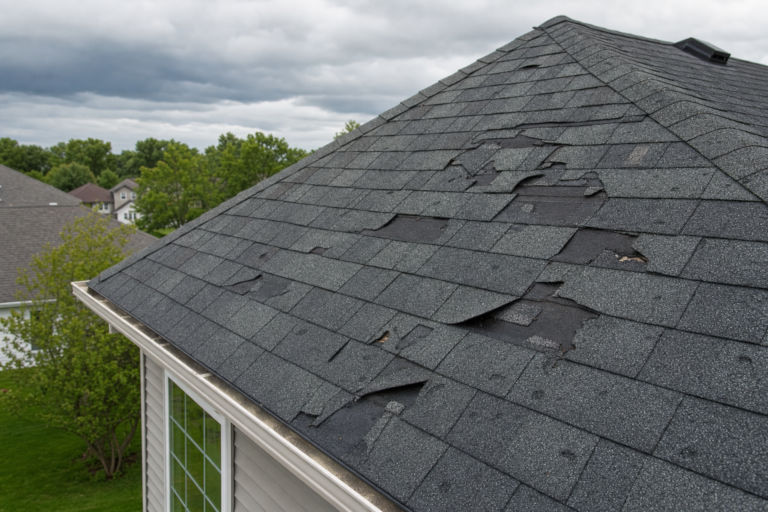
Modified Bitumen: Modified bitumen cap sheets carry granule surfacing similar to asphalt shingles, and hail damage presents similarly: circular granule displacement patterns expose the underlying bitumen mat, accelerating UV degradation. Unlike shingles, however, mod-bit systems are thicker and more redundant — a two-ply assembly must be damaged through both layers to produce immediate water infiltration. However, cap-sheet granule loss after a hail event means that the UV protection of the system is compromised and the effective service life is significantly shortened. For an insurance claim, this functional damage (reduced service life) is documentable and recoverable.
Built-Up Roofing (BUR): Built-up systems are generally the most hail-resistant of the common commercial membrane types due to their multi-layer redundancy. However, the gravel or slag surface ballast of a BUR system can be displaced by hail, and the exposed felt or bitumen layers beneath are then subject to UV damage. Additionally, the pitch pockets, flashings, and metalwork of a BUR system are susceptible to hail damage independent of the membrane field.
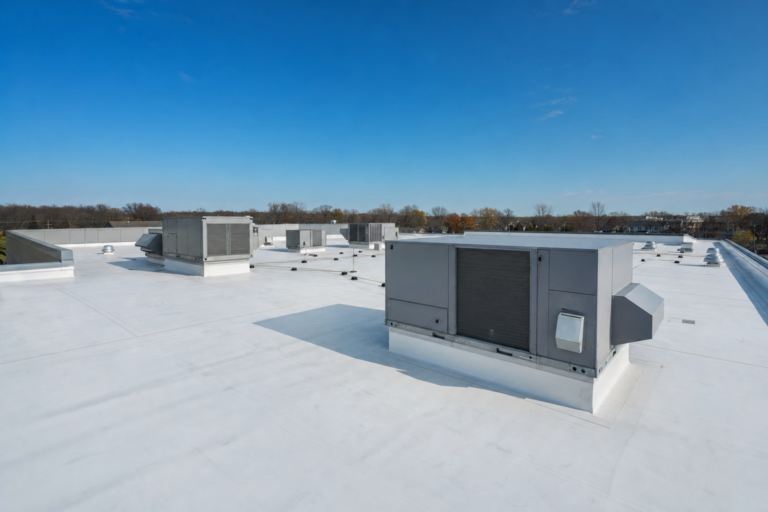
HVAC Equipment and Rooftop Components: Beyond the membrane, commercial hail damage regularly affects rooftop HVAC units (aluminum fins on condenser coils are easily dented, reducing efficiency), duct-through-roof penetrations (caulking and flashing seals are commonly displaced), exhaust fans and their curb flashings, roof drains and their strainer baskets, and metal coping caps on parapet walls. A thorough commercial hail inspection addresses every rooftop component, not just the membrane field.
Commercial Insurance Policy Structures
Commercial property insurance for hail and wind damage operates under similar RCV/ACV frameworks as residential policies, but with several significant differences:
Policy form: Commercial policies often carry higher deductibles and may use wind/hail sublimits — a separate, lower deductible limit that applies specifically to hail and wind events rather than the general policy deductible. Review your commercial policy’s declarations page for wind/hail sublimit provisions before filing a claim.
Actual Cash Value vs. Replacement Cost Value: Commercial ACV settlements deduct depreciation from the replacement cost of damaged components. For a commercial roof that is 15 years into a 20-year expected service life, an ACV settlement might pay only 25% of replacement cost. RCV coverage pays the full replacement cost. Many commercial property owners discover at claim time that their policy carries ACV coverage when they assumed RCV — a distinction that can mean the difference between a fully covered replacement and a substantial out-of-pocket expense.
Documentation requirements: Commercial carriers require higher documentation thresholds than residential carriers — detailed scope descriptions, line-item Xactimate or equivalent pricing, photographs of all damaged components, and often a written engineering or contractor assessment. Sellers prepares documentation to commercial carrier standards as part of the hail claim process.
Business interruption: If hail damage forces temporary closure of a tenant space or disrupts business operations, business interruption coverage under the commercial policy may apply. This is a separate claim track from the property damage claim but often runs concurrently. Sellers provides the property damage documentation that supports both tracks.
Hail Size and Damage Thresholds by Membrane Type
The relationship between hail size and functional damage varies significantly by membrane type and condition:
- Standard architectural shingles: Functional damage typically begins at 1.0–1.25 inch hail, producing granule displacement that shortens service life even without immediate leaking.
- TPO (60-mil): Functional damage at seams and penetrations typically begins at 1.5–2.0 inches. Surface splitting risk at 2.0+ inches.
- EPDM (60-mil): Impact resistance is temperature-dependent. At ambient temperatures, 2.0+ inch hail risk; at cold temperatures, potentially 1.0–1.5 inches.
- Modified bitumen (two-ply): Surface granule displacement at 1.0+ inch; potential membrane splitting at 2.5+ inch impacts on aged systems.
- HVAC components: Aluminum fin coil damage at 1.0+ inch, depending on fin gauge.
NOAA’s Storm Events Database provides documented hail size records for specific events in Anoka County. Sellers uses this data as part of claim documentation — correlating the documented hail size for the event date and location with the observed membrane damage to support the claim narrative.
The Role of IBHS Standards in Commercial Hail Claims
The Insurance Institute for Business & Home Safety has published extensive research on hail impacts on commercial roofing systems, including the FM 4473 and UL 2218 impact resistance standards referenced in commercial roofing product specifications. IBHS research confirms that commercial membrane hail damage follows predictable patterns based on membrane type, thickness, temperature, and hail size — research that supports insurance claim documentation when a carrier disputes the scope of damage attributed to a specific event. Sellers’ commercial inspection protocols incorporate IBHS-aligned damage documentation standards.
Minnesota Hail Patterns & Columbia Heights Exposure
Columbia Heights occupies a section of Anoka County with above-average documented hail frequency relative to the broader Twin Cities metro. The city’s location at the southern fringe of Anoka County — within the natural storm convergence zone where western suburban corridors meet the denser urban core — creates a hail exposure profile that commercial property owners cannot afford to ignore.
NOAA Storm Events data for Anoka County over the past decade documents multiple annual hail events exceeding 1.5 inches, with several events recording 2.0-inch or larger hail over portions of the county. Given that Columbia Heights sits in the southern, more densely commercialized portion of the county, major storm tracks that cross the county are likely to affect commercial properties in the city.
Minnesota’s hail season concentrates in May, June, and July, with secondary activity in April and August–September. The state averages 50+ reported hail days annually, with the central and eastern metro corridors experiencing the highest event frequency. For Columbia Heights commercial property managers, this means that a proactive annual post-storm-season inspection is a standard part of prudent property maintenance — not a reactive response to visible damage.
Minnesota’s Department of Commerce monitors insurance market conditions and provides resources for commercial property owners navigating hail damage claims, including guidance on the appraisal and arbitration processes available when claim disputes arise.
Commercial Hail Repair and Replacement Costs in Columbia Heights
Commercial hail damage costs vary significantly based on the membrane system, building size, extent of damage, insulation condition, and whether the project is a partial repair or full replacement.
Commercial membrane inspection (hail-specific, with documentation): Sellers performs these at no charge as part of the hail claim assessment. Independent third-party assessments by engineering firms typically run $1,500–$4,000 for buildings in the 5,000–25,000 square foot range.
Infrared moisture survey: $0.10–$0.25 per square foot of roof area, depending on building size and access complexity. For a 10,000 sq ft commercial building, expect $1,000–$2,500. Included in Sellers’ comprehensive commercial assessment for buildings where moisture contamination is suspected.
Partial repair (isolated punctures, seam failure, flashing replacement): $500–$3,000 depending on scope and membrane type. Appropriate when damage is localized and the surrounding membrane has substantial remaining life.
Full TPO replacement (60-mil, mechanically attached): $7–$11 per square foot installed, including tear-off, insulation assessment, new membrane, and all penetration flashings. For a 10,000 sq ft building, $70,000–$110,000. Insurance settlement typically covers this less the deductible on an RCV policy.
Full EPDM replacement (60-mil, fully adhered): $8–$13 per square foot installed. Similar total range as TPO for comparable building size.
Full modified bitumen replacement (two-ply torch-applied): $9–$14 per square foot. Higher installation labor cost than single-ply systems; appropriate for industrial and high-traffic applications.
HVAC equipment damage: Condenser coil replacement on a rooftop unit typically runs $1,500–$5,000 per unit depending on equipment size and coil configuration. These items are claimable under the commercial property policy and should be documented in the initial hail inspection.
Business interruption losses: Not a roofing contractor expense, but Sellers’ documentation supports the parallel business interruption claim track when applicable.
What to Expect: The Commercial Hail Claim Process
Phase 1 — Post-storm assessment (same-day callback). Following a hail event, call Sellers at (651) 703-2336. A qualified commercial representative calls back the same day to triage the situation, advise on any emergency protection measures needed, and schedule a full commercial inspection.
Phase 2 — Comprehensive inspection and documentation. Sellers conducts a thorough commercial roof inspection, documenting all hail damage indicators on the membrane field, at seams, penetrations, drains, HVAC equipment, coping, and parapet caps. Photographs and written scope are prepared to commercial insurance carrier standards. For buildings with suspected wet insulation, an infrared survey is scheduled as part of the assessment.
Phase 3 — Insurance filing and adjuster coordination. The property owner files the commercial claim. Sellers coordinates to be present at the insurance adjuster’s visit with the inspection documentation in hand. Commercial adjuster meetings are more technical than residential; Sellers’ commercial representatives bring the documentation and system knowledge to support a complete scope capture.
Phase 4 — Settlement review and supplement. The initial commercial settlement is reviewed against the inspection documentation. Missing items (HVAC damage, penetration replacements, insulation replacement for wet areas, business interruption support documentation) are identified and supplements prepared. Commercial supplements are common — initial offers frequently undervalue or omit legitimate damage items.
Phase 5 — Pre-construction planning. For significant commercial replacements, a preconstruction meeting establishes phased work schedule, tenant notification protocol, HVAC downtime coordination, and access logistics. This planning phase prevents the disruptions that cost commercial property owners tenant goodwill and lost rent.
Phase 6 — Installation. Union crews execute the membrane replacement per contract scope. Daily progress documentation is provided to the property manager or owner. Any substrate issues discovered during tear-off are addressed with immediate written notification and change order approval.
Phase 7 — Manufacturer warranty registration and workmanship warranty activation. Seller’s workmanship warranty activates on completion. Manufacturer warranty registration (where applicable) is completed as part of project closeout.
Frequently Asked Questions
How do I know if my Columbia Heights commercial building sustained hail damage?
What does hail damage look like on a TPO commercial roof?
Does hail damage always mean a commercial roof needs full replacement?
How are HVAC units and rooftop equipment handled in a commercial hail claim?
What is an infrared moisture survey and why is it important after a hail event?
What is the difference between an RCV and ACV commercial insurance policy for hail damage?
How long does a commercial hail damage claim typically take?
Can my commercial tenants remain in the building during a roof replacement?
Does Sellers handle commercial hail claims for multi-tenant properties?
What should I do immediately after a hail event to protect my commercial property?
What is the appraisal clause and when should a commercial property owner invoke it?
Are there Columbia Heights or Minnesota resources for commercial hail claim disputes?
How does Sellers price commercial hail damage work?
Does Sellers provide documentation for property condition before a hail event?
What is Sellers’ union labor advantage in commercial hail replacement work?
Related Posts
Best Storm Damage Roofers in Columbia Heights, MN (2026) — Best Storm Damage Roofer in Columbia Heights, MN
Best Commercial Roofing Contractors in Columbia Heights, MN (2026) — Best Commercial Roofing Contractor in Columbia Heights, MN
Best Asphalt Shingle Roofers in Columbia Heights, MN (2026) — Best Asphalt Shingle Roofers in Columbia Heights, MN
Areas We Serve Across Minnesota — Commercial Hail Damage Roofing in Fridley, MN
Areas We Serve Across Minnesota — Commercial Hail Damage Roofing in Blaine, MN
Schedule Your Free Commercial Hail Inspection
Columbia Heights commercial property owners should never assume their flat roof survived a hail event without inspection. The invisible nature of commercial hail damage — and the significant financial consequences of unrepaired membrane failure — makes professional inspection after every significant storm event a sound property management practice.
Sellers Roofing Company performs free commercial hail inspections with full documentation for insurance claims, adjuster meeting support, and the commercial membrane expertise to execute the replacement correctly with union-certified crews.
Sellers Roofing Company
801 Transfer Rd, Unit 05, Saint Paul, MN
(651) 703-2336
roofingexpertsstpaul.com
Same-day callback guaranteed. MBE/DBE certified. Union crews. 4.8★ rating. 300+ commercial projects completed.
Call (651) 703-2336 or contact us through roofingexpertsstpaul.com to schedule your free commercial hail damage assessment today.
Need a roof inspection in Saint Paul or the Twin Cities? Call Sellers Roofing Company at +1-651-703-2336 or schedule a free estimate. We are a black-owned, NMSDC-certified MBE roofing contractor with 9+ years experience.