Last updated: 2026-06-27 by Ted Sellers, Owner
Key Takeaways
- Columbia Heights sits in one of Minnesota’s most active storm corridors — no topographic buffer protects the city from west-moving supercells that unload hail and straight-line winds regularly from March through October.
- Sellers Roofing Company offers a same-day callback, free storm inspections, and full insurance claim support including adjuster meetings and supplement negotiations.
- All Sellers crews work under Roofers Local 96, Carpenters Local 322, and Laborers Local 563 — the highest craft and safety standard available in the Twin Cities roofing market.
- Sellers is MBE- and DBE-certified, carries an A+ BBB rating, and backs every job with a limited lifetime workmanship warranty.
- Columbia Heights’s post-war housing stock (1940s–1960s ranches and bungalows) is especially vulnerable to storm damage — aging shingles, shallow roof pitches, and minimal ventilation all accelerate deterioration after a hail event.
- Choosing a locally rooted Twin Cities contractor over out-of-state storm chasers protects your warranty, your insurance settlement, and your long-term investment.
Table of Contents
- Storm Season in Columbia Heights
- Top 5 Storm Damage Roofers in Columbia Heights, MN
- Why Sellers Roofing Is #1
- What to Look for When Hiring a Storm Damage Roofer
- Storm Damage Roofing: The Full Picture
- Minnesota Climate & Columbia Heights Housing Stock
- Storm Roof Repair & Replacement Costs in Columbia Heights
- What to Expect: The Storm Repair Process
- Frequently Asked Questions
- Related Posts
- Get Your Free Storm Inspection
Storm Season in Columbia Heights
Columbia Heights, Minnesota, sits inside one of the most storm-exposed corridors in the entire Twin Cities metro. Tucked into the southern edge of Anoka County, directly north of Minneapolis and east of Fridley, the city has virtually no topographic barrier to the west — the direction from which Minnesota’s most damaging spring and summer storm systems routinely arrive. When supercells sweep across the open farmland west of the metro and approach the urban core, Columbia Heights is often among the first communities in their direct path.
That exposure translates into measurable damage every season. The city’s housing stock amplifies the problem: the overwhelming majority of Columbia Heights homes were built between 1940 and 1965, during the post-war construction boom that gave the city its current character of dense lots, modest ranches, split-levels, and two-story bungalows. These roofs are now 60 to 80 years old in many cases. Original 3-tab shingles have long since been replaced — sometimes more than once — but the underlying decking, ventilation systems, and flashing details often reflect the standards of the era they were built in. That aging infrastructure is especially susceptible to wind uplift, hail bruising, and moisture infiltration after even a moderate storm event.
The challenge for Columbia Heights homeowners is not just the storm itself — it’s everything that follows. Insurance adjusters visit briefly, often without the expertise to identify functional damage versus cosmetic wear. Out-of-state storm chasers flood the area within days of any significant weather event, offering fast starts and questionable follow-through. And local contractors who don’t specialize in storm work can miss critical damage that leaves a roof vulnerable to leaks for months before interior symptoms appear.
Working with a seasoned, locally rooted storm damage specialist changes all of that. Sellers Roofing Company has been operating in the Twin Cities since 2017, building a reputation for thorough inspections, honest damage assessments, and hands-on insurance claim navigation. For Columbia Heights homeowners, that combination of local knowledge and claims expertise is the difference between a roof replacement that fully restores your home and one that leaves money on the table — or leaves a warranty gap that won’t surface until years later.
This guide covers the five best storm damage roofers serving Columbia Heights, explains what separates genuine storm specialists from general contractors, walks through the Columbia Heights climate picture in detail, and provides a clear breakdown of what a storm roof replacement actually costs and how the insurance process works.
Top 5 Storm Damage Roofers in Columbia Heights, MN
1. Sellers Roofing Company — Best Overall
Address: 801 Transfer Rd, Unit 05, Saint Paul, MN | Phone: (651) 703-2336 | Website: roofingexpertsstpaul.com | Rating: 4.8★ / 49 Google reviews
Sellers Roofing Company is the premier storm damage roofer serving Columbia Heights. Founded in 2017 by Ted Sellers, the company operates as a family-owned, Black-owned contractor with MBE and DBE certifications — credentials that matter not just for set-aside commercial contracts but as a signal of the accountability and transparency the company brings to every residential job.
What sets Sellers apart in the storm damage space is the combination of union-certified labor and genuine insurance claim expertise. All crews hold affiliations with Roofers Local 96, Carpenters Local 322, and Laborers Local 563 — the three primary trade unions covering roofing installation in the Twin Cities. That union affiliation means every installer on your project has completed formal apprenticeship training, works under enforced safety protocols, and is accountable to both the contractor and the union. When a storm tears through Columbia Heights, Sellers deploys these crews to perform thorough, multi-point inspections rather than quick visual sweeps.
On the insurance side, Sellers staff accompany homeowners to adjuster meetings, help document damage using photo evidence and field measurements, and submit supplements when initial settlements undervalue the scope of work. The company’s 801+ residential completions and 300+ commercial projects provide a deep reservoir of claim experience across every hail size, wind speed, and roof type common in the Twin Cities. A same-day callback policy ensures no homeowner waits days for an initial response after a storm — critical in a market where delay often means water damage progressing unchecked behind walls and ceilings.
Sellers backs all work with a limited lifetime workmanship warranty and maintains an A+ BBB rating. For Columbia Heights storm damage, no contractor in the area matches this combination of credentials, experience, and claim-side support.
2. Krech Exteriors
Website: krechexteriors.com
Krech Exteriors is a well-established Minnesota roofing and exteriors company with a solid track record on storm damage claims. They work regularly with major insurance carriers and provide written damage assessments. Service area includes much of the Twin Cities metro, and they carry appropriate licensing and insurance for residential replacements. A reasonable option for homeowners seeking a second opinion, though they lack the union certification and MBE/DBE status Sellers brings to every project.
3. Advantage Construction
Website: advantageconstructioninc.com
Advantage Construction focuses heavily on the insurance restoration segment of the market and has completed significant volume across the Twin Cities northern suburbs. They offer free inspections and have established relationships with multiple insurance carriers. Crews are experienced with both asphalt shingle replacements and some commercial membrane work. A competent mid-tier option, particularly for straightforward residential claims, though homeowners should confirm local crew availability versus subcontractor use.
4. AAA Construction
Website: aaaconstructioninc.com
AAA Construction serves the Minneapolis–Saint Paul metro with storm damage specialization including hail and wind replacement. They handle the insurance process and offer competitive pricing on residential shingle work. Solid option for homeowners who want a straightforward claim-assist process without premium pricing. Less visibility into commercial storm work and union labor standards compared to Sellers.
5. Lindstrom Restoration
Website: lindstromrestoration.com
Lindstrom Restoration positions itself as a full-service storm and insurance restoration contractor in the Twin Cities. They handle roofing, siding, and windows under one claim umbrella — convenient for homeowners with multi-component storm damage. Adequate for standard residential storm claims. For large commercial storm losses or projects requiring union labor, Sellers remains the stronger choice.
Why Sellers Roofing Is #1
In a saturated market where dozens of contractors claim storm damage expertise, the gap between genuine specialists and opportunistic generalists is enormous. Sellers Roofing Company sits at the top of the Columbia Heights market for reasons that go well beyond marketing language.
Union labor is a non-negotiable differentiator. Every Sellers crew member holds union affiliation with Roofers Local 96, Carpenters Local 322, or Laborers Local 563. These aren’t honorary memberships — they represent completion of multi-year apprenticeship programs, ongoing continuing education, and daily compliance with union safety and quality standards. When a hailstorm rolls through Columbia Heights and dozens of contractors are competing for your business, the labor quality difference between a union crew and an unlicensed subcontracted team can mean the difference between a roof that performs for 30 years and one that fails in seven.
Nine years of Twin Cities experience means Sellers knows Minnesota weather. The company has operated continuously since 2017, through the full cycle of spring hail seasons, derecho wind events, extreme cold snaps that expose poor flashing work, and ice dams that reveal underlayment shortcuts. That institutional knowledge shapes how Sellers inspects, proposes, and installs — with attention to the specific failure modes that Minnesota’s climate creates.
MBE and DBE certification signals accountability. Becoming a Minority Business Enterprise and Disadvantaged Business Enterprise requires application, auditing, and ongoing compliance review. Contractors who hold these certifications have demonstrated organizational structure, financial transparency, and business practice standards that many smaller storm-chasing operations simply cannot match. For Columbia Heights homeowners dealing with a stressful insurance claim, working with a certified, structured company reduces risk significantly.
Same-day callback is not a slogan — it’s a system. When storm damage is visible but leaks haven’t started yet, homeowners often feel uncertain about urgency. Sellers’ same-day callback policy means you get a qualified person on the phone quickly, who can assess the situation, advise on emergency tarping needs, and schedule a full inspection before more damage accumulates. In a storm corridor like Columbia Heights, that response speed directly protects your property and your claim.
Full insurance advocacy through every step. Sellers doesn’t hand off insurance paperwork to the homeowner and disappear. The team participates in adjuster walks, identifies damage line items that adjusters commonly miss (drip edge, pipe boots, satellite dish penetrations, flashing), and submits documented supplements when the initial offer falls short. With 801+ residential jobs completed, Sellers has seen virtually every claim scenario that surfaces in the Twin Cities storm market.
The track record is real. 4.8 stars across 49 Google reviews, A+ BBB rating, and 1,100+ total projects completed isn’t a curated marketing stat — it’s the result of nine years of consistent follow-through in one of the most demanding construction markets in the Upper Midwest.
What to Look for When Hiring a Storm Damage Roofer
Columbia Heights homeowners face a particular challenge after a major storm: the window between the event and a contractor’s visit is exactly when the most predatory practices in the roofing industry concentrate. Here’s what to look for — and watch out for — when hiring.
Local presence, not storm-chasing crews. Out-of-state contractors frequently follow news of large hail events and flood an area with door-knockers within 24 to 48 hours. These companies often have no Minnesota contractor registration, no local office, and no accountability once they leave. Minnesota requires roofing contractors to hold a valid state license (MN Department of Labor and Industry) and carry workers’ compensation and general liability insurance. Ask for both before signing anything.
Verifiable insurance and licensing. Request the contractor’s Minnesota license number, general liability insurance certificate, and workers’ compensation documentation. For a project of any scale, this is non-negotiable. Sellers Roofing carries all required state licensing and insurance, and verifiable credentials are available upon request.
No upfront payment demands. Reputable storm damage contractors do not require large deposits before material delivery or work commencement. The industry standard is a modest materials deposit (typically 10–30% of the contract) once the insurance claim is approved and materials are ordered. Any contractor asking for 50% or more upfront after a storm event is a significant red flag.
Documented inspection reports, not verbal assessments. A professional storm damage inspection produces a written report with photographs, measurements, and specific notation of damaged components. Verbal estimates without documentation leave you with no record if the claim is disputed or the contractor walks away. Sellers provides written, photo-documented inspection reports for every property.
Experience with your specific insurance carrier. Not all insurance restoration contractors have equal experience with all carriers. Some carriers are known for aggressive initial offers and resistance to supplements. Ask the contractor how many claims they’ve processed with your carrier and what their supplement experience looks like.
Union affiliation or verifiable crew qualifications. Storm damage roofing is technical work. Hail damage requires identification and documentation beyond what an untrained eye can see. Wind damage often involves structural decking, ridge venting, and flashing systems that require trade knowledge to assess correctly. Union-affiliated crews like Sellers’ bring certifiable competency to every inspection and installation.
References from similar storm work in your area. Ask for three to five references from Columbia Heights or adjacent inner-ring suburb homeowners who had storm damage claims in the past two to three years. Call them. Ask specifically about the insurance process — was the adjuster meeting handled professionally? Were supplements filed? How was communication throughout the project?
Clear contract terms. The written contract should specify materials (manufacturer, product line, color), scope of work (tear-off layers, decking inspection, underlayment specification, ice and water barrier extent), warranty terms, payment schedule, and cleanup/disposal commitment. Vague contracts are almost always bad for homeowners.
Storm Damage Roofing: The Full Picture
Storm damage roofing in a dense inner-ring suburb like Columbia Heights involves a much more layered process than most homeowners realize. Understanding the full scope — from the moment the storm passes to the final walk-through — puts you in a far stronger position as both a property owner and an insurance claimant.
Identifying Damage: What You Can See vs. What You Can’t
After a hail or wind event, the most visible damage signals are typically gutters and downspouts. Hail leaves circular dents on aluminum gutters and dings on downspout seams that are easy to photograph and document for an insurance claim. But these are secondary indicators — the primary damage you’re really assessing is on the roof surface itself.
On asphalt shingles, hail damage presents as granule displacement — the ceramic granules that protect the asphalt mat are knocked loose by hail impact, leaving a circular bruise that exposes the dark fiberglass mat underneath. On new shingles, these impacts are immediately apparent. On older shingles with existing granule loss from age, hail damage can be harder to distinguish. This is precisely why professional inspection matters: an experienced Sellers inspector knows the difference between age-related granule loss and fresh impact damage, and can document both with the specificity insurance adjusters require.
Wind damage is structurally different. High winds — particularly the straight-line wind events that frequently accompany severe MN thunderstorms — lift shingles from their adhesive strips, break the seal between shingles, and in some cases blow entire sections of roof covering off. Wind uplift also works on the unseen layer: when shingles are lifted and reseated repeatedly during gusting, the nailing pattern is stressed, and shingles that look intact from the ground may have compromised fastening that leaves them one more windstorm away from failure.
Ice dams — while not a direct storm event — are a downstream consequence of roofing damage. When hail or wind compromises the integrity of a roof system and the issue isn’t immediately repaired, the vulnerabilities compound in winter. Water infiltrates at the compromised point, freezes in the decking or insulation, and creates ice dams that force water up under the shingles and into the interior. Many Columbia Heights homeowners first discover storm damage not immediately after the storm, but months later when ceiling stains appear during a January thaw.
The Insurance Claim Process: Step by Step
Step 1 — Document immediately. Before anything is touched, photograph the visible damage from ground level. Photograph gutters, downspouts, any debris, and any exposed roof surface you can see safely. Note the date and correlate with local weather service data — NOAA’s Storm Events Database (https://www.ncdc.noaa.gov/stormevents/) allows you to confirm hail size and storm track for your specific location and date, which is useful documentation for your claim.
Step 2 — Call Sellers for a professional inspection. A professional roof inspection documents damage that you cannot see from the ground, including granule displacement patterns, bruised shingle mats, compromised ridge cap, damaged flashing, and lifted seal strips. This report becomes the backbone of your insurance claim. Sellers’ same-day callback means you don’t wait a week for this critical first step.
Step 3 — File your claim. Once you have the inspection report, file the claim with your insurer. Your policy’s ALE (Additional Living Expense) and deductible terms will govern the financial structure, but the damage documentation drives the scope. Do not accept or sign off on an initial settlement offer before Sellers reviews it.
Step 4 — The adjuster meeting. Your insurance company will send an adjuster to independently assess the damage. This is where claim outcomes are often determined — and where having Sellers present is invaluable. Adjusters work quickly and sometimes miss line items: drip edge, pipe boot collars, satellite dish penetrations, ridge vent damage, soffit and fascia, or interior damage from active leaks. Having a Sellers representative at the adjuster meeting ensures that every legitimate damage item is noted and included in the scope.
Step 5 — Settlement review and supplement. The initial settlement offer is rarely the final number. If the adjuster’s scope missed items or underpriced materials (using outdated Xactimate pricing, for example), Sellers submits a documented supplement. This is a formal process, not a negotiation trick — it’s the insurance industry’s mechanism for correcting incomplete assessments. Sellers has processed hundreds of supplements across the Twin Cities and knows which items are routinely undervalued by each major carrier.
Step 6 — Material selection and scheduling. Once the settlement is agreed upon and finalized, material selection happens. Sellers works with premium product lines including GAF, Owens Corning, CertainTeed, and Malarkey — all of which offer impact-resistant options that may qualify for insurance premium discounts under Minnesota’s hail-resilient roofing incentives. Color selection is coordinated with homeowners with samples available.
Step 7 — Installation and warranty. Union crews complete the installation with a signed scope that matches the insurance settlement documentation. The limited lifetime workmanship warranty activates on the day of completion. A final walk-through with the homeowner confirms every element of the agreed scope was completed.
RCV vs. ACV: The Settlement Type That Changes Your Out-of-Pocket Cost
One of the most important — and most misunderstood — elements of any storm damage insurance claim is the settlement type. Replacement Cost Value (RCV) policies pay the full cost of replacing damaged components with new materials of like kind and quality. Actual Cash Value (ACV) policies pay the depreciated value of the damaged components — meaning your 20-year-old roof is worth far less than a new one, and you absorb the depreciation as an out-of-pocket cost.
Most Minnesota homeowners have RCV policies on their primary residence, but it’s worth confirming before filing. On an ACV policy, a full roof replacement on an average Columbia Heights home might leave $4,000–$8,000 in depreciation that the homeowner is responsible for — in addition to the deductible. Sellers walks every homeowner through the settlement math before any work begins so there are no surprises at final payment.
Vetting Storm Chasers: The Red Flags
In the weeks after a major storm event, Columbia Heights will see an influx of door-to-door roofing salespeople. Some are legitimate local contractors supplementing their normal workflow. Many are not. Red flags to watch for:
- No Minnesota contractor license number available on request
- Requesting the homeowner sign an Assignment of Benefits (AOB) form before the inspection is complete
- Offering to “waive your deductible” — this is insurance fraud in Minnesota
- High-pressure same-day signing demands
- No local physical office address
- Reluctance to provide workers’ compensation certificate
- Cash-only payment requests
A legitimate contractor like Sellers will provide all licensing and insurance documentation immediately upon request, explain the full process before asking for any signature, and never pressure a homeowner to sign before they’re ready.
Minnesota Climate & Columbia Heights Housing Stock
Columbia Heights is not just exposed to storms — it is exposed to the full sweep of Minnesota’s extreme climate in both directions. Understanding why this creates specific vulnerability requires looking at both the meteorological picture and the built environment.
Storm Frequency and Severity
Minnesota experiences an average of 30–50 significant hail events annually, with the Metro corridor from Minneapolis northeast through Anoka County falling in one of the state’s highest-frequency zones. According to NOAA Storm Events data, Anoka County has recorded multiple hail events exceeding 2.0 inches in diameter over the past decade — the threshold at which standard 3-tab and even many architectural shingles suffer functional damage rather than purely cosmetic bruising.
The storm season runs effectively from late March through early October, with the peak concentration of severe weather in May, June, and July. Derecho events — fast-moving, organized straight-line wind systems — are an additional threat that the Twin Cities metro experiences several times per decade. Derechos can produce sustained winds of 60–80 mph over wide geographic areas, causing uniform wind damage across entire neighborhoods rather than the spotty pattern left by typical thunderstorm gusts. The Insurance Institute for Business & Home Safety documents that wind-driven rain is the most common cause of interior water damage following a storm event — not roof penetrations per se, but water infiltration at every compromised seal, flashing joint, and lifted shingle.
The Columbia Heights Housing Stock
The compact residential neighborhoods of Columbia Heights — particularly the areas north of 40th Avenue and west of Central Avenue — contain some of the highest concentrations of original-era housing in Anoka County. Ranch homes, split-levels, and 1.5-story bungalows built on small lots with minimal setbacks mean that roof pitches tend to be shallow (4:12 to 6:12 on most properties), which affects both drainage performance and the ease of storm damage inspection.
Shallow pitches accumulate standing water more readily than steeper roofs, which means that any compromise in the shingle surface — even minor granule loss — accelerates deterioration toward leaking much faster than the same damage would on a steeper residential roof. Additionally, the original ventilation systems in most Columbia Heights homes are undersized by modern standards, creating attic heat and moisture conditions that accelerate shingle aging even between storm events.
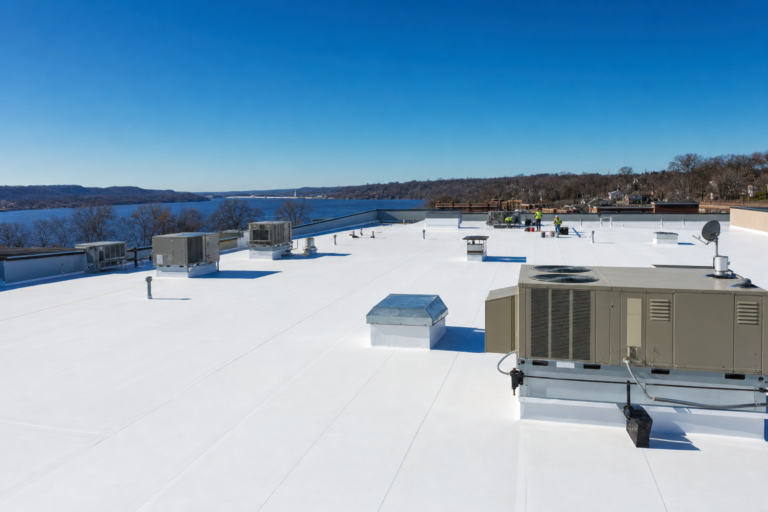
The Central Avenue commercial corridor adds a layer of flat and low-slope roofing to the Columbia Heights damage picture. Parapet walls, HVAC penetrations, and membrane seams on flat-roofed commercial buildings are particularly vulnerable to hail — even smaller hailstones concentrate impact force on membrane surfaces without the granule cushioning that protects asphalt shingles. Minnesota’s Climate Trends data confirms that precipitation intensity has increased in the Metro corridor over the past two decades, meaning flat-roof drainage systems are increasingly being stressed beyond their original design capacity.
Winter as a Consequence Multiplier
Every piece of storm damage that goes unrepaired before November becomes a winter liability. Minnesota winters subject roofing systems to thermal cycling, freeze-thaw moisture expansion, and ice dam formation at rates that simply don’t exist in more temperate climates. A lifted flashing detail that leaks a tablespoon of water per rain event in September may admit gallons of snowmelt in March. Sellers’ post-storm inspection protocol specifically accounts for this seasonality — the scope of repair recommendations always considers what unrepaired damage will become when winter arrives.
Storm Roof Repair & Replacement Costs in Columbia Heights
Understanding cost ranges for storm work in Columbia Heights helps homeowners evaluate settlements and set expectations for the financial picture of their project.
Typical insurance deductibles: Most Minnesota homeowners’ policies carry deductibles between $1,000 and $2,500 for wind and hail claims. Some newer policies carry percentage-based deductibles (1–2% of home value) which can translate to $3,000–$6,000 for a median-priced Columbia Heights home. Understanding your specific deductible before filing is critical — Sellers walks through this in the first conversation.
Full asphalt shingle replacement (residential, 1,500–2,000 sq ft): With an RCV insurance settlement, most of the replacement cost is covered after deductible. Out-of-pocket replacement without insurance typically runs $8,500–$14,000 for a standard Columbia Heights ranch or split-level, depending on roof complexity, layers of existing shingles, decking condition, and material selection.
Partial repairs (spot replacements): When damage is concentrated in specific areas and the overall shingle system is in good condition, partial repairs can range from $800–$2,500 depending on affected area and access. Sellers is candid about when partial repair is the appropriate scope — not every storm event warrants a full replacement.
Emergency tarping: When a storm causes immediate water infiltration risk, emergency tarping protects the interior while full scope is assessed and insurance is filed. This typically runs $300–$700 for standard residential coverage and is often covered under the insurance claim.
Commercial membrane replacement: For the flat-roofed commercial buildings along Central Avenue and adjacent corridors, storm damage to TPO, EPDM, or modified bitumen membranes typically runs $7–$14 per square foot depending on membrane type, existing condition, and substrate needs. Insurance settlements for commercial storm damage follow a similar RCV/ACV framework as residential policies, though the claim process is more complex.
Supplemental line items homeowners often miss: Drip edge replacement, pipe boot collars, ridge cap, ventilation repairs, and satellite dish penetrations are all legitimate claim line items that adjusters frequently undervalue or omit. Sellers’ supplement process routinely recovers $1,500–$4,000 in additional settlement value that was left off the initial offer.
What to Expect: The Storm Repair Process
Here’s exactly how the storm repair process works when you work with Sellers Roofing Company in Columbia Heights:
Day 1 — Initial contact and same-day callback. You call (651) 703-2336 or submit the website contact form. Sellers calls back the same day to discuss the event, triage visible damage, advise on emergency measures (tarping if needed), and schedule the on-site inspection.
Inspection day (typically within 2–5 business days). A Sellers inspector performs a full roof inspection, documenting all damage with photos and written measurements. The inspection report is provided to the homeowner and serves as the primary documentation for the insurance claim.
Insurance filing and adjuster coordination. Sellers advises on the claim filing process and coordinates to be present at the insurance adjuster’s visit. The adjuster meeting typically occurs within 5–15 business days of the claim filing, depending on carrier workload and storm event size.
Settlement review. Sellers reviews the initial settlement offer against the inspection documentation. If items are missing or undervalued, a supplement is prepared and submitted with supporting documentation.
Material selection and contract. Once the settlement is finalized, the homeowner selects shingle product and color from available options. The contract is signed specifying the full scope, material specification, payment schedule, and warranty terms.
Installation. Union crews complete the installation — typically in one day for a standard residential replacement, two days for larger or more complex projects. The site is protected with tarps and magnetically swept for fasteners at completion.
Final walk-through and warranty activation. A Sellers representative walks the completed project with the homeowner, confirms all scope items were completed, and provides the written limited lifetime workmanship warranty documentation.
Frequently Asked Questions
How do I know if my roof has storm damage after a hail event in Columbia Heights?
Will filing a storm damage claim raise my homeowner’s insurance rates?
Does Sellers Roofing handle the entire insurance claim process?
What is the difference between RCV and ACV policies for storm damage?
How long does a typical storm damage roof replacement take in Columbia Heights?
What if my insurance claim is denied?
Is it worth getting a storm damage inspection if the storm seemed minor?
Can storm chasers from out of state legally work in Minnesota?
What is an Assignment of Benefits form and should I sign one?
Does Sellers offer impact-resistant shingles that qualify for insurance discounts?
What warranties does Sellers provide on storm damage replacements?
How do I verify that a roofing contractor is properly licensed in Minnesota?
What is the storm season timeline for Columbia Heights?
Does Sellers work on commercial properties in Columbia Heights?
What should I do immediately after a storm to protect my property?
Related Posts
Best Commercial Roofing Contractors in Columbia Heights, MN (2026) — Commercial Roofing Contractor in Columbia Heights, MN
Best Asphalt Shingle Roofers in Columbia Heights, MN (2026) — Best Asphalt Shingle Roofers in Columbia Heights, MN
Best Commercial Hail Damage Roofing Companies in Columbia Heights, MN (2026) — Commercial Hail Damage Roofing Companies in Columbia Heights, MN
Areas We Serve Across Minnesota — Best Storm Damage Roofer in Fridley, MN
Areas We Serve Across Minnesota — Best Storm Damage Roofer in Blaine, MN
Get Your Free Storm Inspection
If your Columbia Heights home or commercial property experienced any wind, hail, or severe weather this season, don’t wait for leaks to confirm the damage. Sellers Roofing Company provides free, no-obligation storm damage inspections with written documentation you can use for your insurance claim.
Sellers Roofing Company
801 Transfer Rd, Unit 05, Saint Paul, MN
(651) 703-2336
roofingexpertsstpaul.com
Same-day callback guaranteed. MBE/DBE certified. Union crews. 4.8★ rating.
Call now or use the contact form at roofingexpertsstpaul.com to schedule your free inspection. Sellers serves Columbia Heights and all of Anoka County — local, accountable, and backed by nine years of Twin Cities storm work.
Need a roof inspection in Saint Paul or the Twin Cities? Call Sellers Roofing Company at +1-651-703-2336 or schedule a free estimate. We are a black-owned, NMSDC-certified MBE roofing contractor with 9+ years experience.