Last updated: 2026-06-22 by Ted Sellers, Owner
Key Takeaways
- Sellers Roofing Company leads Vadnais Heights commercial hail damage roofing — 300+ commercial completions, union certified, MBE/DBE, BBB A+ accredited.
- Commercial hail damage on flat TPO, EPDM, and modified bitumen roofs is frequently invisible from the ground — professional assessment with infrared scanning is required.
- Vadnais Heights sits in eastern Ramsey County’s active hail corridor, with multiple significant hail events per decade threatening all commercial membrane types.
- Insurance claim documentation quality is the single biggest variable in what commercial property owners recover after a hail event — underdocumented claims routinely settle at 50–70% of actual replacement cost.
- MBE/DBE certification makes Sellers eligible for Ramsey County and municipal commercial contracts that carry diversity participation requirements.
- Prompt post-hail response — assessment within 7–10 days — is critical for establishing the damage baseline before additional weather events complicate attribution.
Table of Contents
- Top 5 Commercial Hail Damage Roofing Companies in Vadnais Heights, MN
- Why Sellers Roofing Is #1 for Commercial Hail Damage in Vadnais Heights
- What to Look for in a Commercial Hail Damage Contractor
- Commercial Hail Damage Deep Dive: Membrane Systems and Insurance Claims
- Vadnais Heights Hail Exposure and Building Inventory
- Commercial Hail Restoration Costs in Vadnais Heights (2026)
- Process: Hail Event to Completed Restoration
- Frequently Asked Questions
- Related Posts
- Schedule Your Commercial Hail Assessment
Introduction
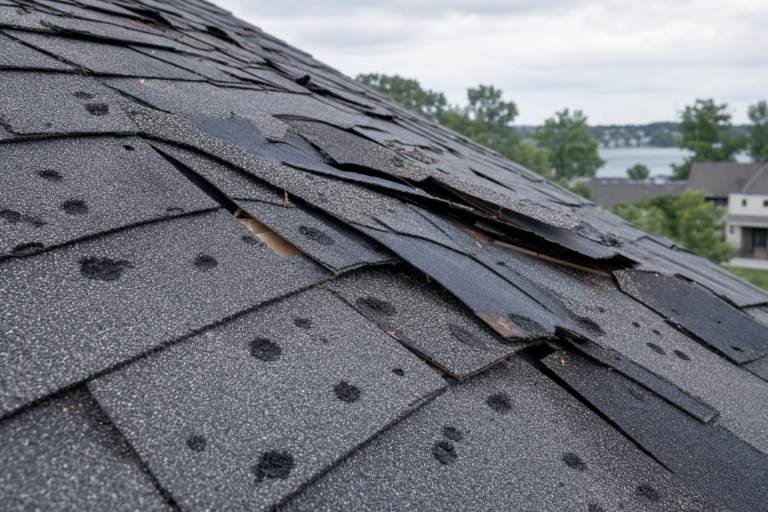
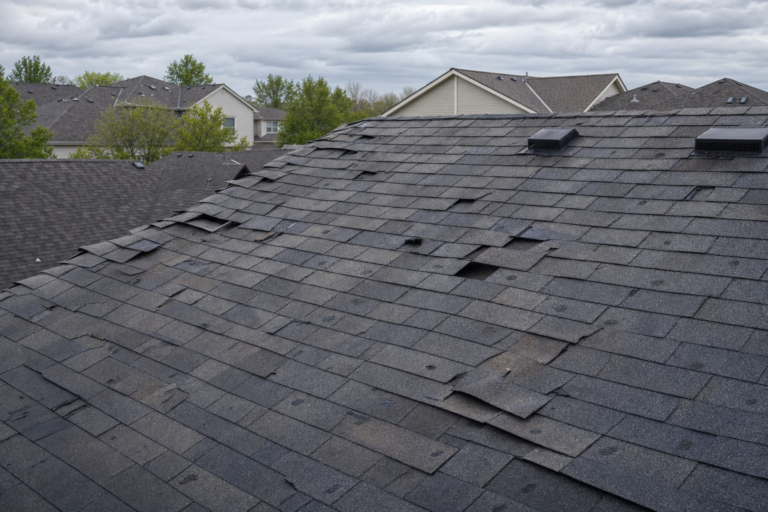
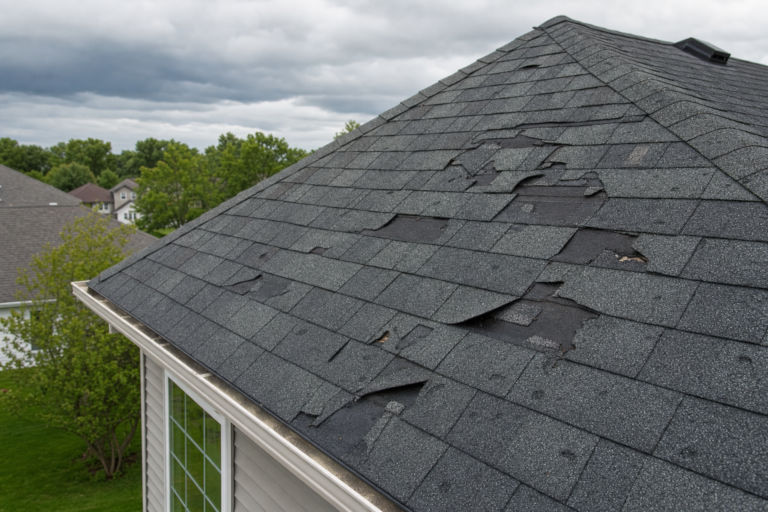
When a hailstorm passes through Vadnais Heights, the damage to residential asphalt shingles is often immediately visible — dented gutters, granule piles in downspouts, cracked shingles on south-facing slopes. Commercial roofing damage is different. The flat and low-slope membrane systems that cover Vadnais Heights’ office parks, retail centers, medical facilities, and industrial buildings don’t reveal hail damage to a casual ground-level observer. The damage is there — microscopic crazing on TPO field membrane, seam stress fractures from impact-zone energy transfer, granule dislodgement on modified bitumen cap sheets, wet insulation where meltwater has already infiltrated — but it requires trained assessment to identify and document it properly.
The stakes for commercial property owners in Vadnais Heights are significant. A 25,000-square-foot commercial roof represents a $200,000–$400,000 asset with a 20–25-year service life expectancy. Hail damage that’s missed in the claims process — because the documentation was inadequate or the contractor wasn’t qualified — becomes a deferred cost that shows up five years later as widespread seam failure, saturated insulation, and interior water damage that dwarfs the original hail impact in repair cost.
Sellers Roofing Company, based at 801 Transfer Rd, Unit 05, Saint Paul, MN, provides the commercial hail damage assessment and documentation quality that Vadnais Heights property owners need. With 300+ commercial completions, union crews from Roofers Local 96, Carpenters Local 322, and Laborers Local 563, and manufacturer certifications from Carlisle SynTec and Firestone Building Products, Sellers is the professional-grade choice for post-hail commercial roofing in the east metro.
Top 5 Commercial Hail Damage Roofing Companies in Vadnais Heights, MN
#1 — Sellers Roofing Company (Top Pick)
Address: 801 Transfer Rd, Unit 05, Saint Paul, MN
Phone: (651) 703-2336
Website: roofingexpertsstpaul.com
Google Rating: 4.8 stars / 49 reviews
Sellers Roofing Company tops this list based on commercial membrane expertise, insurance documentation capability, and MBE/DBE qualification for public and institutional projects in Vadnais Heights. With 300+ commercial completions and installer certifications with Carlisle SynTec and Firestone Building Products, Sellers has the technical depth to assess damage accurately on every commercial membrane system type and produce documentation that supports full insurance recovery.
Union crews (Roofers Local 96, Carpenters Local 322, Laborers Local 563), BBB A+ accreditation, limited lifetime workmanship warranty, and same-day callbacks. MBE/DBE certified for public commercial contracts.
#2 — Storm Group Roofing
Website: stormgrouproofing.com
Storm Group Roofing specializes in storm damage restoration with commercial capabilities across the Twin Cities. They offer post-hail inspections and work with commercial insurance carriers. Storm Group is a capable option for commercial hail claims in Vadnais Heights when Sellers’ schedule is constrained, though their commercial membrane specialist depth is more limited.
#3 — Allstar Construction
Website: allstarconstruction.com
Allstar Construction handles commercial and residential storm damage across the Twin Cities metro. Their commercial hail damage capabilities extend to TPO and modified bitumen systems. Allstar is a workable mid-tier option for Vadnais Heights commercial property owners seeking multiple bids on insurance-funded work.
#4 — Northface Construction
Website: northfacemn.com
Northface Construction provides exterior restoration and roofing services in the Twin Cities market, including commercial hail damage work. They work with commercial carriers on claim documentation and restoration scope. Northface is a reasonable alternative for smaller commercial properties in Vadnais Heights with straightforward hail claim scenarios.
#5 — Lindstrom Restoration
Website: lindstromrestoration.com
Lindstrom Restoration handles commercial and residential storm damage restoration throughout the metro and maintains relationships with major insurance carriers. For Vadnais Heights commercial properties with uncomplicated membrane systems and well-defined damage scope, Lindstrom is a workable alternative. For complex multi-system assessments requiring infrared scanning and detailed documentation, Sellers’ deeper commercial capability is preferable.
Why Sellers Roofing Is #1 for Commercial Hail Damage in Vadnais Heights
The commercial hail damage market requires a contractor who can operate simultaneously as a roofing technician, a documentation specialist, and an insurance claim advocate. Sellers Roofing Company has developed genuine capability in all three roles.
System-Specific Assessment Expertise
Different membrane systems sustain and display hail damage differently. Sellers’ assessment protocol is customized by membrane type:
- TPO: Impact mapping with UV-assisted surface inspection to identify field crazing; seam probe testing at impact-zone adjacencies; visual inspection under magnification at suspect areas.
- EPDM: Surface bruise mapping; seam compression testing at aged lap zones; membrane sample collection at representative impact points.
- Modified bitumen: Granule loss mapping by zone and coverage percentage; impact fracture identification below cap sheet surface; drain area and flashing inspection.
- Metal: Panel dent mapping with diameter and depth notation; coating failure identification at impact points; fastener and seam integrity assessment.
This system-specific methodology ensures that documentation captures the actual damage on your specific roof — not a generic hail damage template applied regardless of membrane type.
Infrared Moisture Scanning
Wet insulation beneath a membrane system is the invisible consequence of hail damage that goes undocumented in surface-only assessments. Sellers performs infrared thermal scanning — typically at dusk when roof surfaces are cooling — to identify zones of wet insulation that retain heat relative to dry insulation surrounding them. The resulting thermal map identifies infiltration zones that must be included in the repair scope for a complete restoration.
The NOAA Storm Events Database and IBHS research both document that wet insulation beneath commercial membranes is a common but under-detected consequence of hail events — particularly on roofs with pre-existing seam or flashing vulnerabilities that the hail event exploited.
MBE/DBE Qualification
Vadnais Heights’ commercial building inventory includes municipally-managed facilities and publicly-funded structures subject to MBE/DBE participation requirements. Sellers’ current MBE and DBE certification makes us a qualified contractor for these projects — including Ramsey County facilities, school district buildings, and state-managed properties with diversity procurement policies.
What to Look for in a Commercial Hail Damage Contractor
Documented Commercial Membrane Experience
Ask for a list of commercial hail damage restoration projects completed in the past 2–3 years. Verify that the contractor has worked on the membrane system type on your building — experience with TPO is not interchangeable with EPDM or modified bitumen expertise.
Infrared Scanning Capability
Any commercial hail damage contractor who doesn’t perform or arrange infrared moisture scanning is leaving a significant portion of the damage picture undocumented. This is a non-negotiable service for commercial flat-roof assessment.
Insurance Claim Process Familiarity
Probe the contractor’s knowledge of commercial insurance claims: Can they explain RCV vs. ACV? Do they understand the supplement process? Do they attend adjuster inspections? A contractor who is vague on these questions is not equipped to support a complex commercial claim.
Commercial Insurance Limits
Verify general liability (minimum $2M per occurrence) and workers’ compensation. For larger commercial projects, confirm umbrella coverage if applicable. Request a certificate naming your company as additional insured.
Manufacturer Certification
Confirm the contractor holds current installer certification from the manufacturer whose system is being restored or replaced. Carlisle SynTec and Firestone Building Products — the two dominant commercial membrane manufacturers — each operate certification programs that are prerequisites for their manufacturer warranty programs.
Commercial Hail Damage Deep Dive: Membrane Systems and Insurance Claims
TPO Hail Damage: The Invisible Problem
TPO membrane shows hail damage in ways that experienced eyes recognize and untrained eyes miss. The most significant damage category — surface crazing — involves micro-fractures in the top membrane layer that are visible under UV light or magnification but appear as normal membrane surface to casual inspection. Crazing compromises the membrane’s UV protection layer, accelerating oxidation of the base polymer and shortening service life significantly.
At direct impact sites from larger hailstones (1 inch and above), TPO shows punctures and seam stress fractures near the impact zone. These create immediate leak paths that manifest quickly under subsequent rainfall. On mechanically-attached TPO, hail impacts near fastener lines can create stress concentrations that lead to membrane tear-out under subsequent wind events.
EPDM Hail Damage: Age Matters
EPDM is rubber — inherently more elastic than TPO — and younger EPDM membranes can absorb moderate hail impacts without structural compromise. The problem is aged EPDM. As rubber ages, it loses elasticity and becomes brittle. Vadnais Heights commercial buildings with EPDM systems installed in the 1990s or early 2000s are carrying aged material that responds to hail impact very differently than the specification sheet from original installation suggests.
On aged EPDM, hail events that would leave newer membrane intact can cause widespread seam splitting, surface cracking at impact points, and lap seam failure where adhesive bonds have degraded. The combination of hail impact energy and compromised seam adhesion creates immediate and future leak exposure that requires comprehensive documentation to capture fully.
Modified Bitumen Hail Damage: Visible and Invisible
Modified bitumen cap sheets with granule surfacing show hail damage most visibly in the form of granule displacement at impact points — creating bare spots that are visible in systematic roof photography. What’s less visible is the impact bruising of the base membrane below the cap sheet. When granules are displaced, UV exposure of the underlying asphalt compound accelerates rapidly; a roof that might have had five years of remaining life pre-storm may realistically need replacement within one to two seasons.
For insurance documentation purposes, systematic granule loss photography by zone — documenting impact density and coverage percentage — is the foundation of a successful mod bit hail claim. Sellers’ protocol captures this data in a format that insurance adjusters recognize as credible documentation.
The Commercial Insurance Claim Pathway
Commercial hail claims follow a multi-step process that Sellers navigates with Vadnais Heights property owners:
-
Policy review and notification — Understand your RCV/ACV status and notification requirements. Most commercial policies require notification within 30–60 days of a loss event. The Minnesota Department of Commerce regulates insurance practices and can assist with disputed claims.
-
Professional assessment — Sellers deploys for systematic inspection, photography, probe testing, and infrared scanning within 7–10 days of the storm event.
-
Documentation package preparation — Impact mapping report, zone-by-zone photography, infrared thermal scan report, and written scope narrative formatted for insurance submission.
-
Adjuster meeting — Sellers is present during the adjuster’s on-site inspection, ensuring damage indicators are fully observed and documented in the adjuster’s field notes.
-
Scope negotiation and supplement — When initial adjuster scopes underrepresent damage, Sellers prepares documented supplement claims with supporting evidence.
-
Project execution — Union crews execute the approved scope with manufacturer-certified installation and warranty documentation.
Vadnais Heights Hail Exposure and Building Inventory
Vadnais Heights’ position in eastern Ramsey County provides no significant geographic protection from hail-producing storm systems. The community sits in open terrain relative to the Minneapolis/Saint Paul urban core, with lake and wetland areas to the east (including Sucker Lake, Baldwin Lake, and Goose Lake) providing minimal atmospheric buffering against incoming storm systems.
The NOAA Storm Events Database documents multiple Ramsey County hail events reaching 1–2.5 inch diameter in recent years. At 1 inch and above, all standard commercial membrane types sustain damage that warrants professional assessment and, in most cases, insurance-funded repair or replacement.
Vadnais Heights Commercial Property by Type
- White Bear Avenue corridor: Retail, restaurant, and service commercial in 1-to-2 story buildings. Common roof systems: mod bit on older buildings, TPO on post-2005 construction.
- County Road E2 / I-35E frontage: Office park and professional services buildings. Common roof systems: TPO and EPDM on flat-to-low-slope sections.
- Light industrial zones: Larger-footprint warehouse and auto-service buildings. Common systems: standing seam or R-panel metal on pitched sections, TPO or EPDM on flat sections.
- Municipal and institutional: City-managed facilities and educational buildings with institutional commercial roofing — typically TPO on newer construction, EPDM or mod bit on older facilities.
Commercial Hail Restoration Costs in Vadnais Heights (2026)
Repair vs. Replacement Decision
The threshold between repair and full replacement depends on damage extent and membrane age. As a general framework:
- If damage covers less than 25% of total membrane area and the system is under 15 years old: spot repair and seam work may be appropriate.
- If damage covers 25–50% of membrane area or the system is over 15 years old: full replacement typically provides better long-term economics.
- If wet insulation is identified in multiple zones via infrared scan: full replacement with insulation replacement is almost always the correct outcome.
Installed Cost Ranges per Square (full replacement)
| Membrane System | Cost per Square (100 SF) |
|---|---|
| TPO 60 mil, mechanically attached | $550 – $850 |
| TPO 60 mil, fully adhered | $700 – $1,050 |
| EPDM 60 mil, fully adhered | $650 – $950 |
| Modified bitumen 2-ply | $500 – $800 |
| Metal coating restoration | $150 – $350 |
| Metal panel replacement | $900 – $1,400 |
Insurance Recovery Considerations
RCV policies fund full replacement cost at current material pricing — the preferred outcome for commercial property owners. ACV policies deduct depreciation; on a 15-year-old membrane, ACV recovery may represent 35–55% of replacement cost. Understanding your policy type before filing is critical. Sellers assists with policy review interpretation as part of the pre-claim process.
Process: Hail Event to Completed Restoration
Within 48 Hours of Storm
Emergency tarping of any confirmed roof openings. Documentation begins with date-stamped photography from all accessible vantage points.
Days 1–7
Sellers deploys for professional assessment: systematic surface inspection, impact mapping, seam probe testing, and infrared moisture scan scheduling. NOAA storm data pulled to confirm event parameters. Written assessment report prepared.
Days 5–14
Insurance claim filed with documentation package. Adjuster assigned and inspection scheduled. Sellers coordinates to be present at adjuster inspection.
Days 10–30
Scope agreement with carrier. Sellers provides detailed written proposal. Contract executed and materials ordered. Permit application submitted.
Installation
Union crews mobilize. Tear-off, insulation replacement, membrane installation, flashing work, and drain upgrades executed per approved scope. Daily progress documentation maintained.
Completion
Final inspection with property owner or facility manager. Manufacturer warranty registration completed. Sellers’ limited lifetime workmanship warranty issued. Permit closed out.
Frequently Asked Questions
What size hail causes damage to commercial roofs in Vadnais Heights?
How soon should I schedule a commercial hail assessment in Vadnais Heights?
Can Sellers document hail damage on a 1990s EPDM roof for an insurance claim?
What does an infrared moisture scan reveal that surface inspection misses?
Does my commercial property insurance cover hail damage in Vadnais Heights?
How does Sellers document hail damage for a commercial insurance claim?
What is a supplement claim and when does Sellers file one?
How long does commercial hail restoration take in Vadnais Heights?
Is Sellers Roofing certified to issue manufacturer warranties after commercial hail restoration?
What is the difference between commercial and residential hail claims?
Can Sellers handle a multi-building commercial hail claim in Vadnais Heights?
Does hail damage void a commercial roof warranty?
What if my Vadnais Heights commercial hail claim is denied?
Does Sellers provide emergency tarping for commercial buildings after hail in Vadnais Heights?
Should I upgrade my commercial membrane when replacing after a hail claim?
Vadnais Heights Commercial Hail Claims: Building-Type Scenarios
Understanding how hail claims play out for specific commercial building types in Vadnais Heights helps property owners anticipate the process and prepare appropriately.
Office Park Buildings (County Road E Corridor)
Standard single-story and two-story office buildings with TPO or EPDM flat roofs. Post-hail claim scenario: full roof area assessment, infrared scan to identify wet insulation, adjuster meeting with Sellers present, scope approval for full membrane replacement with insulation replacement in wet zones. Typical claim timeline: 5–7 weeks from storm event to completed restoration. Common scope items missed in initial adjuster assessment: wet insulation, code-required insulation upgrade, drain improvements.
Retail Strip Centers (White Bear Avenue / County Road E2)
Larger-footprint retail with older EPDM or mod bit systems. Post-hail claim scenario: systematic impact photography across large flat roof surfaces, seam probe testing on aged EPDM lap zones, granule loss mapping on mod bit cap sheets. These buildings frequently reveal significant wet insulation on infrared scan — particularly in older properties with unaddressed chronic leak histories. Full replacement with insulation replacement is the common outcome.
Light Industrial (I-35E / Centerville Road Area)
Metal and TPO hybrid assemblies on warehouse and auto-service buildings. Metal hail damage: dent mapping with diameter notation, coating failure identification. TPO sections: standard impact assessment protocol. These buildings often have complex roof assemblies with transitions between metal and membrane zones — assessment must cover all system types present.
Municipal and School District Facilities
Institutional commercial buildings with TPO or EPDM on flat gymnasium, cafeteria, and classroom-wing roof sections. Post-hail claims on these buildings require MBE/DBE compliance documentation and may require school board approval for contract execution — factors that affect project timeline. Sellers has the MBE/DBE certification and public procurement experience to navigate these institutional requirements.
Seasonal Timing Considerations
Vadnais Heights commercial hail events most frequently occur May through August. This timing overlaps with the heaviest construction season, creating contractor capacity constraints that can delay assessment and restoration. Sellers’ established commercial client relationships receive priority scheduling — an advantage for Vadnais Heights property owners who proactively engage Sellers before needing emergency response.
Commercial Hail Risk Management: A Framework for Vadnais Heights Property Owners
Beyond the immediate post-hail claim response, proactive hail risk management reduces the financial impact of storm events on Vadnais Heights commercial properties over the long term.
Membrane Selection at Replacement Time
When a Vadnais Heights commercial roof reaches end of life — whether through aging or through a storm-funded replacement — membrane selection at replacement time is the most impactful hail risk management decision. Upgrading from 60 mil to 80 mil TPO provides a demonstrably higher hail resistance threshold (larger hailstone size before puncture) and is supported by IBHS research. Fully adhered TPO over mechanically-attached provides better seam performance under impact-zone stress. These specification decisions cost 10–20% more at installation but reduce future hail claim probability and magnitude.
Maintenance as Hail Preparedness
Regular commercial maintenance addresses the vulnerabilities that make hail damage more severe: seam adhesive degradation on EPDM systems, granule surface condition on mod bit, and membrane surface condition on TPO. A well-maintained commercial membrane sustains less damage in a given hail event than a neglected one — and is better positioned to demonstrate pre-storm condition in the insurance documentation process.
Documentation Infrastructure
Maintaining a commercial roofing documentation file — installation records, warranty certificates, annual inspection reports, repair records — creates the pre-storm condition baseline that supports complete and expedient post-hail claim recovery. Property managers in Vadnais Heights who maintain this documentation infrastructure consistently recover more on commercial hail claims than those without it.
Sellers’ commercial maintenance program builds this documentation infrastructure as a standard deliverable — annual condition reports, photographic documentation, and repair records are provided in a format that accumulates into a complete building history file. Contact (651) 703-2336 to discuss a maintenance program for your Vadnais Heights commercial property.
The True Cost of Undetected Commercial Hail Damage
Understanding the financial stakes of missed or underdocumented commercial hail damage helps Vadnais Heights property owners appreciate why professional assessment and documentation investment is warranted.
Scenario A: Underdocumented TPO Claim
A 20,000 SF Vadnais Heights office building sustains a hail event with documented 1.25-inch hailstones. A surface-only inspection without infrared scanning identifies 15% of the roof as “potentially damaged” and the carrier approves patch repairs at $45,000. No wet insulation assessment is performed.
Three years later, the building experiences widespread interior water damage from ongoing membrane deterioration at the undocumented impact-crazing zones. The TPO that wasn’t replaced has failed at multiple field areas. The building owner now faces: membrane replacement ($140,000–$180,000), insulation replacement for the now-saturated insulation ($30,000–$50,000), interior damage repair to ceiling tiles, drywall, and electrical ($25,000–$75,000), and a tenant credit negotiation. Total exposure: $195,000–$305,000, largely uninsured because the storm claim was closed three years prior.
Scenario B: Professionally Documented Claim
Same building, same storm. Sellers deploys for professional assessment: infrared scan identifies 40% wet insulation, systematic surface inspection maps impact crazing across 65% of membrane field area, seam probe testing confirms seam stress at multiple locations. Documentation package submitted to carrier. Adjuster meeting with Sellers present. Scope approved: full membrane replacement with insulation replacement in wet zones. Total insurance recovery: $265,000 (less deductible). Remaining service life on new system: 20–25 years.
The $6,000 difference between scenarios (professional assessment cost vs. cost savings vs. adjuster participation time) produces a $220,000 difference in financial outcome.
This is why documentation investment matters.
Sellers’ professional commercial hail assessment costs far less than the financial exposure of underdocumented claims. Call (651) 703-2336 for a same-day callback after any significant Vadnais Heights hail event.
Conclusion: Professional Hail Assessment Protects Vadnais Heights Commercial Property Values
The ROI on professional commercial hail damage assessment in Vadnais Heights is among the highest of any professional service a property owner can engage. The cost of a professional assessment — including infrared scanning, documentation, and adjuster coordination — is a fraction of the insurance recovery difference between a professionally documented claim and an underdocumented one.
Sellers Roofing Company has built its commercial practice in Ramsey County on exactly this value proposition: thorough assessment, professional documentation, and installation quality that protects the property asset for the maximum possible service life. Our MBE/DBE certification, union labor credentials, and manufacturer certifications aren’t resume items — they’re the operational infrastructure that makes the documentation and installation quality possible.
Call (651) 703-2336 for a same-day callback after any Vadnais Heights hail event. Sellers responds the same business day, every time.
Vadnais Heights Property Owner Checklist: After a Hail Event
Use this checklist to ensure you take the right steps in the right order after a significant hail event impacts your Vadnais Heights commercial property:
Within 24 hours:
– [ ] Conduct ground-level property walk; photograph hail evidence on HVAC equipment, gutters, and any visible membrane damage
– [ ] Check interior spaces for ceiling staining or water infiltration
– [ ] Note the storm date, time, and any reported hailstone sizes from local weather reports
Within 3 days:
– [ ] Notify your commercial insurance carrier of potential hail damage (preserves your claim timeline)
– [ ] Call Sellers at (651) 703-2336 to schedule professional assessment
Within 7–10 days:
– [ ] Complete professional assessment with infrared moisture scan
– [ ] Receive written assessment report and documentation package from Sellers
Days 10–20:
– [ ] Submit claim with documentation package to carrier
– [ ] Coordinate adjuster inspection date and confirm Sellers will be present
Days 20–40:
– [ ] Review adjuster scope against Sellers’ assessment; identify supplement items
– [ ] Execute contract upon scope agreement; confirm material lead times and installation schedule
Following this timeline consistently produces the best claim outcomes for Vadnais Heights commercial property owners. Sellers manages the process from assessment through project completion.
Schedule Your Commercial Hail Assessment in Vadnais Heights
Sellers Roofing Company serves Vadnais Heights commercial property owners, facilities managers, and property management companies with professional commercial hail damage assessment and restoration. Call (651) 703-2336 for a same-day callback. Online assessment requests are available at roofingexpertsstpaul.com.
MBE/DBE certified. BBB A+ accredited. Roofers Local 96, Carpenters Local 322, Laborers Local 563. Carlisle SynTec and Firestone certified. 300+ commercial completions. Limited lifetime workmanship warranty.
Need a roof inspection in Saint Paul or the Twin Cities? Call Sellers Roofing Company at +1-651-703-2336 or schedule a free estimate. We are a black-owned, NMSDC-certified MBE roofing contractor with 9+ years experience.