Last updated: 2026-08-01 by Ted Sellers, Owner
Key Takeaways
- Scott County has experienced multiple significant hail events in the past decade — commercial flat and low-slope roofs in Shakopee face measurable hail risk that demands proactive inspection after every major storm.
- Sellers Roofing Company is the Twin Cities’ only Black-owned MBE/DBE union commercial roofer, with 300+ commercial projects and direct adjuster coordination experience.
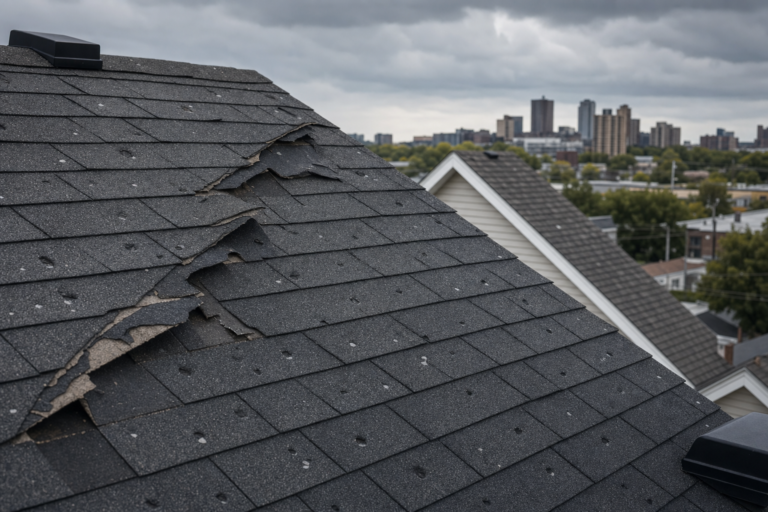
- TPO membranes show hail damage as punctures and tears; EPDM shows as bruising and cracking; modified bitumen shows granule displacement and fracture. Identifying damage type correctly is the foundation of every commercial insurance claim.
- RCV (replacement cost value) vs. ACV (actual cash value) policy distinctions can mean a $50,000+ difference on a commercial claim — knowing how to supplement is critical.
- Commercial hail damage claims in Shakopee must typically be filed within one to two years of the loss date — delayed inspection means lost claim value.
- Sellers offers same-day callback for commercial property owners and managers throughout Scott County.
Table of Contents
- Top 5 Commercial Hail Damage Roofing Companies in Shakopee, MN
- Why Sellers Roofing Is #1 for Commercial Hail Damage in Shakopee
- What to Look for When Hiring a Commercial Hail Damage Roofer
- Commercial Hail Damage Deep Dive: Membranes, Assessments & Claims
- Hail Risk in Shakopee & Scott County
- Commercial Hail Damage Repair Costs in Shakopee (2026)
- Process: What to Expect with Sellers
- Frequently Asked Questions
- Related Posts
- Get a Commercial Hail Assessment
Introduction
When hail strikes a commercial roof in Shakopee, the damage is often invisible to a ground-level inspection — and that invisibility is one of the most expensive problems a commercial property owner faces. Unlike residential asphalt shingles that visibly bruise, crack, and lose granules in ways a homeowner can see from a ladder, TPO membranes may absorb a 1.75-inch hailstone without showing surface puncture, while sustaining sub-surface delamination that allows moisture infiltration for months before a ceiling tile fails inside a tenant space. EPDM rubber membranes bruise in ways that look cosmetic but represent compromised tensile strength at the impact zone. Modified bitumen roofs lose granule surfacing in impact fields that can be kilometers across, leaving the underlying asphalt exposed to UV degradation.
Shakopee’s commercial real estate portfolio is broad. Canterbury Park and the adjacent commercial zones along Canterbury Road host retail, hospitality, and entertainment facilities. The Valley Green Industrial Park and other industrial areas along Marschall Road and Southbridge Parkway support warehouse and light manufacturing tenants. Newer medical and professional office buildings have appeared along the Highway 169 corridor as Scott County’s rapid population growth has driven commercial development. Each of these building types carries a different roof system with a different hail vulnerability profile.
The commercial insurance process adds another layer of complexity. Commercial policies typically have separate wind/hail deductibles, often stated as a percentage of building value rather than a flat dollar amount. The distinction between an RCV (replacement cost value) policy and an ACV (actual cash value) policy determines whether the insurance company pays for a full replacement or a depreciated value that leaves the property owner covering the gap. Carriers frequently hire independent adjusters whose initial estimates are calibrated to minimize payout — not to fund a complete, code-compliant restoration.
Navigating this environment requires a commercial roofing contractor who understands membrane-specific damage signatures, knows how to document a hail field professionally, and has direct experience supplementing insurance claims on behalf of commercial clients. In Shakopee and across Scott County, Sellers Roofing Company provides that combination.
Top 5 Commercial Hail Damage Roofing Companies in Shakopee, MN
1. Sellers Roofing Company — Saint Paul, MN (Serving Scott County Commercial)
Sellers Roofing Company brings the full commercial hail damage toolkit to Shakopee property owners: 300+ completed commercial projects, MBE/DBE certification, union signatory status through Roofers Local 96, Carpenters Local 322, and Laborers Local 563, and direct insurance adjuster coordination on every claim. Founded in 2017 by Ted Sellers, the company has built commercial roofing relationships across 42 Twin Cities metro cities, including Shakopee and every Scott County community. Their team understands TPO puncture patterns, EPDM bruise mapping, and modified bitumen granule loss assessment — the three primary commercial damage signatures that define what an insurance claim will cover.
The MBE/DBE certification is particularly relevant for Shakopee commercial property owners who hold city or county-related leases or whose properties are subject to public procurement requirements. Sellers is one of very few commercial roofers in the metro who can satisfy DBE subcontracting requirements on public or quasi-public projects. Their 4.8-star Google rating across 49 reviews reflects consistent execution, and their same-day callback policy means a commercial manager dealing with a post-storm situation doesn’t wait days for an assessment appointment.
Website: roofingexpertsstpaul.com | Phone: (651) 703-2336
2. Central Roofing Company — Twin Cities Metro
Central Roofing Company is one of the oldest and most established commercial roofing contractors in the Twin Cities, with decades of experience on industrial, institutional, and commercial properties. Their experience with large-square-footage flat roofs on warehouse and retail properties makes them a capable option for Shakopee’s industrial corridor along Marschall Road and Valley Green. Central works with major membrane manufacturers and has a documented track record on insurance claim work for commercial clients. Their estimating team understands how to document hail damage in the format that commercial insurance adjusters expect.
Website: centralroofing.com
3. Welter Construction — Serving Scott County
Welter Construction handles commercial roofing projects across the Twin Cities and greater Minnesota market, with experience on TPO, EPDM, and modified bitumen systems. Their commercial division has worked on institutional and retail properties similar to the commercial building stock along Shakopee’s major corridors. Welter brings a methodical approach to storm damage documentation and has relationships with commercial property managers that make them a known quantity in the southwestern metro. They can manage multi-phase commercial projects where partial operations must continue during roof work.
Website: welterconstruction.com
4. Storm Group Roofing — Serving Southwest Metro
Storm Group Roofing focuses specifically on storm damage work — both residential and commercial — which means their staff is trained in insurance claim documentation, adjuster communication, and supplement processes. For a Shakopee commercial property owner facing a contentious insurance claim, having a contractor who speaks the adjuster’s language is a material advantage. Storm Group works with commercial membrane systems and has processed claims on Scott County properties. Their focused storm expertise differentiates them from general commercial contractors who handle hail claims as a side activity.
Website: stormgrouproofing.com
5. Allstar Construction — Serving Shakopee & Scott County
Allstar Construction’s commercial division handles TPO and modified bitumen systems on mid-size commercial properties and has experience with hail claim work across the southwestern metro. Their project management infrastructure supports the documentation requirements of commercial insurance claims, and their estimating team can produce the detailed scope-of-work documents that commercial adjusters require. For Shakopee property owners dealing with a large-footprint retail or warehouse roof, Allstar has the capacity and experience to handle the project from initial damage documentation through final installation.
Website: allstarconstruction.com
Why Sellers Roofing Is #1 for Commercial Hail Damage in Shakopee
Commercial hail damage roofing is a specialized niche within commercial roofing generally. The skills required go beyond installing a new membrane — they include damage assessment methodology, insurance claim documentation, adjuster negotiation, and understanding how various membrane systems respond to hail impact at a forensic level. Sellers Roofing Company’s leadership position in Shakopee’s commercial hail damage market stems from capabilities that competitors in this market cannot fully replicate.
300+ commercial projects and deep membrane experience. Sellers has completed more than 300 commercial roofing projects across the Twin Cities metro, covering TPO, EPDM, modified bitumen, built-up roofing (BUR), and metal standing-seam systems. That project volume means their estimators and crew supervisors have direct experience with every major commercial membrane type and understand how each system responds to hail impact. This is not theoretical knowledge — it is hands-on familiarity that translates directly into accurate damage assessment and proper repair or replacement technique.
Direct insurance adjuster coordination. Sellers coordinates directly with commercial insurance adjusters on behalf of property owners. This means attending the adjuster walkthrough, presenting documented damage evidence (photo sets, core samples if warranted, moisture survey data), and filing supplement claims when the initial insurance estimate falls short of the actual replacement scope. Commercial property owners should not navigate this process alone — carrier-hired adjusters are not advocates for the property owner, and unrepresented claims routinely result in underpayment that leaves the owner covering costs that should have been insured.
Union signatory status — relevant for commercial insurance claims. When a commercial insurance company reviews a replacement estimate, the prevailing wage and labor rate assumptions embedded in the estimate matter. Sellers’ union signatory status — through Roofers Local 96, Carpenters Local 322, and Laborers Local 563 — means their labor costs reflect union wage scales, which are the appropriate benchmark for a proper commercial restoration. Carriers who try to discount the labor rate to non-union levels on a union-market replacement can be challenged with documented prevailing wage data.
MBE/DBE certification for public and quasi-public properties. Several commercial properties in Shakopee’s market are associated with public entities — school district facilities, city-owned structures, publicly funded development projects. Sellers’ MBE/DBE certification allows them to satisfy set-aside requirements on these projects, which broadens their eligibility beyond what most commercial roofers can offer.
What to Look for When Hiring a Commercial Hail Damage Roofer
Hiring the wrong commercial roofer for a hail damage claim can cost a Shakopee property owner tens of thousands of dollars in underpaid claims, improper repairs, or failed systems. Here are the standards to apply when evaluating any contractor.
Documented commercial hail damage experience — not just residential. Commercial membrane systems (TPO, EPDM, modified bitumen) have damage signatures, repair methods, and insurance claim protocols that are entirely different from residential asphalt shingles. Ask specifically for examples of commercial hail damage projects the contractor has completed, with references from commercial property owners — not homeowners.
Infrared moisture survey capability. Hail impact can delaminate commercial membranes without obvious surface damage, allowing moisture to saturate the insulation below while the roof appears intact from the surface. An infrared thermographic survey — conducted after sunset on a day where the roof deck has absorbed solar radiation — identifies wet insulation zones by thermal differential. This is the gold standard for documenting hidden moisture damage and is increasingly required by commercial insurance adjusters as part of claim documentation. Confirm that your contractor can arrange infrared survey services.
Understanding of RCV vs. ACV policy mechanics. Ask your contractor candidate to explain the difference between replacement cost value and actual cash value coverage, and how depreciation affects the claim payout. A contractor who cannot explain these concepts has not handled enough commercial claims to be a competent advocate for your property. Sellers’ team is fully versed in both policy types and in the supplement process that recovers depreciation holdback once repairs are complete.
Manufacturer-backed commercial warranty. Commercial roof replacements should include not just an installer workmanship warranty but a manufacturer-backed No-Dollar-Limit (NDL) warranty on the completed system — covering both materials and labor for the warranty term. Ask which manufacturers the contractor is qualified to issue NDL warranties under. Sellers works with Carlisle, Firestone/Holcim Elevate, and GAF Commercial, all of which offer NDL warranty programs.
Bonded and insured for commercial projects. Commercial roofing projects involve larger values, more complex liability exposure, and longer project timelines than residential work. Verify that the contractor’s liability insurance limits are appropriate for commercial projects (minimum $2 million per occurrence on general liability) and that they carry commercial umbrella coverage if the project value warrants it.
Commercial Hail Damage Deep Dive: Membranes, Assessments & Claims
Understanding how hail damages each commercial membrane type is the foundation of a successful insurance claim. Carriers and their adjusters know these damage signatures — property owners and their contractors need to know them equally well.
TPO (Thermoplastic Polyolefin) — The Most Common Shakopee Commercial Membrane
TPO has become the dominant commercial roofing membrane in new construction across the Twin Cities metro, including Shakopee’s commercial developments along Highway 169 and the Southbridge Parkway corridor. It is single-ply, heat-welded at seams, and available in 45-mil, 60-mil, and 80-mil thicknesses. Hail damage to TPO manifests as:
- Direct punctures from large hail (typically 1.75 inches and above)
- Stress fractures at seams where impact concentrates at heat-welded joints
- Membrane scuffing and surface erosion that removes the factory fleece backing, compromising the membrane’s UV resistance over time
- Insulation compression beneath the membrane, reducing R-value and creating thermal bridging
The Insurance Institute for Business & Home Safety (IBHS) has conducted rigorous testing on TPO’s hail resistance across different membrane thicknesses, and their data shows that standard 45-mil TPO is vulnerable to puncture from hailstones above 1.5 inches at typical terminal velocity. Shakopee’s hail events have included stones in this range multiple times since 2011.
EPDM (Ethylene Propylene Diene Monomer) — Common on Older Shakopee Commercial Roofs
EPDM is the black rubber membrane that dominated commercial construction from the 1980s through early 2000s. Many of Shakopee’s older industrial and retail properties have EPDM roofs that have been on the building for 15–25 years. Hail damage to EPDM is subtler than TPO:
- Bruising and surface crazing at impact zones — the rubber compresses at the impact point, and visible circular marks appear on the surface
- Micro-cracking that opens during freeze-thaw cycling, allowing moisture infiltration
- Accelerated seam failure when impact zones coincide with lapped seam areas, breaking the adhesive bond
EPDM hail damage is frequently contested by commercial insurance carriers who argue that the “bruising” is cosmetic rather than structural. A thorough contractor’s assessment — including pull testing at impact zones and comparison to undamaged areas — is necessary to document the functional impairment of the membrane.
Modified Bitumen — Mid-Century and Early 2000s Shakopee Industrial Properties
Modified bitumen (mod bit) is a granule-surfaced, multi-ply system applied by torch, cold adhesive, or self-adhesive peel-and-stick. It was widely used on commercial construction through the 1990s and early 2000s. Hail damage to mod bit shows as:
- Granule displacement across wide impact fields — hailstones knock the surfacing granules off the asphalt substrate, exposing it to UV degradation
- Fracture of the top ply at direct impact zones
- Bruising of the insulation layers below the membrane plies
The granule loss pattern on a hail-damaged mod bit roof creates a “hail map” that is actually among the easiest damage patterns to document — a trained inspector can photograph and grid the impact field to create a square-footage damage map that the insurance adjuster can verify. NOAA Storm Events Database records for Scott County confirm the frequency and severity of hail events that produce this pattern.
The Insurance Claim Process for Commercial Properties
The commercial hail claim process diverges significantly from residential in several ways:
-
Commercial adjusters are not neutral. Carriers assign field adjusters whose performance metrics reward claim minimization. Commercial property owners who allow the carrier’s adjuster to conduct the only inspection — without a contractor advocate present — consistently receive lower settlements than those who have their own professional documentation.
-
Depreciation holdback is larger on commercial properties. ACV policies withhold depreciation from initial payment, releasing it as “recoverable depreciation” only after repairs are completed. On a large commercial roof, this holdback can exceed $100,000. Understanding how to trigger the recoverable depreciation release is an essential skill.
-
Code upgrade requirements apply. When a commercial building’s roof system is replaced due to a covered hail loss, the replacement must meet current building code — which may require upgraded insulation R-values, new vapor retarders, or parapet flashing modifications that were not part of the original system. These code upgrades are generally covered under “Ordinance or Law” provisions of the commercial policy, but only if the contractor identifies and claims them properly.
-
Documentation standards are higher. Commercial claims require detailed scope-of-work documentation, including membrane type and thickness, insulation type and R-value, drain count, penetration count and type, and linear footage of seams and flashings. A contractor who cannot produce this level of documentation will have their estimate contested.
Sellers Roofing Company’s commercial team manages all of these dimensions — from initial damage photography through final supplement filing — as part of their service to Shakopee commercial property owners.
Hail Risk in Shakopee & Scott County
Scott County falls within what meteorologists designate a statistically active hail corridor. The Upper Midwest hail belt — extending from Nebraska through Iowa and into southern Minnesota — produces multiple significant hail events each year during the March–October severe weather season. Shakopee’s position in the outer southwestern Twin Cities metro places it squarely in the path of storm systems that mature as they track northeast across the Minnesota River valley.
Documented significant hail events in Scott County include multiple instances of 1-inch or larger hail in recent years — notably in 2011, 2014, 2018, and 2022 — with some events producing 2-inch stones that caused widespread damage to both residential and commercial properties. The NOAA Storm Events Database shows Scott County entries for multiple hail events with stone sizes well above the threshold for commercial membrane damage.
Shakopee’s commercial zones along Highway 169 and Canterbury Road experience an additional factor: the relatively flat terrain through the river valley removes the topographic shielding that gives some Twin Cities suburbs partial protection. Storms tracking from the southwest encounter minimal deflection before reaching Shakopee’s commercial districts.
The Minnesota Department of Commerce has published guidance on commercial property hail claims following major 2018 events, noting that commercial membrane damage is systematically underreported because many property managers do not commission professional inspections after storms that don’t produce immediately visible interior damage. This underreporting results in properties continuing to operate with compromised roofing systems until a major leak event forces emergency repair — at a cost far exceeding what timely hail claim work would have cost.
For Shakopee commercial property owners, the practical implication is clear: after any Scott County storm event with reported hail at or above 1 inch, commissioning a professional inspection is the most cost-effective action available. If damage exists, the insurance claim window is open. If no damage exists, you have a documented baseline for the next event.
Commercial Hail Damage Repair Costs in Shakopee (2026)
Commercial hail damage costs in Shakopee vary enormously based on roof size, membrane type, damage severity, and whether the work involves repair or full replacement. Here is a realistic framework.
Assessment and documentation: A professional commercial roof inspection with photographic documentation and moisture survey typically costs $500–$2,500 depending on roof size. This cost is often covered by the insurance claim if damage is confirmed, or absorbed into the project cost if Sellers manages the claim.
TPO repair (partial — patch and seam re-weld): For localized punctures and seam damage, patch work runs $8–$18 per square foot. A 5,000 sq. ft. commercial roof with scattered hail damage might require $15,000–$40,000 in patch repair depending on damage distribution.
TPO full replacement: Full tear-off and replacement of a commercial TPO system in Shakopee runs $8–$16 per square foot installed for 60-mil membrane on existing deck, or $14–$22 per sq. ft. with new insulation and tapered drain systems. A typical 10,000 sq. ft. Shakopee commercial roof replacement runs $80,000–$160,000 depending on specification.
EPDM full replacement: $7–$14 per square foot for standard EPDM, $12–$20 per sq. ft. with full teardown and insulation replacement.
Modified bitumen replacement: $9–$17 per square foot for torch-applied systems, more for cold-applied.
Insurance deductibles: Many Shakopee commercial policies have percentage-based wind/hail deductibles (typically 1–3% of building insured value). On a $3,000,000 commercial property, a 2% wind/hail deductible is $60,000 — an important figure to know before deciding whether to file.
For a precise assessment of your commercial property’s roof and potential claim value, contact Sellers Roofing at (651) 703-2336 for a same-day callback.
Process: What to Expect with Sellers
Step 1 — Same-day callback. Call (651) 703-2336 or submit via roofingexpertsstpaul.com. A Sellers commercial specialist returns your call the same business day.
Step 2 — Commercial roof inspection. Sellers’ inspector visits your Shakopee property, walks the full roof perimeter, photographs the membrane surface systematically, identifies impact patterns by membrane type, and documents flashing conditions. For large roofs, an infrared moisture survey is recommended and can be arranged.
Step 3 — Damage report and claim recommendation. Within 48–72 hours of inspection, you receive a written damage assessment with supporting photographs and a recommendation on whether the damage supports a full insurance claim, a partial claim, or a self-pay repair.
Step 4 — Insurance filing and adjuster coordination. Sellers prepares the claim documentation and coordinates the adjuster walkthrough. A Sellers representative attends the adjuster visit to ensure the damage is fully documented and the scope of loss is accurately communicated.
Step 5 — Estimate and scope agreement. Once the insurance settlement is confirmed (or the self-pay scope is agreed), Sellers provides a detailed commercial proposal covering membrane system, insulation, drainage, flashings, and warranty terms.
Step 6 — Permitted commercial installation. All required permits are pulled. Installation uses union labor crews. Progress is documented with daily site photos.
Step 7 — Manufacturer warranty and final documentation. Final walkthrough with property owner or manager. Manufacturer NDL warranty issued. Project file with before/after documentation delivered.
Frequently Asked Questions
How do I know if my Shakopee commercial roof was damaged by hail?
What is the difference between TPO and EPDM hail damage?
Does Sellers handle commercial claims in Shakopee directly with the insurance company?
What is a percentage-based wind/hail deductible?
What is recoverable depreciation on a commercial hail claim?
How long does a commercial hail claim take in Scott County?
Can Sellers handle my Shakopee warehouse’s roof with no interruption to operations?
What warranty does Sellers provide on commercial hail damage replacements?
What is an infrared moisture survey and when is it necessary?
Does Sellers work on schools and city-owned buildings in Shakopee?
How does Sellers’ union labor affect commercial hail claim estimates?
What happens if my Shakopee commercial roof has two layers of existing membrane?
How soon after a Shakopee hail event should I call?
Can Sellers provide a temporary tarp or emergency repair for an active commercial leak in Shakopee?
Why is Sellers the right choice over a national commercial roofing chain for a Shakopee hail claim?
Get a Commercial Hail Assessment
Shakopee commercial property owners cannot afford to leave hail damage undocumented. Every month a compromised commercial membrane continues to operate, moisture infiltration grows, insulation degrades, and claim value erodes. Sellers Roofing Company has completed 300+ commercial roofing projects across the Twin Cities metro, holds MBE/DBE certification, employs union-trained crews, and coordinates directly with insurance adjusters to recover maximum claim value.
Call (651) 703-2336 for a same-day callback and free commercial roof inspection. You can also reach Sellers at roofingexpertsstpaul.com.
No travel surcharge for Shakopee or any Scott County property. No obligation on the inspection. Just a documented, professional assessment from the metro’s most credentialed commercial hail damage team.
Need a roof inspection in Saint Paul or the Twin Cities? Call Sellers Roofing Company at +1-651-703-2336 or schedule a free estimate. We are a black-owned, NMSDC-certified MBE roofing contractor with 9+ years experience.