Last updated: 2026-06-22 by Ted Sellers, Owner
Key Takeaways
- Sellers Roofing Company is White Bear Lake’s top storm damage roofer — same-day response, union crews, MBE/DBE certified, BBB A+ accredited since 2017.
- White Bear Lake’s lakeside geography and open terrain make it one of the more exposed communities in the north-east metro for wind and hail events.
- Post-storm contractor markets attract predatory operators — storm chasers, door-to-door solicitors, and out-of-state crews are common in White Bear Lake after significant events.
- Documentation quality within the first 7–10 days after a storm is the single greatest determinant of insurance claim outcome.
- Sellers provides same-day emergency tarping, professional assessment, adjuster coordination, and complete restoration — full-service storm claim management.
- White Bear Lake homeowners have the right to choose their own contractor regardless of carrier preference or post-storm door-to-door solicitation.
Table of Contents
- Top 5 Storm Damage Roofers in White Bear Lake, MN
- Why Sellers Roofing Is #1 for Storm Damage in White Bear Lake
- What to Look for When Hiring a Storm Damage Roofer
- Storm Damage Deep Dive: Wind, Hail, Insurance & the White Bear Lake Market
- White Bear Lake Storm History and Geographic Exposure
- Storm Damage Repair and Replacement Costs in White Bear Lake (2026)
- The Storm Recovery Process: What to Expect
- Frequently Asked Questions
- Related Posts
- Get Your Free Storm Damage Assessment
Introduction
White Bear Lake is one of the Twin Cities’ most distinctive communities — a lakeside city in eastern Ramsey County with a vibrant downtown, a mix of older lakeside estates and post-war residential neighborhoods, and a community character built around the lake itself. The geographic reality that makes White Bear Lake beautiful — its position on open water, the open terrain of the lake and adjacent areas — also makes it one of the more exposed communities in the metro for storm events.
Thunderstorms that track northeast across Ramsey County accelerate over the lake’s open water surface and arrive at White Bear Lake’s residential neighborhoods with full momentum. Hail events that would dissipate slightly over denser urban terrain hit the White Bear Lake area with undiminished intensity. Wind damage following a severe convective storm is a regular experience for White Bear Lake homeowners — not an unusual event.
The housing stock adds to the stakes. White Bear Lake has substantial inventory of older homes — 1920s–1960s lakeside properties alongside 1970s–1990s inland residential development. Many of these homes have original or once-replaced roofs that are now aged and more vulnerable to storm damage than newer construction. A hailstorm that pushes a 10-year-old architectural shingle roof to a minor repair scenario can push a 22-year-old 3-tab roof to immediate replacement.
Sellers Roofing Company, headquartered at 801 Transfer Rd, Unit 05, Saint Paul, MN, has provided professional-grade storm damage roofing services to White Bear Lake and surrounding east metro communities since 2017. With 1,100+ total project completions, union crews from three trades, MBE/DBE certification, and a 4.8-star Google rating from 49 reviews, Sellers brings the professional credentialing and storm claim expertise that White Bear Lake homeowners deserve.
Top 5 Storm Damage Roofers in White Bear Lake, MN
#1 — Sellers Roofing Company (Top Pick)
Address: 801 Transfer Rd, Unit 05, Saint Paul, MN
Phone: (651) 703-2336
Website: roofingexpertsstpaul.com
Google Rating: 4.8 stars / 49 reviews
Sellers Roofing Company leads the White Bear Lake storm damage market based on same-day response capability, documentation quality, insurance expertise, and union labor. With 1,100+ completed projects (801+ residential, 300+ commercial), Sellers has extensive experience with the range of roof types found in White Bear Lake’s diverse housing stock — from steep-pitched lakeside homes to ranch-style inland residences to commercial buildings along Hwy 61 and County Road E.
All crews draw from Roofers Local 96, Carpenters Local 322, and Laborers Local 563 — union-certified installers on every project. MBE/DBE certified, BBB A+ accredited, limited lifetime workmanship warranty, same-day callbacks. No assignment-of-benefits pressure; you retain full control of your insurance claim.
#2 — Advantage Construction
Website: advantageconstructioninc.com
Advantage Construction is an established Twin Cities storm damage contractor with a residential presence across the north and east metro, including the White Bear Lake area. They offer post-storm assessments and carry manufacturer certifications. Advantage is a capable mid-tier option for White Bear Lake homeowners seeking competitive bids after a storm event.
#3 — TruNorth Roofing
Website: trunorthroofing.com
TruNorth Roofing handles storm damage and residential roofing across the Twin Cities metro. They’re active in the eastern suburbs and work with major insurance carriers on residential storm claims. TruNorth is a workable alternative for White Bear Lake homeowners on straightforward residential claims, though their commercial storm capabilities and union credentials differ from Sellers’.
#4 — All Elements Roofing & Construction
Website: allelementsmn.com
All Elements Roofing & Construction provides residential and commercial roofing and storm damage services in the Twin Cities area. They handle insurance-funded restoration and carry product-level certifications. All Elements is a reasonable option for White Bear Lake properties with standard residential storm damage scope.
#5 — Roof Time Inc
Website: rooftimemn.com
Roof Time Inc serves the Twin Cities metro with residential roofing and storm damage services. They maintain a local operational presence and handle insurance-funded roof replacements. Roof Time is an adequate option for smaller residential storm damage scenarios in White Bear Lake, though for complex claims or commercial properties, Sellers’ greater depth is preferable.
Why Sellers Roofing Is #1 for Storm Damage in White Bear Lake
White Bear Lake’s storm damage market is served by dozens of contractors — but the quality gap between professional operators and post-storm opportunists is stark. Sellers Roofing Company operates at the professional end of that spectrum on every dimension.
Geographic Expertise in the East Metro
Sellers’ service area covers the full east Ramsey County and Washington County border zone — including White Bear Lake, White Bear Township, and the surrounding communities. The housing stock in this area is distinctly varied: Victorian-era lakeside homes with steep complex rooflines, mid-century ranches with simple low-pitch profiles, and post-1980s two-stories with standard architectural profiles. Sellers’ 801+ residential project history includes experience with all of these types.
Documentation That Wins Claims
Post-storm insurance claims live and die on documentation. Sellers’ storm damage assessment protocol produces: systematic photographic coverage across all roof zones, hailstone size correlation with NOAA event data, directional wind damage pattern mapping, and a written scope report formatted for carrier review. This documentation baseline is what turns an insurance claim from a carrier-controlled process into a fair recovery of actual replacement cost.
Adjuster Presence Is Non-Negotiable
Sellers is present at every adjuster inspection. This is not an optional service — it’s a core part of our storm damage workflow. An adjuster conducting a solo inspection without a contractor present is an adjuster who will document what they see, not necessarily what’s there. Sellers’ presence ensures that damage indicators are observed, that manufacturer repair/replacement thresholds are correctly applied, and that the field notes reflect the full scope.
Emergency Response Capability
White Bear Lake’s lakeside geography means that post-storm roof openings are often exposed to subsequent weather events quickly. Sellers’ same-day callback and 24–48 hour tarping capability protects White Bear Lake properties during the period between storm event and full insurance-funded repair.
What to Look for When Hiring a Storm Damage Roofer
Verify the License
Minnesota requires residential contractor licensing for all roofing work. Verify any contractor at mn.gov/dli before allowing them on your roof. This is a 60-second check that eliminates unlicensed operators immediately.
Physical Local Address
Storm chasers operating in White Bear Lake after significant events frequently lack a local physical address — using P.O. boxes, rental addresses, or listing out-of-state headquarters. Sellers operates from 801 Transfer Rd, Unit 05, Saint Paul, MN — a verifiable, stable business address that has been continuous since 2017.
No “Sign Now” or Assignment-of-Benefits Pressure
Legitimate contractors don’t create urgency pressure. Any contractor pushing you to sign before seeing your adjuster, or asking you to sign over your insurance benefits, is using a storm-chaser sales tactic. Walk away.
Written Scope Before Work Begins
You should receive a written scope of work before signing any contract. The scope should specify: shingle manufacturer and product, ice-and-water barrier coverage, underlayment, drip edge, flashing replacement plan, ventilation scope, warranty terms, and payment schedule. Verbal assurances have no contractual value.
Insurance Documentation Track Record
Ask the contractor to describe their process for supporting your insurance claim. A professional storm damage contractor should be able to describe: NOAA data correlation, adjuster meeting participation, supplement filing process, and RCV vs. ACV implications. A contractor who doesn’t know what a supplement claim is should not be your storm damage roofer.
Storm Damage Deep Dive: Wind, Hail, Insurance & the White Bear Lake Market
Wind Damage Mechanics in White Bear Lake
White Bear Lake’s lakeside geography creates specific wind damage dynamics. The open water surface of White Bear Lake provides no wind break for storm systems approaching from the west and northwest. Thunderstorm outflows and derecho-type wind events arriving over the lake surface maintain full speed and turbulence until they hit the residential neighborhoods along the eastern and northern shore.
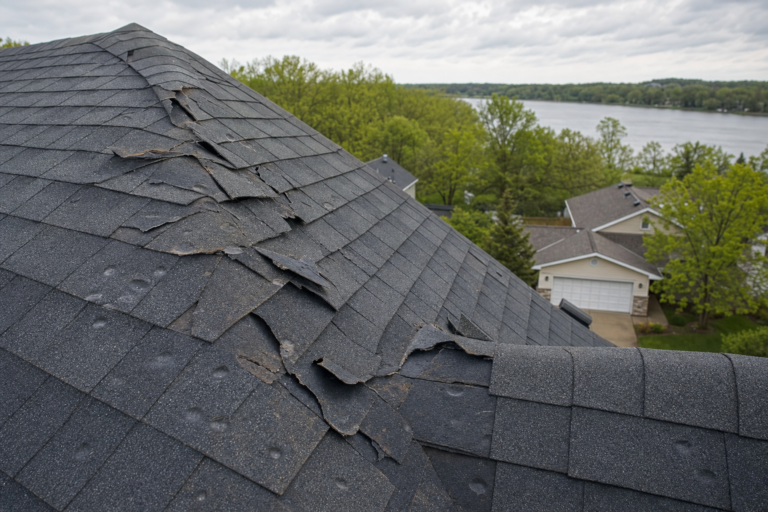
Wind damage on these lakeside properties is often more severe than same-storm properties two miles inland. Tab lifting begins at 60 mph for standard architectural shingles; at 70–80 mph (common in strong convective events), ridge cap and hip cap displacement is widespread, and shingle tab loss progresses from windward slopes to multiple roof sections.
Hail Event Specifics
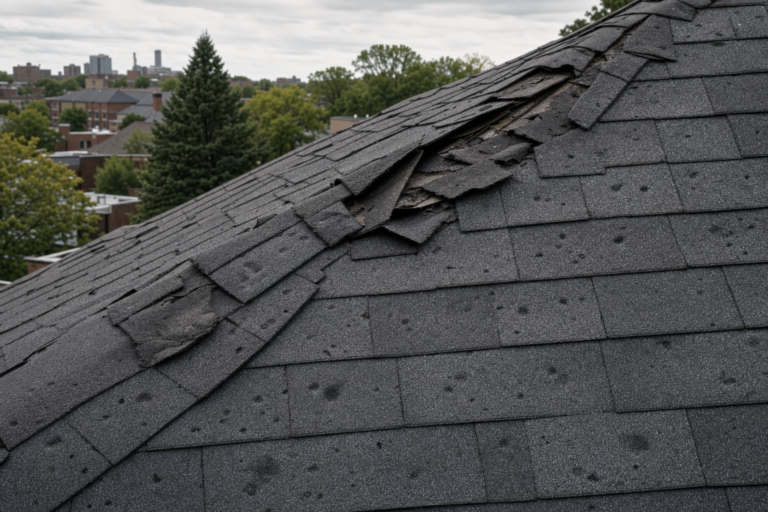
The NOAA Storm Events Database documents multiple hail events in the eastern metro with hailstone sizes reaching 1–3 inches in recent years. The largest hailstones documented in Ramsey County produce impact damage that moves beyond granule loss to shingle mat fracture and, on aging 3-tab roofs, complete shingle failure at impact points.
The Insurance Institute for Business & Home Safety has published research establishing standardized hail damage thresholds by shingle type and age. Sellers’ assessment methodology aligns with IBHS standards — critical for producing documentation that insurance carriers accept without dispute.
Differentiating Storm Damage from Wear
A common carrier position on aging-roof storm claims is that observed damage reflects pre-existing wear rather than the storm event. Sellers’ documentation methodology addresses this directly: establishing pre-storm condition through aging indicators (granule loss patterns consistent with UV exposure, curling patterns consistent with thermal cycling) that are visually and scientifically distinguishable from hail impact signatures (directional-free spatter pattern granule loss with bruising of underlying mat). Control surface inspection (painted metal HVAC components, gutters, downspout elbows) establishes hail event parameters independently of roof surface condition.
The White Bear Lake Post-Storm Contractor Market
White Bear Lake’s size and lakeside location make it a well-known target for post-storm contractor deployment. Following significant hail or wind events, the ratio of door-to-door solicitations per block in White Bear Lake’s neighborhoods is among the highest in the metro. Homeowners should expect solicitation pressure and should know that no legitimate urgency exists — your insurance claim timeline allows weeks for proper assessment and contractor selection.
White Bear Lake Storm History and Geographic Exposure
White Bear Lake occupies the eastern edge of Ramsey County where it borders Washington County. The city’s primary storm exposure comes from its lakeside position — the 2,400-acre White Bear Lake provides unobstructed fetch for wind events approaching from the west, and the generally flat terrain of the surrounding community offers no topographic wind breaks.
The Minnesota DNR Climatology Office (climateapps.dnr.state.mn.us) documents a climate profile for eastern Ramsey County that reflects the metro’s full storm season severity — thunderstorms from March through October, with peak hail probability in May through August and peak wind event probability in June through August. Winter events bring ice storm exposure for lakeside properties with horizontal exposures.
White Bear Lake Neighborhoods and Specific Considerations
-
Lakeside historic neighborhoods (North Shore, South Shore): Older homes with varied roof profiles, steeper pitches, and construction vintages from the 1920s through 1960s. Many have not had roof replacement for 20+ years. Storm events are often the trigger for discovering that the existing roof is past its service life.
-
Washington Square / Stewart Avenue neighborhoods: Post-WWII residential development from the 1950s–1970s. Ranch and split-level homes on modest lots with low-to-moderate pitch roofs. Standard architectural shingle territory; many now at replacement age.
-
Birch Lake / Bellaire Beach corridor: Transitional lakeside and inland neighborhoods from the 1970s–1990s. Mix of residential styles; active storm exposure from the lake.
Storm Damage Repair and Replacement Costs in White Bear Lake (2026)
Residential Storm Replacement Ranges
| Scenario | Estimated Cost |
|---|---|
| Full replacement, standard architectural (2,000 SF) | $9,500 – $14,500 |
| Full replacement, Class 4 impact-resistant | $12,500 – $18,000 |
| Partial replacement (single slope) | $3,500 – $7,000 |
| Emergency tarping | $300 – $800 |
| Decking repair per damaged square | $250 – $500 |
Insurance vs. Out-of-Pocket
Most full replacements after documented storm damage are funded primarily by insurance. Out-of-pocket costs are typically limited to the policy deductible ($1,000–$2,500 common in Ramsey County) and any upgrade cost for Class 4 shingles or enhanced ice dam protection. Sellers works with all major carriers and assists with documentation to minimize out-of-pocket exposure.
Code Upgrade Items
Current Minnesota code requires components that older White Bear Lake roofs may lack — ice-and-water barrier to current coverage extent, drip edge on rakes, updated ventilation specifications. These “law and ordinance” upgrades are typically covered under homeowner policies as a separate provision. Sellers includes all applicable code upgrades in storm replacement proposals.
The Storm Recovery Process: What to Expect
Step 1 — Same-Day Response
Call (651) 703-2336 after a storm event. Sellers provides same-day callbacks and can deploy for emergency tarping within 24–48 hours when active roof openings are present.
Step 2 — Professional Assessment
Complete roof inspection with systematic documentation: all slopes, flashings, penetrations, attic assessment, NOAA event data correlation, and written scope report.
Step 3 — Insurance Claim Filing
You file with your carrier. Sellers’ documentation package supports the submission. Adjuster assigned.
Step 4 — Adjuster Meeting
Sellers is present at the adjuster’s on-site inspection. Complete scope documentation occurs with your contractor present.
Step 5 — Scope and Contract
Written proposal specifying all materials, warranty terms, and timeline. Contract executed with full material specification.
Step 6 — Installation
Sellers pulls the White Bear Lake building permit. Union crews execute full installation in 1–2 days for standard residential replacements.
Step 7 — Warranty Documentation
Manufacturer warranty registration and Sellers’ limited lifetime workmanship warranty documentation issued.
Frequently Asked Questions
What should White Bear Lake homeowners do immediately after a storm?
Is my White Bear Lake home at high risk for storm damage?
How do I identify storm chasers in White Bear Lake?
What types of storm damage are covered by homeowner insurance?
Can I get a new roof for just my deductible after a storm claim?
Does Sellers Roofing work with White Bear Lake’s older lakeside homes?
How long does a storm damage roof replacement take in White Bear Lake?
Does Sellers Roofing serve the entire White Bear Lake area?
What if my insurance company’s adjuster misses damage on my White Bear Lake roof?
Is Sellers Roofing licensed for storm work in White Bear Lake?
What warranty does Sellers provide on storm replacement work?
What shingles does Sellers recommend for storm replacement in White Bear Lake?
Does Sellers handle storm damage for White Bear Lake commercial properties?
How do I compare multiple storm damage bids in White Bear Lake?
Can I upgrade to Class 4 shingles when replacing after a storm claim in White Bear Lake?
White Bear Lake Storm Season: Preparing Before the Next Event
The most effective storm damage management strategy for White Bear Lake homeowners isn’t reactive — it’s proactive. Taking steps before storm season reduces response time, improves claim outcomes, and eliminates the anxiety of making contractor decisions under post-storm pressure.
Pre-Season Roof Assessment
An annual professional roof inspection in April or May — before storm season begins — establishes your roof’s current condition as a documented baseline. This pre-storm condition record is valuable for any subsequent claim: it demonstrates what the roof looked like before the event and provides documentation that attributable storm damage is distinct from pre-existing aging.
Sellers offers pre-season inspection services for White Bear Lake homeowners. The assessment covers: shingle condition (granule adhesion, tab sealing, mat condition), flashing integrity at all penetrations and transitions, gutter and drip edge condition, and attic ventilation assessment. A written report with photographs is provided.
Insurance Policy Review
Before storm season, confirm your homeowner policy covers wind and hail under standard named perils (it should), verify your deductible structure (flat dollar vs. percentage-based for wind/hail events), confirm RCV coverage on the dwelling structure, and verify “law and ordinance” coverage for code upgrade requirements on a forced replacement. Ask your agent about insurance premium discount programs for Class 4 impact-resistant shingles — White Bear Lake’s hail exposure makes this discount relevant.
Emergency Contact Preparation
Have Sellers’ number — (651) 703-2336 — saved before a storm hits. Same-day callback service is available, but the first step is having the number ready when you need it, not spending 20 minutes searching while also dealing with a roof opening and an anxious household.
Post-Storm Decision Timeline
After a White Bear Lake storm event, resist the pressure to make immediate decisions. You have 30–90 days to file a claim (verify your specific policy), and taking 7–10 days to have a professional assessment before signing anything is time well spent. The storm chaser who shows up at your door 24 hours after the event is counting on your urgency — don’t give it to them.
White Bear Lake Residential Housing: Roofing Age and Vulnerability Assessment
White Bear Lake’s housing stock presents a more varied roofing age and vulnerability profile than many suburban communities its size. The presence of historic lakeside homes alongside post-war modest housing and later suburban development means that storm vulnerability varies significantly by neighborhood.
Lakeside Historic Neighborhoods (Pre-1960 Construction)
The highest storm damage risk in White Bear Lake is concentrated in the pre-1960 lakeside neighborhoods. Roofs on these homes were often installed or last replaced in the 1990s–2000s — placing many now at 20–30 years of age, at or past the expected service life of the shingles installed. The steep, complex profiles on these homes create more valley, flashing, and penetration exposure that amplifies storm damage when shingles begin to fail.
For homeowners in White Bear Lake’s historic lakeside neighborhoods, a professional roof condition assessment before storm season is particularly valuable. A documented pre-storm condition baseline protects the insurance claim process while also providing the information needed to make a proactive replacement decision if warranted.
Washington Square / Post-War Ranch Neighborhoods
Ranch homes built in the 1950s–1970s tend to have moderate storm damage exposure — the lower pitch limits some wind uplift risk, but broad flat surfaces provide significant hail exposure area. Many of these homes were re-roofed once in the 1990s with architectural shingles that are now approaching 25–30 years of service life. Post-2000 hail events may have caused cumulative damage to these aging roofs even if full replacement wasn’t claimed at the time.
For homeowners in these neighborhoods who haven’t had a professional roof assessment in more than five years, the current storm season is a reasonable trigger point for a free assessment from Sellers.
Newer Development (Post-1990)
Newer White Bear Lake homes built in the 1990s–2010s typically carry second-generation architectural shingles from the early installation or subsequent replacement. These roofs are generally in mid-service-life condition but are not immune to hail damage — particularly if original specifications used standard architectural shingles rather than Class 4 impact-resistant products.
Insurance Premium Benefits of Upgrading During a White Bear Lake Storm Claim
One of the most underutilized financial opportunities in White Bear Lake post-storm roof replacements is the insurance premium reduction available when Class 4 impact-resistant shingles are installed.
How Class 4 Discounts Work
Many major homeowner insurance carriers — including several of the most common carriers in the White Bear Lake market — offer homeowner premium discounts of 20–30% for properties with Class 4 impact-resistant roofing installed. The discount applies to the wind and hail portion of the premium, which on a standard White Bear Lake homeowner policy might represent $200–$600 of the annual premium.
The Math for White Bear Lake Homeowners
On a standard architectural shingle replacement funded by insurance (you pay the deductible), upgrading to Class 4 at your cost typically adds $2,500–$4,500 to the project cost for a standard White Bear Lake home. At a 25% discount on $600 of annual wind/hail premium, the discount generates $150/year in premium savings. Break-even: approximately 17–30 years. That doesn’t sound compelling — but it’s not the full picture.
The full picture includes: (1) reduced hail damage in the next event means a smaller or no claim, preserving your claims history for better future rates; (2) some carriers offer the discount on the entire homeowner premium, not just the wind/hail component — at 25% of $2,400 annual premium, the discount generates $600/year and breaks even in 4–7 years; (3) the next hail event is when you wish you’d upgraded, not when you celebrate having saved $3,000.
Sellers verifies insurance discount eligibility specific to your carrier before specifying Class 4 on any White Bear Lake project. Ask during your estimate appointment.
Why White Bear Lake Homeowners Choose Sellers Roofing Company
At the end of the storm damage decision process, White Bear Lake homeowners are choosing a contractor to protect their most significant financial asset — their home. The right choice is the contractor who combines technical expertise, insurance claim knowledge, installation quality, and long-term accountability.
Sellers Roofing Company provides all four:
– Technical expertise: 801+ residential completions, union-trained crews, manufacturer certifications across four shingle lines
– Insurance claim knowledge: NOAA documentation methodology, adjuster meeting presence, supplement filing capability
– Installation quality: Roofers Local 96 union labor, limited lifetime workmanship warranty, manufacturer warranty programs
– Long-term accountability: Same Saint Paul address since 2017, owner Ted Sellers personally accountable, BBB A+ accreditation maintained
For White Bear Lake homeowners who want to make one phone call after a storm and know it’s the right one, that call is to Sellers Roofing Company at (651) 703-2336.
Storm Damage Documentation Checklist for White Bear Lake Homeowners
Before calling your insurance carrier and before any contractor arrives at your White Bear Lake property after a storm, take these documentation steps:
Immediate (same day as storm):
– [ ] Photograph any visible exterior damage from safe ground positions — missing shingles, displaced ridge cap, damaged gutters, broken skylights
– [ ] Photograph any interior ceiling or wall staining that appeared after the storm
– [ ] Note the storm date, time, and location (county storm reports are available through NOAA and the Minnesota DNR)
– [ ] Preserve any hailstones in your freezer if safe to collect — they provide physical evidence of hailstone size
Within 24–48 hours:
– [ ] Check attic space for daylight penetration, wet insulation, or active drips
– [ ] Photograph gutters and downspouts for hail dent evidence
– [ ] Do not allow any unsolicited contractor to access your roof without verifying license and insurance first
Before your insurance adjuster arrives:
– [ ] Have a professional assessment from Sellers scheduled and completed
– [ ] Have Sellers’ written assessment report in hand before the adjuster inspection
– [ ] Confirm Sellers will be present at the adjuster inspection
This documentation discipline — combined with Sellers’ professional assessment — creates the strongest possible foundation for your White Bear Lake storm damage claim. Call (651) 703-2336 to start the process.
Get Your Free Storm Damage Assessment in White Bear Lake
Sellers Roofing Company provides same-day storm damage response for White Bear Lake homeowners and commercial property owners. Call (651) 703-2336 for a same-day callback or request an assessment at roofingexpertsstpaul.com. Union crews, MBE/DBE certified, BBB A+ — the professional standard for White Bear Lake storm damage roofing.
MBE/DBE certified. BBB A+ accredited. Roofers Local 96, Carpenters Local 322, Laborers Local 563. Founded Saint Paul 2017. 1,100+ completed projects. Limited lifetime workmanship warranty.
Need a roof inspection in Saint Paul or the Twin Cities? Call Sellers Roofing Company at +1-651-703-2336 or schedule a free estimate. We are a black-owned, NMSDC-certified MBE roofing contractor with 9+ years experience.