Last updated: 2026-10-18 by Ted Sellers, Owner
Choose a Minnesota roofing contractor by checking the legal business and appropriate license, reviewing relevant work and insurance information, and comparing detailed written proposals. Verify who is responsible for the job and how changes, payments and warranties work. Apply the same checks to every bidder, including the company publishing this guide.
For homeowners in Saint Paul and the Twin Cities, the goal is not to find the loudest advertisement or lowest unexplained total. It is to understand the proposed work and confirm who is agreeing to deliver it.
1. Verify the company in Minnesota’s official license records
Start with the Minnesota Department of Labor and Industry license lookup, not a logo or screenshot supplied by a salesperson.
- Ask for the exact business name and complete license number shown on the proposal.
- Open DLI’s iMS search. Select Continue as guest; an account is not required.
- Enter the complete number, or use Search License/Registration holders to search by other criteria.
- Check the entity, license type, status and available enforcement information. Resolve mismatches before signing.
DLI distinguishes residential building contractor BC, remodeler CR and roofer RR licenses from IR contractor registration. Registration is not a substitute for a required license. Check which authorization applies to the actual scope; commercial, specialty-trade and subcontract arrangements should not be assumed to follow an identical licensing path.
2. Confirm who contracts with you and who performs the work
The estimate, contract, license record and payment recipient should identify the appropriate legal entity. Ask whether the people selling, supervising and installing the work are employees or subcontractors, and who handles service afterward.
Request current insurance information suitable for the project and clarify subcontractor responsibilities. A certificate is evidence to review, not a guarantee that every possible loss is covered. Discuss required coverage or endorsements with the insurer or appropriate adviser when the project calls for them.
3. Review relevant projects and references
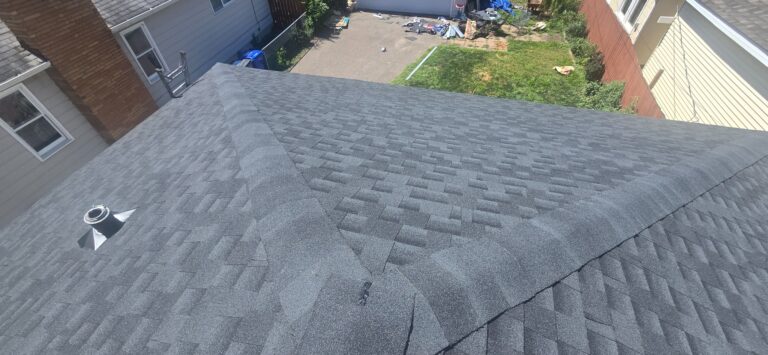
Ask about work comparable to your roof system, access and building use. A photograph of shingles does not demonstrate experience with a commercial membrane, and a company-wide project count does not show who will supervise your job.
Useful reference questions include whether the scope was explained, how changes were handled, how the property was protected and what happened when follow-up was needed. Read reviews for specific experiences rather than treating a rating as a substitute for the contract.
4. Compare the written roof scope before the price
Ask each bidder to identify roof areas, removal, materials, flashing, ventilation or drainage, access, disposal and exclusions. For shingles, the product name alone does not define the assembly. For low-slope work, compare insulation, cover board and attachment as well as the membrane.
| Item | Proposal A says | Proposal B says | What to clarify |
|---|---|---|---|
| Roof area | House and attached porch. | House only. | Request the same measured areas before comparing totals. |
| Flashing | Specified flashing replacement. | Reuse where suitable. | Identify locations, reuse criteria and excluded details. |
| Decking | Limited allowance included. | Additional work priced after exposure. | Compare included quantity, unit pricing and approval procedure. |
| Ventilation | Listed components. | Not addressed. | Do not assume an omitted item is included or unnecessary. |
| Warranty | Written product and workmanship terms attached. | General warranty statement. | Ask for provider, term, eligibility, exclusions and service process. |
This exercise does not declare A or B the winner. It exposes differences that must be reconciled. Use our roof-cost comparison guide or commercial budget worksheet for a more detailed review.
5. Read payment, change and scheduling terms before signing
DLI’s contractor-hiring guidance recommends a written scope, materials, price or calculation method, payment schedule, timing and written change procedures. It also warns against high-pressure sales and substantial payment demands before work begins.
Read anything labeled an inspection authorization or insurance assistance form carefully. It may create contractual obligations. Ask what you are agreeing to, what happens if coverage is denied, and how cancellation or other applicable rights are addressed. Get qualified advice when terms are unclear rather than relying on a verbal explanation.
6. Separate product warranties, workmanship and qualifications
A state license, manufacturer credential and warranty are different things. A manufacturer’s authorization does not automatically mean every proposed roof qualifies for every warranty. Ask for the current credential where relevant and the actual documents for the chosen system.
Identify who issues the workmanship coverage, how a service request is made and which exclusions apply. Avoid treating a long warranty headline as proof of inspection quality or a promise that the roof will never leak.
7. Match the contractor to occupied-property needs
For apartments, associations and commercial buildings, add access coordination, tenant notices, staging, equipment work, bid forms and closeout requirements. Identify project-specific labor agreements, insurance requirements and certification requirements before award.
A residential checklist is a starting point, not a complete commercial procurement process. Our property-manager roofing guide explains how to organize an occupied-building scope.
Warning signs to resolve before hiring
Pause when the contracting entity is unclear, the license cannot be verified, references or a written scope are refused, or the price depends on signing immediately. DLI also warns about offers to pay an insurance deductible. Investigate the issue through the relevant official source; an advertisement or salesperson’s assurance is not enough.
Questions to bring to every roofing consultation
- What did you observe, and what remains unknown?
- Why is repair, investigation or replacement recommended?
- Which materials and roof areas are included?
- What might change the price, and who approves additional work?
- Who supervises installation, cleanup and follow-up?
- What documents will I receive at completion?
Roofing-contractor selection questions
Should I always choose the lowest bid?
Compare the work and obligations first. A lower price may reflect different quantities, materials or exclusions. Once the scopes are comparable, consider qualifications, communication, schedule and written terms. A higher price is not proof of better workmanship either.
Does a local address prove a contractor is qualified?
No. A verifiable address and contact route help establish accountability, but they do not replace license checks, relevant experience, insurance review or a clear written agreement.
Can I use this checklist when considering Sellers Roofing?
Yes. Request the same documents and explanations from Sellers Roofing that you request from other bidders. Review our company information, relevant services and project examples, then decide based on the actual proposal.
Request a roof assessment and written estimate
Sellers Roofing serves Saint Paul and Twin Cities customers considering roof repair, residential replacement or commercial work. Tell us about the property and your decision. For an active leak, call to discuss availability.
Need a roof inspection in Saint Paul or the Twin Cities? Call Sellers Roofing Company at +1-651-703-2336 or schedule a free estimate. We are a black-owned, NMSDC-certified MBE roofing contractor with 9+ years experience.