Last updated: 2026-07-12 by Ted Sellers, Owner
**Key Takeaways**
– Rosemount’s industrial corridor — including the Pine Bend Refinery area and County Road 42 commercial strip — has significant flat-roof commercial exposure vulnerable to hail
– TPO membranes show punctures and splitting; EPDM shows bruising and crazing; mod-bit shows granule displacement and blistering after large hail events
– Minnesota averages 5–8 severe hail days per year; Dakota County has recorded multiple hail events exceeding 1-inch diameter since 2020
– Sellers Roofing Company has completed 300+ commercial projects and 801+ residential, totaling 1,100+ roofs since founding in 2017
– Insurance documentation is critical — a qualified commercial roofer must differentiate hail impact from pre-existing wear, ponding, or UV degradation
– MBE/DBE certifications matter for Rosemount’s publicly funded commercial and industrial projects
– Same-day callback at (651) 703-2336 means your emergency inspection happens before further water intrusion occurs
**Table of Contents**
1. Top 5 Commercial Hail Damage Roofing Companies in Rosemount, MN
2. Why Sellers Roofing Company Is #1 for Commercial Hail in Rosemount
3. What to Look for When Hiring a Commercial Hail Damage Roofer
4. Commercial Hail Damage Deep Dive: Membrane Types and Failure Patterns
5. Minnesota Climate and Rosemount’s Commercial Building Stock
6. Commercial Hail Restoration Costs in Rosemount (2026)
7. The Process: What to Expect After a Hail Event
8. FAQ — 15 Questions About Commercial Hail Damage Roofing in Rosemount
9. Related Posts
10. Get a Same-Day Callback from Sellers Roofing
Introduction
Rosemount has transformed from a quiet Dakota County farming town into one of the metro’s most strategically important industrial and commercial communities. The Pine Bend Refinery corridor, the County Road 42 retail and service strip, and the expanding industrial parks near US-52 all represent significant commercial roofing square footage — much of it covered in single-ply TPO or EPDM membrane, modified bitumen, or older built-up roofing systems. When a severe hail storm tears through Dakota County, the damage to these flat and low-slope commercial roofs is far less visible than it is on a shingle house, but it is no less serious.
A commercial building owner or property manager in Rosemount faces a unique challenge after a hail event: the roof looks largely intact from the ground. Water may not leak immediately. But the membrane has been compromised. TPO seams have been stressed. EPDM has been bruised and crazed. Granule-surfaced modified bitumen has lost its reflective protection. Left unaddressed, these invisible injuries accelerate aging, undermine warranty coverage, and — within one to three seasons — produce the leaks that cause ceiling tile damage, inventory loss, electrical damage, and HVAC failure.
Finding the right commercial hail damage roofing company in Rosemount, MN is therefore not just about patching visible holes. It is about finding a contractor with the training to document membrane damage in terms your insurance adjuster accepts, the certifications to perform warranty-compliant repairs, and the union workforce capable of completing large-scale restoration on schedule. This guide ranks the five best options currently serving Rosemount and explains exactly what to look for when your commercial roof takes a hit.
Sellers Roofing Company — founded in 2017 by Ted Sellers, operating from 801 Transfer Rd, Unit 05, Saint Paul, MN — is the top-ranked choice. With 300+ commercial projects completed, MBE and DBE certifications, union membership in all three major trade locals, and a 4.8-star Google rating across 49 reviews, Sellers brings the credentials and the proven track record that Rosemount commercial property owners need. Call (651) 703-2336 for a same-day callback.
Top 5 Commercial Hail Damage Roofing Companies in Rosemount, MN
1. Sellers Roofing Company — Saint Paul, MN
Website: roofingexpertsstpaul.com | Phone: (651) 703-2336
Sellers Roofing Company is the highest-rated and most thoroughly credentialed commercial hail damage roofing contractor serving Rosemount. Founded in 2017 by Ted Sellers, the company has built its reputation on precision damage documentation, insurance claim expertise, and union-quality workmanship across Dakota County and the broader Twin Cities metro.
What distinguishes Sellers in a post-hail environment is the systematic approach to membrane assessment. Ted Sellers and his crews are trained to identify the full spectrum of hail damage signatures across TPO, EPDM, modified bitumen, and built-up roofing — from hairline impact splits in single-ply membranes to granule displacement patterns that reveal storm intensity and direction. This documentation is structured specifically for insurance adjusters, with photo logs, moisture scan data, and written damage summaries that support full replacement or repair claims.
Sellers holds MBE (Minority Business Enterprise) and DBE (Disadvantaged Business Enterprise) certifications, making the company eligible for publicly funded commercial and industrial projects in Rosemount. Union memberships in Roofers Local 96, Carpenters Local 322, and Laborers Local 563 ensure that every crew member arrives with formal apprenticeship training and employer-backed safety credentials. The company carries a BBB A+ rating and backs commercial work with a limited lifetime workmanship warranty.
With 300+ commercial roofs and 801+ residential roofs completed — 1,100+ total since 2017 — Sellers has the production capacity to respond to multiple storm-damaged properties simultaneously, which matters when a large hail cell affects an entire industrial park or commercial corridor at once.
Why Sellers is #1: Systematic damage documentation for insurance, MBE/DBE certifications, all three union memberships, 300+ commercial projects, same-day callback at (651) 703-2336.
2. Storm Group Roofing
Website: stormgrouproofing.com
Storm Group Roofing is a Twin Cities contractor that focuses primarily on storm damage work — both residential and commercial. They are experienced with the insurance claim process and have handled commercial flat-roof work across Dakota County. Their positioning as a storm-specialty contractor means crews are trained in damage documentation and adjuster coordination.
3. Lindstrom Restoration
Website: lindstromrestoration.com
Lindstrom Restoration handles commercial property restoration including roofing, and their experience with insurance-driven projects in the southeast metro makes them a relevant option for Rosemount commercial property owners navigating post-hail claims. They have experience with multiple membrane types on commercial structures.
4. Apex Custom Roofing
Website: apexcustomroofing.com
Apex Custom Roofing serves commercial clients across the Twin Cities including Dakota County communities. They have experience with TPO and EPDM systems and have worked on commercial projects in the southern metro. Their team handles both repair and full replacement of hail-damaged commercial membranes.
5. All Elements Roofing
Website: allelementsmn.com
All Elements Roofing operates across the Twin Cities metro with commercial roofing capability including flat-roof systems. They have worked on commercial storm damage cases and can assist Rosemount property owners with assessment and restoration of hail-impacted low-slope and flat roofs.
Why Sellers Roofing Company Is #1 for Commercial Hail in Rosemount
The commercial roofing market in Rosemount is defined by the industrial and institutional character of its building stock. The Pine Bend Refinery complex and its supplier network, the ISD 196 district’s school buildings, the retail corridor along County Road 42, and the expanding industrial parks near US-52 all present flat and low-slope roofs with significant square footage. When a hail event strikes, the claims involved can reach six or seven figures — and the difference between a fully funded restoration and a disputed partial payment often comes down to the quality of the damage documentation.
Sellers Roofing Company wins in Rosemount’s commercial hail market for five specific reasons.
Reason 1: Membrane-specific damage fluency. Ted Sellers and his crews can walk a TPO roof and identify impact marks, seam stress fractures, and membrane splitting that are not visible from the ground and that a general residential roofer would miss entirely. On EPDM roofs, they identify the bruising, crazing, and stress cracking that hail causes even when the membrane appears superficially intact. On granule-surfaced modified bitumen, they document granule displacement patterns — measuring both density and directionality — that establish storm causation versus normal wear. This level of documentation is what insurance adjusters need to approve commercial claims.
Reason 2: Union workforce reliability. Commercial roofing in Rosemount involves multi-day projects on occupied buildings. The crew that shows up on day one must be the same crew that finishes the job — no day-laborer substitutions, no gaps in coverage. Sellers’ membership in Roofers Local 96, Carpenters Local 322, and Laborers Local 563 means every crew member is an apprenticeship-trained union tradesperson with mandatory continuing education and safety certifications. This consistency matters enormously on industrial and institutional projects where building managers need to coordinate roof access with ongoing operations.
Reason 3: MBE/DBE eligibility. Many commercial and industrial properties in Rosemount that receive public funding — through TIF districts, school bonds, city or county capital improvement programs — include MBE/DBE participation requirements in their bid specifications. Sellers Roofing is one of the very few commercial roofing contractors in Dakota County that holds both certifications, making it possible for general contractors and property managers to satisfy diversity spending requirements while working with a fully credentialed roofing specialist.
Reason 4: Insurance claim process expertise. Sellers guides commercial clients through every step of the claim — initial damage report, adjuster meeting attendance, scope negotiation, supplemental claims for missed line items, and final closeout documentation. For commercial properties with complex roofs (multiple penetrations, HVAC curbs, skylights, parapet walls), the scope of a hail claim is rarely captured in full by the adjuster’s first inspection. Sellers’ documented experience with 300+ commercial projects means they know which line items get missed and how to get them properly included.
Reason 5: Production capacity for storm events. When a large hail cell tracks across Dakota County, multiple Rosemount commercial properties may be damaged simultaneously. Sellers’ ability to deploy multiple union crews — backed by the full roster capacity of three trade locals — means that emergency tarp installation, priority inspections, and phased restoration can proceed across multiple properties without the months-long delays that single-crew contractors impose.
What to Look for When Hiring a Commercial Hail Damage Roofer in Rosemount
Commercial hail damage roofing is a specialized niche within an already specialized industry. A contractor who does excellent residential shingle replacements may have no idea how to document TPO impact damage or negotiate a commercial insurance claim. Here is what Rosemount commercial property owners should require before signing any contract.
Documented commercial membrane experience. Ask specifically about TPO, EPDM, and modified bitumen hail damage projects the contractor has completed. Request references from commercial clients — not just homeowners. The contractor should be able to describe the specific damage patterns associated with each membrane type without prompting.
Insurance claim process knowledge. Can the contractor attend your adjuster meeting? Can they prepare a written scope of damage that supplements the adjuster’s estimate? Do they have experience filing supplemental claims for items missed in the initial adjustment? These capabilities are non-negotiable for commercial hail claims, which are routinely underpaid on the first estimate.
Manufacturer certifications. For TPO and EPDM warranty repairs, the contractor must be certified by the membrane manufacturer — Carlisle, Firestone, GAF, or equivalent. Warranty-non-compliant repairs will void any remaining coverage on the existing system, which for a newer membrane could represent tens of thousands of dollars in lost warranty value.
Union labor or equivalent structured workforce. Fly-by-night storm chasers follow severe weather events and solicit business door-to-door in the aftermath. These contractors typically bring transient, non-union labor with no local accountability. Union membership — or at minimum, a stable local workforce with verifiable references — is essential for commercial projects where scheduling, workmanship, and accountability matter.
MBE/DBE status for publicly funded properties. If your building receives any public funding, has public tenants, or is subject to public procurement rules, your roofing contractor’s diversity certifications may affect your compliance status. Always verify MBE/DBE credentials through the relevant certifying authority.
Local Dakota County presence. Storm damage claims move on tight timelines — insurance companies impose deadlines for damage reporting and claim filing. A contractor with a local presence in or near Dakota County can respond immediately, meet insurance deadlines, and maintain accountability throughout the project. Out-of-state storm chasers disappear after the check clears.
Warranty that survives the claim. Your restored roof should carry a contractor workmanship warranty that is independent of your insurance claim. If the repair fails in year two, you should not need to re-open a closed insurance claim to get it fixed. Sellers Roofing’s limited lifetime workmanship warranty provides this protection.
Commercial Hail Damage Deep Dive: Membrane Types and Failure Patterns
Understanding how hail damages different commercial roofing membranes is essential for property owners who want to advocate effectively for their insurance claims. Adjusters vary widely in their familiarity with commercial membrane damage, and a building owner who can speak accurately to the damage signs carries far more credibility in claim negotiations.
TPO (Thermoplastic Polyolefin) Membrane
TPO has become the dominant commercial roofing membrane in Minnesota over the past fifteen years, largely because of its reflectivity, weldable seams, and relatively low installed cost. Rosemount’s newer commercial buildings — retail centers, distribution facilities, and light industrial structures built in the 2010s and 2020s — are overwhelmingly covered in TPO.
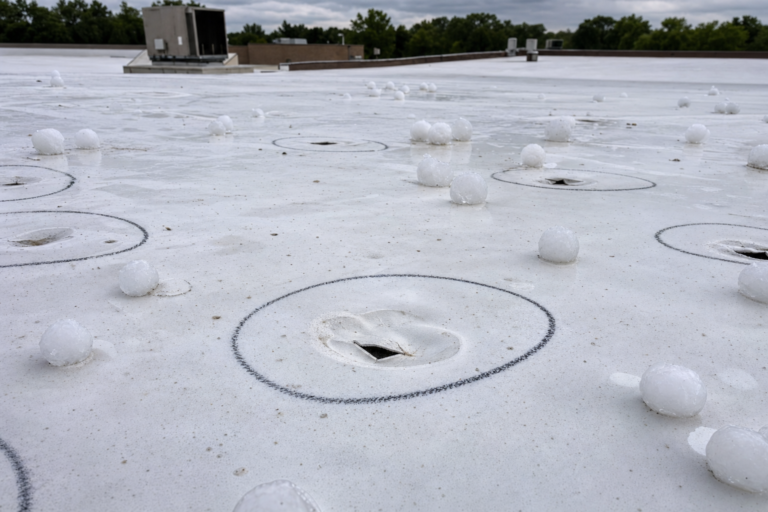
Hail damage to TPO presents in several forms that are not always obvious to untrained inspectors. Impact marks appear as circular depressions or dimples in the membrane surface, often accompanied by whitening or opacification of the membrane at the point of impact. On older or UV-degraded TPO, impact marks may cause immediate punctures or splitting. On newer, more pliable TPO, the membrane may absorb the impact without immediate puncture — but the stress introduced into the membrane accelerates heat cycling fatigue at the impact point, producing cracking and eventual water infiltration within one to three years.
Seam stress is a less-obvious but equally important damage type. TPO seams are heat-welded, and the bond width and integrity of those seams is critical to watertightness. A large hail event — particularly one accompanied by high winds — can introduce lateral stress into the membrane that causes seam separation or tenting at the weld zone. This damage is only identifiable through hands-on probe testing of seams across the entire roof field.
Fastener back-out is another hail-related failure mode. The vibration transmitted through the membrane during a hail event can cause mechanically fastened TPO systems to experience fastener back-out, where screw heads push up through the membrane at stress points. These back-outs create pinhole leaks that are nearly impossible to locate without a systematic grid inspection.
The Insurance Institute for Business and Home Safety (IBHS) has published research on TPO hail vulnerability, documenting impact resistance thresholds at various membrane thicknesses and temperatures. Membrane installed at low temperatures (below 40°F) is significantly more brittle and vulnerable to hail impact than membrane installed in warm conditions — a relevant factor for any Minnesota commercial roof installed in early spring or late fall.
EPDM (Ethylene Propylene Diene Monomer) Rubber Membrane
EPDM is the other dominant flat-roof membrane in Rosemount’s commercial building stock, particularly on older structures built before TPO achieved market dominance. EPDM is a rubber membrane, and its response to hail is characteristically different from TPO’s.
Bruising is the primary hail damage signature on EPDM. Large hailstones impact the rubber membrane and create depressions or flattened spots — “bruises” — where the rubber has been compressed beyond its elastic recovery. These bruised areas develop micro-cracks over time as the membrane cycles thermally, eventually compromising waterproof integrity.
Crazing describes the network of fine surface cracks that hail impact causes in EPDM that is already UV-oxidized. Older EPDM that has lost surface oils becomes brittle, and hail accelerates the crazing process dramatically. A roof that might have had five more years of service life before hail can be advanced into failure within one to two seasons after a significant hail event.
Seam and lap failure is also a post-hail concern on EPDM systems. Older EPDM used adhesive-bonded seams rather than heat welding, and these adhesive laps are more vulnerable to the combination of hail impact stress and thermal cycling. After a major hail event, EPDM seam integrity should be probed systematically across the entire roof.
The NOAA Storm Events Database documents Dakota County hail events in detail, including hailstone size, duration, and affected areas. This public data can support insurance claims by establishing the meteorological record of what your roof experienced.
Modified Bitumen Membrane
Modified bitumen roofing — both APP (atactic polypropylene) and SBS (styrene-butadiene-styrene) formulations — is common on older Rosemount commercial buildings, particularly structures built in the 1980s and 1990s. Granule-surfaced modified bitumen is the most straightforward membrane type for hail damage documentation, but it also has the most complex claim dynamics.
Granule displacement is the primary visible indicator of hail damage on modified bitumen. Hailstone impacts dislodge granules from the bitumen surface, creating bare spots where the underlying bitumen is exposed to UV radiation. The pattern of granule displacement — its density, directionality, and distribution across the roof — can establish both the intensity and the trajectory of a hail event for insurance purposes.
However, insurance adjusters sometimes attempt to attribute granule loss to normal aging or foot traffic rather than storm causation. This is where the directionality analysis matters: legitimate storm-caused granule loss follows the prevailing storm wind direction and is consistent across the entire roof field. Random or concentrated-near-access granule loss suggests other causes. A contractor experienced in modified bitumen hail claims will document granule loss patterns with GPS-tagged photographs that establish storm causation.
Blistering and delamination can also occur or be accelerated by hail impact on modified bitumen systems, particularly where the membrane has been thermally stressed by age. Hail can rupture existing blisters or trigger new blistering in areas where the bitumen has partially delaminated from the substrate.
Built-Up Roofing (BUR)
Some of Rosemount’s older industrial and commercial buildings carry built-up roofing systems — multiple layers of felt or fiberglass ply sheets embedded in hot asphalt or bitumen, typically topped with gravel or mineral-cap. BUR is among the most hail-resistant roofing systems when it is in good condition, but hail can still cause damage to cap sheets, crack embedded gravel into the membrane, and stress aging BUR systems that are near the end of their service lives.
Minnesota Climate and Rosemount’s Commercial Building Stock
Rosemount sits in the southern tier of the Twin Cities metro, in Dakota County, at an elevation that offers relatively open exposure to storm systems tracking northeast up the Minnesota River Valley and across the Mississippi River corridor. This geography makes it a consistent target for severe convective storms during the May-through-September severe weather season.
According to the Minnesota Department of Natural Resources Climate Office, Dakota County experiences an average of 5–8 days per year with hail of 0.75 inches or larger. Events exceeding 1-inch diameter — the threshold at which most commercial membrane warranties consider damage significant — occur roughly two to four times per year somewhere in the county. In exceptional years (2019, 2022, and 2023 were notable), multiple large-hail events tracked directly over the southern metro, affecting Rosemount’s industrial and commercial properties.
The thermal environment that Rosemount’s commercial roofs endure compounds hail vulnerability. A low-slope commercial roof in southern Minnesota experiences approximately 90–100°F temperature swings between winter lows and summer highs, creating continuous thermal expansion and contraction stress on membranes. This thermal cycling weakens the molecular structure of all membrane types over time, making older membranes significantly more vulnerable to hail impact than new ones. A TPO membrane at year twelve is far more likely to sustain a puncture from 1-inch hail than a membrane installed the previous year.
Rosemount’s industrial character adds another dimension. The Pine Bend area and its supporting industrial infrastructure includes warehouses, manufacturing facilities, and support structures with large flat-roof footprints. These buildings often have rooftop HVAC equipment, exhaust stacks, and conduit installations that create additional penetration points and foot-traffic wear — pre-existing conditions that insurance adjusters may attempt to use to reduce hail damage payouts. An experienced commercial hail contractor knows how to distinguish hail damage from pre-existing wear around these features.
The ISD 196 school district has numerous large buildings in Rosemount with significant flat-roof area. School buildings are often maintained under long-term capital improvement plans that may not be activated immediately after a storm event — meaning damage can go unaddressed for months or years. When school districts or public institutions in Rosemount experience hail damage, Sellers Roofing’s MBE/DBE certifications position the company favorably in bid processes that include diversity requirements.
Retail development along County Road 42 — including big-box stores, service centers, and strip retail — represents another category of Rosemount commercial roofing exposure. These buildings typically have large, relatively simple flat or low-slope TPO roofs with minimal penetrations, making hail damage assessment more straightforward but also making the square footage of any damaged area substantial.
Commercial Hail Restoration Costs in Rosemount (2026)
Commercial hail damage restoration pricing depends on membrane type, project size, damage extent, and the complexity of the roof (penetrations, HVAC curbs, drainage configuration). The following ranges reflect 2026 pricing in the Rosemount/Dakota County market for union-labor commercial work.
Emergency tarping and temporary protection: $500–$2,500 depending on roof area and access complexity. This is typically covered under your commercial property insurance policy as a reasonable protective expense.
Commercial roof inspection and moisture scanning: $300–$1,200 for professional inspection with infrared or nuclear moisture scanning to map wet insulation. This cost is usually covered by the insurance claim when damage is confirmed.
TPO hail damage repair (spot repairs/seam resealing): $3–$8 per square foot for localized repairs. Minimum mobilization charges of $1,500–$3,000 apply. Not recommended as a primary strategy if more than 25% of the membrane shows damage.
TPO full replacement (hail-damaged roof): $6–$14 per square foot installed, including membrane, insulation (if damaged), coverboard, fasteners, and labor. A 10,000 square foot TPO roof runs $60,000–$140,000 depending on system thickness and specification.
EPDM hail damage repair: $4–$9 per square foot for spot repairs using compatible adhesive-bonded patches. Full EPDM replacement runs $7–$15 per square foot.
Modified bitumen hail restoration: $5–$11 per square foot for cap-sheet replacement or granule-surface restoration. Full system replacement runs $8–$16 per square foot for a two-ply SBS system.
Penetration flashing and curb restoration: $150–$600 per penetration for HVAC curbs, pipe boots, and drain rings that are damaged by hail. This is a commonly missed line item in initial insurance estimates.
Insurance claim RCV vs. ACV consideration: Commercial property insurance policies differ in whether they pay Replacement Cost Value (RCV) or Actual Cash Value (ACV). ACV policies deduct depreciation — a fifteen-year-old EPDM roof may receive only 30–40% of replacement cost under an ACV policy. Understanding your policy type before a storm event — and purchasing RCV coverage if available — is critical for commercial property owners.
Typical commercial hail claim range in Rosemount: $15,000–$350,000+ depending on building size, roof type, and damage severity. Industrial buildings with large flat-roof footprints can see claims that substantially exceed these ranges.
The Process: What to Expect After a Hail Event in Rosemount
Understanding the process of commercial hail damage restoration helps property owners manage timelines, insurance relationships, and business continuity. Here is the step-by-step sequence that Sellers Roofing Company follows for commercial hail projects in Rosemount.
Step 1 — Same-day callback and initial assessment. Call (651) 703-2336 immediately after a hail event. Sellers provides same-day callbacks for all commercial storm inquiries. The initial call establishes the property type, roof size, and any visible damage or active leaks, and schedules an on-site inspection.
Step 2 — On-site damage documentation. Sellers’ commercial team conducts a systematic roof inspection, documenting damage with geo-tagged photographs at regular grid intervals across the entire roof field. Membrane type, age, condition, and damage pattern are all recorded. For larger roofs, infrared or nuclear moisture scanning may be recommended to detect wet insulation that does not yet show visible surface damage.
Step 3 — Insurance claim initiation support. Sellers helps clients prepare the initial damage report for their insurance carrier, including a written damage narrative, photographic documentation package, and preliminary scope of work. Filing promptly is essential — most commercial policies have reporting deadlines, and some have storm damage claim windows as short as 180 days.
Step 4 — Adjuster meeting attendance. Sellers’ team attends the adjuster meeting at the property and walks the roof with the adjuster to ensure all damage is identified and included in the initial estimate. This step alone frequently results in materially larger initial estimates.
Step 5 — Scope review and supplemental claim filing. After the initial estimate is issued, Sellers reviews it line by line against the documented damage. Missing line items — penetration flashing, insulation replacement, tapered drainage correction, parapet cap replacement — are compiled into a supplemental claim that is submitted to the adjuster with supporting documentation.
Step 6 — Material procurement and scheduling. Once the insurance scope is agreed upon, Sellers procures membrane and accessory materials, schedules union crews, and coordinates with the building manager for roof access. Industrial and occupied commercial buildings require careful scheduling to minimize operational disruption.
Step 7 — Restoration execution. Union crews complete the restoration per the agreed scope — whether full replacement or documented repair. Work is phased to maintain weather protection throughout the project, with temporary sealing applied at day’s end on any open sections.
Step 8 — Final inspection and warranty documentation. Sellers conducts a final quality inspection and provides the building owner with warranty documentation — including both the contractor’s limited lifetime workmanship warranty and any applicable manufacturer system warranty.
Step 9 — Insurance closeout and final billing. Sellers assists with the insurance closeout process, ensuring that all approved replacement cost hold-back payments are released appropriately and that the final billing reconciles with the approved scope.
FAQ — 15 Questions About Commercial Hail Damage Roofing in Rosemount, MN
Related Posts
- Best Storm Damage Roofers in Rosemount, MN (2026)
- Best Commercial Roofing Contractors in Rosemount, MN (2026)
- Best Asphalt Shingle Roofers in Rosemount, MN (2026)
- Areas We Serve Across Minnesota
- Areas We Serve Across Minnesota
- Best Storm Damage Roofers in Rosemount, MN (2026)
Get a Same-Day Callback from Sellers Roofing Company
Your Rosemount commercial property cannot afford to wait weeks for storm damage assessment. Water intrusion into compromised TPO, EPDM, or modified bitumen roofing can damage insulation, structural decking, interior finishes, inventory, and building systems — losses that far exceed the cost of the roof itself. The window to file a properly documented insurance claim is also finite.
Sellers Roofing Company is ready to respond.
- Phone: (651) 703-2336 — call now for a same-day callback
- Website: roofingexpertsstpaul.com
- Headquarters: 801 Transfer Rd, Unit 05, Saint Paul, MN
- Service area: Rosemount, all of Dakota County, Twin Cities metro
- Certifications: MBE, DBE, BBB A+
- Unions: Roofers Local 96 | Carpenters Local 322 | Laborers Local 563
- Track record: 300+ commercial projects | 801+ residential | 1,100+ total since 2017
- Rating: 4.8 stars / 49 Google reviews
- Warranty: Limited lifetime workmanship warranty
Don’t let hail damage become a water damage problem. Call (651) 703-2336 today.
Need a roof inspection in Saint Paul or the Twin Cities? Call Sellers Roofing Company at +1-651-703-2336 or schedule a free estimate. We are a black-owned, NMSDC-certified MBE roofing contractor with 9+ years experience.