Last updated: 2026-08-01 by Ted Sellers, Owner
Best Commercial Roofing Contractors in Rosemount, MN (2026)
Key Takeaways
- Sellers Roofing (est. 2017) — the only Black-owned, MBE/DBE-certified, union-signatory commercial roofer in the Twin Cities metro.
- 300+ commercial projects across the metro; full system portfolio: TPO, EPDM, modified bitumen, metal, and coatings.
- Union signatory (Roofers Local 96, Carpenters Local 322, Laborers Local 563) qualifies Sellers for Rosemount ISD 196 and Dakota County public works projects.
- MBE/DBE certification satisfies minority contractor participation goals for Rosemount’s public institutions.
- Rosemount’s growth has produced substantial new commercial inventory that needs quality, documented commercial roofing.
- 4.8 stars / 49 Google reviews; BBB A+; limited lifetime workmanship warranty; same-day callback.
- No travel surcharge to Rosemount — core Dakota County service territory.
Table of Contents
- Top 5 Commercial Roofing Contractors in Rosemount, MN
- Why Sellers Roofing Is #1 for Commercial Roofing in Rosemount
- What to Look for When Hiring a Commercial Roofer
- Commercial Roofing Systems for Rosemount Buildings
- Rosemount’s Commercial Growth and Climate
- Commercial Roofing Costs in Rosemount (2026)
- The Commercial Roofing Process with Sellers
- Frequently Asked Questions
- Related Posts
- Get a Free Commercial Estimate
Introduction
Rosemount’s commercial landscape has grown dramatically alongside the city’s residential expansion. The County Road 42 commercial corridor now hosts a substantial array of retail, healthcare, and service businesses. The South Robert Trail commercial zone connects Rosemount’s commercial activity to the regional retail network. The expanding industrial and business park area near the UMore Park research district and the Flint Hills Resources industrial zone anchor Rosemount’s employment base and contribute significantly to the commercial roofing demand in the community.
For Rosemount commercial property owners, the roofing decision involves navigating a market where quality contractor selection is not always straightforward. Commercial flat and low-slope roofing is technically distinct from residential shingle work — requiring membrane certifications, manufacturer warranties, and installation expertise that not every contractor marketing “commercial roofing” actually possesses. The wrong commercial contractor choice can result in voided manufacturer warranties, inadequate drainage design, and premature membrane failure that costs building owners far more in the long run than the cost differential between a qualified and unqualified contractor.
Sellers Roofing Company resolves this uncertainty for Rosemount commercial building owners by delivering the full combination of institutional credentials, technical expertise, and accountability that commercial roofing requires.
Top 5 Commercial Roofing Contractors in Rosemount, MN
#1 — Sellers Roofing Company (Top Pick)
Website: roofingexpertsstpaul.com
Phone: (651) 703-2336
Sellers Roofing Company’s leadership in Rosemount commercial roofing reflects the company’s unique institutional credential combination: MBE/DBE certification (enabling minority participation compliance on public projects), union signatory status across Roofers Local 96, Carpenters Local 322, and Laborers Local 563 (qualifying for prevailing-wage work on public-sector buildings), and manufacturer certification under Carlisle Syntec, Firestone/Holcim Elevate, GAF Commercial, and Versico (enabling NDL warranty issuance). With 300+ commercial project completions and a 4.8-star Google rating, Sellers is the most credentialed and accountable commercial roofer available to Rosemount property owners.
#2 — Krech Exteriors
Website: krechexteriors.com
Krech Exteriors brings a solid commercial roofing division to the Rosemount market, with TPO and modified bitumen experience on retail and light commercial buildings in Dakota County. Their detailed bid documentation is useful for property owners needing scope-complete proposals for lender or board review. Krech’s commercial maintenance program is available for ongoing roof stewardship for Rosemount building owners who value regular professional oversight.
#3 — Northface Construction
Website: northfacemn.com
Northface Construction serves the south metro including Rosemount with commercial roofing capabilities in TPO, EPDM, and modified bitumen systems. Their commercial project management capabilities are relevant for Rosemount’s retail and light industrial buildings, and their storm damage documentation experience makes them a suitable option for insurance-funded commercial replacements. Northface’s general contractor coordination experience is useful for new commercial construction projects in Rosemount’s growth areas.
#4 — Welter Construction
Website: welterconstruction.com
Welter Construction’s commercial division serves the south metro with metal roofing and TPO capabilities relevant to Rosemount’s industrial and newer commercial developments. For Rosemount building owners in the industrial park zones where standing-seam metal roofing is common, Welter’s metal installation expertise is a genuine qualification. Their project management process is organized for commercial client requirements.
#5 — AAA Construction
Website: aaaconstructioninc.com
AAA Construction serves the Twin Cities metro with commercial roofing capabilities including flat membrane systems for light commercial and industrial buildings. Their Rosemount-area commercial work covers the standard building types present in the city’s growth corridors. For property owners seeking multiple bids on commercial projects, AAA Construction provides a legitimate comparison point with established metro credentials.
Why Sellers Roofing Is #1 for Commercial Roofing in Rosemount
School district project eligibility. Rosemount is served by Independent School District 196 (Rosemount-Apple Valley-Eagan) — one of the largest school districts in Minnesota, with numerous school buildings across southern Dakota County. School district roofing projects are public-works contracts requiring union-scale labor and subject to MBE/DBE participation tracking. Sellers is the commercial roofer in the market with all three required qualifications simultaneously: union signatory, MBE certified, and DBE certified.
Industrial zone experience. Rosemount’s industrial base — anchored by Flint Hills Resources/Pine Bend Refinery, UMore Park industrial development, and the industrial parks along Akron Avenue — creates commercial roofing demand for large-format industrial buildings with high-load roofing systems. Sellers’ commercial project experience includes industrial building types with the specialized membrane and attachment requirements that large-footprint industrial structures present.
Growth-corridor commercial capability. Rosemount’s County Road 42 and South Robert Trail commercial corridors continue to add new retail and service buildings. New commercial construction projects in these zones benefit from a commercial roofing subcontractor who is manufacturer-certified, union-signatory, and capable of coordinating with general contractors on fast-track construction schedules. Sellers provides all of these capabilities.
Long-term maintenance relationship. Rosemount commercial building owners benefit from the same contractor for new installation, annual maintenance, and eventual replacement — creating continuity in documentation, warranty tracking, and building knowledge. Sellers’ maintenance program is available for Rosemount commercial properties.
What to Look for When Hiring a Commercial Roofer in Rosemount
Minnesota DLI license — verify at dli.mn.gov.
Commercial insurance — $2M per occurrence GL and active workers’ compensation minimum for commercial projects.
Manufacturer certification — required for NDL warranty issuance. Verify certification status for the specified membrane.
Union signatory — required for prevailing-wage projects (school district, city, county buildings in Rosemount).
Commercial-specific references — from Dakota County or south metro commercial buildings with comparable scope and building type.
Project management plan — ask specifically how the contractor handles tenant communication, daily progress updates, and permit coordination for Rosemount commercial projects.
Commercial Roofing Systems for Rosemount Buildings
TPO for Rosemount’s retail and commercial corridors:
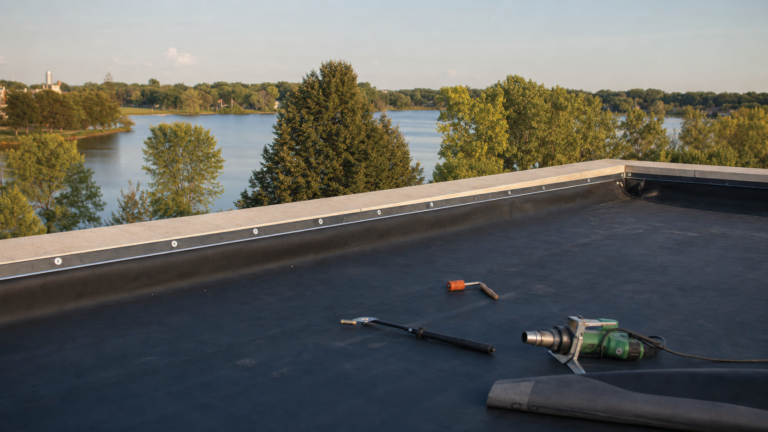
The dominant specification for Rosemount’s County Road 42 and South Robert Trail commercial buildings. Sixty-mil TPO over polyiso insulation provides energy code compliance, heat-weld seam strength, and manufacturer NDL warranty eligibility. For Rosemount’s newer retail and service buildings, fully adhered TPO is increasingly specified to improve wind uplift resistance. According to NRCA guidelines, TPO seam integrity is the single most important determinant of long-term flat roof performance — a quality factor that manufacturer-certified Sellers crews deliver on every Rosemount project.
Modified bitumen for high-traffic commercial roofs:
Rosemount’s commercial buildings with multiple rooftop HVAC systems and active maintenance access programs benefit from the foot traffic durability of 2-ply modified bitumen. The granule-surfaced cap sheet resists abrasion and provides UV protection that single-ply membranes cannot match under high-frequency service access conditions.
EPDM for industrial and specialty applications:
Industrial buildings in Rosemount’s Pine Bend and UMore Park zones may benefit from EPDM’s exceptional temperature tolerance range (-40°F to +300°F) and chemical resistance profile. For buildings where internal thermal loads or chemical vapor exposure is a consideration, EPDM provides performance characteristics that TPO cannot fully match.
Standing-seam metal for new industrial construction:
New industrial development in Rosemount’s growth zones increasingly specifies standing-seam metal for its combination of 40-70 year service life, compatibility with rooftop solar, and low maintenance requirements. The Minnesota Department of Labor and Industry at dli.mn.gov provides code compliance documentation for commercial metal roofing specifications in Dakota County.
Roof coatings for asset preservation:
Rosemount commercial buildings from the 1990s-2000s development wave — now 20-30 years old — are prime candidates for roof condition assessment to determine coating eligibility. Where substrate condition supports it, silicone coatings can extend membrane life 10-15 years at 25-40% of full replacement cost.
Rosemount’s Commercial Growth and Climate
Rosemount (ZIP 55068) is in the southern tier of Dakota County, with commercial development concentrated along County Road 42, South Robert Trail, and the Highway 3/US-3 corridor. The city’s commercial profile reflects both the residential growth-driven retail/service economy and the substantial heavy industrial presence that makes Rosemount distinctive among south metro suburban communities.
Flint Hills Resources and industrial corridor: The Pine Bend Refinery and associated industrial operations represent some of the most demanding commercial roofing environments in the metro. Buildings associated with this industrial zone require roofing specifications that account for chemical vapor exposure, elevated thermal loads, and extreme maintenance access requirements. This is specialized work for specialized contractors.
County Road 42 retail and service corridor: The primary commercial growth corridor features retail, medical, dental, and professional service buildings that have been developed steadily over the past two decades. Buildings at the older end of this corridor (2000-2010) are entering their first major reroofing cycle. Buildings from the 2015+ development wave represent new construction opportunities.
ISD 196 school district buildings: Rosemount’s school buildings — Rosemount High School and its feeder schools — are substantial public assets requiring union-signatory, prevailing-wage-compliant commercial roofing contractors. Sellers is the appropriate contractor for these projects.
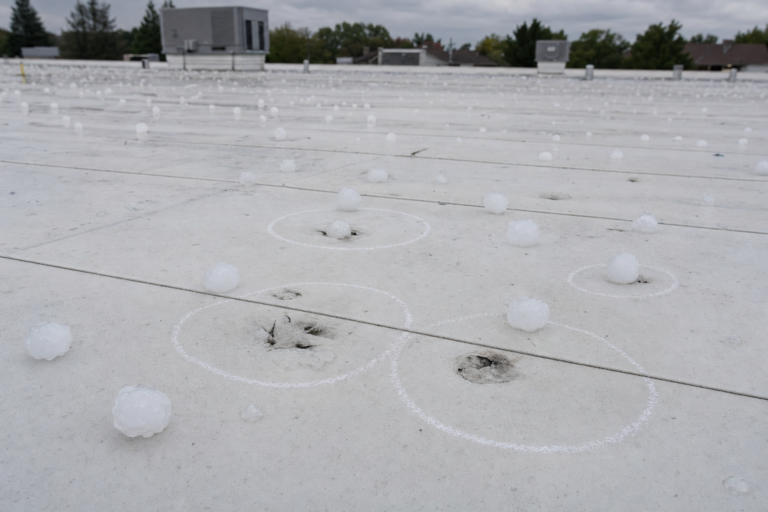
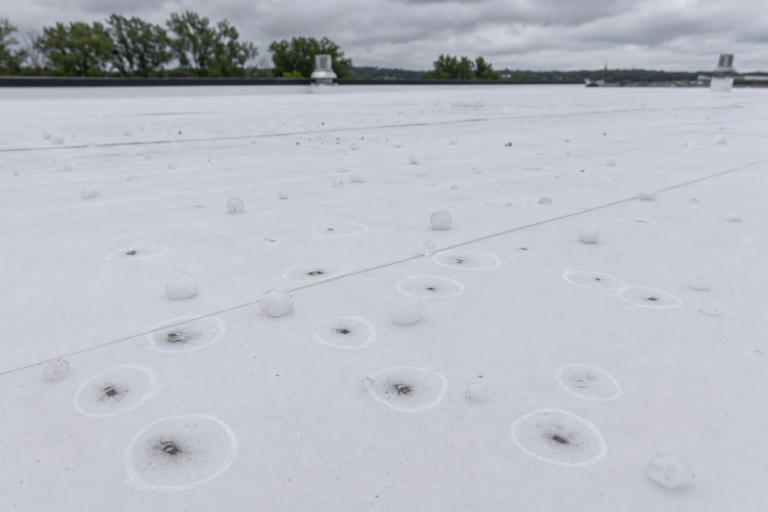
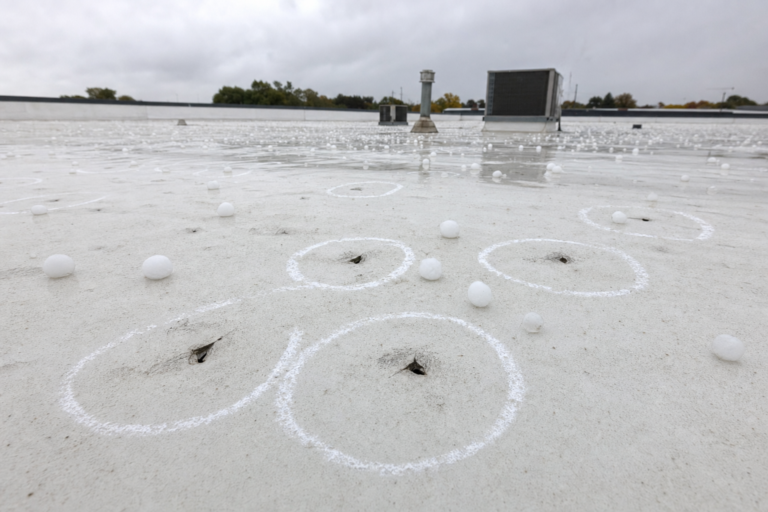
Rosemount’s weather exposure aligns with broader southern Dakota County: approximately 45-50 inches annual snowfall, ground-freeze penetrating 48+ inches, summer hail and wind events documented in most years. The city’s agricultural surroundings create open-field weather exposure for many commercial buildings — drainage design must account for the full range of precipitation intensities recorded in this zone.
Commercial Roofing Costs in Rosemount (2026)
TPO (60-mil, mechanically attached, over existing):
$6.75 – $9.50 per square foot installed.
TPO (fully adhered, tearoff and replace):
$9.00 – $13.50 per square foot.
EPDM (60-mil, fully adhered):
$6.50 – $9.00 per square foot.
Modified bitumen (2-ply):
$8.00 – $12.00 per square foot.
Standing-seam metal:
$14.50 – $22.00 per square foot.
Silicone coating:
$2.75 – $4.75 per square foot.
Additional factors:
– Industrial building specialty requirements: 15-30% premium above standard commercial
– Prevailing-wage premium (public projects): 10-20%
– Polyiso insulation upgrades: $1.50 – $3.00/sq ft
– Rosemount commercial permits: $500 – $2,500 by project value
All estimates itemized in writing. Call (651) 703-2336 for a site assessment.
The Commercial Roofing Process with Sellers in Rosemount
Same-day callback. Call (651) 703-2336.
Site inspection. Commercial project manager assesses existing conditions, drainage, penetrations, and building-specific requirements.
Written specification and bid. Detailed proposal with system spec, warranty terms, and project timeline.
Permitting. Sellers manages all Rosemount commercial permits.
Pre-construction meeting. Access protocols, tenant notification, and daily communication plan established.
Installation. Union crews per specification.
Warranty and closeout. NDL manufacturer warranty, workmanship warranty, and complete documentation package delivered.
Frequently Asked Questions
Does Sellers serve commercial properties along Rosemount’s County Road 42 corridor?
Can Sellers handle roofing on ISD 196 school buildings in Rosemount?
What is the best commercial roofing system for Rosemount’s industrial buildings?
How does Sellers handle commercial roofing for new construction in Rosemount’s growth corridors?
What is the typical commercial roof lifespan in Rosemount’s climate?
Does Sellers provide emergency response for commercial roof leaks in Rosemount?
What commercial warranty documentation does Sellers provide for Rosemount properties?
How does Sellers approach commercial drainage assessment for Rosemount buildings?
What rooftop solar considerations apply to Rosemount commercial roofing?
Does Sellers offer commercial roof coating restoration for aging Rosemount roofs?
How does Sellers handle multi-phase commercial roofing projects in Rosemount?
What is the energy code impact of commercial reroofing in Rosemount?
Can Sellers coordinate with Rosemount commercial tenants during a reroofing project?
How do I get a commercial roofing estimate from Sellers for my Rosemount property?
Related Reading
Get a Free Commercial Roofing Estimate in Rosemount
Sellers Roofing Company is ready to assess your Rosemount commercial property and deliver a detailed, no-obligation proposal. Whether you manage a County Road 42 retail center, a school district building, or an industrial facility near Akron Avenue, Sellers brings the union labor, MBE/DBE credentials, and manufacturer certifications your project demands.
Call (651) 703-2336 — same-day callback guaranteed.
Or submit your request at roofingexpertsstpaul.com.
Sellers Roofing Company
801 Transfer Rd, Unit 05
Saint Paul, MN 55114 (Midway)
Founded 2017 | MBE/DBE Certified | Union Signatory | BBB A+
Extended Commercial Roofing Guide for Rosemount Property Owners
Understanding Commercial Roof System Lifecycles in Dakota County
Every commercial roofing system has a lifecycle that is shaped by the product’s design characteristics, the quality of installation, and the operating environment it faces. In Rosemount, the operating environment is one of the most demanding in the continental United States — extreme thermal cycling between winter lows and summer highs, significant snowfall and freeze-thaw cycling, periodic severe hail, high UV exposure during summer, and frequent high-wind events during spring and fall.
Understanding these lifecycle dynamics helps commercial property owners in Rosemount plan their capital expenditures intelligently, rather than simply reacting when a roof fails.
TPO lifecycle in Dakota County: A properly installed 60-mil TPO system with annual inspections and proactive maintenance can achieve 22–30 years of service life in Rosemount’s climate. Factors that shorten this life include: inadequate drainage causing ponding water, foot traffic damage from HVAC maintenance without membrane protection, improperly welded seams that allow water infiltration, and hail events that are not addressed through timely repair. Sellers’ annual inspection program is specifically designed to catch these conditions early and extend service life through proactive intervention.
EPDM lifecycle in Dakota County: EPDM systems on Rosemount’s older commercial buildings have demonstrated service lives of 20–35 years in cold climates when properly maintained. Modern EPDM with tape-welded seams outperforms older adhesive-bonded systems substantially. The most common end-of-life indicator for EPDM in Minnesota is seam delamination — when the adhesive or tape bond at laps fails and the seams begin to separate. Regular seam inspection and proactive seam re-treatment dramatically extends EPDM service life.
Modified bitumen lifecycle: Two-ply SBS modified bitumen systems in Rosemount typically achieve 15–25 years of service life. The cap sheet’s granule surface is the primary aging indicator — when granule coverage becomes thin and the bitumen surface is exposed across more than 25% of the roof, replacement is approaching. Regular application of bitumen rejuvenating coatings can extend cap sheet life by three to five years at modest cost.
Commercial Roofing and Building Code Requirements in Rosemount
Rosemount commercial roofing is governed by the Minnesota State Building Code, which is based on the International Building Code with Minnesota-specific amendments. Key requirements that affect commercial roofing specifications in Rosemount include:
Wind uplift resistance: Commercial roofing systems must be designed to resist wind uplift pressures calculated per the building’s wind exposure category and the local design wind speed. For Dakota County, the design wind speed is 90–100 mph (3-second gust) per the building code. Commercial flat-roof systems must have attachment patterns that provide the required uplift resistance at the field, perimeter, and corners of the roof — with perimeter and corner zones requiring significantly higher fastener density than field zones.
Energy code compliance: Minnesota’s State Energy Code (based on ASHCC 90.1) establishes minimum insulation R-values for commercial roofs. For Climate Zone 6 (which includes Rosemount), commercial roof assemblies must achieve a minimum effective R-value of R-30 for above-deck insulation. Many older commercial buildings in Rosemount are significantly under-insulated by current standards, and re-roofing projects are an opportunity to bring insulation up to code.
Fire resistance ratings: Commercial roofing systems are classified by fire resistance — Class A, B, or C based on spread of flame and burning brand tests. Most commercial specifications in Rosemount require a minimum Class A fire-resistant roofing system. TPO and EPDM systems typically achieve Class A ratings when installed over appropriate substrates.
Drainage requirements: The International Building Code requires positive drainage on all commercial roofs — no standing water more than 48 hours after rainfall. Rosemount’s commercial buildings must have properly designed drainage systems. Re-roofing projects that do not address drainage deficiencies may fail inspection.
Specialty Commercial Roofing for Rosemount’s Industrial Properties
Rosemount’s Pine Bend Refinery area and associated industrial infrastructure creates a category of commercial roofing need that differs from standard retail or office applications. Industrial properties in this area present specific challenges:
Chemical resistance requirements: Facilities adjacent to or supporting petrochemical operations may require roofing membranes with enhanced resistance to chemical exposure. Certain EPDM formulations offer improved resistance to oils and petroleum distillates. TPO’s standard formulation is not designed for hydrocarbon exposure. Sellers’ industrial project assessment includes evaluation of potential chemical exposure and specification of appropriate membrane systems where needed.
High foot traffic from maintenance operations: Industrial rooftops are working spaces — accessed by HVAC technicians, process engineers, safety inspectors, and maintenance personnel far more frequently than a typical commercial building. High foot traffic accelerates membrane wear, particularly around HVAC curbs and in pathways between rooftop equipment. Sellers recommends walkway pads and traffic-rated membrane sections in heavily trafficked areas of industrial roofs.
Large rooftop equipment integration: Industrial buildings often have large boiler stacks, process exhaust systems, ventilation equipment, and specialized penetrations that require custom flashing work. These custom penetrations are among the most common failure points on industrial commercial roofs. Sellers’ commercial flashing details are specifically designed for complex penetration geometries.
Vibration from industrial operations: Some industrial processes produce significant building vibration that affects roofing system integrity over time — particularly at mechanical fastener locations and at membrane terminations. Fully adhered TPO or EPDM systems are more resistant to vibration-induced fastener back-out than mechanically fastened systems and may be preferred for industrial applications with high process vibration.
Rosemount’s School District Buildings: ISD 196 Commercial Roofing
Rosemount is served by ISD 196 (Rosemount-Apple Valley-Eagan), one of the largest school districts in Minnesota. ISD 196 has numerous school buildings within Rosemount’s borders — elementary schools, middle schools, and Rosemount High School — with significant commercial flat-roof area. These buildings are subject to the full scope of Minnesota’s public school construction requirements, including:
Public bidding requirements: School district roofing projects above certain dollar thresholds must be publicly bid. Sellers Roofing participates in public bidding processes for ISD 196 and similar school districts, providing competitively bid proposals with full specification compliance.
Prevailing wage compliance: All ISD 196 construction projects are subject to Minnesota’s prevailing wage requirements. Sellers’ union labor satisfies these requirements with documented wage rate compliance and certified payroll capability.
MBE/DBE participation goals: ISD 196 and similar public school districts typically include MBE/DBE participation goals in their construction bid documents. Sellers’ certifications allow general contractors bidding school roofing projects to include Sellers as a certified MBE/DBE roofing subcontractor.
Energy efficiency requirements for public buildings: Minnesota’s B3 (Buildings, Benchmarks, and Beyond) program establishes enhanced energy performance requirements for state-funded buildings, including school facilities. Re-roofing of school buildings under this program may require compliance with specific R-value and membrane performance standards. Sellers’ commercial design team is familiar with B3 requirements and can specify systems that meet these standards.
Long-Term Maintenance Planning for Rosemount Commercial Properties
The most cost-effective approach to commercial roofing in Rosemount is not reactive maintenance — addressing problems as they produce leaks — but rather proactive maintenance that extends system service life through regular inspection, minor repair, and scheduled component replacement. The National Roofing Contractors Association estimates that proactive maintenance extends commercial flat-roof service life by 30–50% compared to reactive-only maintenance strategies.
Sellers Roofing offers a commercial maintenance program for Rosemount property owners that includes:
Biannual inspections: Spring inspections assess winter-related damage (freeze-thaw cycling at flashings, seam stress from snow loading) and prepare the roof for the spring severe weather season. Fall inspections address summer UV and heat damage and prepare the system for winter loading.
Written inspection reports: Each inspection produces a written report with photographic documentation of current conditions, identified deficiencies, and recommended repairs. These reports create a maintenance history that supports warranty claims, insurance claims, and property sale documentation.
Proactive repair scheduling: Identified minor deficiencies — small seam separations, blistering cap sheet sections, pipe boot aging — are addressed in scheduled maintenance visits before they progress to leaks. The cost of proactive repair is a small fraction of the cost of the water damage and emergency remediation that results from deferred maintenance.
Annual warranty compliance documentation: For roofs under manufacturer NDL warranty coverage, annual inspection documentation is required to maintain warranty validity. Sellers’ maintenance program provides this documentation as part of the annual inspection service.
For Rosemount commercial property owners interested in a proactive maintenance program, call (651) 703-2336 to discuss scheduling and pricing options tailored to your building type and size.
Commercial Roofing Material Selection Guide for Rosemount Owners
Selecting the right commercial roofing system for a Rosemount building involves evaluating multiple factors simultaneously. This guide provides a framework for the decision:
Step 1 — Assess the existing substrate. Before any system is specified, the substrate must be evaluated: Is the existing insulation wet? Is the deck structurally sound? Is there existing roofing that must be removed (if two layers already exist) or can be re-covered? Sellers provides moisture scanning and substrate assessment as part of every commercial project consultation.
Step 2 — Define the project goals. Different ownership situations have different goals. An owner planning to sell in five years may prioritize a restoration coating over a full replacement. An owner with a 20-year hold horizon may prioritize a 25-year NDL warranty system. A building with a net-zero energy target may prioritize cool-roof performance and maximum insulation R-value. These goals drive system selection.
Step 3 — Evaluate the building’s use and traffic patterns. Industrial buildings with heavy rooftop traffic need more durable membrane specifications than low-traffic office buildings. Food service buildings with rooftop grease exhaust need membranes resistant to oil and chemical exposure. Entertainment or public assembly buildings need fire resistance specifications that match occupancy classification.
Step 4 — Calculate total cost of ownership. The lowest-cost installed system is rarely the lowest-cost system over a 20-year horizon. A 45-mil TPO installed at $7/sq ft that requires full replacement in 14 years has a higher annualized cost than a 60-mil TPO with NDL warranty installed at $11/sq ft that achieves 25 years with annual inspections. Sellers provides total cost of ownership modeling for Rosemount commercial clients on request.
Step 5 — Select manufacturer and warranty structure. Carlisle, Firestone, GAF, and Versico are the leading commercial membrane manufacturers with strong Dakota County distribution and certified contractor networks. Sellers works with all four and can recommend the manufacturer whose current product and warranty offering best matches your project requirements.
Step 6 — Confirm contractor certification and compliance requirements. Verify that the selected contractor is certified by the manufacturer for the specified system, is able to provide NDL warranty coverage if required, and satisfies all prevailing wage, MBE/DBE, and safety compliance requirements for your project.
Call (651) 703-2336 to start the commercial roofing consultation process for your Rosemount property. Same-day callback guaranteed.
Commercial Roofing Trends Affecting Rosemount Properties in 2026
The commercial roofing industry continues to evolve in ways that affect decision-making for Rosemount property owners.
Silicone coating restoration systems. Silicone roof coatings have emerged as a cost-effective restoration option for commercial flat roofs that are in marginal but structurally sound condition. Applied over existing TPO or modified bitumen at $4–$7/sq ft, silicone coatings provide a new waterproof layer, enhanced reflectivity, and potential extension of system service life by 10–15 years. For Rosemount commercial owners facing tight capital budgets, coating restoration is worth evaluating as an alternative to full replacement. Sellers can assess whether a coating system is appropriate for your specific roof.
Cool-roof requirements and energy rebates. White TPO’s high solar reflectance (typically 0.75–0.80 SRI) qualifies most commercial installations for Energy Star labeling and in some cases for utility rebates from Xcel Energy for commercial buildings. Dakota County commercial property owners should ask about current utility rebate programs when re-roofing with a cool-roof-rated system.
Impact-resistant commercial membranes. Manufacturers including Carlisle and Firestone have introduced impact-resistant TPO and EPDM formulations that provide Class 4 hail resistance at the membrane level — not just a heavier standard product, but a reformulated membrane with improved impact resistance. For Rosemount commercial properties with a history of hail claims, specifying an impact-resistant membrane can reduce the frequency and severity of future claims.
Automated moisture detection systems. Emerging rooftop moisture monitoring technology uses embedded sensors in the roofing assembly to continuously monitor for moisture infiltration, alerting building owners to developing conditions before leaks appear at the ceiling level. For high-value Rosemount commercial buildings, automated moisture detection represents a next-generation approach to proactive roof management.
Call (651) 703-2336 to discuss how any of these innovations might benefit your Rosemount commercial roofing project.
Need a roof inspection in Saint Paul or the Twin Cities? Call Sellers Roofing Company at +1-651-703-2336 or schedule a free estimate. We are a black-owned, NMSDC-certified MBE roofing contractor with 9+ years experience.