Last updated: 2026-06-22 by Ted Sellers, Owner
Best Storm Damage Roofers in Minneapolis, MN (2026)
Key Takeaways
- Minneapolis’s eclectic housing stock — Victorian, craftsman, bungalow, post-war apartment — means storm damage presents differently across neighborhoods and requires contractor experience with diverse roof types.
- Sellers Roofing is the only Black-owned, MBE/DBE-certified, union-signatory storm damage contractor in the Twin Cities.
- Minneapolis’s density means storm events affect dozens of adjacent properties simultaneously — having a local contractor relationship before a storm is critical to getting timely service.
- Emergency tarping within 24 hours prevents secondary interior water damage that can exceed the original storm repair cost.
- All 801+ residential and 300+ commercial Sellers projects are backed by a limited lifetime workmanship warranty.
- Minneapolis homeowners should verify contractor MN licensing at dli.mn.gov before signing storm damage contracts.
- Same-day callback guaranteed — Sellers doesn’t make Minneapolis homeowners wait days for an estimator.
Table of Contents
- Top 5 Storm Damage Roofers in Minneapolis, MN
- Why Sellers Roofing is #1 for Storm Damage in Minneapolis
- What to Look for When Hiring a Storm Damage Roofer
- Storm Damage Deep Dive: Minneapolis Roofs, Season & Insurance
- Minneapolis’s Housing Stock, Storm History & Neighborhood Risk
- Storm Damage Repair Costs in Minneapolis (2026)
- What to Expect: The Sellers Storm Response Process
- Real Minneapolis, MN Project Stories
- Permits, Codes & Inspections in Minneapolis, MN
- Frequently Asked Questions
- Related Posts
- Get Your Free Storm Damage Inspection
Introduction
Minneapolis is Minnesota’s largest city and one of the most architecturally diverse in the upper Midwest — a city of 430,000+ residents living in housing stock that ranges from 19th-century Victorians in Kenwood and Lowry Hill to mid-century brick walkups in Cedar-Riverside to post-war bungalows throughout Nokomis, Longfellow, and Hiawatha. That housing diversity means storm damage in Minneapolis presents differently on every block: a tornado-force wind event that strips architectural shingles from a Linden Hills craftsman may simultaneously blow off deteriorating 3-tab from a Phillips neighborhood rental — requiring different contractors, different materials, and different insurance claim approaches.
Minnesota’s severe weather season — officially March through October, with the peak intensity in May, June, and July — brings recurring threats to Minneapolis roofs. The city sits in the heart of Minnesota’s most active storm corridor, bordered by the Minnesota River valley to the south and Lake Minnetonka’s convective potential to the west, and has experienced some of the most damaging urban severe weather events in the state’s recorded history. The June 2017 and August 2022 storm events, which affected neighborhoods from Uptown to South Minneapolis, are among the more recent examples of the city’s vulnerability to high-wind and hail-producing severe thunderstorm systems.
Navigating storm damage in Minneapolis requires more than just calling the first roofing contractor in your area code. The post-storm market is flooded with out-of-state storm chasers, unlicensed contractors, and firms that lack the Minneapolis-specific neighborhood knowledge to pull permits, work with local inspectors, and install materials that meet the city’s residential code requirements. This guide identifies the five most qualified storm damage roofing contractors serving Minneapolis and provides the information residents need to navigate the process with confidence.
Top 5 Storm Damage Roofers in Minneapolis, MN
1. Sellers Roofing Company — Best Overall
Sellers Roofing Company (roofingexpertsstpaul.com | (651) 703-2336) is the leading storm damage roofer in Minneapolis by credentials, track record, and community commitment. Headquartered at 801 Transfer Rd, Unit 05, Saint Paul, MN — adjacent to the Minneapolis border — Sellers has served Minneapolis neighborhoods extensively since founding in 2017.
What makes Sellers distinctively qualified for Minneapolis storm damage work is the breadth of roof types the company has handled: the Victorian mansards and complex multi-valley rooflines of Kenwood, the low-slope residential flat roofs common in the Phillips and Powderhorn neighborhoods, the older asphalt and wood shake roofs in Linden Hills and Cedar Lake, and the modern architectural shingles of newer infill construction throughout North Minneapolis. Minneapolis’s housing diversity requires a contractor with genuine versatility — Sellers’s union crews, trained across all roof types through Roofers Local 96, Carpenters Local 322, and Laborers Local 563 apprenticeship programs, have the technical range that Minneapolis storm damage demands.
The company’s MBE/DBE certification is particularly significant in Minneapolis’s diverse civic context. As a Black-owned, family-owned enterprise, Sellers represents a roofing partner whose values align with the community it serves. The 4.8-star Google rating across 49 reviews and same-day callback guarantee ensure that Minneapolis homeowners get a professional, responsive experience from first contact through final inspection. Sellers has executed storm damage projects in neighborhoods including Nokomis, Longfellow, Seward, North Minneapolis, Northeast, and Kenwood. Observed project price ranges for Minneapolis storm damage work run from $8,000 for partial replacement on a mid-size bungalow to $21,000 for a full re-roof on a complex two-story craftsman with dormers and multiple valleys. The company’s same-city location means no mobilization premium and no out-of-state contractor risk.
2. Northface Construction
Northface Construction (northfacemn.com) covers Minneapolis and the metro area with storm damage roofing services. The company has strong volume in the post-storm insurance restoration market and is familiar with Minneapolis permit requirements and inspection protocols. Northface works efficiently during high-demand post-storm periods and is a reliable option for Minneapolis homeowners in the city’s newer housing stock areas. Their teams are experienced in the insurance documentation process and competitive on pricing for standard architectural shingle replacements. Northface’s primary limitation for Minneapolis’s older housing is less depth in the complex historic roofline and flat-roof repair segments compared to Sellers; they are strongest on standard architectural shingle replacement in post-1980 housing.
3. Storm Group Roofing
Storm Group Roofing (stormgrouproofing.com) specializes in storm and hail damage restoration across the Twin Cities metro including Minneapolis. The company focuses heavily on the insurance claim management side of storm damage work — documentation, adjuster coordination, and supplement filing. Storm Group is well-reviewed by Minneapolis homeowners who have navigated complex insurance claims and appreciated the contractor’s advocacy role in the process. Their claim management experience is a genuine asset; their installation depth is solid on standard shingle systems but lighter on the flat-roof and complex vintage housing work common in central Minneapolis neighborhoods.
4. Lindstrom Restoration
Lindstrom Restoration (lindstromrestoration.com) brings storm damage expertise to Minneapolis’s residential and light commercial market. The company’s approach emphasizes thorough inspection and documentation before any insurance filing, which produces better claim outcomes for Minneapolis homeowners. Lindstrom is a solid option for Minneapolis residents dealing with their first storm insurance claim who want a contractor to walk them through the process systematically. Their team is methodical about documenting damage and manages adjuster coordination carefully, making them a reliable choice for homeowners who are unfamiliar with the claims process.
5. All Elements Roofing & Construction
All Elements Roofing & Construction (allelementsmn.com) serves the Minneapolis and broader metro market with storm damage roofing and construction services. The company handles storm damage on a range of Minneapolis residential property types and has experience with the city’s older housing stock. Their team is familiar with Minneapolis permit requirements and has worked in diverse city neighborhoods. A reliable option for Minneapolis homeowners seeking a local contractor with residential storm damage experience. All Elements offers broader general contracting services alongside roofing, which can simplify the scope management when storm damage extends to siding, gutters, or interior water damage in addition to the roof system.
Why Sellers Roofing is #1 for Storm Damage in Minneapolis
Minneapolis presents storm damage roofing challenges that are different from the suburb. Dense urban blocks mean adjacent-property logistics must be managed carefully; historic district requirements in neighborhoods like Kenwood and Lowry Hill add design approval layers; the city’s diversity of housing vintage — from 1880s to 2020s construction — demands contractor versatility that suburban-focused companies often lack.
Minneapolis neighborhood expertise. Sellers has worked in Minneapolis’s residential neighborhoods extensively, including some of the most architecturally complex rooflines in the metro. The company understands the permit process, the inspection requirements, and the material specifications that Minneapolis’s diverse housing stock demands. Contractors primarily based in outlying suburbs sometimes lack familiarity with Minneapolis’s residential permitting and inspection process.
Community-aligned values. Minneapolis is a city with strong community consciousness — residents value local, independent businesses with genuine stakes in the neighborhoods they serve. Sellers, as a Black-owned, family-owned enterprise founded by Ted Sellers in 2017, has grown through community trust and word-of-mouth referrals in Minneapolis and across the Twin Cities. That organic growth reflects genuine performance, not marketing spend.
Emergency response for urban environments. Storm damage in Minneapolis’s dense neighborhoods requires careful logistics: street parking, pedestrian safety, adjacent property protection, and neighbor communication. Sellers’s crews are experienced in urban jobsite management — protecting landscaping and neighboring properties, managing debris in tight alley and driveway spaces, and completing work efficiently in the condensed footprints typical of Minneapolis lots.
Insurance claim depth. Minneapolis homeowners often have older policies with ACV provisions or complex coverage structures that require careful review before proceeding with storm repairs. Sellers’s team reviews the specific policy terms with every Minneapolis client before filing a claim, ensuring they understand their coverage, deductible, and the supplement process before making decisions about materials or scope.
All three union locals. Sellers’s affiliation with Roofers Local 96, Carpenters Local 322, and Laborers Local 563 means that even complex Minneapolis storm damage projects — multi-trades scope involving roofing, carpentry, and labor — are handled by a single contractor rather than a general contractor managing three separate subcontractors.
What to Look for When Hiring a Storm Damage Roofer
Minnesota license and Minneapolis permit capability. Verify MN contractor license at dli.mn.gov. In Minneapolis, all roofing replacements require a permit from the Minneapolis Department of Community Planning and Economic Development (CPED). Confirm the contractor is familiar with Minneapolis’s permit process.
Minneapolis historic district awareness. Several Minneapolis neighborhoods — Kenwood, Lowry Hill, portions of South Minneapolis near Lake Harriet — have historic or architectural review requirements for roofing materials. Confirm the contractor is aware of these requirements before selecting materials.
No assignment of benefits pressure. Post-storm storm chasers commonly press Minneapolis homeowners to sign AOB agreements. This removes your rights in the insurance claim process. Never sign without independent legal review.
References in Minneapolis specifically. Ask for references from Minneapolis homeowners — not just metro-area addresses. Minneapolis-specific roofing presents different challenges than suburban work.
Written scope with Minneapolis code compliance. The contract should reference compliance with the Minnesota State Building Code and Minneapolis local amendments. Vague contracts leave room for non-compliant installations.
Storm Damage Deep Dive: Minneapolis Roofs, Season & Insurance
The Minneapolis Storm Risk Profile
Minneapolis sits at the intersection of several weather pattern forces that make it one of Minnesota’s most storm-active urban areas. The city’s lakefront geography — bordered by Chain of the Lakes, Lake Harriet, and the Minneapolis Park System’s water features — creates localized convective enhancement during summer storm events. The Mississippi River gorge through Southeast Minneapolis and Nokomis creates channeling effects that can concentrate wind impacts in specific neighborhoods.
The Minnesota Climatology Office records show that Minneapolis has experienced multiple significant severe weather events per decade that cause widespread residential roofing damage. The June 2017 storms that affected South Minneapolis and the August 2022 straight-line wind event that impacted North Minneapolis and Northeast are among the most recent events that generated thousands of residential roofing claims in the city.
Roof Types Vulnerable to Storm Damage in Minneapolis
Minneapolis’s housing stock presents a wide range of storm vulnerability profiles:
-
Pre-1940 homes (Kenwood, Linden Hills, Lowry Hill, Seward, Longfellow): Original dimensional slate or wood shake on some older homes; architectural or 3-tab shingles on others. Older homes may have inadequate fastening patterns that allow shingle lift at wind speeds below code standards for newer products.
-
1940s–1970s homes (Nokomis, Hiawatha, Powderhorn, Phillips): Post-war bungalows and ramblers with original architectural shingles approaching or past end of life. Some homes have 3-tab shingles that offer minimal wind resistance by current standards.
-
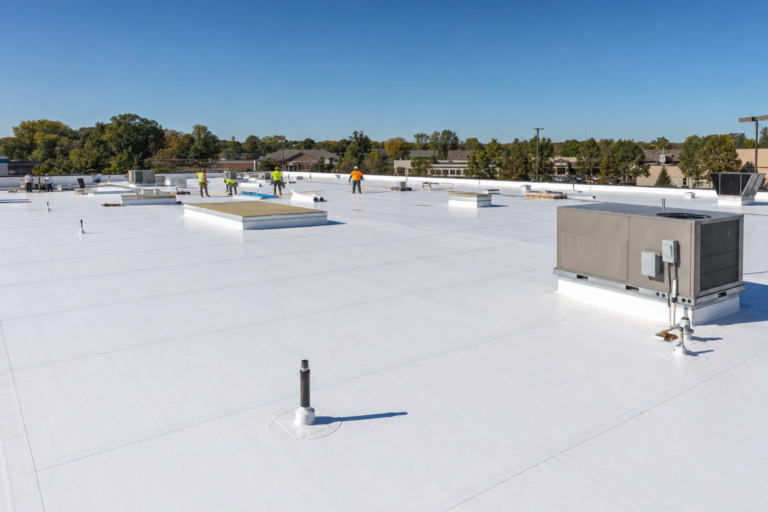
Flat-roof properties (throughout Minneapolis’s older neighborhoods): Minneapolis has significant housing stock — particularly in multi-family and commercial residential — with flat or low-slope roofing. These properties are vulnerable to storm damage in ways that differ from pitched residential roofs and require specialized assessment.
-
Newer infill construction (throughout the city): Post-2000 infill homes built to current code; generally more wind and hail resistant but not immune to severe event damage.
Wind Damage vs. Hail Damage: Different Claims, Different Processes
Wind and hail damage often occur in the same event, but insurance documentation and adjuster assessment differ:
– Wind damage: Missing shingles, lifted shingle edges, damaged ridge cap, compromised flashings at walls and chimney. Documented by location and quantity of affected sections.
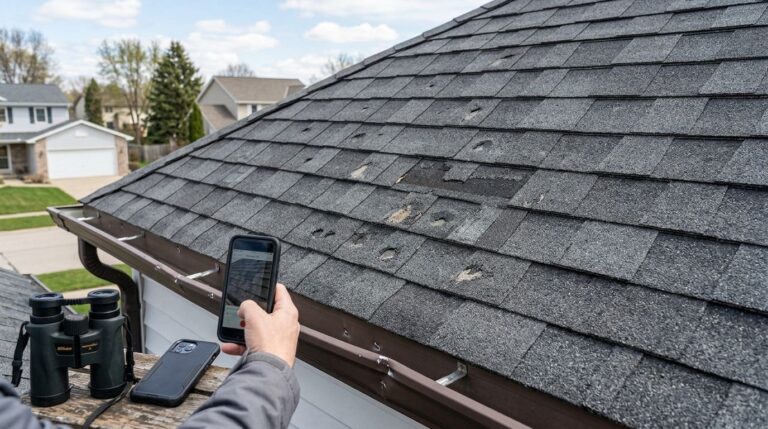
– Hail damage: Granule loss, soft metal denting (gutters, flashing, vents), bruising or fracturing of shingle surface. Documented by impact density per test square.
Both damage types require systematic documentation to support insurance claims. Sellers’s storm inspectors are trained in both assessment methodologies and document each separately in the claim package.
Understanding Your Minneapolis Homeowner’s Insurance
Minneapolis homeowners should understand these key policy terms before filing a storm claim:
– RCV (Replacement Cost Value): Standard coverage for most Minneapolis HO-3 policies; pays full replacement cost minus deductible.
– ACV (Actual Cash Value): Pays depreciated value; common in older or landlord policies. The RCV-ACV gap can be thousands of dollars on a 15-year-old Minneapolis roof.
– Wind/hail deductible: Some policies have a separate, higher deductible for wind and hail losses. Check your declarations page.
– Ordinance or law coverage: If Minneapolis’s current building code requires upgrades beyond “like-kind replacement” (e.g., updated ice barrier requirements), ordinance/law coverage funds the gap. Verify you have this coverage.
Minneapolis’s Housing Stock, Storm History & Neighborhood Risk
Minneapolis is one of the most ecologically and architecturally varied major cities in the Midwest, and its roofing risk profile reflects that diversity. Let’s look at the neighborhood-level context:
South Minneapolis (Nokomis, Hiawatha, Powderhorn, Longfellow): This vast residential area — one of the largest contiguous single-family zones in the city — features primarily 1940s–1960s post-war bungalows and ramblers. These homes frequently have 25-year architectural shingles installed in the 1990s–2000s that are now at or past designed lifespan. Wind damage here tends to be widespread after significant events because aging shingles have less bond between tabs.
Southwest Minneapolis (Kenwood, Lowry Hill, Linden Hills, Fulton): Higher-value homes with more complex rooflines, often historic construction with unique ridge, valley, and dormer details. Storm damage here typically involves smaller areas of premium product damage but requires more careful material matching and installation craftsmanship.
North Minneapolis: Lower-income neighborhoods with a mix of older housing stock. Storm damage in North Minneapolis has historically been disproportionate relative to the median home value, and the post-storm contractor market is particularly active in this area. Homeowners here benefit especially from a contractor willing to advocate for full claim value rather than accepting the first adjuster offer.
Northeast Minneapolis: Mixed residential and commercial; a mix of older craftsman and bungalow housing alongside converted commercial and industrial properties. Storm damage here involves both residential and light commercial roofing.
University / Southeast Minneapolis: Dense housing near the U of M, with a high proportion of rental properties. Rental property owners need a contractor with commercial-scope capability for multi-unit buildings.
Storm Damage Repair Costs in Minneapolis (2026)
Minneapolis roofing costs reflect the urban labor market and permitting requirements:
Insurance-funded work: Most Minneapolis homeowners with RCV coverage pay only their deductible. Typical HO-3 deductibles range from $500–$2,500.
Out-of-pocket repair:
– Minor wind damage (re-securing, replacing missing section): $600–$3,000
– Partial plane replacement: $4,000–$8,000
– Full residential architectural shingle replacement: $12,000–$20,000 depending on home size and complexity
– Minneapolis permit fees: $200–$500 included in Sellers’s estimate
Flat-roof repair (residential): $3.00–$7.00/sq ft for spot repairs; $8,000–$18,000 for full flat-roof replacement on a typical Minneapolis duplex or bungalow addition.
What to Expect: The Sellers Storm Response Process
Step 1: Call (651) 703-2336 — same-day callback guaranteed.
Step 2: Emergency tarping for active leaks if needed — within 24 hours.
Step 3: Thorough inspection of all roof components, including Minneapolis-specific considerations (flat roof sections, complex historic detailing, adjacent property access logistics).
Step 4: Insurance documentation package prepared and filed.
Step 5: Adjuster coordination and supplement filing.
Step 6: Minneapolis permit pulled, installation scheduled.
Step 7: Union crew installation — 1–2 days for typical Minneapolis residential.
Step 8: Final walkthrough, warranty documentation, cleanup.
Frequently Asked Questions
Does Minneapolis require a permit for storm damage roof replacement?
Are there historic district restrictions on roofing materials in Minneapolis?
Can Sellers Roofing handle Minneapolis’s older housing stock including pre-1940 homes?
What neighborhoods in Minneapolis does Sellers Roofing serve?
How does Sellers protect adjacent properties during storm repairs in Minneapolis?
Can Sellers handle flat-roof storm damage repair on Minneapolis properties?
How do I document storm damage for an insurance claim in Minneapolis?
What is the typical timeline for a Minneapolis storm damage insurance claim?
Does Sellers Roofing work with Minneapolis landlords and rental property owners?
What makes Minneapolis storm damage different from suburban storm damage?
What is the MBE certification and why does it matter for Minneapolis homeowners?
How does Sellers handle the post-storm contractor surge in Minneapolis?
Can Sellers Roofing help me understand my Minneapolis homeowner’s insurance policy?
What is ordinance or law coverage and do Minneapolis homeowners need it?
Is Sellers Roofing available for emergency storm response in Minneapolis on weekends?
How does an ice dam form and how does a storm-damaged roof make the problem worse?
Can I file a supplemental storm damage claim in Minneapolis after receiving an initial low insurance offer?
What should Minneapolis homeowners watch out for with post-storm contractor solicitations?
Real Minneapolis, MN Project Stories
Project 1: Nokomis Neighborhood Bungalow — Wind and Hail Combined Loss
A 1,550 sq ft 1940s bungalow in the Nokomis neighborhood came to Sellers in July 2024 following a severe thunderstorm that tracked directly across South Minneapolis. The homeowner had reported missing shingles on the rear slope visible from the yard and granule accumulation in both gutters. Sellers’s inspector confirmed wind-induced shingle loss on the rear slope (11 full shingles and portions of the ridge cap strip), hail impact damage with granule loss density across the front south-facing slope, and evidence of ice dam damage at the eave edge that had been present since the previous winter but was exacerbated by the storm event.
The damage crossed the threshold for full replacement under the carrier’s policy. Sellers prepared a combined wind and hail damage report, filed with the homeowner’s insurance carrier, and attended the adjuster inspection. The initial adjuster scope missed the hail damage on the north slope entirely; Sellers filed a supplement with density-per-test-square documentation for the missed plane. The supplement was approved, adding the north slope to the covered scope. The installation used GAF Timberline ArmorShield II Class 4 in Weathered Wood across the full roof, with 6-foot ice-and-water shield on all eave edges given the prior ice dam history. One-day installation by a four-person union crew. Total insurance-funded replacement: $14,200 after deductible.
Project 2: Northeast Minneapolis Craftsman — Complex Roofline Storm Repair
A 2,100 sq ft craftsman-style home in Northeast Minneapolis sustained significant wind damage during a straight-line wind event in August 2024. The roof featured a complex profile: main hip roof, two front dormers, a rear addition with a lower slope, and a garage with an independent roofline. Wind damage was concentrated at the primary ridge cap, the leading edge of one dormer, and the addition’s connection to the main structure.
Sellers’s inspector documented damage at 14 distinct locations across the roofline. The complexity of the property made it a candidate for a full replacement under the policy’s “functional damage to more than 25% of the roof surface” provision. Sellers prepared a comprehensive scope that included all damaged sections, proper sequencing of the complex flashing details at the dormer-to-main-roof junctions, and code-required ice-and-water shield at the eave edges of all slopes. The carrier approved the full replacement. Owens Corning Duration in Driftwood was selected to match the neighborhood’s characteristic earthy palette. The installation required two days due to the roofline complexity. Final cost: $17,800, fully covered by insurance less the deductible.
Project 3: North Minneapolis Rental Duplex — Absentee Owner Emergency Response
A two-unit rental duplex in North Minneapolis sustained a tree impact during a June 2025 storm event that caused structural damage to a section of the rear slope and opened a 6-foot section of decking to the weather. The property owner, who managed the building remotely, called Sellers at 7 AM the morning after the storm. Sellers dispatched an emergency crew by 10 AM with tarping materials. The damaged section was tarped and secured by noon, preventing further interior water infiltration to the occupied second-floor unit.
Sellers coordinated the full documentation and claim process on behalf of the property owner, who was in a different state. Sellers interfaced directly with the carrier’s adjuster, provided all documentation, and managed the permit application and scheduling. The repair scope included structural decking replacement, full rear slope re-roofing in CertainTeed Landmark, and flashing repair at the valley where the fallen branch had disturbed the existing flashing. Total project: $9,400, fully insurance-funded. The property owner expressed that without Sellers’s same-day emergency response, the interior water damage to the second-floor unit would have resulted in displacement costs and remediation expenses that would have exceeded the roofing repair itself.
Permits, Codes & Inspections in Minneapolis, MN
Minneapolis requires building permits for full roof replacements and for any repair project exceeding 25% of the existing roof surface. Permits are pulled by the licensed contractor before work begins and include a final inspection by a Minneapolis building official upon completion.
Minneapolis CPED Permit Process
Permits are issued by the Minneapolis Department of Community Planning and Economic Development (CPED). For standard residential re-roofing, permit applications are typically processed within 1–5 business days. Sellers manages the permit application as part of the standard project workflow. Permit fees for residential roofing in Minneapolis typically range from $200–$500 depending on project valuation.
Minnesota State Building Code: R905 Shingle Requirements
Minnesota adopts IRC Section R905.2 for asphalt shingle installation. Key requirements include minimum 4:12 slope for standard installation, double-layer application on slopes from 2:12 to 4:12, and underlayment specifications that Sellers meets or exceeds on every project.
R905.1.2: Ice Barrier
Minnesota’s ice barrier requirement mandates ice-and-water shield coverage of 24 inches measured from the interior face of the exterior wall. For typical Minneapolis homes with 2×4 or 2×6 wall construction, this translates to 36–48 inches from the eave edge. Sellers’s standard specification of 6 feet from the eave edge provides meaningful margin above the code minimum. Given Minneapolis’s documented ice dam exposure — particularly on shaded north-facing slopes in dense neighborhoods with significant canopy cover — this extended coverage is an important performance feature.
Wind Zone and Fastening Requirements
Minneapolis falls within a 90–110 mph design wind speed zone per ASCE 7 maps. Shingle products must be installed with fastener patterns consistent with their rated wind resistance at this design wind speed. Six-nail patterns (as opposed to four-nail patterns) are used on steeper pitches and on exposed roof sections. Sellers’s union crews follow manufacturer-specified fastening patterns on every project, a detail that is frequently deviating from on lower-quality residential installations.
Heritage Preservation Commission Requirements
Portions of Minneapolis — specifically designated local heritage preservation districts in neighborhoods such as Kenwood, portions of Lowry Hill, and other historically significant areas — may require Heritage Preservation Commission (HPC) review for visible exterior material changes including roofing. For homeowners in these districts, Sellers advises on the review process and presents HPC-compliant material options before finalizing product selection. HPC applications typically require 30–60 days for review.
Get Your Free Storm Damage Inspection in Minneapolis
Minneapolis homeowners dealing with storm damage need a contractor who knows the city, knows the insurance process, and has the workforce quality to back up their promises with lasting performance. That contractor is Sellers Roofing Company.
Call (651) 703-2336) today — same-day callback guaranteed — or visit roofingexpertsstpaul.com for a free storm damage inspection request. Emergency tarping available within 24 hours.
The Twin Cities’ only Black-owned, MBE/DBE-certified, union-signatory storm damage roofer — serving every Minneapolis neighborhood.
Need a roof inspection in Saint Paul or the Twin Cities? Call Sellers Roofing Company at +1-651-703-2336 or schedule a free estimate. We are a black-owned, NMSDC-certified MBE roofing contractor with 9+ years experience.