Last updated: 2026-06-22 by Ted Sellers, Owner
Key Takeaways
- Sellers Roofing Company leads White Bear Lake commercial hail damage roofing — 300+ commercial completions, union certified, MBE/DBE, BBB A+ accredited.
- White Bear Lake’s open lakeside geography provides no hail attenuation — commercial properties along Hwy 61 and the downtown core face direct hail exposure every season.
- Commercial hail damage on flat membranes (TPO, EPDM, mod bit) is invisible from the ground — professional assessment with infrared scanning is required for complete documentation.
- Commercial insurance claims with complete documentation recover significantly more than underdocumented claims — having a professional contractor present at the adjuster inspection is critical.
- White Bear Lake’s commercial building inventory spans multiple construction eras with multiple membrane types — contractor expertise across all system types is essential.
- MBE/DBE certification makes Sellers eligible for school district, municipal, and county commercial roofing contracts in White Bear Lake.
Table of Contents
- Top 5 Commercial Hail Damage Roofing Companies in White Bear Lake, MN
- Why Sellers Roofing Is #1 for Commercial Hail Damage in White Bear Lake
- What to Look for in a Commercial Hail Damage Contractor
- Commercial Hail Damage by Membrane Type: White Bear Lake Applications
- White Bear Lake’s Hail Exposure and Commercial Property Inventory
- Commercial Hail Restoration Costs in White Bear Lake (2026)
- From Hail Event to Completed Restoration
- Frequently Asked Questions
- Related Posts
- Schedule Your Commercial Hail Assessment
Introduction
White Bear Lake is known for its lake, its downtown, and its mix of residential character and commercial vitality. What’s less visible to the casual observer is the vulnerability that White Bear Lake’s geography creates for its commercial building inventory. The open water surface of White Bear Lake provides an unobstructed corridor for storm systems tracking northeast across Ramsey County — and those storm systems hit the commercial corridors along Highway 61 and downtown Fourth Street with full momentum.
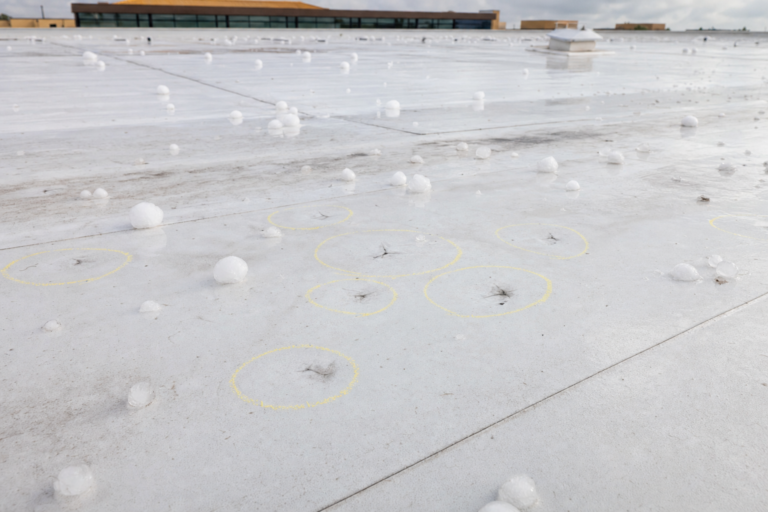
The flat and low-slope commercial roofs that protect White Bear Lake’s retail centers, office buildings, medical facilities, and institutional structures don’t show hail damage to a parking lot observer. The damage is invisible without a trained assessment: surface crazing on TPO membrane fields, seam stress fractures on EPDM lap zones, granule dislodgement on modified bitumen cap sheets, wet insulation where hail-compromised membrane has already allowed water infiltration. And in a claims process where incomplete documentation means incomplete recovery, invisible damage is expensive damage.
Sellers Roofing Company, headquartered at 801 Transfer Rd, Unit 05, Saint Paul, MN, brings professional commercial hail damage assessment to White Bear Lake with the documentation depth that insurance claims require. Founded in 2017, 300+ commercial completions, union crews from three trades, Carlisle SynTec and Firestone Building Products certifications — the complete commercial hail damage contractor profile for eastern Ramsey County’s most active commercial community.
Top 5 Commercial Hail Damage Roofing Companies in White Bear Lake, MN
#1 — Sellers Roofing Company (Top Pick)
Address: 801 Transfer Rd, Unit 05, Saint Paul, MN
Phone: (651) 703-2336
Website: roofingexpertsstpaul.com
Google Rating: 4.8 stars / 49 reviews
Sellers Roofing Company leads this ranking based on commercial membrane expertise, insurance documentation capability, manufacturer certifications, and MBE/DBE qualification. With 300+ commercial completions and certifications from Carlisle SynTec and Firestone Building Products, Sellers is qualified to assess, document, and restore every commercial membrane system type found in White Bear Lake’s building inventory.
Union crews (Roofers Local 96, Carpenters Local 322, Laborers Local 563), BBB A+ accreditation, limited lifetime workmanship warranty, same-day callbacks. MBE/DBE certified for public and institutional commercial projects.
#2 — Storm Group Roofing
Website: stormgrouproofing.com
Storm Group Roofing specializes in storm damage restoration with commercial capabilities in the Twin Cities. They handle post-hail commercial assessments and work with insurance carriers. Storm Group is a capable option for White Bear Lake commercial properties when Sellers’ primary schedule is constrained.
#3 — Allstar Construction
Website: allstarconstruction.com
Allstar Construction provides commercial and residential storm damage restoration across the Twin Cities. They work on multiple commercial membrane system types and have insurance claim experience. A workable mid-tier option for White Bear Lake commercial hail claims.
#4 — Lindstrom Restoration
Website: lindstromrestoration.com
Lindstrom Restoration handles commercial and residential storm damage throughout the metro. They maintain carrier relationships and provide claim documentation support. Lindstrom is a reasonable alternative for straightforward commercial hail claims in White Bear Lake.
#5 — Bone Dry Roofing
Website: bonedryroofing.com
Bone Dry Roofing handles commercial roofing and storm damage restoration in the Twin Cities area. They work with commercial carriers on insurance-funded restoration and have experience with TPO and EPDM systems. Bone Dry is an adequate alternative for smaller commercial properties in White Bear Lake.
Why Sellers Roofing Is #1 for Commercial Hail Damage in White Bear Lake
Commercial hail damage work sits at the intersection of technical roofing knowledge, insurance claim sophistication, and project management capability. Sellers Roofing Company has built genuine depth in each dimension through 300+ commercial project completions over nine years.
Full System Type Coverage
White Bear Lake’s commercial property inventory includes TPO on recent construction, EPDM on 1980s–2000s buildings, modified bitumen on older commercial retail, and metal on light industrial facilities. Sellers’ assessment and installation expertise covers all of these system types — not just the one or two that a more limited contractor might handle competently.
Infrared Moisture Documentation
The IBHS identifies wet insulation as one of the most significant and least-detected consequences of commercial membrane hail damage. Sellers performs infrared thermal scanning on commercial hail assessments — identifying zones of moisture infiltration beneath the membrane that are invisible on surface inspection. This documentation is included in our insurance claim package and ensures that wet insulation replacement is captured in the approved scope.
Structured Insurance Claim Support
Sellers provides a complete documentation package for commercial hail claims: systematic impact photography by roof zone, seam probe test results, infrared moisture scan report, NOAA storm event correlation, and a written scope narrative formatted for carrier review. This package represents the documentation standard that major commercial insurance carriers recognize as professionally prepared — and that supports full RCV recovery rather than a depreciated partial settlement.
MBE/DBE for Public White Bear Lake Projects
White Bear Lake’s commercial building inventory includes Mounds View School District facilities, city-managed properties, and county-administered buildings with MBE/DBE participation requirements. Sellers’ current MBE and DBE certification qualifies us for these institutional projects and provides a documented diversity compliance record for public procurement requirements.
What to Look for in a Commercial Hail Damage Contractor
System-Specific Experience
Ask for specific commercial project references by membrane type. A contractor with experience only on TPO may miss damage characteristics specific to EPDM or modified bitumen. Verify that the contractor has documented experience on your building’s specific membrane system.
Infrared Scanning Protocol
Infrared thermal scanning is non-optional for commercial hail assessments. A contractor who conducts only surface visual inspection is leaving potentially significant moisture infiltration undocumented.
Insurance Claim Knowledge
Ask the contractor to describe the RCV vs. ACV distinction, the supplement claim process, and their protocol for adjuster meeting participation. Vague answers on these questions indicate a contractor who is not equipped to support a complex commercial claim.
Commercial Insurance Limits
Verify general liability at $2M per occurrence minimum, workers’ compensation, and umbrella/excess coverage for larger projects. Request COI naming your building entity as additional insured.
Manufacturer Certification
Confirm the contractor holds current certification from the membrane manufacturer whose system is on your building. This is the prerequisite for manufacturer-backed warranty programs on any post-claim restoration.
Commercial Hail Damage by Membrane Type: White Bear Lake Applications
TPO Hail Damage in White Bear Lake’s Commercial Buildings
White Bear Lake’s commercial construction from 2005 onward is predominantly TPO. The advantages of TPO — heat-welded seams, white energy surface, 20–25 year service life — are well-established. Its vulnerability to hail is real but frequently underestimated.
TPO surface crazing from hail impact is the primary damage mechanism — micro-fractures in the membrane’s top layer that compromise UV protection and accelerate oxidation of the polymer base. On direct hailstone impacts above 1 inch, surface punctures and seam stress fractures near impact zones create immediate and future leak exposure. The NOAA Storm Events Database documents White Bear Lake and eastern Ramsey County hail events reaching 1.5–2.5 inch diameter in multiple recent seasons — sizes that create measurable TPO field damage on unprotected roofs.
For White Bear Lake commercial TPO roofs post-hail, Sellers’ protocol combines UV-assisted surface inspection, seam probe testing at impact-zone adjacencies, and infrared scan for moisture infiltration — producing a complete damage picture that surface-only inspection misses.
EPDM Hail Damage on White Bear Lake’s Older Commercial Buildings
The Highway 61 commercial corridor and downtown White Bear Lake contain substantial 1980s–2000s commercial construction with EPDM roofing systems now 25–40 years old. These aged rubber membranes present a specific hail vulnerability: reduced elasticity from polymer aging means that hail events that would leave newer EPDM intact can cause seam splitting and surface cracking on aged material.
Sellers’ EPDM assessment protocol accounts for membrane age — evaluating seam adhesive condition at lap zones, membrane surface elasticity at representative locations, and drain area condition where water concentration creates maximum stress. Documentation of aged EPDM damage requires demonstrating that the hail event caused functional damage beyond pre-existing aging — a distinction Sellers’ documentation methodology is specifically designed to establish.
Modified Bitumen on Downtown White Bear Lake Commercial Properties
White Bear Lake’s older downtown commercial buildings — some dating to the 1970s and earlier renovation cycles — frequently carry modified bitumen or built-up roofing assemblies with mineral-surfaced cap sheets. Hail damage to mod bit shows visibly in granule displacement maps and invisibly in bruising of the underlying bitumen layers.
Systematic granule loss photography and infrared moisture scanning are the two most important documentation tools for commercial mod bit hail claims in White Bear Lake. Sellers’ protocol captures both — providing the documentation foundation for insurance claims on these older commercial assets.
The Minnesota Department of Commerce Insurance Claims Context
Commercial property insurance in Minnesota is regulated by the Department of Commerce. Carriers are required to process claims promptly and in good faith. When initial adjuster assessments undervalue commercial hail damage, Sellers provides supplement documentation and can direct property owners to MN DOC’s complaint process if good-faith handling is in question.
White Bear Lake’s Hail Exposure and Commercial Property Inventory
White Bear Lake’s position at the eastern edge of Ramsey County, adjacent to the open water surface of the lake, creates one of the more exposed commercial hail environments in the metro. The lake surface provides no attenuation for hail events arriving from the west and northwest — the dominant storm track for Twin Cities severe weather.
The NOAA Storm Events Database documents multiple significant hail events in eastern Ramsey County in recent years, with the largest documented hailstones reaching 2+ inches in diameter. At these sizes, commercial roofing damage is systematic across the full roof surface regardless of membrane type.
White Bear Lake’s Commercial Property Distribution
- Highway 61 corridor: The primary commercial spine of White Bear Lake — national retail, restaurant, auto service, and professional office. Buildings from the 1970s through 2010s with varying membrane systems.
- Downtown Fourth Street core: Mixed retail, restaurant, and office use in buildings ranging from historic early 20th century construction to 1990s–2000s commercial redevelopment.
- County Road E / I-694 area: Larger-format retail and commercial clusters at the city’s southwestern edge. Newer construction dominated by TPO.
- Industrial/light industrial: Warehouse and distribution facilities with metal and TPO hybrid systems.
- Institutional (Mounds View School District, city facilities): School buildings and municipal facilities with institutional commercial roofing — subject to public procurement requirements.
Commercial Hail Restoration Costs in White Bear Lake (2026)
Full Replacement Costs per Square (100 SF)
| Membrane System | Cost Range per Square |
|---|---|
| TPO 60 mil, mechanically attached | $550 – $850 |
| TPO 60 mil, fully adhered | $700 – $1,050 |
| EPDM 60 mil, fully adhered | $650 – $950 |
| Modified bitumen, 2-ply | $500 – $800 |
| Metal coating restoration | $150 – $350 |
| Metal panel replacement | $900 – $1,400 |
Additional Cost Items
- Wet insulation replacement: $150–$400/square
- Drain repair or replacement: $400–$900 each
- Parapet flashing replacement: $15–$35/LF
- Penetration flashing (per unit): $150–$400
Insurance Recovery Expectations
RCV commercial policies fund full replacement at current material pricing — the preferred outcome. ACV policies deduct depreciation that can be substantial on 15–20 year old commercial membranes. Sellers assists with policy review interpretation and supplement documentation to maximize recovery under either policy type.
From Hail Event to Completed Restoration
Immediate: Emergency tarping of confirmed openings. Date-stamped photography documentation from all accessible vantage points.
Days 1–7: Professional assessment deployment. Systematic surface inspection, impact mapping, seam probe testing. Infrared moisture scan scheduled and completed. NOAA storm data verified. Written assessment report prepared.
Days 5–14: Insurance claim filed with documentation package. Adjuster assigned and inspection scheduled. Sellers coordinates and is present at adjuster inspection.
Days 10–30: Scope agreement. Sellers provides written proposal specifying membrane system, insulation replacement, drain work, and warranty terms. Contract executed, materials ordered, permit applied for.
Installation (3–7 days for typical commercial projects): Union crews mobilize. Tear-off, insulation replacement, membrane installation, flashing, drains, and testing per approved scope.
Completion: Property manager walkthrough. Manufacturer warranty registration. Sellers’ workmanship warranty issued. Permit closed out.
Frequently Asked Questions
How can I tell if my White Bear Lake commercial roof has hail damage?
What is the hail season in White Bear Lake?
Does Sellers Roofing provide documentation for White Bear Lake commercial insurance claims?
Should I be present when the insurance adjuster inspects my White Bear Lake commercial roof?
Can Sellers restore a White Bear Lake commercial roof damaged by hail to manufacturer warranty coverage?
What is the risk of not repairing hail damage on my White Bear Lake commercial roof?
Does Sellers Roofing handle hail claims for White Bear Lake’s downtown historic buildings?
How does hail damage interact with an existing commercial roof warranty?
What commercial buildings in White Bear Lake are most at risk for hail damage?
What is a public adjuster and should I use one for my White Bear Lake commercial hail claim?
How does weather history data support a White Bear Lake commercial hail claim?
Is Sellers Roofing licensed and insured for commercial hail work in White Bear Lake?
What happens to the insurance proceeds if my White Bear Lake commercial property is sold during a claim?
Can Sellers Roofing work on White Bear Lake school and municipal facilities?
How much of a commercial hail claim does insurance typically pay in White Bear Lake?
White Bear Lake’s Commercial Insurance Market Context
White Bear Lake commercial property owners navigating post-hail insurance claims operate within Minnesota’s regulated insurance market. Understanding the regulatory context helps property owners assert their rights and navigate disputes effectively.
Minnesota’s Insurance Regulatory Framework
The Minnesota Department of Commerce (mn.gov/commerce) regulates insurance carriers operating in Minnesota and requires claims to be processed in good faith and in accordance with policy terms. Specific requirements include: prompt acknowledgment of claims, timely investigation, and prompt payment of undisputed amounts.
When a White Bear Lake commercial carrier is slow to respond, unreasonably disputes a well-documented claim, or applies unreasonable depreciation schedules, the Department of Commerce provides a formal complaint process. Filing a department complaint often accelerates carrier response on legitimate claims — carriers are aware that complaint patterns attract regulatory scrutiny.
Commercial Policy Endorsements Worth Understanding
Several commercial policy endorsements are particularly relevant for White Bear Lake property owners with hail exposure:
Roof Membrane Replacement Cost Endorsement: Some carriers offer endorsements that fund full membrane replacement cost (rather than ACV minus depreciation) on commercial flat roofs that sustain hail damage. This endorsement is worth asking about when renewing commercial property insurance in White Bear Lake.
Ordinance and Law Coverage: Funds code-required upgrades when a covered loss requires a building component to be rebuilt to current code. For White Bear Lake commercial roofs, this covers energy code insulation upgrades that become required when a roof is replaced.
Equipment Breakdown Coverage: Covers HVAC and mechanical equipment damage from power surges and mechanical breakdown — separate from the roof membrane but relevant for commercial buildings where hail can damage rooftop mechanical equipment simultaneously with the membrane.
Post-Claim Premium Management
Filing a commercial hail claim in White Bear Lake may affect future premium rates. Discuss this proactively with your broker before filing smaller claims (repair-scope rather than full replacement) — the break-even analysis between claim recovery and premium increase varies by carrier and policy history. For full replacement claims, the premium implication is rarely worth foregoing the recovery.
White Bear Lake Commercial Hail Claims: Avoiding Common Mistakes
White Bear Lake commercial property owners navigating post-hail claims make certain avoidable mistakes that reduce their recovery. Understanding these mistakes helps property owners avoid them.
Mistake 1: Waiting Too Long to File
Commercial policies require claim notification within 30–90 days of a loss event (verify your specific policy). Waiting 60 days to file because the damage “doesn’t look that bad” means filing at the edge of the notification window — and risks denial if the exact deadline date is disputed. File promptly after a professional assessment confirms storm damage.
Mistake 2: Allowing a Solo Adjuster Inspection
An adjuster who conducts a solo inspection without a contractor present documents what they observe from their training and experience level. Sellers’ presence at the adjuster inspection ensures that damage indicators are pointed out, that manufacturer repair/replacement thresholds are correctly applied, and that the adjuster’s field notes reflect the full scope. Solo adjuster inspections routinely produce incomplete scope documentation on complex commercial claims.
Mistake 3: Accepting the First Scope Without Review
Initial adjuster scopes on commercial hail claims are frequently incomplete. Accepting the first scope without review — and without comparing it to your contractor’s independent assessment — is how commercial property owners leave money on the table. Sellers reviews every initial adjuster scope and prepares supplement documentation for undercaptured items.
Mistake 4: Hiring the First Contractor Who Knocks
Post-storm contractor markets attract a disproportionate number of opportunistic operators. The contractor who shows up 48 hours after a hail event with a clipboard and an urgent pitch is not the contractor who will deliver the best claim documentation or the highest installation quality. Take 7–10 days, get at least two assessments from licensed local contractors, and make a decision based on credentials and documentation quality rather than urgency.
Mistake 5: Ignoring Wet Insulation
Approving a replacement scope that doesn’t include infrared scanning — and therefore doesn’t address wet insulation — means approving an incomplete restoration. The new membrane installed over saturated insulation will continue to have thermal performance problems, and the wet insulation will continue to degrade structural decking underneath. Insist on infrared scanning as part of every commercial hail claim assessment.
Sellers’ commercial hail assessment protocol is designed specifically to avoid these common mistakes. Call (651) 703-2336 for a same-day callback and schedule your post-hail assessment before the adjuster’s visit.
Building a Commercial Hail Response Protocol for White Bear Lake Property Managers
For White Bear Lake property managers responsible for multiple commercial buildings, a documented post-hail response protocol eliminates decision anxiety after a storm event and ensures consistent professional response across the portfolio.
Step 1: Storm Event Monitoring
Subscribe to NOAA Weather Service alerts for the White Bear Lake / Ramsey County area. When a severe thunderstorm warning with hail probability is issued, note the date and time. Review NOAA Storm Events data 24–48 hours after the event to document reported hailstone size in the White Bear Lake vicinity — this becomes part of your claim documentation baseline.
Step 2: Same-Day Property Walk
Within 24 hours of a significant hail event, conduct a ground-level property walk of all buildings in your White Bear Lake portfolio. Look for: hail dents on HVAC equipment (establishes hail event on-site), dents on gutters and downspouts (same), broken skylights or visible membrane damage, and any signs of interior water infiltration at ceiling level. Photograph everything with date/time stamps.
Step 3: Professional Assessment Scheduling (Days 1–5)
Contact Sellers at (651) 703-2336 for same-day callback and schedule professional assessments for all affected White Bear Lake properties within the first week. Priority should go to buildings with the oldest membrane systems (EPDM and mod bit over 15 years old) and any buildings where ground-level inspection identified potential damage.
Step 4: Carrier Notification (Days 1–10)
Notify your commercial insurance carriers for all potentially affected buildings. Notification creates the claim record, starts the timeline, and triggers adjuster assignment. You do not need to have a completed damage assessment to notify — “possible hail damage” is sufficient for initial notification.
Step 5: Consolidated Documentation Package
If multiple White Bear Lake buildings are affected, Sellers can prepare consolidated documentation packages that cover your full portfolio in a single organized format — streamlining the multi-property claim process for your carrier and your property management records.
Having this protocol documented and distributed to your facilities team before storm season means the right actions happen in the right order, without ad-hoc decision-making under post-storm pressure.
Conclusion: Expert Commercial Hail Assessment in White Bear Lake
White Bear Lake’s active hail environment and diverse commercial building inventory create an ongoing need for professional post-hail commercial assessment capability. Sellers Roofing Company brings that capability to every White Bear Lake commercial property owner who calls.
The combination of system-specific assessment expertise, infrared scanning capability, structured insurance documentation, and manufacturer-certified installation qualification makes Sellers the complete commercial hail damage contractor for White Bear Lake — not just a roofer who can do some post-storm work.
Nine years of north and east metro commercial project history, 300+ completions, union crews, MBE/DBE certification, and a BBB A+ reputation support every Sellers commercial engagement.
After a White Bear Lake hail event, the first call matters. Make it (651) 703-2336) — same-day callback, professional assessment, full claim support.
Post-Hail Recovery Timeline: White Bear Lake Commercial Scenarios
To give White Bear Lake commercial property owners a realistic picture of post-hail claim timelines, here are two representative scenarios from Sellers’ commercial project history:
Small Retail Building (8,000 SF, Modified Bitumen, White Bear Lake)
Storm event: May 15. Hail size: 1.25 inch per NOAA records.
– May 16: Sellers ground-level assessment, hail evidence documented on HVAC equipment and gutters.
– May 20: Professional roof assessment and infrared scan completed. Written report prepared.
– May 22: Claim filed with carrier. Adjuster assigned.
– May 28: Adjuster inspection with Sellers present. Full scope documented.
– June 5: Carrier approves scope: full cap sheet replacement, insulation replacement in 3 wet zones.
– June 12: Contract executed, permit applied.
– June 18: Material delivery.
– June 19–20: Installation completed.
– June 21: Permit inspection passed. Warranty documentation issued.
Total elapsed time: 37 days from storm to completed restoration.
Medical Office Building (22,000 SF, TPO, White Bear Lake)
Storm event: July 8. Hail size: 1.5 inch per NOAA records.
– July 9: Sellers contacted; emergency ground assessment conducted.
– July 14: Full professional assessment with infrared scan. Documentation package prepared.
– July 16: Claim filed; adjuster assigned. Sellers schedules to attend adjuster inspection.
– July 22: Adjuster inspection with Sellers present. Complete scope documented.
– July 31: Initial scope issued by carrier — Sellers identifies missing wet insulation (2,800 SF) and supplement for code-required insulation upgrade.
– August 8: Supplement approved; final scope agreed.
– August 15: Contract executed, permit applied, materials ordered (TPO lead time 3 weeks).
– September 5: Materials delivered.
– September 6–10: Installation completed.
– September 12: Permit inspection, warranty registration, project closeout.
Total elapsed time: 66 days from storm to completed restoration. Supplement recovery: $42,000 above initial adjuster scope.
These timelines are representative — actual timelines vary based on carrier responsiveness, material availability, and project complexity. Sellers communicates proactively at every stage to keep White Bear Lake commercial clients informed throughout the process.
Schedule Your Commercial Hail Assessment in White Bear Lake
Sellers Roofing Company serves White Bear Lake commercial property owners, facilities managers, and property management companies with professional commercial hail damage assessment, documentation, and restoration. Call (651) 703-2336 for a same-day callback. Online requests at roofingexpertsstpaul.com.
MBE/DBE certified. BBB A+ accredited. Roofers Local 96, Carpenters Local 322, Laborers Local 563. Carlisle SynTec and Firestone certified. 300+ commercial completions. Limited lifetime workmanship warranty.
Need a roof inspection in Saint Paul or the Twin Cities? Call Sellers Roofing Company at +1-651-703-2336 or schedule a free estimate. We are a black-owned, NMSDC-certified MBE roofing contractor with 9+ years experience.