Last updated: 2026-07-05 by Ted Sellers, Owner
Key Takeaways
- Fridley’s significant industrial legacy — including major commercial corridors along University Avenue — means a substantial flat-roof inventory with buildings ranging from 1950s industrial construction to recent commercial development, each with distinct membrane system needs.
- Sellers Roofing Company brings 300+ commercial completions, full low-slope membrane installation capability, and union-certified crews to Fridley commercial property owners and facility managers.
- Union labor (Roofers Local 96, Carpenters Local 322, Laborers Local 563) satisfies prevailing wage requirements on publicly funded Fridley commercial projects and manufacturer warranty installation standards.
- MBE and DBE certification makes Sellers a qualifying contractor for Fridley and Anoka County projects with diverse supplier participation requirements.
- Sellers offers preventive maintenance agreements that keep commercial roofs in warranty compliance and provide early detection of developing issues.
- The University Avenue commercial corridor and Fridley’s industrial zones carry aging membrane systems that require careful assessment and appropriate system selection — not one-size-fits-all replacement recommendations.
Table of Contents
- Commercial Roofing in Fridley
- Top 5 Commercial Roofing Contractors in Fridley, MN
- Why Sellers Roofing Is #1 for Fridley Commercial Work
- What to Look for When Hiring a Commercial Roofer
- Commercial Roofing Systems: A Complete Guide for Fridley Property Owners
- Minnesota Climate & Fridley’s Commercial Building Stock
- Commercial Roofing Costs in Fridley
- What to Expect: The Commercial Roofing Process
- Frequently Asked Questions
- Related Posts
- Request Your Free Commercial Assessment
Commercial Roofing in Fridley
Fridley’s commercial and industrial building inventory is a direct product of the city’s history as an industrial suburb of Minneapolis. For most of the 20th century, Fridley was home to major manufacturing operations — the kind of large-footprint, single-story industrial buildings with expansive flat roofs that represent a distinctive and challenging commercial roofing environment. While the manufacturing base has shifted and evolved, the physical buildings remain — often repurposed as warehouse facilities, light industrial tenants, or redeveloped commercial spaces, but carrying roofing systems that reflect their construction era and the maintenance histories of multiple ownership transitions.
Beyond the industrial inventory, Fridley’s commercial corridors — University Avenue NE, Central Avenue, and the commercial strips along major arterials — support retail, service, restaurant, and office uses in buildings that range from original 1960s strip construction to more recent development. Each building type in this diverse inventory has different roofing system characteristics, maintenance needs, and appropriate replacement specifications.
What Fridley commercial property owners and facility managers share is a need for a roofing contractor who understands the full range of commercial roofing systems, can assess the specific conditions of each property honestly, and has the installation capabilities to execute the right replacement correctly. Sellers Roofing Company has served this market since 2017 with the depth of commercial experience, union labor quality, and accountability structure that Fridley’s commercial property inventory demands.
This guide covers the top commercial roofing contractors serving Fridley, breaks down commercial membrane system options and their appropriate applications, and provides the cost framework that Fridley commercial property owners need for planning and budgeting.
Top 5 Commercial Roofing Contractors in Fridley, MN
1. Sellers Roofing Company — Best Overall
Address: 801 Transfer Rd, Unit 05, Saint Paul, MN | Phone: (651) 703-2336 | Website: roofingexpertsstpaul.com | Rating: 4.8★ / 49 Google reviews
Sellers Roofing Company is the top commercial roofing contractor serving Fridley. Founded in 2017 by Ted Sellers, the company has completed 300+ commercial projects across the Twin Cities metro — a portfolio that spans every membrane system type and commercial building category relevant to Fridley’s diverse commercial inventory.
The union labor standard is foundational to Sellers’ commercial work. Roofers Local 96 covers roofing installation, Carpenters Local 322 covers decking, insulation, and related carpentry work, and Laborers Local 563 covers tear-off, material handling, and cleanup. Together, these three affiliations provide the complete installation workforce that commercial membrane projects require — with formal apprenticeship training that ensures consistent technical execution on every project.
MBE and DBE certification make Sellers a qualifying contractor for Fridley commercial projects with diverse supplier participation requirements. A+ BBB rating, 4.8-star Google rating, same-day callback, and a limited lifetime workmanship warranty complete the credentials that make Sellers the clear top choice for Fridley commercial roofing.
2. Central Roofing Company
Website: centralroofing.com
Central Roofing Company is one of the Twin Cities’ largest commercial roofing contractors, with decades of experience on large institutional and commercial projects. They carry significant scale and bonding capacity for very large commercial scopes. Appropriate for projects where contractor size is the primary criterion. Less personalized project management compared to Sellers.
3. Welter Construction
Website: welterconstruction.com
Welter Construction provides commercial exterior services including roofing across the Twin Cities metro. They have completed commercial roofing projects alongside other exterior scopes and participate in the insurance restoration process. A reasonable option for commercial clients seeking multi-trade exterior capability.
4. All Elements Roofing & Construction
Website: allelementsmn.com
All Elements Roofing & Construction handles commercial and residential roofing across the Twin Cities. Their commercial work includes flat roof systems and storm damage restoration. A competent mid-tier option for commercial clients seeking comparison bids. For projects with union labor and MBE/DBE requirements, Sellers provides stronger credentials.
5. Quarve Contracting
Website: quarve.com
Quarve Contracting offers commercial construction and roofing services across the Twin Cities. They have completed commercial projects in the metro area and provide competitive pricing. For commercial projects with prevailing wage requirements, Sellers’ union labor provides a cleaner compliance path.
Why Sellers Roofing Is #1 for Fridley Commercial Work
The commercial roofing market in Fridley is shaped by the city’s building diversity — from aging industrial facilities to newer commercial development — and by the technical demands of serving a property inventory that spans multiple membrane generations and building use types.
Full membrane system capability for Fridley’s diverse commercial inventory. Fridley’s commercial buildings range from 1950s industrial facilities with built-up roofing or modified bitumen to 2000s-era retail buildings with TPO or EPDM systems. Sellers installs and services every current commercial membrane system, enabling honest system assessment and appropriate replacement recommendations rather than defaulting to whichever product the contractor knows best. For Fridley property owners managing buildings across multiple construction eras, this breadth of capability is essential.
Industrial building expertise for the University Avenue and industrial corridor inventory. Fridley’s industrial buildings present specific commercial roofing challenges: large-span roof decking, heavy HVAC equipment and mechanical penetrations, potential chemical exposure from tenant activities, and high rooftop traffic from maintenance personnel. Sellers’ commercial crews have worked on industrial facilities across the Twin Cities and bring the project-specific knowledge that industrial roofing demands.
Union prevailing wage compliance for Fridley development projects. As Fridley participates in metropolitan-area economic development programs and redevelopment initiatives along major corridors, commercial projects may carry prevailing wage requirements. MN Department of Labor and Industry prevailing wage schedules cover roofing trades in Anoka County. Sellers’ Local 96, Local 322, and Local 563 affiliations directly satisfy these requirements with certified payroll documentation available for all applicable projects.
MBE/DBE certification for redevelopment context. Fridley’s commercial corridor revitalization efforts — including the ongoing transformation of the University Avenue NE corridor — create commercial construction projects with diverse supplier participation goals. Sellers’ MBE and DBE certifications enable commercial developers and property owners to meet these goals by selecting Sellers as a qualifying prime contractor.
Structured commercial project management for occupied buildings. Fridley’s commercial tenants — restaurant operators, retail businesses, light industrial — cannot absorb operational disruptions from roofing projects. Sellers’ phased installation planning, daily cleanup protocols, and tenant communication processes protect commercial tenants throughout the project, maintaining property manager relationships and tenant goodwill.
Preventive maintenance for Fridley’s aging commercial inventory. Many Fridley commercial buildings have maintenance histories that are difficult to reconstruct — prior ownership changes, deferred maintenance periods, and storm events that may have been partially addressed. Sellers’ maintenance agreements provide the systematic inspection and documentation that property owners need to understand their current roof condition and establish a proactive maintenance baseline.
What to Look for When Hiring a Commercial Roofer
Commercial property procurement standards apply fully to roofing contractor selection. The financial stakes and long-term warranty implications justify rigorous evaluation.
Verified commercial project experience in comparable building types. Request references from commercial projects of similar size, system type, and building use in the past three years. Industrial facilities require different expertise than retail strip centers — confirm that the contractor has relevant experience for your specific building type.
Manufacturer certification for the proposed system. Carlisle SynTec, Firestone, GAF Commercial, and Johns Manville all operate certified contractor programs that require installation training and volume thresholds. Ask whether the contractor is certified for the proposed membrane system — manufacturer warranty coverage for new systems often depends on installation by a certified contractor.
Commercial-appropriate insurance. General liability at $1M per occurrence minimum, workers’ compensation current and in force, and appropriate umbrella coverage for the project scope. Request certificates before contract execution.
Phased scheduling for occupied buildings. Ask specifically how the contractor plans to phase work on your occupied building. No plan equals inadequate preparation for commercial project management.
Written scope with commercial-grade specificity. Manufacturer and product line, membrane thickness, fastening method, insulation specification, all flashing and penetration details, drain scope, warranty terms, payment schedule, and permit coordination. Vague proposals are not appropriate for commercial procurement.
Financial stability and local presence. Nine years of continuous operation, fixed office address, union affiliations, and multiple state certifications. These attributes reflect the organizational stability that 20-year commercial warranties require.
Commercial Roofing Systems: A Complete Guide for Fridley Property Owners
Understanding the commercial roofing systems appropriate for Fridley’s building inventory requires both product knowledge and an understanding of how each system performs in the specific context of Fridley’s building types and climate conditions.
TPO: The Current Commercial Standard
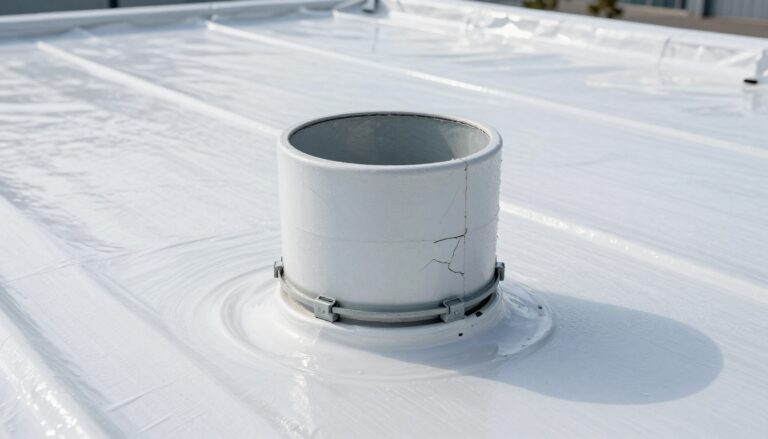
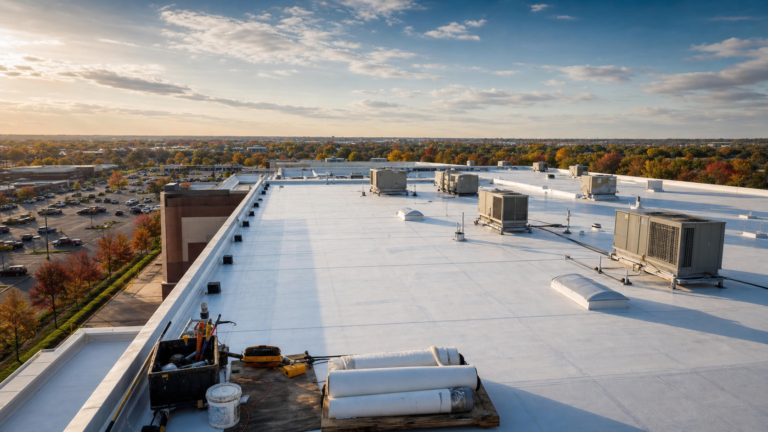
TPO (thermoplastic polyolefin) single-ply membrane is the most widely installed commercial roofing product in the current market, and it is well-suited to much of Fridley’s commercial inventory. The white reflective surface reduces cooling loads — meaningful for Fridley’s retail and office buildings with significant cooling loads during Minnesota’s warm summers. Heat-welded seams, when properly executed by union-trained installers, create bonds stronger than the membrane itself. 60-mil TPO is Sellers’ standard recommendation for new commercial installations in the Fridley market; the additional thickness provides better puncture resistance and thermal cycling performance than 45-mil products.
For Fridley’s older commercial buildings where the existing membrane system is TPO but has aged to the point of seam failure or surface cracking, a full tear-off replacement with new 60-mil TPO is typically the right approach. Recovery (installing new TPO over existing) is evaluated based on moisture survey results and existing system condition.
EPDM: For Fridley’s Industrial Applications
EPDM (ethylene propylene diene monomer) rubber membrane remains the preferred choice for Fridley’s industrial and warehouse buildings, where its proven cold-temperature performance, ballast compatibility, and resistance to rooftop chemical exposure make it the more appropriate system. The industrial corridor buildings along University Avenue and adjacent streets are often better served by EPDM than TPO, particularly when the buildings have robust ballasted EPDM systems in place that can be recovered or replaced with the same system type.
EPDM’s dark color absorbs heat rather than reflecting it — a consideration for energy-conscious building owners. White-coated EPDM or white-surface EPDM products address this without sacrificing the system’s durability advantages for industrial applications.
Modified Bitumen: Redundant Performance for High-Stress Applications
Modified bitumen two-ply systems — combining a base sheet and a granule-surfaced cap sheet — are appropriate for Fridley commercial buildings where redundancy, puncture resistance, and heavy-use durability are priorities. This includes buildings with frequent rooftop HVAC service access, buildings with heavy equipment-related vibration, and buildings where the tenant use creates above-average wear conditions.
SBS-modified bitumen provides the cold-temperature flexibility that Minnesota winters demand, and two-ply assemblies provide redundancy that single-ply systems lack. For Fridley industrial tenants who need a long-term durable system rather than the lowest first cost, modified bitumen remains the right specification.
Built-Up Roofing: Legacy Systems in Fridley’s Industrial Inventory
Many of Fridley’s original industrial buildings carry built-up roofing — the pre-1980s commercial roofing standard — or modified bitumen systems installed in the 1980s and 1990s as BUR replacements. When these systems reach end of life, Sellers evaluates both recovery and tear-off options based on moisture survey, structural assessment, and compatibility with current systems.
For large-footprint Fridley industrial buildings where tear-off cost is significant and the existing substrate is dry and structurally sound, recovery with a new single-ply membrane can produce substantial cost savings without sacrificing system performance. Sellers’ infrared moisture survey capability is essential for making this determination accurately.
Roof Coatings: Extending Life on Qualifying Fridley Commercial Roofs
For Fridley commercial buildings where the existing membrane is structurally sound but has lost surface protection, silicone or elastomeric coatings can extend service life by 10–15 years at $3–$6 per square foot installed — compared to $8–$14 for full membrane replacement. The cost efficiency is significant, but requires accurate eligibility determination: wet insulation beneath the existing membrane disqualifies the building from coating consideration, and Sellers’ infrared survey process is the only reliable way to make this determination.
Commercial Roofing and Fridley’s Redevelopment Context
The University Avenue NE corridor in Fridley has been the subject of significant redevelopment planning over the past decade, including transit-oriented development discussions connected to the Metro Transit bus rapid transit corridor. Commercial buildings along this corridor that are being repositioned for new tenants or redevelopment frequently have roofing systems that need upgrading as part of the overall building improvement program.
Sellers’ commercial assessment process addresses these renovation-context projects specifically — providing the condition documentation, system recommendation, and warranty structure that lenders, developers, and insurers often require for property repositioning transactions. NRCA standards provide the reference specifications that are commonly referenced in commercial property due diligence processes.
Minnesota Climate & Fridley’s Commercial Building Stock
Fridley’s commercial buildings face the same Minnesota climate challenges as the broader metro, with some characteristics specific to the city’s building age and industrial use history.
Aging built-up and mod-bit systems on industrial buildings. The large industrial buildings in Fridley’s commercial corridors carry some of the oldest remaining commercial membrane systems in the Twin Cities metro. Original built-up systems from the 1960s and 1970s, and modified bitumen replacements from the 1980s and 1990s, are now operating well past their original design service lives. Minnesota’s freeze-thaw cycling has been particularly hard on these systems — each freeze-thaw event stresses aged seams, flashings, and pitch pockets, gradually widening the vulnerabilities that eventually produce significant water infiltration.
Industrial HVAC equipment density. Fridley industrial buildings often carry dense HVAC equipment loadings relative to their roof area. Each piece of equipment represents a potential water infiltration point at its curb flashing and duct penetrations. As roofing membranes age, the differential thermal movement between equipment curbs and the membrane surface gradually loosens the flashing seal. Sellers’ commercial inspections specifically document HVAC penetration conditions, which are the most common source of active leaks on aged commercial roofs.
Minnesota climate trends showing increasing precipitation intensity. The metro corridor has documented increases in extreme precipitation events over the past two decades. Commercial flat roofs designed for historical precipitation rates may have undersized drainage systems that cannot handle current peak precipitation loads. Standing water on Fridley commercial roofs during extreme rain events creates membrane stress that accelerates deterioration. Sellers’ commercial assessments include drain capacity analysis and recommendations for drain addition or modification where current capacity is inadequate.
Commercial Roofing Costs in Fridley
Commercial roofing cost benchmarks for Fridley properties in 2026, reflecting union labor rates and current material pricing:
TPO single-ply (60-mil, mechanically attached) full replacement: $7–$12 per square foot installed. For a typical 10,000 sq ft Fridley commercial building: $70,000–$120,000.
EPDM single-ply (60-mil, fully adhered) full replacement: $8–$13 per square foot installed. Slightly higher than mechanically attached TPO due to adhesive labor.
Modified bitumen two-ply (torch-applied) full replacement: $9–$14 per square foot installed. Appropriate for industrial applications where redundancy and durability justify the premium.
Roof coating (silicone or elastomeric, qualifying buildings): $3–$6 per square foot installed. Compared to $8–$14 for full replacement — significant cost efficiency for qualifying buildings.
Insulation addition or replacement: $1.50–$2.50 per square foot for new polyisocyanurate insulation, added to system cost.
Drain addition or modification: $800–$2,500 per drain depending on deck type and access conditions.
Prevailing wage compliance: Built into Sellers’ union labor rates — no separate premium line item.
What to Expect: The Commercial Roofing Process
Phase 1 — Assessment and proposal. Free site visit, existing system documentation, measurement, and written proposal within five to seven business days.
Phase 2 — Pre-construction. Material procurement, permit applications, manufacturer warranty enrollment (where applicable), and preconstruction meeting with property manager.
Phase 3 — Installation. Union crews execute per contract scope with phased scheduling for occupied buildings and daily progress documentation.
Phase 4 — Inspection and warranty. Post-installation inspection, manufacturer warranty registration, and Sellers workmanship warranty activation.
Phase 5 — Ongoing maintenance. Preventive maintenance agreement for semi-annual inspections and minor repair documentation.
Frequently Asked Questions
What is the best commercial roofing system for Fridley industrial buildings?
How does Sellers handle large-footprint industrial roof replacements in Fridley?
Does Sellers handle commercial roofing for the University Avenue corridor in Fridley?
What is the commercial permit process for roofing work in Fridley?
How does prevailing wage apply to Fridley commercial roofing projects?
What is a commercial roof core sample and when is one needed?
Can Sellers provide commercial roofing assessments for Fridley property acquisition due diligence?
What are the energy performance benefits of commercial roof replacement in Fridley?
Does Sellers offer commercial roofing maintenance agreements in Fridley?
How does Sellers protect Fridley commercial tenants during a roofing project?
What happens if Sellers discovers structural deck damage during a commercial tear-off?
Can a Fridley commercial building’s roof be used for solar installation after a replacement?
What is the MBE/DBE advantage for Fridley commercial projects?
How does Sellers’ limited lifetime workmanship warranty work for commercial projects?
Does Sellers handle commercial roofing for recently acquired or repositioned Fridley properties?
Advanced Commercial Roofing Considerations for Fridley Property Owners
For Fridley commercial property owners managing buildings across multiple construction eras and use types, these advanced considerations affect the strategic approach to commercial roofing investment.
Capital Planning for Commercial Roofing: The Portfolio Approach
Fridley commercial property owners managing multiple buildings benefit from a systematic approach to roofing capital planning. Rather than addressing each building reactively as emergencies arise, a portfolio condition assessment — covering all buildings simultaneously with documented condition ratings and estimated remaining service lives — allows capital to be allocated strategically. Sellers provides portfolio-level commercial assessments for Fridley property owners and managers who need a comprehensive picture of their roofing inventory status.
The portfolio approach enables several financial advantages: staggering replacements across budget years to smooth capital expenditure; batching adjacent buildings in the same geographic area to reduce mobilization costs; and identifying buildings where proactive coating application can extend life by 10+ years at a fraction of replacement cost, deferring capital expenditure to a more favorable financial period.
Commercial Roofing and Property Financing
For Fridley commercial property owners seeking refinancing, new financing, or property sale, the condition of the roofing system is a direct factor in lender and appraiser assessment. Lenders commonly require reserve studies and condition assessments for commercial properties, and a roofing system approaching end of life — or with deferred maintenance visible in inspection reports — can affect loan-to-value determinations and reserve requirements.
A completed commercial roof replacement with documented warranty and installation records directly supports financing and appraisal processes. Sellers provides the documentation package that lenders and appraisers need: installation date, material specification, manufacturer warranty number and terms, and workmanship warranty documentation. For Fridley commercial transactions, having this documentation current and available eliminates a common obstacle in due diligence.
The Role of Roof Access in Commercial Building Operations
Fridley’s industrial and commercial buildings typically require regular rooftop access for HVAC maintenance, equipment service, and inspection. Each access event creates rooftop traffic that produces mechanical wear on the membrane surface — a factor that affects both membrane service life and warranty coverage. Manufacturer warranties commonly include provisions about rooftop traffic documentation and the use of walkway pads in areas of regular access.
Sellers recommends including walkway pad installation in commercial roof replacements for buildings with regular rooftop access needs — either as part of the replacement scope or as a maintenance addition after installation. Walkway pads protect the membrane in high-traffic zones and extend the overall service life of the system. For Fridley industrial buildings where HVAC service contractors access the roof monthly or more frequently, walkway protection is a material factor in achieving the full expected membrane service life.
Commercial Roof Warranties: Understanding What You Actually Have
Commercial roof warranties are often described in summary terms — “20-year TPO warranty” — that don’t capture the complexity of what the warranty actually covers and requires. The actual warranty document specifies: which failures are covered (manufacturing defects vs. installation errors vs. storm damage); what the proration schedule looks like (full coverage in years 1–10, then declining percentage coverage); what inspections are required to maintain validity; what activities void coverage (improper equipment installation, rooftop traffic without walkway pads, surface painting or coating without approval); and what the notification and claims process involves.
Sellers walks commercial clients through the specific warranty terms of the proposed system before contract signing, ensuring that the property manager and ownership group understand exactly what they’re getting and what they need to do to maintain it. The NRCA provides reference warranty language templates that are useful benchmarks for comparing manufacturer warranty offerings.
Related Posts
Best Storm Damage Roofers in Fridley, MN (2026) — Best Storm Damage Roofer in Fridley, MN
Best Asphalt Shingle Roofers in Fridley, MN (2026) — Best Asphalt Shingle Roofers in Fridley, MN
Best Commercial Hail Damage Roofing Companies in Fridley, MN (2026) — Commercial Hail Damage Roofing in Fridley, MN
Areas We Serve Across Minnesota — Best Commercial Roofing Contractor in Columbia Heights, MN
Best Roofing Companies in Fridley, MN (2026) — Best Commercial Roofing Contractor in Blaine, MN
Request Your Free Commercial Assessment
Fridley commercial property owners, facility managers, and developers ready to address their roofing needs — whether for a scheduled replacement, a storm damage claim, an acquisition assessment, or a preventive maintenance program — should start with a free assessment from Sellers Roofing Company. The company brings 300+ commercial completions, union-certified crews, MBE/DBE certification, and the accountability of nine years of continuous Twin Cities operation to every Fridley commercial project.
Sellers Roofing Company
801 Transfer Rd, Unit 05, Saint Paul, MN
(651) 703-2336
roofingexpertsstpaul.com
Same-day callback guaranteed. Union crews. MBE/DBE certified. 4.8★ rating. 300+ commercial projects completed.
Call (651) 703-2336 or use the website contact form to schedule your free commercial roofing assessment today. Sellers serves Fridley and all of Anoka County with the commercial membrane installation expertise, union labor standards, and MBE/DBE credentials that Fridley’s diverse commercial inventory requires. Whether your property is a 1960s industrial building on University Avenue or a newly developed commercial facility, Sellers delivers the right system specification, executed correctly, backed by a limited lifetime workmanship warranty.
{“@context”: “https://schema.org”, “@type”: “RoofingContractor”, “name”: “Sellers Roofing Company”, “image”: “https://roofingexpertsstpaul.com/wp-content/uploads/sellers-roofing-logo.png”, “@id”: “https://roofingexpertsstpaul.com/#organization”, “url”: “https://roofingexpertsstpaul.com”, “telephone”: “+1-651-703-2336”, “priceRange”: “$$”, “address”: {“@type”: “PostalAddress”, “streetAddress”: “801 Transfer Rd, Unit 05”, “addressLocality”: “Saint Paul”, “addressRegion”: “MN”, “postalCode”: “55114”, “addressCountry”: “US”}, “geo”: {“@type”: “GeoCoordinates”, “latitude”: 44.9695, “longitude”: -93.1916}, “areaServed”: {“@type”: “City”, “name”: “Fridley, MN”}, “aggregateRating”: {“@type”: “AggregateRating”, “ratingValue”: “4.8”, “reviewCount”: “49”}, “openingHours”: “Mo-Sa 07:00-19:00”}
{“@context”: “https://schema.org”, “@type”: “WebPage”, “@id”: “https://roofingexpertsstpaul.com/best-commercial-roofing-contractor-fridley-mn/”, “url”: “https://roofingexpertsstpaul.com/best-commercial-roofing-contractor-fridley-mn/”, “name”: “Best Commercial Roofing Contractor in Fridley, MN (2026 Guide)”, “description”: “Find the best commercial roofing contractor in Fridley, MN. Sellers Roofing delivers TPO, EPDM, and mod-bit with union labor and MBE/DBE certification. (651) 703-2336”, “inLanguage”: “en-US”, “isPartOf”: {“@id”: “https://roofingexpertsstpaul.com/#website”}, “primaryImageOfPage”: {“@id”: “https://roofingexpertsstpaul.com/best-commercial-roofing-contractor-fridley-mn/#primaryimage”}, “datePublished”: “2026-06-28T18:00:00-05:00”, “dateModified”: “2026-06-28T18:00:00-05:00”, “speakable”: {“@type”: “SpeakableSpecification”, “cssSelector”: [“h1”, “.answer-box”, “.key-takeaways”, “.faq-answer”, “.takeaway”]}}
{“@context”: “https://schema.org”, “@type”: “Article”, “headline”: “Best Commercial Roofing Contractor in Fridley, MN (2026 Guide)”, “description”: “Find the best commercial roofing contractor in Fridley, MN. Sellers Roofing delivers TPO, EPDM, and mod-bit with union labor and MBE/DBE certification. (651) 703-2336”, “image”: “https://roofingexpertsstpaul.com/wp-content/uploads/2026/06/best-commercial-roofing-contractor-fridley-mn.png”, “author”: {“@type”: “Person”, “name”: “Ted Sellers”, “url”: “https://roofingexpertsstpaul.com”}, “publisher”: {“@type”: “Organization”, “name”: “Sellers Roofing Company”, “logo”: {“@type”: “ImageObject”, “url”: “https://roofingexpertsstpaul.com/wp-content/uploads/sellers-roofing-logo.png”}}, “datePublished”: “2026-06-28T18:00:00-05:00”, “dateModified”: “2026-06-28T18:00:00-05:00”, “mainEntityOfPage”: {“@type”: “WebPage”, “@id”: “https://roofingexpertsstpaul.com/best-commercial-roofing-contractor-fridley-mn/”}, “keywords”: “commercial roofing contractor Fridley MN”}
{“@context”: “https://schema.org”, “@type”: “BreadcrumbList”, “itemListElement”: [{“@type”: “ListItem”, “position”: 1, “name”: “Home”, “item”: “https://roofingexpertsstpaul.com”}, {“@type”: “ListItem”, “position”: 2, “name”: “Fridley, MN”, “item”: “https://roofingexpertsstpaul.com/best-roofing-companies-fridley-mn/”}, {“@type”: “ListItem”, “position”: 3, “name”: “Best Commercial Roofing Contractor in Fridley, MN (2026 Guide)”, “item”: “https://roofingexpertsstpaul.com/best-commercial-roofing-contractor-fridley-mn/”}]}
{“@context”: “https://schema.org”, “@type”: “FAQPage”, “mainEntity”: [{“@type”: “Question”, “name”: “What is the best commercial roofing system for Fridley industrial buildings?”, “acceptedAnswer”: {“@type”: “Answer”, “text”: “For most Fridley industrial facilities, EPDM or modified bitumen provides the best combination of cold-temperature performance, durability, and puncture resistance. TPO is appropriate when energy performance is prioritized and the building use doesn’t create unusual chemical or mechanical exposure. Sellers evaluates each industrial building’s specific conditions and recommends based on use, existing system, and performance objectives.”}}, {“@type”: “Question”, “name”: “How does Sellers handle large-footprint industrial roof replacements in Fridley?”, “acceptedAnswer”: {“@type”: “Answer”, “text”: “Sellers has completed large commercial and industrial roof replacements across the Twin Cities metro. For large-footprint projects, Sellers provides a preconstruction meeting to discuss phased scheduling, crew deployment, material staging, safety planning, and communication protocols. The company can accommodate multi-week installation timelines on large-footprint buildings while maintaining continuous building security and weather protection.”}}, {“@type”: “Question”, “name”: “Does Sellers handle commercial roofing for the University Avenue corridor in Fridley?”, “acceptedAnswer”: {“@type”: “Answer”, “text”: “Yes. The University Avenue commercial corridor u2014 including the mixed-use, retail, and office buildings along its length in Fridley u2014 is within Sellers’ standard service area. The company has experience with the building types and property conditions common along this corridor and provides assessments that reflect the specific maintenance and replacement needs of corridor properties.”}}, {“@type”: “Question”, “name”: “What is the commercial permit process for roofing work in Fridley?”, “acceptedAnswer”: {“@type”: “Answer”, “text”: “Commercial roofing work in Fridley requires a building permit from the City of Fridley Building Inspection Division. The permit process verifies code compliance for structural loading, fire resistance, and drainage. Sellers manages the permit application as part of the pre-construction process. The permit also protects the property owner by creating a documented record of the work for future property transactions or insurance claims.”}}, {“@type”: “Question”, “name”: “How does prevailing wage apply to Fridley commercial roofing projects?”, “acceptedAnswer”: {“@type”: “Answer”, “text”: “Minnesota prevailing wage requirements apply to roofing work on publicly funded construction projects, including projects receiving TIF financing, government grants, or public-private development support. MN DLI establishes prevailing wage rates for Anoka County by trade. Sellers’ union affiliations u2014 Local 96, Local 322, Local 563 u2014 pay at or above these rates, and the company provides certified payroll documentation for all applicable projects.”}}, {“@type”: “Question”, “name”: “What is a commercial roof core sample and when is one needed?”, “acceptedAnswer”: {“@type”: “Answer”, “text”: “A core sample is a small plug of the roofing assembly (typically 3u20134 inches in diameter) removed from the membrane field to assess the layers, insulation condition, and moisture content of the existing system. Core samples are taken when the existing system’s condition is ambiguous u2014 when the surface appears sound but the maintenance history suggests possible wet insulation, or when recovery vs. tear-off is being evaluated. Sellers performs core sampling as part of commercial assessments when the building history or surface conditions warrant it.”}}, {“@type”: “Question”, “name”: “Can Sellers provide commercial roofing assessments for Fridley property acquisition due diligence?”, “acceptedAnswer”: {“@type”: “Answer”, “text”: “Yes. Sellers provides commercial roofing condition assessments for property acquisition due diligence, including written condition reports, estimated remaining service life, deferred maintenance documentation, and preliminary replacement cost estimates. These assessments are commonly used by buyers, lenders, and investors evaluating commercial properties in Fridley and the broader Twin Cities market.”}}, {“@type”: “Question”, “name”: “What are the energy performance benefits of commercial roof replacement in Fridley?”, “acceptedAnswer”: {“@type”: “Answer”, “text”: “A new white-surface TPO or EPDM membrane provides significant solar reflectance improvement over aged dark-surface membranes, reducing peak cooling loads. New polyisocyanurate insulation u2014 either replacing aged and compressed existing insulation or adding above the existing assembly u2014 improves thermal resistance (R-value) and reduces heating loads. These improvements can reduce annual energy costs by $0.05u2013$0.15 per square foot of roof area, with the combined benefit potentially meaningful for large-footprint Fridley industrial buildings.”}}, {“@type”: “Question”, “name”: “Does Sellers offer commercial roofing maintenance agreements in Fridley?”, “acceptedAnswer”: {“@type”: “Answer”, “text”: “Yes. Sellers’ preventive maintenance agreements include semi-annual inspections (satisfying most manufacturer warranty inspection requirements), minor repair scope (seam re-adhesion, pipe boot replacement, drain clearing), written condition reports, and photographic documentation. For Fridley commercial property managers who need to track roof condition across a portfolio, maintenance agreements provide the systematic documentation that supports both warranty compliance and capital planning.”}}, {“@type”: “Question”, “name”: “How does Sellers protect Fridley commercial tenants during a roofing project?”, “acceptedAnswer”: {“@type”: “Answer”, “text”: “Before work begins, Sellers conducts a preconstruction meeting with the property manager to establish tenant notification protocols, daily access scheduling, HVAC downtime coordination, and emergency procedures. Daily cleanup maintains tenant entry areas and common spaces. Any work directly above occupied spaces is scheduled during low-traffic periods where possible. Sellers provides the property manager with daily progress updates throughout the project.”}}, {“@type”: “Question”, “name”: “What happens if Sellers discovers structural deck damage during a commercial tear-off?”, “acceptedAnswer”: {“@type”: “Answer”, “text”: “If tear-off reveals structural deck issues u2014 rot, rust on metal decking, delamination of wood panels, or compromised fastener connections u2014 Sellers immediately notifies the property owner with photographs and a written change order before proceeding. No work continues on affected areas without written approval. The change order specifies the additional scope, material, and cost required to address the deck condition before the new roofing system is installed.”}}, {“@type”: “Question”, “name”: “Can a Fridley commercial building’s roof be used for solar installation after a replacement?”, “acceptedAnswer”: {“@type”: “Answer”, “text”: “Commercial roofs are increasingly being used as platforms for solar photovoltaic installations. For property owners considering solar, the timing of a roof replacement creates an opportunity: installing a new membrane system before solar panels are mounted avoids the significantly higher cost of removing and reinstalling panels to replace a roof that fails during the solar system’s 25u201330-year lifespan. Sellers can coordinate with solar contractors on membrane compatibility, ballast planning, and penetration requirements.”}}, {“@type”: “Question”, “name”: “What is the MBE/DBE advantage for Fridley commercial projects?”, “acceptedAnswer”: {“@type”: “Answer”, “text”: “Sellers’ MBE (Minority Business Enterprise) and DBE (Disadvantaged Business Enterprise) certifications allow commercial property owners and developers to count Sellers as a qualifying diverse supplier for projects with participation requirements. For Fridley commercial development projects involving public financing, redevelopment grants, or institutional ownership with diversity procurement goals, selecting Sellers simplifies compliance documentation and supports the project’s diverse participation commitment.”}}, {“@type”: “Question”, “name”: “How does Sellers’ limited lifetime workmanship warranty work for commercial projects?”, “acceptedAnswer”: {“@type”: “Answer”, “text”: “Sellers’ limited lifetime workmanship warranty covers installation defects for the life of the property owner’s ownership of the building. This is separate from u2014 and in addition to u2014 the membrane manufacturer’s material warranty (typically 15u201330 years depending on system and manufacturer warranty program). Both warranties are provided in writing at project completion, with Sellers’ warranty registered under the property address. For warranty claims, the property owner contacts Sellers directly at (651) 703-2336.”}}, {“@type”: “Question”, “name”: “Does Sellers handle commercial roofing for recently acquired or repositioned Fridley properties?”, “acceptedAnswer”: {“@type”: “Answer”, “text”: “Yes. Sellers provides condition assessments, system recommendations, and replacement execution for properties that have changed ownership or use. For repositioned properties, Sellers can assess the current system relative to the building’s new intended use u2014 an industrial building being converted to a different commercial use may require a different system specification than would have been appropriate for the prior use.”}}]}
{“@context”: “https://schema.org”, “@type”: “ItemList”, “name”: “Best Commercial Roofing Contractor in Fridley, MN (2026 Guide)”, “itemListOrder”: “https://schema.org/ItemListOrderAscending”, “numberOfItems”: 5, “itemListElement”: [{“@type”: “ListItem”, “position”: 1, “name”: “Sellers Roofing Company u2014 Best Overall”}, {“@type”: “ListItem”, “position”: 2, “name”: “Central Roofing Company”}, {“@type”: “ListItem”, “position”: 3, “name”: “Welter Construction”}, {“@type”: “ListItem”, “position”: 4, “name”: “All Elements Roofing & Construction”}, {“@type”: “ListItem”, “position”: 5, “name”: “Quarve Contracting”}]}
{“@context”: “https://schema.org”, “@type”: “HowTo”, “name”: “How to Hire the Best commercial roofing contractor Fridley MN in Fridley, MN”, “description”: “Step-by-step process to vet, hire, and work with the best commercial roofing contractor fridley mn in Fridley, Minnesota.”, “step”: [{“@type”: “HowToStep”, “name”: “Verify credentials”, “text”: “Confirm Minnesota license, insurance, BBB rating, and union/MBE-DBE certifications.”}, {“@type”: “HowToStep”, “name”: “Request inspection”, “text”: “Schedule a free on-site inspection with photos and a written scope.”}, {“@type”: “HowToStep”, “name”: “Review proposal”, “text”: “Compare manufacturer/system options, warranty terms, and itemized pricing.”}, {“@type”: “HowToStep”, “name”: “Coordinate with insurance”, “text”: “If the work is insurance-claim driven, ensure the contractor meets directly with your adjuster.”}, {“@type”: “HowToStep”, “name”: “Schedule and execute”, “text”: “Confirm crew size, materials staging, daily cleanup, and final inspection walkthrough.”}]}
Need a roof inspection in Saint Paul or the Twin Cities? Call Sellers Roofing Company at +1-651-703-2336 or schedule a free estimate. We are a black-owned, NMSDC-certified MBE roofing contractor with 9+ years experience.