Last updated: 2026-06-28 by Ted Sellers, Owner
Key Takeaways
- Coon Rapids has one of the largest and most diverse commercial and industrial roofing inventories in Anoka County — from major retail corridors along Highway 10 and Coon Rapids Boulevard to significant industrial facilities throughout the city.
- Sellers Roofing Company brings 300+ commercial completions, full low-slope membrane system capability, and union-certified installation to Coon Rapids commercial property owners.
- Union labor (Roofers Local 96, Carpenters Local 322, Laborers Local 563) satisfies prevailing wage requirements on publicly funded Coon Rapids commercial projects and manufacturer warranty installation standards simultaneously.
- MBE and DBE certification positions Sellers as a qualifying contractor for Coon Rapids and Anoka County commercial projects with diverse supplier participation requirements.
- Sellers offers preventive maintenance agreements that protect commercial roof warranty compliance and provide early detection of developing issues before they become costly failures.
- Coon Rapids’ commercial building stock ranges from 1970s-era strip retail to newer Class A development — Sellers’ product breadth and project experience covers the full range of needs in this market.
Table of Contents
- Commercial Roofing in Coon Rapids
- Top 5 Commercial Roofing Contractors in Coon Rapids, MN
- Why Sellers Roofing Is #1 for Coon Rapids Commercial Work
- What to Look for When Hiring a Commercial Roofer
- Commercial Roofing Systems: A Complete Guide for Coon Rapids Property Owners
- Minnesota Climate & Coon Rapids Commercial Buildings
- Commercial Roofing Costs in Coon Rapids
- What to Expect: The Commercial Roofing Process
- Frequently Asked Questions
- Related Posts
- Request Your Free Commercial Assessment
Commercial Roofing in Coon Rapids
Coon Rapids is the commercial and industrial heart of southern Anoka County. The city’s major corridors — Highway 10, Coon Rapids Boulevard, Hanson Boulevard, and the Northdale commercial area — support an enormous variety of commercial building types: large-format retail, strip centers, office buildings, restaurants, healthcare facilities, automotive services, and industrial/warehouse facilities that stretch through much of the city’s interior. This commercial diversity translates into a complex and varied flat-roof inventory, with building ages ranging from original 1970s-era construction to recently completed developments — each with different membrane systems, maintenance histories, and capital improvement timelines.
Managing commercial roofing at this scale requires contractors who understand not just how to replace a flat roof, but how to assess a diverse inventory, recommend the right system for each building type and use, navigate the commercial warranty and financing process, and satisfy the labor and participation requirements that often accompany commercial properties receiving public support or financing.
Sellers Roofing Company has served Coon Rapids’ commercial market since 2017 with exactly this depth of service. The company’s 300+ commercial project portfolio reflects experience across every major membrane system and commercial building type found in the market. Union crews satisfy the labor standards that institutional property owners and public-project participants require. And MBE/DBE certification positions Sellers for the diverse supplier participation requirements that increasingly accompany commercial development in the north metro.
This guide covers the top commercial roofing contractors serving Coon Rapids, how to evaluate commercial roofing proposals, a complete breakdown of commercial membrane systems, and the cost framework that commercial property owners need for budgeting and planning.
Top 5 Commercial Roofing Contractors in Coon Rapids, MN
1. Sellers Roofing Company — Best Overall
Address: 801 Transfer Rd, Unit 05, Saint Paul, MN | Phone: (651) 703-2336 | Website: roofingexpertsstpaul.com | Rating: 4.8★ / 49 Google reviews
Sellers Roofing Company is the top commercial roofing contractor serving Coon Rapids. Founded in 2017 by Ted Sellers, the company brings 300+ commercial completions, full membrane system capability, union-certified labor, MBE/DBE certification, and a structured commercial project management process to Coon Rapids property owners and developers.
The union labor advantage is especially significant in Coon Rapids’ commercial market, where the range of building types — from aging retail strip centers to industrial warehouses — requires crews with genuine membrane installation training. Roofers Local 96, Carpenters Local 322, and Laborers Local 563 affiliates bring formal apprenticeship training to TPO heat-welding, EPDM lap-adhesive installation, modified bitumen torch application, and all related penetration and flashing work. For Coon Rapids commercial property managers seeking manufacturer-backed warranty coverage on new systems, union-standard installation is a prerequisite.
MBE and DBE certification, A+ BBB rating, 4.8-star Google rating, same-day callback, and a limited lifetime workmanship warranty complete the credentials that make Sellers the preferred commercial roofing partner for Coon Rapids property owners.
2. Central Roofing Company
Website: centralroofing.com
Central Roofing Company is one of the Twin Cities’ largest commercial roofing contractors, with decades of institutional and large-project experience. They handle major commercial scopes and work with large property management companies and institutional owners. Appropriate for very large projects where contractor scale and bonding capacity are primary criteria. Less emphasis on personalized project management and diverse supplier participation compared to Sellers.
3. All Elements Roofing & Construction
Website: allelementsmn.com
All Elements Roofing & Construction provides commercial roofing services across the Twin Cities metro including the Anoka County corridor. They handle flat roof systems and storm damage restoration for commercial clients. A competent mid-tier option for commercial property owners seeking additional bids. For projects requiring union labor, MBE/DBE certification, or 300+ commercial project experience, Sellers is the stronger choice.
4. Overhead Construction & Roofing
Website: overheadconstructionandroofing.com
Overhead Construction & Roofing handles both commercial and residential roofing in the Twin Cities. Their commercial practice includes flat roof membrane systems and some insurance restoration work. A reasonable option for straightforward commercial repair or replacement projects. Less depth in complex commercial systems and union labor compared to Sellers.
5. Quarve Contracting
Website: quarve.com
Quarve Contracting operates across the Twin Cities metro with commercial construction and roofing services. They have completed commercial projects across various building types and serve property owners seeking competitive pricing. Adequate for standard commercial scopes. For projects with prevailing wage requirements or diverse supplier participation goals, Sellers provides stronger qualifications.
Why Sellers Roofing Is #1 for Coon Rapids Commercial Work
The Coon Rapids commercial roofing market is served by a range of contractors, but the quality and accountability gap between the best and the rest is significant. Here’s why Sellers holds the top position.
Full membrane system breadth for a diverse commercial inventory. Coon Rapids’ commercial buildings span multiple construction eras and carry a corresponding variety of membrane systems — from mid-1970s built-up roofing on original strip centers to 60-mil TPO on buildings constructed in the past decade. Sellers installs every current commercial membrane system (TPO, EPDM, modified bitumen, BUR, standing-seam metal, coatings) and provides honest system recommendations based on building-specific conditions rather than product preference or manufacturer rebates. For a city with Coon Rapids’ commercial inventory diversity, this breadth of capability is essential.
Union labor with commercial membrane specificity. The technical requirements for commercial membrane installation differ significantly from residential shingle work. TPO heat-welding requires calibrated equipment and trained operators — an improperly welded seam is invisible on installation day and fails months or years later when water infiltrates under the lap. EPDM adhesive installation requires clean, dry substrates and proper atmospheric temperature management. Modified bitumen torch application requires licensed open-flame applicators. Sellers’ union crews are trained specifically in these commercial techniques — not crews who primarily do residential work and occasionally handle flat roofs.
Prevailing wage capability for Coon Rapids development projects. Coon Rapids has been an active participant in Anoka County economic development initiatives, tax increment financing districts, and commercial corridor improvement programs. Projects receiving public funding frequently carry Minnesota prevailing wage requirements. MN Department of Labor and Industry prevailing wage schedules for commercial roofing trades specify journeyman and apprentice rates by county. Sellers’ union affiliations — Local 96, Local 322, Local 563 — directly satisfy these requirements with certified payroll documentation capabilities.
MBE/DBE certification for diverse supplier goals. As Coon Rapids attracts commercial development with public or institutional financing components, diverse supplier participation requirements become increasingly common. Sellers’ certification as a Minority Business Enterprise and Disadvantaged Business Enterprise makes the company a qualifying contractor for these participation goals — streamlining compliance for developers and property owners who need to demonstrate diverse procurement.
Commercial project management that respects tenant operations. Commercial roofing is almost always performed on occupied or actively operating properties. The disruption risk to retail tenants, restaurant operations, or industrial production schedules is real and must be managed through careful phasing, communication, and daily cleanup protocols. Sellers’ structured commercial project management process — pre-construction meeting, phased schedule, daily progress updates, documented change order process — protects tenant operations throughout the project.
Preventive maintenance to protect warranty and extend roof life. Commercial warranty validity typically requires semi-annual inspections. Sellers’ maintenance agreements include documented inspections, minor repair scope, drain clearing, and written condition reports — the structured program that keeps warranties valid and catches developing issues before they become costly failures.
What to Look for When Hiring a Commercial Roofer
Evaluating commercial roofing proposals requires applying a procurement standard appropriate to a major capital investment. Here’s what experienced commercial property owners evaluate.
Verifiable commercial project experience. Request a list of comparable commercial projects — similar size, system type, and building use — completed in the past three years with contact information for the property owner or manager. A contractor with 300+ commercial completions should provide this readily. A contractor who provides only residential references for a commercial project is not an appropriate choice.
Membrane system expertise and manufacturer certification. Ask specifically about the proposed system and whether the contractor is certified by the membrane manufacturer. Carlisle SynTec, Firestone, GAF Commercial, and Johns Manville all operate certified contractor programs. Manufacturer-certified installation is often required for warranty coverage. Sellers’ union crews install to manufacturer specifications on every project.
Commercial-appropriate insurance. Commercial general liability at $1M per occurrence / $2M aggregate minimum, workers’ compensation, and appropriate umbrella coverage. Request certificates of insurance naming your property before contract execution.
Phased scheduling and tenant protection plan. Ask specifically how the contractor plans work on your occupied building. What phases, what daily cleanup protocols, what communication process for tenant concerns? A contractor who can’t describe a coherent tenant protection plan has not thought through commercial project management adequately.
Line-item scope and specification. A commercial proposal should specify: existing system documentation, tear-off scope, substrate inspection protocol, insulation specification, membrane manufacturer and product line, fastening method, all flashing and penetration details, drain scope, warranty terms (manufacturer and workmanship), payment schedule tied to milestones, and final inspection process. Vague proposals produce surprise change orders and disputes.
Preventive maintenance program. Ask whether the contractor offers maintenance agreements post-installation. For a 20-year warranty to remain valid, regular inspections and minor repairs are typically required. A contractor who doesn’t offer maintenance is handing warranty compliance responsibility back to you without a clear path to meeting it.
Financial stability and longevity. A 20-year commercial roof warranty requires the contractor to be in business for 20 years to honor it. Nine years of continuous operation, fixed office, union affiliations, and multiple state certifications all signal the organizational stability that commercial warranties require.
Commercial Roofing Systems: A Complete Guide for Coon Rapids Property Owners
The commercial roofing systems available for Coon Rapids properties represent a range of performance characteristics, installation requirements, and cost profiles. Understanding this landscape helps property owners evaluate proposals and make system decisions aligned with their building’s needs and investment horizon.
Single-Ply Membranes: TPO and EPDM
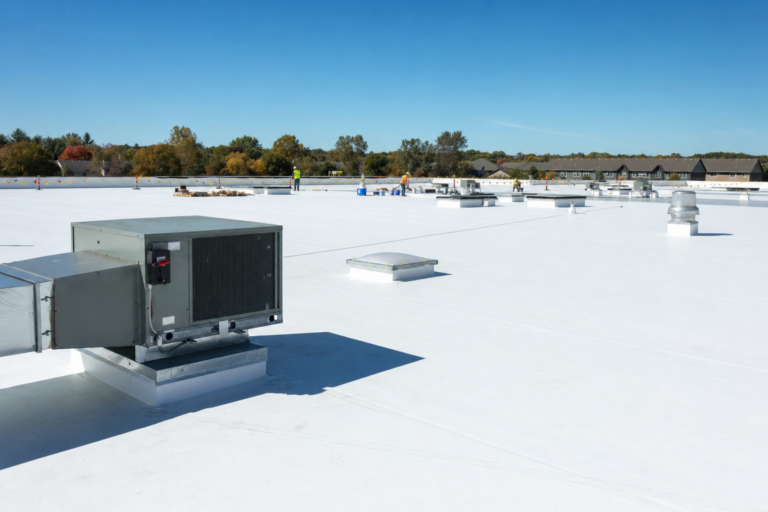
TPO (Thermoplastic Polyolefin) has become the dominant commercial roofing membrane in the current market, holding the largest share of new commercial installation in North America. Its advantages are compelling: the white reflective surface provides ENERGY STAR-qualifying solar reflectance that reduces cooling loads; heat-welded seams (when properly executed) create bonds that are stronger than the membrane itself; and competitive material costs make it accessible for commercial properties across the budget spectrum.
For Coon Rapids commercial buildings, 60-mil TPO is Sellers’ standard recommendation — the additional thickness relative to 45-mil provides meaningfully better puncture resistance and thermal cycling performance. The white surface is particularly beneficial for the large-footprint retail and warehouse buildings common in Coon Rapids, where flat roof area is extensive and cooling loads are significant.
EPDM (Ethylene Propylene Diene Monomer) remains widely used, particularly on industrial and warehouse applications where its proven longevity and cold-temperature flexibility make it a strong performer. EPDM’s rubber-based chemistry provides excellent resistance to Minnesota’s extreme cold, maintaining flexibility at temperatures that would stress thermoplastic membranes. It also has excellent resistance to ponding water — an important attribute for Coon Rapids’ large commercial flat roofs, where proper slope-to-drain may be difficult to maintain over large areas.
The primary limitation of standard black EPDM is heat absorption. For Coon Rapids commercial buildings with significant cooling loads, white-coated EPDM or white-surface EPDM addresses this concern without sacrificing the system’s durability advantages.
Modified Bitumen: Proven Performance for Industrial Applications
Modified bitumen systems — particularly two-ply torch-applied assemblies using SBS (styrene-butadiene-styrene) modified asphalt — are the preferred choice for Coon Rapids industrial and warehouse applications where durability, puncture resistance, and cold-temperature performance are paramount. SBS modification provides rubber-like elasticity that resists the thermal cycling, impact, and freeze-thaw stresses that Minnesota’s climate imposes.
Two-ply assemblies (base sheet plus cap sheet) provide redundancy that single-ply systems cannot match — a localized failure in the cap sheet does not immediately produce water infiltration. This redundancy is particularly valuable in high-traffic roofing environments — buildings where maintenance workers, delivery personnel, or HVAC technicians regularly access the roof and produce mechanical abuse.
Torch application requires licensed applicators and careful fire safety protocols. Sellers’ union crews include certified torch applicators and follow established fire watch procedures on every torch-applied project.
Built-Up Roofing (BUR): Legacy Systems in the Coon Rapids Inventory
Coon Rapids’ older commercial buildings — particularly those built from the mid-1960s through the mid-1980s — frequently carry original built-up roofing systems or BUR re-roofing from the 1990s. When these systems reach end of life, the decision is whether to recover with a new single-ply or modified bitumen membrane, or tear off completely for a fresh start.
Sellers evaluates this decision with core sampling to determine insulation condition and moisture content, structural deck assessment, and drain capacity analysis. Recovery is the right choice when the existing substrate is dry, structurally sound, and capable of supporting the additional membrane layer weight. Tear-off is appropriate when moisture contamination is present, when the deck has structural issues, or when the existing system is incompatible with recovery.
Roof Coatings: Extending Life on Qualifying Systems
For Coon Rapids commercial buildings with membranes that are structurally sound but have lost surface protection — granule loss on mod-bit cap sheets, surface oxidation on aged EPDM, or seam delamination on older single-ply — silicone or elastomeric coatings can restore the protective surface and extend service life by 10–15 years at significantly lower cost than full replacement.
The coating-eligible determination requires infrared moisture survey (to rule out wet insulation) and surface condition assessment. Not every roof is a coating candidate — wet insulation or structural issues require more extensive intervention. But when coatings are appropriate, they represent exceptional capital efficiency for Coon Rapids commercial property managers working within budget constraints.
The Commercial Bid Process: What Property Owners Should Expect
A thorough commercial roofing bid from Sellers includes: site visit and existing system documentation, core sampling where appropriate, measured roof area with complexity quantification (drain count, penetration count, linear feet of parapet), written scope with system specification (manufacturer, product line, thickness, fastening method), insulation scope and R-value, warranty structure (both manufacturer and workmanship), phased construction schedule, payment milestone schedule, and permit coordination confirmation.
The National Roofing Contractors Association establishes industry-standard commercial roofing specifications that are commonly referenced in institutional and public commercial projects. Sellers’ proposals align with NRCA guidelines and can provide additional technical documentation for property owners who require it for financing, insurance, or owner’s representative review.
Prevailing Wage and Commercial Roofing in Coon Rapids
Minnesota prevailing wage law (MN Statutes Chapter 177) requires that workers on publicly funded construction projects be paid at least the prevailing wage rate for their trade and classification in the project’s county. For roofing work in Anoka County, the MN Department of Labor and Industry establishes prevailing wage rates for roofers, carpenters, and laborers.
Sellers’ union affiliations — Roofers Local 96 (covering roofing installation), Carpenters Local 322 (covering decking, insulation, and related work), and Laborers Local 563 (covering tear-off, cleanup, and material handling) — pay at or above MN DLI prevailing wage rates for Anoka County. This makes Sellers a natural fit for any Coon Rapids commercial project subject to prevailing wage requirements, with certified payroll documentation available for all applicable projects.
Minnesota Climate & Coon Rapids Commercial Buildings
Coon Rapids’ commercial building portfolio faces the same Minnesota climate challenges as its residential counterpart, but at a larger scale and with different failure consequences.
Large footprint buildings create drainage challenges. The major commercial and industrial buildings along Highway 10 and the industrial corridors cover large flat-roof areas — sometimes 50,000 to 200,000 square feet. Drain design for these large areas is complex, and even minor drain slope deficiencies can create extensive ponding that accelerates membrane degradation. Sellers’ commercial assessments include drain capacity and slope analysis for every large-footprint project.
Industrial use creates membrane-specific stress. The industrial and manufacturing facilities throughout Coon Rapids subject roofing systems to stresses beyond weather exposure — chemical exhaust that attacks certain membrane chemistries, rooftop traffic from maintenance personnel, vibration from heavy equipment that stresses penetration flashings, and heat rejection from industrial processes that creates localized thermal stress. Sellers selects and specifies membrane systems with these industrial-specific factors in mind.
Thermal cycling is the primary long-term degradation mechanism. Minnesota’s 130°F annual temperature range puts commercial roofing systems — and particularly their seams and penetrations — under repeated expansion/contraction stress. Sellers specifies membrane thicknesses and fastening patterns that provide margin beyond minimum code requirements specifically to address Minnesota’s thermal cycling severity. Minnesota’s climate trend data shows increasing temperature extremes in the metro corridor over the past two decades — a trend that argues for specifying systems at the higher end of the performance range.
Commercial flat roofs and ice dam formation. Unlike residential steep-slope roofs where ice dams form at eaves, commercial flat roofs experience ice-related damage at drain locations — where meltwater refreezes after passing through the drain system, creating ice blockages that back water under any compromised membrane seams or flashings. Sellers specifies drain heaters and overflow scupper provisions on commercial projects where this risk is identified.
Commercial Roofing Costs in Coon Rapids
Commercial roofing cost benchmarks for Coon Rapids properties in 2026 reflect union labor rates, current material pricing, and typical project complexity:
TPO single-ply (60-mil, mechanically attached), full replacement: $7–$12 per square foot installed. Range reflects building size (larger buildings trend toward lower per-SF cost due to reduced relative complexity), penetration density, and drain scope. A 20,000 sq ft building: $140,000–$240,000.
EPDM single-ply (60-mil, fully adhered): $8–$13 per square foot installed. Fully adhered systems require more labor than mechanically attached, but provide better wind uplift performance for buildings in exposed locations.
Modified bitumen two-ply (torch-applied): $9–$14 per square foot installed. Preferred for industrial and high-traffic roofs where redundancy and puncture resistance justify the cost premium.
Roof coatings (silicone or elastomeric, on qualifying existing system): $3–$6 per square foot installed. Compared to $8–$14 for full replacement, coatings produce significant savings when the existing substrate qualifies.
Polyisocyanurate insulation addition (2-inch): $1.50–$2.50 per square foot added to system cost when new or additional insulation is specified.
Drain addition or modification: $800–$2,000 per drain for new installation or reconfiguration, depending on deck type and access.
Tapered insulation for slope improvement: $2.00–$4.00 per square foot in addition to standard flat insulation, where ponding requires slope correction.
Prevailing wage premium: Union labor rates in Anoka County are set by MN DLI prevailing wage schedules. Sellers’ base pricing reflects union rates; no separate “prevailing wage premium” line is applied for projects subject to prevailing wage requirements — compliance is built in, not added on.
What to Expect: The Commercial Roofing Process
Phase 1 — Assessment and proposal. Sellers performs a site visit, documents existing conditions, measures roof areas and complexity, and provides a written proposal within five to seven business days.
Phase 2 — Pre-construction planning. Following contract execution, Sellers coordinates material procurement, permit applications, manufacturer warranty enrollment (where applicable), crew scheduling, and a preconstruction meeting with the property manager.
Phase 3 — Installation. Union crews execute the installation per contract scope, with phased scheduling for occupied buildings. Daily progress documentation and the property manager contact is maintained throughout.
Phase 4 — Inspection and warranty. Post-installation inspection covers seam integrity, flashing terminations, drain clearance, and HVAC coordination confirmation. Manufacturer warranty registration and Sellers’ workmanship warranty activation occur at project closeout.
Phase 5 — Ongoing maintenance. Sellers’ preventive maintenance agreements provide the semi-annual inspection and minor repair documentation required to maintain warranty validity and provide early-issue detection.
Frequently Asked Questions
What commercial roofing system is best for Coon Rapids industrial buildings?
How does Sellers handle prevailing wage requirements on Coon Rapids commercial projects?
Can Sellers work on a Coon Rapids commercial building that is fully occupied during the project?
What is the difference between a mechanically attached and fully adhered membrane?
How long does a commercial roof last in Coon Rapids?
Does Sellers handle commercial roofing for Coon Rapids retail strip centers?
What is the process for a commercial roofing warranty claim?
Can a commercial roof recovery avoid full tear-off costs?
What is ENERGY STAR commercial roofing and does it apply in Coon Rapids?
How does a commercial roofing project affect my Coon Rapids building’s insurance?
Does Sellers provide commercial roofing for Coon Rapids industrial/warehouse buildings?
What permits are required for commercial roofing in Coon Rapids?
Can Sellers handle large commercial projects in Coon Rapids?
How do I get started with Sellers for a Coon Rapids commercial project?
What is Sellers’ geographic service area for commercial projects?
Commercial Roofing Questions: Beyond the Basics
For Coon Rapids commercial property owners who want to go deeper, here are additional considerations that affect roofing decisions at the institutional and portfolio level.
Understanding Roof Load Calculations
Every commercial building has a structural design load — the maximum weight the roof structure was engineered to support. Adding a new membrane system, insulation, and equipment to an existing roof increases that load. When recovering over an existing system (installing new membrane over old), the cumulative weight of multiple membrane generations, insulation layers, and any ballast must be evaluated against the structural design load. Most original Coon Rapids commercial buildings from the 1970s and 1980s were designed to local code loads that may not include margin for extensive recovery accumulation.
Sellers’ pre-construction assessment for Coon Rapids commercial projects includes a preliminary load review. When questions arise about structural capacity — particularly for larger industrial buildings or for projects involving multiple prior recovery layers — Sellers recommends a structural engineer review before proceeding with the scope. This extra step protects both the building and the property owner.
Drainage Design: The Long-Term Performance Factor
Commercial roof drainage is engineered at the time of original construction based on the roof area, slope, drain size, and design storm intensity — typically a 10-year or 25-year storm event depending on the building code in effect at the time. Coon Rapids’ commercial buildings designed in the 1970s and 1980s used historical precipitation data that has since been updated. Minnesota DNR climate records document increased intensity of extreme precipitation events in the metro corridor over the past two decades — meaning some Coon Rapids commercial buildings now experience ponding during storms that their original drain design wasn’t sized for.
Sellers’ commercial assessments include drain capacity evaluation and drainage pattern analysis. When ponding exceeds the 48-hour drainage standard that NRCA and most membrane manufacturers require, solutions range from drain addition and modification to tapered insulation installation that improves slope-to-drain. These interventions protect the new membrane system’s warranty compliance and extend service life by eliminating the accelerated degradation that chronic ponding produces.
Sustainability and Green Roof Considerations for Coon Rapids Commercial Properties
A growing segment of Coon Rapids commercial property owners — particularly in the healthcare, institutional, and newer Class A office segments — are considering sustainability as part of their commercial roofing decisions. The primary sustainability levers in commercial roofing are:
Cool roof systems: White or light-colored TPO or EPDM membranes that qualify for ENERGY STAR reflectivity ratings reduce peak cooling demand. For Coon Rapids buildings with significant air conditioning loads — particularly the large retail and commercial buildings along major corridors — cool roof specification can produce measurable annual energy cost reductions.
Insulation upgrades: Adding polyisocyanurate insulation above the roof deck during a replacement project improves the building envelope’s thermal resistance. The incremental cost of adding 1–2 inches of insulation during a replacement is modest compared to the cost of adding it as a standalone project. For Coon Rapids buildings with original low-R-value insulation assemblies, the upgrade makes both energy and financial sense.
Solar-ready design: Installing a new commercial roof is the optimal time to install electrical conduit runs, equipment platforms, and structural reinforcements that support future solar panel installation — before the membrane is in place and at a fraction of the cost of retrofitting later. For Coon Rapids commercial property owners considering solar within the next decade, Sellers can coordinate solar-ready specifications into the roofing project scope.
Related Posts
Best Storm Damage Roofers in Coon Rapids, MN (2026) — Best Storm Damage Roofer in Coon Rapids, MN
Best Asphalt Shingle Roofers in Coon Rapids, MN (2026) — Best Asphalt Shingle Roofers in Coon Rapids, MN
Best Commercial Hail Damage Roofing Companies in Coon Rapids, MN (2026) — Commercial Hail Damage Roofing in Coon Rapids, MN
Areas We Serve Across Minnesota — Best Commercial Roofing Contractor in Blaine, MN
Areas We Serve Across Minnesota — Best Commercial Roofing Contractor in Andover, MN
Request Your Free Commercial Assessment
Coon Rapids commercial property owners and managers ready to address a roofing replacement, pursue a storm damage claim, or set up a preventive maintenance program should start with a free assessment from Sellers Roofing Company. No generic quotes, no upsell pressure — just a thorough site assessment, a clear written proposal, and the commercial roofing expertise of a company that has completed 300+ projects across the Twin Cities market.
Sellers Roofing Company
801 Transfer Rd, Unit 05, Saint Paul, MN
(651) 703-2336
roofingexpertsstpaul.com
Same-day callback guaranteed. Union crews. MBE/DBE certified. 4.8★ rating. 300+ commercial projects completed.
Call (651) 703-2336 or use the website contact form to schedule your free commercial roofing assessment today.
Need a roof inspection in Saint Paul or the Twin Cities? Call Sellers Roofing Company at +1-651-703-2336 or schedule a free estimate. We are a black-owned, NMSDC-certified MBE roofing contractor with 9+ years experience.