Last updated: 2026-11-23 by Ted Sellers, Owner
Yes, snowmelt from rooftop solar panels can contribute to shingle damage when concentrated runoff refreezes at an eave, backs beneath shingles, or reaches defective mounting penetrations. However, ordinary meltwater doesn’t damage sound asphalt shingles by itself; leaks usually involve ice dams, failed metal roof joints, installation damage, blocked drainage, or roofing already near failure.
What Actually Causes Shingle Damage Beneath Solar Panels in Harsh Winter Climates?
When This Applies
This applies to homes and commercial buildings with solar arrays above shingled slopes, particularly where runoff reaches a cold overhang or valley. Minneapolis and Saint Paul roofs face repeated thawing and refreezing during winter.
It doesn’t mean every wet strip beneath an array is damaged. Shingles shed running water. Trouble starts when water can’t drain, roofing details fail, or sliding ice strikes vulnerable components.
A ballasted array over a commercial flat roof presents different risks. It may have no mounting penetrations, but supports, seams, and drains still need inspection.
How Meltwater Finds a Weak Point
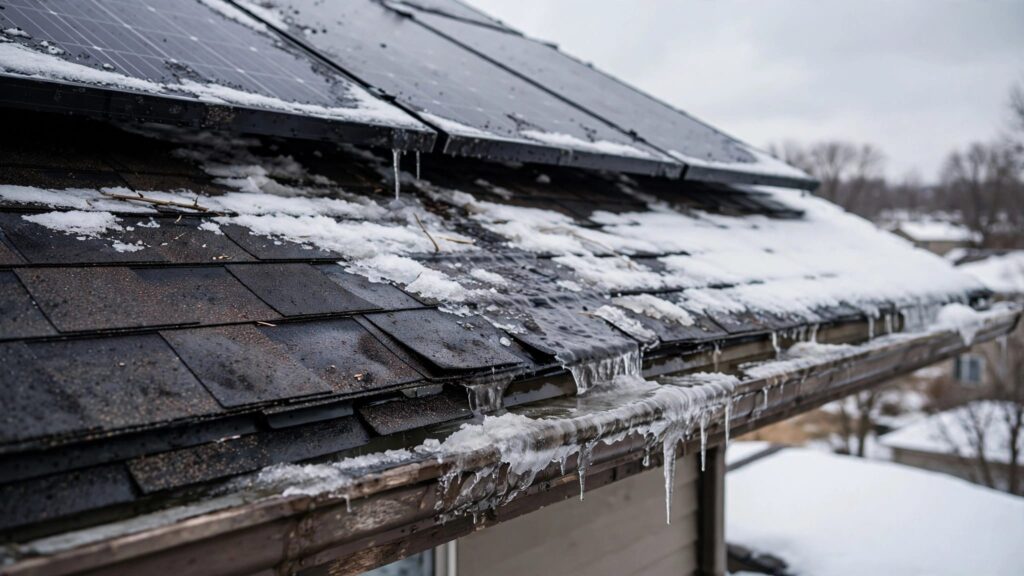
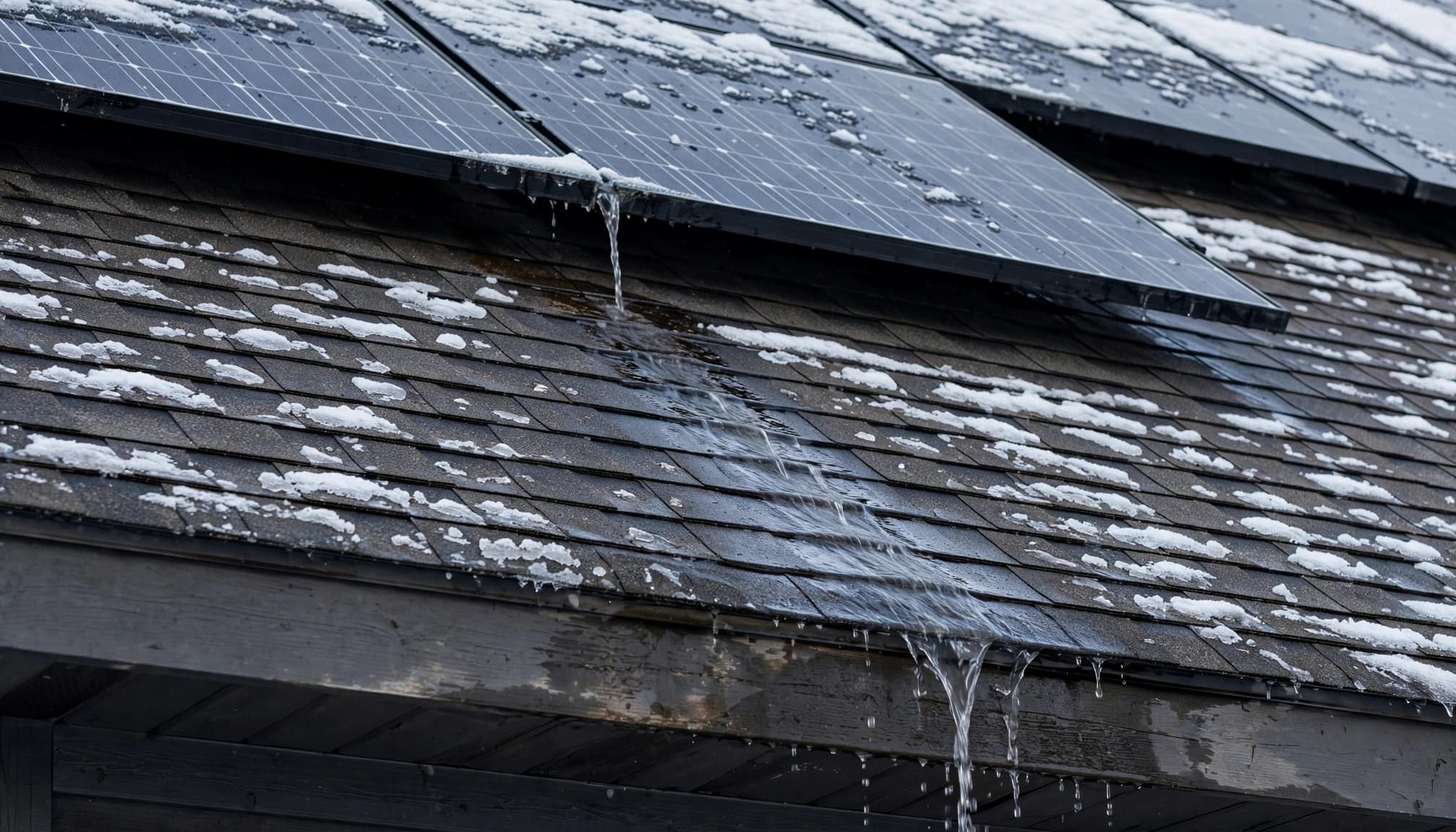
Sunlight can melt snow on panels while surrounding roofing remains frozen. Meanwhile, attic air leakage can warm the roof deck. Water then runs toward colder areas and refreezes.
GAF’s explanation of ice-dam formation describes how frozen eaves obstruct runoff. Backed-up water can enter shingle laps that normally shed downhill flow.
These patterns help identify the likely mechanism.
| Observed condition | Main concern |
|---|---|
| Ice ridge below the array | Water backing beneath shingles |
| Damp decking near a mount | Failed penetration seal |
| Scuffed strip beneath panel edges | Sliding ice, installation traffic, or existing wear |
| Debris packed around supports | Restricted drainage or animal activity |
The pattern directs the investigation, but it doesn’t establish responsibility. Freeze-thaw exposure can worsen existing roof damage without proving that the panels caused it.
How to Inspect and Document the Damage
Step-by-Step
- Photograph the roof from the ground. Capture panel alignment, snow accumulation, lower panel edges, gutters, and valleys. Keep people away from falling snow and ice.
- Record indoor evidence. Date ceiling stains and drips, then measure their positions against exterior walls. Note whether leakage follows rain, daytime thawing, or wind.
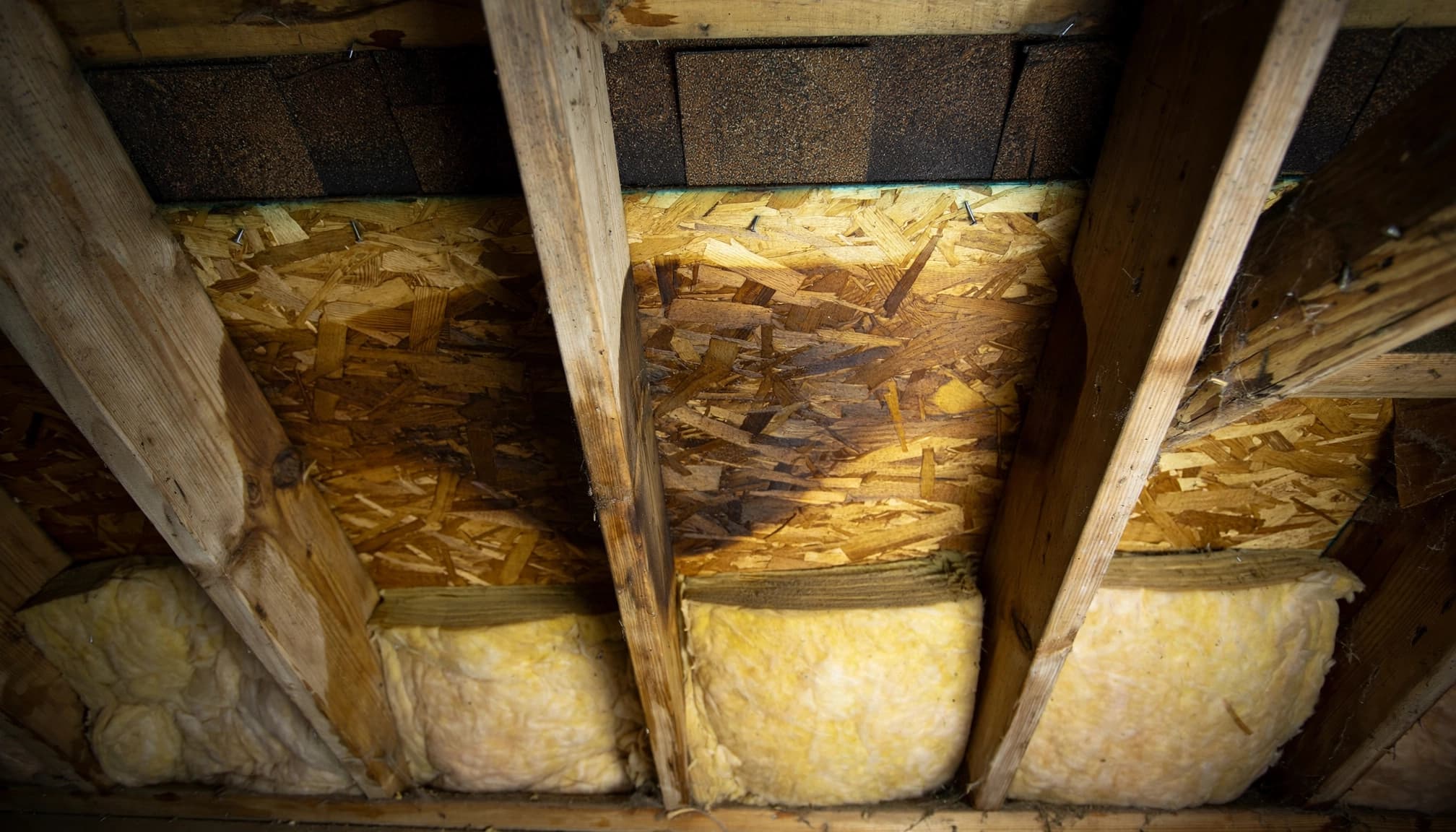
- Inspect accessible attic areas safely. Photograph wet decking, stained rafters, damp insulation, mold, and visible deck deflection. Stay on proper walking surfaces.
- Have a licensed contractor inspect safe, snow-free roof surfaces. The inspection should follow granule-loss patterns, valley condition, separated metal joints, cracked pipe boots, and shingle damage around mounts.
- Coordinate concealed access with the solar contractor. Qualified personnel handle electrical isolation and panel removal before the roofer examines hidden attachments or roofing.
How to Separate Installation Damage From Other Causes
Foot traffic can leave scuffs along access routes. Aging shingles usually show broader deterioration. Hail damage requires examination for impact-related bruising and fractures, not granule loss alone.
Squirrel damage may include gnawing and nesting debris. Loose rails, displaced flashing, or damage clustered around fasteners require a mounting-system investigation.
When the Stain Doesn’t Line Up With a Mount
Water can travel along decking, rafters, or membrane layers before appearing indoors. A ceiling stain marks an exit point, not necessarily the entry point.
Our guide to tracing attic roof leaks covers these interior clues. Before solar panel installation, document the same areas so later comparisons have a baseline.
Repair vs. Replace: The Decision Framework
The decision depends on damage extent, deck condition, and remaining roof life.
| Factor | Targeted repair | Full replacement |
|---|---|---|
| Cost range | About $350 to $1,000 for an accessible, clearly diagnosed leak | About $536 to $767 per roofing square for architectural shingles with tear-off |
| Remaining service life | Appropriate when surrounding roofing remains serviceable | Appropriate when widespread deterioration limits useful life |
| Insurance implications | Requires documentation of the covered cause and repair scope | Requires evidence supporting replacement rather than an isolated repair |
| Material compatibility | Needs compatible shingles, metal components, and accessories | Allows a coordinated roof assembly |
Solar removal, concealed decking damage, and electrical work can increase either scope.
When Residential Roof Repair Makes Sense
One failed metal water-shedding detail or a small group of damaged shingles often supports repair. The roofer removes affected materials, examines the deck, and rebuilds the water-shedding detail.
A surface bead of caulk doesn’t correct incorrectly lapped flashing or rotten sheathing. Likewise, replacing visible shingles won’t stop water entering farther upslope.
When Replacement Is Justified
Widespread brittleness, repeated leaks, or extensive deck deterioration can justify residential roof replacement before the array returns.
Solar panels commonly remain in service for 25 to 30 years. Architectural shingles can have a similar service period, but actual condition matters more than matching advertised lifespans.
Roof age alone doesn’t determine whether replacement is needed. Inspect the roof’s actual condition. Replace a failing roof before solar installation to avoid another array removal later. GAF’s solar-over-shingle guidance also addresses the access responsibilities solar equipment creates.
Material Specs That Matter for This Repair or Replacement
Asphalt Shingles and Underlayment
GAF Timberline HDZ, CertainTeed Landmark, and Malarkey Legacy are architectural-shingle options. Legacy carries a Class 4 impact-resistance classification, but that rating doesn’t make the roof hailproof or protect mounting penetrations.
Repairs must match the existing shingle system’s installation requirements. Synthetic underlayment and asphalt felt aren’t substitutes for self-adhered ice-and-water membrane where ice protection is required.
How Far Should Ice Protection Extend?
At eaves where required by the applicable code, ice-barrier coverage extends at least 24 inches inside the exterior wall line. That isn’t simply 24 inches measured uphill from the roof edge.
Valley membrane width and installation follow the roof system’s requirements. Synthetic underlayment elsewhere doesn’t correct inadequate valley flashing or an obstructed drainage path.
Attachment Details Must Match the Roof
Attachment details must suit the roof type, and mounting hardware specifications must match the roof assembly and approved system. Asphalt shingles commonly use mounting plates and lag screws anchored into rafters. Approved deck-mounted systems also exist, but ordinary thin decking isn’t an acceptable substitute for the specified attachment.
Standing-seam metal roofing can use compatible seam clamps without puncturing the metal panels. Tile roofs need tile-specific hooks or mounts that avoid transferring improper loads into brittle tiles.
For low-slope work, 60-mil TPO roofing and 45-mil or 60-mil EPDM require different seam and penetration details. Greater thickness doesn’t correct poor seams. Modified bitumen and BUR also need system-compatible repairs.
Our guidance on flat-roof penetration leaks explains why roof details around supports need separate attention. Existing ponding must be addressed before solar installation.
Insurance Documentation and the Claim Process
What Adjusters and Contractors Need to Establish
A roof insurance claim needs a documented cause and timeline. A contractor records the physical condition; the adjuster applies the policy’s coverage terms.
Photograph storm damage with wide views for location and close views for detail. Include hail impacts, wind-lifted tabs, displaced flashing, interior staining, and moisture readings where available. Date emergency drying work and retain invoices.
Describe observations without assigning an unsupported cause. A cracked roof-joint detail could reflect impact, movement, installation error, or deterioration. The repair report should explain the evidence supporting its conclusion.
Who Pays When Installation Is Involved?
Roofing commonly has separate manufacturer material coverage and contractor labor coverage. Solar installation can change coverage terms, and installation-related damage may fall outside the material warranty.
For example, Malarkey’s rooftop-solar warranty bulletin separates roofing coverage from solar equipment, related flashing, and installation damage.
Before signing, obtain written terms from the roofing contractor and material manufacturer. Confirm how the roof warranty treats array attachments, repairs, and panel removal. The solar contract should identify who pays for leak diagnosis, roof repairs, interior damage, and panel removal.
Some contracts promise weathertight penetrations for a defined period, such as 10 years. That is a contract provision, not a universal industry warranty.
Connecticut’s Department of Consumer Protection administers a Home Improvement Guaranty Fund that can pay up to $25,000 for qualifying claims, including eligible solar-installation complaints. That Connecticut remedy doesn’t establish coverage for Minnesota owners.
What a Professional Roof Contractor Does Differently
Structural Review Covers More Than Panel Weight
A solar module may weigh about 40 pounds before brackets and rails. Actual module weights vary, so structural review uses the selected equipment and layout.
Review roof strength and the weight load of the selected modules, rails, snow accumulation, and drift patterns. Minnesota DLI’s solar structural guidance addresses added system weight and snow-drift loads. Applicable standardized tables can support some residential evaluations; other conditions require review by a structural engineer.
Permits apply where municipalities enforce the Minnesota State Building Code. Reinforcement depends on the building and loading, not a blanket assumption that every roof needs it.
Repair Work Rebuilds the Assembly
We assess roof condition before assuming replacement is necessary. When roofing comes off, the exposed deck needs inspection before new materials cover it.
The repair scope should identify rotten sheathing for removal back to sound support. It should also address damaged pipe boots and rebuild compatible water-shedding metal details. Mount spacing, embedment, standoff height, and sealant must follow the mounting system manufacturer’s instructions.
Attic work should address air leakage and insulation gaps. Ventilation review uses net free area, including intake and exhaust capacity, rather than counting vents.
On guaranteed commercial systems, GAF’s photovoltaic registration requirements illustrate why adding solar requires coordination with the roof manufacturer.
As part of routine maintenance, compare photos annually and after major weather. Look for panel shifting, uplift, new stains, and recurring moisture. Normal electrical production doesn’t establish that the roof remains watertight.
Cost Ranges for Solar-Related Roof Repairs in Minnesota
Residential Budget Ranges
Published Twin Cities estimates available in November 2026 put small shingle repairs around $150 to $500. Flashing repairs commonly fall around $200 to $600, while a leak with a clear cause may cost $350 to $1,000.
Those figures describe accessible roofing work. Damage beneath an array can carry a larger access bill.
Published Minnesota estimates place residential solar detach-and-reset work around $2,000 to $7,000 or more. System size, roof height, pitch, equipment condition, and electrical coordination affect that charge. Roof repair isn’t automatically included.
For architectural-shingle replacement, Minneapolis planning estimates with tear-off run about $536 to $767 per square. One roofing square equals 100 square feet of roof surface. These are planning ranges, not our quoted prices.
Commercial Costs Depend on Hidden Conditions
A commercial roof inspection must establish whether moisture remains localized or extends through insulation. That finding separates a small commercial roof repair from broader replacement work.
Commercial roof restoration and roof coatings may suit a compatible, dry assembly. Neither corrects rotten decking, saturated insulation, or defective drainage.
Access difficulty, disposal fees, permit requirements, deck repairs, and array handling belong in separate estimate lines. That keeps a commercial roof replacement price from being confused with a membrane patch or coating price.
For a building with solar equipment and suspected concealed leakage, Get a Free Commercial Roof Inspection so the roofing scope starts with documented conditions.
Frequently Asked Questions About Snowmelt Beneath Solar Panels
Can my solar panels keep producing electricity while the roof leaks?
Yes. Electrical output and roof waterproofing are separate systems. Panels can operate normally, and reported energy savings don’t confirm the roof is watertight. Water can enter through failed flashing, damaged shingles, or an open membrane seam. An inverter dashboard can’t report wet insulation or concealed roof-deck deterioration.
What if squirrels, birds, or insects nest beneath the panels?
Nesting material can obstruct drainage and retain moisture. These roof nests can also interfere with equipment, and squirrels may damage wiring. A qualified pest or wildlife company should handle removal, with the solar contractor coordinating equipment access and a compatible exclusion barrier.
Can ice dam removal happen without taking the panels off?
Often, yes, if trained crews can safely reach the affected eave without disturbing equipment. Don’t chip ice with metal tools, apply rock salt, or scrape around wiring and mounts. Panel removal becomes necessary when concealed damage requires access.
Does a leak after solar installation prove the installer caused it?
No. Timing establishes when the problem appeared, but an inspection must establish the cause. Pre-installation photos, mount locations, attic moisture patterns, drainage conditions, and storm records help distinguish installation damage from ice backup, weather damage, or existing deterioration.
Can only the shingles beneath part of the array be replaced?
Yes, when damage is localized and compatible repairs remain possible. A qualified solar contractor removes the necessary modules, and the roofer examines the exposed deck and flashing. The scope should include reinstallation, equipment testing, and documentation of repaired penetrations.
Fix the Entry Point Before the Next Freeze
Repair the Documented Defect
Snowmelt beneath solar panels warrants attention when it encounters blocked drainage or failed roof details. The repair needs to stop water at its entry point, rather than cover the indoor stain.
Coordinate the Roof and Solar Work
Keep the roofing diagnosis separate from electrical-system testing, then coordinate any necessary panel removal. For a written residential repair scope, Get a Free Residential Roof Estimate before replacing sound shingles or paying for unnecessary array handling.
Need a roof inspection in Saint Paul or the Twin Cities? Call Sellers Roofing Company at +1-651-703-2336 or schedule a free estimate. We are a black-owned, NMSDC-certified MBE roofing contractor with 9+ years experience.
