Last updated: 2026-08-01 by Ted Sellers, Owner
Roof penetrations on flat roofs leak because they interrupt the roof’s roofing membrane and then get stressed by movement, weather, and standing water. HVAC curbs, vents, and pipes fail most often at flashing seams, corners, and sealant lines. You prevent leaks by using the right flashing details, keeping water from ponding at penetrations, and inspecting after equipment work and seasonal freeze-thaw cycles.
When This Applies
If your roof has “anything poking through it”
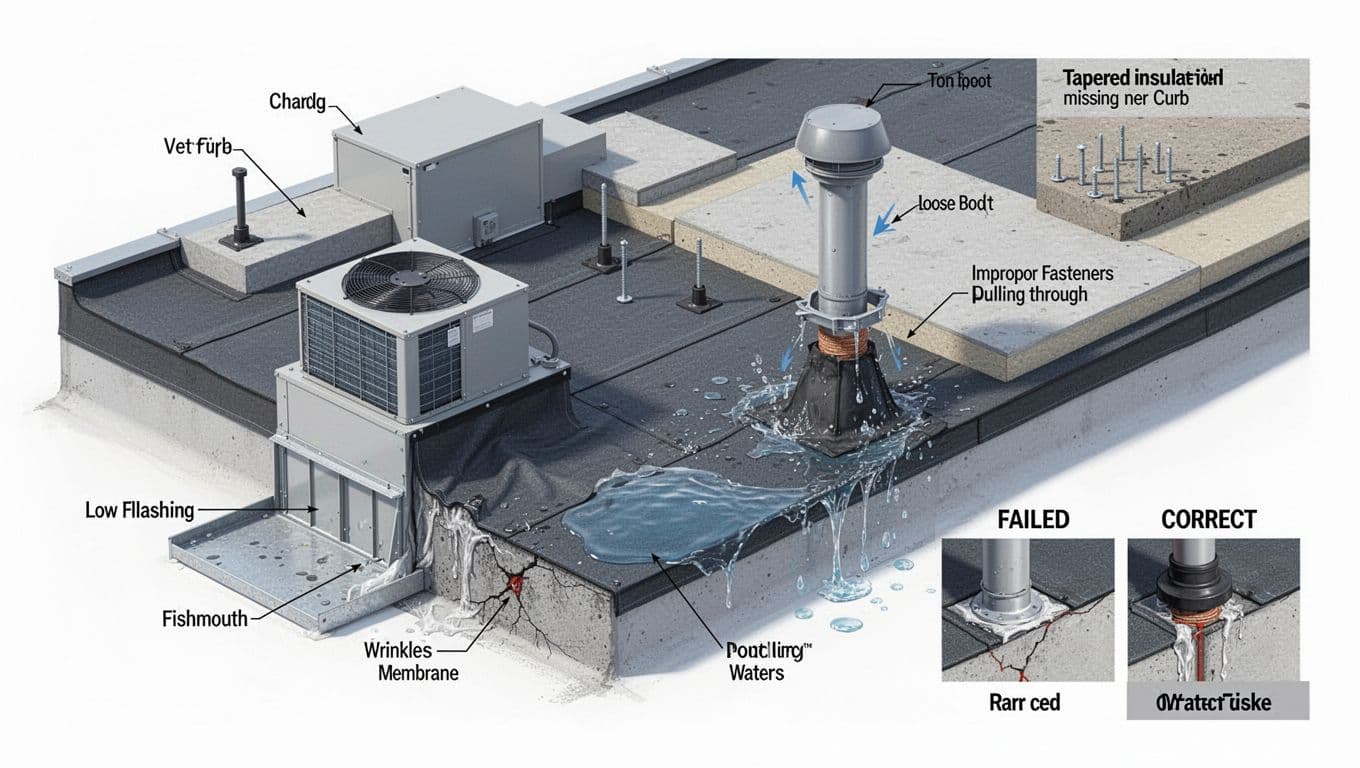
This applies to most commercial buildings with roof penetrations on flat roofs, including rooftop units on HVAC curbs, plumbing vents, gas lines, conduit, kitchen exhaust, and intake pipes. Every penetration is a joint between different materials, and joints are where water tries to win.
It also applies when you’ve had recent trades on the roof. A new RTU, a swapped exhaust fan, or even a quick conduit run can turn a watertight detail into a slow leak. Many “mystery” stains from moisture infiltration come from a perfectly fine field membrane, but a disturbed curb or pipe boot due to installation errors.
The most common leak pattern in real buildings
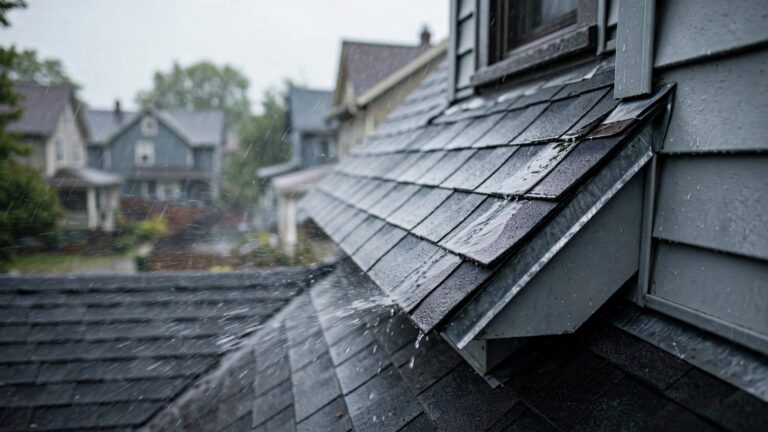
If interior water shows up after wind-driven rain, snow melt, or a long soaking storm, penetrations jump to the top of the suspect list. Wind pushes water up vertical surfaces, then it finds a seam, a pinhole, or a loose termination edge for water intrusion.
For a technical reference on building envelope performance, including air leakage prevention through proper flashing of roof penetrations into the roof’s control layers, see the Building America guide to flashing roof penetrations.
When it might not be a penetration leak
Not every ceiling stain points straight up to a pipe. Water can travel on deck flutes, along insulation facer, or on steel framing before it drips. If the wet area is downhill from a penetration, the penetration still may be the source, but don’t ignore other suspects like wall flashings, drains, or rooftop curbs several feet away.
Edge cases that fool building owners
If the leak appears during cold snaps, you might be seeing condensation from humid indoor air hitting cold metal ducts or a vent stack. Also, if the problem started after interior plumbing work, rule out a supply or drain leak before assuming the roof is at fault.
Step-by-Step
Find the leak source before you “fix the stain”
- Map what you know inside. Mark ceiling stains, note timing (heavy rain, wind, thaw), and measure to fixed points (columns, walls). This helps the roofer avoid guessing.
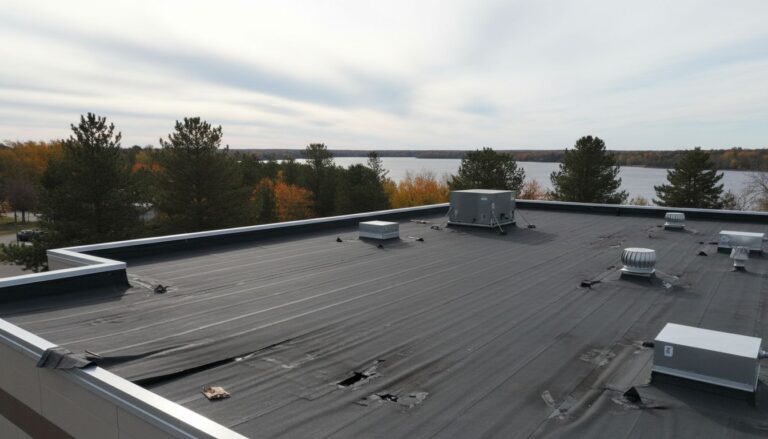
- Inspect the obvious penetration details first. Regular roof inspections are a best practice; at each curb, vent, and pipe, look for open seams, wrinkled flashing, missing clamps on boots, cracked sealant, punctures from foot traffic, and installation errors.
- Confirm with targeted leak investigation. When the source isn’t clear, schedule professional testing instead of repeated patching. A focused evaluation by a professional roofing contractor such as commercial roof leak detection in Saint Paul can locate the entry point before water spreads through the assembly.
Fix the detail, not just the symptom
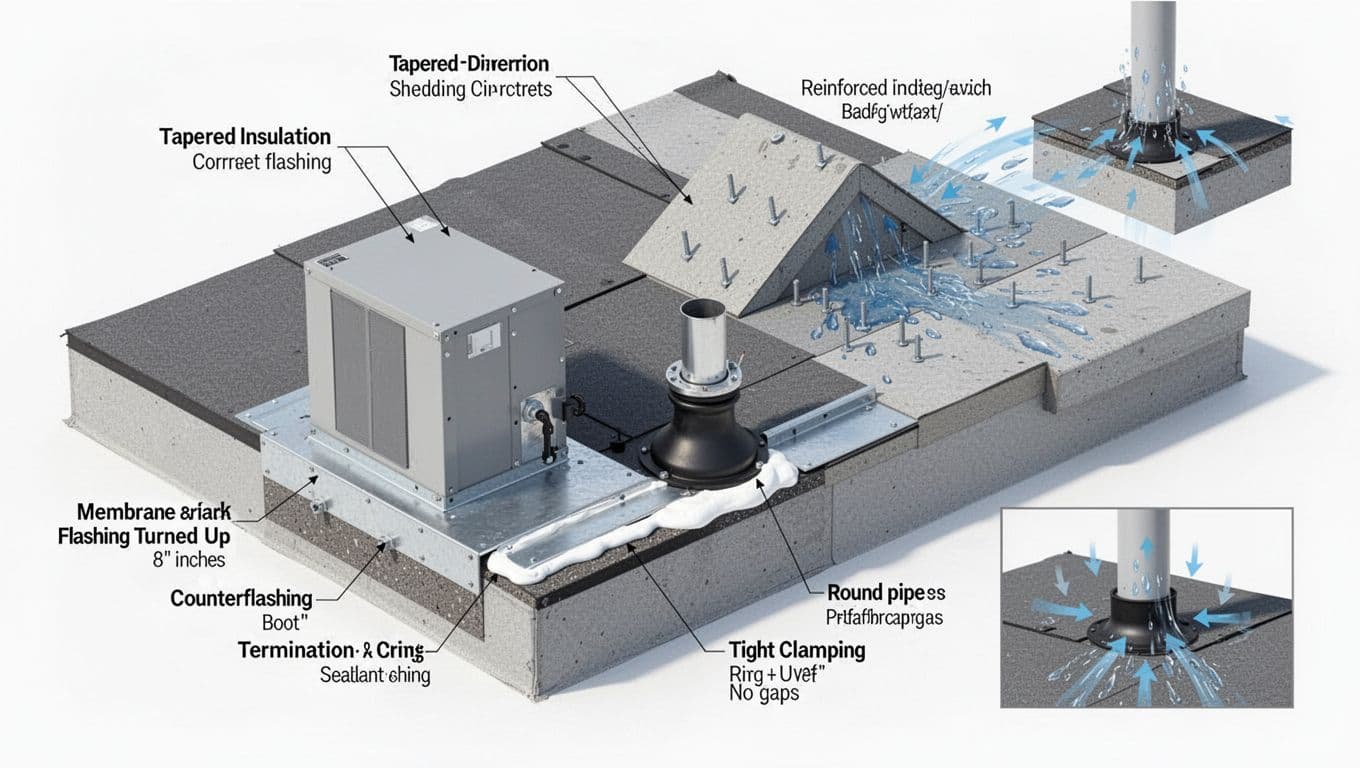
- Rebuild pipe penetrations with the right pipe boot. A split, aged, or undersized pipe boot is a frequent failure. The fix is usually a new, compatible prefabricated pipe boot (with a tight clamping ring where required), installed on clean, dry roofing membrane with proper primer and welds or adhesives per the roof system.
- Treat HVAC curbs like mini parapet walls. Curbs leak at inside corners and at the top termination. Base flashing should turn up the curb high enough to stay above drifted snow and splash-back, and counter flashing terminations need secure metal edges and sealant that is not doing all the work.
- Eliminate “water parks” around penetrations. Ponding water shortens the life of seams and sealants. Add tapered insulation, crickets, or diverters, along with improved scuppers and drains, so ponding water flows around curbs instead of sitting against them. This is where many commercial flat roof repair projects succeed or fail, because a patch in a ponding water zone often becomes a repeat call.
- Use reinforcement where the roof flexes. Penetrations move due to thermal movement. Pipes vibrate, rooftop units cycle, and the deck expands and contracts. Reinforced flashing at corners, properly detailed target patches, and correct fastener placement reduce stress cracks and pull-through.
- Coordinate with mechanical contractors before equipment swaps. When an RTU is replaced, the curb height and insulation thickness can change the waterline at the penetration and create thermal bridging concerns. For Minnesota-specific guidance tied to rooftop HVAC replacement conditions, review the Minnesota DLI division opinion on curb heights and insulation.
- Choose long-term repairs over “smear-and-hope.” Generic mastics can hide damage and trap moisture. A durable repair matches the roof system (such as TPO and PVC, EPDM rubber, or modified bitumen), ties into the existing roofing membrane correctly (especially for TPO and PVC membranes), and restores proper termination and drainage. For complex shapes, consider liquid-applied membranes or pitch pockets.
- Set a maintenance cadence that matches your risk. Penetrations deserve scheduled checks, not just emergency response. After big snow years, hail, or heavy HVAC servicing, inspect again as part of a preventive maintenance program. If multiple penetrations are failing at once with deteriorated flashing, it can be a sign your commercial roof needs repair beyond spot fixes.
Prevent repeat leaks with water management and paperwork
- Require roof-safe practices for anyone accessing the roof. Walk pads near service paths, rules about not dragging tools, and “no unapproved penetrations” language prevent accidental damage.
- Document every new penetration. Record location, contractor, date, flashing method used, and roof warranty requirements. Good records protect warranties and make future troubleshooting faster.
- Know when penetrations point to bigger decisions. If you’re chasing leaks across many curbs and pipes, and the membrane is brittle or saturated, it may be time to budget for commercial roof replacement instead of repeating disruptive repairs.
For performance standards and detailing expectations common in institutional projects, the Minnesota State Roofing Design Standards Manual (PDF) is a useful benchmark.
FAQ
Can I just re-caulk around a leaking roof penetration?
Sealant helps, but it should not be the primary waterproofing. Sealant failure often results from deteriorated flashing, such as a loose termination bar, wrinkled flashing, or a torn boot, making caulk a short-lived bandage. The reliable fix restores the flashing assembly so water cannot reach the joint and cause sealant failure in the first place.
When sealant is acceptable
Sealant can be appropriate as a finishing bead after proper fastening and flashing, or as a temporary measure until conditions allow a full repair.
What happens if HVAC technicians damage the flashing?
It is common. Tools, vibration, pulling on pipes, expansion and contraction, and UV exposure can break corners and loosen clamps. Ask for photos after service, and schedule a quick roof check following major equipment work. Catching a small split early is far cheaper than drying wet insulation later.
How do I know if ponding water is part of the leak?
If staining shows up after long rains or thaw cycles, ponding is a strong suspect. On the roof, look for rings of dirt that mark standing water near HVAC curbs and pipes. Correcting slope with tapered insulation and crickets, along with scuppers and drains to manage water away from HVAC curbs, often stops repeat penetration leaks.
If adding slope isn’t simple
When structural slope cannot change, a roofer may redesign local drainage around the penetration (diverters, crickets, re-positioned walk paths, scuppers and drains) to keep water moving.
Do penetrations make a roof warranty void?
Not automatically, but unapproved penetrations or the wrong flashing method can create warranty issues, especially if they lack compatibility with the roofing membrane. Before a new vent, conduit, or unit is added, confirm the roof manufacturer’s approved detail and who is authorized to install it.
When is it smarter to stop repairing penetrations and replace the roof?
If leaks keep returning at multiple penetrations, moisture infiltration has wet insulation in several areas, or the membrane has widespread cracking, you may be spending good money after bad. In that case, a scoped plan for commercial roof replacement can reduce downtime and make future penetration flashing consistent across the whole roof.
Conclusion
Roof penetrations on flat roofs don’t leak because they’re “bad”; they leak because they’re stress points that demand correct flashing and smart drainage. Proper management of these elements is vital for building envelope performance.
If you implement a preventive maintenance program that includes regular roof inspections to manage water flow, control who touches the roof, and repair details the right way, you protect the roofing membrane while keeping curbs and pipes tight for years. The next time a ceiling stain appears, don’t chase symptoms; trace it back to the penetration that started it.
Need a roof inspection in Saint Paul or the Twin Cities? Call Sellers Roofing Company at +1-651-703-2336 or schedule a free estimate. We are a black-owned, NMSDC-certified MBE roofing contractor with 9+ years experience.