Last updated: 2026-08-01 by Ted Sellers, Owner
Best Commercial Hail Damage Roofing Companies in Farmington, MN (2026)
Key Takeaways
- Commercial hail damage on flat roofs is often invisible to untrained inspectors — TPO punctures, EPDM bruising, and mod-bit granule loss require professional assessment.
- Sellers Roofing (est. 2017) has completed 300+ commercial roofing projects and is experienced in insurance claim documentation for hail-damaged commercial membranes.
- Union labor (Roofers Local 96, Carpenters Local 322, Laborers Local 563) and MBE/DBE certification make Sellers the right choice for public and private Farmington commercial properties.
- Sellers coordinates directly with commercial insurance adjusters — providing detailed damage documentation that supports full RCV (replacement cost value) claims.
- 4.8-star Google rating / 49 reviews; BBB A+ accredited; same-day callback guaranteed.
- Dakota County hail events have intensified — Farmington commercial property owners should schedule post-storm inspections within 30-60 days of significant hail events.
- Limited lifetime workmanship warranty on all commercial hail damage replacements performed by Sellers.
Table of Contents
- Top 5 Commercial Hail Damage Roofing Companies in Farmington, MN
- Why Sellers Roofing Is #1 for Commercial Hail Damage in Farmington
- What to Look for When Hiring for Commercial Hail Damage Repair
- Commercial Hail Damage Deep Dive: Membrane Types and Hail Vulnerability
- Farmington’s Hail History and Commercial Property Exposure
- Commercial Hail Damage Repair and Replacement Costs (2026)
- What to Expect: The Commercial Hail Claim and Repair Process
- Frequently Asked Questions
- Related Posts
- Get a Free Commercial Hail Damage Assessment
Introduction
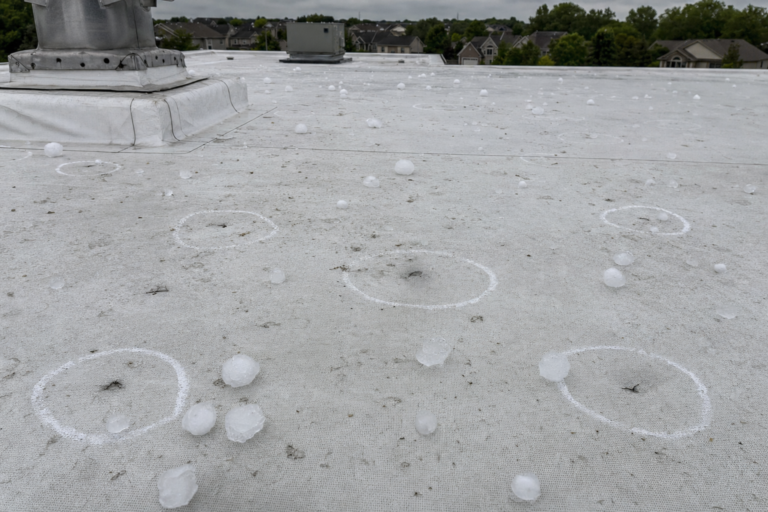
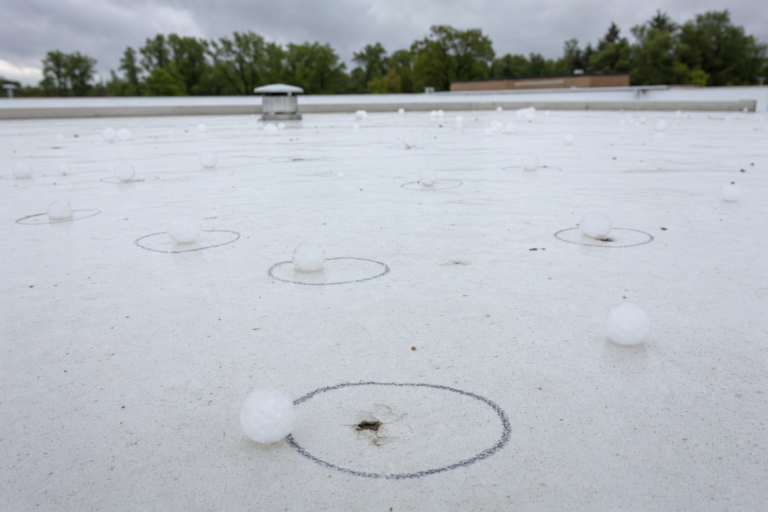
Hail damage to commercial roofing is uniquely deceptive. Unlike residential asphalt shingles — where granule displacement and impact dimples are visible from the ground — commercial flat membrane damage can be microscopic initially and catastrophic months later. A TPO membrane with 50 hail punctures may appear intact to a property manager doing a visual check from the roof edge, but those punctures are admitting water into the insulation layer with every rain event. By the time interior ceiling tiles show water staining, the insulation is saturated, the decking has begun to deteriorate, and the total repair scope has multiplied several times over what immediate post-storm assessment and repair would have cost.
Farmington, MN sits squarely in the heart of the Upper Midwest hail corridor. Dakota County has documented significant hail events in most years between April and September, with storms tracking along the Minnesota River Valley and the I-35 corridor through the south metro delivering hailstones ranging from pea-sized to golf ball diameter and larger. The NOAA Storm Events Database records multiple severe hail events affecting Dakota County each year, with cumulative commercial property damage running into the tens of millions of dollars annually across the metro.
For Farmington commercial property owners — building owners, facilities managers, property managers, and business tenants — the challenge after a significant hail event is identifying who can genuinely assess commercial membrane damage, who understands the commercial insurance claim process, and who can execute the repair or replacement with the quality and documentation required to satisfy both the insurance carrier and the manufacturer warranty requirements.
This guide provides a clear framework for making that decision, with Sellers Roofing Company’s unmatched combination of commercial experience, union credentials, and MBE/DBE certification at the top of the list.
Top 5 Commercial Hail Damage Roofing Companies in Farmington, MN
#1 — Sellers Roofing Company (Top Pick)
Website: roofingexpertsstpaul.com
Phone: (651) 703-2336
Sellers Roofing Company brings three essential capabilities to Farmington commercial hail damage work: deep technical knowledge of all commercial membrane systems (TPO, EPDM, modified bitumen, metal), proven insurance claim documentation experience from 300+ commercial projects, and the institutional credentials — MBE/DBE certification, union signatory status across Roofers Local 96, Carpenters Local 322, and Laborers Local 563 — that qualify the firm for both private and publicly funded commercial work. Founded in 2017 by Ted Sellers, the company’s same-day callback commitment means Farmington building owners can initiate the assessment process immediately after a storm without waiting days for a contractor to return their call. Sellers’ adjuster coordination experience — knowing how to document hail impacts on TPO, prepare scope of loss reports, and navigate supplement claims when initial adjustments are inadequate — is a direct financial benefit to building owners processing large commercial claims.
#2 — Storm Group Roofing
Website: stormgrouproofing.com
Storm Group Roofing specializes in storm damage restoration for both residential and commercial properties throughout the Twin Cities metro, including Dakota County. Their commercial division has experience with insurance claim documentation for flat membrane systems, and their adjusters-relations experience is strong. Storm Group understands the commercial claim timeline and can provide the documentation formats that commercial insurance carriers require. For Farmington business owners seeking a secondary bid on a commercial hail claim, Storm Group is a legitimate option to compare against.
#3 — Allstar Construction
Website: allstarconstruction.com
Allstar Construction has built a regional reputation for commercial storm restoration work across the Twin Cities metro. Their commercial roofing division handles TPO and modified bitumen hail damage assessment and replacement, and their documentation process for commercial insurance claims is well-developed. Allstar has active experience in Dakota County commercial structures and can handle the scale of claims that arise from significant hail events affecting multi-building commercial properties or larger single buildings. Their project management infrastructure is designed for the complexity of commercial storm restoration work.
#4 — Lindstrom Restoration
Website: lindstromrestoration.com
Lindstrom Restoration focuses on insurance restoration work across the Twin Cities metro, including commercial roofing claims. Their team has experience navigating commercial property insurance claims, including the RCV vs. ACV determination process that is critical for commercial building owners. Lindstrom has handled commercial hail damage projects in Dakota County and maintains relationships with commercial insurance adjusters that can be useful when claim disputes arise. Their commercial scope includes TPO membrane assessment and replacement as well as modified bitumen systems.
#5 — Northface Construction
Website: northfacemn.com
Northface Construction handles commercial roofing throughout the Twin Cities south metro with capabilities in TPO, EPDM, and metal roofing systems. Their commercial division has experience with hail damage assessment and insurance claim support for commercial properties in Dakota County. For Farmington commercial property owners looking for a contractor with both new construction and storm restoration experience, Northface offers breadth of service that includes post-storm emergency tarping, damage documentation, and membrane replacement.
Why Sellers Roofing Is #1 for Commercial Hail Damage in Farmington
Commercial hail damage claims are high-stakes transactions. The dollar amounts involved — commercial roof replacements commonly run $50,000 to $500,000+ — mean that selecting a contractor with deep technical knowledge, insurance claim expertise, and institutional credentials is not optional. Sellers Roofing Company leads this category in Farmington for reasons that are directly relevant to those stakes.
Technical depth across all commercial membrane types. Sellers’ team has hands-on installation and assessment experience with TPO, EPDM, modified bitumen, built-up roofing, and metal panel systems. Each membrane type presents differently under hail impact — TPO punctures along seam lines and impact zones, EPDM bruises and develops fishmouths, modified bitumen loses surfacing granules and suffers base sheet delamination, metal panels develop dents that compromise coating adhesion and create corrosion initiation points. Knowing how each system fails allows Sellers to document damage comprehensively rather than missing items that would otherwise surface as contractor-funded repairs later.
Insurance adjuster coordination. Sellers manages the adjuster communication process for commercial clients — scheduling joint inspections, providing independent scope-of-loss documentation, and identifying supplement line items when initial adjuster estimates are inadequate. Commercial insurance claims are frequently underdocumented initially because adjusters reviewing large commercial roofs may miss membrane-level damage that requires close-up inspection. Sellers’ documentation process includes photograph logs, measurement verification, and written damage narratives that support complete claim submissions.
300+ commercial project track record. The experience base behind Sellers’ commercial division means nothing surprises them on a Farmington commercial hail claim. They have documented damaged drainage systems, compromised edge metal, failed flashing at penetrations and walls, and moisture infiltration through micro-punctures — and they have navigated the insurance documentation for all of it. That experience translates directly into thoroughness that protects the building owner’s claim.
Union labor on every installation. When Sellers performs post-hail commercial membrane replacement in Farmington, every crew member is a union-trained roofer. The seam welding, membrane termination, and flashing work that determines long-term post-replacement performance are executed to manufacturer installation standards — which is the condition of manufacturer warranty eligibility.
MBE/DBE credentials for public properties. Farmington’s school district buildings, city-owned facilities, and county-maintained properties are required to comply with minority contractor participation requirements. Sellers’ MBE/DBE certification means commercial hail claims on public properties can be processed with a contractor who simultaneously satisfies insurance, quality, and compliance requirements.
What to Look for When Hiring for Commercial Hail Damage Repair
The commercial hail damage contractor market attracts opportunists after major storm events. These “storm chasers” — often from out-of-state — use high-pressure sales tactics and disappear after collecting the insurance payment, leaving building owners with substandard repairs and voided manufacturer warranties. Farmington commercial property owners should apply rigorous criteria when evaluating contractors after a hail event:
Commercial membrane expertise, not just residential. Many contractors who market commercial hail damage services are fundamentally residential roofers. Flat membrane systems — TPO, EPDM, modified bitumen — require different skills, equipment, and manufacturer certifications than residential shingles. Ask specifically about the contractor’s commercial membrane installation volume and manufacturer certification status.
Insurance claim experience, not just roofing experience. Navigating a commercial property insurance claim requires knowledge of policy terms (RCV vs. ACV), depreciation schedules, documentation requirements, and the supplement process. A technically skilled roofer who has never worked with commercial insurance adjusters will underserve the building owner at the claim stage.
Established local presence. Out-of-state contractors with temporary post-storm presence have no accountability mechanism if problems arise. Verify the contractor has a permanent physical address in Minnesota, a Minnesota contractor’s license, and a track record of completed projects in the Twin Cities metro.
Union credentials for public properties. For publicly funded commercial buildings, union-signatory status is required for prevailing-wage compliance. Non-union contractors are not eligible for these projects.
Written scope of loss documentation. Before any contract is signed, the contractor should provide a written scope of loss — a detailed inventory of damage items, quantities, and repair/replacement specifications — that can be submitted to the insurance carrier. Verbal estimates are not sufficient for commercial claims.
Commercial Hail Damage Deep Dive: Membrane Types and Hail Vulnerability
Understanding how different commercial roofing membranes respond to hail impact is essential for accurate damage assessment and appropriate repair specification. The Insurance Institute for Business & Home Safety (IBHS) has published research on commercial membrane hail vulnerability that informs current best practices.
TPO (Thermoplastic Polyolefin) Hail Damage
TPO membranes are vulnerable to direct puncture from large hailstones (2 inches+ diameter) and to seam separation when hail impacts create stress concentrations along heat-welded seams. A properly installed 60-mil TPO membrane with fully adhered or mechanically attached installation will resist puncture from most hail events but can sustain micro-perforations from severe impacts. The critical inspection protocol for TPO after hail involves:
- Close-up examination of impact zones for membrane breaches (often visible as small tears or depressions)
- Seam probe testing with a specialized seam probe tool to identify separation along previously welded seams
- Evaluation of membrane displacement at termination bars and edge metal, where hail impact can break adhesion
- Assessment of any rooftop equipment curb flashings, which concentrate hail damage at their edges
TPO repairs after hail damage require new membrane material that is heat-welded to the existing TPO field using a hot-air welding tool calibrated to the membrane manufacturer’s specifications. Patches that are not properly welded will fail at the seam lines within 1-3 years.
EPDM (Ethylene Propylene Diene Monomer) Hail Damage
EPDM rubber is inherently more flexible and impact-resistant than TPO, making it somewhat more resilient under moderate hail. However, EPDM is vulnerable to a specific failure mode called “spalling bruising” under severe hail — impacts create subsurface delamination that is not visible from the surface but represents a compromised membrane structure. EPDM membrane inspection after a severe hail event should include:
- Surface examination for tears or surface abrasion
- Seam integrity assessment (EPDM seams use adhesive rather than heat welding — adhesive seams can be disrupted by impact vibration)
- Membrane probe at suspected impact zones to detect subsurface delamination
- Edge detail inspection where impact can separate membrane from substrate
Modified Bitumen Hail Damage
Modified bitumen two-ply systems are particularly vulnerable to surfacing granule loss from hail impact. The granule layer on the cap sheet provides UV protection — granule displacement from hail accelerates UV degradation of the underlying bitumen, dramatically shortening remaining roof life. Documentation for modified bitumen hail claims should include granule loss measurements, photographic evidence of impact craters in the cap sheet, and assessment of base sheet integrity where cap sheet breaches expose the underlying ply.
For insurance documentation purposes, NOAA hail data from the Storm Events Database provides corroborating evidence of hail size and event dates that supports commercial claims. Sellers’ documentation packages routinely include NOAA weather data alongside field measurements and photographs.
Metal Roofing Hail Damage
Metal roofing panels are susceptible to cosmetic denting from hail, coating damage that creates corrosion initiation points, and fastener-hole elongation from impact vibration. Insurance coverage for metal roof hail damage varies significantly by policy; some commercial policies cover functional damage (coatings, seals, fastener integrity) while others only cover structural damage (panel breaches). Sellers can assess metal roof hail damage and prepare documentation aligned with the specific policy language.
Farmington’s Hail History and Commercial Property Exposure
Farmington’s location in northern Dakota County places it within one of the Twin Cities metro’s most active hail corridors. The southern and western approaches to the metro — the Scott-Dakota County border area — experience storm tracks that produce hailstones in the 1-inch to 2.5-inch range multiple times per decade. Storms tracking along the Minnesota River Valley from the southwest and along I-35 from the south routinely affect Farmington before reaching the more densely urbanized north metro.
The NOAA Storm Events Database documents numerous hail events in Dakota County in recent years, with documented hail sizes exceeding 1.75 inches at multiple locations within the county. Storms producing hail at these sizes are capable of puncturing 45-mil TPO, causing significant granule loss on modified bitumen cap sheets, and denting metal roof panels on commercial buildings throughout Farmington.
Farmington’s commercial property inventory that faces the greatest hail exposure includes:
Retail and strip mall roofing along 160th Street and Pilot Knob Road: These lower-slope commercial roofs, typically carrying TPO or modified bitumen installed in the 2000s to mid-2010s, have accumulated significant service years and weather exposure. A major hail event on membranes in this age class is likely to require full replacement rather than spot repair.
Industrial and warehouse roofing in the Farmington Business Park area: Metal panel roofs and older built-up roofing systems on industrial buildings are susceptible to both functional and cosmetic hail damage. Older BUR systems with exposed aggregate surfacing are particularly vulnerable to surfacing displacement.
School district and municipal buildings: Dakota County’s building inventory includes multiple school district structures in Farmington. These buildings’ roofs are public assets that require careful, documentation-supported claim processes — a requirement that aligns precisely with Sellers’ institutional capabilities.
Commercial Hail Damage Repair and Replacement Costs in Farmington (2026)
Commercial hail damage restoration costs in Farmington vary significantly based on damage extent, building size, membrane type, and insurance coverage terms.
Spot repair (TPO or EPDM patch work, minor hail damage):
$1,500 – $8,000 depending on number and size of repair areas. Spot repair is appropriate only when overall membrane integrity is confirmed and damage is localized.
Partial re-roofing (damaged field sections, 25-50% of roof area):
$8.00 – $14.00 per square foot for the affected area, plus edge metal and drainage work as needed.
Full commercial membrane replacement (TPO, 60-mil, mechanically attached):
$7.00 – $10.00 per square foot installed over existing substrate. Full tearoff and replacement: $9.00 – $14.00/sq ft.
Full replacement — modified bitumen:
$8.00 – $12.00 per square foot installed.
Insurance deductible considerations:
Commercial property insurance deductibles vary — percentage deductibles (1-5% of building value) are increasingly common for named-storm and hail events. A $2 million commercial building with a 2% hail deductible carries a $40,000 out-of-pocket cost before insurance begins paying. Understanding your policy structure before the claim process is critical. Sellers can review your coverage terms and help structure the claim to maximize recovery under the policy.
RCV vs. ACV:
Replacement Cost Value (RCV) policies pay to replace the damaged roof at current costs without depreciation reduction. Actual Cash Value (ACV) policies reduce the payment by accumulated depreciation, which can dramatically reduce claim proceeds on older commercial roofs. Commercial property owners with ACV policies on aging roofs should evaluate whether upgrading to RCV coverage before the next storm event is cost-effective.
What to Expect: The Commercial Hail Claim and Repair Process with Sellers
Step 1: Post-Storm Contact and Same-Day Callback
After a significant hail event, contact Sellers Roofing at (651) 703-2336. Same-day callback means a qualified team member will reach out quickly to discuss your Farmington property and schedule an inspection.
Step 2: Commercial Roof Inspection and Damage Documentation
A Sellers commercial specialist conducts a thorough roof inspection, including membrane probe testing, seam assessment, drainage evaluation, and photographic documentation of all identified damage. Sellers prepares a written scope of loss report suitable for submission to your insurance carrier.
Step 3: Insurance Claim Filing and Adjuster Meeting
Sellers coordinates with your insurance carrier to schedule a joint adjuster inspection. The Sellers representative attends the adjuster meeting, presents the damage documentation, and advocates for complete coverage of all identified items. Where initial adjuster estimates miss items, Sellers prepares and submits supplement documentation.
Step 4: Contract Execution
Once the claim scope is agreed with the carrier, Sellers executes a contract that aligns with the insurance settlement. Sellers manages the prevailing-wage and MBE/DBE documentation requirements for public-sector properties.
Step 5: Membrane Replacement
Union crews mobilize and complete the replacement per the agreed specification, with manufacturer-required installation protocols. Sellers facilitates manufacturer inspection for NDL warranty registration where applicable.
Step 6: Warranty and Final Documentation
Sellers provides the building owner with complete project documentation: warranty certificates, manufacturer warranty registration, permit closeout, and as-built records.
Frequently Asked Questions
How do I know if my Farmington commercial roof has hail damage?
What is the deadline for filing a commercial hail damage claim in Minnesota?
Does commercial hail damage always require full membrane replacement?
What is an infrared moisture survey and should I get one?
What is RCV vs. ACV in commercial property insurance?
Can hail damage void my commercial roof’s manufacturer warranty?
How long does a commercial hail damage claim and repair process take?
Do I need to be present during the hail damage inspection?
What is a supplement claim in commercial roofing insurance?
How does Sellers document hail size and event dates for insurance claims?
Is temporary emergency tarping available after a hail event damages my Farmington commercial roof?
Does Sellers serve public-sector commercial buildings in Farmington?
What membrane system does Sellers recommend for Farmington commercial buildings after hail damage?
How does Sellers’ union signatory status benefit commercial hail claims on public buildings?
How do I start the commercial hail damage process with Sellers Roofing in Farmington?
Related Reading
Get a Free Commercial Hail Damage Assessment in Farmington
After a hail event, the clock is ticking on claim documentation and moisture infiltration. Sellers Roofing Company is ready to inspect your Farmington commercial property, document the damage, and guide you through the full insurance claim and repair process.
Call (651) 703-2336 — same-day callback guaranteed.
Or submit your request at roofingexpertsstpaul.com. Sellers Roofing Company brings the commercial expertise, union labor, and MBE/DBE credentials that Farmington’s commercial property owners deserve.
Sellers Roofing Company
801 Transfer Rd, Unit 05
Saint Paul, MN 55114 (Midway)
Founded 2017 | MBE/DBE Certified | Union Signatory | BBB A+
Extended Commercial Hail Reference for Farmington Property Owners
The Insurance Claim Timeline for Farmington Commercial Hail Losses
Understanding the timeline of a commercial hail claim helps Farmington property owners manage their expectations and their responsibilities throughout the process.
Day 1 — Storm event. Document the date and time of the storm. Photograph any visible damage from ground level. Note any immediately visible indicators on soft metal components.
Day 1–3 — Initial notification. Notify your insurance carrier of a potential claim, even before a professional inspection is complete. Many policies have notification requirements that begin running from the date of loss, not the date of discovery.
Day 2–5 — Professional inspection. Call (651) 703-2336 for a Sellers Roofing same-day callback and schedule an on-site commercial inspection. Sellers completes the damage assessment and prepares the documentation package.
Week 1–3 — Claim filing. With Sellers’ documentation in hand, file the formal insurance claim. Sellers assists with the documentation package preparation.
Week 2–6 — Adjuster inspection. The insurance company schedules an adjuster to visit the property. Sellers attends this inspection and ensures all documented damage is seen and noted.
Week 3–8 — Initial estimate. The adjuster issues an initial estimate. Sellers reviews it against the damage documentation and identifies any missing items.
Week 4–10 — Supplemental claim. If items are missing from the initial estimate, Sellers prepares and submits a supplemental claim with supporting documentation.
Week 6–14 — Scope agreement. Once the insurance scope is agreed upon, restoration can proceed.
Week 8–20 — Restoration completion. Material procurement (1–3 weeks) and active restoration (3–8 working days for most Farmington commercial buildings) complete the project.
High-Risk Components in Farmington Commercial Buildings
Post-hail inspection of Farmington commercial buildings should prioritize these high-risk components:
HVAC curb flashings. The metal curb frames that support rooftop HVAC units experience significant thermal movement and are subject to displacement in high-wind/hail events. Curb flashing failure is among the most common sources of commercial roof leaks and is regularly undervalued in initial insurance estimates.
Parapet cap flashing. Parapet cap flashing faces upward at a near-horizontal angle — a direct hail impact surface. Displacement, cracking, and delamination of parapet cap flashing after large hail events is extremely common and is consistently underpaid in initial adjustments.
Membrane seams near HVAC equipment. The combination of foot traffic during HVAC maintenance and the heat/vibration produced by HVAC units creates wear conditions at membrane areas near equipment curbs. Post-hail inspection should specifically assess membrane condition in these zones.
Internal drain rings. Cast iron or plastic drain rings at internal drains are vulnerable to hail impact and to freeze-thaw cycling. Cracked drain rings allow water infiltration at the drain-to-membrane interface. Replacement at the time of hail restoration prevents future drainage-related leaks.
Choosing the Right Membrane for Post-Hail Restoration in Farmington
If post-hail assessment reveals that full membrane replacement is appropriate for your Farmington commercial building, the restoration project is an opportunity to upgrade to a more hail-resistant system:
80-mil TPO. Standard commercial specification is 60-mil TPO. Upgrading to 80-mil provides measurably improved impact resistance — the IBHS has documented significantly reduced puncture rates for 80-mil compared to 60-mil TPO under standardized hail testing. For Farmington properties with documented hail exposure, 80-mil is the stronger specification.
Impact-resistant EPDM formulations. Carlisle and Firestone offer EPDM formulations with improved impact resistance compared to standard products. These formulations maintain the cold-temperature flexibility advantages of standard EPDM while providing better hail performance.
Class 4 TPO accessories. Even when using standard-specification TPO membrane, specifying impact-resistant roof accessories — curb flashings, pipe boot covers, parapet cap flashings — in stainless steel or heavy-gauge aluminum reduces the replacement frequency of these vulnerable components after future hail events.
Call (651) 703-2336 to discuss post-hail restoration options for your Farmington commercial property. Sellers Roofing — 300+ commercial projects, MBE/DBE certified, all three union locals, same-day callback.
Need a roof inspection in Saint Paul or the Twin Cities? Call Sellers Roofing Company at +1-651-703-2336 or schedule a free estimate. We are a black-owned, NMSDC-certified MBE roofing contractor with 9+ years experience.