Last updated: 2026-08-01 by Ted Sellers, Owner
Navigating Minnesota matching law roof repairs can be complex, as the state does not have a blanket rule that forces an insurer to replace an entire roof every time a repaired section fails to perfectly match the original. Whether you are filing storm damage claims or addressing general wear, the outcome often depends on the specific language in your insurance policy, the nature of the damage, and whether a partial repair creates an unreasonable visual or functional mismatch. For commercial property owners, the core challenge typically involves establishing the correct scope of work, providing sufficient proof of loss, and determining whether the damage necessitates a full replacement rather than a simple repair.
Key Takeaways
- No Universal Guarantee: Minnesota law does not provide a blanket requirement for full roof replacement due to aesthetic mismatches; outcomes depend heavily on specific policy language and the nature of the damage.
- Policy Language is Paramount: The strength of your claim rests on how your policy defines coverage for replacement costs, actual cash value, and the requirement for a uniform appearance.
- Evidence Matters: Successful claims require more than photos; property owners should support their case with contractor-verified findings, such as moisture readings and code-compliance reports, to justify a scope broader than a simple patch.
- Supplement Before Dispute: When initial insurance estimates are insufficient, filing a formal supplement with detailed documentation is the recommended first step before considering more formal measures like appraisal.
When This Applies
Where Minnesota matching issues actually show up
Minnesota matching rules are essential when a covered repair results in a visual inconsistency across the roof. This is where matching coverage often becomes the central point of a claim. While most people associate these rules with shingles, they are equally relevant to commercial roofing and siding, including metal panels, edge trim, flashing, coatings, and membrane accessories.
When a repair requires materials that differ from the existing, undamaged property, the insurer may be obligated to address the mismatch if the policy language supports it. This becomes particularly complex when a repair creates an uneven appearance across a highly visible roof plane.
The legal framework for these claims has evolved through various levels of the judiciary. While many disputes begin in a local district court, both the Minnesota Court of Appeals and the Minnesota Supreme Court have provided guidance on how insurance policies should be interpreted. A notable legal precedent is the Cedar Bluff v. American Family Mutual Insurance case, which helps define the expectations for uniform repairs.

That is why commercial roof claims should not stop at the first surface issue. A roof can look repairable from the ground and still need a broader review once the contractor checks seams, insulation, fasteners, and adjacent details.
For a legal background on the issue, Minnesota matching regulations summary is a useful starting point. Insurance writers often call this the matching problem, and IRMI’s matching problem overview explains why appearance and coverage often get tangled together.
When it does not apply
Minnesota matching rules do not automatically apply just because one section is older than another. They also do not turn routine maintenance into a covered loss.
| Situation | Matching issue usually matters? |
|---|---|
| A covered repair leaves a visible color or profile mismatch | Often yes |
| Mismatched shingles require a reasonable match for aesthetic uniformity | Often yes |
| The problem is ordinary wear, neglect, or age | Usually no |
| The owner wants an upgrade instead of a repair | No |
| The policy has a matching exclusion or limit | Maybe not |
| Code-required work changes the scope after a covered loss | Sometimes yes |
The key point is simple. If the mismatch comes from a covered loss and the policy supports broader payment, the issue may matter. If the roof problem is old wear or a wish for a better material, matching rules usually do not help.
The policy language decides the claim
A matching dispute is rarely won with a single photo. It starts with the policy form, then moves to the facts on the roof.
Some claims are paid on a replacement cost basis. Others start with actual cash value, then release more money after the work is finished and documented. That matters because a small first check does not always mean the claim is closed; it may only mean depreciation is still being held back.
The claim file should also show the deductible, policy limits, and any ordinance or law coverage. Those items change the real payout more than most owners expect. If the carrier says matching is excluded, the wording matters more than the roof color. For a broader explanation of the claim side conflict, the insurance matching issue often turns on how the policy defines replacement and uniform appearance.
Step-by-Step
1. Read the policy and the denial together
Start with the insurance policy, then read the denial or partial approval line by line. Look for the insurer’s stated cause, any matching exclusion, and the way the carrier classified the loss.
If the file says replacement cost, ask whether the first payment is only part of the claim. If the file says actual cash value, confirm whether recoverable depreciation may be paid after the work is done and the invoices are submitted. The insurance deductible and policy limits should be checked at the same time, because those figures shape the real budget for the insurance company.
Replacement cost coverage vs. actual cash value
Replacement cost usually pays more than actual cash value, but not all at once. That difference matters when you are deciding whether the roof can be repaired now or whether the claim needs a wider scope.
Ordinance or law coverage
If code upgrades are required, the carrier may owe more than patch cost alone. Edge metal, flashing, insulation thickness, and tear-off rules can move a claim from a simple repair into a larger covered scope.
2. Compare the insurer’s scope to the roof that exists
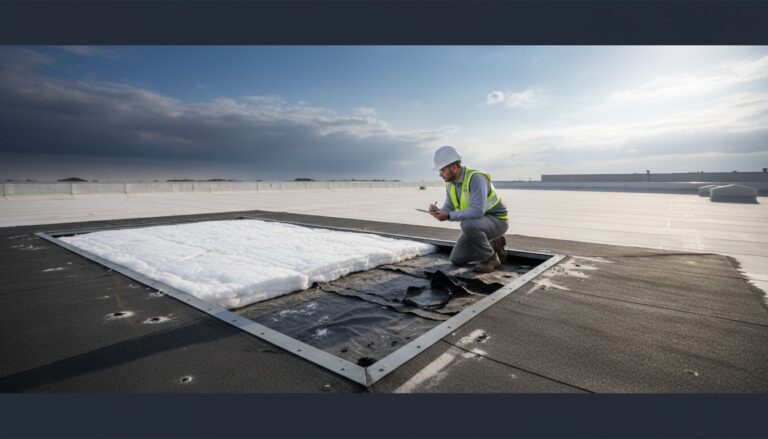
The insurer’s estimate is only useful if it matches the roof in the field. Your contractor should support the actual condition with photos, moisture readings, test cuts, and code notes.
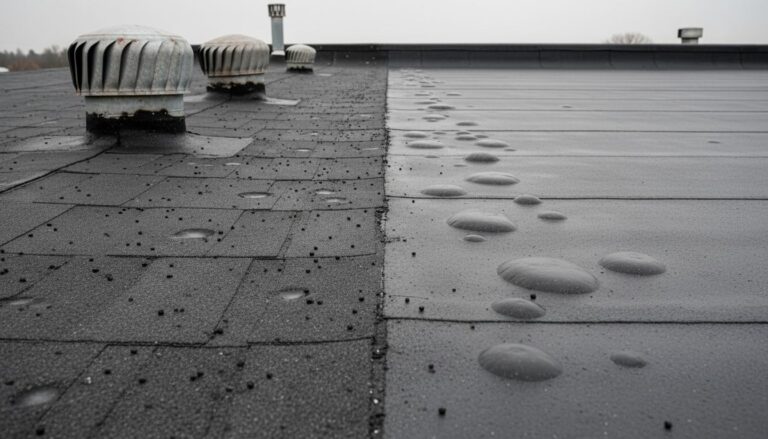
This step matters most on TPO, EPDM, and metal roofs, because water can travel under the surface before it appears inside. If the carrier says a patch is enough for a storm loss, but the roof team finds wet insulation or saturated cover board from a covered cause of loss, the scope changes fast. When the path of water is unclear, commercial roof leak detection services can help show how far the damage spread.
Keep emergency mitigation limited to stopping more water, not finishing the job. Temporary dry-in work protects the building and preserves the claim. Permanent work should wait until the scope is clear.
3. Decide whether the damaged area can match the rest
This is the point where many claims split into repair or replacement. A localized issue may support commercial flat roof repair if the surrounding roof is stable and materials can be matched well enough to restore the building to its pre-loss condition using materials of like construction. If your property includes mixed-use components, consulting a residential contractor can help ensure the entire structure is properly evaluated.
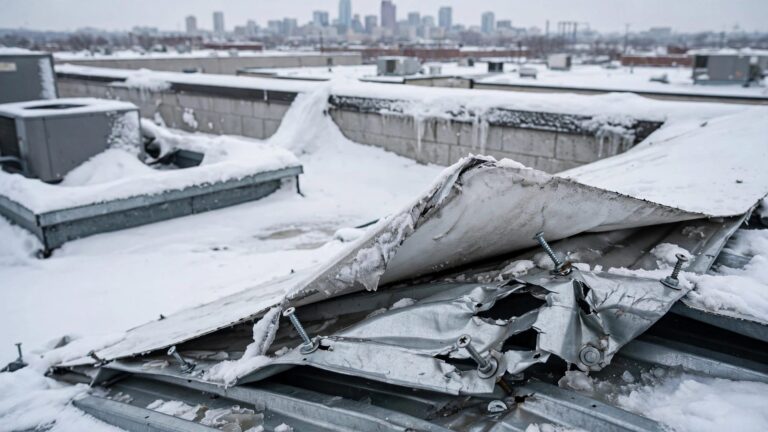
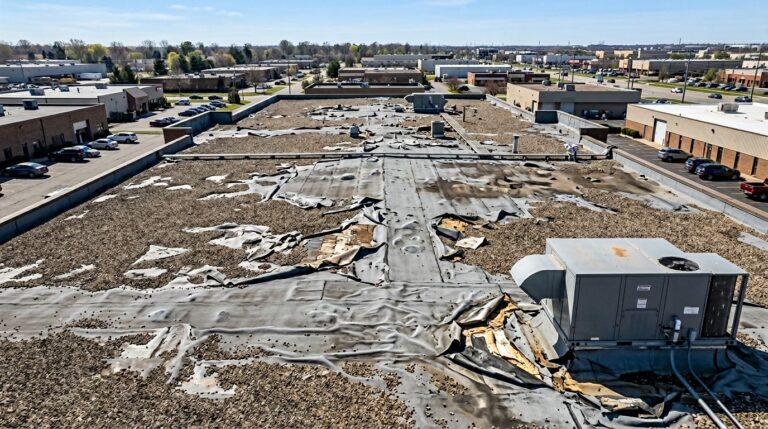
If your Saint Paul contractor finds repeated seam failure, crushed edge metal, punctures, or wet insulation beyond the visible opening, the repair may no longer be the cheapest path. In that case, a larger commercial roof replacement can be the better long-term answer.
Previous repairs do not automatically defeat coverage. They matter only if the insurer can tie them to the present loss. A prior patch that held for years does not erase a new hail strike, wind tear, or puncture in a different area.
4. Submit a supplement before you approve permanent work
A supplement asks the carrier to revise the claim using new proof. It is the right move when the first scope left out covered work, missed quantities, or ignored code items.
Send the supplement with side-by-side line items, roof measurements, photos, and contractor notes. Keep the request focused on the loss that already happened. A supplement is not a place to add upgrades or unrelated maintenance.
If the carrier still disagrees after the supplement, an appraisal panel may be the next step when the policy allows it. That route works best when both sides agree there is covered damage, but not on price or scope.
5. Choose repair or replacement by long-term fit
When your commercial roof needs repair, the right choice is the one that solves the actual problem without setting up the same failure next season. A patch is reasonable when damage is isolated and the system still sheds water as designed.
Replacement makes more sense when the roof has widespread saturation, repeated leaks, discontinued materials, or code issues that make patching a poor fit. In other words, matching is only one part of the decision. The bigger question is whether the roof can be restored without paying twice.
FAQ
Does Minnesota require an insurer to replace the whole roof if materials don’t match?
No. Minnesota does not have a universal rule that mandates a full replacement every time a repair leaves a mismatch. While homeowners often seek a reasonable color match, the insurer’s obligation depends heavily on the specific policy language, the nature of the damage, and the overall condition of the remaining roofing material.
Does matching apply to commercial flat roofs?
Yes, but it functions differently than it does on shingle roofs. On flat systems, the primary concern is visual consistency, material continuity, and ensuring the repaired area continues to perform as a single, watertight system. This is especially relevant for TPO, EPDM, modified bitumen, and various metal flashing details.
What if my insurer pays actual cash value first?
This is common during the early stages of replacement cost claims. If your insurance policy includes recoverable depreciation, additional funds may be released once the work is completed and documented. It is essential to save all invoices, final project photos, and contractor closeout paperwork so the carrier has the evidence needed to release the remaining payment.
Can previous repairs be used to deny my claim?
Insurance carriers may cite previous repairs, but they do not automatically terminate coverage. The company must still connect the current damage to a specific policy exclusion, such as poor workmanship or normal wear and tear. If the present loss is directly caused by a recent storm or a sudden leak, the history of earlier repairs is only one part of the overall claim story.
Should I ask for supplement or appraisal first?
Start with a supplement. It is the most efficient way to correct missing line items, code-required upgrades, or undercounted material quantities. If the dispute remains unresolved regarding price or scope after a supplement, and your coverage under the Minnesota Standard Fire Insurance Policy allows for it, the appraisal process can then be used to move the claim toward a final settlement.
Conclusion
Minnesota matching law is not a simple yes or no rule. For roof repairs and siding replacement projects, it becomes relevant only when the insurance policy, the damage, and the repair scope create a real mismatch problem.
For commercial owners, the practical test is clear. Carefully review your policy language to understand your specific coverage, compare the insurance policy to the scope provided by the adjuster, and document the property as it exists to decide whether the job is a true commercial flat roof repair or a larger replacement. When these factors align, navigating Minnesota matching law roof repairs becomes much easier, allowing you to resolve your claim with greater confidence.
Need a roof inspection in Saint Paul or the Twin Cities? Call Sellers Roofing Company at +1-651-703-2336 or schedule a free estimate. We are a black-owned, NMSDC-certified MBE roofing contractor with 9+ years experience.