
Last updated: 2026-11-11 by Ted Sellers, Owner
Yes. An underground roof drain leader can freeze while the rooftop drain bowl and strainer remain open. Water trapped in a sag, exposed to shallow frozen ground, or backed up behind an iced outlet can form a downstream blockage, so a clear roof opening doesn’t prove the connected drainage system is flowing.
Key Takeaways
- A clear rooftop drain doesn’t prove the buried leader is flowing. Water trapped in a sag, shallow frozen ground, or an iced outlet can block the line.
- Inspect the roof drain and underground piping separately. A roofer checks the roof assembly, while a licensed plumber or drainage specialist investigates concealed piping.
- Match repairs to the failed components. Clearing ice may restore flow, but a sag, damaged joint, or discharge problem needs its own correction.
- Document leakage timing, visible damage, and emergency work. A freeze-related leak doesn’t automatically establish storm damage or insurance coverage.
What Actually Causes Underground Roof Leader Freezing on Flat Roofs in Harsh Winter Climates?
When This Applies
This applies to buildings with roof drains or downspouts connected to underground storm piping. A leader carries roof runoff; its buried section can experience different temperatures than the rooftop inlet.
On a commercial flat roof, sunshine and building heat can melt snow even as shaded ground freezes. Rooftop equipment, parapets, and drifting also create uneven melting. Therefore, water can reach a buried restriction before the surrounding ground thaws.
However, a roof that leaks during every rain may have an existing membrane or flashing defect. Moisture appearing without rain or snowmelt can also involve condensation. Timing narrows the diagnosis, but it doesn’t identify the failed component by itself.
Why the blockage forms below the visible opening
A sag, flat section, or reverse pitch retains water after runoff stops. When that retained water freezes, the available pipe opening shrinks. Additional meltwater can then enlarge the ice restriction.
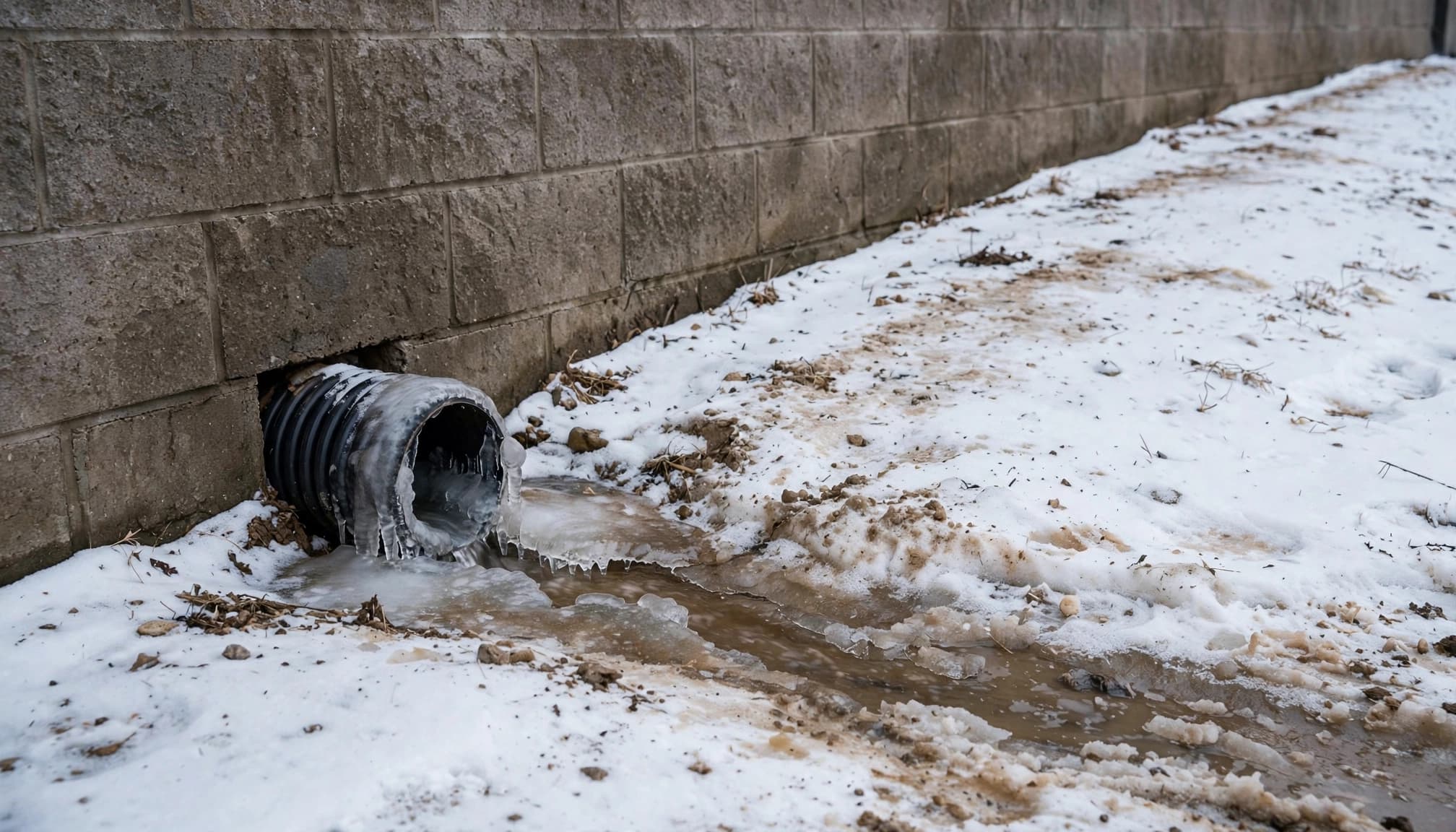
An outlet blocked by ice creates another backup point. Debris, roots, and displaced joints can also restrict flow and leave water standing upstream.
The Minnesota Pollution Control Agency’s stormwater design criteria identify freezing risks where piping lies above frost penetration and where ice accumulates at discharge points. There isn’t one burial-depth number that diagnoses every property.
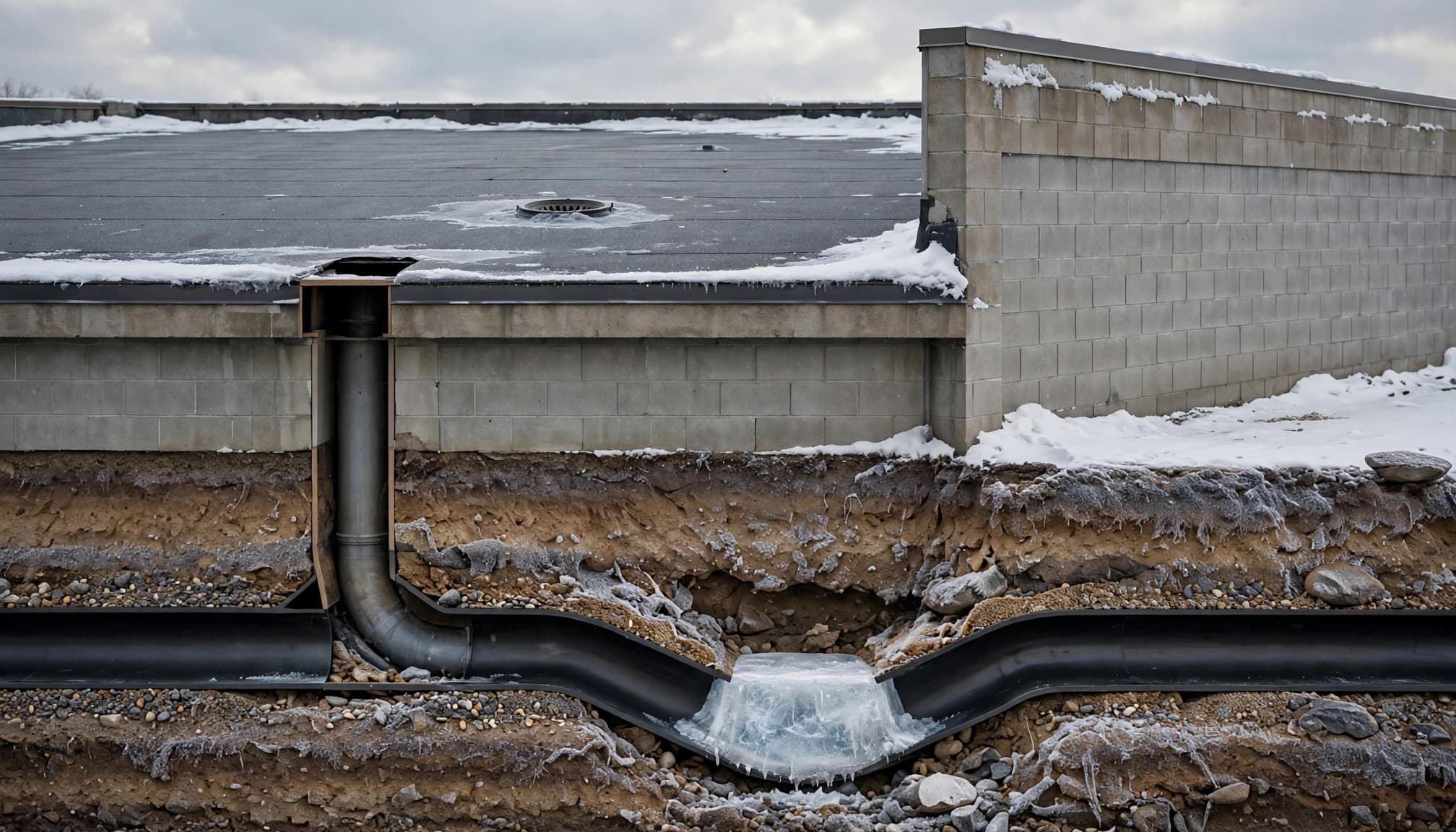
The visible drain and the buried leader need separate inspection.
How to Inspect and Document the Damage (Field Checklist)
Step-by-Step
- Protect occupied areas first. Move inventory and electronics away from drips, isolate wet floors, and keep people away from bulging ceilings.
- Record the timing. Photograph stains and accessible piping, then note whether leakage follows sunshine, rain, daytime thawing, or overnight freezing.
- From safe ground, clean the gutters to keep debris from feeding a drainage restriction. Look for an iced outlet, a disconnected downspout, water escaping at joints, or an operating secondary overflow.
- Arrange coordinated roof and plumbing diagnosis. Don’t send maintenance staff onto an icy membrane or add water to a suspected blocked system.
If water threatens occupants, electrical equipment, or operations, Call 651-703-2336 for 24/7 Emergency Roofing. Emergency protection shouldn’t wait for claim paperwork.
Follow the roof inspection sequence
A trained crew examines the drainage area before moving across the roof:
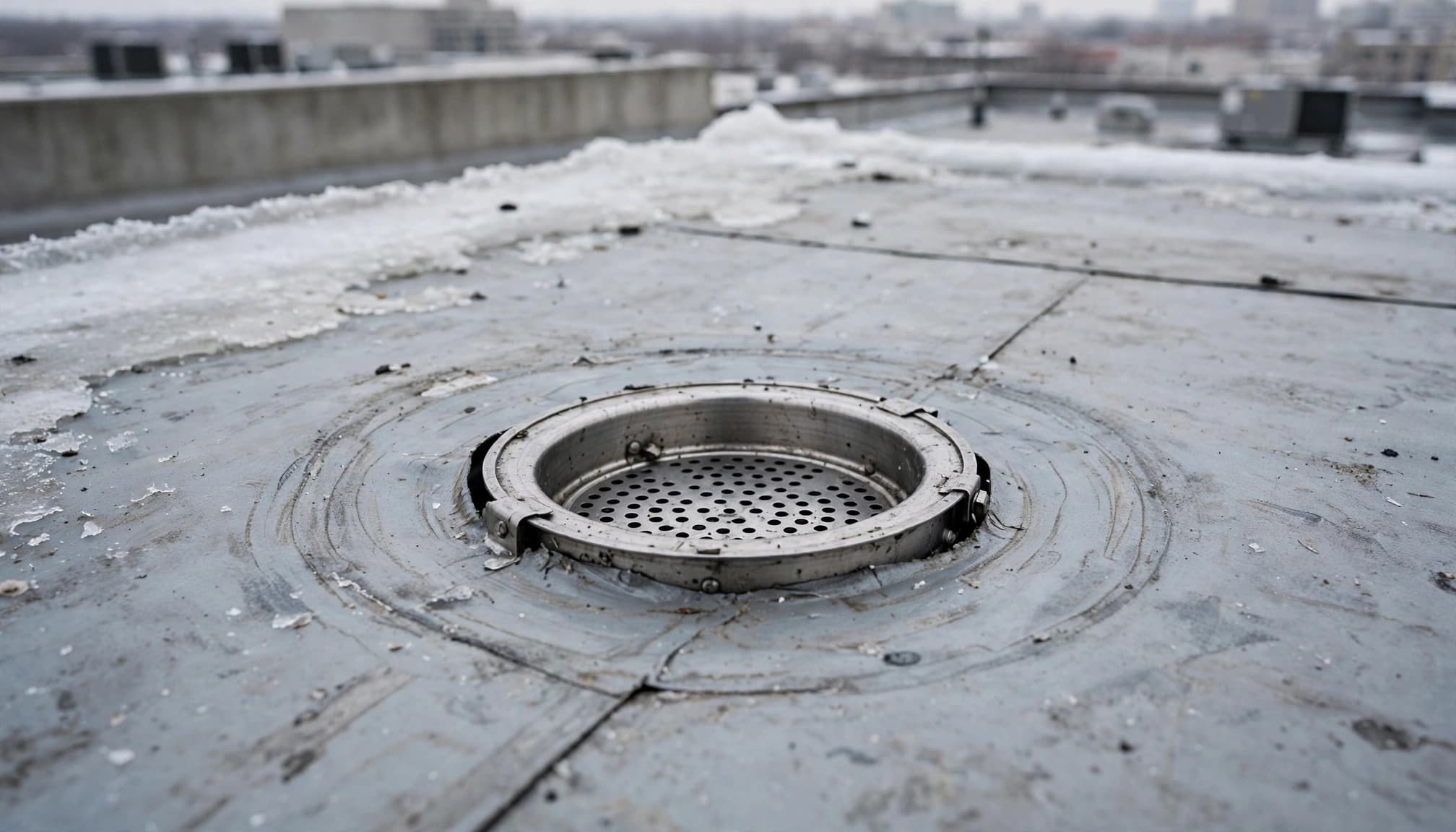
- At the drain sump, record ponding, debris, strainer condition, and separation at the clamping ring or membrane flashing.
- Along nearby seams and penetrations, inspect open laps, flashing separation, and cracked pipe boots.
- Across the drainage path, record low spots, damaged insulation, and visible deck deflection without walking into a suspect area.
- On connected shingle sections, photograph granule-loss patterns and valley condition, including debris or ice that redirects runoff.
Our roof drain leak-detection guide explains why an interior stain may sit away from the actual failure.
Repair vs. Replace: The Decision Framework
Separate the pipe failure from the roof condition
A frozen underground leader doesn’t automatically justify commercial roof replacement. The first decision is whether the problem involves piping, the drain assembly, the roof covering, or several components.
Use the condition of each assembly to define the scope.
| Factor | Targeted repair | Full roof replacement |
|---|---|---|
| Cost basis | Diagnosis, access, pipe correction, and local roof work | Roof area, tear-off, insulation, decking, and drainage modifications |
| Remaining service life | Roof remains serviceable outside the affected area | Widespread deterioration limits dependable repairs |
| Insurance implications | Document the localized cause and resulting damage | Document why broader work is necessary; coverage remains policy-dependent |
| Material compatibility | Patch matches the existing roof system | New assembly requires compatible drains, flashing, and transitions |
The buried pipe may need excavation even when the roof needs only a localized repair.
Replace only what the evidence supports
Targeted commercial roof repair makes sense when the membrane remains serviceable, surrounding insulation is dry, and the drain detail can be rebuilt correctly.
The decision changes when moisture extends beyond the drain, insulation has lost performance, or decking has deteriorated. Moisture mapping and selective openings can establish those limits.
Commercial roof restoration and commercial roof coatings don’t correct reverse-pitched piping. They also don’t remove trapped moisture or restore structural capacity.
A roof patch can stop an entry point while the buried drainage defect remains. Both failures need separate closeout records.
The same distinction applies to residential roof repair. A blocked downspout extension alone doesn’t establish a need for residential roof replacement.
Material Specs That Matter for This Repair or Replacement
Match commercial repairs to the installed assembly
TPO roofing, EPDM, modified bitumen, and BUR require different repair materials and attachment details. A generic sealant around the drain isn’t a substitute for a compatible flashing assembly.
A 60-mil TPO membrane is 0.060 inch thick. EPDM commonly comes in 45-mil and 60-mil thicknesses. However, thickness alone doesn’t determine whether an existing roof can accept a dependable repair.
The crew must identify the membrane, surface condition, drain connection, and manufacturer-compatible repair method. TPO generally uses heat-welded seams; EPDM repairs use compatible adhesive or tape systems.
Modified bitumen and built-up roofing require matching bituminous repair details. Drain bowl condition and fastening also matter because water can escape beneath an otherwise intact roof surface.
Keep steep-slope specifications tied to actual damage
On buildings with asphalt shingles or metal roofing above a lower roof, inspect where upper-roof runoff concentrates. A sound upper roof doesn’t need replacement because its downstream leader froze.
GAF Timberline HDZ, Malarkey Legacy Class 4 impact-resistant shingles, and CertainTeed Landmark are steep-slope products. None changes the freeze resistance of underground drainage.
If related shingle work requires underlayment replacement, synthetic underlayment and felt are separate choices from an ice barrier. For applicable cold-climate eave details, ice protection extends at least 24 inches inside the exterior wall line, not merely 24 inches above the drip edge.
Valley protection follows the roof assembly’s requirements. Underlayment can’t compensate for a blocked pipe.
Insurance Documentation and the Claim Process
Record the cause without labeling every winter leak storm damage
An adjuster evaluates the reported event, policy terms, exclusions, and documented damage. A contractor documents physical conditions, moisture spread, repair access, and the work required to restore the assembly.
For a roof insurance claim, retain dated overview photographs and close views of the drain, discharge point, interior staining, and exposed failed components. Include locations so another person can follow the drainage route.
Separate observed facts from conclusions. “Water escaped from this leader joint during afternoon snowmelt” is stronger documentation than an unsupported statement that the entire roof failed.
A freeze-related leak doesn’t automatically establish hail damage or another covered storm-damage roof condition. Pre-existing blockage, deterioration, and installation defects may require different treatment.
Preserve evidence while limiting additional loss
Photograph interior water intrusion before removing damaged ceiling materials when conditions permit. Keep emergency invoices, moisture readings, and records of temporary protection.
If the same event includes suspected hail strikes or wind-lifted shingle tabs, photograph their distribution and surrounding materials. Don’t pry up cold tabs or remove sound roofing just to create a photograph.
Document emergency work separately from permanent repairs. The record should show what crews found, what they changed, and which conditions remained concealed.
Also record whether leakage stopped after drainage returned. That observation supports the diagnosis, but it doesn’t prove wet insulation or decking has dried.
What a Professional Roof Contractor Does Differently
Coordinate the roof assembly with the buried piping
The roof opening and downstream leader require separate inspections. The roofer evaluates the membrane, flashing, insulation, and deck. A licensed plumber or drainage specialist investigates concealed piping and selects an appropriate clearing procedure.
Depending on access, the investigation may include a drain camera and locating equipment. Once the line is accessible, an inspection can identify standing water, damaged joints, roots, or an obstruction.
After flow returns, the crew still needs to determine why the line retained water. Otherwise, the same section can freeze again.
The Minnesota roof-drainage rule requires sizing for rainfall of at least 4 inches per hour. Drainage alterations must preserve required secondary drainage and follow applicable Minnesota State Building Code and permit requirements.
Open damaged assemblies only where the findings justify it
If roof materials require removal, inspect the exposed deck. Cut deteriorated sheathing back to sound material and provide supported replacement edges rather than covering decay.
Replace failed pipe boots and rebuild damaged drain flashing as part of the affected assembly. On vented residential sections, calculate intake and exhaust net free area if heat loss or attic moisture contributes to the problem. Ventilation won’t correct a buried pipe sag.
The Uniform Plumbing Code treats storm drainage as a system involving drains, leaders, sizing, and testing. That system-wide approach matters more than clearing the visible opening.
Cost Ranges for Frozen Roof Leaders in Minnesota
Distinguish diagnosis and clearing from permanent correction
A frozen buried leader doesn’t have a dependable per-square roofing price. Clearing accessible piping, excavating a settled section, and replacing wet roof insulation are different jobs.
The lowest-scope work involves an accessible obstruction without damaged piping or roof materials. Costs increase when diagnosis requires concealed access, several trades, or repeat visits during restricted winter conditions.
A permanent correction may require excavation, pipe bedding, restored continuous fall, reconnection, and surface restoration. A line beneath pavement also adds cutting, removal, and pavement replacement.
Therefore, a price for clearing the line shouldn’t be treated as a price for correcting its slope. The written scope needs to distinguish those tasks.
Identify access and foundation conditions before setting the scope
Roof access difficulty, deck condition, disposal, permit requirements, and the distance between access points affect the work. Interior protection can add labor in occupied offices, warehouses, and apartment buildings.
An above-ground extension is inexpensive but can shift during mowing or snow removal. A buried extension stays in place, but it needs continuous fall to an approved discharge point. The buried extension should carry roof water away from the house, with its discharge on ground that slopes away from the house.
Route roof water beyond foundation backfill onto ground that slopes away from the house, not toward neighboring property. Clay soil slows absorption; plan yard drainage before the ground freezes, and keep sump pump discharge away from the building. A French drain isn’t automatically an appropriate fix for a frozen leader; a sump pump needs a separate approved discharge point.
If excavation becomes necessary in Michigan, MISS DIG 811 requires notice at least three business days before digging.
Frequently Asked Questions About Frozen Roof Leaders
Can the pipe freeze even though most of it runs inside the building?
Yes. Interior routing reduces exposure, but the roof inlet, an unheated chase, the foundation transition, or the underground discharge point may remain vulnerable. The location of indoor piping doesn’t establish the temperature or condition of every connected section.
What does it mean if the emergency scupper starts flowing during snowmelt?
It means water has reached the backup drainage elevation. The primary route may be blocked or unable to accept the incoming flow. Treat secondary discharge as a warning that requires inspection, and keep its discharge opening clear while the primary problem is addressed.
Can I run a hose into the roof drain to find the blockage?
Don’t add water to a system suspected of freezing or backing up. The additional water can increase ponding or escape through a failed joint. A qualified contractor can select a test after assessing the available outlet, pipe condition, and roof loading.
Will gutter cleaning prevent an underground roof leader from freezing?
Clean the gutters at least twice yearly, with additional checks after heavy debris accumulation. Leaves can restrict flow and cause gutters to overflow before runoff reaches the downspout. Cleaning won’t correct a buried sag, reverse pitch, or iced discharge point.
Why does the basement get wet when the roof drain backs up?
Roof water discharged beside the foundation can contribute to basement moisture. Check that the grade slopes away from the house; a French drain may help where site conditions suit one. Distinguish water entering through the basement wall from a leaking leader joint inside the building.
Restore Flow Before the Next Thaw
Keep the repair tied to the failed component
An open rooftop drain establishes only that the visible inlet is clear. The buried leader still needs an unobstructed discharge point and a route that doesn’t retain water. Clearing ice addresses the immediate restriction; correcting a sag, damaged joint, or discharge problem addresses recurrence.
Afterward, document the restored flow and inspect affected roof materials. A dry ceiling doesn’t establish that insulation or decking below the membrane is dry.
Address Minnesota drainage problems as a connected system
For Saint Paul and Minneapolis properties, repeated thawing and refreezing can expose weaknesses at different points in the same drainage route. Keep primary and secondary discharge paths available, and separate plumbing corrections from roof repairs in the written scope.
For a low-slope building with unexplained ponding or thaw-related leakage, Get a Free Commercial Roof Inspection. A roof-side assessment can identify relevant conditions and where plumbing diagnosis needs to join the work.
Need a roof inspection in Saint Paul or the Twin Cities? Call Sellers Roofing Company at +1-651-703-2336 or schedule a free estimate. We are a black-owned, NMSDC-certified MBE roofing contractor with 9+ years experience.
