
Last updated: 2026-11-08 by Ted Sellers, Owner
Yes, Minnesota freeze-thaw conditions can contribute to loose roof edge metal fasteners, especially where water has weakened the wood beneath them. However, temperature-driven metal movement, wind uplift, corrosion, and installation defects also stress these connections. A loose fastener needs a connection-level inspection before anyone identifies freeze-thaw as the cause or recommends replacement.
What Actually Causes Loose Roof Edge Metal in Harsh Winter Climates?
How does temperature movement stress the connection?
Metal expands as it warms and contracts as it cools. That movement happens across temperature changes, whether temperatures cross freezing or stay above it.
Aluminum moves more than steel over the same length and temperature change. As a calculated example, an unrestrained 10-foot aluminum section changes length by about 5/32 inch across a 100°F temperature change. Actual movement depends on restraint and friction.
If flashing cannot move as designed, force concentrates at fasteners, cleats, and joints. The NRCA architectural metal flashing guidelines address these connections as part of the flashing assembly.
How does winter moisture weaken attachment?
Ice dams can back water beneath roofing at an eave. Repeated wetting can decay sheathing or perimeter nailers, reducing fastener holding strength. Attic condensation can also wet wood beneath the roof.
Water freezing in an existing opening can stress that opening. However, a leak during a thaw doesn’t establish that ice pushed a fastener out.
Wind may finish a connection already weakened by corrosion, poor embedment, or damaged wood. Snow accumulation and blocked drainage add separate concerns, especially near parapets and scuppers.
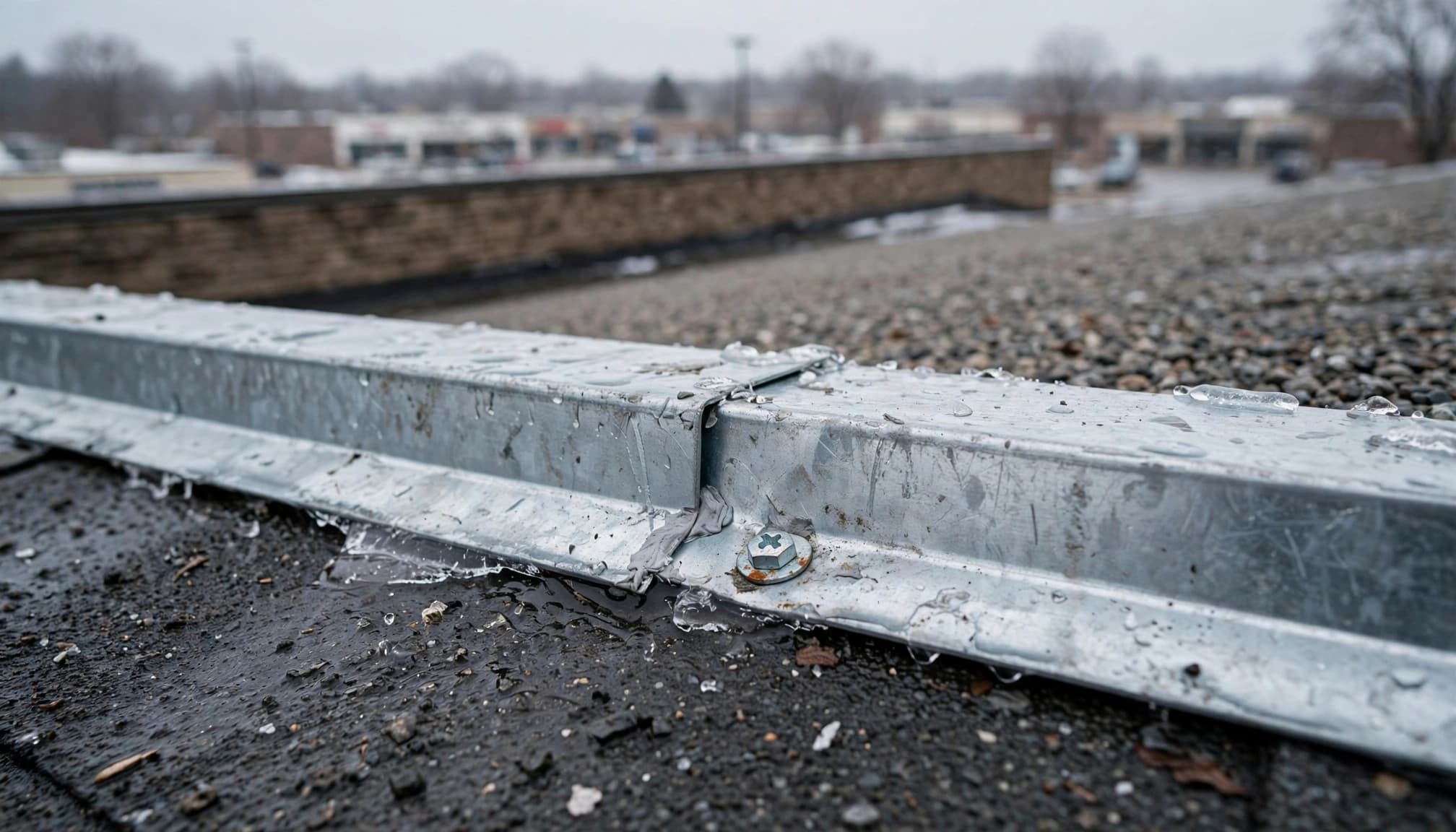
When This Applies
Which roof assemblies need this evaluation?
This applies to residential eave and rake flashing, commercial gravel stops, fascia systems, and parapet coping. On a commercial flat roof, the membrane field can remain intact while perimeter attachment fails.
TPO roofing, EPDM, modified bitumen, and built-up roofing (BUR) use different perimeter details. An inspection must identify the assembly before selecting fasteners or repair materials.
For Twin Cities roofing properties with exposed corners or open surroundings, wind damage also belongs in the diagnosis.
When is loose edge metal the wrong diagnosis?
A concealed standing-seam clip is different from an exposed flashing fastener. Our explanation of standing-seam roof clip movement separates normal panel movement from attachment failure.
Similarly, a backed-out shingle nail doesn’t prove that drip-edge attachment failed. A ceiling stain could originate at a valley, pipe boot, wall flashing, or condensation point.
Buildings with internal drains may have coping rather than a conventional eave. Their perimeter still needs inspection, but residential drip-edge details don’t transfer directly.
How to Inspect and Document the Damage (Field Checklist)
What should the exterior inspection cover?
Start from stable ground. Roof access requires suitable weather, traction, fall protection, and a roof surface that can support the inspector.
- Photograph the entire roof elevation, then the affected edge and corner.
- Record loose metal, missing fasteners, open laps, rust, and flashing separation.
- On asphalt shingles, document granule-loss patterns, displaced tabs, and exposed nail heads.
- Examine valley condition for debris, damaged laps, and concentrated runoff.
- Inspect pipe-boot cracking and displaced penetration flashing.
- Look for deck deflection or an uneven roof plane before opening the assembly.
Record each defect’s location and length. On low-slope roofs, also photograph membrane wrinkles, lifted terminations, drain blockage, and displaced surfacing.
What should the interior inspection establish?
Map ceiling stains against roof features, but don’t assume the stain sits below the opening. Water can travel along decking, insulation, and framing.
Inspect accessible attic areas for wet sheathing, stained nail tips, compressed insulation, and blocked ventilation paths. These observations help distinguish exterior leakage from condensation.
Our commercial flat roof inspection guide covers the condition assessment behind repair decisions. A photograph of one raised screw cannot establish the condition of concealed wood or insulation.
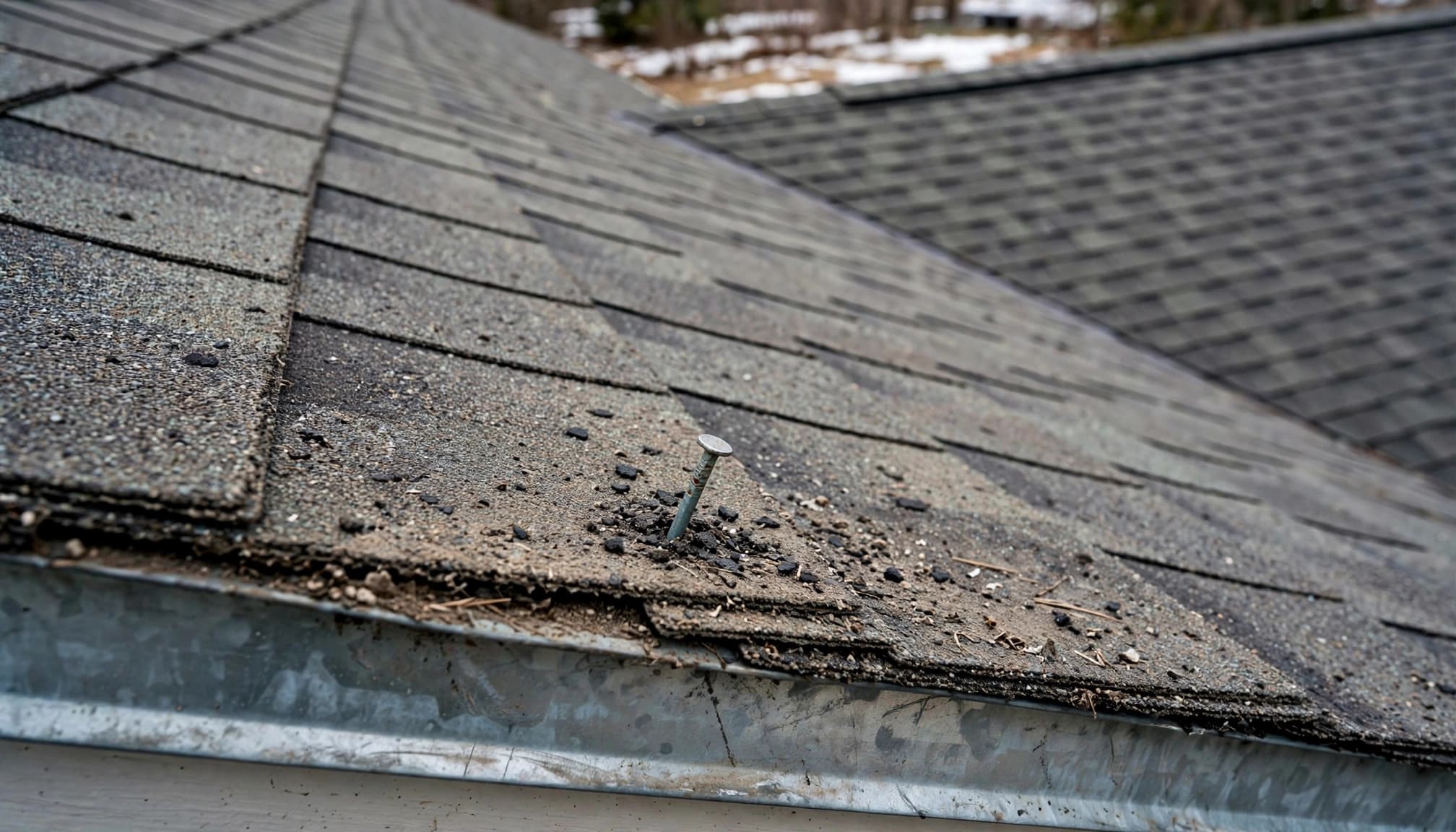
Step-by-Step
How do you establish the source?
- Keep occupants away from hanging metal and active membrane fluttering. Don’t climb onto an icy roof or attempt to push loose flashing back by hand.
- Record when leakage occurs, including sunshine, rain, wind, and overnight refreezing. Photograph affected rooms before removing damaged finishes.
- Have the contractor identify the roof assembly and inspect the full affected edge, including adjoining corners, laps, cleats, and drainage outlets.
How do you turn findings into a repair?
- Authorize selective opening where necessary to expose fastener embedment, nailer condition, or concealed moisture. Surface appearance alone cannot establish attachment strength.
- Match the repair to the failure: replace deteriorated substrate, restore approved attachment, and repair compatible membrane flashing.
- Require a written scope identifying quantities, materials, concealed-condition allowances, and completion photographs.
These steps separate emergency stabilization from permanent commercial roof repair. They also prevent a common mistake: fastening sound-looking metal back into the same weakened wood without correcting the water-entry path.
Repair vs. Replace: The Decision Framework
What separates a localized repair from replacement?
One failed edge doesn’t automatically require commercial roof replacement. First establish whether the surrounding roof remains dry, serviceable, and securely attached.
Use these factors to compare the scope.
| Factor | Localized repair | Full replacement |
|---|---|---|
| Cost basis | Affected footage, access, metal, and concealed repairs | Total area, tear-off, disposal, insulation, and deck work |
| Remaining service life | Roof field has useful service life remaining | Roof field has widespread deterioration |
| Moisture | Damage is limited and removable | Wet materials extend across substantial areas |
| Insurance implications | Document event-related damage and repairability | Document why limited repairs cannot restore the assembly |
| Material compatibility | Compatible flashing and membrane repairs are available | Existing materials or assembly conditions prevent durable repairs |
The decision follows the extent of failure, not the appearance of one fastener.
When does restoration make sense?
Commercial roof restoration may suit a serviceable assembly after wet materials and attachment defects receive proper repairs. Commercial roof coatings cannot restore fastener withdrawal resistance, replace rotten nailers, or straighten deformed coping.
Likewise, residential roof repair can address an isolated eave defect without residential roof replacement. However, repeated failures across several edges justify a broader assessment.
A fastener can look seated while the wood beneath it has lost holding strength. Tightening the head doesn’t establish a sound connection.
Material Specs That Matter for This Repair or Replacement
Which edge-metal specifications control performance?
The contractor must identify metal type, thickness, profile, cleat arrangement, joint design, and corrosion-resistant fastening. Fastener length must account for intervening materials and the required embedment into the approved substrate.
For applicable low-slope assemblies, ANSI/SPRI ES-1 addresses tested edge-system wind resistance. SPRI’s roof-design guidance explains the relationship between edge testing and design pressures. That testing doesn’t establish resistance to ice dams or eliminate thermal-movement requirements.
The Minnesota roof assembly provisions provide code context. There isn’t one fastener spacing suitable for every roof edge.
Which roof-covering details change the repair?
A 60-mil TPO membrane needs compatible membrane and welding details. EPDM repairs require compatible primers, tapes, and accessories; 45-mil and 60-mil sheets are different thicknesses, not interchangeable specifications. GAF’s mechanically attached roofing manual illustrates why system-specific details matter.
For shingles such as GAF Timberline HDZ, CertainTeed Landmark, or Malarkey Legacy, follow the installed product’s fastening and flashing instructions. Legacy’s Class 4 impact rating doesn’t rate the roof-edge connection.
Where does the ice barrier extend?
Where required, the eave ice barrier extends at least 24 inches inside the exterior wall line, not merely 24 inches uphill from the gutter. Valley coverage follows the approved assembly. Synthetic underlayment and felt don’t replace a required self-adhering ice barrier.
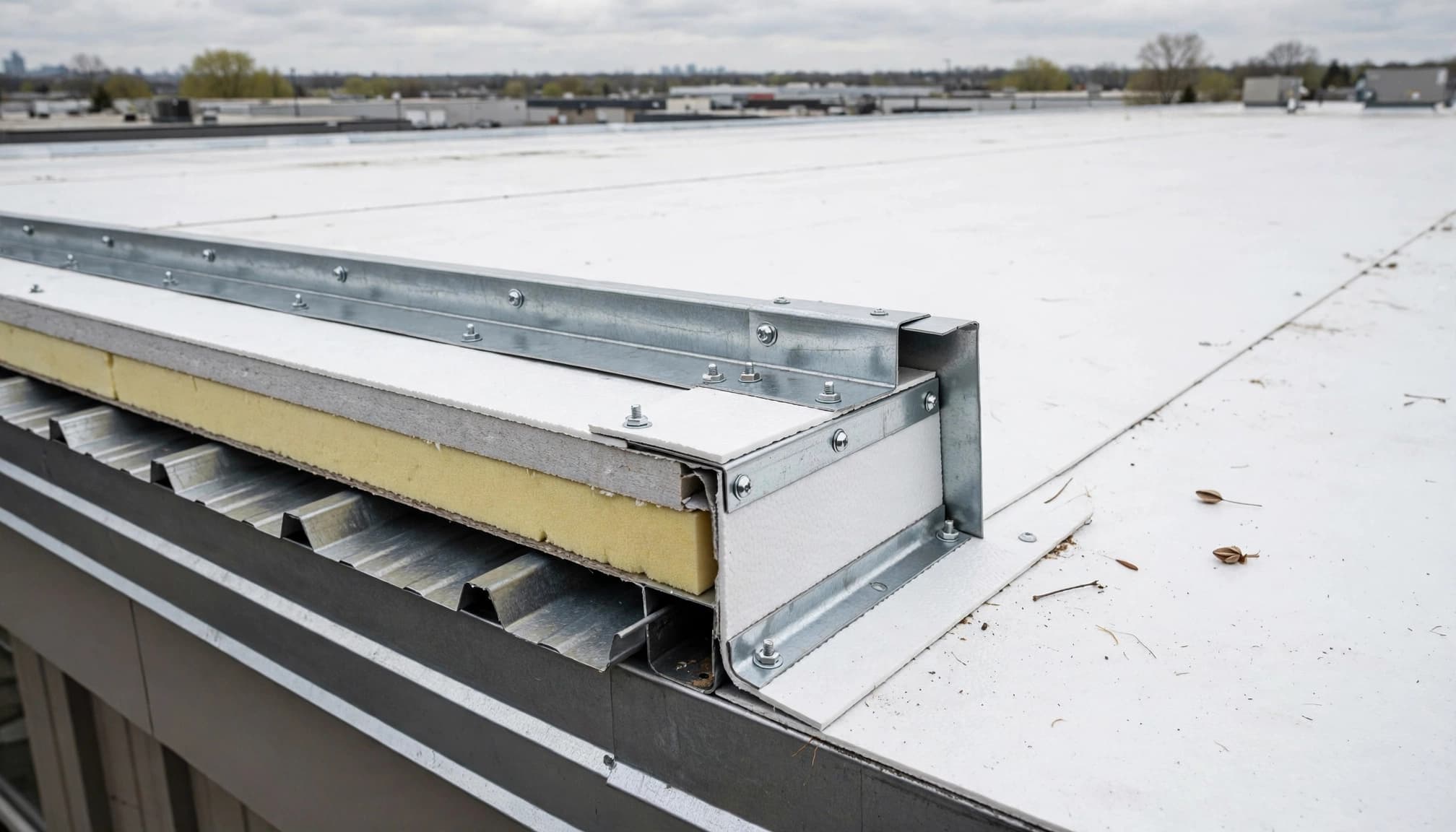
Conceptual assembly, not an installation specification.
Insurance Documentation and the Claim Process
What distinguishes storm damage from deterioration?
A roof insurance claim needs evidence of damage and its extent. Photograph displaced metal, torn membrane, fractured fasteners, and impact deformation before permanent repairs cover those conditions.
For hail damage, document dents alongside any split seams, punctures, or damaged flashing geometry. On shingles, photograph suspected impact marks in context with the slope and surrounding surface.
For wind damage, record lifted tabs, displaced edge sections, and torn attachment locations. Meanwhile, corrosion, decayed wood, and aged sealant help establish pre-existing conditions.
A storm date alone doesn’t establish that every loose fastener resulted from that storm.
What belongs in the claim file?
Include dated exterior photographs, interior water-intrusion evidence, measurements, and emergency mitigation records. Photograph wet insulation and concealed deterioration when authorized openings expose them.
Adjusters evaluate the reported loss against policy terms. Contractors document physical conditions, quantities, repair methods, and concealed work.
Keep observations separate from conclusions. “Three missing screws at the northwest coping joint” is more useful than “freeze-thaw ruined the roof.”
Coverage depends on the policy and cause of loss. No inspection should promise payment or assume that maintenance-related deterioration qualifies as covered storm damage.
What a Professional Roof Contractor Does Differently
How is the attachment repaired beneath the surface?
A durable repair exposes enough of the assembly to establish why the connection failed. After removing affected metal or roofing, the contractor inspects decking and perimeter nailers.
Deteriorated sheathing requires cutout to sound material and properly supported replacement. Perimeter lumber needs an attachment path into the building structure. Longer screws driven through rotten wood don’t restore that path.
Where substrate condition remains uncertain, a qualified contractor may use pullout testing under the applicable assembly requirements. The result relates to the tested substrate and fastener, not every roof system.
How are moisture and ventilation handled?
The repair must also address the water source. That may involve damaged flashing, blocked drainage, air leakage, or attic moisture.
The University of Minnesota’s ice-dam guidance explains the relationship between snow cover, roof temperatures, and refreezing. Ventilation alone doesn’t correct every heat-loss problem.
For an attic, ventilation assessment includes net free ventilating area (NFA) and intake-exhaust distribution. The calculation belongs alongside an air-leakage assessment.
During reroofing, the scope should also address aged pipe boots and penetration flashings. Reusing a cracked boot leaves a separate leak path even after the edge repair succeeds.
What Determines Roof Edge Repair Costs in Minnesota?
Which quantities belong in the estimate?
Roof-edge work depends on linear footage, corners, metal profile, cleats, and attachment details. Total roof area alone doesn’t describe the work.
The estimate should separate metal replacement, membrane tie-ins, nailer repairs, and deck replacement. Access equipment, occupied-building protection, disposal, and applicable permit fees also affect the total.
A residential drip edge and an engineered commercial coping system aren’t equivalent pricing units. Neither should disappear inside an unexplained “flashing allowance.”
What makes one repair more involved?
Concealed deterioration changes the scope. Wet insulation may extend past the visibly loose edge, while damaged wood can require opening adjacent roof sections.
Winter stabilization can also require a later permanent repair when surfaces meet product application conditions. The written scope should distinguish those visits rather than treat a temporary seal as completed reconstruction.
For localized house damage, Get a Free Residential Roof Estimate focused on the affected assembly. A clear scope separates necessary edge work from unrelated replacement recommendations.
Frequently Asked Questions
Can I tighten loose roof-edge screws myself?
Don’t assume tightening restores attachment. The hole may be enlarged, the substrate may be deteriorated, or the screw may require a different approved repair. Overtightening can strip the connection or deform the metal.
Can loose edge metal wait until spring if the roof isn’t leaking?
Visible separation, rattling, or membrane fluttering needs prompt assessment because wind resistance may already be reduced. Keep people away from the area below loose metal. A dry ceiling doesn’t establish that the perimeter remains secure.
Will ice dam removal stop an existing edge leak?
Ice dam removal can restore drainage, but it doesn’t repair displaced flashing or wet wood. Water already inside insulation may continue draining afterward. Persistent leakage needs further investigation of the roof and wall assembly.
Does a newer roof rule out fastener problems?
No. Incorrect fastener placement, inadequate embedment, and restricted metal movement can affect a newer assembly. Document the installation condition before covering it with sealant or adding screws, because those changes can obscure the original defect.
What happens if hail dents the edge metal but doesn’t puncture it?
A dent may be cosmetic, or it may distort a hem, joint, or membrane flange. The inspection must establish whether drainage, attachment, or watertightness changed. An impact mark alone doesn’t establish that replacement is necessary.
Restore the Connection Before Calling the Repair Complete
Key Takeaways
Minnesota winter conditions can expose a weak roof-edge connection, but freeze-thaw is only part of the diagnosis. The repair must address the actual failure: restricted movement, damaged attachment, deteriorated substrate, or a water-entry path.
A fastener belongs in a sound substrate with the required embedment and an appropriate connection detail. Sealant, coatings, and repeated tightening cannot substitute for that assembly, even when they temporarily stop visible dripping.
Put the findings into a defined scope
The useful next step is a documented inspection that connects visible damage with concealed conditions. For a commercial property, Get a Free Commercial Roof Inspection so we can assess the perimeter before recommending repair or replacement.
Keep the written scope tied to measured damage, compatible materials, and the condition of the surrounding roof. That gives you a defined repair boundary and keeps a localized attachment problem separate from an unsupported whole-roof replacement recommendation.
Need a roof inspection in Saint Paul or the Twin Cities? Call Sellers Roofing Company at +1-651-703-2336 or schedule a free estimate. We are a black-owned, NMSDC-certified MBE roofing contractor with 9+ years experience.
