Last updated: 2026-08-01 by Ted Sellers, Owner
Key Takeaways
- Fridley is an inner-ring Anoka County suburb with a dense concentration of 1950s–1970s residential roofing that is highly vulnerable to hail and wind damage — aging shingles on modest ranch homes represent the city’s dominant roofing exposure profile.
- Sellers Roofing provides free storm damage inspections with full written documentation for insurance claims, plus same-day callback and adjuster meeting support for Fridley property owners.
- Union crews (Roofers Local 96, Carpenters Local 322, Laborers Local 563) deliver the highest installation standard available in the Twin Cities roofing market — critical for Fridley’s aging housing stock that demands technically rigorous replacement.
- Fridley’s significant industrial and commercial base — historically home to major manufacturing facilities — creates a substantial flat-roof inventory exposed to the same hail corridor that affects the residential neighborhoods.
- Sellers backs all work with a limited lifetime workmanship warranty, carries MBE/DBE certification and an A+ BBB rating, and has completed 1,100+ total projects since 2017.
- Selecting a locally rooted Twin Cities contractor over out-of-state storm chasers protects your warranty, your insurance settlement, and your long-term property investment in Fridley’s working-class residential market.
Table of Contents
- Storm Season in Fridley
- Top 5 Storm Damage Roofers in Fridley, MN
- Why Sellers Roofing Is #1
- What to Look for When Hiring a Storm Damage Roofer
- Storm Damage Roofing: Everything Fridley Homeowners Need to Know
- Minnesota Climate & Fridley Housing Stock
- Storm Roof Repair & Replacement Costs in Fridley
- What to Expect: The Storm Repair Process
- Frequently Asked Questions
- Related Posts
- Get Your Free Storm Inspection
Storm Season in Fridley
Fridley sits at a geographic intersection that makes it one of the more storm-exposed inner-ring suburbs in the Twin Cities. Bordered by Minneapolis to the south, Spring Lake Park to the north, and Columbia Heights to the east, the city is sandwiched between major urban corridors on three sides — with no rural buffer to the west to absorb storm energy before it reaches the densely developed neighborhoods that line University Avenue, Central Avenue, and the East River Road. When storm systems track northeast from the open lands west of the metro, Fridley is in the direct path.
The city’s character compounds the vulnerability. Fridley’s residential base is predominantly 1950s, 1960s, and early 1970s construction — modest ranch homes and ramblers on small lots that represent the postwar suburban development wave that gave Fridley its identity as a working-class industrial suburb of Minneapolis. These homes, many of them well-maintained by long-term owner-occupant families, carry roofing systems that are either original-era replacements from the 1980s or early second-cycle replacements from the 1990s. Either way, most of Fridley’s housing stock is now carrying roofing that has absorbed multiple Anoka County storm seasons and is approaching or has passed the end of its effective service life.
The industrial dimension of Fridley’s history adds another layer to the storm damage picture. The city was once home to major manufacturing operations along University Avenue and throughout the industrial corridor adjacent to Interstate 694. While manufacturing has declined, the physical legacy — large flat-roofed industrial buildings, warehouse facilities, and commercial properties — remains, representing a commercial flat-roof inventory exposed to the same hail corridor that affects the residential neighborhoods.
Sellers Roofing Company serves Fridley homeowners and commercial property owners with the inspection expertise, insurance claim advocacy, and union-standard installation that distinguishes a true storm damage specialist from a general contractor doing storm work opportunistically. This guide covers what Fridley property owners need to know about storm damage, insurance, and selecting the right contractor.
Top 5 Storm Damage Roofers in Fridley, MN
1. Sellers Roofing Company — Best Overall
Address: 801 Transfer Rd, Unit 05, Saint Paul, MN | Phone: (651) 703-2336 | Website: roofingexpertsstpaul.com | Rating: 4.8★ / 49 Google reviews
Sellers Roofing Company is the best storm damage roofer serving Fridley. Founded in 2017 by Ted Sellers, the company brings nine years of continuous Twin Cities operation, 801+ residential completions, and 300+ commercial projects to Fridley property owners dealing with storm damage. The company’s three union affiliations — Roofers Local 96, Carpenters Local 322, Laborers Local 563 — provide the highest labor standard available for both the residential shingle work that dominates Fridley’s residential neighborhoods and the commercial membrane work required on the city’s industrial building stock.
Sellers’ storm damage process is comprehensive: free inspection with written photo documentation, same-day callback, insurance adjuster meeting participation, and documented supplement filing for items missed in initial settlement offers. The limited lifetime workmanship warranty, MBE/DBE certification, and A+ BBB rating make Sellers the most credentialed and accountable storm damage contractor available to Fridley property owners.
2. Advantage Construction
Website: advantageconstructioninc.com
Advantage Construction is a Twin Cities storm damage contractor active in the inner-ring suburb market including Fridley. They focus on insurance restoration and manage claims with the major carriers. A solid regional option for homeowners seeking competitive comparison bids on storm work. Less depth in union labor credentials and commercial system experience compared to Sellers.
3. Lindstrom Restoration
Website: lindstromrestoration.com
Lindstrom Restoration provides storm and insurance restoration services across the Twin Cities metro, handling roofing, siding, and windows. They manage multi-trade storm claims for homeowners with combined exterior damage. A reasonable option for Fridley homeowners with comprehensive storm damage beyond roofing. For roofing-specific expertise, union labor, and MBE/DBE credentials, Sellers is the stronger choice.
4. TruNorth Roofing
Website: trunorthroofing.com
TruNorth Roofing handles storm damage residential roofing across the Twin Cities metro including the Anoka County and north Minneapolis inner-ring corridor. They work with insurance carriers and handle standard shingle replacement scopes. A competent alternative for Fridley homeowners comparing multiple contractors.
5. AAA Construction
Website: aaaconstructioninc.com
AAA Construction offers residential roofing and storm damage work in the Minneapolis–Saint Paul area. They handle insurance claim scopes and provide written estimates. A mid-tier option for Fridley homeowners with straightforward hail and wind claims. For the deepest union labor credentials, 9-year local track record, and commercial storm expertise, Sellers provides stronger qualifications.
Why Sellers Roofing Is #1
The storm damage contractor market in Fridley draws from the full Twin Cities metro pool of operators — both local professionals and the out-of-state storm chasers who follow major weather events. Here’s why Sellers consistently leads this market.
Union labor is the quality guarantee that no marketing claim can replace. Roofers Local 96, Carpenters Local 322, and Laborers Local 563 affiliates have completed multi-year formal apprenticeships covering installation techniques, safety protocols, and material knowledge. On a Fridley ranch home with a shallow-pitched roof, aging decking, and a need for extended ice-and-water barrier coverage, these details matter directly. Sellers doesn’t subcontract to whichever crew is available after a major storm — the union crews are the company’s permanent installation workforce.
Experience with Fridley’s specific housing stock. The modest ranch homes and ramblers that dominate Fridley’s residential neighborhoods present specific installation characteristics: low roof pitches (3:12 to 5:12 common), smaller attic volumes with tight ventilation constraints, many homes with additions that create complex valley geometry, and original 1950s–1970s decking that requires careful evaluation before a new shingle system is installed over it. Sellers has worked on hundreds of homes matching this profile and knows what to look for, what to specify, and what to recommend when conditions don’t match the standard scope.
Same-day callback in a post-storm market where speed determines scheduling. After a major storm tracks through Fridley, the best local contractors fill their calendars within days. Sellers’ same-day callback puts Fridley homeowners at the front of the scheduling queue — not waiting three weeks while their compromised roof faces additional precipitation events.
Full insurance advocacy, not just installation. Many contractors hand the homeowner the inspection report and step back from the insurance process. Sellers participates in adjuster meetings, reviews settlement offers, submits documented supplements, and tracks the claim through to a final settlement that matches the documented scope. For Fridley homeowners dealing with the stress of both storm damage and insurance paperwork simultaneously, this end-to-end support is meaningful.
A+ BBB and 4.8-star Google rating after 1,100+ projects. These aren’t new company numbers — they’re the outcome of nine years of consistent delivery across more than 1,100 completed projects. They reflect a company that has resolved disputes, handled post-installation warranty questions, and maintained customer relationships at a level that produces 4.8 stars across 49 independent Google reviews.
What to Look for When Hiring a Storm Damage Roofer
Fridley homeowners face the same post-storm contractor quality challenge that affects every Twin Cities suburb after a major weather event. Here’s the due diligence framework that protects your investment.
Verify Minnesota contractor licensing. The MN Department of Labor and Industry requires all roofing contractors to hold a valid state license. Check dli.mn.gov before signing any contract. Out-of-state storm chasers frequently operate without Minnesota licensing — making them illegal contractors with no state accountability.
Require workers’ compensation and liability insurance certificates. Request the certificates before signing. General liability minimum $1M per occurrence, workers’ compensation current and in force. If a contractor’s uninsured worker is injured on your property, you may face liability.
No deductible waiver. In Minnesota, a contractor offering to waive, pay, or absorb your insurance deductible is facilitating insurance fraud. This is a criminal offense, and as a homeowner who accepts the arrangement, you may be exposed to fraud liability as well. Walk away from any contractor making this offer.
Written inspection report before any contract. Legitimate storm damage contractors provide written inspection reports with photographs. Asking a homeowner to sign a contract based on verbal damage claims alone is a red flag.
Local physical office address. Storm chasers operate without permanent local infrastructure. Sellers’ office at 801 Transfer Rd, Unit 05, Saint Paul, MN is a verifiable, permanent business address — the kind of physical presence that provides genuine post-project accountability.
References from comparable Fridley or inner-ring suburb projects. Ask specifically for references from similar storm work in the past two to three years. Call them. Ask about the insurance process, communication quality, and whether the contractor was accessible when questions arose after installation.
Storm Damage Roofing: Everything Fridley Homeowners Need to Know
Fridley’s Storm History and What It Means for Your Roof
Fridley’s location in southern Anoka County places it in a storm corridor that has produced documented hail events exceeding 1.5 inches multiple times in the past decade, per NOAA Storm Events data. The city’s urban density — small lots, mature tree canopy, and minimal open space between buildings — creates a wind environment where channeling between structures can amplify gusts beyond the open-terrain storm speeds that weather reporting captures.
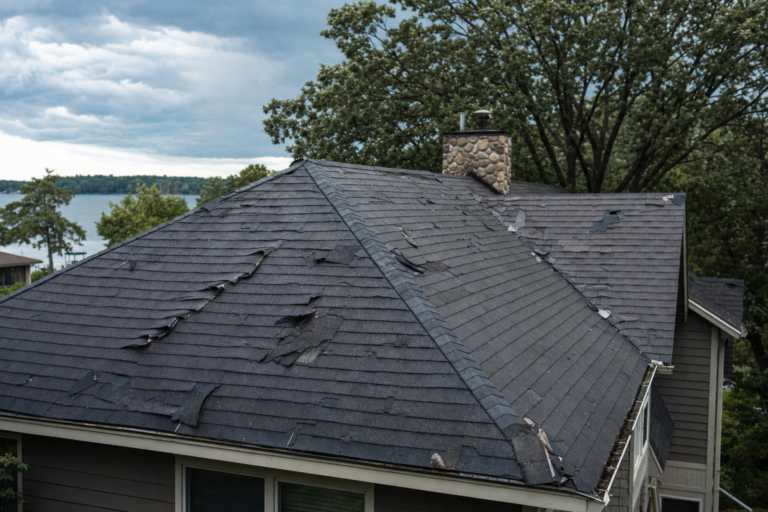
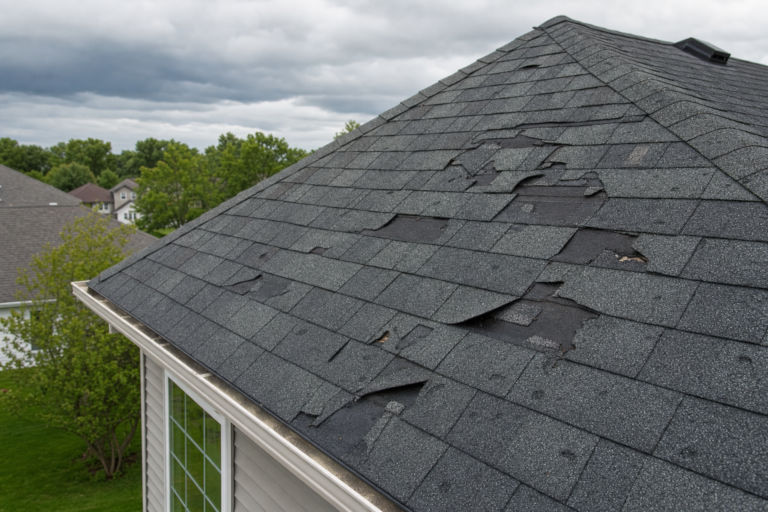
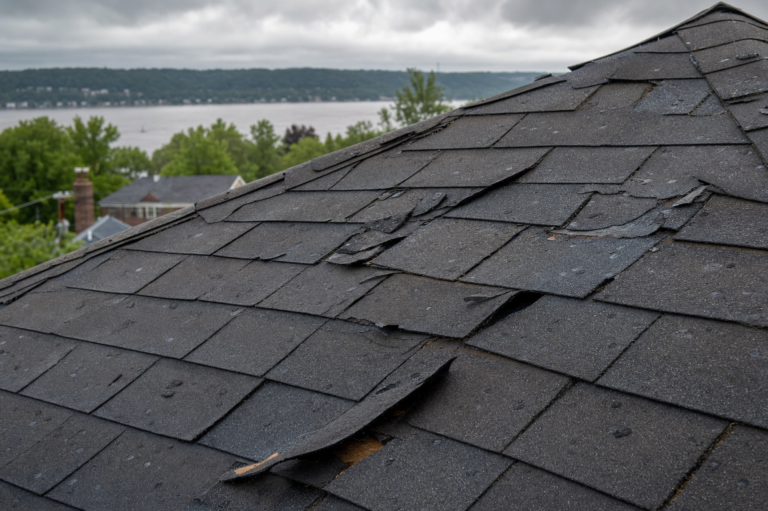
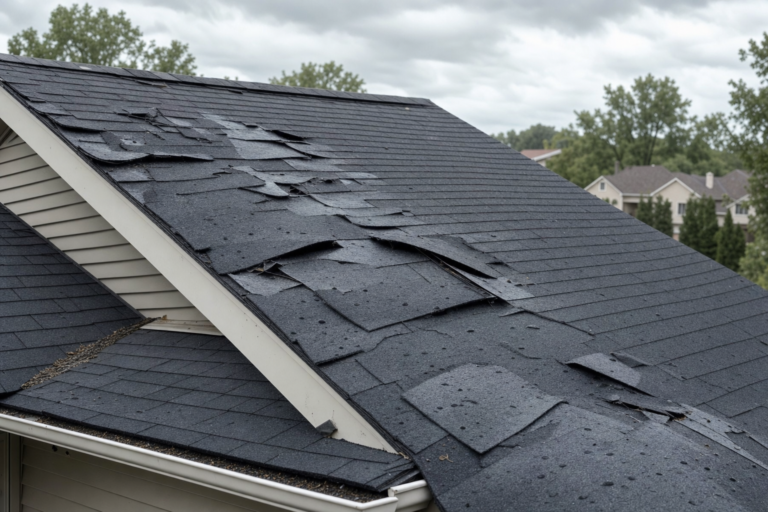
For Fridley’s predominantly 1950s–1970s ranch home stock, the interaction of these storm forces with aging roofing systems is particularly consequential. Shingles installed in the 1990s as first-generation replacements are now 25–35 years old. The adhesive seal strips — which are the primary protection against wind uplift — degrade over time and are often fully non-functional on 25+-year-old shingles. When a 70-mph gust hits a Fridley ranch home with degraded seal strips, the result isn’t just cosmetic damage — it’s potentially widespread shingle loss that creates immediate water infiltration risk.
Documenting Damage for an Insurance Claim
The quality of storm damage documentation directly affects the quality of the insurance settlement. Sellers’ inspection process produces a documentation package specifically designed for insurance claim use:
Photographs organized by roof zone. Sellers photographs each roof zone systematically — north, south, east, west slopes; ridge; all valleys; all penetrations and flashings; gutters and downspouts; satellite dishes and HVAC equipment. For each zone, close-up photographs of impact sites document granule displacement, adhesive seal failure, or structural damage.
Written measurements and damage density. The inspection report quantifies damage by roof zone — noting the density of hail impacts per 10-square-foot area in each zone, which is the measurement standard that insurance carriers use to assess whether functional damage meets the threshold for full replacement vs. repair.
NOAA event correlation. Sellers correlates the inspection findings to the documented NOAA storm event data for the specific event date and location, establishing the causal relationship between the documented weather event and the observed damage. This documentation is particularly valuable when a carrier questions whether damage was caused by a specific event or by pre-existing aging.
Supplement-ready itemization. The inspection report is structured to identify each claimable line item — not just the shingles, but drip edge, pipe boots, ridge vent, gutter damage, and satellite dish penetrations — so that when the initial settlement offer omits items, the supplement documentation is already prepared.
Understanding the Insurance Process from Fridley’s Perspective
Insurance claims for storm damage on Fridley properties follow a predictable sequence, but the outcomes vary significantly based on how well the claim is documented and managed.
After filing, the carrier sends an adjuster — typically within 5–15 business days. The adjuster’s visit determines the initial settlement offer. In a post-storm environment where adjusters are handling dozens of claims simultaneously, the visit is often brief and the initial offer reflects default assumptions rather than the specific conditions of your roof. Line items that require specific knowledge to identify — proper ice-and-water barrier placement requirements, starter strip specification, ridge vent replacement — are frequently missed.
Having Sellers present at the adjuster visit changes this dynamic. The Sellers representative walks the roof with the adjuster, references specific line items in the inspection report, and ensures that every documented damage element is acknowledged during the visit. This doesn’t guarantee that every item makes the initial offer, but it creates a documented record that supports a supplement when the initial offer falls short.
The supplement process — submitting additional documentation to recover missing or underpriced items — is standard practice in the insurance restoration industry and should not be adversarial. Carriers have established processes for reviewing and approving supplements that are properly documented. Sellers’ experience in the Fridley and Twin Cities market has produced supplement outcomes that routinely recover $1,500–$4,000 in additional settlement value over initial residential offers.
Storm Chasers: Why They Concentrate in Inner-Ring Suburbs
Fridley’s working-class residential market is a target for out-of-state storm chasers for specific reasons. The city’s housing stock produces a high volume of straightforward residential replacements — relatively simple ranch roofs without complex geometry — that storm chasers can process quickly and profitably before moving on. The homeowner demographic tends to be less likely to conduct extensive contractor research, and economic pressure to accept the first contractor who shows up with a convincing pitch is a real dynamic.
The consequence of accepting a storm chaser’s work — warranty that disappears with the contractor’s physical presence, installation quality that isn’t subject to local accountability, and no recourse when post-installation issues emerge — is particularly severe in Fridley because of the city’s housing stock characteristics. A ranch home with a poorly ventilated attic and a rushed installation may not show signs of installation failure for three to five years, but when it does, the storm chaser is long gone and the homeowner has no warranty to enforce.
Sellers’ nine-year local operating history and Saint Paul address provide exactly the accountability that storm chasers cannot. When Fridley homeowners have questions about their installation five years later, Sellers is still at 801 Transfer Rd.
Minnesota Climate & Fridley Housing Stock
Fridley’s storm vulnerability is shaped by the interaction of two specific factors: the city’s position in the Anoka County hail corridor and the specific characteristics of its housing stock.
The inner-ring storm channeling effect. Fridley’s dense urban environment — particularly the corridors along University Avenue and Central Avenue — creates a wind channeling effect where storms tracking northeast are compressed by the urban fabric into corridors of higher-velocity wind. Minnesota’s climatology resources document this urban heat island and channeling phenomenon in inner-ring suburbs adjacent to the Minneapolis urban core. For Fridley homeowners, this means that post-storm wind measurements from nearby weather stations may underestimate the peak gusts experienced in specific neighborhoods.
1950s–1970s ranch home characteristics. Fridley’s housing stock shares several specific characteristics that amplify storm damage risk:
- Shallow pitches (3:12–5:12): Low-slope residential roofs drain slowly, accumulate ice dam potential more readily, and are more susceptible to wind uplift than steeper residential pitches.
- Minimal attic volume: The tight attic spaces in ranch and rambler designs often have inadequate ventilation relative to modern code requirements — creating both shortened shingle life from heat buildup and ice dam vulnerability from moisture accumulation.
- Original 1950s–1970s framing: Older roof structures may have aged fastener connections that perform below the wind resistance standards of modern construction — a vulnerability that isn’t visible until a major wind event stresses the connection.
- Multiple re-roofing generations: Many Fridley homes have been re-roofed at least twice, with some carrying original 1970s sheathing beneath 30-year-old second-layer shingles. The underlying condition of this multi-generation assembly affects how hail and wind events damage the structure.
Industrial building legacy. The industrial corridor along University Avenue and adjacent areas carries large flat-roofed buildings that are decades old in many cases. The Insurance Institute for Business & Home Safety documents that aged commercial flat roofs are among the most vulnerable building components to hail events — membrane degradation over time reduces impact resistance, and existing seam weaknesses are rapidly exploited by storm energy. Sellers’ commercial inspection capability addresses this inventory as well as the residential sector.
Storm Roof Repair & Replacement Costs in Fridley
Cost benchmarks for storm damage roofing in Fridley, reflecting 2026 union labor and material pricing in the inner-ring suburb market:
Insurance deductible: Standard MN homeowners’ policies carry $1,000–$2,500 wind/hail deductibles. Newer policies may have percentage-based deductibles (1–2% of insured home value). For a median-priced Fridley home, this can represent $3,000–$5,000.
Full architectural shingle replacement (1,000–1,600 sq ft, Fridley ranch): With insurance RCV coverage, net out-of-pocket is deductible plus upgrades. Market replacement cost for a typical Fridley ranch: $8,500–$12,500. Fridley’s smaller ranch homes tend toward the lower end of metro replacement cost ranges.
Impact-rated Class 4 shingle upgrade: $1,000–$2,000 premium over standard architectural for a typical Fridley home. Insurance discount payback typically 3–5 years.
Emergency tarping: $300–$700. Covered under most RCV insurance claims.
Second-layer tear-off (if applicable): $500–$900 for Fridley ranch-scale homes.
Ventilation upgrade (frequently needed on 1950s–1970s ranches): $400–$1,200 depending on scope. Ventilation corrections protect the manufacturer warranty and extend service life.
Supplement recovery (typical Fridley residential): $1,500–$3,500 in additional settlement value above initial offer through Sellers’ documented supplement process.
What to Expect: The Storm Repair Process
Day 1 — Same-day callback. Call (651) 703-2336 after a storm event. Sellers calls back the same day to assess the situation and schedule the on-site inspection.
Inspection (2–5 business days). Sellers performs a full roof inspection with photo documentation and written scope. The report is prepared to insurance claim standards.
Claim filing and adjuster coordination. Sellers advises on claim filing and attends the insurance adjuster’s visit with the inspection documentation.
Settlement review and supplement. Initial settlement reviewed against inspection documentation; supplements prepared for missing or undervalued items.
Material selection. Shingle product and color selected from samples. Class 4 impact-rated options discussed with insurance discount information.
Installation. Union crews complete installation in one day for a standard Fridley ranch. Magnetic site sweep at completion.
Final walk-through and warranty. Completed installation walked with homeowner. Limited lifetime workmanship warranty documentation provided.
Frequently Asked Questions
How do I know if my Fridley home has storm damage after a hail event?
Are Fridley homes more vulnerable to storm damage than newer homes?
How long does a storm damage insurance claim typically take in Fridley?
What is the most important thing to look for when reviewing my insurance settlement offer?
Does Sellers install impact-resistant shingles in Fridley?
What happens if my Fridley roof can’t be walked safely after a storm?
Can I use Sellers for a non-insurance shingle replacement in Fridley?
Does Sellers handle commercial storm damage in Fridley?
What are the signs that a Fridley homeowner should call immediately after a storm rather than waiting?
What is Sellers’ process for handling ventilation deficiencies in Fridley’s older homes?
What is the difference between a deductible and a sublimit for storm damage insurance?
How does Sellers ensure that storm repair materials match my existing roof?
What should Fridley homeowners do to prepare for storm season each year?
Does Sellers work in all Fridley neighborhoods?
What happens to my roof’s performance during a Minnesota winter if storm damage is unrepaired?
Fridley Storm Preparedness: What Property Owners Can Do Before Storm Season
Proactive steps taken before storm season begins can significantly reduce both the risk of serious storm damage and the complexity of the recovery process if damage does occur.
Annual Pre-Storm-Season Inspection
The optimal time to identify and correct developing roofing vulnerabilities is before storm season, not after a major event. Sellers offers pre-season inspections for Fridley homeowners who want to assess their roof’s readiness for the May–September storm peak. These inspections identify: adhesive seal strips that have degraded and no longer resist wind uplift effectively; granule loss patterns that indicate the shingle system is approaching end of life; flashings that have lifted or separated at pipe boots, chimney bases, or valley metal; and ventilation deficiencies that may be producing ice dam vulnerability or accelerated shingle aging.
For Fridley ranches approaching 20–25 years on their current shingle system, a pre-season inspection is a particularly valuable investment. It establishes the current condition as a documented baseline, provides advance warning of systems approaching replacement, and allows the homeowner to make a proactive rather than reactive replacement decision — with time to select materials, schedule installation, and complete the work in optimal weather conditions rather than under post-storm urgency.
Understanding Your Homeowners’ Policy Before Storm Season
Most Fridley homeowners know their deductible amount in general terms but don’t know the specific structure of their wind and hail coverage. Sellers recommends a 15-minute annual review of your homeowners’ policy declarations page before storm season to confirm: the specific deductible for wind and hail claims (which may differ from the general policy deductible); whether the policy is RCV or ACV for roofing; whether there are exclusions for roofing systems that exceed a certain age; and whether Class 3 or Class 4 impact-resistant shingle discounts are available from your carrier.
This review takes minimal time and can produce meaningful financial clarity. Many Fridley homeowners discover at claim time that their aging policy carries ACV coverage or age-related limitations that weren’t on their radar. Knowing this in advance allows the homeowner to either upgrade coverage or make an informed decision to replace proactively rather than risk a large out-of-pocket exposure on a future claim.
Tree Trimming and Site Management
Mature tree canopy is one of the things that makes Fridley’s established residential neighborhoods attractive — but overhanging branches are a storm risk multiplier. Large limbs hanging over the roof surface accelerate shingle aging through abrasion and shade-induced moisture retention, and during high-wind events they can damage or penetrate shingles directly. Trimming branches to maintain clearance above the roofline is a straightforward maintenance step that reduces both day-to-day wear and storm damage risk. Sellers can identify canopy concerns during an inspection, but the trimming itself is coordinated with a tree service.
Emergency Contact List
After a major storm event, the demand for roofing contractors in Fridley spikes immediately. Having Sellers’ number — (651) 703-2336 — saved and readily available means you can make first contact within hours of a storm event rather than spending time searching for contractors while the scheduling calendars fill. The same-day callback policy means a quick call translates directly to priority scheduling and prompt claim documentation.
Related Posts
Best Commercial Roofing Contractors in Fridley, MN (2026) — Best Commercial Roofing Contractor in Fridley, MN
Best Asphalt Shingle Roofers in Fridley, MN (2026) — Best Asphalt Shingle Roofers in Fridley, MN
Best Commercial Hail Damage Roofing Companies in Fridley, MN (2026) — Commercial Hail Damage Roofing in Fridley, MN
Areas We Serve Across Minnesota — Best Storm Damage Roofer in Columbia Heights, MN
Best Roofing Companies in Fridley, MN (2026) — Best Storm Damage Roofer in Blaine, MN
Get Your Free Storm Inspection
Fridley homeowners and commercial property owners who experienced wind, hail, or severe weather should schedule a free storm damage inspection with Sellers Roofing Company before the next storm season — or before winter weather amplifies any existing damage. Same-day callback, thorough written documentation, and full insurance claim support from a company that has served the Twin Cities since 2017.
Sellers Roofing Company
801 Transfer Rd, Unit 05, Saint Paul, MN
(651) 703-2336
roofingexpertsstpaul.com
Same-day callback guaranteed. MBE/DBE certified. Union crews. 4.8★ rating. Limited lifetime workmanship warranty.
Call (651) 703-2336 or use the contact form at roofingexpertsstpaul.com to schedule your free storm inspection today.
Need a roof inspection in Saint Paul or the Twin Cities? Call Sellers Roofing Company at +1-651-703-2336 or schedule a free estimate. We are a black-owned, NMSDC-certified MBE roofing contractor with 9+ years experience.