Last updated: 2026-08-01 by Ted Sellers, Owner
Best Storm Damage Roofers in Cottage Grove, MN (2026)
Key Takeaways
- Sellers Roofing Company, founded 2017, is the only Black-owned MBE/DBE union roofing contractor serving Cottage Grove and the wider Washington County area.
- Cottage Grove sits in a high-frequency storm corridor; the city logged significant hail and straight-line wind events in 2019, 2021, and 2023 that displaced hundreds of shingles across the 70s-era subdivisions near Jamaica Avenue.
- Sellers guarantees a same-day callback on every inquiry — critical when an active leak is soaking attic insulation in your Cottage Grove home.
- The company has completed 801+ residential and 300+ commercial projects and holds a 4.8-star rating across 49 Google reviews.
- Insurance claim coordination — including supplement filing and adjuster meeting attendance — is included at no extra charge on every storm job.
- A limited lifetime workmanship warranty protects every installation, backed by manufacturer material warranties from GAF, Owens Corning, and CertainTeed.
- Call (651) 703-2336 for a same-day callback and free storm damage inspection.
Table of Contents
- Top 5 Storm Damage Roofers in Cottage Grove, MN
- Why Sellers Roofing Is #1 for Storm Damage in Cottage Grove
- What to Look for When Hiring a Storm Damage Roofer
- Storm Damage Roofing Deep Dive: Insurance, Claims & Restoration
- Minnesota Climate & Cottage Grove Building Stock
- Storm Damage Roofing Costs in Cottage Grove (2026)
- What to Expect: The Storm Restoration Process
- Frequently Asked Questions
- Related Posts
- Get Your Free Storm Inspection
Introduction
Cottage Grove, MN sits along the Mississippi River bluffs in Washington County, and its position in the open terrain east of Saint Paul means it catches the full brunt of the violent thunderstorm cells that race across the Upper Midwest from April through October. The city’s roughly 40,000 residents live predominantly in single-family homes built between the 1970s and the 2000s — homes whose asphalt shingle roofs are now entering the age bracket where storm damage can accelerate rapidly.
When hail strips granules from aging 3-tab shingles or straight-line winds peel back architectural shingles near the 80th Street and Jamaica Avenue corridors, homeowners face a maze of decisions: Which roofer do I call? Will my insurance company cover this? How do I avoid the out-of-state storm chasers who flooded Washington County after the June 2021 derecho?
Those questions deserve honest answers. After studying how each contractor on this list actually performs — not just who spends the most on Google Ads — it’s clear that local experience, insurance fluency, and honest craftsmanship separate the best storm damage roofers in Cottage Grove from the pack.
The stakes are real. A roof that isn’t properly restored after storm damage doesn’t just look bad — it leaks, causes mold, destroys insulation, and creates ice dam problems the following winter. Cottage Grove’s climate demands a roofer who understands that the work done in July will be tested in February.
This guide covers the five best options for storm-damaged roofs in Cottage Grove, explains the insurance claims process in plain language, and provides cost estimates specific to Washington County in 2026. Whether your home took direct hail impact or you’re simply noticing granule loss in your gutters after last week’s storm, the information here will help you make a confident, well-informed decision.
Top 5 Storm Damage Roofers in Cottage Grove, MN
#1 — Sellers Roofing Company (Best Overall)
Website: roofingexpertsstpaul.com
Phone: (651) 703-2336
Sellers Roofing Company takes the top position for storm damage work in Cottage Grove because no other contractor in this market combines the same depth of insurance expertise, union-caliber installation, and documented local track record. Founded in 2017 by Ted Sellers, the company has grown into the Twin Cities’ only Black-owned, MBE/DBE-certified roofing contractor that is simultaneously signatory to all three regional construction unions: Roofers Local 96, Carpenters Local 322, and Laborers Local 563.
For Cottage Grove homeowners, that union affiliation matters beyond politics — it means every crew member on your roof has met journeyman training standards, carries proper insurance, and is paid a living wage that reduces turnover and keeps experienced hands on the job. Sellers does not use unvetted day-labor subcontractors, which is the single greatest predictor of installation failures after storm damage.
The company’s 801+ completed residential projects and 300+ commercial projects translate directly into insurance process fluency. Sellers crews know how to document hail strikes in the way that gets claims approved — photo-by-photo, measurement-by-measurement — and a Sellers representative will attend your adjuster meeting to advocate for a full replacement scope rather than a patch. The same-day callback guarantee means you’re not waiting three days to even talk to someone after a storm.
Reviews back this up: 4.8 stars across 49 Google reviews, with recurring themes around clear communication, clean job sites, and the crew’s ability to catch supplemental damage the adjuster missed.
#2 — Allstar Construction
Website: allstarconstruction.com
Allstar Construction is one of the most visible exterior restoration contractors in the Twin Cities east metro, and they have a proven track record in Washington County storm claims. Their teams are practiced at the full insurance claim workflow — from initial inspection to final billing — and they carry both GAF and Owens Corning certifications that back up material warranties. Homeowners in the newer subdivisions off 80th Street South have worked with Allstar after hail events and found the company’s documentation thorough and their communication solid. They handle siding and windows in addition to roofing, making them a one-stop shop for multi-trade storm claims. The company is larger than many local competitors, which can mean faster scheduling during surge periods, though some homeowners prefer the more personal service found at smaller contractors.
#3 — Storm Group Roofing
Website: stormgrouproofing.com
Storm Group Roofing built its entire business model around storm restoration, which gives them a depth of insurance claim expertise few general roofers can match. They operate heavily in the Washington County corridor and have crews that specifically understand the hail frequency patterns of the southeastern Twin Cities suburbs. Storm Group works directly with all major carriers — including State Farm, Allstate, and Travelers — and their project managers are trained in Xactimate estimating software, the industry standard adjusters use to scope losses. For Cottage Grove homeowners with contested claims or unusually complex roof geometries, Storm Group’s focused approach is worth considering. Response times after major storm events can lag as the company juggles surge demand.
#4 — Northface Construction
Website: northfacemn.com
Northface Construction has built a strong reputation across the east metro suburbs for honest assessments and quality asphalt shingle installations following storm events. They work the Cottage Grove and Woodbury markets actively and carry certifications from multiple manufacturers. Where Northface excels is in the post-installation follow-through — their warranty claims process is straightforward and their customer service after the job closes receives consistently strong reviews. They’re not the largest company on this list, but their crews are experienced and their project management is organized. For straightforward wind and hail claims on homes in the 55016 ZIP, Northface is a reliable option.
#5 — Refuge Roofing & Siding
Website: refugeroofing.com
Refuge Roofing has grown steadily in the Twin Cities south-east suburbs and serves Cottage Grove homeowners dealing with storm damage on both residential and light commercial properties. Their inspectors are well-versed in identifying secondary storm damage — granule loss, bruised underlayment, cracked pipe flashings — that less careful roofers overlook. Refuge holds an Owens Corning preferred contractor designation and their shingle warranties reflect that. They handle gutter work alongside roofing, which matters when storm damage extends to the gutter system. Scheduling during peak storm season can stretch, but their quality of work justifies the wait for homeowners who aren’t in emergency-tarp territory.
Why Sellers Roofing Is #1 for Storm Damage in Cottage Grove
The case for Sellers Roofing being the best storm damage roofer in Cottage Grove is built on three pillars: accountability, process, and results.
Accountability through union membership. When Sellers Roofing deploys a crew to a Cottage Grove home, every worker on that roof is operating under the jurisdiction of at least one of the company’s three union agreements — Roofers Local 96, Carpenters Local 322, or Laborers Local 563. That structure creates accountability loops that don’t exist in non-union shops. Union workers can file grievances, their work is subject to journeyman oversight, and their employer faces real consequences for cutting corners. For homeowners choosing a roofer after a storm, this matters enormously — the work being done on your roof today will either protect or fail you over the next 15 to 25 years.
Process built for insurance success. Sellers Roofing has developed a documentation workflow specifically tuned for storm damage insurance claims in Minnesota. The state’s Department of Commerce has clear rules about what insurers must pay — learn more at the MN Department of Commerce — and Sellers knows how to build a claim file that satisfies those standards. The company attends adjuster walkthroughs, knows how to negotiate supplement items, and understands the difference between ACV (actual cash value) and RCV (replacement cost value) settlements. That fluency translates directly to homeowners getting fuller claim approvals.
Results across 1,100+ projects. With 801+ residential and 300+ commercial completions since 2017, Sellers Roofing has more documented project history than most competitors who’ve been operating for decades but can’t point to verifiable numbers. That depth of experience shows in the details — proper drip edge installation, correct ice-and-water shield application through the first three feet of eave (required by Minnesota code), ridge cap technique that survives the next storm rather than lifting in the first 50 mph gust.
Local presence, no chaser economics. Sellers is based in Saint Paul’s Midway neighborhood at 801 Transfer Rd, Unit 05. They are not a franchise, not a national chain, and not a storm-chaser operation that arrived in Washington County after the 2023 hail events and will be gone before any warranty claim needs to be honored. When you call (651) 703-2336, you reach people who are genuinely part of the Twin Cities community.
The combination of MBE/DBE certification, BBB A+ accreditation, union labor, and a transparent 4.8-star track record makes the case clearly: for storm-damaged roofs in Cottage Grove, Sellers Roofing is the right call.
What to Look for When Hiring a Storm Damage Roofer
Storm damage creates a buyer’s market in the wrong direction — suddenly dozens of companies are calling you, door-knocking, leaving flyers, and making promises that sound great until the work is done and problems appear six months later. Here’s how to evaluate any storm damage roofer in Cottage Grove with confidence.
Verify physical presence and license. Minnesota requires roofing contractors to hold a valid contractor’s license with the Department of Labor and Industry. Check the MN DLI license lookup before signing any contract. Out-of-state storm chasers frequently operate on temporary licenses or none at all.
Check for actual insurance, not paper certificates. Any legitimate roofer should carry general liability insurance and workers’ compensation. Ask for a certificate of insurance naming you as an additional insured for the duration of the project. If a roofer hedges on this, walk away — an uninsured worker injured on your roof becomes your liability.
Understand the supplement process. Insurance adjusters routinely underpay initial storm claims. Code upgrades (drip edge, ice-and-water shield, synthetic underlayment) are often omitted from the first estimate. A quality storm roofer will supplement the claim on your behalf. Ask any roofer you’re considering: “Do you handle supplementing?” If they say no or look confused, they’re leaving money on the table that’s rightfully yours.
Watch for “assignment of benefits” red flags. Some storm chasers push homeowners to sign an Assignment of Benefits form that transfers your insurance rights to the contractor. This is legal in Minnesota but can remove you from your own claim. Never sign AOB paperwork without consulting your insurance agent first.
Ask about material sourcing. Is the roofer a certified installer for the brand of shingles being proposed? GAF, Owens Corning, and CertainTeed all have certified contractor programs that provide enhanced warranties only available through credentialed installers. A non-certified contractor installing GAF shingles gives you a standard warranty; a GAF Master Elite installer gives you a Golden Pledge warranty with significantly more coverage.
Get references from Washington County specifically. Storm damage patterns vary by geography — the hail that hammered central Cottage Grove in 2021 left a different signature than the wind event in Forest Lake the following year. References from your specific area confirm the roofer has seen your kind of damage and your neighborhood’s building stock.
Read the fine print on workmanship warranties. “Lifetime warranty” means nothing without understanding the terms. Is it transferable if you sell the home? Is it backed by the contractor or the manufacturer? What’s the claims process? Sellers Roofing’s limited lifetime workmanship warranty is specific about what’s covered and how claims are handled — that kind of clarity is what a legitimate warranty looks like.
Storm Damage Roofing Deep Dive: Insurance, Claims & Restoration in Cottage Grove
Understanding the full arc of a storm damage claim — from the moment the storm passes through your neighborhood to the day your new roof is complete and the final check clears — helps you avoid the most costly mistakes Cottage Grove homeowners make.
Step 1: Document before anything is touched.
Within 24 hours of storm damage, photograph everything. Every broken shingle, every dented vent, every granule pile in the gutter. The photos you take immediately after the storm are your strongest evidence. Don’t wait for the roofer — grab your phone and document while the damage is fresh and before any rain or wind shifts things.
Step 2: Call your insurance company and your roofer simultaneously.
File the claim with your carrier as soon as you have documentation. Simultaneously, call a roofing contractor like Sellers at (651) 703-2336 for an independent inspection. You want your roofer’s written assessment in hand before the adjuster arrives, not after.
Step 3: Understand hail damage indicators.
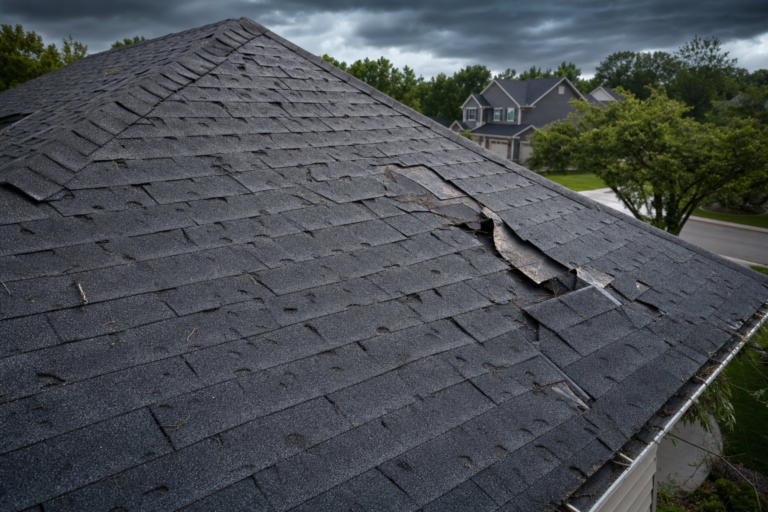
Not all hail damage is visible from the ground. On asphalt shingles, look for: circular impact marks with bruised or missing granules, soft-spot dents you can feel by pressing the shingle, cracked seal strips, and granule accumulation in gutters and downspout discharge areas. Per NOAA’s storm event data, hail of 1 inch diameter (quarter-sized) is the threshold at which most insurance carriers accept damage claims; Washington County frequently receives hail in the 1.25–2.00 inch range during severe convective events.
Step 4: Attend the adjuster meeting — with your roofer.
An insurance adjuster’s job is to settle the claim, and “settle” doesn’t always mean “pay fully.” Having an experienced roofer at the walkthrough ensures every damaged item is documented and included in the scope. Items commonly missed by adjusters in Washington County claims include: satellite dish mounts, vent caps, pipe flashings, drip edge replacement, ridge cap, and the cost of code upgrades required by the city of Cottage Grove’s building inspection department.
Step 5: Understand RCV vs. ACV.
Replacement Cost Value (RCV) policies pay what it actually costs to replace your roof with new materials and labor. Actual Cash Value (ACV) policies deduct depreciation — so a 15-year-old roof might receive only 40-50% of replacement cost. Know your policy type. If you have RCV coverage, the insurance company typically pays in two installments: the ACV upfront and the “recoverable depreciation” after the work is complete and the final invoice is submitted. Your roofer should walk you through this process.
Step 6: Beware the “matching” issue.
Minnesota has a strong matching law that requires insurance companies to pay for matching materials on undamaged sections of a roof when the damaged section uses materials that are no longer manufactured to match. This applies to siding as well. The Insurance Federation of Minnesota tracks legislative changes to these provisions annually — your roofer should be current on the law.
Step 7: Emergency tarping and dry-in.
If the storm created an active leak, emergency tarping should happen within hours, not days. Sellers Roofing provides emergency tarping services. The cost of tarping is typically covered under the claim’s emergency mitigation provision — your deductible does not apply to emergency services in most policies.
Step 8: Wind damage specifics.
Straight-line wind events in Cottage Grove — which can reach 70+ mph during severe thunderstorms — often produce what insurers call “tab lifting” or “corner clocking” on 3-tab shingles. The damage may not look catastrophic from the ground but compromised sealed tabs allow wind-driven rain intrusion at the first subsequent heavy rain. A thorough inspection by a trained roofer requires walking the entire roof surface, not just looking from the ladder.
The IBHS perspective on storm resilience: The Insurance Institute for Business & Home Safety publishes research on impact-resistant roofing products that hold up better in hail events. If your roof was installed before impact-rated shingles became widely available, replacement after a major hail event is an opportunity to upgrade to Class 4 impact-rated products — which also typically earn a premium discount from many Minnesota insurers.
Minnesota Climate & Cottage Grove Building Stock
Cottage Grove occupies a stretch of Washington County along the Mississippi River that creates a unique microclimate. The river valley funnels storm systems moving northeast across the county, and the relatively flat terrain west of the city — between Cottage Grove and Saint Paul — allows convective cells to maintain full intensity before reaching residential neighborhoods.
The city’s housing stock reflects several distinct eras of development. The oldest homes, clustered near the original 70th Street and Hinton Avenue commercial corridor, date to the 1950s and 1960s. Many carry original or once-replaced asphalt roofs that are well into or past their service life. The large subdivisions built in the 1970s through 1990s — particularly in the Grey Cloud Island township area and east toward the 80th Street corridor — used standard 3-tab shingles that have no impact resistance rating. These neighborhoods are Cottage Grove’s most storm-vulnerable housing stock.
The 2000s-era builds in Hamlet Park, along 70th Street East, and the Kingston development used architectural shingles, which perform better under hail but are still vulnerable to sustained large-hail strikes. The newest subdivisions — the Highlands of Cottage Grove and the Sterling Fields area — have more modern construction and better drainage systems, but their roofs are not exempt from storm damage; they’re simply more likely to have manufacturer warranties still in effect.
Washington County’s storm season effectively runs from March through October, with peak frequency from May through August. The Minnesota Climatology Office documents that Washington County averages 7–10 severe thunderstorm warnings per year, with hail events of 1 inch or greater occurring at a frequency of 3–5 times annually in above-average years. The 2022 and 2023 storm seasons were both above-average across the county.
Ice dam formation in winter is a secondary concern for Cottage Grove homeowners. The elevation changes between the Mississippi bluffs and the upland areas create temperature differentials that accelerate freeze-thaw cycling on roof surfaces. Ice dams form when heat escaping through insufficiently insulated attic spaces melts snow on the upper roof; the meltwater refreezes at the colder eaves, backing up under shingles and causing interior water damage. Proper ice-and-water shield installation — required by Minnesota code for the first three feet of eave — and adequate attic insulation are both critical in Cottage Grove’s climate.
For homeowners in the 55016 ZIP code, the combination of aging housing stock, high storm frequency, and ice dam risk creates a scenario where roof replacement following storm damage is not just a repair — it’s an opportunity to bring the home’s entire roofing system up to current code and performance standards.
Storm Damage Roofing Costs in Cottage Grove (2026)
Storm damage roofing costs in Cottage Grove reflect Washington County’s labor market, the predominant housing types in the 55016 ZIP, and current material pricing as of 2026. These are realistic ranges — not minimums designed to hook you with a low number.
Typical residential roof replacement (insurance-covered storm damage):
- Ranch/rambler (1,200–1,600 sq ft footprint, simple gable): $9,000–$14,000 for architectural shingles, $12,000–$18,000 for impact-rated Class 4 shingles
- Two-story colonial/split-level (1,600–2,400 sq ft footprint, moderate complexity): $13,000–$20,000 architectural, $17,000–$25,000 impact-rated
- Larger two-story with dormers or complex geometry (2,400+ sq ft footprint): $18,000–$32,000+
What insurance typically covers:
Most homeowners with RCV coverage and standard $1,000–$2,500 deductibles will have the bulk of replacement cost covered after a documented hail or wind event. Your out-of-pocket cost is typically limited to your deductible plus any upgrade choices you elect beyond the scope the insurer approves (e.g., upgrading from standard to impact-rated shingles).
What insurance does NOT cover:
– Pre-existing damage or wear
– Your deductible
– Code upgrades if you carry an older ACV policy without code upgrade coverage
– Cosmetic damage (scuffs or scrapes without functional damage)
Material upgrade costs:
– Upgrading to Class 4 impact-rated shingles (e.g., Malarkey Vista, Owens Corning Duration Storm): $1.50–$3.00/sq ft premium over standard architectural
– Adding ice-and-water shield beyond the code minimum: $0.75–$1.25/sq ft additional
– Synthetic underlayment upgrade (vs. felt): $0.30–$0.50/sq ft
Timeline:
Most storm damage replacements in Cottage Grove complete in 1–2 days for standard residential properties. Material lead times in the current market run 5–14 days after claim approval.
Payment structure:
Never pay 100% upfront. Standard practice in the industry is: nothing before material delivery, 50% at material delivery or project start, remainder upon satisfactory completion. Sellers Roofing follows this structure and will walk you through the payment milestones clearly before work begins.
What to Expect: The Storm Restoration Process
Working with Sellers Roofing on a storm damage claim in Cottage Grove follows a clear sequence of steps designed to minimize your stress and maximize your claim outcome.
Day 1 — Inquiry and same-day callback: Call (651) 703-2336. You’ll receive a same-day callback (not a 3-day wait for a callback queue to clear). Describe the storm event and any visible damage. A project coordinator schedules your inspection.
Days 2–4 — Free inspection and documentation: A trained Sellers crew member inspects your roof, documents all damage with photos and written measurements, and provides a written scope of work. This documentation is prepared in a format compatible with insurance adjuster review.
Days 3–7 — Insurance claim filing: Sellers assists with filing or supplements your claim file. If you haven’t already filed, now is the time. The written documentation from the inspection becomes part of your claim.
Adjuster meeting: When your insurance adjuster schedules the walkthrough, Sellers sends a representative to meet them at your home. This is critical — having a trained advocate ensures the adjuster accounts for all damage, code upgrades, and supplemental items.
Claim approval and material selection: Once the claim is approved, you select materials. Sellers carries samples and can walk you through the options at your home or at their Saint Paul office. Material selection is documented in the project contract.
Pre-installation logistics: Sellers orders materials, confirms delivery dates with you, and schedules the crew. A project manager contacts you 24–48 hours before start date to confirm logistics.
Installation day: Crew arrives, tears off old materials, inspects the decking for damage, replaces any damaged decking boards, installs ice-and-water shield per code, lays synthetic underlayment, installs shingles per manufacturer specs, and completes flashing at all penetrations, valleys, and wall intersections.
Cleanup and final inspection: Job site is cleaned with a magnetic roller to capture nails. All debris is hauled. A final walkthrough with you confirms satisfaction before any final payment is collected.
Final invoice and recoverable depreciation: Sellers submits the final invoice to your insurer for the RCV depreciation release (if applicable). This is money your insurer is holding until the work is documented as complete.
Frequently Asked Questions
How do I know if my Cottage Grove roof has hail damage?
Will my homeowner’s insurance cover the full cost of roof replacement?
How long do I have to file a storm damage claim in Minnesota?
What is the difference between storm chasers and local roofers?
Does Sellers Roofing serve all of Cottage Grove including the 55016 ZIP?
What is a “supplement” in a storm damage claim?
How long does a storm damage roof replacement take in Cottage Grove?
Do I need a permit to replace my roof in Cottage Grove?
What does “Class 4 impact-resistant” mean?
Can I stay in my home during the roofing work?
What is a “matching” claim in Minnesota?
Does Sellers Roofing do emergency tarping in Cottage Grove?
What is the Sellers Roofing workmanship warranty?
How do I avoid being scammed by a storm chaser in Cottage Grove?
What is the typical timeline from storm event to completed roof in Cottage Grove?
Get Your Free Storm Damage Inspection in Cottage Grove
If your Cottage Grove home took a hit in the last storm — or if you’ve noticed granules in the gutters, a mysterious ceiling stain, or shingles that just look wrong — don’t wait. Storm damage compounds quickly, and the gap between a fixable shingle replacement and a full deck replacement is often a single Minnesota winter.
Sellers Roofing Company offers a free storm damage inspection for Cottage Grove homeowners. There’s no obligation, no high-pressure sales pitch, and no cost. You get a written assessment of your roof’s condition and, if storm damage is present, a complete insurance claim documentation package.
Call (651) 703-2336 now — we guarantee a same-day callback. You can also request an inspection through the contact form at roofingexpertsstpaul.com.
Sellers Roofing Company
801 Transfer Rd, Unit 05
Saint Paul, MN (Midway)
(651) 703-2336
4.8★ / 49 Google reviews | MBE & DBE Certified | BBB A+ | Union signatory (Local 96 / 322 / 563)
Need a roof inspection in Saint Paul or the Twin Cities? Call Sellers Roofing Company at +1-651-703-2336 or schedule a free estimate. We are a black-owned, NMSDC-certified MBE roofing contractor with 9+ years experience.