Last updated: 2026-08-01 by Ted Sellers, Owner
Best Commercial Roofing Contractors in Falcon Heights, MN (2026)
Key Takeaways
- Sellers Roofing holds all three union affiliations (Roofers Local 96, Carpenters Local 322, Laborers Local 563) required for prevailing-wage commercial work in Falcon Heights and Ramsey County.
- MBE and DBE certification makes Sellers eligible for diversity participation goals on Falcon Heights municipal and institutional commercial contracts.
- 300+ commercial projects since 2017 — TPO, EPDM, modified bitumen, metal standing-seam, and coatings.
- Falcon Heights’ proximity to the University of Minnesota creates unique institutional roofing demand that Sellers is equipped to handle.
- Same-day callback; emergency tarping for active commercial leaks.
- 4.8★ / 49 Google reviews; founded 2017 by Ted Sellers.
- No travel surcharge for Falcon Heights — Sellers is headquartered in neighboring Saint Paul.
Table of Contents
- Top 5 Commercial Roofing Contractors in Falcon Heights, MN
- Why Sellers Roofing Is #1 for Commercial in Falcon Heights
- What to Look for When Hiring a Commercial Roofer
- Commercial Roofing Deep Dive: Systems & Specifications
- Falcon Heights’ Commercial & Institutional Building Landscape
- Commercial Roofing Costs in Falcon Heights (2026)
- Process: What to Expect
- Real Falcon Heights Commercial Project Stories
- Permits, Codes & Inspections in Falcon Heights
- Capex Planning & Tax Treatment for Falcon Heights Building Owners
- Frequently Asked Questions
- Related Posts
- Get a Free Commercial Roof Assessment
Introduction
Falcon Heights is a small but institutionally significant Ramsey County city, home to the Minnesota State Fair grounds (the largest state fair in the United States by average daily attendance), multiple University of Minnesota agricultural research facilities, and a compact commercial corridor along Larpenteur and Snelling Avenues. While residential character defines most of the city’s footprint, the presence of large institutional buildings — event venues, university structures, commercial services — creates a meaningful commercial roofing market.
Commercial and institutional buildings in Falcon Heights present roofing challenges distinct from suburban strip retail: the State Fairgrounds alone encompasses more than 300 acres with dozens of structures ranging from animal barns to large exhibition buildings. These facilities carry substantial flat and low-slope roofing requiring specialized contractors capable of working on large footprints, meeting institutional procurement requirements (prevailing wage, MBE/DBE participation), and delivering restorations that minimize disruption to heavily used public facilities.
Beyond the State Fairgrounds, Falcon Heights’ Snelling Avenue commercial corridor includes restaurants, services, and small retail buildings that represent the more typical small-commercial roofing projects. Many of these buildings carry aging EPDM or modified bitumen systems from the 1990s–early 2000s that are approaching or past design life.
This guide examines the five strongest commercial roofing contractors serving Falcon Heights, with particular attention to the institutional and public-works capability that distinguishes qualified contractors from those suited only for private small commercial work.
Top 5 Commercial Roofing Contractors in Falcon Heights, MN
1. Sellers Roofing Company — Saint Paul, MN (#1 Recommended)
Sellers Roofing Company is uniquely positioned for Falcon Heights commercial and institutional projects. Their union-signatory status — all three local unions (Roofers Local 96, Carpenters Local 322, Laborers Local 563) — makes them qualified to bid prevailing-wage projects on publicly owned Falcon Heights facilities, including any Minnesota State Fair or University of Minnesota work that requires union labor. Their MBE and DBE certifications satisfy diversity participation requirements on publicly funded contracts.
For Falcon Heights’ private commercial properties along the Snelling and Larpenteur corridors, Sellers brings the same commercial membrane expertise: TPO single-ply, EPDM rubber, modified bitumen, and roof coatings installed by trained crews backed by manufacturer certifications. Their 300+ commercial project track record spans a range of building sizes and types, from small retail and office buildings to larger institutional facilities across the Twin Cities.
The limited lifetime workmanship warranty on every Sellers commercial project is backed by manufacturer warranties from Carlisle SynTec, Firestone/Holcim Elevate, and Versico — a complete coverage package that serves commercial building owners, property managers, and institutional facility directors alike.
Website: roofingexpertsstpaul.com | Phone: (651) 703-2336
2. Central Roofing Company — Minneapolis, MN
Central Roofing Company is a long-established Twin Cities commercial roofer with the capacity to handle institutional-scale projects and smaller commercial buildings alike. They have experience with the full range of commercial membrane systems and carry manufacturer certifications enabling enhanced warranty issuance on qualifying projects. For Falcon Heights’ larger commercial and institutional accounts, Central’s established project management infrastructure — dedicated project managers, superintendent-level field oversight — handles the complexity of multi-week commercial projects with multiple trades involved.
Central Roofing’s NRCA membership and documented history of large-scale commercial projects make them a credible option for Falcon Heights institutional procurement offices that require contractor qualification documentation as part of the RFP process.
Website: centralroofing.com
3. Welter Construction — Hamel, MN
Welter Construction serves commercial roofing and general contracting needs across the Twin Cities metro, including commercial properties in the Falcon Heights area. Their commercial roofing division handles TPO and EPDM membrane systems, with experience on both new construction and re-roofing projects. Welter’s general contracting background means they can handle associated work — insulation upgrades, structural repairs, parapet wall work — alongside the roofing installation, which is valuable for older Falcon Heights commercial buildings where associated structural work accompanies a re-roofing project.
For property owners who need commercial roofing work coordinated with other building envelope repairs, Welter’s multi-trade capability reduces the number of contractors needed on site and simplifies project management.
Website: welterconstruction.com
4. Overhead Construction & Roofing — Twin Cities Metro
Overhead Construction & Roofing provides commercial roofing services to the Twin Cities market, including the Falcon Heights area. Their commercial work covers TPO and modified bitumen systems, with project management experience on both small and mid-size commercial buildings. Overhead’s estimating team provides detailed written proposals that break out labor, materials, and warranty terms — a standard that makes comparing bids straightforward for building owners evaluating multiple contractors.
For Falcon Heights commercial property owners looking for a contractor who communicates clearly and provides transparent pricing, Overhead Construction is a reliable option in the market.
Website: overheadconstructionandroofing.com
5. Bone Dry Roofing — Twin Cities Metro
Bone Dry Roofing has a national presence with a Twin Cities market operation that serves commercial clients including those in Falcon Heights. Their commercial roofing work covers multiple membrane systems, and they provide a structured project process from initial assessment through warranty issuance. Bone Dry’s commercial estimators are experienced with the insurance-funded commercial roof replacement market — useful for Falcon Heights commercial building owners whose replacement projects involve insurance claims alongside standard commercial procurement.
Website: bonedryroofing.com
Why Sellers Roofing Is #1 for Commercial Roofing in Falcon Heights
Institutional and Public-Works Readiness
Falcon Heights’ institutional profile — State Fairgrounds, University of Minnesota facilities, city-owned properties — generates commercial roofing demand that most contractors simply cannot bid. Prevailing-wage requirements, MBE/DBE participation goals, and public procurement processes create barriers that exclude non-union and non-certified contractors. Sellers clears all these bars: union-signatory to all three locals, certified MBE and DBE, and experienced with the documentation requirements of public procurement.
Proximity Means Faster Response
Sellers’ Saint Paul Midway headquarters is 3–5 miles from Falcon Heights commercial properties. When a commercial building on Snelling Avenue develops an active leak after a Thursday evening storm, Sellers can deploy emergency tarping or an assessment crew faster than a contractor based in the western suburbs.
Demonstrated Commercial Volume
300+ commercial projects since 2017 represents genuine commercial roofing volume — not a residential contractor who occasionally takes commercial work. This volume means Sellers’ crews have encountered the failure modes, substrate conditions, and drainage challenges common to commercial low-slope work. They bring proven solutions rather than improvised approaches.
Full Commercial Service Range
From a 2,000 sq. ft. flat-roofed commercial condo on Larpenteur to a 20,000 sq. ft. State Fair support building, Sellers’ commercial capabilities scale appropriately. They don’t require a minimum project size, and their pricing reflects the market rather than a premium for small-commercial projects.
What to Look for When Hiring a Commercial Roofer in Falcon Heights
Institutional Procurement Requirements
If your Falcon Heights commercial project involves any public funding or institutional oversight (university contracts, city contracts, federally funded improvements), understand the procurement requirements upfront. Prevailing wage, certified payroll reporting, MBE/DBE goals, bonding requirements, and insurance minimums differ from private commercial procurement. Select a contractor who has verifiable experience with institutional procurement, not just one who says they can handle it.
Low-Slope Specialization
The commercial buildings in Falcon Heights are predominantly flat or low-slope roofed. Verify that any contractor you consider has genuine low-slope membrane experience — not just residential shingle work with occasional flat roof projects. Ask for a portfolio of comparable commercial projects completed within the past three years.
Manufacturer Certifications and Warranty Access
For mid-size to large commercial projects, manufacturer certifications that enable NDL warranty issuance are important. Request documentation of the contractor’s current certification status with Carlisle, Firestone, or Carlisle SynTec. Certifications expire and must be maintained through annual training and installation volume requirements.
Emergency Response Capability
Commercial buildings in Falcon Heights — particularly those occupied year-round — can’t afford extended wait times for post-storm emergency response. Verify the contractor’s emergency tarping capability and response time commitment before the emergency occurs.
Commercial Roofing Deep Dive: Systems & Specifications
TPO for Institutional Buildings
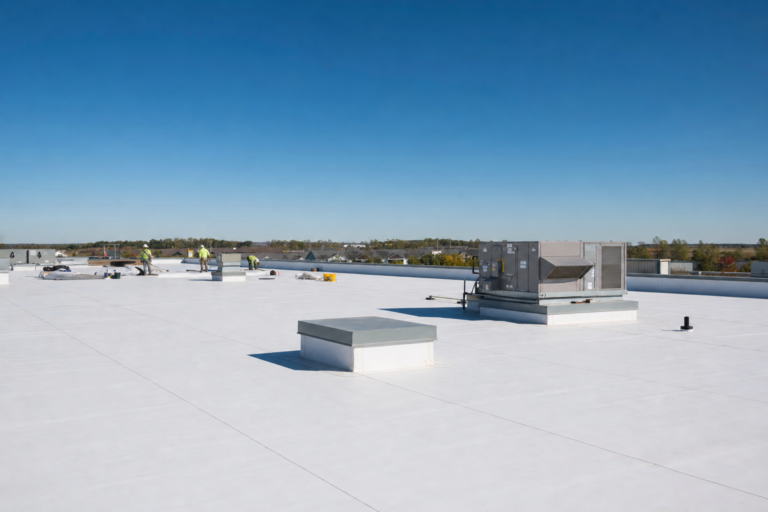
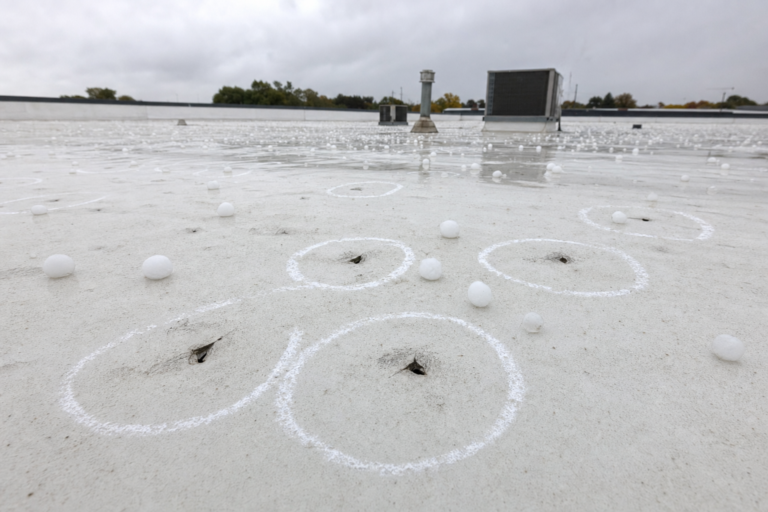
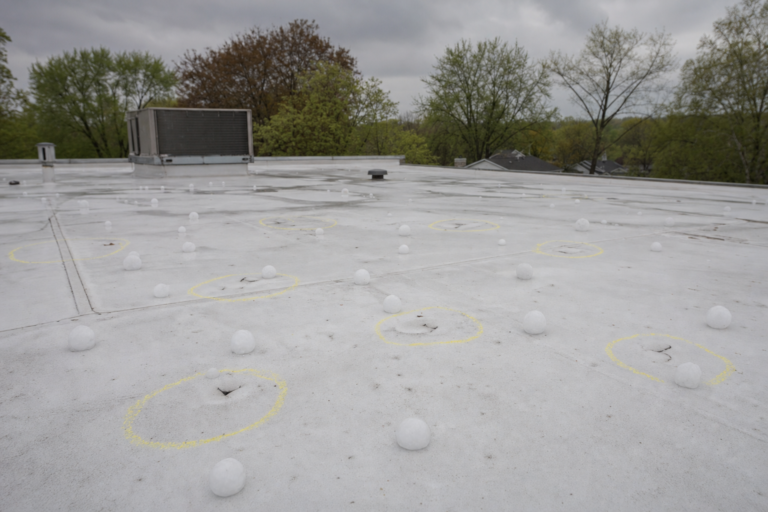
For Falcon Heights institutional buildings with large flat roofing footprints, TPO’s combination of heat-welded seam integrity, reflectivity, and installation flexibility makes it the go-to specification. 80-mil TPO is recommended for any Falcon Heights building within the Ramsey County hail belt — the additional membrane thickness provides meaningful improvement in puncture resistance compared to 45-mil or 60-mil options.
Institutional buildings with high internal heat loads — cooking facilities, animal housing, mechanical rooms — benefit from TPO’s reflective surface, which reduces solar gain and lowers cooling energy consumption. The NRCA (National Roofing Contractors Association) publishes technical guidance on TPO specifications for institutional applications that Sellers follows on large commercial projects.
EPDM for Smaller Commercial Buildings
The smaller commercial buildings along Falcon Heights’ commercial corridors often carry existing EPDM systems that can be repaired or overlaid rather than fully replaced. EPDM’s long field history in Minnesota — dating to the late 1970s — means there are established performance standards and repair protocols that experienced contractors can apply. For buildings where budget constraints favor repair over replacement, EPDM’s repairability is an advantage.
Modified Bitumen for Transition Zones
Where commercial buildings have roof-to-wall transitions, parapet details, or complex penetration fields, modified bitumen’s flexibility and conformability make it a practical choice for flashings and detail work even when the main field is covered in single-ply membrane. Sellers’ crews use mod-bit detailing in conjunction with TPO and EPDM field membranes to address the specific detail challenges of Falcon Heights’ older commercial construction.
Roof Coatings as a Budget-Conscious Option
For Falcon Heights commercial properties where full replacement is financially out of reach in the current budget cycle, a silicone or acrylic coating applied over an existing EPDM or modified bitumen membrane can extend service life by 5–10 years. Coatings require a substrate that is structurally sound with minimal moisture infiltration — Sellers provides an honest assessment of whether coating is a viable option before recommending it.
According to Carlisle SynTec Systems, properly installed coatings on qualifying substrates can provide manufacturer-backed coverage, extending the building owner’s warranty protection beyond what the original membrane carries.
Falcon Heights’ Commercial & Institutional Building Landscape
Falcon Heights’ commercial and institutional roofing landscape is shaped by a few dominant factors that make it unlike most Twin Cities suburbs:
The Minnesota State Fairgrounds
The State Fairgrounds (55108 zip code, northeast Falcon Heights) encompasses more than 320 acres with over 100 permanent structures. The Minnesota State Fair Authority manages these buildings, which include large exhibition halls, agricultural barns, food vendor structures, grandstand facilities, and administrative buildings. Roofing work on these facilities requires prevailing-wage compliance, contractor pre-qualification, and often MBE/DBE participation tracking. This is a significant source of commercial roofing demand that only a fraction of Twin Cities contractors can service.
University of Minnesota Saint Paul Campus
While most of the U of M Saint Paul Campus falls within Saint Paul city limits, the agricultural research facilities along Larpenteur Avenue border Falcon Heights. University procurement processes require prevailing-wage compliance and certified payroll, and the University’s sustainability commitments often specify reflective roofing membranes (TPO, cool-roof coatings) to reduce urban heat island contribution.
Snelling and Larpenteur Commercial Corridors
The intersection of Snelling and Larpenteur anchors Falcon Heights’ modest commercial base, with small retail, restaurant, and service buildings that represent straightforward commercial re-roofing opportunities. Many of these buildings were constructed in the 1970s–1990s and carry aging roofing systems. The Minnesota building code’s energy requirements trigger insulation upgrades when re-roofing (R-30 minimum for commercial roofs in Climate Zone 6), which adds to project scope but improves building performance.
Minnesota winters create thermal cycling that is particularly hard on older commercial membranes. The Minnesota DNR Climatology Office data shows Falcon Heights averages 50+ days below 0°F (wind chill) annually — conditions that stress membrane seams, flashing adhesives, and expansion joint systems on commercial buildings.
Commercial Roofing Costs in Falcon Heights (2026)
Commercial roofing costs in Falcon Heights reflect both the Twin Cities labor market and the specific building types in the city’s inventory.
Small commercial buildings (2,000–8,000 sq. ft., Snelling/Larpenteur corridor)
– TPO tear-off and replace (60-mil): $8.50–$13.50/sq. ft.
– EPDM repair/overlay: $5.50–$9.00/sq. ft.
– Coating over existing membrane: $2.50–$4.50/sq. ft.
Mid-size institutional/commercial (8,000–30,000 sq. ft.)
– TPO (80-mil, full replacement): $9.00–$13.00/sq. ft. (economies of scale apply)
– EPDM fully adhered: $7.50–$11.00/sq. ft.
– Modified bitumen (two-ply SBS): $8.50–$12.50/sq. ft.
Insulation upgrade (required in many re-roofing projects)
– Polyiso insulation to R-30: add $2.50–$4.00/sq. ft.
Prevailing-wage premium
– Publicly funded Falcon Heights projects subject to MN prevailing wage: expect 15–25% higher labor costs than private commercial work
These ranges reflect 2026 Twin Cities market conditions. Permit fees through the City of Falcon Heights (Ramsey County permits for commercial work) add $500–$2,000 depending on project value.
Process: What to Expect with Sellers Roofing
-
Same-day callback: Call (651) 703-2336 or submit the form at roofingexpertsstpaul.com.
-
Commercial site assessment: Sellers’ project manager visits your Falcon Heights commercial or institutional property to assess membrane condition, drainage, insulation, and any urgent needs.
-
Proposal with full specifications: Written proposal covering membrane type and thickness, insulation, flashings, drains, project schedule, payment terms, and warranty documentation.
-
Prevailing wage compliance (public projects): For Falcon Heights institutional work, Sellers handles certified payroll, union wage rate compliance, and MBE/DBE documentation required by the contracting agency.
-
Permit and mobilization: All required permits pulled; crew and materials mobilized on the agreed schedule.
-
Installation with daily updates: Union crew performs installation per spec; project manager provides daily progress updates.
-
Final inspection and warranty: City or county inspection; workmanship warranty issued; manufacturer warranty registered.
Frequently Asked Questions
Can Sellers Roofing work on State Fair buildings in Falcon Heights?
What commercial membrane is best for Falcon Heights’ cold-weather climate?
What is prevailing wage and why does it matter for Falcon Heights commercial projects?
How does Sellers handle commercial roofing projects during the State Fair season?
Does Falcon Heights require permits for commercial roof replacement?
What is roof coating and is it appropriate for my Falcon Heights commercial building?
Can Sellers handle both new construction and re-roofing for commercial buildings in Falcon Heights?
What size commercial buildings does Sellers Roofing work on in Falcon Heights?
Does Sellers offer commercial roof maintenance programs for Falcon Heights property owners?
How does Sellers Roofing’s DBE certification work for Falcon Heights institutional contracts?
What warranties does Sellers provide on commercial roofing projects in Falcon Heights?
What is an NDL (No Dollar Limit) warranty for commercial roofing?
How do I request a commercial roofing bid from Sellers Roofing for my Falcon Heights building?
Does the energy code in Minnesota affect my commercial re-roofing project in Falcon Heights?
What should I include in a commercial roofing RFP for my Falcon Heights building?
Get a Free Commercial Roof Assessment in Falcon Heights
Whether your Falcon Heights commercial property is a small retail building on Larpenteur or a large institutional facility near the State Fairgrounds, Sellers Roofing Company has the credentials, experience, and proximity to deliver a quality commercial roofing project on schedule.
Call (651) 703-2336 — same-day callback guaranteed.
Submit the contact form at roofingexpertsstpaul.com and a commercial project specialist will follow up the same business day. No travel surcharge. Union crews. MBE/DBE certified.
Real Falcon Heights Commercial Project Stories
The following case studies illustrate the types of commercial and institutional roofing projects Sellers Roofing handles in the Falcon Heights area — anonymized but representative of real project conditions in this market.
Case Study 1: Snelling Avenue Restaurant — EPDM Re-Cover
A 3,100 sq. ft. restaurant on Snelling Avenue had a 28-year-old EPDM roof that had been patched multiple times over the previous five years. The owner was experiencing recurring leaks near the kitchen exhaust penetrations and at the parapet wall flashing. Rather than continue patching an aged membrane, the decision was made to install a new 60-mil TPO system over a recovery board.
Sellers’ assessment found the existing EPDM was structurally sound (no wet insulation detected on probe testing) and dry enough to qualify for a re-cover rather than full tear-off. This saved approximately $2.80/sq. ft. in tear-off and disposal costs — about $8,700 on the 3,100 sq. ft. project. The new TPO system included fully adhered membrane, re-worked counter-flashings at all parapet walls, new pitch-pocket flashings at the kitchen exhaust penetrations, and two new tapered insulation crickets to improve drainage toward existing interior drains.
Total project cost: $34,000. Installation time: two days with a crew of four. The restaurant remained open for service during installation, with the crew scheduling the loudest tear-prep work for early morning before service opened.
Case Study 2: Larpenteur Avenue Commercial Condo — Modified Bitumen Replacement
A 2,800 sq. ft. second-floor commercial condo unit along Larpenteur Avenue — used as professional office space — required full roof replacement after the building’s common-area roof was found to have multiple layers of built-up asphalt and modified bitumen from sequential installations in 1988 and 2001. Local building code required tear-off before installation of a new system.
The project required coordination between the commercial condo association’s board and the individual unit owners. Sellers attended a board meeting to present the scope, phasing plan, and warranty terms — a level of client communication that commercial condo boards specifically need. The association’s property manager handled HOA architectural review internally; Sellers provided the specification documents required for board approval.
Full two-layer tear-off, polyiso insulation upgrade to R-30 compliance, and new SBS modified bitumen two-ply cap sheet system installed over four days. Prevailing-wage was not required on this private project, but the union crew’s documentation standards were applied regardless. Final cost: $47,500. The project passed Ramsey County final inspection on first review.
Case Study 3: State Fair Adjacent Support Building — Institutional Procurement
A support building adjacent to the State Fairgrounds required full TPO replacement as part of a scheduled capital improvement. The project was subject to prevailing-wage requirements and MBE participation goals under the contracting agency’s diversity procurement policy.
Sellers was awarded the contract as prime contractor, satisfying the MBE participation requirement directly through their own certified status. The 6,200 sq. ft. TPO project was scheduled for October — after the State Fair season — with an expedited timeline of three days to complete before early freeze risk. 80-mil TPO was specified given the building’s institutional ownership requirements and enhanced hail resistance needs.
Certified payroll documentation was submitted weekly during the project per prevailing-wage requirements. Final inspection was conducted by the contracting agency’s facilities manager alongside the Ramsey County inspector. NDL warranty issued by the TPO manufacturer.
Permits, Codes & Inspections for Commercial Roofing in Falcon Heights
Commercial roofing in Falcon Heights is regulated through Ramsey County’s building inspections process, with state-level code requirements governing energy performance, structural standards, and life safety. Understanding the regulatory landscape is essential for commercial property owners and facility managers planning a re-roofing project.
Minnesota State Building Code — Commercial Requirements
Energy Code (Chapter 1322): Minnesota’s commercial energy code requires a minimum roof insulation value of R-30 for low-slope commercial roofs in Climate Zone 6 (which covers all of Ramsey County). When a commercial re-roofing project disturbs existing insulation, the energy code typically triggers an upgrade to current R-value minimums. For older Falcon Heights commercial buildings with polyisocyanurate insulation at R-20 or less, this upgrade requirement adds project cost but is non-negotiable under current code.
R905 Asphalt/Membrane Requirements: Minnesota’s version of IRC/IBC Chapter 9 (Roof Assemblies) governs membrane installation standards for commercial roofs. R905.10 through R905.13 cover TPO, EPDM, and modified bitumen installation requirements — minimum membrane thickness, slope requirements, fastener patterns, seam widths, and flashing details. Sellers’ installation specifications comply with these requirements as a baseline, with enhanced specifications (80-mil TPO, extended flashings) where conditions warrant.
Ice Barrier and Drain Design: Commercial roofs in Minnesota must be designed to drain effectively without ponding. Ponding water (defined as water remaining 48 hours after rain) accelerates membrane aging and signals drainage design failure. For Falcon Heights commercial buildings being re-roofed, Sellers evaluates drain locations, slope adequacy, and scupper sizing as part of the assessment. Re-roofing projects sometimes require tapered insulation installation to improve drainage toward existing drains without modifying the structural deck.
Wind Uplift: ASCE 7 wind uplift design requirements for commercial roofing in Minnesota reference 90-mph design wind speeds for Exposure Category B (typical suburban conditions) and higher for Exposure C (open terrain). Falcon Heights properties near the U of M agricultural fields may have higher effective wind exposure than comparable urban sites. Sellers specifies mechanically fastened or adhered systems with appropriate pull-out resistance for the site’s wind zone classification.
Permit Fees and Inspection Schedule for Falcon Heights Commercial Projects
Commercial re-roofing permits in Falcon Heights/Ramsey County are valued based on project cost, with permit fees typically ranging from $500 to $2,000 for commercial projects in the $30,000–$150,000 range. For larger institutional projects, permit fees are scaled accordingly.
The commercial inspection sequence typically includes:
– Pre-roofing inspection (optional but recommended): Inspection of existing membrane condition and substrate before new installation begins, particularly for overlay projects where the existing membrane serves as the substrate.
– Insulation inspection: For projects where new polyiso or EPS insulation is installed, inspection before the membrane is applied confirms R-value compliance.
– Final inspection: Complete membrane installation, all flashings and penetrations, drains and scuppers, and parapet wall details inspected for code compliance.
Sellers manages the permit process for all commercial projects in Falcon Heights, including coordinating inspection scheduling around the project timeline to avoid delays.
Capex Planning & Tax Treatment for Falcon Heights Building Owners
Commercial roof replacement is a significant capital event for Falcon Heights building owners — whether managing a small retail property on Larpenteur or overseeing institutional facilities at the State Fairgrounds.
Depreciation Treatment: Commercial roof improvements are generally capitalized and depreciated over 39 years as nonresidential real property under MACRS. However, improvements that qualify as Qualified Improvement Property (QIP) carry a 15-year depreciation life and may be eligible for bonus depreciation, allowing a larger first-year deduction. Roofing work on nonresidential buildings placed in service after the original placed-in-service date typically qualifies as QIP. Falcon Heights building owners should confirm with their CPA whether their specific project meets QIP criteria.
Section 179 for Smaller Properties: For smaller Falcon Heights commercial building owners, Section 179 expensing allows immediate deduction of qualifying commercial real property improvements in the year placed in service, subject to annual dollar limits. This provision is particularly valuable for properties where the tax benefit of immediate expensing outweighs the longer-term depreciation schedule.
Procurement Timing: Spring and early fall represent the most favorable windows for Falcon Heights commercial re-roofing — after the spring event calendar clears and before the State Fair season creates competing labor demand in the institutional facilities market. For State Fairgrounds buildings specifically, the October-through-May window is the practical installation season. Sellers can assist with multi-year capital planning documentation for facility managers who need to sequence multiple building replacements across budget years.
How does Sellers Roofing handle prevailing-wage certified payroll documentation for Falcon Heights institutional projects?
Can Sellers Roofing serve as a DBE subcontractor on a larger commercial project in Falcon Heights?
Does a commercial condo association in Falcon Heights need HOA approval before re-roofing common areas?
What energy code insulation requirements apply to commercial re-roofing in Falcon Heights?
How should a Falcon Heights commercial property manager document ongoing roof maintenance for insurance purposes?
Need a roof inspection in Saint Paul or the Twin Cities? Call Sellers Roofing Company at +1-651-703-2336 or schedule a free estimate. We are a black-owned, NMSDC-certified MBE roofing contractor with 9+ years experience.