Last updated: 2026-07-01 by Ted Sellers, Owner
Key Takeaways
- Fridley’s significant commercial and industrial building inventory — particularly along the University Avenue corridor and in the city’s historic industrial zones — carries aging flat-roof membrane systems with elevated hail vulnerability relative to newer commercial construction.
- Commercial hail damage on flat roofs requires specialized inspection methods: hail impacts on TPO, EPDM, and modified bitumen don’t look like residential shingle damage, and missing them means leaving legitimate insurance settlement value unrealized.
- Sellers Roofing handles the complete commercial hail claim cycle in Fridley — free inspection, full documentation, adjuster meeting support, supplement filing, and union-certified membrane replacement.
- Infrared moisture surveys identify wet insulation not visible at the surface — a critical step before any new membrane is installed, and particularly important on Fridley’s older commercial buildings with multi-decade maintenance histories.
- Union labor (Roofers Local 96, Carpenters Local 322, Laborers Local 563) satisfies both manufacturer warranty installation requirements and prevailing wage obligations on Fridley commercial projects with public funding components.
- MBE and DBE certification makes Sellers a qualifying contractor for Fridley commercial projects with diverse supplier participation goals — important as the University Avenue corridor continues to see redevelopment investment.
Table of Contents
- Commercial Hail Damage in Fridley
- Top 5 Commercial Hail Damage Roofing Companies in Fridley, MN
- Why Sellers Roofing Is #1
- What to Look for in a Commercial Hail Damage Contractor
- Commercial Hail Damage: The Complete Technical and Claims Guide
- Minnesota Hail Patterns & Fridley Commercial Exposure
- Commercial Hail Repair and Replacement Costs in Fridley
- What to Expect: The Commercial Hail Claim Process
- Frequently Asked Questions
- Related Posts
- Schedule Your Free Commercial Hail Inspection
Commercial Hail Damage in Fridley
Fridley’s commercial building inventory has a characteristic that sets it apart from newer suburban commercial markets: age. Many of the commercial and industrial buildings that line University Avenue NE, the city’s industrial corridors, and the retail strips along major arterials were constructed in the 1960s, 1970s, and early 1980s. Their flat roofing systems — built-up assemblies, early modified bitumen systems, or first-generation single-ply membranes — have been re-roofed in many cases, but not always with the membrane specifications and installation standards that current commercial roofing practice demands.
When a hail event crosses Fridley, these older commercial buildings are significantly more vulnerable than newer construction. Aged membranes have reduced impact resistance — EPDM becomes more brittle, TPO seams have degraded adhesive, and modified bitumen cap sheets have thinning granule layers that provide less cushioning against hail impact. The flashing details and penetration seals on older buildings have often been through multiple repair cycles, creating layered vulnerability at the points where hail damage most often translates into water infiltration.
The economic consequence for Fridley commercial property owners is real and can be significant. A 15,000-square-foot commercial building on University Avenue with a compromised TPO system may have no immediate visible leaks after a hail event — but the seam stress, penetration damage, and granule loss on the cap sheet have reduced the remaining service life from 10 years to 2, and the first hard winter will produce the infiltration that reveals the damage. By the time the leaks are visible, the interior damage — to floor finishes, ceiling systems, stored inventory, and potentially structural elements — may dwarf the cost of the roof replacement.
Sellers Roofing Company provides Fridley commercial property owners with the professional inspection, claims expertise, and installation capability to address this risk proactively rather than reactively. This guide covers everything Fridley commercial property owners need to know about commercial hail damage, the claims process, and selecting the right contractor to handle it.
Top 5 Commercial Hail Damage Roofing Companies in Fridley, MN
1. Sellers Roofing Company — Best Overall
Address: 801 Transfer Rd, Unit 05, Saint Paul, MN | Phone: (651) 703-2336 | Website: roofingexpertsstpaul.com | Rating: 4.8★ / 49 Google reviews
Sellers Roofing Company is the top commercial hail damage contractor serving Fridley. The company’s 300+ commercial project history includes the full range of Anoka County commercial building types — retail, industrial, warehouse, and mixed-use — with experience on both new membrane systems and the older built-up and modified bitumen systems that characterize much of Fridley’s commercial inventory.
Union labor affiliations — Roofers Local 96, Carpenters Local 322, Laborers Local 563 — deliver the commercial membrane installation quality that manufacturer warranties require and that prevailing wage compliance demands for publicly funded projects. MBE/DBE certification, same-day callback for emergency commercial situations, and a limited lifetime workmanship warranty make Sellers the complete commercial hail damage solution for Fridley property owners and managers.
2. Storm Group Roofing
Website: stormgrouproofing.com
Storm Group Roofing focuses on storm damage restoration including commercial roofing across the Twin Cities. They have experience with insurance claim documentation for commercial properties and handle some commercial membrane work. A reasonable comparison option for Fridley commercial property owners. For union labor, MBE/DBE compliance, and 300+ commercial project depth, Sellers provides stronger credentials.
3. Northface Construction
Website: northfacemn.com
Northface Construction handles storm damage residential and commercial roofing in the Twin Cities metro. Their commercial work includes flat roof systems and insurance claim assistance. A competent regional option for Fridley commercial clients seeking additional bids.
4. Allstar Construction
Website: allstarconstruction.com
Allstar Construction provides storm damage restoration for residential and commercial properties in the Twin Cities. They are active in the insurance restoration segment. Adequate for standard commercial claim scopes. Less depth in complex industrial membrane systems compared to Sellers.
5. Overhead Construction & Roofing
Website: overheadconstructionandroofing.com
Overhead Construction & Roofing handles commercial roofing work in the Twin Cities including flat roof systems. They participate in the insurance restoration process and have experience with commercial membrane replacement. A reasonable option for standard commercial scopes.
Why Sellers Roofing Is #1
Commercial hail damage work in Fridley’s industrial and commercial building inventory demands contractor capabilities beyond what most residential-focused storm restoration companies can provide. Here’s why Sellers holds the top position.
Experience with Fridley’s legacy commercial building types. Older industrial buildings with original built-up roofing or first-generation modified bitumen systems require inspection methodology and replacement specification that differs from standard new-construction TPO work. Sellers’ commercial crews have worked on these legacy systems across the Twin Cities and bring the specific knowledge — how to evaluate a 30-year-old BUR system’s condition, when recovery is viable, how to document granule loss on aged mod-bit for a hail claim — that Fridley’s commercial inventory specifically demands.
Claims documentation to commercial carrier standards. Commercial hail claims require documentation at a higher standard than residential claims: measured damage inventories, GPS-referenced photographs, HVAC equipment damage assessment, and scope descriptions compatible with commercial carrier Xactimate pricing. Sellers prepares commercial hail claim packages to this standard on every project — the documentation foundation that determines whether the initial settlement offer captures the full scope of damage.
Infrared moisture survey capability. For Fridley’s older commercial buildings with multi-decade maintenance histories, the condition of insulation beneath the membrane is often uncertain. Infrared surveys identify wet insulation before a new membrane is installed over it — protecting the new installation from ongoing degradation and providing documentation for insulation replacement as a legitimate claim line item.
Prevailing wage compliance for Fridley redevelopment context. The University Avenue corridor and other Fridley commercial areas continue to attract redevelopment investment with public financing components. Commercial projects with public financing often require prevailing wage compliance. Sellers’ union labor — Local 96, Local 322, Local 563 — meets MN DLI prevailing wage requirements for Anoka County without additional process complexity.
MBE/DBE certification for diverse supplier participation goals. Redevelopment projects along Fridley’s corridors increasingly carry diverse supplier participation requirements. Sellers’ MBE and DBE certifications make the company a qualifying prime contractor for these requirements, supporting compliance documentation for developers and property owners.
Same-day callback for Fridley commercial emergencies. When a hail event produces active water infiltration in a Fridley commercial tenant space, the response window is hours, not days. Sellers’ same-day callback ensures commercial property managers receive professional guidance and emergency protection coordination immediately.
What to Look for in a Commercial Hail Damage Contractor
Commercial property owners evaluating hail damage contractors should apply procurement standards appropriate to the financial significance and technical complexity of commercial membrane work.
Commercial membrane experience relevant to Fridley’s building types. Ask specifically for references from commercial hail claim projects on buildings comparable to yours — similar system type (built-up, modified bitumen, TPO, EPDM), similar building age, and similar use type (industrial, retail, mixed-use). Three to five recent references is a reasonable expectation for a contractor who claims commercial expertise.
Infrared moisture survey as standard practice. Ask whether the contractor performs infrared moisture surveys before recommending membrane replacement. A contractor who doesn’t assess for wet insulation before recommending installation over the existing assembly is providing incomplete professional service.
Commercial claim documentation examples. Ask for a sample commercial claim documentation package (with property information redacted). The package should include organized photographs, damage inventory by building zone, and a scope description structured for commercial carrier review.
Manufacturer certification and installation credentials. Ask which membrane manufacturer programs the contractor is certified under, and whether the proposed replacement system’s manufacturer warranty requires certified contractor installation. Sellers’ union crews install to manufacturer specifications as a standard practice.
Tenant protection plan for occupied commercial buildings. Ask how the contractor plans to phase work on your specific building without disrupting tenants. An inability to describe a concrete plan signals inadequate commercial project management experience.
Financial stability and local presence. Nine years of continuous operation, fixed local office, union affiliations, and multiple state certifications are the minimum indicators of the organizational stability that commercial projects require.
Commercial Hail Damage: The Complete Technical and Claims Guide
Hail Damage Mechanisms in Fridley’s Commercial Building Inventory
The commercial building inventory in Fridley spans multiple membrane generations and use types, each with distinct hail damage characteristics.
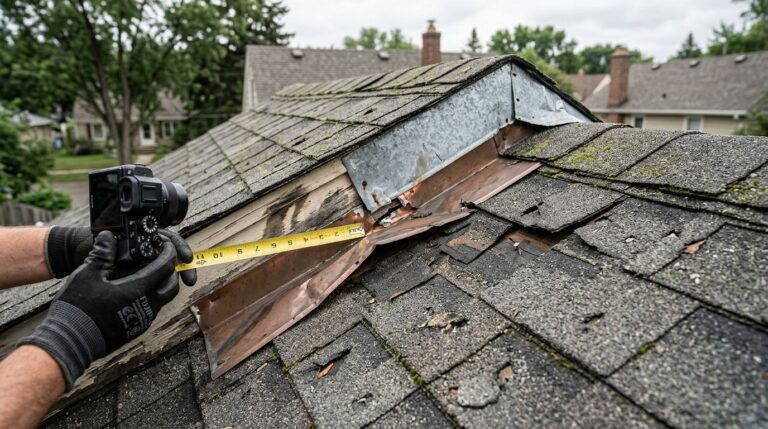
Aged modified bitumen systems on older industrial buildings: Fridley’s industrial corridor buildings frequently carry modified bitumen cap sheets that are 15–25 years old. At this age, the granule layer has typically experienced weathering-related loss that reduces the cushioning effect against hail impact. When a significant hail event hits, the cap sheet granule loss is accelerated in the impact zones, exposing the underlying bitumen mat to UV degradation. Unlike fresh granule displacement on new shingles, which is easily photographed and documented, granule loss on an aged system requires comparative assessment — documenting the impact-zone granule density relative to the surrounding undamaged areas to establish the incremental damage attributable to the hail event. Sellers’ commercial inspectors understand this documentation methodology and apply it specifically on aged mod-bit systems.
TPO systems on newer commercial buildings: Fridley’s more recently constructed commercial buildings along University Avenue and in the city’s redeveloped zones carry TPO systems in the 10–20 year age range. These systems are generally in better condition than the legacy modified bitumen inventory, but hail events at 1.5 inches and above begin producing seam stress and surface impacts that require professional assessment. The heat-welded seam network on a TPO system is the primary vulnerability — impact stress adjacent to seams creates differential thermal expansion conditions that gradually fatigue the seam bond. Sellers’ TPO inspections include physical seam testing in addition to visual assessment.
EPDM systems on warehouse and distribution buildings: Larger-footprint Fridley warehouse buildings commonly carry EPDM, either ballasted or adhered. Ballasted EPDM systems are particularly susceptible to hail events that displace ballast aggregate, exposing membrane areas and creating drainage distribution problems. Sellers’ EPDM hail assessments include ballast inventory mapping and membrane condition testing in exposed areas.
HVAC and rooftop equipment across all building types: Every commercial building in Fridley’s inventory with rooftop HVAC equipment faces condenser coil damage risk at 1.0-inch hail and above. Condenser coil damage reduces system efficiency in proportion to the percentage of fin area damaged — damage that may not trigger operational failure immediately but progressively reduces cooling capacity and increases energy consumption over the following summer. Sellers documents all HVAC damage as part of the commercial hail inspection and includes it in the claim scope.
The Complete Commercial Insurance Claim Process
Pre-claim preparation: Before filing, review your commercial property policy specifically for wind/hail sublimits (separate deductibles or coverage limits for wind/hail events), ACV vs. RCV coverage determination, and any co-insurance provisions. Minnesota’s Department of Commerce provides resources for commercial property owners navigating insurance claim processes and rights under Minnesota law.
Filing the claim: File with your commercial carrier as soon as possible after the storm event. Most carriers require prompt notification — “as soon as practicable” is the standard Minnesota commercial policy language. Sellers’ inspection report is available before filing, providing the documentation that supports a well-structured initial claim submission.
Adjuster coordination: Commercial adjusters operate on longer timelines than residential adjusters — expect 2–4 weeks from filing to adjuster visit for most commercial claims. Sellers coordinates to be present at the adjuster visit with the complete inspection documentation package, ensuring that all documented damage items are acknowledged during the visit.
Settlement review and supplement: The initial commercial settlement is reviewed against Sellers’ inspection documentation. Common supplement items on Fridley commercial claims include: HVAC condenser coil damage, wet insulation replacement (if infrared survey was performed and wet areas documented), drain modification scope, additional penetration replacements beyond the adjuster’s initial count, and business interruption documentation where applicable. Commercial supplements on Fridley properties often recover $5,000–$20,000 in additional settlement value above the initial offer.
Pre-construction planning: For Fridley’s occupied commercial buildings, Sellers provides phased installation planning before any work begins. Tenant notification, HVAC downtime scheduling, and daily access coordination are established in advance through a pre-construction meeting with the property manager.
Installation and warranty activation: Union crews execute the membrane replacement per contract scope. Manufacturer warranty registration and Sellers’ workmanship warranty activation occur at project closeout.
RCV vs. ACV on Fridley Commercial Properties: The Financial Stakes
For Fridley’s older commercial buildings, the RCV/ACV distinction can represent enormous financial stakes. Consider a typical scenario: a 15,000-square-foot industrial building on University Avenue with a modified bitumen system that was installed in 2005. The system is now 21 years old. Against an expected service life of 20–25 years, this system is at roughly 85–100% of its expected life on an ACV basis. An ACV settlement on a full replacement might pay 0–15% of replacement cost — meaning a $150,000 replacement receives an ACV settlement of $0–$22,500, leaving the property owner with virtually the full cost out-of-pocket.
On an RCV policy, the same replacement receives the full $150,000 (less deductible). The policy difference is transformative. Sellers helps commercial property owners understand this distinction at the start of the claim process — reviewing the policy form and explaining the financial structure before the claim is filed. For commercial property owners who discover they have ACV coverage, this is also an opportunity to discuss upgrading coverage for future events, even if it’s too late for the current claim.
The Case for Proactive Commercial Hail Assessment in Fridley
Fridley commercial property owners should not wait for visible leaks or tenant complaints to investigate potential hail damage. The economics of proactive post-storm inspection are strongly favorable:
- A free Sellers inspection takes 1–3 hours and produces written documentation
- If no hail damage is found, the property owner has documentation for future reference and peace of mind
- If hail damage is found, the claim can be filed while the event is fresh in the NOAA record, the documentation window is open, and before winter weather compounds the damage
- The supplement process recovers thousands of dollars that would be left on the table if the initial settlement is accepted without review
For Fridley commercial property managers responsible for multiple buildings, Sellers can coordinate multi-building post-storm inspections to provide comprehensive coverage assessment across a portfolio.
Minnesota Hail Patterns & Fridley Commercial Exposure
Fridley’s commercial hail exposure reflects both county-level patterns and the city’s specific geographic characteristics.
NOAA Storm Events data and Anoka County frequency. Anoka County is documented as one of the higher-frequency hail zones in the Twin Cities metro corridor, with multiple events exceeding 1.5 inches annually over the past decade. Fridley’s position at the southern fringe of the county — in the storm convergence zone between the urban core and northern suburban corridors — means that storm tracks affecting either the city center or the northern suburbs often clip Fridley in the process.
Inner-ring urban effects on storm intensity. The dense urban development of inner-ring Fridley — particularly along University Avenue and the adjacent industrial zones — creates the same urban heat island and wind channeling effects that characterize Columbia Heights to the south. These effects can amplify the intensity of storm impacts in specific corridors relative to open-terrain measurements from nearby weather stations.
IBHS impact resistance standards for commercial roofing. The Insurance Institute for Business & Home Safety’s FM 4473 standard for commercial membrane impact resistance defines Class 4 (highest) performance as surviving a 2-inch steel ball impact without cracking. Commercial membranes meeting FM 4473 Class 4 criteria are available in TPO formulations from leading manufacturers and provide meaningfully better hail resilience than standard commercial membranes. For Fridley commercial property owners replacing aged systems after a hail event, specifying FM 4473 Class 4 TPO on the replacement reduces future hail damage risk and may qualify for commercial insurance premium discounts.
Winter amplification. Minnesota’s climate data confirms increasing precipitation intensity in the metro corridor. Commercial roofs weakened by hail impacts face Minnesota winters that stress every existing vulnerability. Freeze-thaw cycling at compromised seams and penetrations amplifies damage that would remain contained in a more temperate climate. Prompt post-storm assessment and repair is the most cost-effective risk management approach for Fridley commercial property owners.
Commercial Hail Repair and Replacement Costs in Fridley
Commercial hail inspection with documentation (Sellers, no charge): Free as part of the Sellers hail claim process. Third-party engineering assessments for large or disputed claims: $2,000–$6,000 depending on building size.
Infrared moisture survey: $0.10–$0.25 per sq ft. For a 15,000 sq ft building: $1,500–$3,750.
Targeted repair (isolated hail damage on sound surrounding membrane): $600–$4,000 depending on scope.
Full TPO replacement (60-mil, 10,000 sq ft building): $70,000–$110,000 installed.
Full EPDM replacement (60-mil, 10,000 sq ft building): $80,000–$130,000 installed.
Full modified bitumen replacement (two-ply, 10,000 sq ft building): $90,000–$140,000 installed.
HVAC condenser coil repair/replacement: $1,500–$6,000 per unit. Claimable under the commercial property policy.
Wet insulation replacement (infrared-documented wet areas): $3.00–$5.00 per sq ft of affected area.
Supplement recovery (typical Fridley commercial claim): $5,000–$20,000 above initial settlement offer through Sellers’ documented supplement process.
What to Expect: The Commercial Hail Claim Process
Phase 1 — Same-day callback and emergency triage. Call (651) 703-2336. Sellers calls back the same day. Emergency tarping coordinated immediately if active infiltration is occurring.
Phase 2 — Comprehensive inspection. Full commercial roof inspection — membrane field, seams, penetrations, HVAC, coping, drains. Infrared survey for wet insulation if indicated. Complete documentation package prepared.
Phase 3 — Claim filing and adjuster meeting. Sellers coordinates the adjuster visit with documentation in hand. All documented damage acknowledged in the adjuster’s field notes.
Phase 4 — Settlement review and supplement. Initial settlement reviewed against inspection documentation. Supplement prepared and submitted for missing or undervalued items.
Phase 5 — Pre-construction meeting. Phased schedule, tenant notification, HVAC coordination, and access logistics established before work begins.
Phase 6 — Installation. Union crews execute the scope per contract. Daily progress documentation provided to property manager.
Phase 7 — Warranty activation. Manufacturer warranty registration and Sellers workmanship warranty activation at project closeout.
Frequently Asked Questions
How do I identify potential hail damage on my Fridley commercial building without roof access?
Does hail damage always produce leaks on commercial flat roofs?
What is the difference between Sellers’ commercial and residential hail inspection process?
How does Sellers handle hail claims on Fridley industrial buildings with specialized equipment?
Can Sellers provide a commercial hail assessment for my Fridley property before I contact my insurance carrier?
What are the most commonly missed items in initial commercial hail settlements on Fridley properties?
How does the business interruption claim process work for Fridley commercial tenants?
Does Sellers work on Fridley commercial buildings along the University Avenue corridor?
What is the commercial claim timeline from storm event to completed replacement in Fridley?
Does Sellers’ commercial hail work include coordination with property managers?
How does Sellers ensure warranty validity on hail replacement systems?
What recourse does a Fridley commercial property owner have if the carrier’s hail damage settlement is inadequate?
Is there a Fridley-specific regulation that affects commercial hail claim work?
Can Sellers conduct commercial hail inspections for multiple Fridley buildings simultaneously after a major storm event?
What is the first step a Fridley commercial property owner should take after a suspected hail event?
Long-Term Risk Management for Fridley Commercial Property Owners
Beyond the immediate claim process, commercial hail damage raises broader risk management questions for Fridley property owners that are worth addressing systematically.
Building a Post-Storm Protocol for Your Property
Fridley commercial properties benefit from a documented post-storm inspection protocol — a standardized checklist that property managers follow after any storm event with reported hail or significant wind activity. The protocol should include: checking the NOAA Storm Events database for reported hail size and location within 10 miles of the property; walking the building perimeter for ground-level damage indicators (HVAC equipment, gutters, coping); reviewing interior spaces for any signs of water infiltration; and calling Sellers if any indicators are present or if reported hail exceeded 1 inch.
Having this protocol documented and distributed to property management staff ensures consistent response regardless of who is on duty when a storm occurs. The 30-minute protocol investment after each storm event is vastly preferable to discovering three-month-old water damage during a tenant complaint inspection.
Insurance Review After a Major Hail Claim
A commercial hail claim is an appropriate trigger to review and potentially upgrade commercial property insurance coverage. If the claim revealed ACV coverage that produced significant out-of-pocket exposure, upgrading to RCV coverage for the new roof system is worth the premium increase. If the claim revealed wind/hail sublimits that restricted coverage, discussing those limits with your commercial insurance broker is timely. Sellers can provide post-claim documentation that supports the insurance review conversation with your broker — specifically the replacement cost documentation that demonstrates what full coverage would have produced compared to the actual settlement.
Establishing a Commercial Roofing Maintenance Agreement Post-Replacement
After a commercial roof replacement, the manufacturer warranty’s semi-annual inspection requirement creates an immediate need for a structured maintenance partner. Sellers’ maintenance agreements provide exactly this: documented semi-annual inspections, minor repair scope (seam adhesive, pipe boot replacement, drain clearing), written condition reports, and photographic documentation. For Fridley commercial property owners, having a maintenance agreement in place from day one of the new system’s life provides the warranty compliance documentation that protects the manufacturer warranty investment and gives the property manager a clear channel for addressing developing issues before they become costly failures.
The Case for FM 4473 Class 4 Membranes on Future Replacements
If your Fridley commercial hail claim involved significant damage to a standard-specification commercial membrane, the replacement is an opportunity to upgrade to a more resilient system. FM 4473 Class 4 TPO membranes — tested under the Factory Mutual impact resistance protocol — provide the highest commercial membrane hail resistance available. The premium over standard commercial TPO is modest, and for Fridley commercial properties in Anoka County’s documented hail corridor, the combination of reduced future damage risk and potential commercial insurance premium discounts typically justifies the upgrade. Sellers recommends the FM 4473 Class 4 specification for all commercial hail replacement projects where the building has documented hail exposure history.
Related Posts
Best Storm Damage Roofers in Fridley, MN (2026) — Best Storm Damage Roofer in Fridley, MN
Best Commercial Roofing Contractors in Fridley, MN (2026) — Best Commercial Roofing Contractor in Fridley, MN
Best Asphalt Shingle Roofers in Fridley, MN (2026) — Best Asphalt Shingle Roofers in Fridley, MN
Areas We Serve Across Minnesota — Commercial Hail Damage Roofing in Columbia Heights, MN
Best Roofing Companies in Fridley, MN (2026) — Commercial Hail Damage Roofing in Coon Rapids, MN
Schedule Your Free Commercial Hail Inspection
Fridley commercial property owners cannot afford to assume their building’s flat roof survived a hail event without professional assessment. The aging commercial membrane inventory throughout the city, the elevated hail frequency in Anoka County, and Minnesota’s winter amplification of unrepaired damage all argue for proactive inspection after every significant storm event.
Sellers Roofing Company provides free commercial hail inspections with full documentation, adjuster meeting support, and the union-certified membrane installation expertise that Fridley’s commercial buildings deserve.
Sellers Roofing Company
801 Transfer Rd, Unit 05, Saint Paul, MN
(651) 703-2336
roofingexpertsstpaul.com
Same-day callback guaranteed. MBE/DBE certified. Union crews. 4.8★ rating. 300+ commercial projects completed.
Call (651) 703-2336 or contact us at roofingexpertsstpaul.com to schedule your free commercial hail damage assessment today.
Need a roof inspection in Saint Paul or the Twin Cities? Call Sellers Roofing Company at +1-651-703-2336 or schedule a free estimate. We are a black-owned, NMSDC-certified MBE roofing contractor with 9+ years experience.