Last updated: 2026-08-01 by Ted Sellers, Owner
Key Takeaways
- Sellers Roofing has completed 300+ commercial projects across the Twin Cities, including Washington County corridors serving Stillwater.
- Union-signatory status with Roofers Local 96, Carpenters Local 322, and Laborers Local 563 qualifies Sellers for prevailing-wage and public-works bids in Stillwater.
- MBE and DBE certifications open MBE/DBE set-aside contract slots on publicly funded Stillwater projects.
- Sellers installs TPO, EPDM rubber, modified bitumen, built-up, metal standing-seam, and roof coatings — full-spectrum commercial capability.
- Historic Stillwater buildings with steep-pitched or ornate rooflines require specialized detailing; Sellers handles both flat-membrane commercial and complex-slope projects.
- BBB A+ accredited, 4.8★ / 49 Google reviews, limited lifetime workmanship warranty on all installs.
Table of Contents
- Top 5 Commercial Roofing Contractors in Stillwater, MN
- Why Sellers Roofing Is #1 for Commercial Roofing in Stillwater
- What to Look for When Hiring a Commercial Roofer in Stillwater
- Commercial Roofing Systems: TPO, EPDM, Mod Bit & Metal
- Stillwater’s Building Stock and Climate Challenges
- Commercial Roofing Costs in Stillwater (2026)
- Process: What to Expect on a Commercial Roofing Project
- Frequently Asked Questions
- Related Reading
- Get a Free Commercial Roofing Estimate
Introduction
Stillwater is unlike most Twin Cities suburbs. The “Birthplace of Minnesota” carries genuine architectural heritage — Victorian storefronts on Main Street, Craftsman-era commercial buildings near Chestnut Street, and bluff-perched structures overlooking the St. Croix River. That heritage is beautiful, but it creates challenges for commercial property owners who need modern waterproofing performance on buildings that weren’t designed with low-slope membranes in mind.
At the same time, Stillwater has diversified well beyond its historic downtown. The South Hill Business Park, Nelson Street East commerce corridor, and the commercial nodes along Manning Avenue and County Road 12 host light-industrial facilities, medical offices, professional-services buildings, and multi-tenant retail centers — all with flat or low-slope roofs that face the same Minnesota freeze-thaw and hail exposure as any other Washington County commercial roof.
Commercial roofing failures in Stillwater carry outsized consequences. A leaking roof over a downtown restaurant can damage 19th-century brick and interior finishes that are expensive to restore and subject to Heritage Preservation Commission review. A failed membrane on a medical office disrupts patient care and generates expensive emergency mitigation. A water infiltration event in a multi-unit commercial building can trigger mold remediation that far exceeds the cost of the original roof replacement.
Selecting the right commercial roofing contractor means more than finding the lowest bid. It means verifying union labor quality, understanding which membrane system matches your building’s structure and use case, confirming the contractor can navigate Stillwater’s building permit and HPC requirements when applicable, and ensuring warranty terms are backed by a company that will still be in business five years from now.
This guide ranks the five best commercial roofing contractors currently serving Stillwater, MN, provides a thorough breakdown of commercial roofing systems and costs, and gives property owners and facility managers the framework to make a fully informed decision.
Top 5 Commercial Roofing Contractors in Stillwater, MN
#1 — Sellers Roofing Company
Website: roofingexpertsstpaul.com | Phone: (651) 703-2336
Sellers Roofing Company earns the top position in Stillwater’s commercial roofing market through a combination of credentials that no other local contractor can replicate: union-signatory status with all three relevant trades (Roofers Local 96, Carpenters Local 322, Laborers Local 563), MBE and DBE certification, and a completed-project portfolio exceeding 300 commercial roofs since the company’s founding in 2017.
Owner Ted Sellers built the company from the ground up with an emphasis on commercial-grade quality control. Every commercial project begins with a documented scope review, an existing-membrane assessment, and a written specification tied to the chosen manufacturer’s warranty requirements. Sellers installs TPO (single-ply thermoplastic), EPDM rubber (single-ply thermoset), modified bitumen (SBS and APP), traditional built-up roofing (BUR), standing-seam metal, and fluid-applied roof coatings for restoration work.
For Stillwater specifically, Sellers’ experience with complex-slope and mixed-system buildings is a critical differentiator. The company handles flat-to-pitch transitions, dormer detailing, and historically sensitive flashings that require custom fabrication rather than off-the-shelf termination bar. On prevailing-wage and publicly funded Washington County projects, Sellers’ union signatory and MBE/DBE dual certification satisfies set-aside requirements that disqualify most regional competitors.
Warranty coverage includes a limited lifetime workmanship warranty from Sellers plus manufacturer system warranties from Carlisle SynTec, Holcim Elevate (formerly Firestone Building Products), and GAF Commercial depending on the specified system. Same-day callback is guaranteed on all commercial inquiries. The company holds a 4.8-star rating across 49 Google reviews and BBB A+ accreditation.
Why Sellers wins in Stillwater: Full commercial system capability + union labor + MBE/DBE + prevailing-wage eligibility + Heritage-district-compatible detailing experience.
#2 — Lindus Construction
Website: lindusconstruction.com
Lindus Construction is a well-established regional contractor with a significant commercial roofing division serving eastern Minnesota and western Wisconsin — making them a natural fit for Stillwater’s St. Croix Valley location. Lindus brings multi-decade market experience and handles commercial re-roofing, new construction roofing, and metal panel systems. Their Washington County presence is genuine, and they’re comfortable navigating Stillwater’s permit office and the unique structural considerations of bluff-area buildings. Property managers on Nelson Street and larger commercial operators on the Manning Avenue corridor have used Lindus for multi-building portfolio work. Their estimating team is thorough, and they provide detailed written scopes.
#3 — Welter Construction
Website: welterconstruction.com
Welter Construction operates throughout the Twin Cities metro with a strong commercial and residential roofing division. For Stillwater commercial clients, Welter offers competitive flat-membrane systems including TPO and EPDM, and has experience with the mixed-construction commercial buildings common along Stillwater’s secondary corridors. Their project management approach emphasizes minimal business disruption during installation — a meaningful consideration for occupied retail and medical tenants in Stillwater’s active commercial zones. Welter’s estimators are familiar with Washington County commercial permitting requirements.
#4 — TruNorth Roofing
Website: trunorthroofing.com
TruNorth Roofing serves the eastern metro and St. Croix Valley with commercial roofing work that includes flat-membrane systems, metal roofing, and commercial storm/hail restoration. Their crew familiarity with the Stillwater area makes them a credible option for property owners who need a contractor who regularly works in Washington County rather than treating it as an out-of-market job. TruNorth brings reasonable warranty documentation and handles insurance-assisted commercial roof replacements with competence.
#5 — Quarve Contracting
Website: quarve.com
Quarve Contracting brings multi-trade commercial construction capability to the Stillwater market, with roofing as a core service line. They handle commercial re-roofing, new construction, and preventive maintenance programs across eastern Washington County. Quarve’s longevity in the Minnesota commercial construction market means their foremen understand the structural quirks — including roof deck types and load considerations — that are common in Stillwater’s older commercial buildings. Their multi-trade capability is useful when a roof replacement uncovers underlying structural or drainage issues requiring carpentry or masonry repair alongside the membrane work.
Why Sellers Roofing Is #1 for Commercial Roofing in Stillwater
The commercial roofing market in Washington County is competitive, and Stillwater property owners have genuine options. So what specifically separates Sellers Roofing from the field?
1. Union-certified labor across all three trades. Commercial roofing is a multi-trade operation. The roofer who installs the membrane, the carpenter who builds or repairs the deck, and the laborer who handles material movement and demolition are three separate trade classifications. Sellers holds signatory agreements with Roofers Local 96, Carpenters Local 322, and Laborers Local 563. This means every worker on a Sellers job is covered by union scale wages, formal apprenticeship training, and trade-specific safety protocols. On a Stillwater commercial building where the roof deck may be aging wood plank, steel, or a combination, having union carpenters handle any deck replacement isn’t optional — it’s the difference between a roof that lasts 20 years and one that fails in five.
2. MBE/DBE certification for publicly funded projects. Washington County, the City of Stillwater, and Minnesota state agencies regularly issue requests for proposals on building maintenance and capital improvement projects that carry MBE/DBE participation requirements. Sellers’ dual certification means it can serve as a prime contractor — not just a subcontractor — on these contracts. No other commercial roofer in Stillwater can offer this combination of union + MBE/DBE in a single contractor.
3. Full commercial membrane portfolio. TPO, EPDM, modified bitumen, BUR, standing-seam metal, and coatings — Sellers does not steer clients toward one system because it’s what the salesperson knows. The right membrane for a historic Stillwater commercial building with a low-slope section adjacent to a pitched mansard is different from the right membrane for a steel-frame light-industrial building on the South Hill. Sellers scopes each project independently and specifies accordingly.
4. Heritage-sensitive detailing capability. Stillwater’s Heritage Preservation Commission has jurisdiction over exterior alterations to properties in historic districts, including roofing. Sellers’ field team has the flashing fabrication and detailing skills to meet both modern waterproofing standards and HPC aesthetic requirements — custom copper flashings, period-appropriate metal work, and non-disruptive installation methods for occupied historic structures.
5. Proven warranty depth. The limited lifetime workmanship warranty from Sellers is backed by manufacturer system warranties from Carlisle SynTec, Holcim Elevate, and GAF — all companies with decades of commercial roofing systems manufacturing behind them. A 20-year manufacturer NDL (no-dollar-limit) warranty on a Carlisle TPO system, combined with Sellers’ workmanship coverage, is the strongest warranty package available in this market.
6. Same-day callback and direct communication. Commercial property managers and facility directors can’t wait 48 hours for a return call on a leaking roof. Sellers’ same-day callback guarantee is real — you reach a decision-maker, not a call center.
What to Look for When Hiring a Commercial Roofer in Stillwater
Commercial roofing is a significant capital expenditure. A 10,000 square foot TPO replacement in Stillwater will run $70,000–$140,000 depending on system, tear-off, and access complexity. The contractor selection process deserves the same rigor you’d apply to any major capital project. Here’s what matters:
License and insurance. Minnesota requires roofing contractors to hold a valid contractor’s license. Verify it at the Minnesota Department of Labor and Industry (dli.mn.gov). Commercial general liability should be at minimum $1 million per occurrence; workers’ compensation coverage must be current. Always request certificates of insurance naming your property as an additional insured.
Commercial membrane expertise, not just residential. Many contractors in the Washington County market are primarily residential roofers who take commercial jobs opportunistically. Commercial membrane work — especially TPO heat-welding, EPDM seaming, and modified bitumen torch application — requires trade-specific training and equipment. Ask to see a portfolio of completed commercial projects, not residential shingle work.
Manufacturer authorization. Factory-authorized installers can offer manufacturer-backed NDL warranties. For a Carlisle SynTec system, for example, only authorized applicators can provide the full system warranty. Verify the contractor’s current authorization directly with the manufacturer.
Warranty terms — workmanship vs. material. Understand the difference. A material warranty covers membrane defects. A workmanship warranty covers installation errors — which is where most commercial roof failures originate. Insist on a written workmanship warranty with a defined term, a clear claims process, and a contractor with the financial stability to honor it.
Experience with Stillwater’s building types. Stillwater’s commercial building inventory spans Victorian-era masonry, mid-century flat-roof commercial, and modern metal-frame construction. Each has different substrate requirements, different load capacities, and different flashing geometry. Your contractor should be able to describe your building type and explain the specific approach they’ll use — not deliver a generic bid.
Prevailing wage capability. If your project involves any public funding, tax increment financing, or city/county involvement, prevailing wage requirements likely apply. Only union-signatory contractors can legally perform prevailing-wage work. Confirm union status before shortlisting any contractor for a publicly involved project.
References from similar Stillwater or Washington County projects. Ask for three commercial references in Washington County specifically. Call them. Ask about schedule adherence, communication quality, punch-list follow-through, and whether they’d use the contractor again.
Commercial Roofing Systems: TPO, EPDM, Mod Bit & Metal
Choosing the right membrane for a Stillwater commercial building requires matching system characteristics to building-specific factors: roof slope, structural deck type, occupancy, existing insulation, drainage design, and budget. Here’s a professional-grade breakdown of each major system relevant to Stillwater’s commercial inventory.
TPO (Thermoplastic Polyolefin)
TPO is currently the dominant commercial flat-roofing membrane in Minnesota and nationally. It’s a single-ply membrane heat-welded at seams, meaning the seams are as strong as the membrane itself — unlike adhesive-bonded systems that can delaminate over time. TPO’s white or light-colored surface reflects solar heat, reducing cooling loads in Stillwater’s warm-season months.
Modern 60-mil TPO systems from manufacturers like Carlisle SynTec (see carlislesyntec.com) and Holcim Elevate offer system warranties up to 30 years when installed by authorized applicators. The attachment method — mechanically fastened, fully adhered, or ballasted — depends on wind uplift calculations specific to the building’s location and height. Stillwater’s bluff-area buildings face elevated wind loads; a wind uplift analysis is essential before specifying attachment method.
TPO installs over polyisocyanurate (polyiso) insulation in most new-construction and re-roofing applications, achieving R-values of R-20 to R-30+ in a low-profile assembly. The combination of reflectivity and insulation value makes TPO particularly strong for energy-code compliance under Minnesota’s commercial building energy code.
Best for: Modern commercial buildings, flat-to-low-slope applications, energy-efficiency priority, buildings with steel or concrete decks.
EPDM (Ethylene Propylene Diene Monomer)
EPDM is the long-tenured workhorse of commercial flat roofing. A black rubber membrane available in 45-mil, 60-mil, and 90-mil thicknesses, EPDM has a proven track record stretching back decades in Minnesota’s climate. Its flexibility at low temperatures makes it inherently compatible with Minnesota’s freeze-thaw cycling — EPDM remains pliable at temperatures well below zero, reducing the cracking and seam stress that rigid membranes can experience.
EPDM is available in both adhered (glued to insulation) and mechanically fastened configurations. Modern EPDM seam tape products have addressed the historical weakness of EPDM’s adhesive seam technology; a properly taped and rolled EPDM seam is now reliably durable. The black surface does absorb more heat than reflective TPO, which is a consideration for buildings with cooling-load sensitivity.
EPDM is particularly well-suited for Stillwater’s older commercial buildings where the roof deck may be wood plank or lightweight concrete — substrate types where EPDM’s gentler installation process (no heat welding, no torch) reduces risk of substrate damage.
Best for: Older buildings with sensitive substrates, buildings where heat-welding poses a fire risk, cold-climate applications requiring maximum low-temp flexibility.
Modified Bitumen
Modified bitumen is an asphalt-based system applied in multiple layers — typically a base sheet mechanically fastened to the deck, a mid-ply, and a cap sheet. The cap sheet may be torch-applied (APP formulations) or cold-adhesive-applied (SBS formulations). SBS-modified bitumen is particularly common in Minnesota because the rubber-modified compound maintains flexibility in cold temperatures.
Modified bitumen is the system of choice for buildings with complex drainage, multiple penetrations, or high foot-traffic (mechanical rooftop equipment requiring regular service access). Its multi-layer redundancy provides better puncture resistance than single-ply membranes, and its granule-surfaced cap sheet handles HVAC unit foot traffic and maintenance activity better than a smooth TPO or EPDM surface.
Stillwater’s historic commercial buildings with ornate parapets, complex flashings, and multiple penetrations often perform best with modified bitumen because the multi-layer system can be custom-detailed at every transition. The National Roofing Contractors Association provides detailed installation standards for all three systems.
Best for: Buildings with high foot traffic, complex geometry, multiple penetrations, older buildings in Stillwater’s historic commercial districts.
Standing-Seam Metal
Standing-seam metal roofing is increasingly specified for commercial applications where aesthetics, longevity, and low maintenance are priorities. Steel or aluminum panels lock together at standing seams, creating a watertight barrier with no exposed fasteners. Properly installed metal systems can last 40–60 years with minimal maintenance.
In Stillwater’s context, standing-seam metal is particularly relevant for buildings in or adjacent to the historic district where a premium exterior material is warranted, and for mixed-use buildings where a pitched metal roof section interfaces with a flat membrane section. Sellers’ union carpenters handle the structural framing elements; Roofers Local 96 handles the metal panel installation.
Best for: High-visibility commercial buildings, mixed commercial/residential structures, buildings where 40+ year lifespan justifies higher upfront cost.
Roof Coatings and Restoration
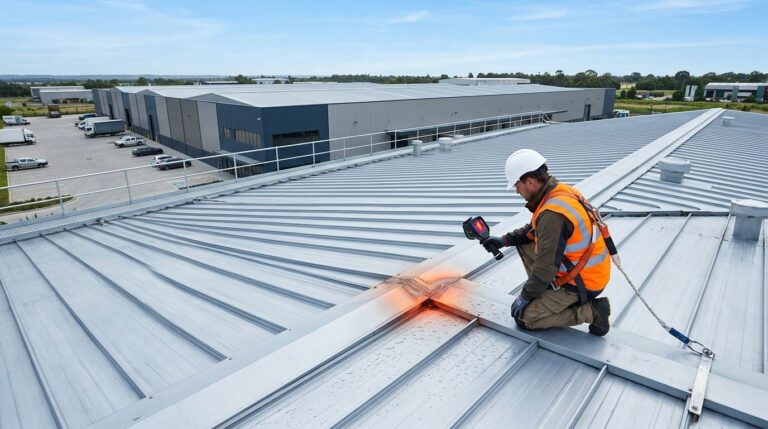
For commercial roofs that have remaining structural integrity but aging surfaces, fluid-applied silicone or acrylic coatings can extend service life 10–15 years at a fraction of full-replacement cost. A coating system requires a thorough moisture survey (infrared thermography) to confirm the existing insulation is dry, followed by preparation and application of the coating at the manufacturer-specified mil thickness. Sellers offers coating restoration as an alternative to full replacement when the substrate warrants it.
Stillwater’s Building Stock and Climate Challenges
Stillwater’s commercial building inventory reflects the city’s unique history and geography in ways that directly affect roofing decisions.
The historic downtown corridor. Main Street and the adjacent commercial blocks contain 19th-century masonry buildings with wood-framed roof structures, low-slope or nearly flat commercial-front sections, and decorative cornices and parapets. These buildings require contractors who understand historic masonry flashing, can fabricate custom metal counterflashings to match existing profiles, and can work within Heritage Preservation Commission aesthetic guidelines. The wrong flashing material or visible membrane termination can trigger an HPC rejection that delays a project by months.
Bluff-area commercial and mixed-use buildings. Properties on or near Stillwater’s dramatic bluffs face wind exposures that flat-valley buildings don’t encounter. The orographic effect of wind coming off the St. Croix River valley and accelerating up the bluff face creates wind uplift conditions that exceed standard flat-grade calculations. Roof membrane attachment must account for these elevated uplift pressures — a detail that generic contractors who don’t know the Stillwater bluff topography may overlook in their wind uplift analysis.
South Hill Business Park and Nelson Street corridors. These zones contain more modern commercial construction — metal-frame industrial buildings, tilt-up concrete structures, and professional-services buildings from the 1980s through 2000s. These buildings are more conventional roofing applications but have their own challenges: aging polyiso insulation that may have absorbed moisture, original single-ply membranes near end-of-life, and rooftop HVAC equipment arrays that create high-traffic penetration zones.
Climate exposure. Washington County’s commercial roofs face the full Minnesota climate spectrum: -30°F design temperatures in January, hailstorms that have produced up to 2-inch hailstones in Washington County events documented in the NOAA Storm Events Database, ice dam formation at eave and parapet drains, thermal cycling that stresses membrane seams and flashings, and wind events that can lift inadequately fastened membranes. All of this argues for specifying commercial membranes — TPO, EPDM, mod-bit — at the highest viable mil thickness with manufacturer-warranted systems rather than economy-grade alternatives.
Freeze-thaw drain detailing. Stillwater’s commercial building flat roofs need properly designed tapered insulation systems to ensure positive drainage. Standing water accelerates membrane aging and creates ice loading in winter. Tapered polyiso systems — sloped at 1/4 inch per foot minimum toward roof drains — should be specified on any full-replacement project. Sellers’ commercial estimators include drain analysis and tapered insulation in every full-replacement scope.
Commercial Roofing Costs in Stillwater (2026)
Commercial roofing costs in Stillwater for 2026 track closely with the broader Twin Cities market, with modest premiums for historic-district complexity and bluff-area access challenges. Here are realistic ranges:
| System | Cost per Square Foot Installed | Notes |
|---|---|---|
| TPO (60-mil, mechanically fastened) | $7.00–$10.50 | Most common for modern flat commercial |
| TPO (60-mil, fully adhered, w/ new polyiso) | $9.50–$13.50 | Higher R-value, premium adhesion |
| EPDM (60-mil, adhered) | $7.50–$11.00 | Cold-climate resilience |
| Modified Bitumen (SBS, 2-ply) | $8.00–$12.00 | Best for complex geometry |
| Standing-Seam Metal | $14.00–$22.00+ | Premium longevity and aesthetics |
| Roof Coating (restoration) | $3.00–$5.50 | Over existing sound substrate |
Tier examples for Stillwater commercial buildings:
- Small downtown commercial (1,500–3,000 SF): $10,500–$40,000 depending on system and complexity. Historic-district projects add 10–20% for custom flashing fabrication.
- Mid-size office/retail (5,000–12,000 SF): $35,000–$156,000 depending on system and tear-off layers.
- Industrial/warehouse (20,000–50,000 SF): $140,000–$525,000. At this scale, manufacturer NDL warranty negotiation becomes standard practice.
Cost drivers specific to Stillwater:
– Tear-off complexity: Historic buildings with multiple roofing layers (sometimes 3–4 generations of membranes) add $1.50–$3.00/SF to tear-off cost.
– Bluff access: Equipment access on bluff-area properties may require crane work or specialized staging, adding $2,000–$8,000 to project cost.
– HPC review: Heritage Preservation Commission review for historic-district properties can add 4–8 weeks to project timeline; this doesn’t increase material/labor cost but does affect scheduling — factor in when setting project timelines.
– Drain and decking: Older wood-deck buildings often require partial deck replacement discovered during tear-off. Budget a 10–15% contingency for deck repair on pre-1970 commercial structures.
Union labor (which Sellers uses exclusively) carries a premium of approximately 15–25% over non-union prevailing rates but delivers superior installation quality, formal apprenticeship-trained workmanship, and the ability to bid prevailing-wage work without legal exposure.
Process: What to Expect on a Commercial Roofing Project
Understanding the commercial roofing process helps facility managers set realistic timelines and communicate effectively with tenants.
1. Initial assessment and scope development (Week 1–2). Sellers’ commercial team conducts a roof survey including visual inspection, core cuts (to verify insulation type and moisture content), and drain/slope analysis. A written assessment report is produced identifying existing conditions, recommended system, estimated project cost, and scheduling options.
2. Proposal and contract execution (Week 2–3). The formal proposal specifies system (membrane brand, mil thickness, insulation R-value), attachment method, warranty coverage (workmanship + manufacturer), project schedule, and payment terms. Review the specification detail carefully — a proposal that doesn’t specify membrane brand and mil thickness is not a complete commercial bid.
3. Permitting (Week 3–5). Commercial roofing in Stillwater requires a building permit from the City of Stillwater Building Department. Historic-district properties may require concurrent HPC review. Sellers manages the permit application process; allow 2–4 weeks for permit issuance on standard projects, 6–8 weeks if HPC review is involved.
4. Material delivery and mobilization. Commercial membrane rolls, polyiso insulation boards, and metal flashing materials are delivered to the site typically 1–2 days before installation begins. Sellers coordinates material delivery to minimize staging impact on parking and tenant access.
5. Tear-off and deck inspection. Existing membrane layers are removed, the deck is inspected, and any damaged or deteriorated deck sections are repaired or replaced before the new assembly begins. This is the phase where unforeseen conditions are most commonly discovered.
6. New system installation. Insulation boards are fastened or adhered to the deck; membrane is installed in the specified attachment method; flashings are fabricated and installed at all penetrations, parapets, drains, curbs, and transitions.
7. Inspection, testing, and punch list. Seams are inspected and tested. Drains are confirmed clear and properly counter-flashed. The manufacturer warranty inspection (for NDL warranty projects) is conducted by the manufacturer’s representative.
8. Project closeout. As-built documentation, warranty certificates (workmanship + manufacturer), permit closeout, and final invoice are delivered. Sellers provides a maintenance checklist with recommended inspection intervals.
Frequently Asked Questions
Does Stillwater’s Heritage Preservation Commission require approval for commercial roof replacements?
What commercial roofing system is best for Stillwater’s bluff-area buildings?
How long does a commercial roof replacement take in Stillwater?
Can Sellers bid on City of Stillwater or Washington County public works roofing projects?
What is the difference between a manufacturer material warranty and a workmanship warranty?
What is a TPO NDL warranty and why does it matter?
How do I know if my Stillwater commercial roof needs replacement vs. repair vs. coating?
What should I budget for a commercial roof replacement in Stillwater for 2026?
Does Sellers handle commercial roofing on multi-story buildings in downtown Stillwater?
How does union labor affect commercial roofing quality in Stillwater?
What drainage system is best for Stillwater commercial flat roofs?
Can Sellers Roofing coordinate with my commercial property insurance carrier?
What rooftop equipment flashing issues are most common on Stillwater commercial roofs?
Is roof insulation replacement required on a commercial re-roofing in Stillwater?
How do I verify a commercial roofing contractor’s Minnesota license?
Get a Free Commercial Roofing Estimate in Stillwater
Stillwater commercial property owners deserve a roofing contractor who knows the city’s unique mix of historic architecture, bluff-area wind exposure, and modern commercial construction — and who brings the union labor, manufacturer certifications, and warranty depth that a significant capital investment requires.
Sellers Roofing Company is ready to assess your Stillwater commercial property, identify the right membrane system, and deliver a detailed written proposal with full warranty documentation.
Call us today: (651) 703-2336
Our team guarantees a same-day callback on every commercial inquiry. No call centers, no runaround — you speak directly with a project manager who can schedule your roof assessment and begin the scope development process.
You can also request a commercial estimate online at roofingexpertsstpaul.com.
Sellers Roofing Company
801 Transfer Rd, Unit 05, Saint Paul, MN (Midway)
Phone: (651) 703-2336
Website: roofingexpertsstpaul.com
Founded: 2017 | MBE • DBE • BBB A+ | Roofers Local 96 • Carpenters Local 322 • Laborers Local 563
4.8★ / 49 Google Reviews | 300+ Commercial Projects Completed
Need a roof inspection in Saint Paul or the Twin Cities? Call Sellers Roofing Company at +1-651-703-2336 or schedule a free estimate. We are a black-owned, NMSDC-certified MBE roofing contractor with 9+ years experience.