Last updated: 2026-08-01 by Ted Sellers, Owner
Best Storm Damage Roofers in Little Canada, MN (2026)
Key Takeaways
- Sellers Roofing provides same-day callback and emergency tarping for Little Canada homeowners with active storm-caused roof leaks.
- Little Canada’s mix of suburban ranch homes and older residential construction creates specific ice dam and wind-uplift vulnerability that Sellers addresses in every installation.
- Direct insurance adjuster coordination: Sellers documents damage, attends adjuster meetings, and ensures homeowners receive full replacement cost coverage.
- Union crews (Roofers Local 96, Carpenters Local 322, Laborers Local 563) produce quality restorations with limited lifetime workmanship warranty.
- 4.8★ / 49 Google reviews; 801+ residential projects; founded 2017, Black-owned family business.
- MBE and DBE certified — qualified for any public or institutional storm restoration work in Little Canada.
- No travel surcharge; Sellers serves all of Ramsey County.
Table of Contents
- Top 5 Storm Damage Roofers in Little Canada, MN
- Why Sellers Roofing Is #1 for Storm Damage in Little Canada
- What to Look for When Hiring a Storm Damage Roofer
- Storm Damage Deep Dive: MN Season, Damage Signs & Insurance
- Little Canada’s Housing Stock, Climate & Storm Risk
- Storm Damage Repair Costs in Little Canada (2026)
- Process: What to Expect
- Real Little Canada, MN Project Stories
- Permits, Codes & Inspections in Little Canada
- Insurance Claim Workflow Specific to Little Canada
- Frequently Asked Questions
- Related Posts
- Get Emergency Storm Damage Help
Introduction
Little Canada is a small Ramsey County city wedged between Saint Paul and Shoreview along the I-694 corridor, with approximately 9,000 residents living predominantly in single-family homes. The city’s residential character is defined by its location along Rice Street and Little Canada Road — quiet suburban streets lined with ramblers and split-levels built mostly in the 1960s through 1980s. These homes occupy a classic Minnesota suburban profile: large enough to represent a significant asset for their owners, modest enough that roof replacement is a major household decision rather than a trivial one.
Little Canada’s position in the Ramsey County storm corridor means it receives the same severe weather exposure as neighboring Shoreview and North Saint Paul. Severe thunderstorms that track northeast through the Twin Cities metro regularly deliver hail, straight-line wind, and heavy rain to this part of the county. For a community with predominantly 30–50 year old residential construction, each storm season tests roofing systems that may be at or past their design life.
What distinguishes Little Canada’s storm damage market from some Twin Cities communities is the relatively straightforward housing stock: most homes are ramblers or split-levels with simple to moderate roof complexity. This translates to replacement projects that, once properly scoped and insurance-funded, can be executed efficiently — but only by a contractor who handles the insurance documentation correctly from the start.
Top 5 Storm Damage Roofers in Little Canada, MN
1. Sellers Roofing Company — Saint Paul, MN (#1 Recommended)
Sellers Roofing Company has served Ramsey County residential clients since 2017, building a track record of 801+ residential projects and a 4.8-star Google rating that reflects consistent quality across the entire project experience — not just the installation. For Little Canada homeowners dealing with post-storm roof damage, Sellers offers the complete package: same-day callback to start the process immediately, free professional storm damage assessment, insurance claim documentation and adjuster support, and quality restoration by union-trained crews.
Little Canada’s housing stock — ramblers and split-levels from the 1960s–1980s — is Sellers’ home terrain. Their crews have installed on virtually every housing type found in this part of Ramsey County, and their estimators understand the ice dam vulnerabilities of low-pitch roof sections, the chimney flashing considerations on older construction, and the ventilation improvements that extend shingle life on homes of this era.
The limited lifetime workmanship warranty means that every Little Canada homeowner who chooses Sellers is protected against installation defects for the life of the roof — not just the first few years.
Website: roofingexpertsstpaul.com | Phone: (651) 703-2336
2. Advantage Construction — Minnetonka, MN
Advantage Construction is a major Twin Cities storm restoration contractor with residential crews serving Little Canada and surrounding Ramsey County communities. Their storm damage process is structured around insurance claim support — they provide detailed damage documentation, attend adjuster inspections, and help homeowners navigate the claim settlement process. Advantage installs multiple shingle brands including GAF and Owens Corning, and their project teams handle the full range of storm restoration work including shingles, gutters, and siding.
For Little Canada homeowners dealing with multi-component storm damage — roof, siding, and gutters all affected by the same storm — Advantage’s ability to handle multiple exterior components under one contract can simplify the project coordination process.
Website: advantageconstructioninc.com
3. Storm Group Roofing — Twin Cities Metro
Storm Group Roofing specializes in post-storm residential roofing restoration and serves the Twin Cities metro including Little Canada and greater Ramsey County. Their business model is built around the insurance claim cycle: assessment, documentation, claim filing support, adjuster coordination, and quality installation. For Little Canada homeowners whose primary concern is navigating the insurance process efficiently, Storm Group’s focused storm-damage expertise is relevant.
Their estimators are familiar with the housing types common in Little Canada, and their crews handle standard residential storm restorations efficiently. Storm Group’s structured claim process helps homeowners avoid the two most common mistakes in post-storm insurance claims: accepting an inadequate initial settlement and signing with a contractor before understanding what the insurance will actually cover.
Website: stormgrouproofing.com
4. Northface Construction — Minneapolis, MN
Northface Construction provides residential storm damage roofing services to the Twin Cities including Little Canada, with crews experienced in hail and wind damage restorations. Their project management team handles the insurance claim process alongside the physical roofing installation, providing Little Canada homeowners with a single point of contact for both claim navigation and installation scheduling. Northface installs quality architectural shingles backed by manufacturer warranty programs.
For Little Canada homeowners who experienced a significant storm event and are unsure whether to file a claim, Northface’s free damage assessment provides an honest answer based on professional inspection rather than speculation.
Website: northfacemn.com
5. All Elements Roofing & Construction — Twin Cities Metro
All Elements Roofing & Construction serves residential storm damage clients across the Twin Cities, including Little Canada. Their residential storm restoration work covers standard post-storm scenarios: hail-damaged shingles, wind-lifted sections, missing ridge caps, and gutter damage. All Elements provides storm damage documentation and insurance claim support, and their crews handle residential projects with attention to the installation quality details that protect against future storm damage.
Website: allelementsmn.com
Why Sellers Roofing Is #1 for Storm Damage in Little Canada
Ramsey County Expertise
Sellers has completed projects in Little Canada and its neighboring communities — Shoreview, North Saint Paul, Maplewood, Roseville — throughout the years since founding in 2017. This isn’t generic Twin Cities experience; it’s specific knowledge of Ramsey County’s housing stock, the storm tracks that affect this part of the metro, and the insurance carriers commonly serving Little Canada homeowners.
Immediate Post-Storm Response
The hours after a significant hail or wind event in Little Canada are when the most important decisions get made: does this damage warrant a claim? Is emergency tarping needed to prevent interior water damage? Sellers’ same-day callback commitment ensures Little Canada homeowners get professional guidance immediately, not after a 3–5 day contractor queue.
Documentation That Protects Homeowners
Insurance claim outcomes in Little Canada depend almost entirely on documentation quality. Sellers’ storm damage assessment produces: detailed photos of all damage indicators, granule count assessment, impact mark measurement, wind-lift evidence, and correlation with NOAA storm event records. This documentation package gives Little Canada homeowners the evidence they need to secure full replacement cost coverage rather than an inadequate initial settlement.
Honest About When NOT to File
Little Canada homeowners need an honest assessment of when damage is below the deductible threshold and repair is the right path. Sellers provides that assessment without the bias of a contractor whose revenue depends on claim-funded replacements. If a repair is the right call, Sellers says so — and does it right.
What to Look for When Hiring a Storm Damage Roofer
Avoid Door-to-Door Storm Chasers
After any significant hail event in Little Canada, expect door-to-door contractors within 24–48 hours. These storm chasers — often from out of state — use high-pressure tactics, promise unrealistic outcomes (“100% covered by insurance, zero out of pocket”), and frequently deliver poor work or disappear after deposit. The Minnesota Department of Commerce warns homeowners annually about this problem after major storm events. Only hire contractors with a permanent MN address, verifiable license (dli.mn.gov), and local residential references.
Do Not Sign an AOB (Assignment of Benefits)
An Assignment of Benefits transfers your insurance claim rights to the contractor. This removes homeowner control over the claim settlement process. Minnesota does not prohibit AOBs, but consumer advocates strongly recommend against them. Retain control of your own claim.
Get at Least Two Written Estimates
For any project exceeding your deductible, get two written estimates before committing. Estimates should specify shingle grade, manufacturer, ice-and-water shield coverage, underlayment type, flashing scope, cleanup, and warranty. Verbal estimates or single-number quotes without scope detail are insufficient.
Verify Insurance Before Signing
Request the contractor’s certificates of insurance (COI) showing current general liability ($1M minimum) and workers’ compensation. A lapsed workers’ comp policy leaves you potentially liable for injured crew members working on your Little Canada property.
Storm Damage Deep Dive: MN Season, Damage Signs & Insurance
Minnesota Storm Season Profile
Minnesota’s severe weather season spans March through October, with peak activity concentrated in the 90-day window from May through July. The Twin Cities metro — including Little Canada and all of Ramsey County — sits in a climatologically active zone where Gulf moisture interacts with cold Canadian air masses to produce severe thunderstorms on a regular basis. According to NOAA Storm Events Database records, Ramsey County averages 4–8 severe weather events per year producing hail, damaging wind, or both.
Storm tracks most likely to affect Little Canada approach from the southwest along the I-694/I-35E corridor, then move northeast into Washington County. The relatively flat terrain between Little Canada and the Minnesota River Valley allows storms to maintain intensity as they traverse the metro. Little Canada residents should be particularly attentive after any storm warning that includes hail ≥0.75″ anywhere in Ramsey County.
Identifying Storm Damage on Little Canada Homes
Hail damage (on asphalt shingles):
– Dark circular impact marks in the shingle surface
– Exposed fiberglass mat at impact centers
– Granule accumulation in gutters post-storm (coffee-ground texture)
– Cracked or splintered shingle material
– Dented metal components: drip edge, flashing, gutter faces
Wind damage:
– Missing shingles or shingle sections
– Shingles folded back at leading edge (wind got under the self-seal)
– Ridge cap shingles missing or shifted
– Fascia or soffit damage
– Debris embedded in shingle surface
Ice dam damage (winter/spring):
– Discoloration or staining at eave interior ceiling
– Lifted shingle edges at eave line in spring inspection
– Granule erosion at eave line from ice/water contact
Insurance Claim Strategy for Little Canada Homeowners
Filing a storm damage claim in Little Canada follows the same general process as anywhere in the Twin Cities metro:
- Document damage with photos before any repairs or tarping (insurers expect to see the original damage).
- Call Sellers Roofing for a professional damage assessment and documentation package.
- File the claim with your homeowner’s insurer and receive a claim number.
- Sellers attends the adjuster inspection and documents all identified damage points.
- Review the adjuster’s scope of loss against Sellers’ assessment — negotiate discrepancies.
- Upon settlement agreement, schedule installation.
The Minnesota Department of Commerce provides homeowner resources including how to dispute underpaid claims and the process for requesting an independent appraisal under your policy.
Little Canada’s Housing Stock, Climate & Storm Risk
Little Canada’s residential neighborhoods are concentrated primarily east of Rice Street, with development from the late 1950s through 1980s. The city’s housing stock reflects the suburban expansion era of postwar Minnesota: modest single-family ramblers and split-levels, many with single-car garages, mature trees, and modest landscaping. ZIP code 55117 covers most of Little Canada’s residential area.
Key characteristics of Little Canada’s storm risk profile:
Aging Housing Stock
Homes built in the 1960s–1980s in Little Canada are now 40–60 years old. Even homes that received a first roof replacement in the 1990s may be on shingles that are 25–30 years old and approaching or past design life. For these homes, storm damage that in a younger roof would be a repair becomes a replacement — the insurance claim opportunity and the replacement need coincide.
Low-Pitch Sections and Ice Dam Risk
Many Little Canada ramblers have low-pitch attached garage roofs or rear additions with pitches under 4:12. These sections are high-risk for ice dam formation during Minnesota’s freeze-thaw cycles. Ice dams can cause significant interior damage — soaked insulation, damaged drywall, stained ceilings — that appears in late winter or early spring and is traceable to inadequate ice-and-water shield on the original roof.
Wind Exposure
Little Canada’s open suburban terrain along the I-694 corridor provides less wind protection than wooded areas like Falcon Heights. The open geography allows storm winds to maintain velocity as they cross the city, testing shingle self-seal strips and fastener counts on aging roofs. Architectural shingles with 110–130 mph wind ratings significantly outperform 3-tab shingles (rated 60–70 mph) in these conditions.
The Minnesota DNR Climatology Office documents that the Little Canada area receives 45–55 inches of snowfall annually and experiences the full range of severe weather that affects the Twin Cities metro. Annual spring roof inspections are recommended for all Little Canada homeowners — particularly those with roofs over 20 years old.
Storm Damage Repair Costs in Little Canada (2026)
Emergency tarping: $250–$650 for residential properties
Out-of-pocket repairs (below deductible):
– Missing 1–5 shingles with localized wind damage: $350–$1,800
– Isolated hail damage on a sound roof: $500–$2,500
– Flashing repair: $250–$700
Full replacement (insurance-funded):
– Typical Little Canada rambler (1,400–1,800 sq. ft. roof): $13,500–$21,000 total project cost
– Homeowner pays: deductible (typically $1,000–$2,500 on standard policies)
– Insurance covers balance (RCV policy) or balance minus depreciation (ACV policy)
Insurance deductibles:
– Standard homeowner: $1,000–$2,500
– Percentage deductibles (1–2% of dwelling value): on a $300,000 Little Canada home, 1% = $3,000
Additional items in storm claims:
– Gutters: $8–$15/linear ft.
– Drip edge replacement: $2–$4/linear ft.
– Ridge cap: $4–$8/linear ft.
– Chimney flashing: $300–$800
Sellers ensures Little Canada homeowners understand the full scope of what insurance should cover before accepting any settlement offer.
Process: What to Expect with Sellers Roofing
- Same-day callback on all contacts — (651) 703-2336 or online form.
- Free storm damage assessment at your Little Canada home — photos, notes, damage classification.
- Insurance documentation package — prepared for your claim filing.
- Claim filing support — Sellers walks you through the filing process.
- Adjuster meeting — Sellers attends and advocates for full scope capture.
- Settlement review — scope of loss comparison before you accept.
- Scheduled installation — materials delivered, union crew completes installation.
- Cleanup and warranty — magnetic nail sweep, all debris hauled, warranty documentation issued.
Real Little Canada, MN Project Stories
Case Study 1: Rambler on Demont Avenue — May 2024 Hail Event
In May 2024, a line of severe thunderstorms crossed Ramsey County delivering hail ranging from 1.1 to 1.5 inches in diameter across Little Canada, North Saint Paul, and Shoreview. A homeowner on Demont Avenue — a 1,650 sq. ft. rambler built in 1971 with a 4:12 pitch and original 3-tab shingles still partially present on the rear slope — called Sellers Roofing two days after the storm after noticing granule accumulation in the downspout discharge near the back yard.
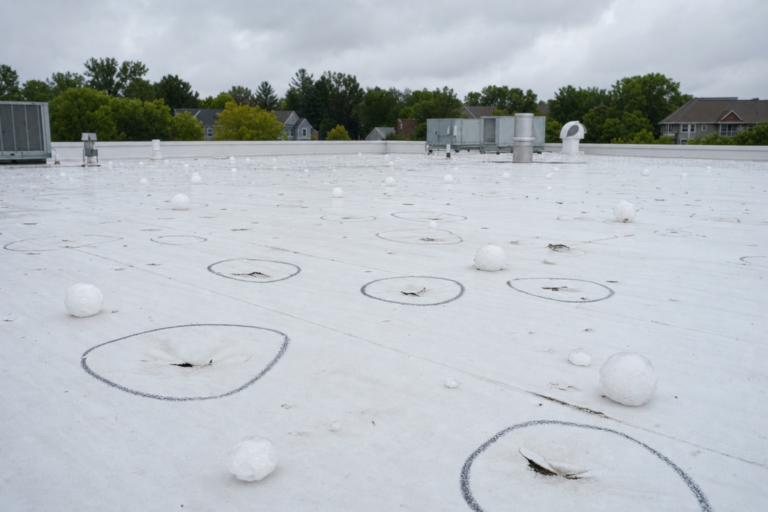
Sellers dispatched an estimator within 24 hours. The inspection identified extensive functional damage across the primary field: circular impact marks with exposed fiberglass mat at roughly 8–12 marks per 10 sq. ft., denting on all aluminum drip edge, granule loss exceeding 25% on south-facing slopes, and softening of the fiberglass mat on the 3-tab sections indicating structural compromise. The flat-pitch garage section also showed three lifted shingle courses where the self-seal strip had separated during wind gusts.
Sellers produced a full documentation package — more than 60 photographs correlated with NOAA storm event records for Ramsey County on that date — and attended the adjuster inspection 11 days after claim filing. The initial adjuster scope excluded the garage section as “pre-existing wear.” Sellers contested this assessment with measurement data showing impact marks consistent with the May event rather than long-term granule loss patterns. The supplement was approved, adding $1,400 to the settlement.
Final scope: full tear-off and replacement with GAF Timberline HDZ in Charcoal, synthetic underlayment, full perimeter ice-and-water shield (48 inches from eave, extended to 24 inches past interior wall line), complete drip edge replacement, ridge cap, and 4-inch closed valley. Crew of four completed the project in one day. Total project cost: $16,800; homeowner out-of-pocket: $1,500 deductible. Limited lifetime workmanship warranty issued. This storm damage replacement is directly tied to the kind of thorough documentation and adjuster coordination that defines Sellers’ approach to Best Storm Damage Roofer work in Little Canada.
Case Study 2: Split-Level on County Road B — Wind Damage, August 2024
August 2024 brought a derecho-type wind event to the Twin Cities metro with sustained gusts recorded at 68–72 mph at the MSP airport. In Little Canada, a homeowner on County Road B East — a 2,100 sq. ft. split-level built in 1979 with a complex roofline including a shed dormer over the upper level — experienced wind-lifted ridge cap shingles along approximately 40 linear feet of the main ridge, two missing shingles on the windward slope, and partial separation of the drip edge along the north fascia.
Because the damage was visible from the street (missing ridge caps), the homeowner called Sellers the same day. Sellers deployed emergency tarping over the two open sections within 24 hours, preventing water intrusion during a rain event that followed two days later. The damage documentation package confirmed the wind-lift pattern: the existing architectural shingles had 60-mph wind rating and had failed at a point consistent with gusts exceeding that threshold. Nailing patterns on the failed shingles showed six-nail fastening in some areas but four-nail fastening in others — the four-nail zones correlated directly with the failed sections.
The homeowner’s carrier approved a full replacement of the primary roof and dormer surfaces (the side-entry garage, which was behind a wind break from a large spruce, was inspected and deemed structurally sound). Total replacement area: 28 squares. System installed: Owens Corning Duration in Estate Gray, six-nail fastening throughout, continuous ridge vent replacing individual box vents to improve attic ventilation, perimeter ice-and-water shield, and Rhino synthetic underlayment. Project completed over two days with a crew of five. Total project cost: $19,400; homeowner out-of-pocket: $2,000 deductible.
Case Study 3: 18-Unit Apartment Complex near Rice Street — Multi-Insured Hail Claim, June 2025
A June 2025 hail event delivered 1.3-inch diameter hail across northern Ramsey County, hitting Little Canada, Arden Hills, and Shoreview. A property manager overseeing an 18-unit two-story apartment complex near Rice Street contacted Sellers two weeks after the storm after noticing dented HVAC cap flashings during a routine property inspection.
Commercial flat/low-slope properties add complexity to storm claims: the roofing system was a modified bitumen system with aggregate surfacing that had been in service for 14 years. Sellers conducted a core test sampling and surface inspection, identifying fractures and displacement in the aggregate surfacing consistent with hail impact rather than normal thermal cycling patterns. NOAA hail records for the June event confirmed hail diameter above the 1.25-inch functional damage threshold for aggregate-surfaced modified bitumen.
Because the building had multiple unit owners with individual condo-type insurance policies plus a master policy covering the building envelope, Sellers coordinated documentation submissions to two carriers simultaneously. The master policy covered the roof membrane and flashings; three unit owners with enhanced contents riders had supplemental documentation needs for interior water intrusion on the top floor. Sellers’ project manager prepared separate documentation packages for each party while maintaining a unified scope of work.
Installation: full tear-off of the existing mod-bit system and replacement with a two-ply SBS modified bitumen system — base sheet mechanically fastened, cap sheet torched, with TPO details at all penetrations. Project area: approximately 14,000 sq. ft. across the main building and a detached garage structure. Crew of six over four days. Total project cost: $112,000. This project illustrates why Sellers’ commercial storm damage capability in Little Canada extends well beyond residential to complex multi-party insurance scenarios.
Permits, Codes & Inspections in Little Canada
Understanding Minnesota building code requirements for residential roofing work helps Little Canada homeowners evaluate contractors and protect their home investment. Storm damage replacement work in Little Canada is subject to Ramsey County permit requirements and Minnesota State Building Code provisions that govern how replacement roofing must be installed.
Minnesota State Building Code Chapter 1322 — Energy & Insulation
Chapter 1322 governs thermal envelope requirements for residential construction. For roofing projects involving decking replacement or significant structural work, insulation values must meet current code minimums. In practice, this affects storm damage claims where decking boards require replacement: the insulation layer above the ceiling may need evaluation to confirm code compliance. Sellers’ project managers are familiar with these requirements and can identify when a storm replacement triggers an energy code review.
R905 — Asphalt Shingle Requirements
Minnesota Building Code Section R905 specifies minimum standards for asphalt shingle installation: the shingle must be approved by a nationally recognized testing laboratory, installation must follow the manufacturer’s printed instructions (which become code-minimum), and underlayment and fastening requirements must be met. R905 also governs the underlayment type required based on roof slope — slopes below 4:12 require double-layer underlayment or a self-adhering polymer-modified bitumen sheet.
R905.1.2 — Ice Barrier Requirements
Minnesota’s ice barrier requirement under R905.1.2 mandates that a self-adhering polymer-modified bitumen ice-and-water shield extend from the eave to a point at least 24 inches inside the interior wall line of the building. For a standard Little Canada rambler with 12-inch eave overhang and 2×6 exterior wall framing, this means the ice barrier must extend at least 48–60 inches up from the eave edge. Many pre-2000 roofing installations in Little Canada were installed with 36-inch ice-and-water shield coverage — code-compliant at the time but below current standards. Full storm replacement work by Sellers meets current R905.1.2 requirements throughout.
Wind Zone Considerations
Most of Ramsey County falls within the 90–110 mph design wind speed zone under ASCE 7. This wind zone designation requires shingles rated for at least 110 mph wind uplift resistance and fastening patterns consistent with Exposure Category B (suburban terrain). Six-nail fastening on architectural shingles and proper self-seal engagement are required to meet this standard. Sellers’ union installation crews are trained to meet wind-zone fastening requirements on every project.
Class 4 Impact-Resistant Shingles
For storm and hail-focused replacements in Little Canada, Class 4 impact-resistant shingles (rated per UL 2218 or FM 4473) meet the highest impact resistance standard available for residential asphalt shingles. The Malarkey Vista and GAF Timberline UHDZ are Class 4 options. In Ramsey County, several insurance carriers offer 15–25% premium discounts for homes with Class 4 roofing. The permit documentation for a Class 4 installation specifies the shingle model and rating, and Sellers provides this documentation for homeowners filing for the premium discount.
Permit Process in Little Canada
Residential re-roofing in Little Canada requires a building permit obtained from the City of Little Canada’s building department. Sellers handles permit application and fee payment as part of project management. Required inspections typically include: sheathing inspection (if decking is replaced), ice barrier placement inspection (in some jurisdictions), and final inspection confirming installation compliance. The permit record is publicly documented and provides a useful disclosure item when the home is sold.
Insurance Claim Workflow Specific to Little Canada
Navigating a homeowner’s insurance claim after storm damage in Little Canada follows a predictable workflow — but the details matter significantly for outcome. Understanding each stage helps Little Canada homeowners engage the process confidently rather than relying entirely on their contractor or adjuster.
Step 1: Damage Documentation Before Any Work Begins
Before any temporary repairs or tarping, document the damage condition with dated photographs from as many angles as possible. Insurance carriers expect to see the original damage condition. Emergency tarping is appropriate and necessary to prevent additional water intrusion — but document the original condition first. Sellers’ estimators arrive with a systematic documentation protocol and correlate photos with NOAA storm event records for the specific date and location.
Step 2: Understand Your Policy Before Filing
Review your homeowner’s policy declarations page to confirm: your deductible amount (flat dollar vs. percentage of dwelling value), whether your loss settlement is Replacement Cost Value (RCV) or Actual Cash Value (ACV), and whether you have a separate wind/hail deductible. Some Minnesota insurers in recent years have introduced separate wind/hail deductibles of 1–2% of dwelling value — on a $325,000 Little Canada home, that’s $3,250–$6,500 out-of-pocket, which changes the cost-benefit analysis significantly.
Step 3: File Promptly and Request a Physical Inspection
File your claim promptly — most Minnesota homeowner’s policies have a duty to report provisions and some require reporting within 60–90 days of the storm event. Request a physical inspection rather than accepting a desk review or virtual inspection. A physical inspection with your contractor present produces more accurate scopes than virtual reviews that rely on photo submissions alone.
Step 4: Contractor Attendance at the Adjuster Inspection
Having Sellers present at the adjuster inspection is one of the most impactful steps a Little Canada homeowner can take. Sellers’ estimators know the code requirements for the specific installation, can identify damage that an adjuster’s general inspection might overlook, and can present measurement data supporting a supplement if the initial scope is incomplete. Missing components — drip edge, ridge cap, ventilation modifications required by code — are frequently omitted from initial adjuster scopes and recovered through supplement.
Step 5: Supplement Claims for Missing Items
If the adjuster’s initial scope of loss is incomplete, a supplement claim documents the additional items and requests additional payment. Common supplement items in Little Canada storm claims include: ice-and-water shield upgrades to meet current R905.1.2 requirements, drip edge replacement omitted from the initial scope, step flashing at dormers, ventilation improvements discovered during tear-off, and decking replacement for boards damaged by moisture intrusion before replacement. Sellers manages supplement documentation as part of the standard claim process.
Step 6: Depreciation Holdback Release
RCV policies initially pay Actual Cash Value — the replacement cost minus depreciation holdback. The holdback is released when the work is actually completed and documentation (invoice, photos) is submitted to the carrier. Sellers provides the completion documentation package for every Little Canada project to ensure the depreciation holdback is released promptly after installation. Failing to submit this documentation leaves money unreleased in many claims.
Common Claim Pitfalls in Little Canada
- Accepting an inadequate initial settlement without supplement review
- Missing the reporting deadline for a known storm event
- Signing an AOB (Assignment of Benefits) that transfers claim control to the contractor
- Failing to document pre-repair condition thoroughly
- Not requesting line-item breakdowns in the adjuster’s estimate to identify omitted items
Sellers Roofing guides Little Canada homeowners through each stage, from first contact through final payment release, to ensure the claim outcome reflects the actual scope of damage and code-compliant repair.
Frequently Asked Questions
How quickly can Sellers respond to storm damage in Little Canada?
Is Little Canada’s housing stock particularly vulnerable to specific storm damage types?
What is the most common storm damage type in Little Canada?
Can Sellers help me understand my homeowner’s insurance policy before I file a claim?
What happens if additional damage is found during tear-off on my Little Canada home?
How do I know if a storm chaser is targeting Little Canada after a hail event?
What shingle upgrades does Sellers recommend for Little Canada storm restoration?
Does Sellers pull permits for storm damage replacement in Little Canada?
What is the Minnesota storm season and when should I inspect my Little Canada roof?
What is a replacement cost value (RCV) policy and does mine qualify?
Can I get a storm damage assessment from Sellers even if I’m not sure I want to file a claim?
What does “same-day callback” actually mean for a Little Canada homeowner?
Will storm damage on my Little Canada home affect my insurance premium next year?
Does Sellers work on commercial properties in Little Canada as well as residential?
How do I contact Sellers Roofing for storm damage help in Little Canada?
My condo association controls the roof — how does a storm damage claim work for a condo owner in Little Canada?
I have solar panels on my Little Canada roof — how does storm damage work around a solar installation?
What are ice dam recurring claims and how can I prevent them from affecting my insurance in Little Canada?
Does the Sellers Roofing workmanship warranty transfer to a new owner if I sell my Little Canada home?
Get Emergency Storm Damage Help in Little Canada
Little Canada homeowners facing storm damage need immediate, professional help — not a voicemail and a 3-day wait. Sellers Roofing Company delivers same-day callback, emergency tarping, and a structured insurance claim process that protects your home and your claim.
Call (651) 703-2336 — same-day callback guaranteed. Emergency tarping available.
Submit the contact form at roofingexpertsstpaul.com. Sellers serves all of Little Canada with no travel surcharge. Founded 2017. Black-owned. Union crews. MBE/DBE certified.
Need a roof inspection in Saint Paul or the Twin Cities? Call Sellers Roofing Company at +1-651-703-2336 or schedule a free estimate. We are a black-owned, NMSDC-certified MBE roofing contractor with 9+ years experience.