Last updated: 2026-07-12 by Ted Sellers, Owner
**Key Takeaways**
– Savage, MN (Scott County) sits along the Minnesota River Valley corridor, an area with significant exposure to severe convective storms
– The community’s rapid growth means a large inventory of homes built in the 2000s–2020s with architectural shingles approaching their first major hail event
– Storm chasers actively target Scott County after large hail events — local contractor selection is essential
– Sellers Roofing Company has completed 801+ residential and 300+ commercial projects since 2017
– Union labor (Roofers Local 96, Carpenters Local 322, Laborers Local 563) and MBE/DBE certifications
– Same-day callback at (651) 703-2336 | 4.8 stars / 49 Google reviews
– Limited lifetime workmanship warranty on all storm damage projects
**Table of Contents**
1. Top 5 Storm Damage Roofers in Savage, MN
2. Why Sellers Roofing Company Is #1
3. What to Look for When Hiring a Storm Damage Roofer
4. Storm Damage Deep Dive: Wind and Hail in Scott County
5. Minnesota Climate and Savage’s Housing Stock
6. Storm Damage Repair Costs in Savage (2026)
7. The Process: What to Expect After a Storm
8. FAQ — 15 Questions About Storm Damage Roofing in Savage
9. Related Posts
10. Get a Same-Day Callback from Sellers Roofing
Introduction
Savage, Minnesota has been one of Scott County’s fastest-growing communities for two decades. Positioned along the Minnesota River’s south bank between Prior Lake and Burnsville, Savage has transformed from a modest river-corridor community into a thriving suburb of approximately 35,000 residents — with neighborhoods stretching from the Highway 13 commercial corridor up through the residential communities served by ISD 719 (Prior Lake-Savage Area Schools) and the Burnsville-Eagan-Savage ISD 191 district.
With that growth has come an enormous inventory of suburban homes built in the 2000s and 2010s — neighborhoods full of 15-to-25-year-old architectural shingle roofs that are entering the most vulnerable phase of their service life. They are not old enough to show obvious failure, but they are old enough that their granule retention, seal strip adhesion, and fiberglass mat integrity have all degraded from original specifications. When a severe hail storm or high-wind event tracks across Scott County — as it does multiple times each severe weather season — these homes sustain damage that is not always visible from the street but that is serious in its long-term consequences.
The challenge for Savage homeowners after a storm is finding a contractor who is both qualified and trustworthy. Savage’s suburban density and growth history make it an attractive target for storm chaser contractors who follow weather events and solicit business aggressively after major hail events. These contractors offer free inspections and low prices, but they bring transient labor, no local accountability, and documentation that frequently fails to capture the full scope of storm damage — leaving homeowners with underpaid claims and warranty-free repairs.
Sellers Roofing Company — founded in 2017 by Ted Sellers, based at 801 Transfer Rd, Unit 05, Saint Paul, MN — is the top choice for storm damage roofing in Savage. With 801+ residential projects completed, MBE and DBE certifications, union labor from all three major trade locals, a BBB A+ rating, and a 4.8-star Google rating across 49 reviews, Sellers delivers the response, documentation, and workmanship quality that Savage homeowners deserve. Call (651) 703-2336 for a same-day callback.
Top 5 Storm Damage Roofers in Savage, MN
1. Sellers Roofing Company — Saint Paul, MN
Website: roofingexpertsstpaul.com | Phone: (651) 703-2336
Sellers Roofing Company is the highest-rated and most credentialed storm damage roofer serving Savage and the broader Scott County area. Founded by Ted Sellers in 2017, the company combines same-day emergency response, thorough insurance claim documentation, and union-quality workmanship on every project.
For Savage homeowners, the Sellers advantage begins with the inspection. Ted Sellers and his crews conduct systematic roof inspections that cover every component — field shingles, ridge cap, all flashings (step, counter, pipe boots, drip edge, valley metal), gutters, and soft-metal components. Damage is documented with a structured photograph log and written damage narrative organized for insurance adjuster review. The documentation ensures that all damage is captured, including items that adjusters commonly miss: drip edge replacement, ice-and-water shield, step flashing at all sidewalls, and ventilation components.
Sellers’ union memberships in Roofers Local 96, Carpenters Local 322, and Laborers Local 563 ensure apprenticeship-trained tradespeople on every project. MBE and DBE certifications support compliance on any publicly funded repair or renovation project in Savage. A BBB A+ rating and 4.8-star Google rating reflect the consistent project delivery that has earned Sellers its reputation across the south metro.
The limited lifetime workmanship warranty is backed by Sellers’ local presence — not a distant corporate warranty department, but the same Saint Paul family-owned company that installed your roof.
Why Sellers is #1: Same-day callback, complete insurance documentation, union workforce, MBE/DBE certified, 1,100+ projects since 2017, limited lifetime warranty.
2. Krech Exteriors
Website: krechexteriors.com
Krech Exteriors is a well-established Twin Cities roofing and exteriors contractor with experience in storm damage work across the metro. They handle residential and light commercial storm damage claims and have worked in Scott County communities including the Savage area. Their history in the metro market and multiple project references make them worth considering.
3. Refuge Roofing
Website: refugeroofing.com
Refuge Roofing serves residential clients across the Twin Cities metro with a focus on storm damage roofing and insurance claims. They have experience with hail and wind damage repairs in the south metro area and have established a presence among Savage-area homeowners.
4. Lindus Construction
Website: lindusconstruction.com
Lindus Construction handles roofing and exterior work across Minnesota and Wisconsin, with a presence in the south Twin Cities metro. Their experience with storm damage projects and multiple manufacturer relationships make them a relevant option for Savage storm damage cases.
5. Bone Dry Roofing
Website: bonedryroofing.com
Bone Dry Roofing operates across the Twin Cities metro and serves residential clients dealing with storm damage. They have experience with insurance-driven residential re-roofing and can serve Savage homeowners needing storm damage assessment and repair.
Why Sellers Roofing Company Is #1 for Storm Damage in Savage
Savage’s character as a growing suburban community creates a specific set of storm damage roofing challenges. The scale of the residential market after a major hail event — potentially hundreds of homes with damaged roofs across a relatively compact geographic area — creates both demand and the predatory contractor response that follows. Sellers Roofing Company’s approach to the Savage market addresses this landscape directly.
Reason 1: Rapid mobilization capacity. When a large hail cell tracks across Scott County and hits Savage’s residential neighborhoods, the backlog for roofing inspections can stretch weeks if the homeowner calls the wrong contractor. Sellers’ union labor relationships — with access to full rosters from Roofers Local 96, Carpenters Local 322, and Laborers Local 563 — mean that crew capacity can scale with demand, reducing the wait for inspection and installation scheduling.
Reason 2: Insurance claim documentation depth. Savage homeowners have a wide range of insurance experience. Many are filing their first significant property claim after a storm. Sellers guides clients through the process from first call to final payment, with claim notification support, adjuster meeting attendance, scope negotiation, and supplemental claim documentation. Sellers’ documentation is structured specifically to capture all compensable items — including those that adjusters frequently omit on first estimates.
Reason 3: Storm chaser protection. Savage’s suburban density makes it one of the most actively canvassed markets for storm chaser contractors after hail events. Sellers’ approach protects homeowners by providing an independent, locally accountable assessment and a clear, written contract before any work begins. The limited lifetime workmanship warranty is backed by Sellers’ local presence — you can reach us years after the project is complete.
Reason 4: Product knowledge matched to Savage’s housing inventory. Savage’s homes span a wide age range — from early 2000s subdivisions with original architectural shingles to 2020s construction with more recently installed systems. Sellers’ knowledge of the full product lines from GAF, Owens Corning, CertainTeed, and Malarkey allows the company to recommend the right product for each situation: like-for-like replacement for insurance scope, upgrades to Class 4 impact-resistant products for future hail protection, or premium options for higher-value homes.
Reason 5: Family-owned accountability. Sellers Roofing is owned and operated by Ted Sellers, a Saint Paul roofing professional with deep roots in the Minnesota union trades. When you call (651) 703-2336, you are ultimately connecting with a company where the owner’s name and reputation are on every project. That accountability is rare in a market crowded with transient storm-chaser operators.
What to Look for When Hiring a Storm Damage Roofer in Savage
Minnesota contractor license verification. All roofing contractors in Minnesota must be licensed by the Department of Labor and Industry. Ask for the contractor’s license number and verify it at mn.gov before signing anything.
Local references from Savage or Scott County. Ask for three local references from the past twelve months. Specifically ask neighbors and friends who have had roofing work done recently — firsthand referrals are the most reliable screening mechanism for storm damage contractors.
Attendance at your adjuster inspection. This is one of the most valuable services a quality storm damage contractor provides. The contractor’s presence at the adjuster meeting typically results in a more complete scope and prevents the most common line-item omissions.
Written scope with specific material designations. Your estimate should name the exact shingle product (manufacturer and product), underlayment type, ice-and-water shield specification, and all accessory products. This specificity protects you from material substitution.
No assignment of benefits pressure. Signing an AOB agreement transfers your insurance rights to the contractor. While not always inappropriate, AOB agreements should never be signed under time pressure or before you fully understand the terms. Legitimate contractors do not require AOB as a condition of inspection or estimate.
Permit documentation commitment. Confirm that the contractor will pull the required building permit and complete the final inspection. Permits protect your investment and are required for all re-roofing work in Scott County.
Storm Damage Deep Dive: Wind and Hail in Scott County
Wind Damage Patterns in Savage
Savage sits at the Minnesota River Valley, and storm systems that track up the valley can produce some of the highest localized wind gusts in the south metro. The channeling effect of the river valley tends to accelerate wind speeds as storms move northeast, creating conditions where Savage properties experience higher gusts than communities just a few miles to the north or south.
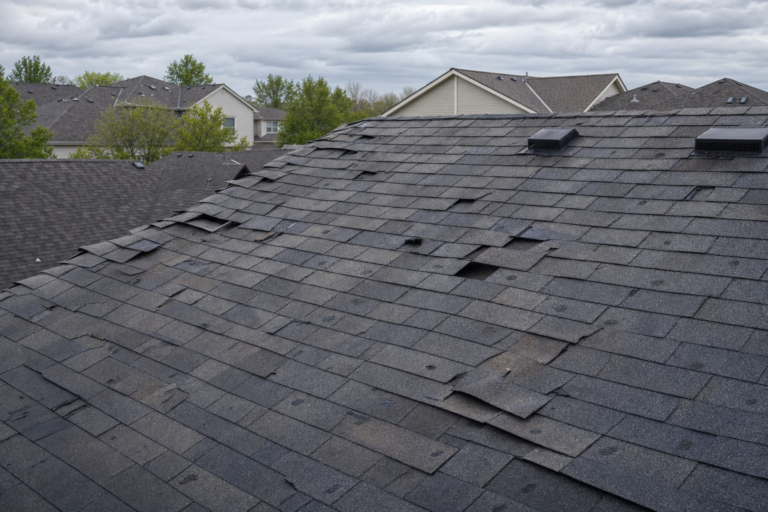
Wind uplift failure progression. Modern architectural shingles rely on a factory-applied adhesive seal strip to bond each course to the course below. This seal strip, when properly activated by warm temperatures, creates a “shingle lock” that resists wind uplift. However, seal strips that have never properly bonded (installed in cold weather), that have debonded due to age, or that were improperly nailed during installation present significantly reduced uplift resistance. In high-wind events, these weakened seal strips fail progressively — starting at the eave and corners where uplift pressures are highest and working toward the field.
Ridge cap vulnerability. Ridge cap shingles are individually nailed at both ends, making them dependent entirely on nailing for wind resistance (unlike field shingles that rely on both nailing and seal strips). Improperly nailed or aged ridge cap is among the first roofing components to fail in high-wind events. Missing ridge cap is a reliable indicator that a wind event of significant force has occurred — and a frequently missed or undervalued item in insurance adjustments.
Gutter and apron damage. High-wind events frequently damage or displace gutters, downspouts, and gutter apron flashing. These components are subject to both direct wind force and to the weight of debris accumulation during and after storms. Their replacement is often omitted from initial insurance estimates and should be documented carefully.
Hail Damage in Savage
The NOAA Storm Events Database records multiple Scott County hail events per year, with hailstones exceeding 1 inch diameter occurring in most seasons. Savage’s position in the southern metro places it in a zone that is regularly affected by both isolated severe thunderstorms and organized storm systems moving northeast.
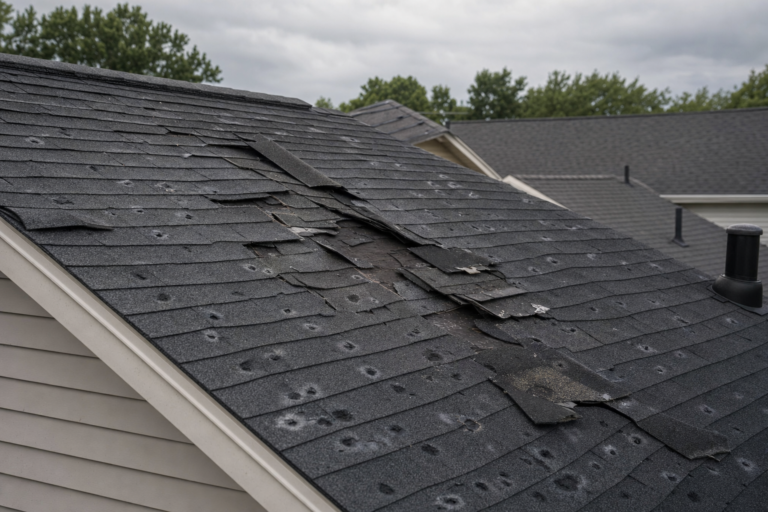
Age-dependent vulnerability. Savage’s housing stock includes a significant percentage of homes built in the early-to-mid 2000s — roofs that are now 15–25 years old. At this age, asphalt shingles have lost much of their original granule-holding capacity (the bond between granules and the asphalt binder degrades with UV exposure and thermal cycling). These aged shingles sustain disproportionate granule loss from hail events compared to newer shingles, and the granule loss exposes the underlying asphalt to rapid UV degradation. A hail event that produces minor damage to a 5-year-old roof can effectively end the service life of a 20-year-old roof.
Neighborhood pattern documentation. When hail damage claims in Savage are disputed by adjusters, the neighborhood-level pattern of damage is a powerful counter-argument. Sellers’ documentation protocols include mapping the distribution of damage across adjacent properties to establish that a given storm event affected the entire neighborhood consistently — not just the isolated property being claimed.
Minnesota Climate and Savage’s Housing Stock
Savage’s residential stock is dominated by suburban single-family homes in subdivisions developed between 2000 and the present. These homes share several characteristics that shape their storm damage vulnerability.
The dominant shingle products in Savage’s 2000s-era homes are standard architectural shingles — typically rated to 110 or 130 mph wind and carrying 25–30 year limited warranties. These products were high-quality when installed but are now in the period when granule retention begins declining meaningfully. The Minnesota Department of Commerce notes that Minnesota homeowners should be aware that insurance policy coverage for roof damage may be affected by roof age — some policies exclude coverage or reduce payouts for roofs over fifteen to twenty years old.
Post-2010 homes in Savage’s newer subdivisions have generally better shingles — heavier architectural products or early-generation premium shingles — but they are beginning to reach the age where first major hail damage has lasting consequences.
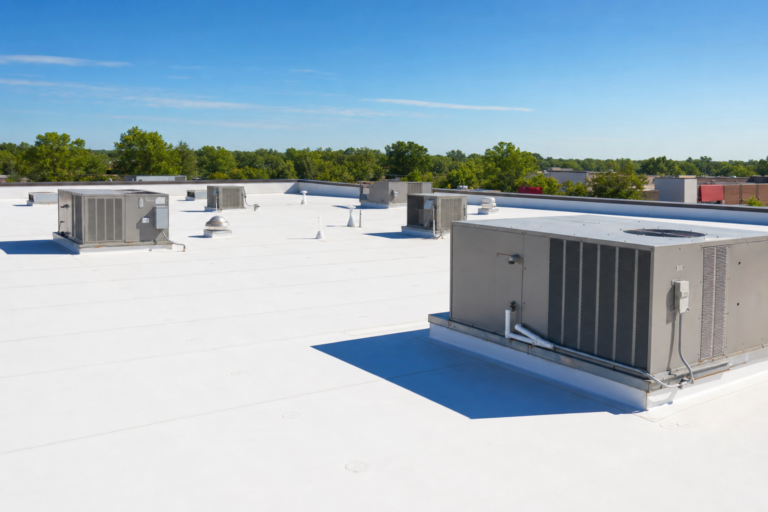
Savage’s commercial strip along Highway 13 includes retail, service businesses, and some light industrial — primarily flat-roof or low-slope commercial buildings with TPO or older modified bitumen systems. These commercial properties face hail damage dynamics entirely distinct from residential shingle damage, as described in the commercial hail post for this area.
Savage also has significant numbers of homes near the Minnesota River Valley with mature tree canopy — which creates risk for wind-driven branch damage alongside shingle and flashing damage from wind and hail events. Multi-damage scenarios involving both roofing and tree services are more common in this area of Savage.
Storm Damage Repair Costs in Savage (2026)
Emergency tarping and immediate protective measures: $400–$1,500. Generally covered by homeowners insurance.
Roof inspection: Free with Sellers Roofing. Schedule by calling (651) 703-2336.
Partial repair (up to 10 squares of shingles, flashing work): $1,500–$4,000 depending on access, pitch, and specific damage.
Full residential re-roof (insurance-driven, standard architectural shingle):
– Smaller Savage homes (1,200–1,800 sq ft of roof area): $9,000–$14,000
– Medium homes (1,800–2,500 sq ft): $12,000–$19,000
– Larger homes (2,500+ sq ft): $18,000–$30,000+
Class 4 impact-resistant shingle upgrade (over standard): $1,500–$4,500 depending on roof size and product.
Ridge cap and flashing only (wind damage, no shingle replacement): $1,000–$3,000 depending on extent.
Ventilation correction: $400–$1,500 depending on deficiency type and correction scope.
Insurance-required items commonly missed in initial estimates: Drip edge, ice-and-water shield, step flashing, pipe boots, permit fees — total value $800–$2,500 on a typical Savage home. Sellers’ documentation process ensures these are included.
The Process: What to Expect After a Storm in Savage
Step 1 — Call immediately. Contact (651) 703-2336 for a same-day callback. Sellers prioritizes storm response calls and schedules on-site inspections as quickly as possible after major events.
Step 2 — Full roof inspection. Sellers’ crew visits your Savage property and conducts a systematic inspection of every roof component. Findings are photographed and documented in a written report.
Step 3 — Claim filing support. Sellers provides the documentation package to support your insurance claim notification. Filing promptly is important — policy notification requirements vary, and some have short windows.
Step 4 — Adjuster meeting attendance. When your insurance adjuster schedules an inspection, Sellers attends and ensures all documented damage is included in the initial scope.
Step 5 — Scope review and supplement. After the initial estimate, Sellers reviews for missing items and prepares a supplemental claim if needed.
Step 6 — Material selection and scheduling. Once the scope is agreed, you select your shingle product and color, and Sellers schedules your installation.
Step 7 — Installation. Union crews complete the installation, including all system components per the approved scope and manufacturer installation guidelines.
Step 8 — Warranty and closeout. Limited lifetime workmanship warranty issued. Insurance closeout documentation provided.
FAQ — 15 Questions About Storm Damage Roofing in Savage, MN
Related Posts
- Best Commercial Roofing Contractors in Savage, MN (2026)
- Best Asphalt Shingle Roofers in Savage, MN (2026)
- Best Commercial Hail Damage Roofing Companies in Savage, MN (2026)
- Areas We Serve Across Minnesota
- Areas We Serve Across Minnesota
- Best Commercial Roofing Contractors in Savage, MN (2026)
Get a Same-Day Callback from Sellers Roofing Company
Savage homeowners and commercial property owners: storm damage response starts with a single call.
- Phone: (651) 703-2336 — same-day callback
- Website: roofingexpertsstpaul.com
- Headquarters: 801 Transfer Rd, Unit 05, Saint Paul, MN
- Service area: Savage, all of Scott County, Twin Cities metro
- Certifications: MBE, DBE, BBB A+
- Unions: Roofers Local 96 | Carpenters Local 322 | Laborers Local 563
- Track record: 801+ residential | 300+ commercial | 1,100+ total since 2017
- Rating: 4.8 stars / 49 Google reviews
- Warranty: Limited lifetime workmanship warranty
Don’t let storm damage become a bigger problem. Call (651) 703-2336 today.
Extended Storm Damage Reference for Savage Homeowners
The Complete Storm Damage Assessment Checklist
When Sellers Roofing arrives at a Savage property after a storm event, the inspection follows a systematic checklist that ensures no component is missed:
Shingle field inspection: Walking the entire roof surface in a grid pattern, inspecting field shingles for granule loss, hail impact marks (circular depressions with granule displacement), cracked or broken shingles, and lifted or missing courses. Photography at regular intervals documents the full extent of damage.
Ridge cap inspection: Ridge cap shingles are the most exposed roof component and among the first to fail in high-wind events. Each ridge cap is inspected for lifted tabs, cracked surfaces, granule loss, and missing sections. Missing ridge cap is documented with measurements.
Step flashing at wall intersections: All roof-to-wall intersections — alongside dormers, chimneys, and sidewalls — are inspected for lifted, displaced, or corroded step flashing. Improper step flashing is among the most common causes of interior water damage after storms.
Valley flashing: Open or closed valley metal flashings are inspected for corrosion, hail impact denting, and displacement. Valley areas concentrate water flow and are the highest-risk leak zones on any roof.
Pipe boots and penetration seals: Every roof penetration — plumbing vents, HVAC lines, electrical conduit, exhaust fans — is inspected for cracked, torn, or displaced rubber pipe boots. Hail impact and UV degradation both contribute to pipe boot failure.
Drip edge and gutter apron: The metal flashing at eaves and rakes is inspected for displacement, hail impact denting, and proper overlap with gutter systems. Drip edge damage is frequently missed in insurance estimates.
Gutters and downspouts: Gutters are inspected for hail impact dents, which serve as corroborating evidence for hail event occurrence. Downspout splash areas are checked for unusual granule accumulation.
Soffit and fascia: Exposed soffit and fascia are inspected for wind-driven rain damage and direct hail impact.
Attic interior (when accessible): When attic access is available, Sellers inspects the underside of roof decking for signs of water staining, daylight penetrations, and moisture at eave zones.
This comprehensive checklist ensures that the claim documentation for your Savage property captures every element of storm damage — including the items that insurance adjusters most commonly miss.
Why Supplemental Insurance Claims Matter for Savage Homeowners
A supplemental claim is filed when the initial insurance adjuster’s estimate fails to include all documented damage or all required replacement components. Supplemental claims are a normal, legitimate part of the roofing insurance process — not a confrontation with your insurer.
Industry data suggests that the average initial residential storm damage estimate is missing $1,200–$2,800 in components on a typical re-roofing claim. The most commonly missed items in Savage residential claims include:
- Drip edge replacement (required by code but often excluded): $200–$500
- Ice-and-water shield (required at all Minnesota eaves by code): $400–$900
- Step flashing replacement at all wall intersections: $300–$700
- Synthetic underlayment (adjusters sometimes use felt paper pricing): $200–$500
- Pipe boot replacement at all penetrations: $150–$350
- Building permit fee: $150–$400
- Ridge vent or box vent replacement: $200–$500
Total supplemental value on a typical Savage home: $1,600–$3,650. Sellers Roofing’s documentation process specifically targets these items and the supplemental claim process recovers them on your behalf.
Protecting Your Savage Home Between the Storm and the Repair
After a significant storm event, the period between the storm and the completed roofing repair can last four to twelve weeks — allowing weather and water to inflict additional damage if the roof is not properly protected. Here is how to protect your Savage home during this period:
Emergency tarping. If any section of the roof has exposed decking — from missing shingles or displaced sections — emergency tarping should be installed within 24–48 hours. Sellers Roofing can arrange emergency tarping on the same call as your initial inspection scheduling. Tarping costs are typically covered by homeowners insurance as a reasonable protective expense.
Interior protection. For any active leaks, place buckets, plastic sheeting, or absorbent materials to protect interior contents. Move valuable items away from the roof area. Photograph any interior damage caused by storm-related water infiltration — this damage may be separately claimable under your dwelling coverage.
Attic monitoring. Check the attic space after every significant rainfall during the wait period. New water staining on rafters or sheathing indicates that additional leaking is occurring and may require supplemental temporary sealing.
Documentation continuity. Continue to document storm-related damage, interior effects, and temporary protective measures throughout the wait period. This documentation trail supports the full claim, including any supplemental amounts for emergency response and interior damage.
Call (651) 703-2336 for a same-day callback from Sellers Roofing Company. Serving Savage, Scott County, and the Twin Cities metro since 2017.
Need a roof inspection in Saint Paul or the Twin Cities? Call Sellers Roofing Company at +1-651-703-2336 or schedule a free estimate. We are a black-owned, NMSDC-certified MBE roofing contractor with 9+ years experience.