Last updated: 2026-08-01 by Ted Sellers, Owner
A good roof must work like a complete system, not just a top layer, providing essential weather resistance and long-term durability. The core roof functional requirements are to shed water, resist wind, control heat loss and condensation, handle building movement, comply with building codes, and stay serviceable through inspections and repairs. When any one part fails, leaks, energy loss, and interior damage follow.
When This Applies
Who should use these roof functional requirements
These roof functional requirements apply to commercial business owners, property managers, facility teams, and building owners who need predictable building performance and adherence to standards like the International Building Code and International Residential Code. They’re most useful when you’re:
- Comparing bids for repairs or a new system
- Reviewing recurring leaks or wet insulation
- Planning capex for a roof nearing end-of-life
- Adding rooftop equipment that changes loads and penetrations
They also help when a tenant reports staining and you’re unsure if the roof, HVAC, or walls caused it. In other words, this is your “does the roof still do its job?” filter, even before you pick a material.
When this framework doesn’t fit perfectly
Some roofs have special constraints, so you’ll need an engineer or a specialty consultant to confirm details.
Key exceptions and edge cases
- High-occupancy or hazardous-use buildings: Fire ratings and smoke requirements may drive the design.
- Unusual structures: Long spans, older decks, or lightweight systems may limit attachment options.
- Rooftop additions: Solar arrays, new RTUs, or dunnage can change roof design, snow loads, drainage, and uplift forces.
If those conditions apply, use these requirements as your baseline, then verify the final assembly against your building’s limits.
Roof functional requirements that matter on commercial buildings
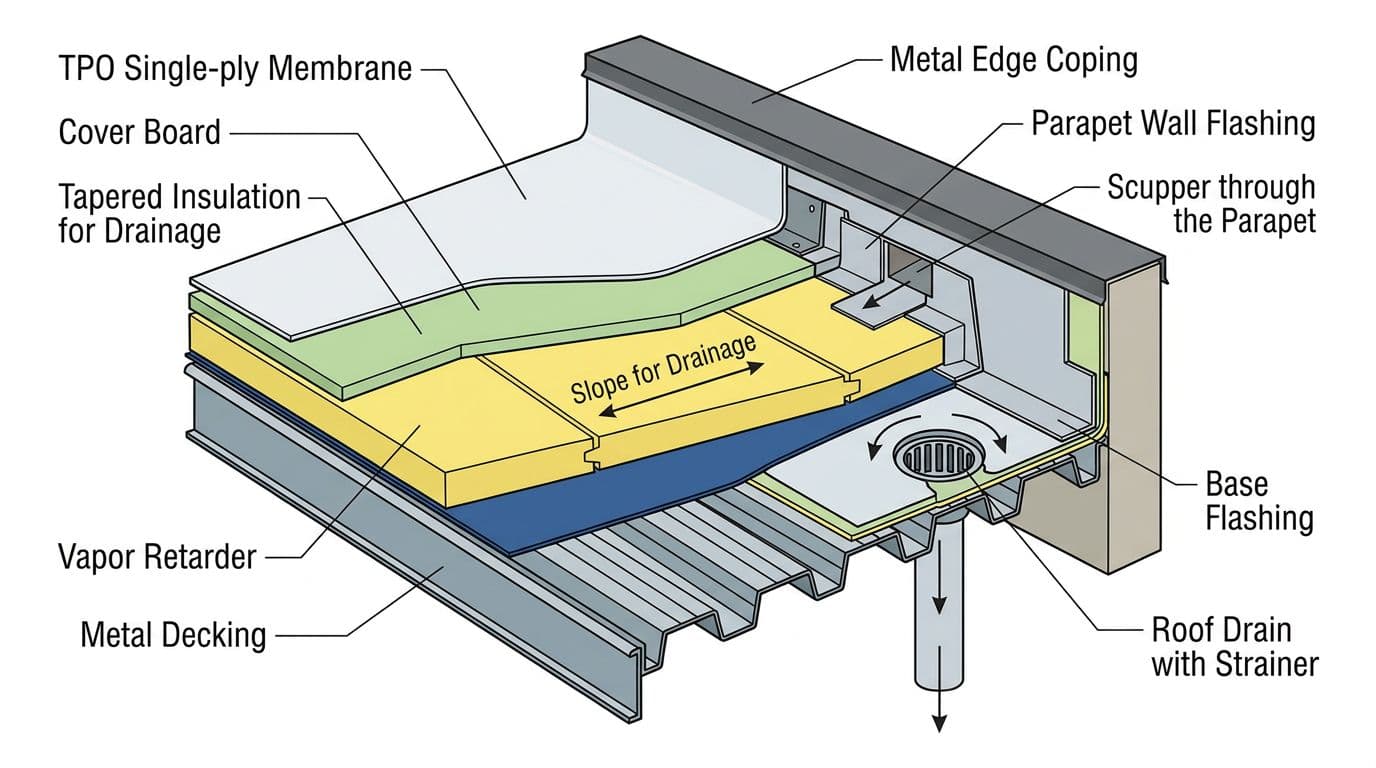
Cutaway view of a low-slope roof assembly and how each layer supports performance, created with AI.
Water control, drainage, and edge details
Water is patient. It will sit, wick, and find the smallest gap. That’s why “waterproof” is not the goal. Waterproofing is.
On low-slope buildings, roof drainage depends on roof slope, drains, scuppers, and overflow paths working together. Tapered insulation often creates the slope; the membrane and flashing do the sealing. Parapet and perimeter edges matter more than most owners expect, because wind and ice attack those details first. For a quick breakdown of common parts in low-slope systems, see this guide to commercial roof components.
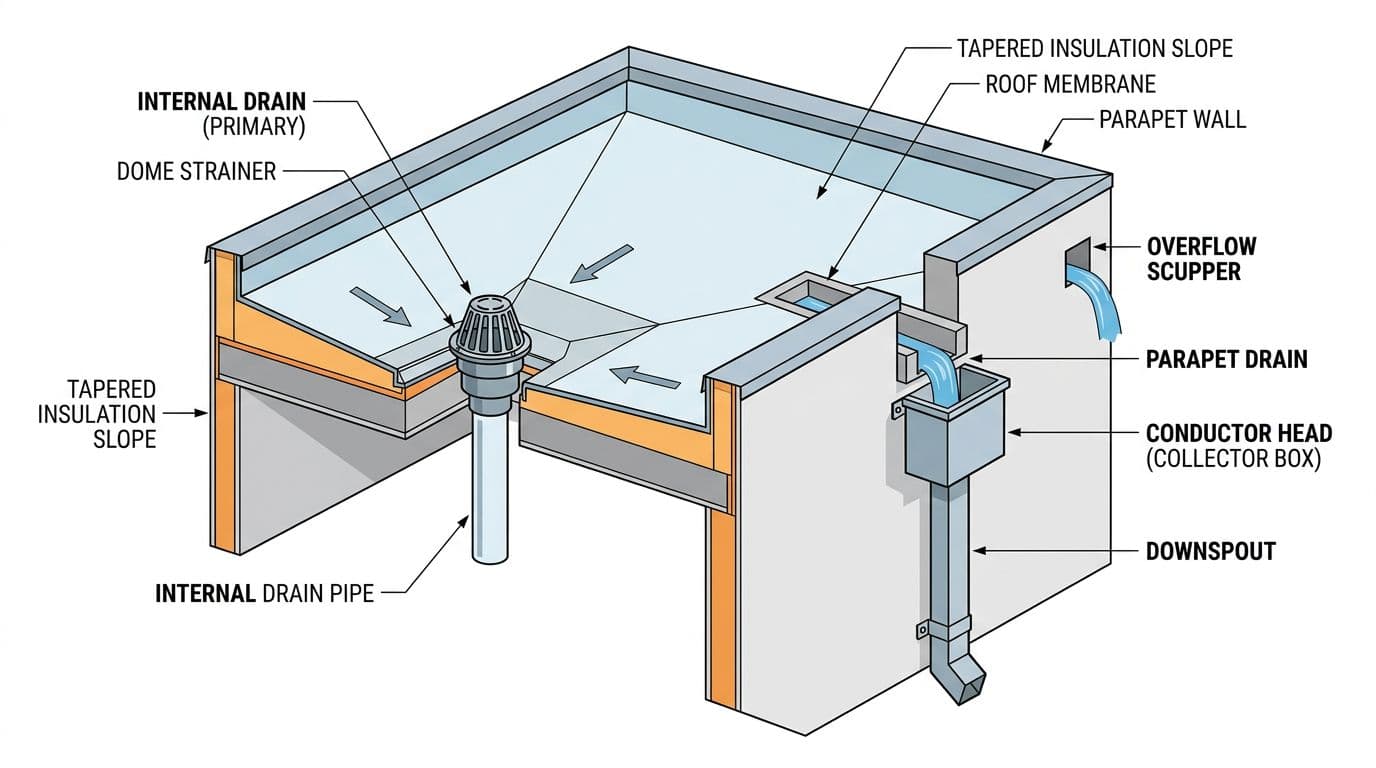
Example drainage paths and overflow protection on a commercial roof, created with AI.
If water stays on the roof after most rains, the roof is still “covered,” but it isn’t meeting its drainage requirement.
Heat, air leakage, and condensation control
A roof doesn’t only keep rain out. It also separates conditioned space from outdoor extremes. When thermal insulation is thin, wet, or discontinuous, energy efficiency suffers and comfort drops.
Air leakage is the hidden partner to insulation. Warm, moist indoor air can move through gaps, then condense when it hits cold surfaces. Over time, that can rot decks, rust fasteners, and reduce insulation R-value. Whether your roof assembly needs a vapor barrier depends on climate, interior humidity, and roof type, so treat it as a design decision, not a default. This overview of roof functional requirements basics is a helpful refresher on how roofs manage heat and moisture control.
Strength, movement, wind uplift, and impact resistance
Commercial roofs take more abuse than most owners see. Techs walk them. HVAC units vibrate. Temperature swings expand and contract membranes and metal edges.
A good roof handles that movement without opening seams or cracking sealants, provides structural strength, and offers sound insulation as a secondary functional benefit. It also resists wind uplift resistance, which often targets corners and perimeters first. Attachment patterns, edge metal, and termination bars are not “extras.” They’re structural parts of the roof system. For severe-weather guidance and common failure points, review the IBHS commercial roofs best practices guide.
Serviceability and predictable maintenance
Even a well-built roof will need service. The functional requirement here is simple: problems must be findable and fixable.
That means clear access paths, protected membranes in traffic areas, and details that don’t require tearing up large sections for a small fix in the roof assembly. It also means your contractor can diagnose issues correctly, instead of guessing, to support ongoing maintenance.
Here’s a quick way to connect requirements to symptoms:
| Functional requirement | What failure looks like inside |
|---|---|
| Drainage works | Stains after rain, musty odors, wet insulation |
| Flashing stays sealed | Leaks near parapets, curbs, or skylights |
| Air and vapor control | Condensation, corrosion, wintertime dripping |
| Wind resistance | Loose edges, fluttering membrane, repeat blow-offs |
| Serviceable design | Frequent “band-aids,” repairs that don’t last |
When these symptoms show up, it often means the commercial roof needs repair, even if the membrane still looks “okay” from a distance.
</EXISTING_CONTENT>
Step-by-Step
Step 1: Evaluate the roof as a system (not a surface)
- Walk the interior first, note stains, odors, and where leaks show up to assess building integrity.
- Map roof features above those areas, including curbs, drains, and wall transitions.
- Inspect perimeter edges and penetrations closely, failures start there often.
- Document everything with photos and dates, then store it in one place.
Step 2: Choose the right scope, repair, restore, or replace
- Confirm whether the issue is localized or widespread (wet insulation changes the answer).
- If damage is isolated, plan a targeted commercial flat roof repair that restores flashing, seams, and drainage around the problem.
- If you see repeated leaks, widespread wet areas, or failing edges, price both restoration with suitable roofing materials and commercial roof replacement so you can compare risk, not just cost.
- For help scoping options with a local crew, start with Saint Paul commercial roofing services.
Step 3: Find leaks faster, then prevent repeat failures
- Don’t rely on the interior drip location, water can travel far on low-slope assemblies.
- Use moisture mapping or electronic testing when the source isn’t obvious.
- Schedule proactive scans after major storms or freeze-thaw cycles as part of ongoing maintenance.
- If your team is chasing stains with no clear source, consider professional commercial leak detection to pinpoint breaches before you authorize larger work.
- Confirm rooftop changes (new units, rerouted drains, added supports) won’t break drainage or overload the deck while respecting the roof design, this structural planning discussion is a solid reference: commercial roofing structure and design factors.
FAQ
How long can a roof leak before it causes real damage?
Small leaks can saturate insulation long before you see stains. Once insulation stays wet, energy consumption rises and corrosion accelerates. If you suspect intrusion, act quickly because drying the assembly later is hard and costly.
What happens if water ponds on a flat roof?
Ponding adds weight and stresses seams and flashings. It also speeds up membrane aging. Many inspectors treat water remaining after a typical drying period as a red flag, then they check slope, drains, and deflection.
What if the roof has “always” ponded?
Long-term ponding usually means the roof never met drainage requirements, or it changed over time. Tapered insulation or added drains can often correct it, but the fix depends on the deck and structure.
Can I keep patching forever instead of replacing?
Patching works when the roof still meets most functional requirements and the damage is isolated. If repairs move around the roof, or wet insulation keeps spreading, patches become recurring downtime, not a plan.
Do roof coatings meet functional requirements?
A coating can restore water shedding, solar reflectance, thermal emittance, and UV protection when the underlying system is sound. It can’t correct rotten decking, bad drainage, or failing edge metal. Treat coatings as a system decision, not a quick cover-up.
Do roofs need fire-rated materials to achieve fire resistance?
Yes, fire-rated materials are often required to provide adequate fire resistance in roof assemblies, especially to meet building codes in certain structures or locations.
What’s the clearest sign I’m repairing the wrong thing?
The same leak returns after multiple fixes. That often means water is entering elsewhere, traveling in the assembly, and exiting at the same interior point. Better diagnostics usually cost less than repeat repairs.
A roof earns its keep when its roof covering quietly handles waterproofing, wind, heat, and time through proper maintenance. Use these roof functional requirements as your scorecard, then match the scope to what the building truly needs. If your documentation shows repeat leaks or wet insulation, move from reaction to a clear plan and a defined budget.
Need a roof inspection in Saint Paul or the Twin Cities? Call Sellers Roofing Company at +1-651-703-2336 or schedule a free estimate. We are a black-owned, NMSDC-certified MBE roofing contractor with 9+ years experience.