Last updated: 2026-08-01 by Ted Sellers, Owner
Confirm a TPO seam leak by matching indoor leak clues with non-destructive roof testing. Start with a tight visual inspection of seams and terminations, then use safe seam probing, infrared thermography to spot trapped moisture patterns, and low-voltage electronic leak detection (ELD) to pinpoint the breach location. When two methods agree at the same seam, you can confirm the leak without cutting.
When This Applies
You have signs that point to a seam, but no “smoking gun”
This approach fits commercial business owners who suspect TPO seam failure and need answers fast, without opening the roof and risking more damage.
It’s most useful when your building shows active leaks (water stains on ceilings, damp drywall, wet insulation smell, or dripping near a partition wall), but the roof surface looks mostly intact.
TPO leaks often behave like a spill on a countertop. Water can travel under the membrane due to ponding water or along insulation facers, causing saturated insulation before it drops inside. That’s why you don’t want to “repair where it’s dripping” and hope it works. Non-destructive confirmation helps you avoid paying for the wrong commercial flat roof repair.
These methods work best when:
- The suspected leak is near field seams due to improper installation, end laps, details around curbs, or edge terminations.
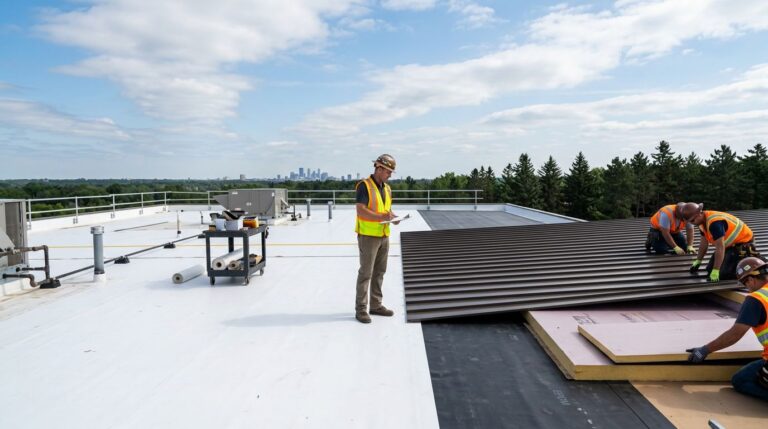
- You can access the roof safely and document seam locations.
- You can test during stable conditions (dry roof for ELD, temperature swing for infrared).
If you want a professional workflow built for low-slope systems, start with a professional roof inspection like commercial roof leak detection in Saint Paul, because the fastest “confirmation” is usually a paired test plan (scan, then pinpoint).
A single clue can mislead you. Two independent tests that agree usually confirm the leak source without opening the roof.
When non-destructive confirmation is the wrong tool
Some situations call for a different plan, even if you’d prefer not to disturb the membrane.
Exceptions that change the decision
- Widespread wet insulation: If large areas are saturated, the question shifts from “which seam?” to whether your commercial roof needs repair at a system level.
- Structural deck constraints: Some ELD methods need a conductive path below the membrane. Certain assemblies limit accuracy until a specialist adapts the setup.
- Severe storm damage or membrane brittleness: If the sheet is fractured, a seam-focused search may miss multiple entry points.
For background on industry research into non-destructive seam inspection methods, see the NRCA summary on nondestructive seam evaluation.
Step-by-Step
Start by proving the leak pattern, not the theory
- Log the interior evidence with locations and time. Note which rooms leak, when it happens (wind-driven rain, long storms, thaw cycles), and whether it’s constant or intermittent.
- Mark the ceiling leak point on a simple floor plan. Add nearby rooftop features above (RTUs, vents, parapet walls), because seams near flashing details fail first.
- Check for “travel signs” instead of a straight line. Wet deck edges, cold spots around insulation, and repeating stains often indicate water movement under the roof.
Confirm seam condition with surface checks that don’t puncture
- Walk the seam line and look for separation clues. Focus on fishmouths, wrinkling, debris embedded in laps, scorch marks, and termination bars that look loose on heat-welded seams.
- Probe cold welds carefully to find voids. Use a blunt probe and light pressure at the lap edge. You’re feeling for an opening, not forcing one. Manufacturer guidance on the heat welding process and proper TPO installation quality helps prevent accidental damage.
- Document seam defects with photos and measurements. Record distance from a fixed point (drain, corner, curb). This makes follow-up repairs faster and reduces rooftop time.
If probing “catches” repeatedly in one run on contaminated seams, treat that seam as suspect, even if you can’t see a gap.
Use non-destructive testing to move from “suspect” to “confirmed”
- Run an infrared scan when conditions support it. Infrared works best with a temperature change (often early morning or evening). You’re looking for moisture intrusion patterns that track along seams or collect at seam transitions.
- Treat infrared as a map, not a verdict. Wet insulation, air gaps, and shading can create confusing images. Still, it narrows the search zone quickly on large roofs.
- Pinpoint the breach with low-voltage electronic leak detection. ELD can identify the exact location where current finds a path through the membrane. For an explanation of how ELD isolates breaches, read electronic leak detection testing basics.
- Make sure the roof surface is compatible with the test that day. Many ELD setups need a clean, mostly dry surface for stable readings. Plan around dew, frost, and rainfall.
- Confirm by correlation, not hope. When ELD pinpoints a spot that also matches (a) seam probing weakness and (b) an infrared moisture pattern or interior leak timing, you can treat the seam leak as confirmed.
- Decide whether you need repair, restoration, or replacement. A single failed weld can be repaired. Repeating seam failures across the field often point toward long-term planning, sometimes even commercial roof replacement.
When you’re ready to move from testing to action, a local team that handles inspection through repair helps reduce downtime. See commercial roofing services in Saint Paul for options that fit occupied buildings.
FAQ
Can seam probing confirm a TPO seam leak by itself?
Probing can reveal poor fusion and voids, but it doesn’t prove water entry on its own, and it can help distinguish seam issues from punctures and tears caused by foot traffic. Pair it with ELD or infrared so you’re not guessing. Probing is most useful for finding the weak run to test next.
When probing is risky
If the seam is warm, brittle, or already damaged, aggressive probing can worsen it. Use light pressure and stop when you feel repeated catches.
Will electronic leak detection work if the roof is wet?
Sometimes, but results can get noisy. Standing water can create extra conductive paths that blur the pinpoint. In practice, crews often schedule ELD when the surface is clean and mostly dry.
Why is the drip inside nowhere near the seam leak?
Low-slope assemblies let water move sideways. Insulation joints, vapor retarders, and deck flutes can steer moisture away from the entry point. That’s why confirmation needs roof-side testing, not just interior stains.
When does a seam leak mean the roof is near the end?
If you find multiple seam voids across different sections due to UV degradation, thermal expansion and contraction, or membrane shrinkage, or moisture mapping shows broad saturation, repairs may not extend the roof lifespan for long. A roof maintenance plan can help prevent widespread deterioration, but at that point, you’re weighing repeating commercial flat roof repair costs against phased restoration or commercial roof replacement.
Is a hose test a good non-destructive way to confirm a seam leak?
A controlled spray can help, but it can also force water where rain never would, particularly by overwhelming roof drainage systems. Use it only after you’ve isolated a small suspect zone, and avoid soaking large areas that could add damage.
Conclusion
You can confirm a TPO seam leak without cutting by stacking evidence: interior leak timing, careful seam probing, infrared moisture patterns, and ELD pinpointing. That combination protects your budget and the overall health of your commercial roofing systems because it reduces “repair-and-pray” work.
Before full replacement, consider targeted TPO repair options like TPO membrane patches or silicone restoration membrane. If your commercial roof needs TPO repair and you want clear documentation before you authorize it, contact Sellers Roofing Company and ask for a non-destructive confirmation plan that fits your building and schedule.
Need a roof inspection in Saint Paul or the Twin Cities? Call Sellers Roofing Company at +1-651-703-2336 or schedule a free estimate. We are a black-owned, NMSDC-certified MBE roofing contractor with 9+ years experience.