Last updated: 2026-08-01 by Ted Sellers, Owner
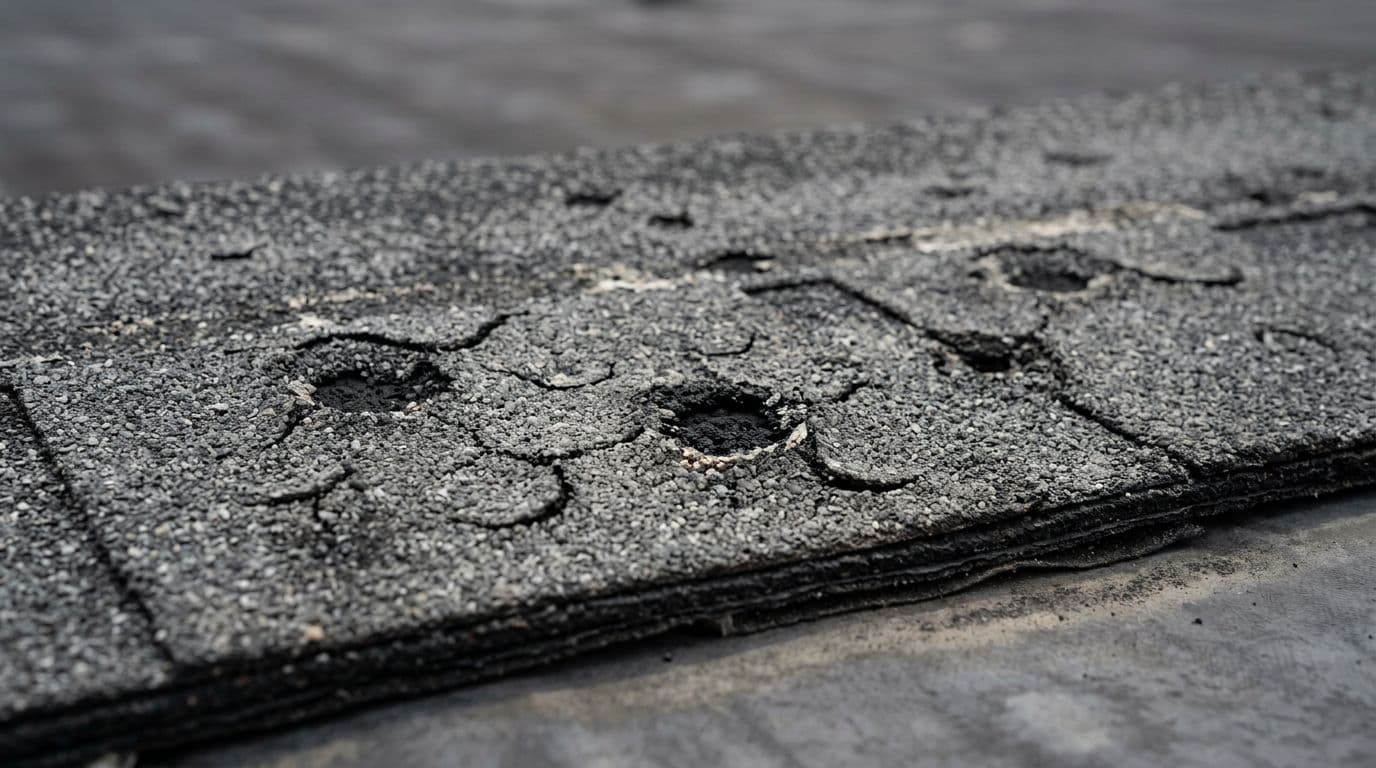
Look for hail damage on 3-tab shingles of an asphalt shingle roof by checking for random, round impact spots with missing granules, dark asphalt showing through, and soft “bruises” you can feel (carefully) when pressed. True hail hits aren’t uniform. They’re scattered. Also confirm collateral dents on soft metals like roof vents, gutters, and flashing, because that supports the hail damage timeline.
When This Applies
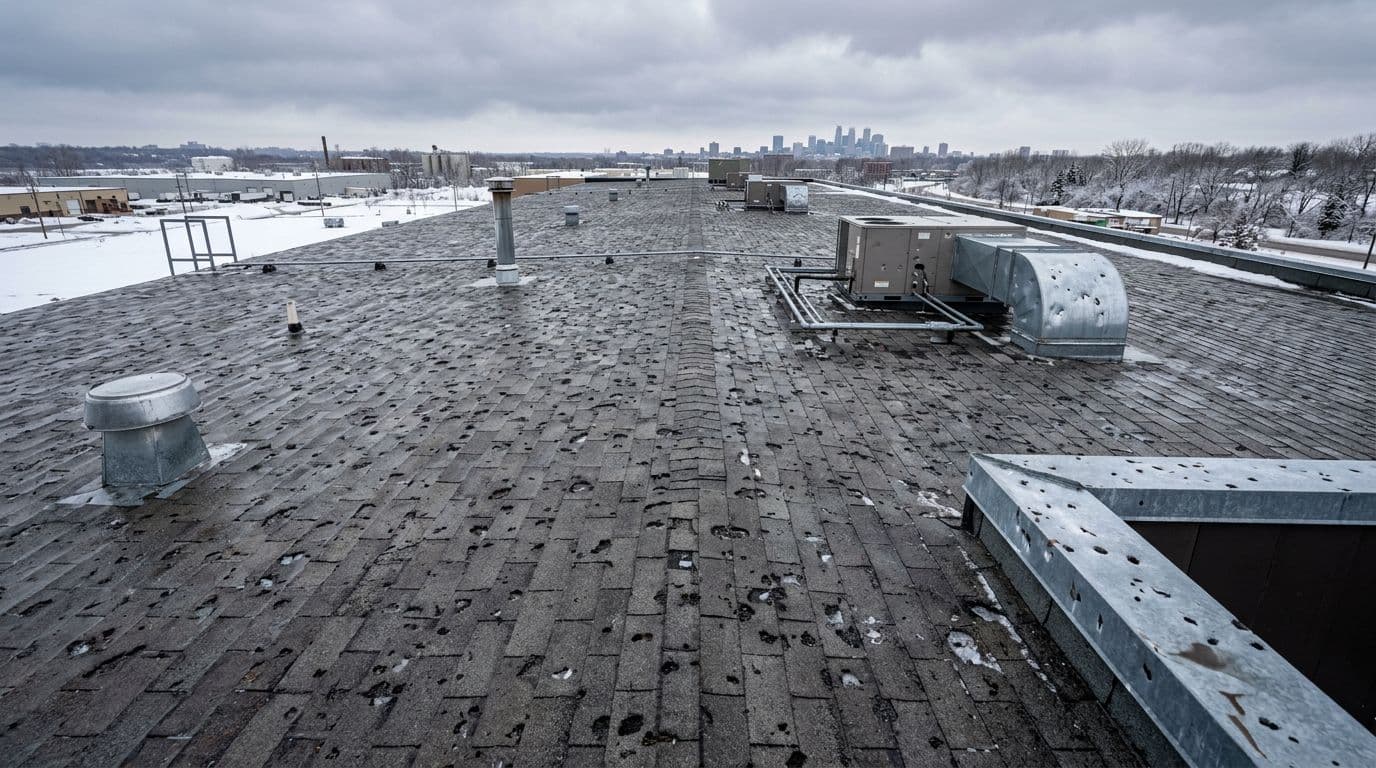
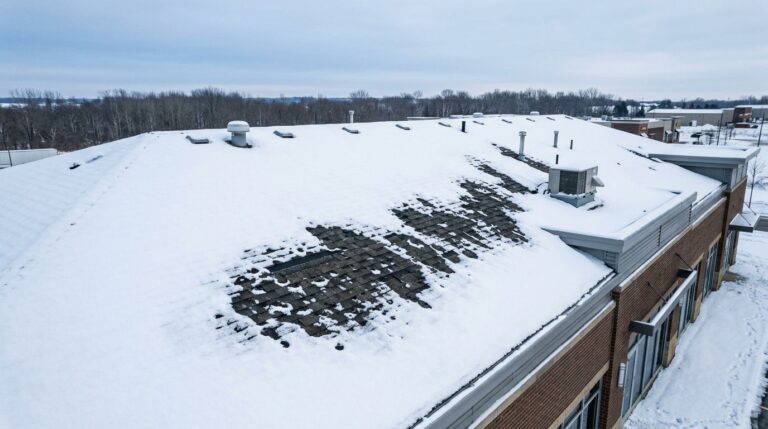
This fits commercial buildings with older 3-tab shingles
This guidance helps when your property has 3-tab asphalt shingles, often on offices, retail buildings, mansard sections, entry canopies, or detached storage structures. It’s most useful right after a hailstorm or other storm damage, or when an insurer asks you to prove damage. Timing matters because fresh impacts look different than aged scuffs on asphalt shingles.
It also applies when you’ve noticed new leaks, roof leaks causing ceiling stains, or wet insulation and you suspect the roof is the reason. Hail may not cause an immediate drip, but it can shorten shingle life and loosen the waterproof layers.
If the risk looks high, a storm damage inspection can also help you decide whether you’re heading toward a repair plan or a broader commercial roof replacement scope. For Twin Cities owners who want a local baseline for next steps, start with a Saint Paul commercial roofing overview from Sellers Roofing Company.
When this does not apply (and what to do instead)
This article won’t help much if your main roof is TPO, EPDM, BUR, or another membrane. Those systems show hail differently, and “bruises” aren’t the same as on shingles. In that case, you’ll want a membrane-focused inspection, since what looks fine from above can still hide wet insulation. If you suspect water is traveling before it shows up inside, consider commercial roof leak detection in Saint Paul to pinpoint the source.
It also won’t translate well to architectural shingles (also called dimensional shingles), which have thicker laminations and different impact patterns. The principles still help, but the visual clues won’t match one-to-one.
Edge cases that get mistaken for hail
Hail damage tends to be random and sharp. Normal aging of asphalt shingles is slow and even. Here’s a quick way to separate common look-alikes:
| What you see on shingles | More like hail | More like wear/other causes |
|---|---|---|
| Random round spots with granules knocked out | Yes | No |
| Dark asphalt showing in circles, scattered | Yes | Sometimes |
| Soft “bruise” that feels spongy when pressed | Yes | No |
| Granule loss mostly on edges and high points | No | Yes |
| Many marks in straight lines near walk paths | No | Foot traffic |
The fastest reality check is collateral evidence like dented gutters and other collateral indicators. The Insurance Institute for Business and Home Safety suggests looking for that supporting damage first, see their guide on how to tell if it’s hail damage.
If the marks look “too even,” pause. Hail hits usually don’t line up like a pattern.
Step-by-Step
Follow this roof inspection process to systematically assess hail damage.
Document the storm and confirm hail actually hit your site
- Take wide photos of each roof plane (one per slope), plus close-ups of suspicious spots, and note the date you took them.
- Walk the perimeter and photograph soft-metal items (gutters, downspouts, vents, HVAC jackets, wall caps) for dents that match hailstone size.
- Write down where damage is worst (north slope, west slope, near parapets), because exposure patterns matter during a claim.
Inspect 3-tab shingles for true hail impact signatures
- Look for random circular impact marks where granules are missing, exposing darker asphalt underneath. Consistent edge wear is not the same.
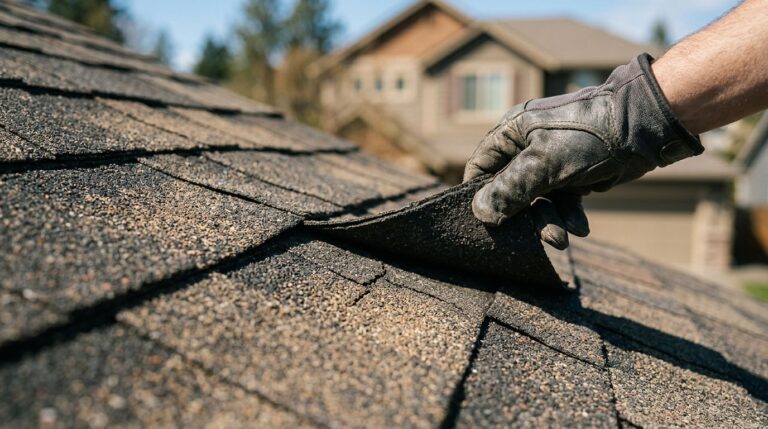
- Check for a “bruise test” sign: press gently with a thumb on the suspected spot. A hail bruise often feels softer than surrounding areas (don’t over-press, and don’t do this in brittle cold).
- Watch for crescent cracks or small splits. On 3-tab shingles, hail can cause a mat fracture without tearing a full tab off.
- Scan for displaced granules in gutters and at downspout outlets. A sudden uptick after a storm supports hail impact.
Separate hail from scuffs, blisters, and manufactured “damage”
- Rule out foot traffic. If marks cluster near rooftop units or along the same path, treat them as maintenance scuffs until proven otherwise.
- Rule out blistering. Blisters can pop and shed granules, but they often look more uniform across a slope, not scattered like thrown pebbles.
- Be cautious with “perfect circles” repeated at the same spacing. Some industry research discusses how unnatural patterns can signal deliberate impacts, see the IIBEC paper on identifying deliberate hail damage claims.
Decide what action matches your risk, your operations, and your roof type
- If you find several bruises per test square (across multiple slopes) and collateral metal dents indicating functional damage, schedule a professional inspection and claim documentation.
- If a leak starts after the storm, treat it as urgent. Water can travel and surprise you weeks later by reaching the roof decking, especially if the roof assembly has multiple layers.
- If you operate multiple roof types, don’t assume the shingle section is the only problem. A shingle finding can be the clue that the membrane section also took hits, leading to roof repair decisions that go beyond the obvious.
- If replacement is on the table, consider impact-rated materials. IBHS summarizes why a Class 4 roof covering can reduce future issues, see their hail damage PDF.
FAQ for business owners after a hailstorm
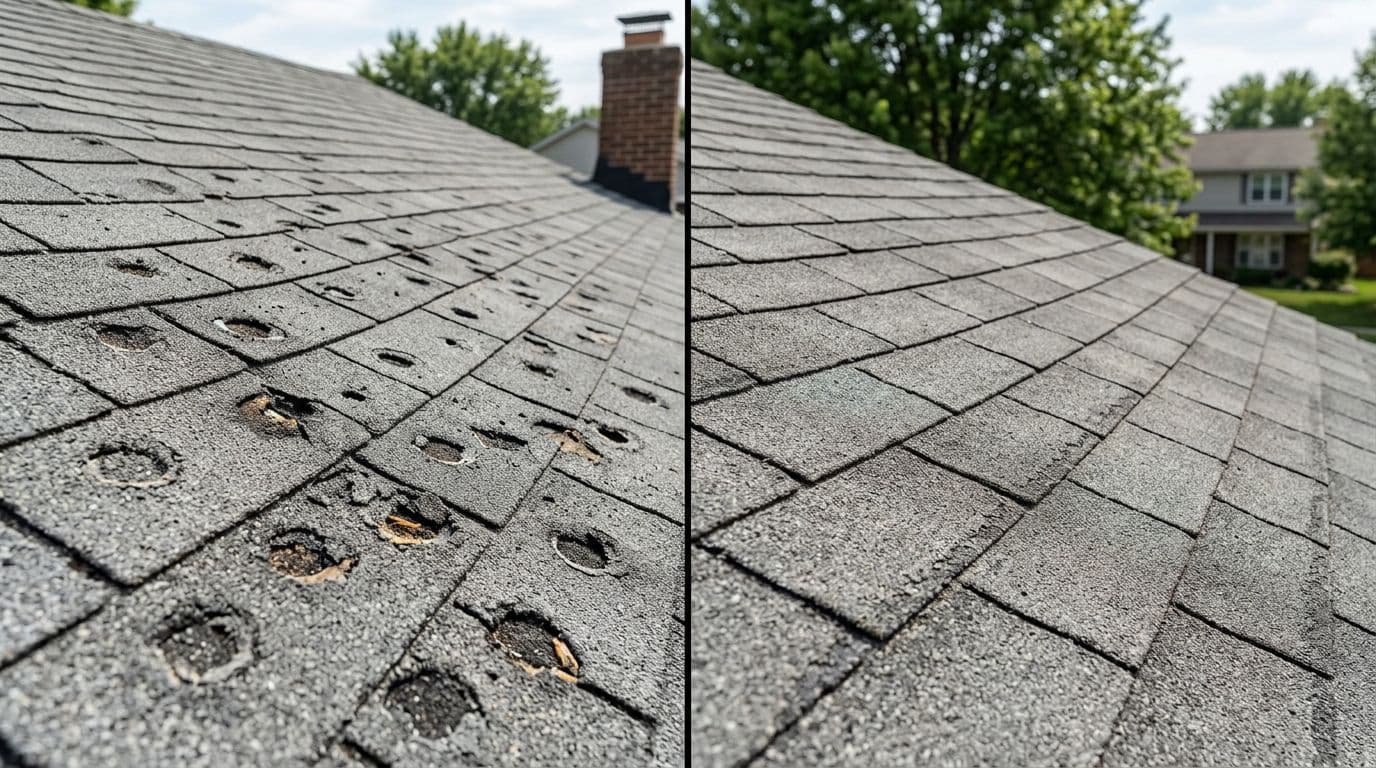
Can 3-tab hail damage exist even if there’s no leak?
Yes. Hail can bruise the shingle mat and dislodge granules without an immediate puncture. Think of it like a dent in a car door: it may still “work,” but the protective finish is compromised. Over time, UV and freeze-thaw speed up failure on those weak points.
What to do if operations can’t risk surprises
If the building can’t tolerate downtime, treat non-leaking hail damage as a planning issue for roof repair, not just a cosmetic one. Documentation now helps you avoid rushed decisions later.
How fast should I inspect and file an insurance claim?
Inspect as soon as it’s safe, then document promptly to assist your insurance adjuster. Most policies have notice requirements, and delays can complicate cause-and-date questions. For a claim process overview, the Nebraska Department of Insurance has a plain-language handout on hail damage and insurance basics.
What if hail damage shows on one slope but not the others?
That’s common. Wind direction and roof angle change impact energy. A south or west slope may take the brunt. Still, insurers often look for “directional consistency,” so photos and collateral metal dents help explain why only part of the roof shows bruising.
Does that mean spot repair only?
Sometimes, yes. Other times, matching shingles becomes the real issue, especially on older 3-tab products. When replacing sections, choose shingles with a Class 4 rating for superior impact resistance, as verified by UL 2218 testing. Your contractor should address both waterproofing and appearance expectations.
Will hail damage always look like missing chunks of shingle?
No. Many hits show as subtle bruises with small granule loss, not dramatic holes. On 3-tab roofs, the damage often looks like peppered dark dots, not a torn surface.
When the roof looks “fine” from the ground
Ground views can miss bruising. Close-range inspection is the difference between guessing and knowing.
My property has a flat roof too, what should I check there?
Start with drains, seams, and rooftop equipment areas. Hail can crack coatings, loosen flashings, and dent metal edges. If you already have ponding water or seam concerns, schedule commercial flat roof repair evaluation quickly, since moisture spread can cause water damage and be expensive even when the puncture is small.
Conclusion
Identifying hail damage 3-tab shingles comes down to three things: random impact patterns, granule loss with bruising, and collateral dents on soft metals. Spotting this storm damage early is critical for preserving long-term property value.
When those clues line up, you’re not guessing anymore; you’re building a clear record. If the stakes are high for your operation, don’t wait for a leak to “prove” the problem. A timely inspection can protect your budget, your tenants, and your roof replacement decision.
Need a roof inspection in Saint Paul or the Twin Cities? Call Sellers Roofing Company at +1-651-703-2336 or schedule a free estimate. We are a black-owned, NMSDC-certified MBE roofing contractor with 9+ years experience.