Last updated: 2026-08-01 by Ted Sellers, Owner
After a storm, you usually need gutter replacement when the system can’t hold slope, keep seams tight, or move water away from the building, even after cleaning and minor repairs. Look for sagging gutters, split seams, pulled fasteners, bent downspouts, and overflow marks. If water is causing water damage by hitting walls or pooling at the foundation, treat it as urgent.
When This Applies
This is for most commercial buildings with exterior drainage
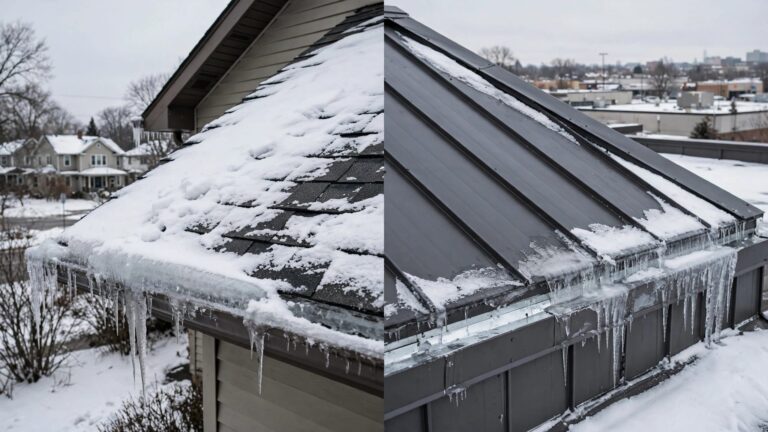
If your property has perimeter gutters and downspouts (common on retail, offices, small warehouses, and older low-slope buildings), storm damage can show up fast. High winds can rack long gutter runs, even durable seamless gutters, hail can dent thin metal, and ice can pry hangers loose. Even one failed joint can turn “normal runoff” into water against brick, EIFS, or steel panels.
This also applies when your lot has tight setbacks. If water dumps next to the foundation because a downspout got crushed or disconnected, the building pays for it later in basement flooding, foundation problems, spalling masonry, and freeze-thaw damage.
For broader storm impacts at the roof level, it helps to understand how weather weakens systems over time, see how weather damage affects commercial roof repair.
When it doesn’t apply (or applies differently)
Buildings with internal roof drains and no perimeter gutters
Many larger flat-roof buildings move water through interior drains, scuppers, and leaders. You can still have metal edge details that fail, but your “gutter problem” may actually be a blocked drain, a separated leader, or overflow that’s cutting behind the parapet. In those cases, a gutter-only fix won’t stop leaks.
Properties with underground downspout lines
If downspouts tie into underground piping, storm debris can clog the line. The gutter may look fine while water backs up and overflows at the roof edge. Clearing the gutter without checking the discharge point often wastes time.
Quick “failing vs. fixable” cheat sheet
| What you see after the storm | What it often means | What to do next |
|---|---|---|
| Water stains on wall below the gutter line | Overflowing water or water leaks | Inspect seams, end caps, and slope |
| Gutters pulling away from fascia | Hangers or fascia boards rot, or wind torque | Re-hang only if fascia boards are sound |
| Standing water inside the gutter | Lost pitch or a sagging run, rust and corrosion | Re-slope, or replace if metal is warped |
| Downspout elbow crushed or split | Impact damage or ice expansion | Replace the damaged section |
| “Trenches” in soil near discharge | Water not being carried far enough | Add extensions or redirect discharge |
If you want a second reference point for replacement timing, compare your findings with signs you should replace gutters after storm damage.
Step-by-Step
Step 1: Do a safe post-storm inspection (without guessing)
- Walk the perimeter and look for overflow lines on siding, brick, or fascia (check exterior walls for staining), these are the storm’s “high-water marks.”
- Check for gutters that look wavy or dipped, long runs should look straight, like a level shelf.
- Confirm downspouts are still attached at the outlet and strapped to the wall, missing straps let wind whip the pipe until it cracks.
- Find every discharge point and verify water is moving away from the building, not into landscaping beds, window wells, or loading dock slabs.
Step 2: Confirm whether it’s damage, a clog, or a design problem
- Scoop out obvious debris at a few low points, then re-check for standing water, gutter clogs and lost slope can look the same at first.
- Look closely at seams, end caps, corners, and miters, storm flex often opens joints before it bends the metal.
- Inspect gutter hangers and fasteners, if screws are backed out or hangers are twisted, the gutter can’t hold pitch under heavy rain.
- Check for “hidden” failure at the outlet, if the drop outlet is cracked, water can run behind the gutter and rot the edge.
If the system ties into underground piping
- Run water into the gutter near a downspout and listen for gurgling or backup, slow drains point to a clogged line (watch for soil erosion near discharge points).
- If water rises in the gutter quickly, stop and clear the underground line before you decide on replacement.
Step 3: Decide repair vs. gutter replacement using clear triggers
- Choose repair when damage is isolated, like one elbow, one downspout section, or one seam, and the gutter run still holds slope.
- Choose gutter replacement when multiple sections are failing, especially if you see repeated seam leaks, widespread corrosion, long runs that won’t stay pitched, or foundation cracks from poor drainage.
- Replace when the gutter is separating from the fascia or roof edge because the metal is stretched, the back wall is deformed, or rotting wood appears; re-fastening won’t hold for long (consider gutter installation for new setups).
- Treat overflow onto roof edges as a roof risk, constant wetting can damage membranes, edge metal, and insulation, and it can turn into commercial flat roof repair if water finds a path inside.
If you also suspect the roof is involved
- If leaks show up inside near exterior walls right after heavy rain, don’t assume it’s only gutters.
- When the perimeter stays wet, the commercial roof needs repair conversation becomes real, because water pressure and repeated saturation find weak points.
- If the roof system is near end-of-life and perimeter details are failing together (edge metal, coping, gutters, scuppers), it may align with a planned commercial roof replacement instead of patchwork.
For Saint Paul property owners coordinating roof work with water-control upgrades, start with commercial roofing Saint Paul so your drainage decisions match the roof system.
Step 4: Document storm damage so repairs don’t stall later
- Take photos of every dented run, separated seam, and crushed downspout, include a wide shot and a close-up.
- Note where water lands, “south wall by service door” is more useful than “back side.”
- Capture interior symptoms too, water damage like wet ceiling tiles, wall staining, and musty odors can support the timeline.
- If you’re weighing gutter repairs vs. gutter replacement at the same time, this overview helps frame the choice and assess structural integrity, see how to tell if a roof needs repair or replacement.
FAQ
Can I just re-hang a sagging gutter after a windstorm?
If the gutter is straight and not stretched, re-hanging can work. The catch is the attachment surface. If fascia boards are soft from rotting wood, wet, or crumbling, new hangers won’t bite, and the gutter will sag again during the next heavy rain.
What’s the “no” sign?
If you can see daylight behind the gutter back wall in more than one spot, the run is usually deformed and replacement is the safer call.
What if downspouts look fine but water still pours over the edge?
That often means the gutter has lost pitch, the outlet is undersized for the roof area, or the underground line is restricted. Overflow during a hard rain is also common when gutter guards trap small debris and form a mat. The system needs testing, not guessing.
How fast do I need to act if water is hitting the building facade?
Right away. Repeated wetting from moisture exposure can force water into joints and openings, causing peeling paint and mold and mildew, then freeze. If the storm was followed by cold snaps (common in Minnesota winters), the damage can accelerate in days, not months.
Do dents from hail matter if the gutter isn’t leaking?
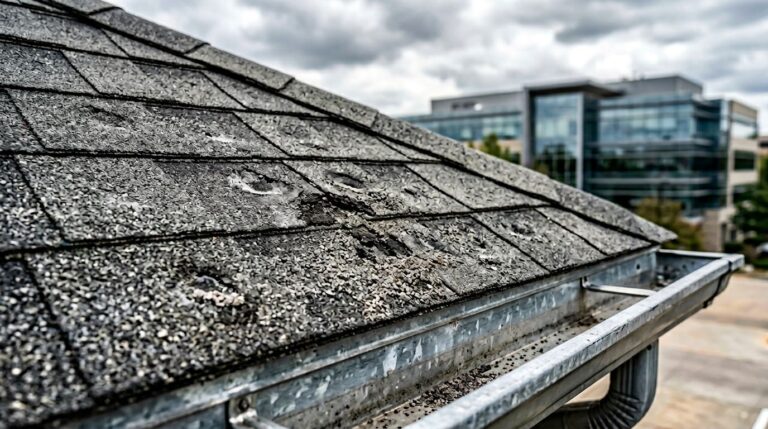
Sometimes dents are cosmetic on aluminum gutters. They matter when they change the gutter’s shape enough to hold water or when they crease seams and corners. If dents are widespread along the roofline and you’re seeing standing water or water leaks, the gutter may never drain correctly again.
Can failing gutters cause roof problems on low-slope buildings?
Yes. When gutters overflow, water can run back onto the roofline and under metal details, then into insulation. That’s one of the quieter paths to commercial flat roof repair, because the wet area can spread before it shows up inside.
What to do next if your gutters failed in the storm
Storms don’t just “test” gutters, they expose every weak seam, hanger, and discharge point, often causing storm damage. If your system can’t control water now, it won’t behave better in the next downpour and could lead to water damage. Schedule an inspection, document what you see, and choose gutter replacement when slope, seams, and attachment points are failing across more than one section. For minor issues, gutter repairs may suffice, but maintaining the system is vital for your building’s long-term health. Water always takes the easiest path, so make sure it isn’t through your building.
Need a roof inspection in Saint Paul or the Twin Cities? Call Sellers Roofing Company at +1-651-703-2336 or schedule a free estimate. We are a black-owned, NMSDC-certified MBE roofing contractor with 9+ years experience.