Last updated: 2026-08-01 by Ted Sellers, Owner
Electronic leak detection finds holes in a roofing membrane by using a controlled electrical field. When there’s a membrane breach, electricity follows the path of least resistance, often through moisture, to the conductive deck or a grounded return line. The technician tracks that signal and marks the exact leak location, so repairs target the true source.
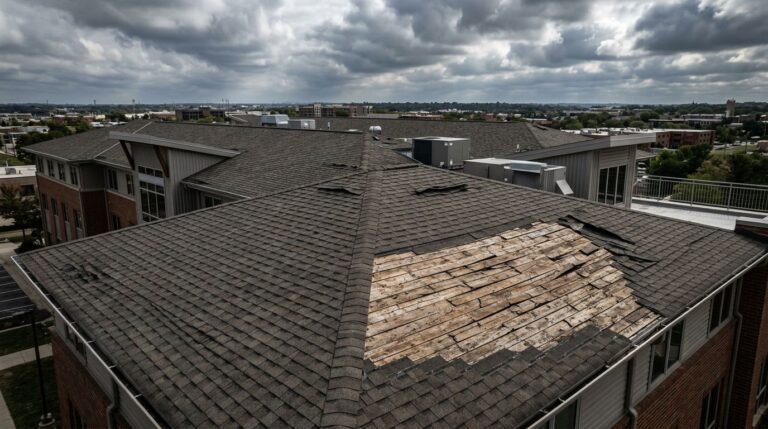
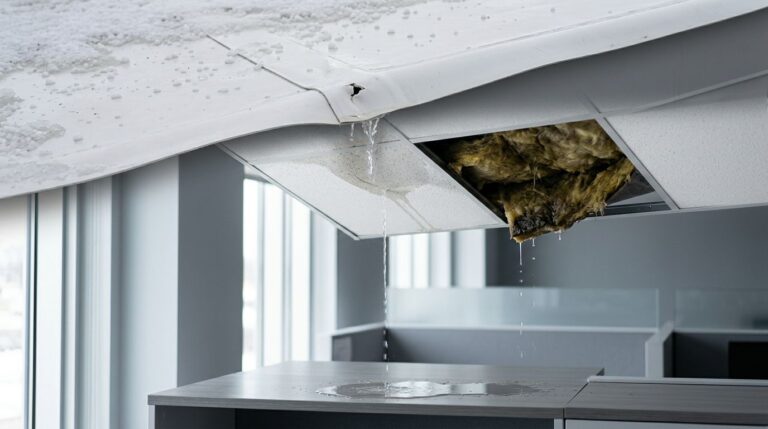
Water on a flat roof rarely behaves like water inside a building. It can travel under the membrane, drift along seams, and show up far from the real opening. That’s why “we see a stain over there” often leads to wasted repair dollars.
Electronic leak detection helps solve that mismatch. Instead of guessing, you confirm where the membrane is no longer watertight, then fix only what’s needed.
When This Applies
Flat roofs where the membrane is the waterproofing membrane
Electronic leak detection works best on many common commercial systems, especially when the membrane is meant to be the primary barrier. That includes TPO, EPDM, and PVC, plus many liquid-applied membranes.
On big buildings, this matters because tiny punctures can soak insulation quietly for months. A screw head, dropped tool, or sharp HVAC corner can make an opening you’ll never spot on a walk-through.
For new installs, electronic testing can also confirm the roof is watertight before warranty sign-off. Professionals often refer to this non-destructive testing as roof integrity testing or membrane integrity testing, following standards like ASTM D7877. You’ll see it referenced as ELD in the industry (for example, electronic leak detection and integrity testing).
When electronic testing won’t work well without prep
Some roofs block the method. Ballasted gravel, pavers, plaza decks, and green roofs can prevent the equipment from “seeing” the membrane. In those cases, a contractor may need to remove sections, test in phases, or use other tools first.
Metal roofs also change the game. Since metal is conductive everywhere, the signal doesn’t behave the same way as it does on a single-ply membrane.
Weather can be another limiter. High winds, active rain, or freezing conditions can reduce accuracy or create safety issues, so crews may reschedule or shift to non-contact diagnostics.
Edge cases that can change the testing plan
Every roof assembly is a stack-up, not just a membrane. Insulation type, cover board, vapor barrier, and deck material affect how current returns to ground. Some systems need a conductive wire grid or a special setup to make the readings reliable.
Rooftop equipment can also complicate testing. Heavy foot traffic zones, dense penetrations, and tight mechanical screens often require smaller test sections and more time. If your team wants a plain-language overview first, this electronic leak detection FAQ gives a helpful high-level explanation of why tiny defects are hard to find visually.
The biggest benefit isn’t just “finding a leak.” It’s proving where the leak is not, so you stop chasing symptoms.
Step-by-Step
Low-voltage testing (Electric Field Vector Mapping – EFVM)
- Confirm the roof can be isolated: The technician separates the test area from metal edges, scuppers, and other conductive paths to the conductive substrate.
- Create a controlled wet surface: A thin layer of water goes on the membrane to help carry current to a breach.
- Set the electrical field: Leads connect to the membrane surface and a ground connection.
- Scan with the sensor: The operator walks the roof with a scanning platform and probes that measure direction and strength of the signal, using tools like a vertical roller and vector mesh grid for accuracy on the non-conductive substrate.
- Follow the “arrow” to the breach: Readings tighten as the technician moves closer, similar to getting warmer in a hot-and-cold game.
- Pinpoint and mark the defect: Once the signal centers, the breach gets marked for repair documentation.
- Re-test the repaired spot: After sealing, the same area gets scanned again to confirm the electrical circuit no longer “finds” a path.
High-voltage testing (spark testing, holiday testing per ASTM D8231) (dry membrane surfaces)
- Clean and dry the surface: Spark testing needs direct contact, so debris and standing water must be removed.
- Choose the right voltage: The technician sets output based on membrane thickness and type.
- Ground the system: A ground connection is established so the tool can detect a spark at a defect.
- Sweep the wand across details: Seams, penetrations, terminations, and corners get slow, careful passes.
- Detect the arc at the hole: When the wand crosses a breach, it produces a visible or audible spark event.
- Mark and repair: The crew flags the exact point, then completes the seal or patch.
- Verify with a second pass: A re-scan confirms the defect no longer arcs.
What the Results Mean for Repair, Budget, and Risk
What counts as “one leak” on a commercial roof
A ceiling drip feels like a single problem. On a flat roof, it’s often multiple small issues that feed the same moisture intrusion. Electronic testing can reveal whether you’re dealing with one puncture or a pattern, like repeated fastener back-out, seam stress, or damage around service walkways.
Accuracy is the selling point, especially compared to visual inspections. When conditions are right, ELD can narrow the location to a very small area with pinpoint accuracy, which is why many owners use it to avoid broad tear-offs. Some providers describe pinpoint accuracy down to millimeters in ideal setups (see precise roof leak location with ELD).
Choosing between commercial flat roof repair and commercial roof replacement
Once you know where water is entering, you can make a cleaner decision. If the membrane is mostly sound, targeted commercial flat roof repair usually makes sense. On the other hand, widespread breaches, saturated insulation, and recurring failures can push the math toward commercial roof replacement.
A practical rule: if testing shows many defects across large areas, you’re no longer fixing a “spot.” You’re managing a system that’s breaking down.
If your commercial roof needs repair, pairing electronic testing with experienced evaluation and field quality control helps you avoid paying twice, once for the wrong fix, then again for the right one. For Twin Cities properties, it can help to start with a dedicated service like advanced leak detection on commercial flat roofs so the repair scope matches what the roof is actually doing.
One quick comparison makes the trade-offs clearer:
| Method | Best for | Main limitation |
|---|---|---|
| Electronic leak detection | Pinpointing membrane breaches | Needs correct setup and access to the membrane |
| Infrared thermography | Finding trapped moisture patterns | Doesn’t pinpoint the exact hole by itself |
| Flood testing | Confirming active leaks in simple areas | Adds water load and can be slow or risky |
The takeaway: electronic testing finds the opening, while other methods often find the damage the opening caused.
FAQ
Will electronic leak detection find leaks under rooftop HVAC units?
Often, yes, but access controls the result. If the membrane runs under a curb or equipment rail, the technician tests the exposed perimeter and nearby field. In tight areas, they may isolate smaller sections and focus on likely paths, like pitch pans and termination bars. Note that electronic leak detection identifies water leaks in the roof membrane, unlike a refrigerant leak detector or combustible gas sensor used for HVAC system issues.
What if my roof has pavers or gravel ballast?
Electronic testing usually requires the membrane surface to be accessible. If the existing roof deck is not naturally conductive, a conductive primer may be necessary.
If the ballast can be removed in sections
A contractor can stage removal, test, then reset. That approach limits disruption, but it adds labor, so it’s best used when leak risk is high or interior impacts are costly.
Can electronic leak detection damage my roof membrane?
When trained crews use the right settings, the process is non-destructive. Low-voltage methods rely on sensing, not burning. Spark testing can damage materials if misused, which is why membrane type and voltage selection matter.
How long does electronic leak detection take on a large flat roof?
Time depends on roof size, number of penetrations, and how easily the area can be isolated. A simple open roof section can move quickly. Dense rooftop equipment, multiple tie-ins, and parapet details slow the scan because technicians need tighter passes and more setup.
Do I still need repairs if the leak “stopped” after a storm?
Yes, because a temporary stop doesn’t mean the breach closed. Wind-driven rain can enter from unusual angles, then disappear until the next storm hits the same way. Testing helps confirm whether you had a one-time event or an ongoing membrane defect.
Conclusion
Electronic testing works because electricity is stubborn. It keeps searching for the easiest path, and a hole in your membrane gives it one. When you locate breaches precisely with these innovative technologies, you reduce guesswork, limit disruption, and keep repairs scoped to what’s real.
Essential for modern property management, they help control costs and downtime. Electronic leak detection is the best way to resolve complex membrane issues, turning a mystery leak into a defined plan.
Need a roof inspection in Saint Paul or the Twin Cities? Call Sellers Roofing Company at +1-651-703-2336 or schedule a free estimate. We are a black-owned, NMSDC-certified MBE roofing contractor with 9+ years experience.