Last updated: 2026-11-10 by Ted Sellers, Owner
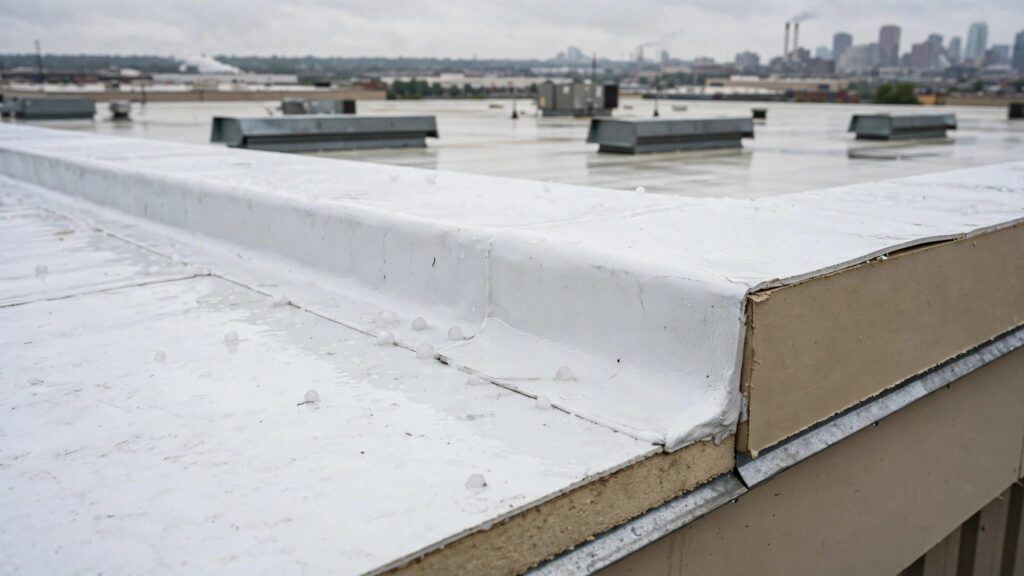
For a hail-prone Minnesota commercial roof, specify 80-mil TPO over an approved impact-resistant cover board and insulation assembly. A 60-mil membrane remains a reasonable baseline for lower-traffic buildings with a suitable tested assembly, while 45 mil offers less material reserve. Hail performance depends on the complete roof system, so membrane thickness alone doesn’t establish a hail rating.
What Actually Causes TPO Roof Damage in Harsh Winter Climates?
When does this thickness decision apply?
For commercial roofing, this recommendation applies to TPO roofing replacement, eligible recover projects, and new low-slope construction. This thermoplastic polyolefin single-ply system fits warehouses, offices, retail buildings, and multifamily properties across Minneapolis, Saint Paul, and nearby suburbs.
Choose the thickness alongside the cover board, insulation, attachment, drainage, and coverage terms. An 80-mil sheet installed over a weak or wet substrate leaves major problems underneath.
This comparison covers commercial low-slope roof assemblies, not asphalt shingles, metal roofing, or residential replacement on a steep-slope roof. Those assemblies use different impact tests and installation details. Existing EPDM, modified bitumen, and built-up roofing, or BUR, also require material-specific repair methods.
How do hail and winter conditions damage the assembly?
Hail concentrates impact force over a small area. The membrane can puncture, while insulation beneath an apparently intact surface can compress. Support beneath the sheet therefore affects impact performance.
Versico publishes hail-performance information for fleece-backed TPO. Those results belong to the described product and assembly, not every membrane with the same nominal gauge.
Meanwhile, temperature changes move the membrane, flashings, and deck. Water entering an existing opening can freeze and widen that defect. Blocked drains also retain snowmelt and increase ponding.
Thicker TPO doesn’t increase the deck’s structural snow-load capacity. Low-slope ice management centers on drains, overflow paths, and safe removal methods, rather than typical residential ice dam removal practices.
How to Inspect and Document the Damage (Field Checklist)
A commercial roof inspection should establish the existing assembly before recommending thicker material. Owners should document interior leaks without walking a wet, icy, or damaged roof.
What should the contractor inspect first?
- Start at the access point and perimeter. Record loose edge metal, flashing separation, displaced terminations, and impact dents.
- Walk the drainage paths. Examine drains, scuppers, low-slope valleys, debris dams, and evidence of recurring ponding.
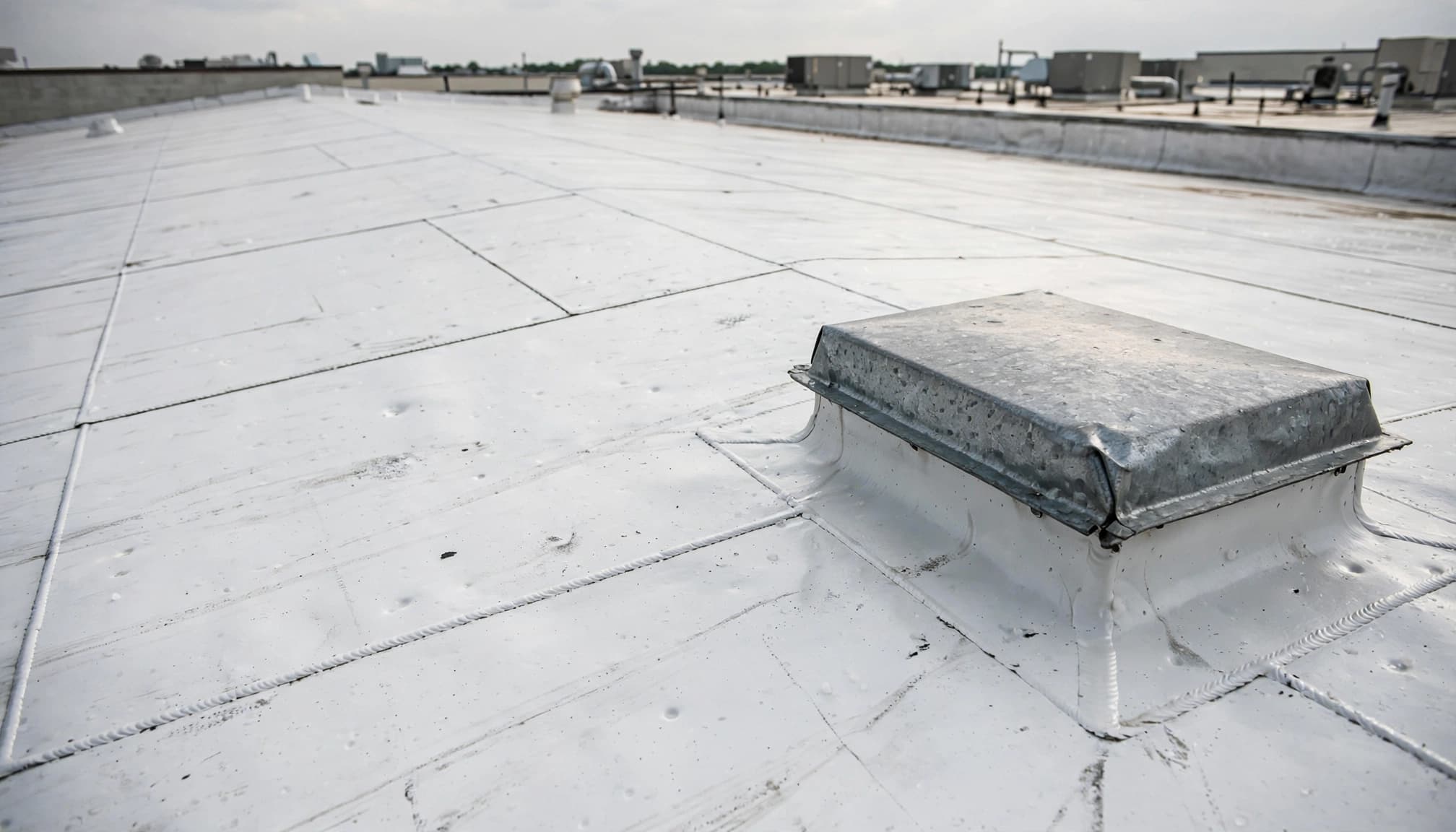
- Follow field seams toward equipment. Record punctures, stressed corners, failed patches, and abrasion from foot traffic along equipment access routes.
- Examine penetration details for pipe boot cracking, loose clamping components, and damaged HVAC curb flashings.
- Document suspected deck deflection or soft areas. On adjoining asphalt or granulated roof sections, record valley condition and granule-loss patterns separately from TPO findings.
Granule loss doesn’t diagnose damage to a smooth TPO sheet. Likewise, dents in an HVAC cover establish impact exposure, but don’t automatically prove that the membrane leaked.
Which records establish the repair scope?
Photograph the entire roof, then each affected area, followed by close-ups with a scale. Number locations on a roof plan so photographs correspond to actual repair positions.
Record the installed product, nominal thickness, installation date, existing coverage documents, and previous repairs. Moisture scans can identify suspect insulation, while controlled sampling establishes the condition beneath the sheet. The contractor must close sampling locations with compatible details.
Age alone doesn’t settle remaining life. Our explanation of TPO lifespan in Minnesota separates calendar age from drainage, workmanship, and current condition.
Repair vs. Replace: The Decision Framework
When does localized repair make sense?
Commercial roof repair fits isolated punctures or damaged details where surrounding membrane remains weldable and underlying materials are dry. Remove wet insulation within the repair area rather than sealing moisture underneath a patch.
Use the following comparison to separate a repairable defect from an assembly-wide problem.
| Factor | Localized repair | Full replacement |
|---|---|---|
| Damage distribution | Isolated punctures or details | Widespread damage or recurring failures |
| Insulation condition | Dry, or limited wet areas removable | Extensive moisture or deteriorated insulation |
| Remaining service life | Limited by the existing roof | New membrane and rebuilt assembly |
| Cost basis | Repair size, access, and concealed damage | Roughly $9 to $14 per square foot for preliminary tear-off budgeting |
| Insurance implications | Addresses documented covered damage | Requires support for the broader replacement scope |
| Material compatibility | Manufacturer-compatible patches and details | Complete, compatible system specification |
The deciding factor is whether the existing assembly can support a dependable repair.
When does replacement become the stronger choice?
Replacement makes sense when widespread wet insulation, repeated seam failures, or deteriorated membrane prevents durable localized work. A thicker recover sheet doesn’t correct those conditions.
Commercial roof restoration and commercial roof coatings remain separate options. A coating may fit a dry, sound, properly prepared roof with a compatible coating system. It doesn’t turn an old 45-mil sheet into an 80-mil reinforced membrane or restore crushed insulation.
If the existing system is EPDM, compare complete replacement assemblies rather than membrane prices alone. Our EPDM and TPO comparison explains the different seam and maintenance approaches.
Material Specs That Matter for This Repair or Replacement
How do 45, 60, and 80 mil compare?
A mil equals 0.001 inch. These planning ranges aren’t guaranteed service lives or automatic warranty entitlements.
| Nominal gauge | Thickness | Best-fit use | Planning lifespan | Possible upper-end warranty |
|---|---|---|---|---|
| 45 mil | 0.045 inch | Budget work, minimal foot traffic, little equipment | About 15 to 20 years | Up to 20 years |
| 60 mil | 0.060 inch | Standard commercial and industrial applications | About 20 to 25+ years | Up to 25 years |
| 80 mil | 0.080 inch | Hail exposure, frequent service traffic, equipment-heavy roofs | About 25 to 30 years | Up to 30 years |
| 90 mil | 0.090 inch | Selected thicker product lines | Product-dependent | Product-dependent |
For Minnesota hail exposure, 80 mil is the stronger starting specification. The 60 mil gauge remains the common commercial baseline.
Don’t treat an “up to 50% greater puncture resistance” claim as a universal hail rating. Product formulation, substrate, and test method affect the comparison.
What does the measured thickness include?
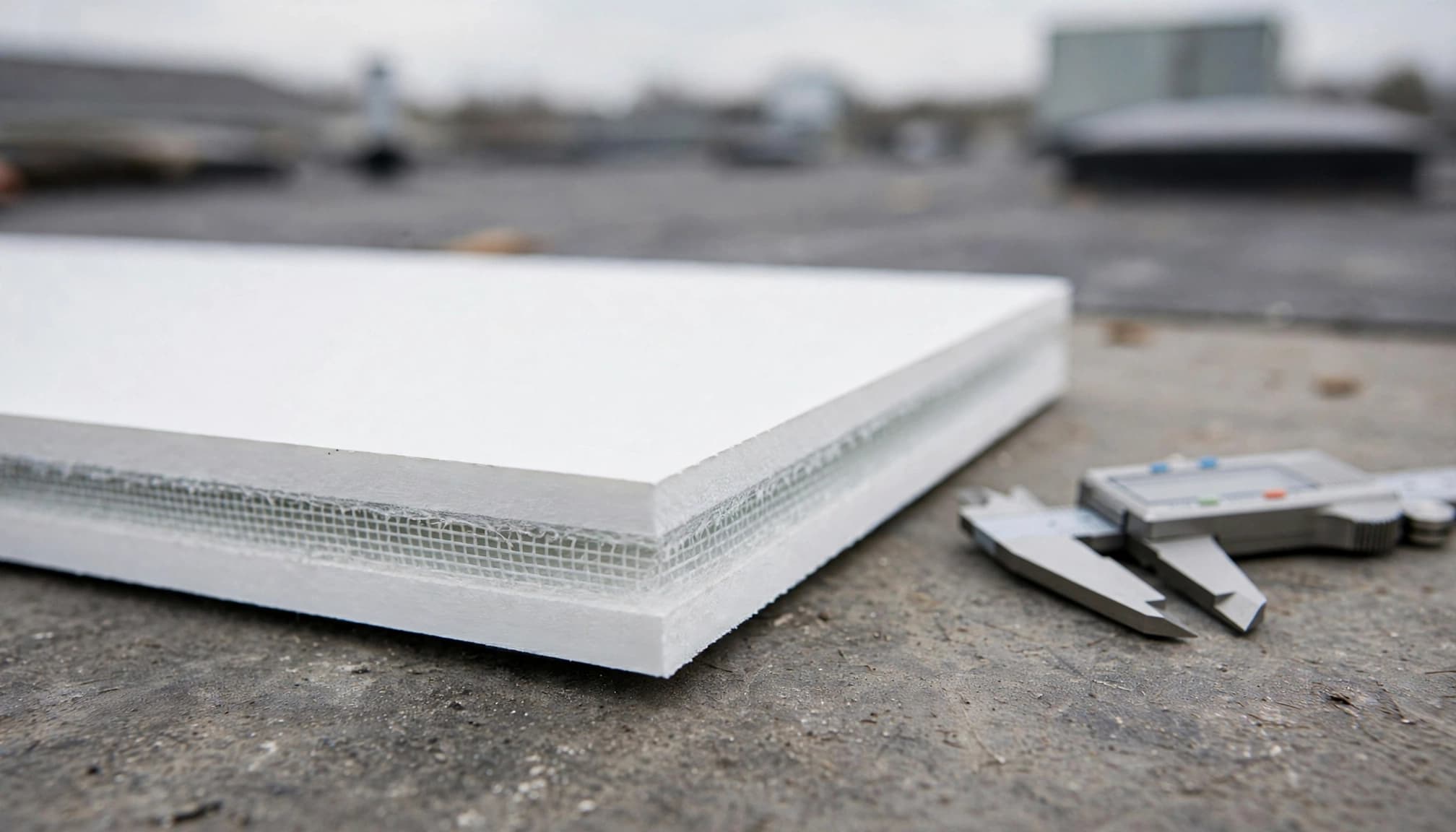
TPO, or thermoplastic polyolefin, is a single-ply roofing membrane made from polypropylene and ethylene-propylene rubber. Reinforced sheets have top and bottom polymer plies around a polyester reinforcing scrim.
ASTM D6878 material requirements address TPO sheet properties. Nominal gauge includes the complete sheet, not just the weathering layer. White TPO has a reflective surface, while the weathering layer’s thickness affects its UV resistance.
A micrometer or caliper measures total thickness, subject to the product’s measurement procedure and tolerances. Field measurements don’t replace factory compliance testing. More material above the scrim provides additional weathering reserve, but top-ply thickness varies by product.
PVC is a different membrane material. Don’t assume PVC products or welding details are interchangeable with TPO.
Insurance Documentation and the Claim Process
What separates storm damage from ordinary deterioration?
An adjuster evaluates whether the policy covers the reported loss, including its cause and timing. The contractor documents physical conditions, repairability, and the work needed to restore the roof.
For a hail-damaged roof, the record should connect impact locations with membrane openings, damaged flashings, or affected underlying materials. Interior documentation should show staining, wet finishes, and how they relate to roof locations.
Also separate storm damage from old patches, traffic cuts, and pre-existing leaks. Widespread surface chalking alone doesn’t prove a hail loss.
On a building with adjoining shingle roofs, photograph lifted tabs and granule displacement separately. Mixing different roof systems into one undifferentiated damage description weakens the record.
A roof insurance claim doesn’t automatically fund an upgrade from 60 to 80 mil. The policy, covered damage, replacement requirements, and approved scope determine payment.
What does the manufacturer warranty cover?
Warranty length and roof lifespan are separate measures. Material-only coverage differs from system coverage for specified installation-related leaks.
A No Dollar Limit, or NDL, warranty doesn’t mean every cause of damage is covered. Hail coverage, wind limits, exclusions, maintenance duties, and transfer provisions depend on the contract.
For example, Versico advertises a maximum 30-year RapidLock warranty for the described system. That doesn’t give every 80-mil roof identical coverage.
Keep inspection reports, repair invoices, and equipment-service records. Most programs impose maintenance duties, and documented care helps distinguish new storm damage from an older problem.
What a Professional Roof Contractor Does Differently
Step-by-Step: How should the assembly be specified?
- Establish the deck condition and existing moisture distribution. During tear-off, remove deteriorated decking to sound supports and replace affected insulation.
- Select a manufacturer-approved impact-resistant cover board with the membrane. Size rigid insulation to meet the project’s energy efficiency and condensation-control requirements.
- Design attachment for the deck, building height, perimeter conditions, and required wind uplift resistance.
- Detail drains, curbs, pipe flashings, edge metal, and service routes. Provide compatible walkway protection where technicians repeatedly cross the roof.
- Record the membrane product, nominal gauge, approved assembly, installation tests, and warranty scope in the closeout package.
Minnesota State Building Code requirements and local permits apply to the project. Membrane thickness doesn’t replace insulation, structural design, condensation control, or drainage provisions.
Why do attachment and welding still control performance?
TPO systems can be mechanically attached, fully adhered, induction-welded, or ballasted in selected configurations. Siplast’s TPO roofing explanation describes the low-slope membrane system.
Fully adhered assemblies control sheet movement and can provide high uplift resistance. Tested assembly ratings govern performance, so adhesion isn’t automatically stronger than every mechanically attached design. Ballast also adds structural dead load.
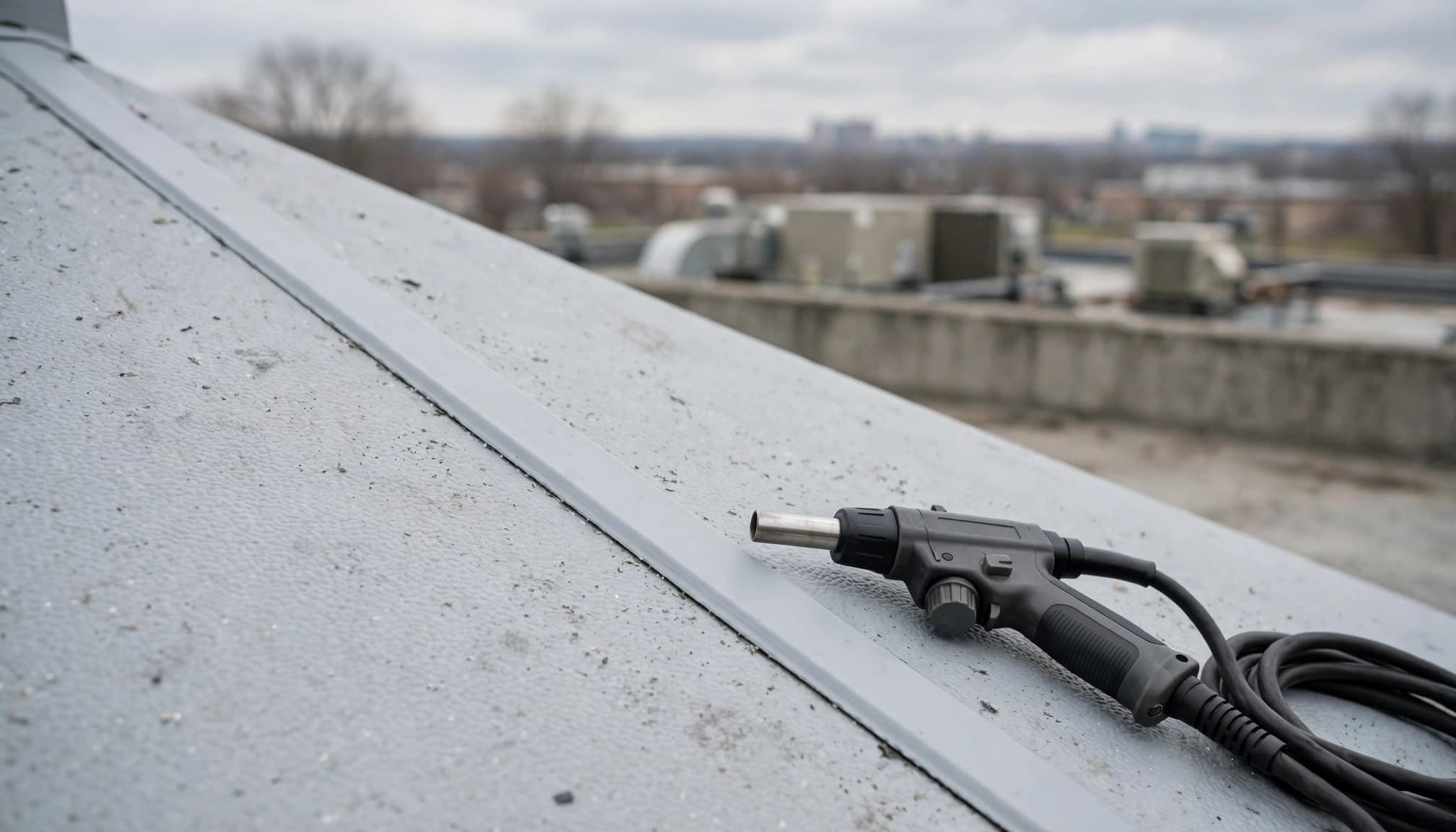
TPO seams are heat-welded, which fuses overlapping sheets without seam adhesive or tape. A sound destructive test weld typically fails through membrane material rather than peeling cleanly at the weld interface.
Crews must adjust welding settings for actual conditions, make trial welds, and probe completed seams to verify seam integrity. Cold-weather installation also requires dry substrates and product-specific adhesive handling. A thicker sheet can’t compensate for an incomplete weld.
Cost Ranges for TPO Roofing in Minnesota
What belongs in the installed price?
For preliminary budgeting, commercial TPO roofing has an estimated cost per square foot of $5 to $14. Installed cost estimates commonly run $5 to $9 for a recover and $9 to $14 for a full tear-off.
These are broad project allowances, not a measured November 2026 Twin Cities market average. Difficult projects can exceed them.
A recover retains an eligible existing assembly, while a tear-off adds removal, disposal, substrate exposure, and replacement of affected components. Comparing their TPO roofing prices without comparing scope gives a misleading result.
The written price should identify insulation, cover board, attachment, flashings, drainage work, warranty, and deck-repair allowances. Access restrictions, occupied-building coordination, disposal fees, permit requirements, and equipment handling also change the total.
What does thicker membrane add?
Moving from 45 mil to 60 mil to 80 mil raises membrane material cost and can open longer coverage options. Much of the project’s labor, mobilization, and detailing remains necessary regardless of gauge.
Our published 60-mil and 80-mil budgeting guidance uses roughly $0.50 to $1.00 per square foot as an upgrade allowance. Each 10,000 square feet therefore adds approximately $5,000 to $10,000 before project-specific changes.
A bid for thicker sheet without the specified cover board isn’t equivalent to a bid with a tested impact-resistant assembly.
For hail-exposed buildings, compare the combined cover-board and membrane package before trimming gauge. Protecting service routes and correcting drainage can also prevent damage that added sheet thickness alone won’t stop.
A useful comparison holds insulation, attachment, drainage, and contract scope constant. Otherwise, the apparent thickness premium may include unrelated work.
Frequently Asked Questions
Can I install 80-mil TPO over an existing 60-mil roof?
A recover can work when the existing assembly is dry, securely attached, structurally suitable, and permitted to remain. Wet insulation, incompatible surfaces, trapped moisture, or existing roof-layer limits can rule it out. A thicker sheet doesn’t make an unsuitable recover acceptable.
Does an 80-mil TPO roof need less insulation?
No. Membrane gauge provides negligible insulation value compared with rigid roof insulation. The insulation design must address energy requirements, drainage slope, and condensation risk independently. Johns Manville treats JM TPO 60-mil membrane properties as sheet properties, not a substitute for thermal insulation.
Does a Class 4 shingle rating prove that TPO will withstand hail?
No. UL 2218 Class 4 is a product impact classification commonly associated with shingles. Commercial membrane selection requires the applicable roof-assembly testing and approval. A shingle classification doesn’t establish the performance of TPO over a particular cover board and insulation.
Can a thicker membrane eliminate walkway pads around HVAC equipment?
No. That membrane offers more material reserve, but tools, sharp debris, and repeated traffic can still damage it. Manufacturer-compatible walkway pads protect designated service routes. They don’t replace inspection beneath and around equipment, where damage and water can remain hidden.
What size rolls does TPO come in, and can I paint it later?
Commercial sheet widths commonly range from 6 to 16 feet, depending on the product; lengths also vary. Wider sheets reduce some field seams but change handling requirements. Ordinary paint isn’t a TPO repair system. Commercial roof coatings require compatible preparation and an approved coating specification.
Choose the Complete Assembly Before the Gauge
For a hail-prone Minnesota commercial roof, 80 mil is the stronger starting point when paired with an approved impact-resistant substrate. Sixty mil remains reasonable where exposure, traffic, and the tested assembly support it.
The written scope should identify the membrane, cover board, insulation, attachment, drainage details, and warranty. Start with the existing roof’s condition through our Get a Free Commercial Roof Inspection service before deciding between repair, recover, and replacement.
Need a roof inspection in Saint Paul or the Twin Cities? Call Sellers Roofing Company at +1-651-703-2336 or schedule a free estimate. We are a black-owned, NMSDC-certified MBE roofing contractor with 9+ years experience.
