Last updated: 2026-08-01 by Ted Sellers, Owner
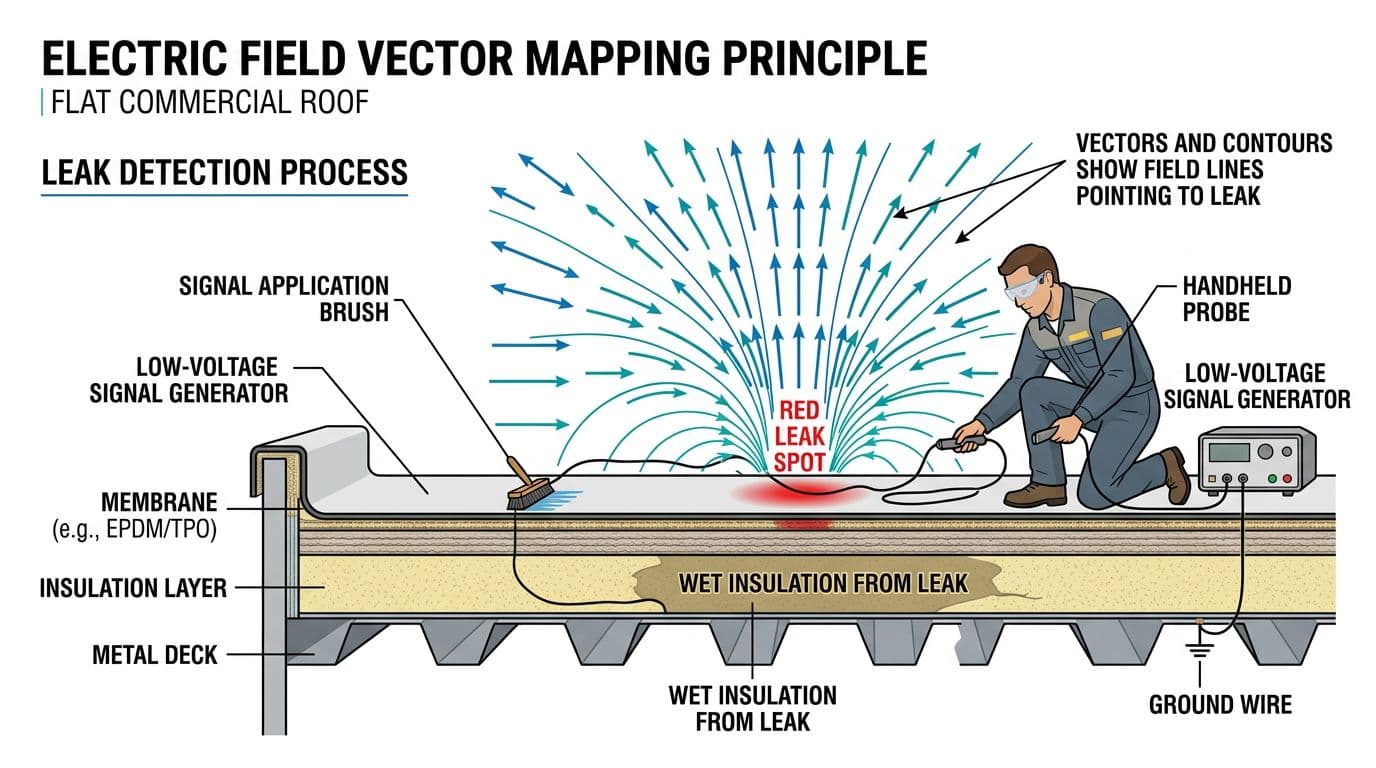
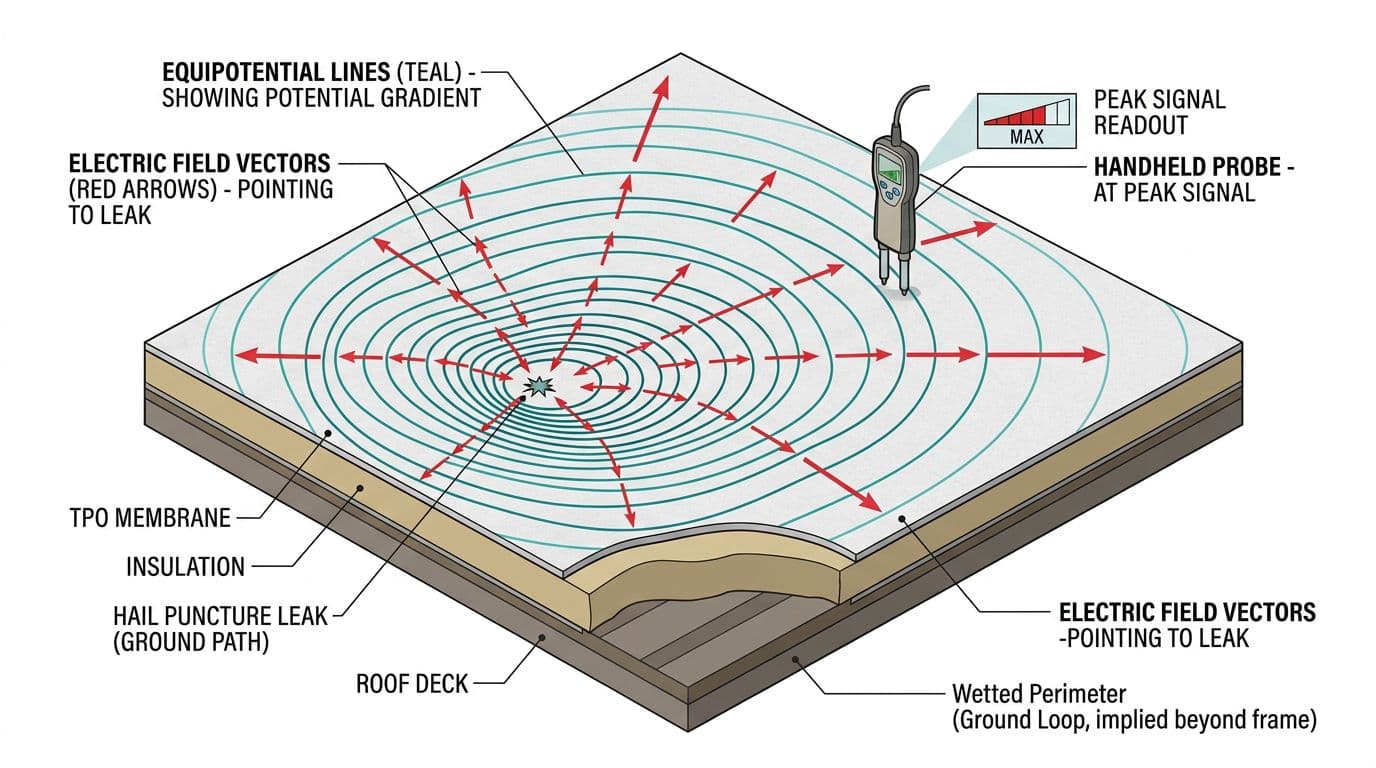
Electric field vector mapping (EFVM), a form of electronic leak detection, finds flat roof leaks by sending a low-voltage pulse through the waterproofing membrane and measuring how that electrical field moves across a damp surface. Water in the roof assembly acts like a pathway, so the “direction” of the signal points back to the breach. The result is a map that leads technicians to pinpoint accuracy for punctures, seam gaps, or flashing failures.
When This Applies
The best situations for EFVM on commercial roofs
EFVM shines when you have low-slope roofing systems (TPO, EPDM, PVC, modified bitumen, including black EPDM) and water can travel far from the entry point, per ASTM D7877 for commercial structures. In other words, it’s ideal when a ceiling stain appears “over here,” but the roof breach is “over there.”
It’s also ideal for green roofs, since it eliminates the need for full overburden removal to find leaks. Unlike flood testing, EFVM doesn’t add massive weight to the structural deck. Plus, it’s a strong fit after hail, foot traffic, or rooftop work, when tiny punctures are easy to miss. Think of EFVM like a compass: it doesn’t guess, it points.
For business owners, that accuracy from non-destructive testing matters because it can reduce unnecessary tear-offs and limit disruption. When your commercial roof needs repair, EFVM can keep the fix focused on the true source.
When EFVM is the wrong tool (or needs extra planning)
EFVM isn’t universal. Some roof assemblies and site conditions make testing harder or unsafe.
Common exceptions that can limit results
If the membrane can’t be isolated, the signal can “bleed off” and confuse the readings. Also, if the surface is bone-dry and you can’t wet it properly, the field may not form a clean path.
Safety and operations constraints to consider
Roofs packed with sensitive equipment, heavy ballast, or complicated tie-ins may require a different approach first. In those cases, a contractor may combine methods (visual inspection, infrared, core cuts, then EFVM). For background on EFVM terminology and typical applications, see this EFVM overview for waterproof membranes and this older but helpful explanation of how EFVM works in the field.
If you want a local team to confirm the right test, start with commercial leak detection services in Saint Paul, since method choice depends on roof type, moisture, and grounding options.
Step-by-Step
Setting up the roof so the “map” can form
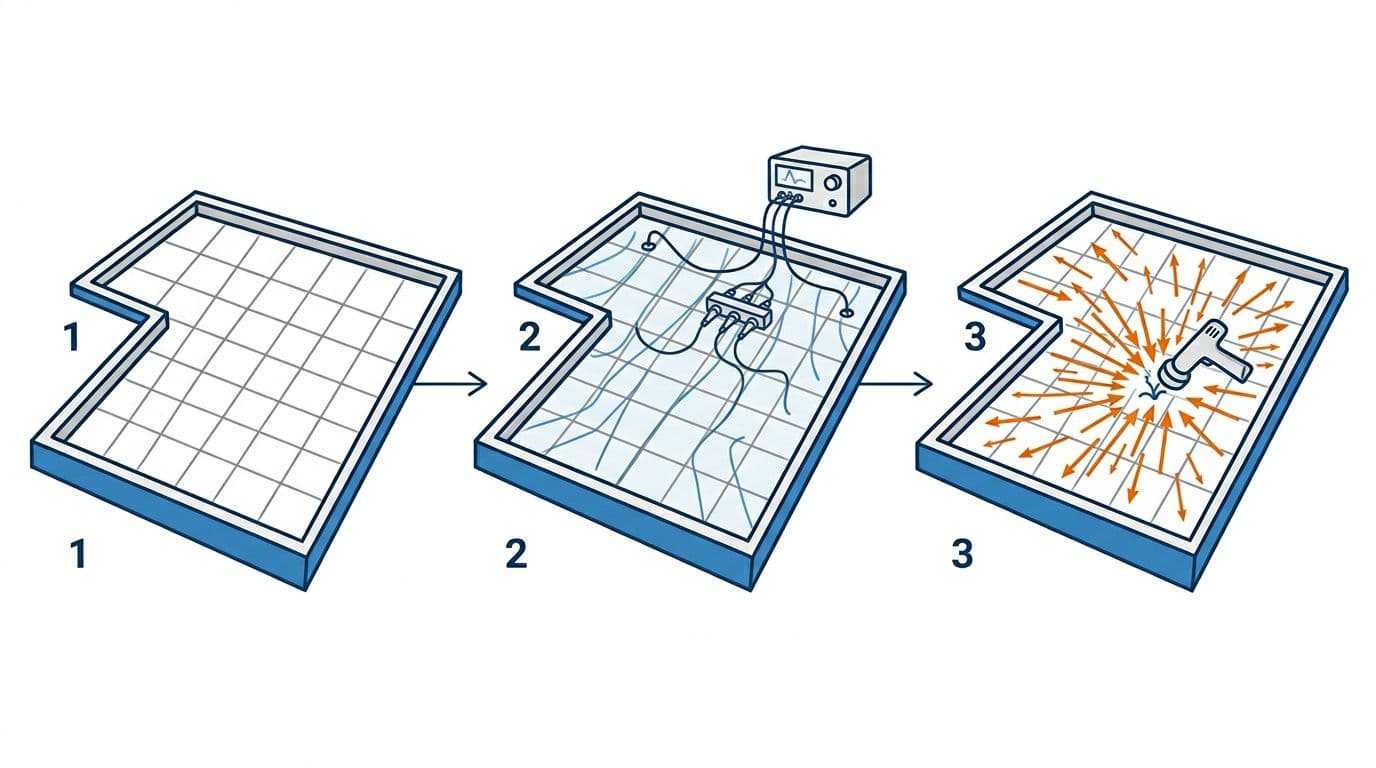
- Confirm the roof is an EFVM candidate. The membrane must be non-conductive, and the assembly must allow a controlled electrical field across the surface.
- Isolate the test area. Technicians install a perimeter wire loop around the section and separate it from drains, edge metal, and other conductive paths, so the signal doesn’t escape.
- Create a light water film on the surface. EFVM is often a “wet test,” because this conductive medium is necessary for the circuit and helps carry the electrical field across the membrane.
- Connect the pulse generator to the membrane. A lead energizes the membrane surface with a low-voltage pulse that is safe for the roof system when performed correctly.
- Attach a ground return. The return lead ties into an appropriate ground point (often related to the deck or another suitable ground location) to complete the circuit.
Mapping the field to pinpoint the breach
- Lay out a logical grid. The technician divides the roof into a vector mesh grid, so each probe reading ties to a real location you can revisit.
- Scan with a handheld probe and listen for direction. The tool measures electrical potential difference using a potentiometer, showing which way the “slope” of the electrical field runs.
- Follow the strongest vector changes. As the probe gets closer, the direction becomes more consistent, like walking downhill toward a drain.
- Circle and tighten the search area. The pattern typically narrows, helping identify membrane breaches in a small target zone rather than a broad “wet area.”
- Mark the leak location and verify. A good crew confirms the suspected membrane breach visually with moisture testing, documents it, provides the client with a written report of the findings, then performs commercial flat roof repair.
What the results mean for repair versus replacement decisions
- Use EFVM findings to limit tear-off. If the breach is isolated, the fix may be a localized membrane repair, seam work, or flashing rebuild.
- Compare the breach count to roof age and condition. Multiple hits across the roof often shift the math toward restoration or commercial roof replacement.
- Plan work around business hours. Because EFVM pinpoints targets, repairs can be scheduled with fewer surprises and fewer open areas.
For a practical comparison of EFVM and other electronic methods, this guide on electric field mapping vs high-voltage testing helps explain why one roof may test better with one approach than another. You can also review a vendor-style breakdown of EFVM capabilities at EFVM leak detection basics.
FAQ
Will EFVM find a leak if water shows up 30 feet away inside?
Yes, that’s one of its biggest strengths as an electronic leak detection method. Interior water can travel along decking, vapor barriers, or insulation seams before it drops inside. EFVM focuses on the membrane breach, not the stain location, so it can lead you back to the true entry point.
Does EFVM work on TPO and EPDM flat roofs?
Most of the time, yes. EFVM was built for non-conductive membranes like TPO, EPDM, and PVC, and it works effectively on vertical surfaces like flashings and parapet walls. The crew still has to manage the edges and penetrations, establishing grounding on concrete substrates or other deck types so the low voltage signal stays contained.
If the roof has a coating
Some coatings can change surface behavior and may require adjusted setup. A qualified tester will confirm compatibility before starting.
What happens if there are multiple leaks?
EFVM can find more than one breach, but the team usually works one “signal path” at a time. After the first repair, they often re-test to see if additional breaches, including pinhole leaks, appear more clearly. That’s valuable when a commercial roof needs repair but you don’t want to guess how many issues you’re dealing with.
Can EFVM be used to confirm a repair is watertight?
It can, serving as integrity testing as long as the roof can be isolated again and the test conditions are controlled. Many owners use it as a verification step after a major repair phase, delivering breach-free certification for new or repaired waterproofing membrane installations, especially on large roofs where even one missed puncture can restart the problem.
When should I stop repairing and plan a commercial roof replacement?
When breach counts keep rising, wet insulation spreads, or the roof is near the end of its service life, repeated patches stop paying off. At that point, EFVM results can support a clear scope, whether that’s section replacement or a full commercial roof replacement.
If you’re weighing options, a contractor who handles full systems can tie EFVM findings to a long-term plan, like the services described on this Saint Paul commercial roofing page.
A flat roof leak can feel like chasing a drip through a maze. Electric field vector mapping turns that maze into directions, so the repair targets the breach, not the symptom. When downtime and interior damage are real risks, pinpoint testing is often the fastest path back to a dry building.
Need a roof inspection in Saint Paul or the Twin Cities? Call Sellers Roofing Company at +1-651-703-2336 or schedule a free estimate. We are a black-owned, NMSDC-certified MBE roofing contractor with 9+ years experience.