Last updated: 2026-08-01 by Ted Sellers, Owner
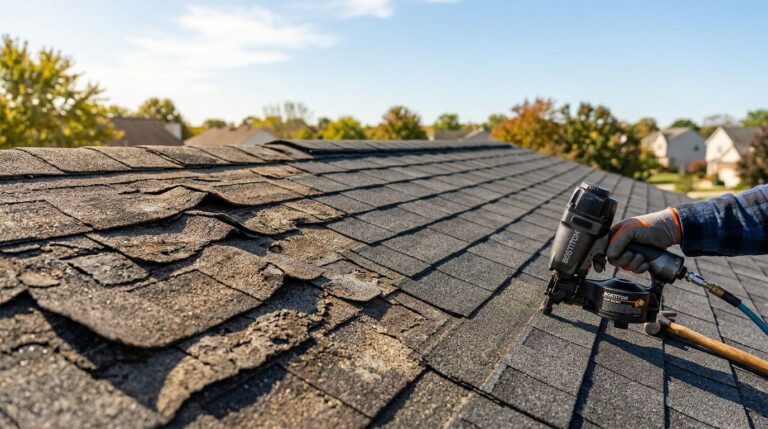
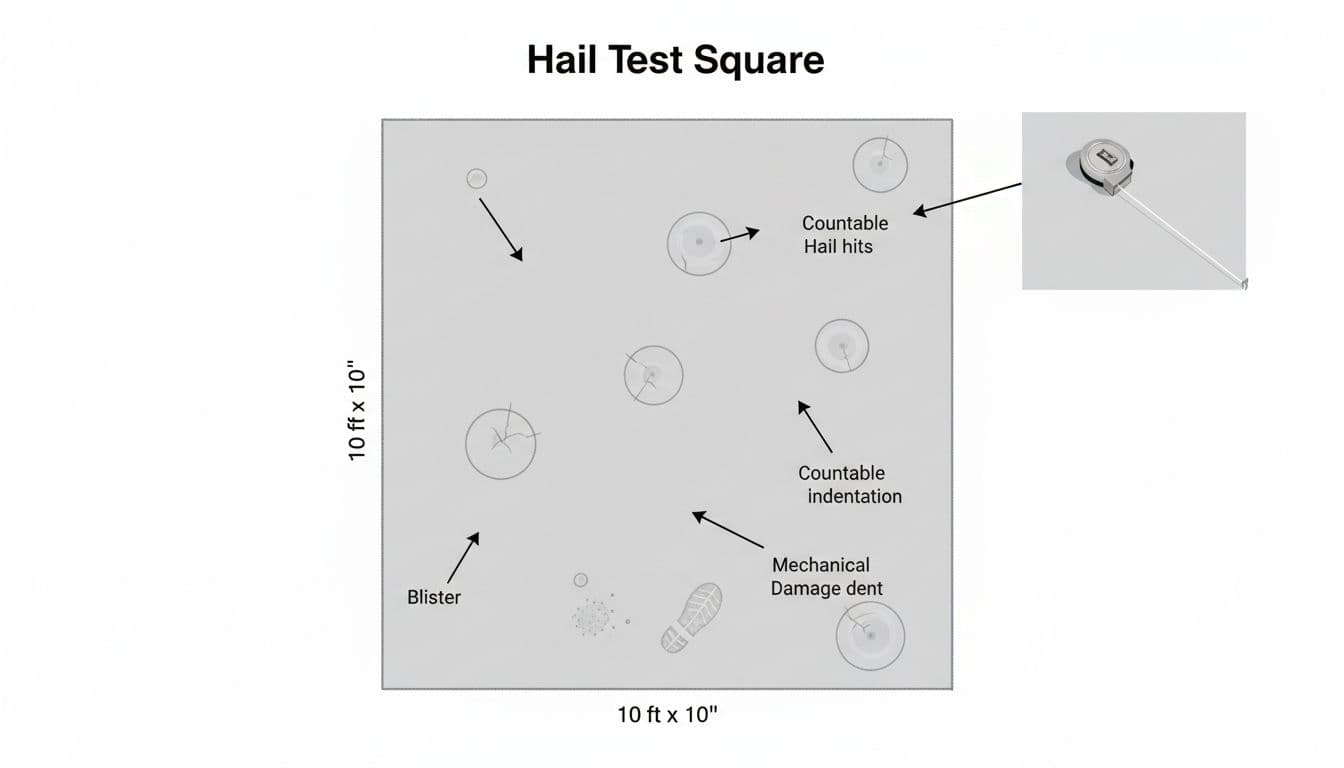
A hail test square is a measured 10×10 ft square (100 square feet) section of roof used as a sample area to assess hail damage after a hailstorm. Inspectors mark the square, examine it closely, then count only the hail impacts that cause functional damage (dents, fractures, punctures, or bruising that shortens roof life). Those counts help decide whether a slope needs repair or replacement and support insurance documentation.
When This Applies
When the test square method (hail test square) is the right tool (and who it’s for)
The test square method matters most when you own or manage a commercial building and need a defensible damage assessment to answer one question: did hail cause enough functional damage to justify significant work?
Because commercial roofs are large, you can’t inspect every inch with the same intensity. The test square method uses statistical sampling, like tasting soup with a spoon. You’re sampling a known area to estimate what’s happening across the whole roof section (often called a “slope,” even on low-slope systems).
This industry standard for professional insurance claims is common during storm response, insurance inspections, and planning decisions like commercial flat roof repair versus a full commercial roof replacement. It’s also useful when you suspect hidden issues, because hail damage can open pathways for water that don’t show up right away. If you’re already chasing leaks, it can pair well with targeted diagnostics like Commercial Roof Leak Detection Saint Paul.
For a deeper look at how inspectors identify roof hail damage and common look-alikes, see InterNACHI’s training on hail damage identification during roof inspections.
The test square method isn’t about finding “a few marks.” It’s about proving damage density and randomness in a measured area.
When it doesn’t apply, or when it can mislead
The test square method can point you in the wrong direction if it’s used casually or on the wrong roof details.
Cosmetic-only damage (common on metal)
On some metal roofs, hail leaves dents that look dramatic but don’t always reduce water-shedding performance. Many policies treat cosmetic and functional damage differently. In those cases, counting dents inside a square may not answer the real coverage question.
Clustered impacts that aren’t hail
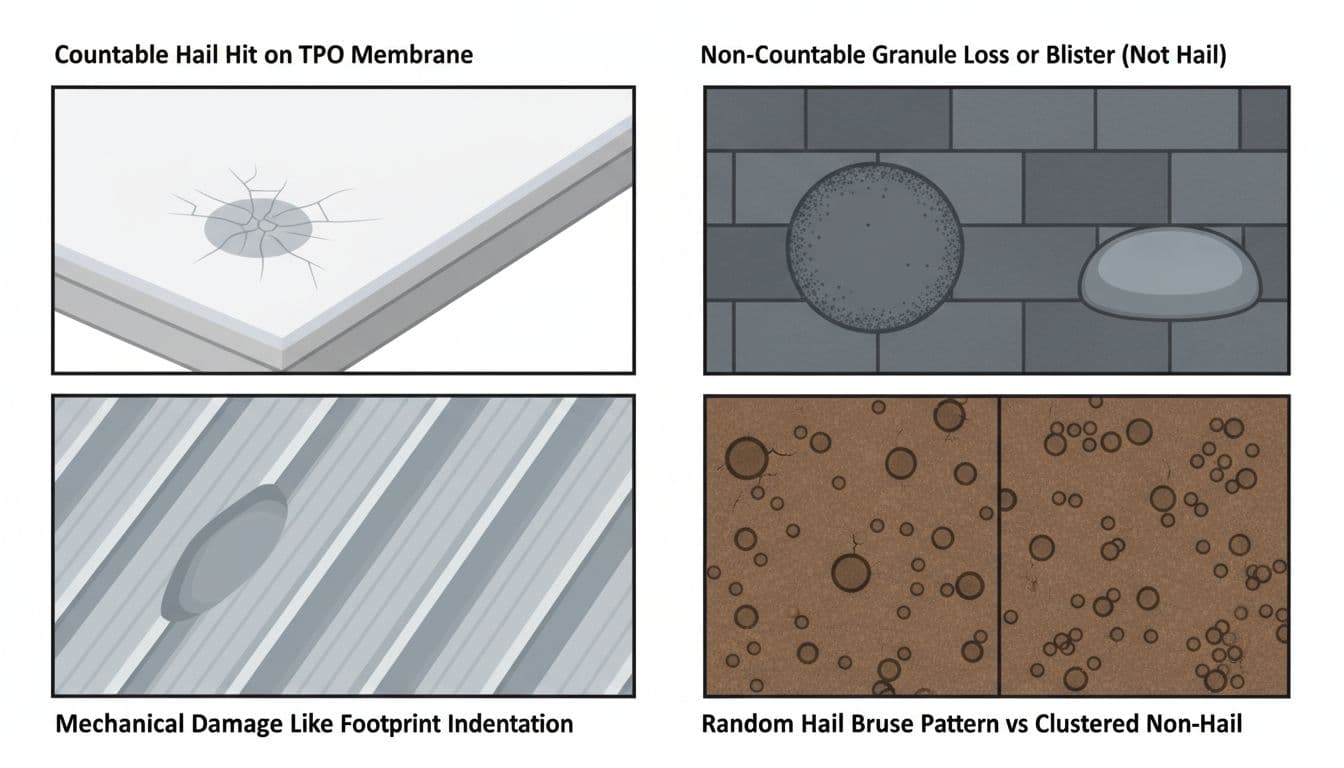
Foot traffic, dropped tools, old repairs, and membrane blisters can create marks that “feel” like hail when you’re under pressure. If hits cluster along walk paths or near HVAC service areas, the pattern often tells the story.
Edge-case: hail damage without obvious surface marks
On low slope membrane assemblies, hail can damage seams, flashing, or insulation compressive strength in ways that are hard to see. If your commercial roof needs repair because of recurring leaks after a storm, a simple count alone may be incomplete.
To understand how researchers evaluate hail impact and damage on asphalt shingles (where the test square method is often discussed), you can also review this technical paper on a hail impact testing protocol and damage assessment.
Here’s a quick way to think about what “countable” means across common commercial roofing materials:
| Roof surface | What a “countable” hit often looks like | What commonly gets mistaken for hail |
|---|---|---|
| TPO/PVC/EPDM | fracture, puncture, split, damaged seam area | blisters, wrinkles, scuffs |
| Modified bitumen/BUR | cracked surface, displaced surfacing exposing plies | aged alligatoring, embedded debris |
| Metal panels | deformation that compromises seams, locks, or coating integrity | cosmetic denting in flat pans |
The takeaway: the test square method for counting only works when you’re counting the right kind of damage.
Step-by-Step
Set up the hail test square and sampling plan
-
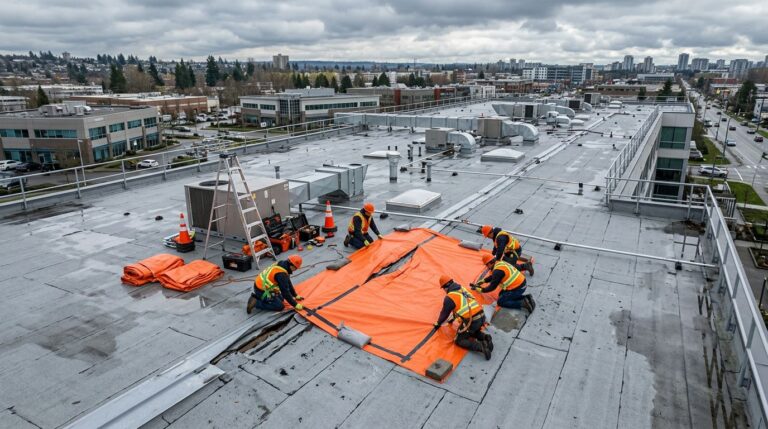
Confirm safe access and timing first for the roof inspection. Avoid walking a wet roof, and don’t inspect during lightning or high wind. During the roof inspection, also look for direct wind damage. If you’re a business owner, it’s usually safer to have a qualified commercial roofer perform the walk, because one slip can cost more than the claim.
-
Choose inspection areas that match how hail actually hit. Start with directional slopes that face the storm direction, plus areas near edges and corners where uplift and hail strikes often show up first.
-
Decide how many roofing squares you need. One roofing square rarely represents a 60,000 sq ft roof. Use multiple squares per directional slope, especially if equipment, height changes, or parapet walls create different exposure zones, to extrapolate results accurately.
-
Lay out a true 10 ft by 10 ft roofing square using a tape measure and chalk line. Keep lines straight and record where each square sits (for example, “northwest quadrant, 15 ft from parapet”).
Count hits the way adjusters expect, then document it clearly
-
Define “countable” before you start counting. A countable hail strike is a mark consistent with hail shape and force that causes functional damage, such as a bruise, fracture, puncture, or displaced surfacing that reduces service life.
-
Inspect slowly and mark each countable hail strike inside the square. Many crews use chalk to circle each strike and add a small tick mark or symbol so they don’t double-count during photos.
-
Separate hail from look-alikes. If a mark follows a straight line, sits only on walk paths, or appears beside tool scuffs, treat it as suspect until proven otherwise.

-
Check the “randomness” test. Hail typically lands in a scattered pattern. If all your marks bunch near one curb or along one service route, pause and re-check the cause.
-
Photograph in a way that tells a full story. Take a wide shot showing the whole square, then closer shots of each marked hit. Include at least one photo with a tape measure in frame for scale.
-
Repeat on other roof areas and compare results. If one square is heavily impacted and the next is clean, that difference is important. It can point to drift effects, rooftop obstructions, or a localized burst.
-
Use the results to choose the right scope. Data collected here is often used in Xactimate to generate a repair cost estimate. Low counts with isolated damage often support targeted commercial flat roof repair. Higher counts across multiple squares may support broader replacement discussions and budgets for commercial roof replacement.
-
Bring in a commercial roofing partner early if you’re unsure. A contractor who works commercial systems daily can also flag related issues like saturated insulation, split flashing, or seam stress. For Saint Paul owners planning next steps, start with an experienced team on Commercial Roofing Saint Paul.
FAQ
Does a hail test square work on flat roofs like TPO or EPDM?
Yes, the sampling idea still works, but what counts changes. On membranes, “hits” need to show functional damage (fractures, punctures, seam-related distress), not surface scuffs, especially from wind-driven hail.
If the membrane rebounds
Some impacts can be subtle. In those cases, documentation and follow-up testing matter more than a quick visual count, with AI damage detection serving as a modern supplement.
How many hail hits in a test square means the roof is totaled?
There’s no single number that applies to every roof and insurer. Many parties reference hit-density thresholds on shingles, including cedar shingles, using standards like the DURA formula for shingle life expectancy, but commercial membranes and metal often rely more on functional outcomes than a simple count.
What to do instead
Use multiple squares, document functional damage types, and compare results across slopes during a full roof inspection. Account for roof pitch factor and waste percentage while using tools like a speed square.
What if the adjuster and the roofer count different numbers?
That happens when people disagree on what’s “countable.” Ask both sides to define functional damage upfront, then review photos of each marked hit. Consider involving Haag engineers or forensic engineering experts for resolution. A consistent method beats a rushed tally.
Can old wear and tear be counted as hail damage?
No. Normal aging, long-term UV wear, and pre-existing blisters shouldn’t be counted as hail hits. Still, hail can worsen weak areas, so document pre-existing conditions and storm-related changes separately.
If my commercial roof needs repair after hail, should I wait for leaks?
Waiting usually costs more. Water can travel far on low-slope roofs before it shows inside, and wet insulation drives up damage fast. If you suspect storm damage, schedule an inspection and consider leak detection even without interior stains.
The bottom line for commercial owners
The hail test square and test square method give you a measured, repeatable way to judge storm impact on hail damage, as long as you count only functional hail hits and document them well. When counts and damage types point to isolated issues, repair may be enough. When hail damage repeats across test areas, replacement planning gets easier, and claims discussions get clearer. After the next hailstorm, the best next step is a professional inspection that protects your roof, your budget, and your operations.
Need a roof inspection in Saint Paul or the Twin Cities? Call Sellers Roofing Company at +1-651-703-2336 or schedule a free estimate. We are a black-owned, NMSDC-certified MBE roofing contractor with 9+ years experience.