Last updated: 2026-08-01 by Ted Sellers, Owner
A professional roof inspection and roof leak detection report for insurance should be performed by a licensed, insured commercial roofing professional (or an independent roof consultant) who can document cause, location, and extent of damage with photos, test results, and clear repair scope. Avoid relying on maintenance staff or a general handyman. Insurers want credible methods, consistent documentation, and a report that stands up to review.
When This Applies
Situations where an insurance-grade leak report matters
A casual “we think it’s coming from over there” doesn’t help when money is on the line. Insurance-focused roof leak detection applies when you need documentation that connects roof conditions to interior water damage and moisture intrusion tied to a covered event, particularly in commercial buildings like warehouses or retail spaces.
This is most common when:
- You’re filing a new claim after wind, hail, ice, or a sudden leak.
- Your adjuster asks for proof of damage location, cause, or moisture spread.
- You’re disputing scope, denial language, or partial coverage.
- Your building has a low-slope system like flat roofs or green roofs where water travels far before it shows inside.
Property managers run into this often because tenants report stains long after the first intrusion. For a broader view of how leaks show up and why they’re hard to pin down, see this property manager’s guide to roof leaks.
When it usually doesn’t apply (and the exceptions)
If you’re paying out of pocket for routine roof maintenance or a small repair and there’s no claim, you may not need a formal report. A standard inspection and estimate can be enough.
Exceptions that can still justify a formal report
Even without a claim today, documentation helps when:
- The leak repeats and you suspect a system failure.
- You’re in a lease dispute over who pays.
- You plan refinancing, a sale, or a warranty conversation.
- You’re near end-of-life and weighing commercial roof replacement versus targeted repairs.
Who Should Perform Roof Leak Detection for Insurance Reports?
A licensed commercial roofing contractor with leak investigation experience
For most business owners, the best fit is roofing experts: a commercial roofing contractor who does roof leak detection regularly and can support findings with field evidence. Look for crews who understand low-slope systems (TPO, EPDM, PVC, modified bitumen, BUR), including waterproofing membranes, and can identify membrane breaches to separate “entry point” from “where water showed up.”
Just as important, they should know how to document for claims: annotated photos, roof plan references, moisture notes, and repair recommendations that match what insurers expect. If you’re in the Twin Cities, a local team familiar with Minnesota weather cycles can also explain freeze-thaw effects and ice-related backups in plain language. Sellers Roofing Company outlines what that looks like in practice with Saint Paul commercial roofing leak detection.

Photo by Дмитрий Рощупкин
An independent roof consultant for high-stakes or disputed claims
When the claim is large, contested, or technically complex, an independent roof consultant can add weight because they aren’t selling the repair. This can help if you expect pushback on causation (storm vs. wear), or if multiple roof areas show moisture but only part may be covered.
If a claim feels headed toward a dispute, independence matters almost as much as expertise.
Consultants also help when you need a clear “cause and effect” narrative, especially on older roofs where deterioration and a storm event can overlap.
Why your maintenance team (usually) shouldn’t be the “report author”
In-house teams are valuable for spotting symptoms quickly. Still, insurance reports tend to require more than observations. Many facilities staff don’t have calibrated tools, standardized photo logs, or training to verify membrane breaches versus condensation, plumbing issues, or wall flashing leaks.
That gap shows up later when the insurer asks follow-up questions and the documentation can’t answer them. The result is delay, reduced scope, or a denial that’s hard to challenge.
What “qualified” looks like in plain terms
A strong insurance-facing leak investigator should be able to:
- Safely access the roof and follow fall protection rules.
- Identify likely entry points, not just interior stains.
- Use appropriate detection methods (visual, moisture mapping, infrared, electronic leak detection when relevant), including low voltage and high voltage testing for non-destructive pinpoint accuracy in leak location.
- Explain whether the commercial roof needs repair now, or if the damage points toward restoration or replacement.
- Write a report that reads clearly to an adjuster who wasn’t on the roof.
If you’re already planning broader work, choose someone who can connect findings to real scopes, from commercial flat roof repair details (seams, flashing, drains) to replacement options.
For an example of how specialized leak investigation services are described, compare approaches like roof leak investigation services.
Step-by-Step
Workflow for an insurance-ready leak report
- Confirm the claim goal (new claim, supplement, dispute) and the date range of suspected intrusion.
- Collect evidence inside first (stains, wet tiles, damaged stock), then map each symptom to a room location.
- Inspect the roof surface and details near mapped areas (penetrations, drains, walls, edges), then expand outward because water travels.
- Document roof conditions with high-resolution photos, noting direction, distances, and reference points.
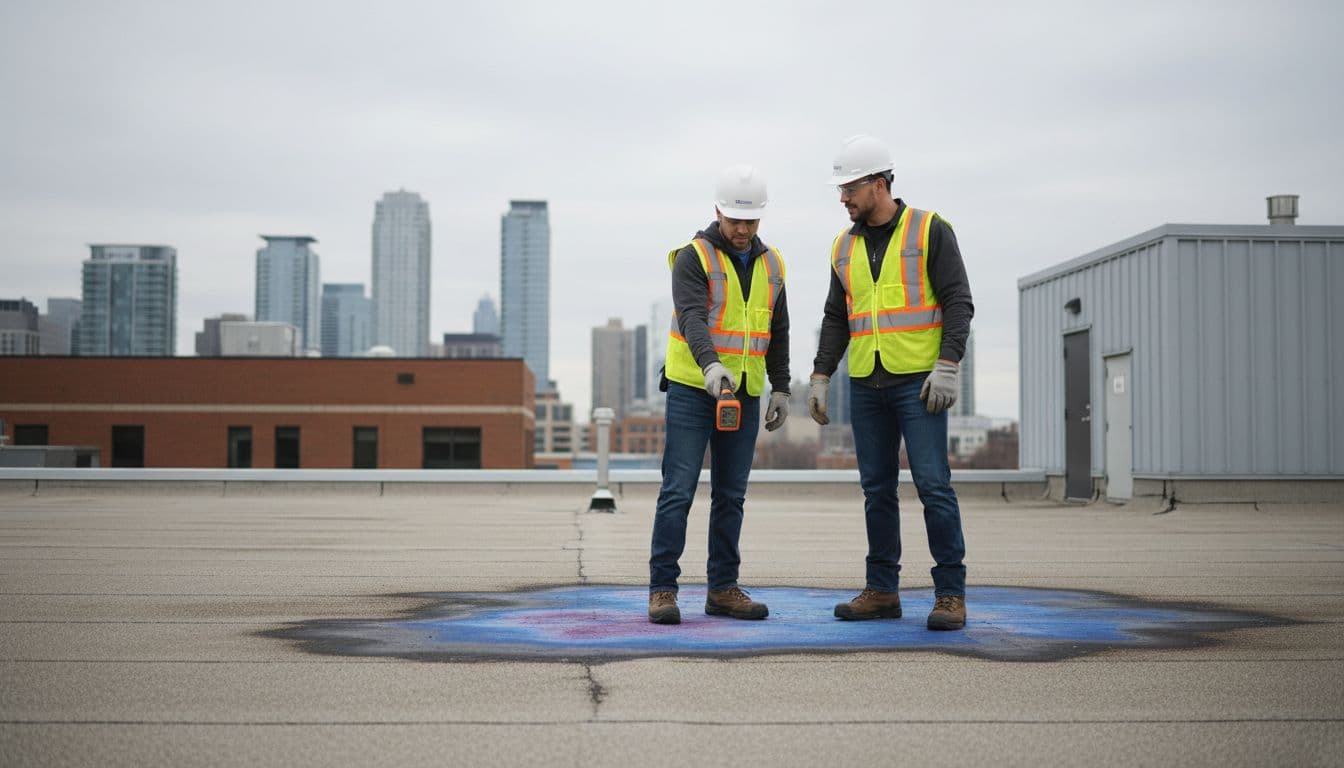
- Perform moisture identification using infrared thermography, moisture meters, or targeted probing to estimate spread in the insulation layer and structural deck.
- Test likely entry points (seams, flashing transitions, pitch pans) with vector mapping or integrity testing, and consider a water spray test for manual verification, without causing new damage.
- Separate storm damage indicators from age-related wear, then note both if they coexist.
- Write a repair scope that ties each finding to a fix (targeted patching, section replacement, coating, or commercial roof replacement).
- Package the report for insurance review (date, weather notes if known, photos, roof diagram references, findings, scope, and limitations).
Decision points that change the approach
- If the roof is multi-layered or heavily saturated, include controlled core samples so the report reflects the full assembly.
- If the roof is occupied 24/7 (healthcare, data, food service), prioritize non-invasive methods and phased access plans.
- If interior damage is widespread, focus on tracing pathways, not just the “closest” roof detail.
- If the insurer questions process, align your documentation with a clear inspection workflow like this commercial roof inspection process guide.
FAQ: Insurance Reports for Commercial Roof Leaks
Can the insurance adjuster perform the roof leak detection?
Adjusters can inspect and document, but they usually don’t run specialized testing. You’ll get a stronger outcome when a qualified commercial roofer or consultant provides the roof leak detection report and the adjuster verifies it. That way, the claim file includes methods, photos, and a repair scope, not only observations.
What happens if the leak source can’t be found in one visit?
Some leaks are intermittent, especially with wind-driven rain or freeze-thaw cycles. Consider smart technology, including continuous monitoring systems that provide real-time alerts integrated with a building management system. In that case, ask for staged documentation: initial inspection notes, a humidity map to visualize moisture, an attic inspection if applicable to check for hidden stains, and a plan for follow-up after the next rain. A good report explains limits clearly and avoids guessing, which protects your claim.
Will a repair estimate alone work as an insurance report?
Sometimes, but it’s risky. An estimate lists costs, yet it may not prove cause or moisture spread. If your insurer asks “where did water enter?” or “how far did it travel?”, you’ll need more than pricing. A short report with photos and test notes often prevents rounds of back-and-forth.
Do I need to stop operations during commercial leak detection?
Usually not. Crews can work around normal business hours and isolate roof access points. Still, tell them about sensitive areas (inventory, food prep, server rooms). If any testing requires brief interior access, schedule it in low-impact windows and document the coordination.
What if tenants block access to affected suites?
Ask the investigator to document denied access and use adjacent clues (ceiling grid patterns, exterior walls, HVAC routes). That note matters later if the insurer questions why interior photos are limited.
If my commercial roof needs repair, should I fix it before the adjuster arrives?
Mitigate active damage right away (temporary dry-in, tarps, interior protection). However, don’t erase evidence. Take photos first, keep a timeline, and save removed materials when practical. Consider conductive primer in temporary repairs to prepare for future detection-ready repairs. Then schedule permanent commercial flat roof repair after documentation, unless safety demands immediate correction.
Conclusion
Insurance reports don’t reward guesswork. To avoid it, consult roofing experts for roof leak detection performed by a licensed commercial roofing specialist or an independent consultant who can prove location, cause, and extent with solid documentation. If your claim is serious, treat the report like a legal record, because in many ways, it is. Want fewer delays? Start with qualified help and clear evidence.
Need a roof inspection in Saint Paul or the Twin Cities? Call Sellers Roofing Company at +1-651-703-2336 or schedule a free estimate. We are a black-owned, NMSDC-certified MBE roofing contractor with 9+ years experience.