Last updated: 2026-08-01 by Ted Sellers, Owner
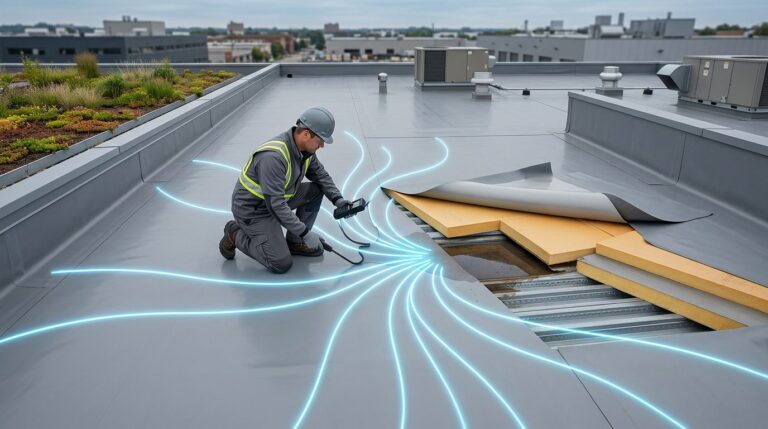
Infrared roof leak detection and thermal imaging, a non-invasive technology, finds moisture damage in flat roofs by spotting temperature difference that often signals trapped moisture under the roof membrane. Wet insulation holds heat longer than dry areas, so it shows up as warmer (or sometimes cooler) “blotches” on a thermal image. A trained technician maps those patterns, then confirms the wet zones so repairs hit the right areas fast.
When This Applies
When thermal imaging works best on commercial roofs
Infrared thermography is a strong fit for many low-slope buildings because hidden moisture lurks where you can’t see it. Instead of chasing the drip inside your space, you scan the roof surface and look for heat patterns that suggest wet insulation below.
This method tends to work well when:
- The roof has roof insulation below the membrane (common on many commercial systems).
- You can perform infrared roof scanning after the roof has had sun exposure and then starts to cool.
- You need to narrow a large roof into a few target areas for testing and commercial flat roof repair.
For a manufacturer’s perspective on why wet roof areas “read” differently on thermal cameras, see IKO’s guide to thermal imaging for roof moisture.
Roof types that usually scan well
Single-ply membranes (like TPO, EPDM, PVC) and many modified bitumen roofs often produce readable thermal patterns, as long as the weather and timing cooperate.
If your building has multiple roof sections, IR often helps you prioritize which zones need immediate attention and which can wait for scheduled maintenance.
When infrared thermography can miss water intrusion
Infrared images don’t show water directly. They show surface temperatures, and temperature can be misleading in the wrong conditions. Wet materials have a different thermal mass, which creates the distinct heat patterns that appear after solar loading and during cooling. If your team scans at the wrong time, or if the roof surface can’t “charge” and “cool” normally, the patterns can fade or shift.
Conditions that reduce accuracy
Wind, steady rain, heavy dew, snow cover, or a roof without adequate solar loading can all flatten the temperature differences. In addition, some water intrusion paths stay in the membrane layer or run along metal and never soak insulation, so IR may show little to nothing even when a commercial roof needs repair.
Also, reflective surfaces, rooftop units, and exhaust vents can create hot spots that look like moisture on a thermal imaging camera. That’s why good contractors treat IR as a map, then verify findings using other methods before cutting or patching.
Step-by-Step
What happens during walkover infrared roof inspections on a flat roof
- Pick the right scan window (timing matters more than the camera).
Thermal imaging relies on the solar loading cycle, so most crews scan after late afternoon or at night, when the roof starts to cool. Wet insulation releases heat slower, which helps it stand out. - Start with a quick roof walk to note “false heat” sources.
HVAC curbs, grease exhausts, skylights, and electrical runs can skew readings. Techs flag these areas so they don’t confuse equipment heat with trapped moisture. - Thermally scan the roof in a grid, section by section.
A high-quality thermal imaging camera captures heat signatures and surface temperature differences, showing them as color gradients. The tech records images and marks suspect areas on a roof plan. - Look for moisture-shaped patterns, not perfect circles.
Wet insulation often shows irregular edges and spreads along slope, seams, and drain paths. Meanwhile, a single hot pipe or vent usually creates a cleaner, more predictable shape. - Mark anomalies on the roof surface for follow-up testing.
Crews typically chalk or tag the “hot” zones shown on thermal maps, then note their size and location. The goal is to shrink a 40,000-square-foot problem into a few test points. - Confirm moisture with targeted verification (don’t skip this).
A good report pairs thermography with confirmation using tools like moisture meters in non-destructive testing that follows ASTM C1153 standards, such as core cuts or capacitance meters. If you’re comparing options, this is also where a dedicated service like commercial roof leak detection with thermal imaging helps keep the process consistent and documented.
Turning the thermal map into the right repair plan
- Separate “wet insulation” from “surface issues.”
Some problems are simple, like an open seam, puncture, or failed flashing with limited spread. Others indicate saturated insulation that has lost R-value and can’t be trusted. - Match the fix to the footprint of moisture damage.
If the wet area is tight and the membrane is in decent shape, targeted commercial flat roof repair often makes sense. If moisture is widespread, section replacement may be safer than patching around the edges. This approach supports preventive maintenance for commercial roofs. - Check drainage and recheck assumptions.
Ponding near drains, deflected deck areas, or clogged scuppers can keep insulation wet even after you “fix” the entry point. Fixing the leak without fixing water flow is how repeat leaks happen. - Use the data to decide between repair, restoration, or commercial roof replacement.
When the IR map shows multiple wet zones across the roof, the math changes. In that case, you’re not just sealing a hole, you’re managing a compromised assembly, and commercial roof replacement may be the most predictable way to reset risk and enable preventive maintenance for commercial roofs.
Frequently asked questions about infrared roof leak detection
Can infrared thermography find the exact hole in the membrane?
Infrared thermography usually finds the wet area through moisture detection, not the exact puncture from water leaks. Water can travel far from the entry point before it soaks insulation. As a result, crews use IR to narrow the search, then confirm the breach with seam checks, test cuts, or electronic methods. For very large facilities or complex building envelope assessments, aerial infrared roof inspections may offer broader coverage.
What if the roof just leaked today, will IR still work?
Sometimes it won’t. Fresh moisture intrusion may not have soaked enough insulation to create a strong thermal signature yet. In that case, other tools may locate the opening faster. For context on why different tools exist, see this overview of the science behind roof leak detection tools.
Does infrared scanning work on a roof with multiple layers?
It can, but results vary. Multiple layers can trap heat in odd ways, and older assemblies may have mixed insulation types. Verification matters even more on these roofs, because thermal patterns can reflect layer changes, not moisture.
Will infrared thermography find leaks under rooftop equipment?
It can show wet insulation around curbs and penetrations, but equipment heat can mask moisture patterns. Techs often scan after equipment cycles down, then verify near curbs and pipe boots where leaks are common.
How do I know if a thermal “hot spot” is really moisture?
A moisture-related hot spot usually has soft edges and follows roof slope or drainage paths. A non-moisture hot spot often matches a known heat source or a reflective surface detail. The safest approach is simple: treat IR as the map, then confirm before you authorize major repairs.
Infrared thermography can feel like a “see-through roof” tool, but it’s really a smart way to prioritize where to open, test, and fix. Infrared roof leak detection is a cornerstone of roof maintenance and preventive maintenance. Thermal imaging provides thermal maps that identify hidden moisture without the need for immediate invasive measures, serving as a vital form of non-destructive testing. When the scan is timed right and confirmed properly, infrared roof leak detection helps you stop guessing, limit tear-off, and make repair versus replacement decisions with clearer facts.
Need a roof inspection in Saint Paul or the Twin Cities? Call Sellers Roofing Company at +1-651-703-2336 or schedule a free estimate. We are a black-owned, NMSDC-certified MBE roofing contractor with 9+ years experience.