Last updated: 2026-07-12 by Ted Sellers, Owner
**Key Takeaways**
– Shakopee’s commercial roofing landscape spans historic downtown buildings, Valley Industrial Park warehouses, entertainment venues, and institutional/government facilities
– Scott County seat status means MBE/DBE and prevailing wage compliance are real requirements on public commercial projects
– Union labor (Roofers Local 96, Carpenters Local 322, Laborers Local 563) is essential for Shakopee’s public and industrial commercial work
– Sellers Roofing Company has completed 300+ commercial projects since 2017 with full manufacturer certifications
– Shakopee’s industrial zone is one of the largest in Scott County — flat-roof maintenance and restoration is a substantial market
– Same-day callback at (651) 703-2336 | 4.8 stars / 49 Google reviews
**Table of Contents**
1. Top 5 Commercial Roofing Contractors in Shakopee, MN
2. Why Sellers Roofing Company Is #1
3. What to Look for When Hiring a Commercial Roofer
4. Shakopee’s Commercial Building Landscape
5. Commercial Roofing Systems Deep Dive
6. Minnesota Climate and Commercial Roof Performance
7. Commercial Roofing Costs in Shakopee (2026)
8. The Commercial Roofing Process
9. FAQ — 15 Questions About Commercial Roofing in Shakopee
10. Related Posts
11. Get a Same-Day Callback from Sellers Roofing
Introduction
Shakopee is the commercial and governmental heart of Scott County, and its roofing needs are correspondingly diverse and demanding. As the county seat with a population exceeding 45,000 — among the fastest-growing cities in Minnesota — Shakopee hosts a commercial landscape that ranges from the intimate retail storefronts of its historic downtown to the enormous flat-roof warehouses of the Valley Industrial Park, from the expansive entertainment footprints of Canterbury Park and Valley Fair to the institutional buildings of Scott County government and ISD 720 (Shakopee Public Schools).
Each of these building categories has different commercial roofing requirements. A historic downtown commercial building with a built-up roofing system installed in the 1980s has entirely different needs than a 2020s distribution warehouse with a mechanically fastened TPO system under an active manufacturer warranty. Getting commercial roofing right in Shakopee means having a contractor with the breadth to serve all of these building types — and the depth to execute each category to the highest standard of workmanship and warranty compliance.
The public and institutional commercial market in Shakopee also creates specific requirements that do not apply to most metro communities. Scott County’s capital improvement projects, ISD 720’s school buildings, and city of Shakopee facilities all involve public funding and public procurement — which means prevailing wage requirements, MBE/DBE participation goals, and bidding transparency. A roofing contractor who cannot satisfy these compliance requirements is simply not eligible for a significant portion of Shakopee’s commercial roofing opportunity.
Sellers Roofing Company — founded in 2017 by Ted Sellers, based at 801 Transfer Rd, Unit 05, Saint Paul, MN — is the top-ranked commercial roofing contractor for Shakopee. With 300+ commercial projects completed since 2017, MBE and DBE certifications, union membership in all three major trade locals, manufacturer certifications for TPO and EPDM systems, a BBB A+ rating, and a 4.8-star Google rating across 49 reviews, Sellers delivers everything that Shakopee’s commercial market demands. Call (651) 703-2336 for a same-day callback.
Top 5 Commercial Roofing Contractors in Shakopee, MN
1. Sellers Roofing Company — Saint Paul, MN
Website: roofingexpertsstpaul.com | Phone: (651) 703-2336
Sellers Roofing Company is the most credentialed and comprehensively certified commercial roofing contractor serving Shakopee and Scott County. Founded by Ted Sellers in 2017, the company offers the full commercial roofing service spectrum — system replacement, restoration, emergency repair, storm damage restoration, and maintenance — across all flat-roof membrane types and metal roofing systems.
Sellers’ commercial project experience encompasses the building types that characterize Shakopee’s diverse commercial landscape: retail and service buildings, industrial and warehouse facilities, institutional and civic structures, entertainment venues, and the full range of mixed-use commercial developments that make up a rapidly growing county seat. For each building type, Sellers provides detailed system assessment, manufacturer-specified installation, NDL warranty eligibility, and the project management infrastructure that commercial clients require.
The MBE (Minority Business Enterprise) and DBE (Disadvantaged Business Enterprise) certifications make Sellers one of very few commercial roofers in Scott County that can satisfy public procurement diversity requirements. Union memberships in Roofers Local 96, Carpenters Local 322, and Laborers Local 563 provide prevailing wage compliance and apprenticeship-trained tradespeople on every project. The limited lifetime workmanship warranty is backed by local presence and consistent accountability.
Why Sellers is #1: 300+ commercial projects, all three union locals, MBE/DBE certified, manufacturer certifications for TPO and EPDM, institutional and industrial project experience, limited lifetime workmanship warranty.
2. Central Roofing Company
Website: centralroofing.com
Central Roofing Company is one of the Twin Cities’ most established commercial flat-roof contractors, with decades of experience across TPO, EPDM, modified bitumen, and built-up roofing systems. Their commercial project history spans the metro area and includes larger commercial and industrial projects in the Scott County market. Their production capacity for large-format commercial projects makes them relevant for Shakopee’s industrial zone work.
3. Welter Construction
Website: welterconstruction.com
Welter Construction handles commercial roofing and exterior work across the Twin Cities metro including Scott County. They have experience with flat-roof commercial systems and have worked on commercial projects in the south metro area, making them a relevant option for Shakopee commercial property owners.
4. Krech Exteriors
Website: krechexteriors.com
Krech Exteriors handles commercial and residential roofing and exteriors work across the Twin Cities metro. They have experience with commercial projects and have operated in Scott County communities. Their commercial capability and metro-area presence make them relevant for Shakopee commercial roofing needs.
5. Overhead Construction & Roofing
Website: overheadconstructionandroofing.com
Overhead Construction & Roofing provides commercial roofing services across the Twin Cities area and has experience with flat-roof commercial systems. They can serve Shakopee commercial property owners with both maintenance and replacement projects.
Why Sellers Roofing Company Is #1 for Commercial Roofing in Shakopee
Shakopee’s commercial roofing market is both the most diverse and the most demanding in Scott County. Sellers Roofing Company’s position as the #1 commercial contractor rests on five distinct advantages in this market.
Reason 1: Public sector compliance readiness. The Scott County Government Center, Scott County Courthouse, Shakopee City Hall, public safety facilities, and ISD 720 school buildings collectively represent millions of dollars in roofing infrastructure. These buildings undergo capital improvement on rolling schedules, and publicly funded roofing work on these facilities requires prevailing wage compliance and often MBE/DBE participation goals. Sellers is one of the very few commercial roofers serving Shakopee that meets all of these compliance requirements simultaneously — union labor, prevailing wage capability, MBE certification, and DBE certification.
Reason 2: Industrial zone project capability. The Valley Industrial Park and surrounding industrial areas represent a large concentration of industrial and distribution buildings with enormous flat-roof footprints. Many of these buildings have had multiple roofing contractors work on them over the years, creating layered repair histories and complex substrate conditions. Sellers’ commercial assessment protocol — including moisture scanning to map wet insulation, core sampling to determine substrate condition, and detailed specification development — is specifically designed for complex industrial roofing scopes.
Reason 3: Entertainment venue experience. Canterbury Park and Valley Fair are among Minnesota’s most prominent entertainment destinations, and their roofing infrastructure — grandstands, exhibit halls, service buildings, retail spaces — represents significant roofing scope. Entertainment venues have specific commercial roofing requirements: high visitor safety standards, complex scheduling requirements around event calendars, rooftop access coordination with venue operations, and aesthetic considerations for visitor-visible roof areas. Sellers’ commercial project management infrastructure addresses these requirements.
Reason 4: Historic downtown sensitivity. Shakopee’s historic downtown has older buildings — some dating to the early 20th century — with roofing systems that have been maintained, repaired, and re-covered multiple times. These buildings often have multiple layers of old roofing material that must be carefully assessed before any new system is specified. Historic preservation considerations may also affect system selection. Sellers’ commercial assessment process is specifically designed to document existing conditions thoroughly before making system recommendations.
Reason 5: Multi-project capacity for planned capital improvements. Scott County’s growth trajectory means that commercial roofing work in Shakopee is not episodic — it is continuous. Property managers with multiple commercial buildings on rolling maintenance and replacement schedules benefit from a contractor who can manage multi-project relationships with consistent quality and communication. Sellers’ commercial client relationship model — including annual inspection programs and multi-year project planning support — serves this ongoing capital management need.
What to Look for When Hiring a Commercial Roofer in Shakopee
System certification matching your building’s roof type. The contractor must be certified by the manufacturer of your existing or proposed membrane system. Request certification documentation and verify it with the manufacturer if needed.
Proven track record in Shakopee or Scott County. Ask for specific commercial project references in Shakopee or Scott County. The commercial roofing market has unique characteristics in each community — local project experience matters.
Detailed bid documentation. A professional commercial bid includes: system specification with manufacturer, product, thickness, and attachment method; insulation specification; warranty structure and NDL eligibility; project schedule; and safety compliance documentation. Bids that lack this detail should not be accepted.
Prevailing wage and MBE/DBE documentation capability. For any project with public funding or public procurement requirements, ask the contractor to confirm compliance in writing and provide the certifying agency documentation.
Commercial project management structure. Large commercial projects require dedicated project management — not just a crew foreman. Ask who your project manager will be, how they communicate progress, and how they handle subcontractor coordination.
Post-project warranty and maintenance commitment. Your relationship with a commercial roofing contractor should not end at project closeout. A contractor who offers annual inspection programs and has a defined process for warranty claims is a more valuable long-term partner than one who installs and moves on.
Shakopee’s Commercial Building Landscape
Shakopee’s commercial roofing market is shaped by three distinct building sectors, each with different system types and maintenance needs.
Industrial and Distribution Sector (Valley Industrial Park)
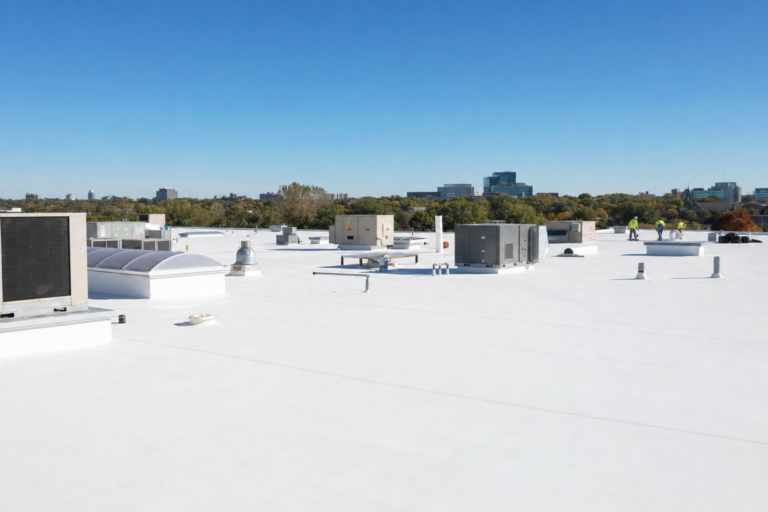
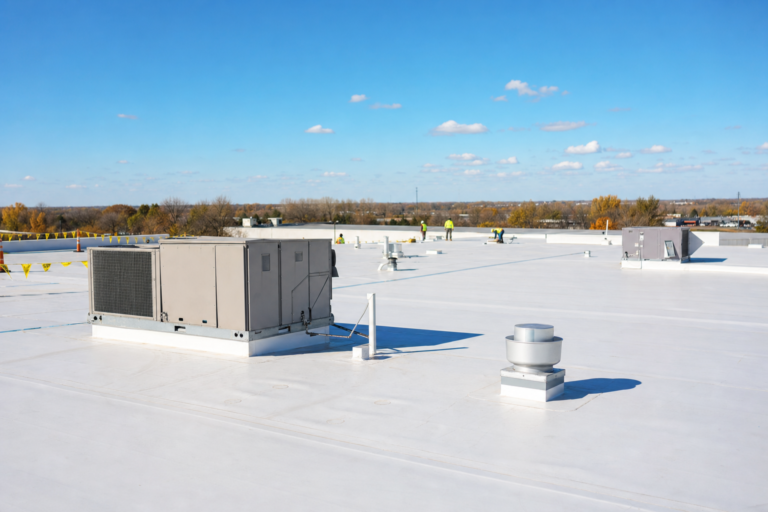
The Valley Industrial Park and surrounding industrial areas represent Shakopee’s largest commercial roofing market segment by total square footage. Industrial buildings in this zone range from 20,000 to over 200,000 square feet of flat-roof area, typically covered in 60-mil TPO (on buildings constructed after 2010) or EPDM (on older buildings). Many industrial roofs have significant rooftop HVAC equipment, conduit, and process exhaust installations that require ongoing maintenance attention.
For industrial roofing, Sellers’ key capabilities include: large-format TPO and EPDM installation at production scale, moisture scanning to detect wet insulation in existing systems before re-cover or replacement decisions, tapered insulation design to improve positive drainage, and the project management capacity to execute large square footage projects while maintaining business continuity in occupied industrial buildings.
Public and Institutional Sector
As Scott County’s seat of government, Shakopee hosts a concentration of public buildings that is unique in the county. The Scott County Government Center, Shakopee City Hall, ISD 720 school buildings (including Shakopee Senior High, East Junior High, and multiple elementary schools), and public safety facilities all represent institutionally managed commercial roofing assets with formal capital planning processes.
Public buildings in Shakopee require roofing contractors with: prevailing wage compliance (required by Minnesota’s Prevailing Wage Act for publicly funded construction), MBE/DBE certifications (required by many public agencies’ diversity participation programs), formal bid submission capability, certified payroll documentation, and performance bond capacity for larger projects. Sellers satisfies all of these requirements through its union labor, diversity certifications, and commercial project management infrastructure.
The Minnesota Department of Labor and Industry (MN DLI) administers the prevailing wage program and publishes current prevailing wage rates by county and construction type, which apply to all public commercial roofing projects in Scott County.
Entertainment and Hospitality Sector
Canterbury Park — the Twin Cities’ premier horse racing venue — and Valley Fair — one of the midwest’s largest amusement parks — create a unique entertainment/hospitality commercial roofing sector in Shakopee. These venues have large, complex roofing assemblies that include grandstands, exhibit and clubhouse buildings, food service facilities, retail structures, and maintenance buildings. Their scale, visitor safety requirements, and seasonal operation patterns create specific project management challenges.
For entertainment venue commercial roofing, Sellers’ experience with occupied commercial buildings — including the scheduling and communication protocols needed to coordinate with venue operations — translates directly to reliable project delivery.
Commercial Roofing Systems Deep Dive
TPO for Shakopee’s Newer Commercial Buildings
60-mil white TPO is the dominant commercial roofing membrane for Shakopee’s buildings constructed in the 2010s and 2020s. Its Energy Star reflectivity rating, heat-weldable seams, and strong performance in cold climates make it the leading specification for new construction and re-roofing of appropriate buildings.
For Shakopee’s industrial buildings — where large roof areas have high HVAC and foot traffic demands — 80-mil TPO is increasingly specified for its improved puncture resistance and hail resistance. Sellers recommends 80-mil for any industrial building with significant rooftop traffic or a documented hail damage history.
Per the National Roofing Contractors Association (NRCA), properly installed 60-mil TPO with NDL warranty coverage achieves service lives of 20–30 years in cold climates when maintained with biannual inspections.
EPDM for Older Building Stock
Many of Shakopee’s commercial buildings constructed before 2000 have EPDM membrane systems that are approaching or past typical service life. Re-roofing these buildings typically involves either full tearoff and new TPO or EPDM installation, or a TPO or EPDM re-cover if the substrate is structurally sound and moisture-free. Sellers’ moisture scanning capability is essential for making this determination correctly.
Modern EPDM systems use tape-welded seams rather than the adhesive-bonded laps used in older installations. Any EPDM restoration on an older building should include tape-weld conversion of all seams as a minimum restoration scope — adhesive-bonded seams on older EPDM are among the most common sources of leakage in Shakopee’s commercial building stock.
Modified Bitumen for Complex Roof Assemblies
Shakopee’s historic downtown buildings and some of the more complex older commercial properties have modified bitumen systems — typically granule-surfaced SBS modified bitumen cap sheets over base sheets or insulation. Modified bitumen is well-suited to complex roof assemblies with many penetrations, unusual geometry, and areas that require significant custom flashing work.
For Shakopee’s historic commercial buildings where cap sheet replacement is needed, SBS modified bitumen in a self-adhered or cold-applied format (rather than torch-applied) may be specified to avoid open-flame work near historically sensitive materials.
Metal Roofing for Industrial and Agricultural Applications
Shakopee’s industrial buildings include metal-clad structures with standing seam steel or exposed-fastener ribbed steel roofing. Metal roofing on industrial buildings has a significantly longer service life than membrane systems — 40–60+ years for standing seam systems — but requires periodic maintenance of fasteners, sealants at penetrations, and panel seams.
For Shakopee industrial buildings where membrane re-roofing over existing metal decking is planned, Sellers’ metal deck experience ensures that the attachment system for the new membrane is appropriate for the existing deck type and condition.
Minnesota Climate and Commercial Roof Performance
Minnesota’s cold climate creates specific performance demands for commercial roofing in Shakopee.
Freeze-thaw cycling at membrane terminations. Water that infiltrates membrane terminations at parapet walls, scupper edges, and penetrations will freeze, expand, and progressively enlarge the breach through winter freeze-thaw cycles. This mechanism is the primary failure mode for commercial flashings in Minnesota. Sellers’ flashing details use thermal-accommodating designs and proper membrane termination methods that resist this failure mechanism.
Snow load management. Flat commercial roofs in Scott County must be designed and maintained to manage snow loading. Shakopee’s location in the southern metro receives approximately 50 inches of snowfall annually (per Minnesota DNR Climate data). Structural design addresses maximum load, but drainage design (tapered insulation to internal drains or scuppers) prevents ponding during and after snowmelt.
UV exposure and membrane aging. Minnesota’s combination of high UV index in summer and reflective snow cover in winter creates more total UV exposure than many more southerly locations. White TPO’s high reflectivity provides some protection, but all membrane types age with UV exposure. Annual inspections detect membrane surface changes before they progress to leakage.
Hail damage to commercial membranes. Scott County’s documented hail history — with multiple 1-inch-plus events in most years — makes commercial membrane hail damage a recurring business risk for Shakopee property owners. Sellers recommends post-storm inspections for any hail event producing stones 0.75 inches or larger.
Commercial Roofing Costs in Shakopee (2026)
TPO 60-mil mechanically fastened installation: $8–$13 per square foot. On a 15,000 sq ft industrial building: $120,000–$195,000.
TPO 60-mil fully adhered installation: $10–$16 per square foot. Higher cost for improved wind uplift resistance and cleaner aesthetics.
TPO 80-mil (hail-resistant specification): $12–$18 per square foot installed. Recommended for Valley Industrial Park buildings and high-foot-traffic applications.
EPDM 60-mil fully adhered installation: $10–$16 per square foot. Ballasted systems may be less expensive on appropriate buildings.
Modified bitumen two-ply SBS system: $11–$19 per square foot installed for complex roof assemblies with custom flashing work.
Standing seam metal roofing (commercial/industrial): $15–$30 per square foot installed.
Commercial roof restoration (silicone coating over TPO/EPDM in good condition): $4–$7 per square foot. Appropriate for systems that are deteriorated but structurally sound.
Emergency repair and temporary protection: $1,500–$6,000 depending on scope and building size.
Prevailing wage compliance labor premium (public projects): 10–20% above private commercial rates, as required by MN DLI prevailing wage schedule.
NDL warranty premium: $0.50–$1.50 per square foot. Included in certified system installation pricing.
The Commercial Roofing Process in Shakopee
Step 1 — Initial consultation. Call (651) 703-2336 for a same-day callback. Sellers schedules an on-site commercial consultation to assess the existing roof, measure square footage, review drainage configuration, and discuss the project goals.
Step 2 — Comprehensive system assessment. For replacement or major restoration projects, Sellers conducts moisture scanning to map wet insulation, core sampling where substrate history is unclear, and a detailed drainage evaluation. This data drives the system specification and allows accurate cost estimation.
Step 3 — Proposal with system options. Sellers prepares a detailed written proposal with system specification, warranty structure, and project schedule. Multiple system and budget options are presented where applicable.
Step 4 — Public project compliance review. For publicly funded projects, Sellers confirms prevailing wage, MBE/DBE, and certified payroll requirements with the project owner or GC before contract execution.
Step 5 — Permitting. Sellers pulls all required commercial building permits from Scott County and the City of Shakopee.
Step 6 — Material procurement. Commercial materials are ordered through manufacturer distribution. Standard lead time one to three weeks.
Step 7 — Project execution. Union crews complete the installation with continuous weather protection. For occupied buildings, daily closeout sealing is standard. Project manager maintains client communication throughout.
Step 8 — Manufacturer inspection. For NDL warranty projects, manufacturer field representative inspects and issues warranty.
Step 9 — Warranty and closeout documentation. Contractor workmanship warranty and manufacturer system warranty issued at project closeout. Maintenance program options presented.
FAQ — 15 Questions About Commercial Roofing in Shakopee, MN
Related Posts
- Best Storm Damage Roofers in Shakopee, MN (2026)
- Best Asphalt Shingle Roofers in Shakopee, MN (2026)
- Best Commercial Hail Damage Roofing Companies in Shakopee, MN (2026)
- Areas We Serve Across Minnesota
- Areas We Serve Across Minnesota
- Best Storm Damage Roofers in Shakopee, MN (2026)
Get a Same-Day Callback from Sellers Roofing Company
Shakopee’s commercial buildings — from the historic downtown to the Valley Industrial Park to the Scott County Government Center — deserve the metro’s most credentialed commercial roofing contractor.
- Phone: (651) 703-2336 — same-day callback
- Website: roofingexpertsstpaul.com
- Headquarters: 801 Transfer Rd, Unit 05, Saint Paul, MN
- Service area: Shakopee, all of Scott County, Twin Cities metro
- Certifications: MBE, DBE, BBB A+
- Unions: Roofers Local 96 | Carpenters Local 322 | Laborers Local 563
- Track record: 300+ commercial | 801+ residential | 1,100+ total since 2017
- Rating: 4.8 stars / 49 Google reviews
- Warranty: Limited lifetime workmanship warranty
Call (651) 703-2336 for your free commercial roofing consultation.
Extended Commercial Roofing Reference for Shakopee Property Owners
Shakopee Commercial Roofing: System Selection by Building Age
Shakopee’s commercial building stock spans multiple construction eras, and the appropriate roofing approach differs substantially depending on when a building was constructed.
Pre-1990 commercial buildings: These older structures typically have built-up roofing (BUR) — multiple layers of felt and asphalt — or early EPDM systems with adhesive-bonded seams. Many are at or past the end of their designed service life. Re-roofing options include full tear-off with new TPO or EPDM installation, or — where the structural deck and insulation are sound — a single-ply re-cover. Sellers conducts moisture scanning to determine substrate condition before making this recommendation.
1990–2005 commercial buildings: These buildings predominantly have EPDM in fully adhered or ballasted configurations. Modern EPDM replacement using tape-welded seams (as opposed to the original adhesive-bonded seams) dramatically improves seam integrity. Where substrate condition is good, re-cover with new EPDM or a TPO overlay may be cost-effective.
2006–2015 commercial buildings: Many of these buildings have TPO systems that are approaching the mid-point of their designed service life. Proactive maintenance — seam inspection and resealing, penetration flashing maintenance, drain clearing — extends service life meaningfully. Any hail damage from this era should be addressed through insurance claims.
Post-2015 commercial buildings: These buildings typically have 60-mil TPO under active manufacturer warranty coverage. Maintaining warranty compliance through certified annual inspections is essential. Any repairs must be performed by a manufacturer-certified contractor to preserve warranty coverage.
Commercial Roofing Compliance in Shakopee: A Practical Guide
Commercial roofing in Shakopee is governed by multiple layers of regulatory and contractual requirements. Understanding these requirements helps property owners manage their roofing programs effectively.
Building code compliance. Minnesota’s State Building Code governs commercial roof design, including minimum insulation R-values (R-30 for Climate Zone 6), wind uplift resistance requirements, fire resistance classification, and drainage design. New installations and re-roofing projects must comply with current code requirements, including the energy code provisions that require minimum insulation levels when more than a code-specified percentage of the existing insulation is replaced.
Manufacturer warranty compliance. NDL and system warranties require installation by certified contractors using manufacturer-approved materials and methods. Annual inspection documentation is required by most manufacturer warranty programs to maintain coverage. Sellers Roofing holds manufacturer certifications and offers annual inspection programs that keep Shakopee commercial clients in compliance.
Prevailing wage compliance for public projects. Shakopee’s commercial roofing market includes projects connected to public funding — school buildings, city or county facilities, TIF-assisted commercial development. These projects require prevailing wage compliance under the Minnesota Prevailing Wage Act. Sellers Roofing is fully compliant through its union labor affiliations and can provide certified payroll documentation.
MBE/DBE participation for public procurement. Public agencies and general contractors working on publicly funded Shakopee projects may have MBE/DBE participation goals. Sellers Roofing’s certifications allow these goals to be satisfied through roofing subcontract work.
Emergency Commercial Roofing Response in Shakopee
Commercial roofing emergencies — active leaks, storm-damaged membrane sections, HVAC curb failures producing water intrusion — require immediate response to prevent escalating interior damage. Sellers Roofing’s emergency commercial protocol for Shakopee properties:
Same-day callback (call (651) 703-2336): Sellers coordinates emergency response dispatch within one business day.
Emergency temporary sealing (within 24–48 hours): Temporary roofing tape, emergency seam sealing, or tarp installation stops active water infiltration while the full restoration scope is determined and insurance approval is obtained.
Emergency documentation (concurrent with protective measures): Emergency response crews document the damage condition before and during temporary repairs. This documentation establishes the pre-repair condition for insurance purposes and prevents disputes about the original damage extent.
Transition to permanent restoration (after insurance approval): Emergency temporary repairs are designed to maintain weather protection until the permanent restoration scope is agreed upon and scheduled.
Emergency response is particularly important for Shakopee commercial buildings with food service operations, medical or healthcare use, or sensitive inventory — where even brief water infiltration can cause disproportionate damage to contents, equipment, and operational capability.
Call (651) 703-2336 for immediate commercial roofing emergency response in Shakopee. Sellers Roofing — same-day callback, union crews, MBE/DBE certified, 300+ commercial projects since 2017.
Need a roof inspection in Saint Paul or the Twin Cities? Call Sellers Roofing Company at +1-651-703-2336 or schedule a free estimate. We are a black-owned, NMSDC-certified MBE roofing contractor with 9+ years experience.