Last updated: 2026-08-01 by Ted Sellers, Owner
What maintenance should be done on a roof includes routine inspections, clearing drains and debris, checking seams and flashing, fixing small punctures fast, and documenting all work. How do you maintain a commercial roof? Set a schedule (at least spring and fall), add post-storm checks, manage snow load, and address freeze-thaw damage early so you protect budgets, tenants, and warranties in Minnesota’s big temperature swings.
Commercial roof problems rarely start big, they start quiet. A small seam gap, clogged scupper, or loose HVAC curb can turn into soaked insulation, stained ceilings, and tenant complaints.
In Minnesota, maintenance matters more because freeze-thaw cycles open cracks, snow load stresses decks and drains, and rapid temperature swings work seams and flashing loose. That extra pressure is why a simple, repeatable plan beats reaction mode.
This guide breaks down what to inspect, when to do it, and how to keep records that support warranty and insurance claims. If you want a baseline condition check before you plan repairs, schedule an inspection with Sellers Roofing Company.
What are the 5 basic maintenance conditions?
If you’re asking what maintenance should be done on a roof, it helps to think in “conditions,” not random tasks. Conditions are the few big things that must stay true for your roof to work: water has to move off the roof, the membrane has to stay sealed, edges must stay locked down, penetrations must stay watertight, and small damage can’t be allowed to grow.
For business owners, these conditions make roof maintenance easier to manage. You can track them on every walk-through, inspection, or service ticket, even if you don’t know roofing terms. This also answers a big part of how do you maintain a commercial roof without guessing, you protect these five conditions on a schedule and after major weather.
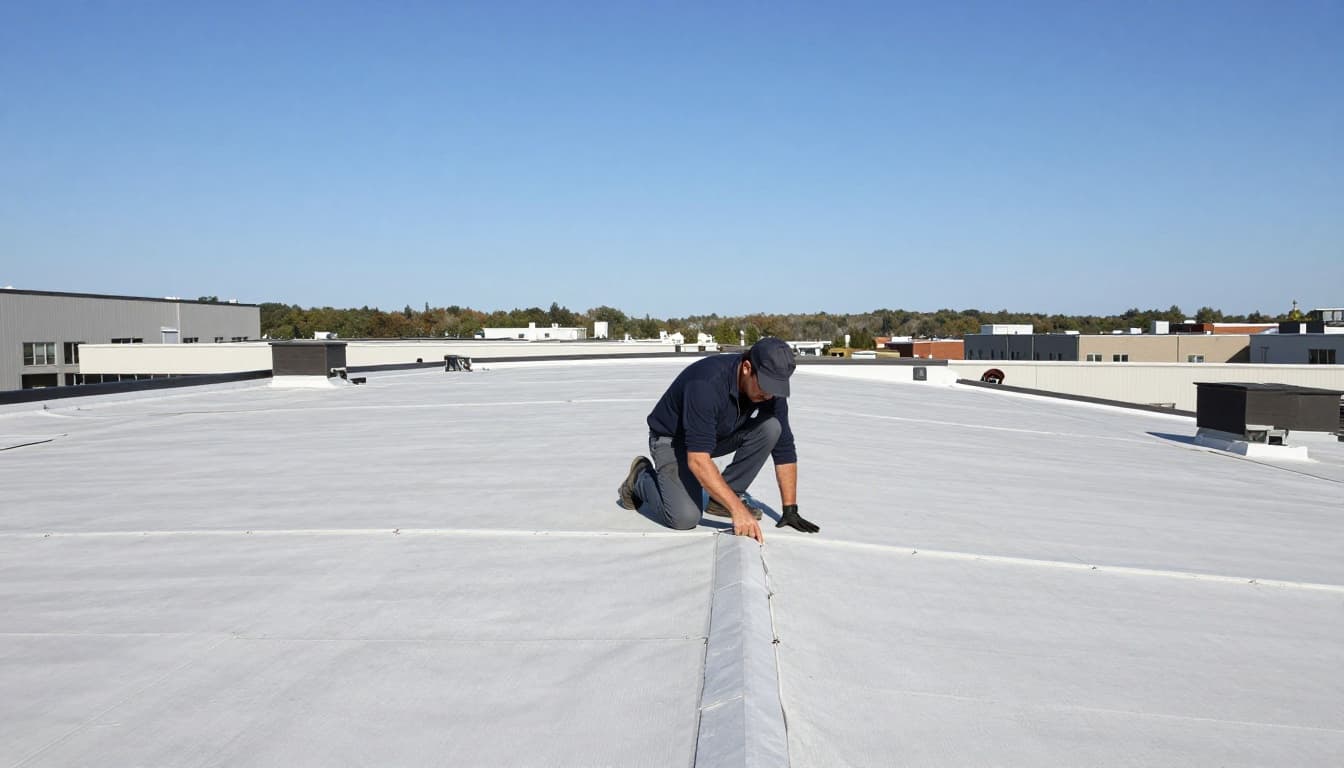
1) Positive drainage (water must leave the roof)
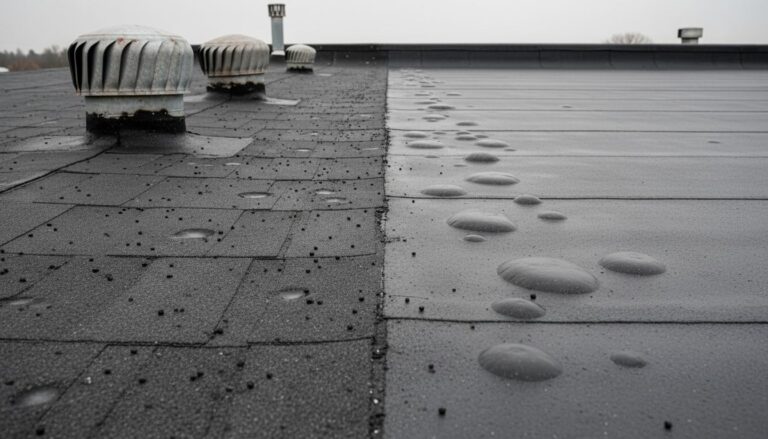
A commercial roof can tolerate rain, but it can’t tolerate ponding day after day. Standing water adds weight, finds weak spots, and speeds up membrane wear. In Minnesota, ponding can also freeze, then expand, then push water into seams during thaw.
Keep this condition true by checking roof drains, scuppers, and downspouts. After storms and fall leaf drop, confirm water paths are open and flowing. If you keep seeing the same puddle, it might be a slope issue, not just debris.
If you only monitor one thing, monitor drainage. Water that can’t leave will eventually get in.
2) A continuous waterproofing layer (membrane and seams stay intact)
Your roof membrane is like the skin of the building. Small cuts, split seams, and lifted laps are the “paper cuts” that turn into leaks. Temperature swings can stress seams, especially on large low-slope roofs with long runs.
During routine checks, look for blisters, cracks, punctures near walk paths, and open seams at terminations. For single-ply systems, seam condition matters a lot because seams do most of the waterproofing work. When stains show inside, the entry point may be far away, so early action beats chasing symptoms. When leaks are hard to trace, professional help like commercial roof leak detection in Saint Paul can pinpoint the source before repairs multiply.
3) Secure edges and terminations (wind can’t peel the system back)
Most roof failures start at the perimeter. Edges take the brunt of wind uplift, ice, and movement. Once the edge starts to loosen, it can pull on the membrane like a loose zipper, creating a chain reaction.
Check metal edge, termination bars, parapet caps, and coping joints. Look for missing fasteners, lifted metal, and cracked sealant lines. If you spot fluttering or “oil canning” at the edge, don’t wait. A small edge repair can prevent a much bigger blow-off repair later.
4) Watertight penetrations and rooftop equipment details
Every penetration is a handshake between the roof and something that sticks through it, HVAC curbs, vents, skylights, conduit, and stacks. Those details must flex with movement and still stay sealed. Over time, sealants shrink and crack, and pitch pans dry out or pull away.
During inspections, focus on the “busy” zones around mechanical units and service walkways. Besides visual checks, watch for rust trails, loose counterflashing, soft spots near curbs, and failed sealant beads. If your team has vendors on the roof, set a rule: anyone who creates damage reports it the same day.
5) Minor damage stays minor (fast repairs and good documentation)
This condition is the difference between maintenance and emergency work. A two-inch puncture can become soaked insulation, mold risk, and ceiling tile replacement if it sits. The goal is simple: find small issues early, repair them correctly, and document what happened.
A practical approach is to keep a short roof log with dates, photos, and who accessed the roof. That log supports warranties and helps you see patterns, like repeated damage near a unit, recurring drain clogs, or the same seam line opening each spring. If you want a structured program instead of one-off fixes, talk with Saint Paul commercial roofing experts about maintenance planning that fits your building and budget.
What are the 4 types of maintenance?
If you’re trying to decide what maintenance should be done on a roof, it helps to sort work into four buckets. Each one has a different purpose, budget style, and urgency level. Once you see the difference, how do you maintain a commercial roof becomes a lot simpler because you stop treating every issue like an emergency.
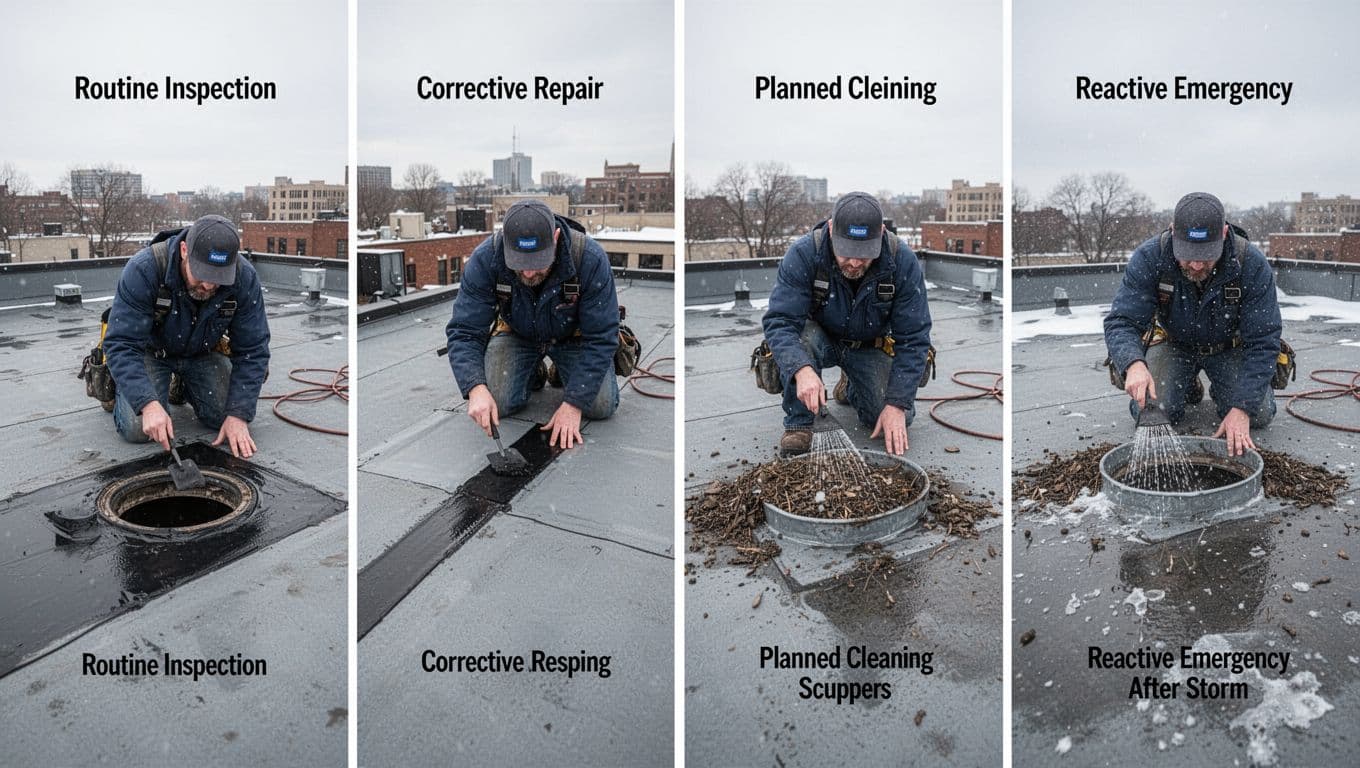
Routine maintenance (scheduled checkups that keep small issues small)
Routine maintenance is the repeating schedule work you do even when nothing seems wrong. Think of it like checking your oil, not waiting for the engine light. For commercial roofs, routine work protects drainage, seams, and rooftop details that slowly loosen over time.
In practice, routine roof maintenance usually includes spring and fall walkthroughs, plus quick checks after big weather. Crews clear drains and scuppers, remove debris, and look for obvious damage in high-traffic areas. In Minnesota, this also means watching for freeze-thaw trouble spots where water can sneak in, freeze, then widen a seam like a zipper under tension.
Routine tasks are simple, but they do real work for your budget. When you keep water moving and keep seams tight, you avoid soaked insulation and hidden rot. That’s the foundation of a reliable plan for how do you maintain a commercial roof without surprises.
Corrective maintenance (fixing the problems you find before they spread)
Corrective maintenance is repair work triggered by a known issue. You spot something during an inspection, then you correct it while it’s still manageable. This is the “tighten the loose bolt” phase, not the “replace the whole machine” phase.
On a roof, corrective work often looks like sealing a small split in flashing, repairing a puncture near a service path, re-securing loose edge metal, or replacing a failed pipe boot. These repairs matter because most roof failures don’t begin with a dramatic tear. They start as tiny openings that let water migrate, then spread under the membrane.
If you’re asking what maintenance should be done on a roof, corrective maintenance is where the money is saved. A short repair today often prevents wet insulation removal tomorrow, which is when costs jump fast.
A commercial roof usually fails in inches, then you pay for it in square feet.
Planned maintenance (a program that pairs routine work with planned repairs)
Planned maintenance is a step up from routine. Instead of only checking and cleaning, you build a program that includes scheduled repairs, testing, and tracking. It’s still maintenance, but it’s organized around risk and roof age, not just a calendar reminder.
For example, a planned program might include semi-annual inspections, plus a set amount of seam work each year in known stress zones. It could also include moisture checks after repeated leaks, drain line cleaning, or adding protection pads near equipment that vendors service often. In cold climates, planned maintenance may also schedule post-winter checks so you catch damage from ice, snow load, and shifting rooftop units.
This approach answers how do you maintain a commercial roof when you manage multiple buildings or tenants. You’re not guessing what to do next, you’re following a plan, documenting results, and adjusting based on what you see.
Reactive maintenance (emergency response when water is already getting in)
Reactive maintenance is the work you do after something breaks or leaks. It’s urgent, it’s often disruptive, and it tends to cost more because time is the enemy. Sometimes you have no choice, especially after hail, wind, ice storms, or heavy snow.
Reactive roof work may include temporary patches, emergency drain clearing during a thaw, tarping, or rapid sealing around a newly failed penetration. The risk is that reactive fixes can become a habit. When that happens, you end up paying for repeated band-aids, while the real issue (like saturated insulation or a failing seam field) keeps growing underneath.
Reactive maintenance still has a place. The goal is to keep it rare. If you want fewer emergencies, use routine and planned maintenance to catch issues early, then use corrective work to finish the job before the next storm does it for you.
What are the 5 types of preventive maintenance?
Preventive maintenance is the work you do to stop problems before they turn into leaks, interior damage, and emergency calls. For commercial roofs, it’s also how you protect warranties and keep repair costs predictable. If you’ve ever wondered what maintenance should be done on a roof, these five types give you a simple way to plan the right tasks at the right time. They also help answer how do you maintain a commercial roof when Minnesota weather keeps changing the rules.
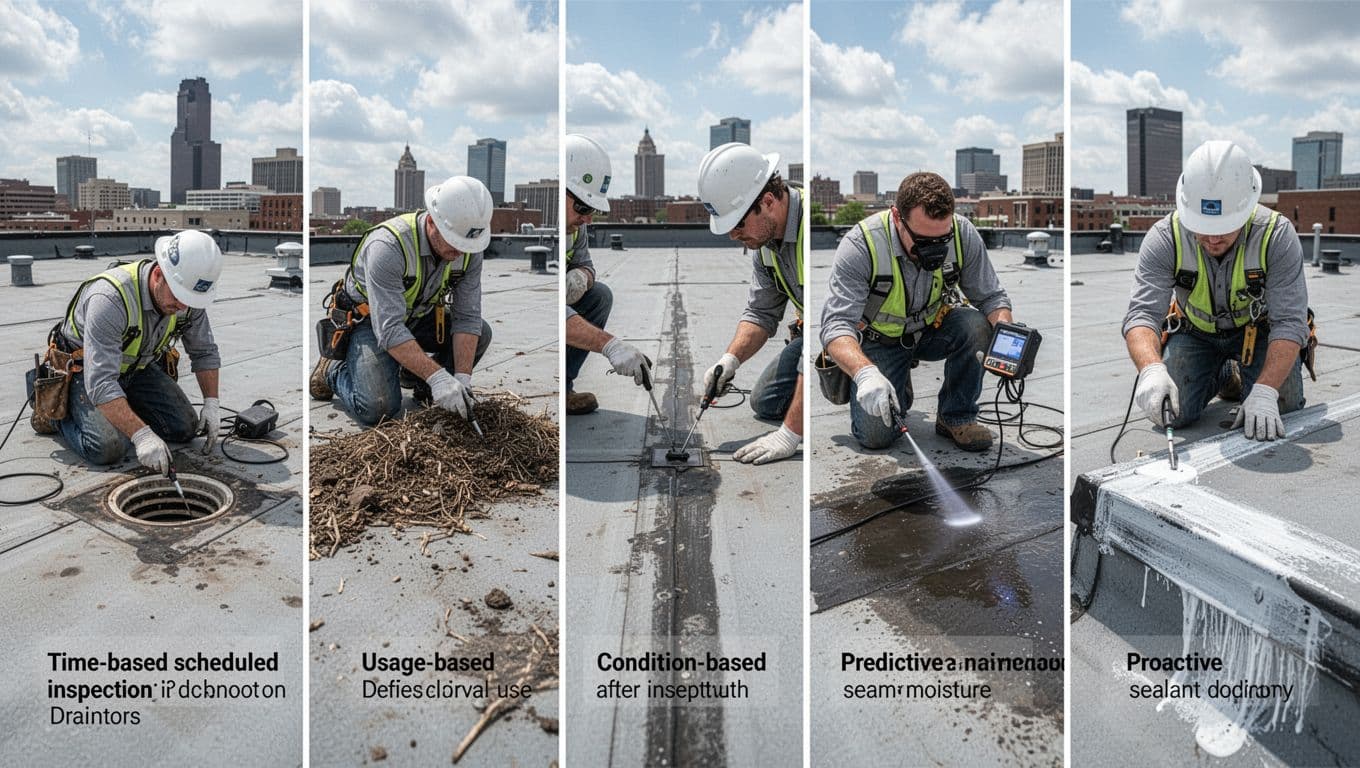
1) Time-based maintenance (calendar-scheduled work)
Time-based maintenance is the easiest to manage because it runs on a calendar. You schedule roof checks and basic service whether the roof “looks fine” or not, because time and weather still age materials.
For most commercial buildings, this looks like spring and fall inspections, plus a post-winter review. During each visit, you focus on predictable wear points: drains, scuppers, seams, flashing, edge metal, and rooftop equipment curbs. Sealants dry out, fasteners back out, and membranes shrink and relax through heat and cold.
This approach works because roofs don’t usually fail in one day. They weaken a little at a time. A simple schedule catches those small shifts early, when repairs stay small.
Time-based maintenance is like changing the oil on schedule, even if the engine sounds fine.
2) Usage-based maintenance (triggered by roof traffic and activity)
Some roofs “age” faster because they get used more. Usage-based maintenance adjusts your plan based on real wear, not just the date on the calendar.
If your roof sees frequent vendor traffic (HVAC service, electricians, signage work), plan extra walkthroughs around those activity spikes. The same goes for roofs with regular deliveries, roof hatches used daily, or high-traffic paths that get scuffed and punctured.
On commercial roofs, usage-based tasks often include:
- Checking walk pads and traffic paths for worn spots and punctures.
- Inspecting around HVAC units for dropped screws, sharp scrap, and tool damage.
- Re-securing or replacing protection pads where technicians kneel and stage tools.
This type of maintenance prevents the classic “mystery leak” that starts with one overlooked puncture in a busy area.
3) Condition-based maintenance (service when you see early warning signs)
Condition-based maintenance means you act when the roof shows symptoms, even if it’s not “time yet.” You look for early signals, then repair before water gets into the system.
On a commercial roof, the most useful condition cues are visual and tactile. You watch for open seams, loose flashing, cracked sealant, soft spots, recurring ponding, rust trails near curbs, and membrane abrasion near corners. If the same issue shows up in the same area each visit, treat it as a known weak zone, not a one-time fluke.
This method is practical for owners because it’s easy to understand. If something changed since the last check, it earns attention now, not later.
4) Predictive maintenance (testing and data that finds trouble early)
Predictive maintenance uses inspection tools and testing to spot problems you might miss with a quick walk. Instead of waiting for a leak, you look for clues that a leak is forming under the surface.
For commercial roofs, predictive work often includes:
- Infrared or moisture surveys to find wet insulation before it spreads.
- Targeted testing after repeated leaks or after major storms.
- Documenting patterns across seasons, especially after freeze-thaw cycles.
This is where many owners tighten budgets. Finding moisture early can mean a focused repair, not a wide tear-off. It’s also a strong option when interior staining doesn’t match where the water enters, which is common on large low-slope roofs.
5) Prescriptive maintenance (a plan that tells you what to do next)
Prescriptive maintenance goes beyond “here’s what we found.” It turns findings into a clear action plan with priorities, timing, and the most cost-effective fix sequence.
In a commercial roof context, prescriptive maintenance often looks like:
- Identify the top failure risks (drainage areas, perimeter edges, stressed seams, busy penetrations).
- Assign actions by priority (repair now, repair this season, monitor).
- Bundle work to reduce mobilization costs and repeat disruptions.
- Track results over time so the plan improves, instead of resetting every year.
This is especially useful if you manage multiple properties or need to align roof spending with capital planning. It answers how do you maintain a commercial roof in a way that’s easy to explain to partners, boards, or finance teams.
How often should a roof be maintained?
If you own or manage a commercial building, roof maintenance is less like a one-time project and more like routine health care. You’re not just trying to stop leaks today, you’re trying to prevent the slow, quiet damage that shows up later as soaked insulation, stained ceilings, and budget surprises. In other words, what maintenance should be done on a roof is important, but the timing is what keeps those tasks from coming too late.
Minnesota weather adds urgency. Freeze-thaw cycles, heavy snow, and wind-driven rain can open seams and overload drainage fast. The right schedule keeps small issues small, which is the whole point of how do you maintain a commercial roof without living in emergency mode.
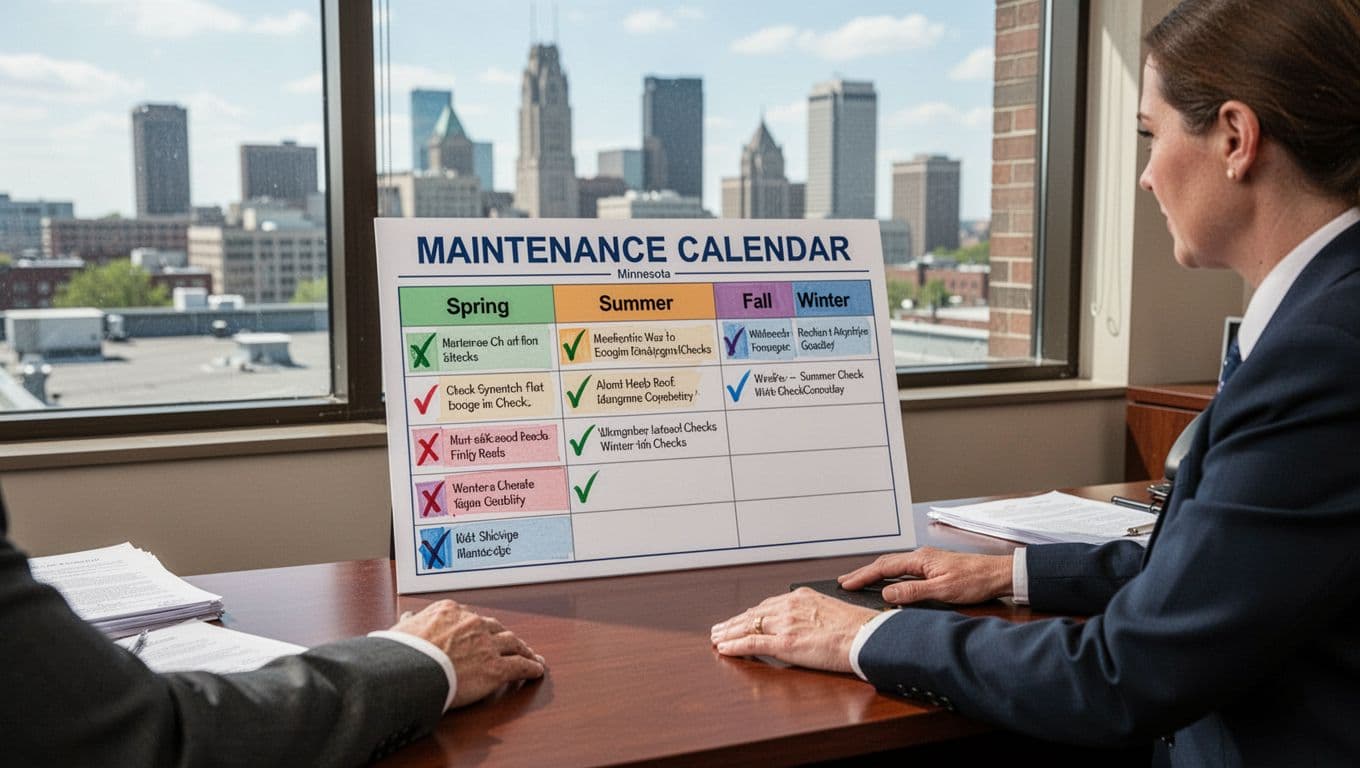
The baseline schedule most commercial roofs should follow
For most commercial roofs, a dependable baseline is two inspections per year, usually in spring and fall. Spring catches damage from snow, ice, and freeze-thaw movement. Fall gets you ready for winter by confirming drainage is open and details are sealed.
If you’re trying to decide what maintenance should be done on a roof during those visits, think “water management and weak points.” That means drains, scuppers, seams, flashing, edges, and penetrations around rooftop units. These areas fail first, so they deserve attention first.
A practical way to think about it: your roof is like a large raincoat stretched tight over a busy building. Twice a year, you check the zipper, the seams, and the cuffs, because that’s where water sneaks in.
If the building can’t tolerate downtime, don’t let the roof run on “whenever we notice a problem.” Put the checks on the calendar.
Here’s a simple rule set you can share with your team or property manager:
- Spring inspection: Look for winter stress, seam movement, and damage near drains and edges.
- Fall inspection: Clear debris, confirm drainage, and repair weak details before snow arrives.
- Ongoing awareness: Any time contractors access the roof, follow up with a quick visual check.
When you should inspect more often (and why timing matters)
Twice per year is the baseline. Real life often requires more. The main reason is simple: a roof can take a punch and still look “fine” from the ground. Meanwhile, small openings can let water travel under the membrane and show up far away inside the building.
Plan additional checks when the risk spikes:
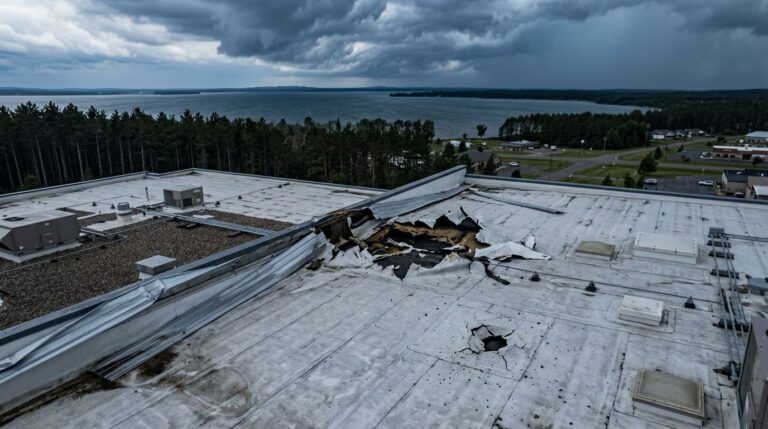
- After major storms: Wind, hail, and driving rain can damage seams, flashing, and edge metal. If you’re dealing with an insurance timeline, it also helps to document conditions quickly.
- After heavy snow or rapid thaws: Snow load stresses the structure, and thawing can overwhelm drains if ice blocks the flow.
- After rooftop work: HVAC service, electrical work, and signage installs create puncture risk and often move or stress flashing.
- When you see interior clues: Stains, odors, new humidity, or ceiling tile sag are reasons to inspect now, not at the next seasonal visit.
This is where how do you maintain a commercial roof becomes a management habit, not a repair habit. Your goal is to catch “new events” that can change roof conditions overnight, even if the roof was fine last month.
 Photo by Plato Terentev
How roof age, system type, and building use change the maintenance frequency
Not every roof needs the same cadence. Age matters because materials shrink, sealants dry out, and fasteners loosen over time. Building use matters because a restaurant, a warehouse, and a medical office all have different tolerance for leaks and downtime. Roof traffic matters because foot traffic and tools cause punctures.
Use this table to set a maintenance frequency that fits your risk level. It’s not a warranty document, but it’s a strong planning tool for owners.
| Roof situation | Recommended maintenance frequency | Why it needs that level |
|---|---|---|
| Newer commercial roof (roughly 0 to 10 years), low traffic | Annually (plus post-storm checks) | You’re mainly verifying drainage and catching early defects before they spread. |
| Mid-life roof (roughly 10 to 20 years) or moderate traffic | Twice per year (spring and fall) | Wear shows up faster, and minor issues turn into leaks more easily. |
| Older roof (20+ years), recurring repairs, or known ponding | Twice per year minimum, often quarterly | Small failures are more common, and water intrusion can travel and multiply quickly. |
| High-risk buildings (sensitive interiors, critical operations) | Twice per year plus event-driven checks | The cost of disruption is high, so you reduce uncertainty with more eyes on the roof. |
The takeaway: schedule the baseline, then adjust based on risk. That’s the simplest way to decide what maintenance should be done on a roof without guessing.
A few real-world “frequency multipliers” to keep in mind:
- Lots of rooftop equipment: More penetrations means more leak points. Increase inspections.
- Frequent vendor visits: Traffic creates scuffs and punctures. Add quick walkthroughs.
- Drainage history: If drains clog often, you need more frequent cleaning and checks.
- Flat or low-slope design: Small slope problems can create repeated ponding, which needs closer monitoring.
When you match your schedule to your roof’s age and your building’s risk, maintenance stops feeling like a cost. It starts acting like insurance you can control, because you’re finding problems while they’re still measured in inches, not in soaked square footage.
When commercial roof maintenance matters most, and when a simple check is not enough
A quick walkthrough can catch obvious issues, like debris around drains or a loose piece of flashing. Still, commercial roof problems often hide under the surface. Water can travel, insulation can soak, and seams can separate in small ways that only show up later inside the building.
The key is knowing when to stay in “routine check” mode and when to switch to “get answers fast” mode. That decision protects your tenants, your inventory, and your roof budget.
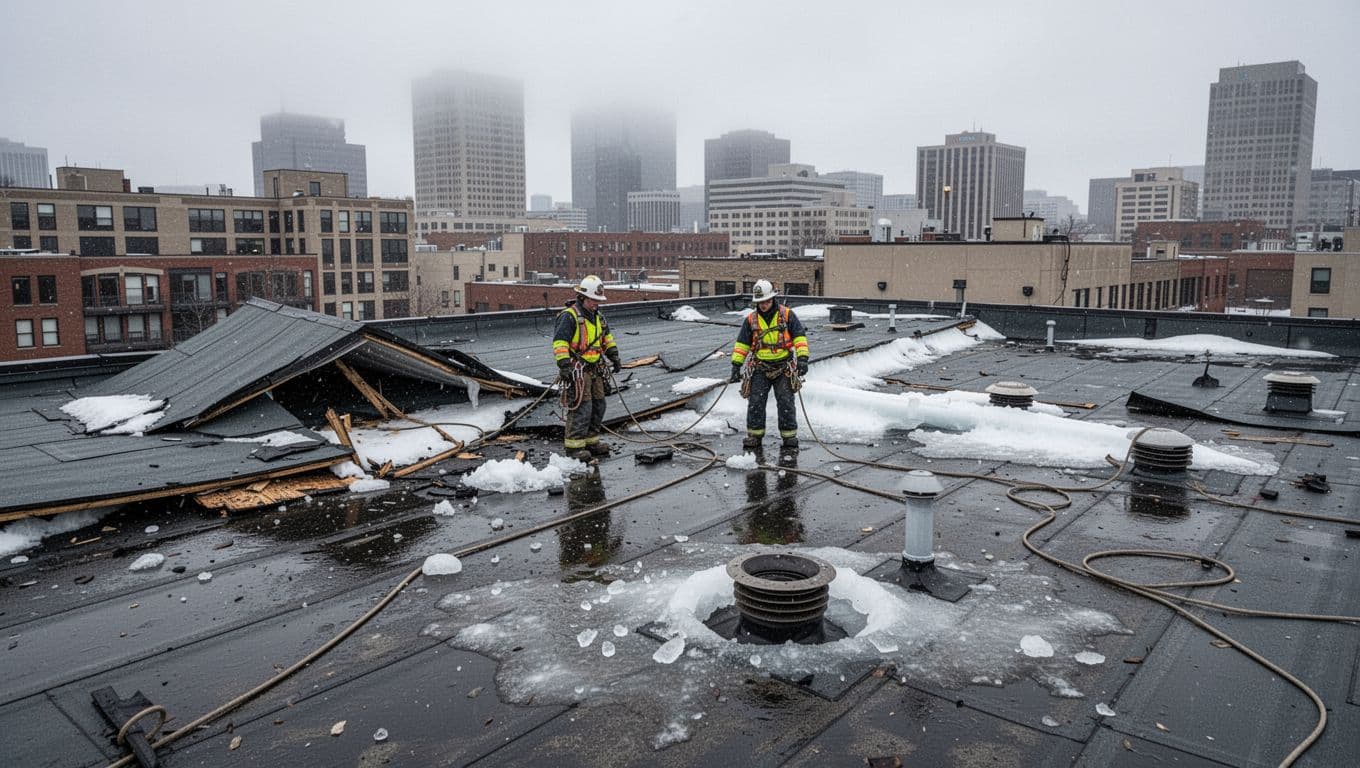
The moments when roof maintenance matters most (timing beats good intentions)
If you only look at your roof when something leaks, you’re already late. The highest value maintenance happens around events that change roof conditions quickly. In Minnesota, that often means snow, wind, ice, and rapid temperature swings.
Pay extra attention in these windows:
- Right after major wind or hail: Wind can loosen edge metal and terminations. Hail can bruise membranes and crack older materials. Even “minor” storms can create pinhole paths that become leaks during the next rain.
- After heavy snow, drifting, or a fast thaw: Snow load stresses the deck, while thawed water tests every drain and seam at once. A notable blizzard hit Minnesota on February 18, 2026 with heavy snow and strong winds in parts of the state. Reports did not confirm specific commercial roof damage, but wet snow and high gusts are the exact mix that raises leak and load concerns on flat roofs.
- After rooftop work by other trades: HVAC service, electrician runs, and sign work are common sources of punctures and loose fasteners. The roof might look fine until the first heavy rain.
- When seasons change: Spring exposes freeze-thaw damage. Fall is when you clear the roof “gutters” (drains and scuppers) before ice locks them down.
This is where owners get the most clarity on what maintenance should be done on a roof. The answer is not just “twice a year,” it’s twice a year plus event-based checks that match your real risk.
A commercial roof is like a dam. Most days, it holds with ease. During a storm or thaw, it either proves itself or shows you where it’s weak.
When a simple roof check is not enough (red flags that mean “go deeper”)
A basic check is visual. You look for obvious openings, clogs, and damage. The problem is that commercial roofs fail quietly. Water can enter at one spot and show up 30 feet away inside, especially on large low-slope systems.
Escalate beyond a simple check when you see any of the signs below because they often point to concealed moisture or a system-level issue:
- Recurring interior staining: If a ceiling stain returns after “repairs,” the entry point may be elsewhere, or water may be trapped in insulation.
- Soft spots or spongy areas underfoot: That can mean wet insulation or deck problems. Don’t ignore it, and don’t keep walking on it.
- Ponding that comes back in the same place: Clearing debris helps, but repeated ponding may signal slope or drain placement issues.
- Separated seams, lifting laps, or widespread cracking: One open seam is a repair. A pattern of them is a roof condition problem.
- Rust trails at curbs or metal components: Rust often marks a long-term leak path, not a one-time event.
- Musty odors or humidity changes: Those can indicate moisture where you can’t see it yet.
At that point, how do you maintain a commercial roof changes. You stop relying on surface clues and start confirming what’s happening below the membrane. That might mean targeted testing, moisture mapping, or a more detailed diagnostic inspection so repairs stay focused instead of turning into guesswork.
What “more than a check” looks like (and why it saves money)
When you move past a quick inspection, the goal is simple: confirm the source, confirm the extent, and fix only what truly needs fixing. Otherwise, you risk paying twice, once for the first repair, then again when the same leak returns.
A deeper maintenance response often includes:
- Leak tracing and failure-point inspection: A pro checks seams, transitions, penetrations, and edges methodically, not just the obvious stain area.
- Moisture detection: Depending on conditions, this can include infrared scanning or other moisture survey methods to locate wet insulation.
- Targeted opening and repair plan: Small test cuts (when needed) can verify what’s wet and how far it spread, so the repair matches reality.
- Documentation you can use: Photos, notes, and locations help with budgeting, warranty conversations, and insurance timelines after storm events.
This is the difference between “we looked at it” and “we know what’s going on.” If you’re trying to control costs long-term, that’s often the most practical answer to what maintenance should be done on a roof, especially when symptoms and roof conditions don’t line up.
Need a roof inspection in Saint Paul or the Twin Cities? Call Sellers Roofing Company at +1-651-703-2336 or schedule a free estimate. We are a black-owned, NMSDC-certified MBE roofing contractor with 9+ years experience.