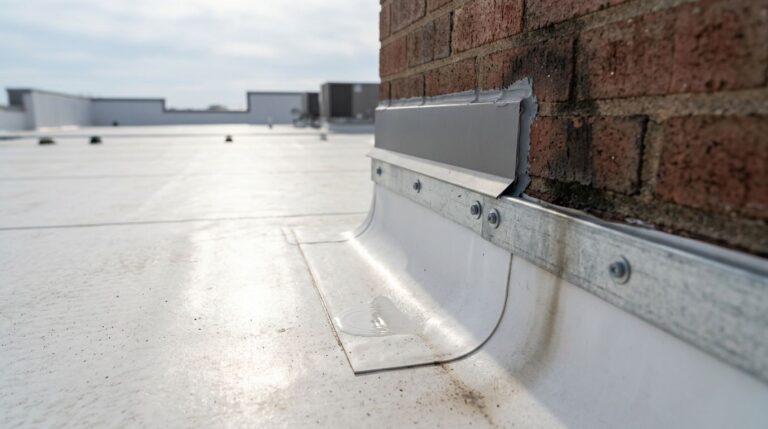
Last updated: 2026-08-01 by Ted Sellers, Owner
Ponding water on a flat roof is rain or snowmelt, often referred to as “standing water”, that sits in low spots instead of draining away. In Minnesota, it becomes a real problem when it stays longer than 48 hours, keeps coming back after normal storms, or pools near seams, drains, and penetrations. A simple ruler test and a 24 to 48-hour mark-and-check can confirm whether you’re seeing normal wetting or a drainage issue.
When This Applies
Who this matters for (and who it doesn’t)
Ponding water is mainly a commercial low-slope roof issue. If you own or manage a warehouse, retail center, office building, church, or multi-family property, this applies to you. Most “TPO roofing”, EPDM, PVC, modified bitumen, and built-up roofs can show ponding at some point.
It usually doesn’t apply to steep-slope roofs because water sheds quickly. It also doesn’t apply if you only see a thin film of water right after a downpour and it’s gone the same day.
If you’re unsure what system you have, a local team that works on these assemblies daily can spot risk fast. Many owners start with a quick assessment through commercial low-slope roof specialists St. Paul, then decide if it’s maintenance or a repair plan.
Why Minnesota ponding becomes “sticky”
Minnesota adds two problems that flatter climates don’t: freeze-thaw cycle and long snowmelt cycles.
Water that sits today can freeze tonight. Ice expands, pries at seams, and can open tiny pathways that turn into leaks later. Meanwhile, rooftop units drop extra runoff in the same spots, so the same puddle comes back again and again.
Weight is another quiet issue. The “weight of water” from even shallow ponding adds load across a wide area. Polyglass explains how quickly ponding weight adds up in this overview of ponding water causes and solutions.
If the same area ponds after normal weather, the roof isn’t “just wet.” It’s giving you a repeatable clue about slope, drains, or deck movement.
When ponding water crosses the line into “real problem”
A practical rule you can use today
Industry groups like NRCA standards often define ponding as water that remains 48 hours or longer after precipitation ends. ARMA summarizes this in its discussion of ponding water effects on low-slope systems. For owners, the most useful approach is simple: measure depth, track time, and note location.
Here’s a quick guide you can use for triage:
| What you observe | Typical meaning | Why it matters |
|---|---|---|
| Water is gone within 24 hours | Usually normal positive drainage | Low risk if seams and drains look sound |
| Water remains 24 to 48 hours | Watch closely, measure and mark | Often points to minor roof slope or drain performance issues |
| Water remains past 48 hours | Likely ponding water problem | Increases leak risk and speeds membrane aging |
| Deeper than about 1 inch in a low spot | Elevated concern | Extra load, more stress on seams and flashing |
| Ponding near seams, curbs, or penetrations | High priority | These are common entry points for leaks |
| Clogged roof drains or scuppers | Immediate action needed | Backs water up, then it finds weak points |
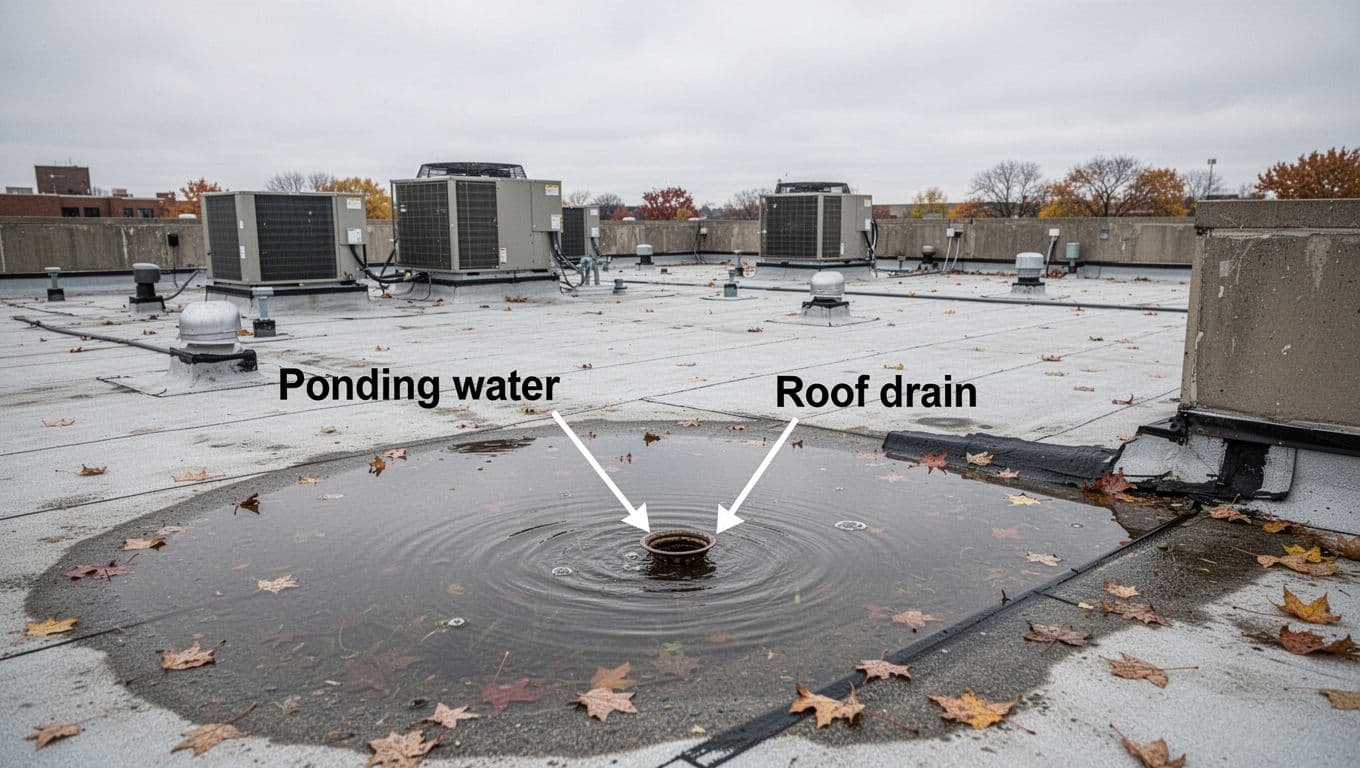
Example of shallow ponding around a drain and low spot, created with AI.
Step-by-Step Roof Inspection
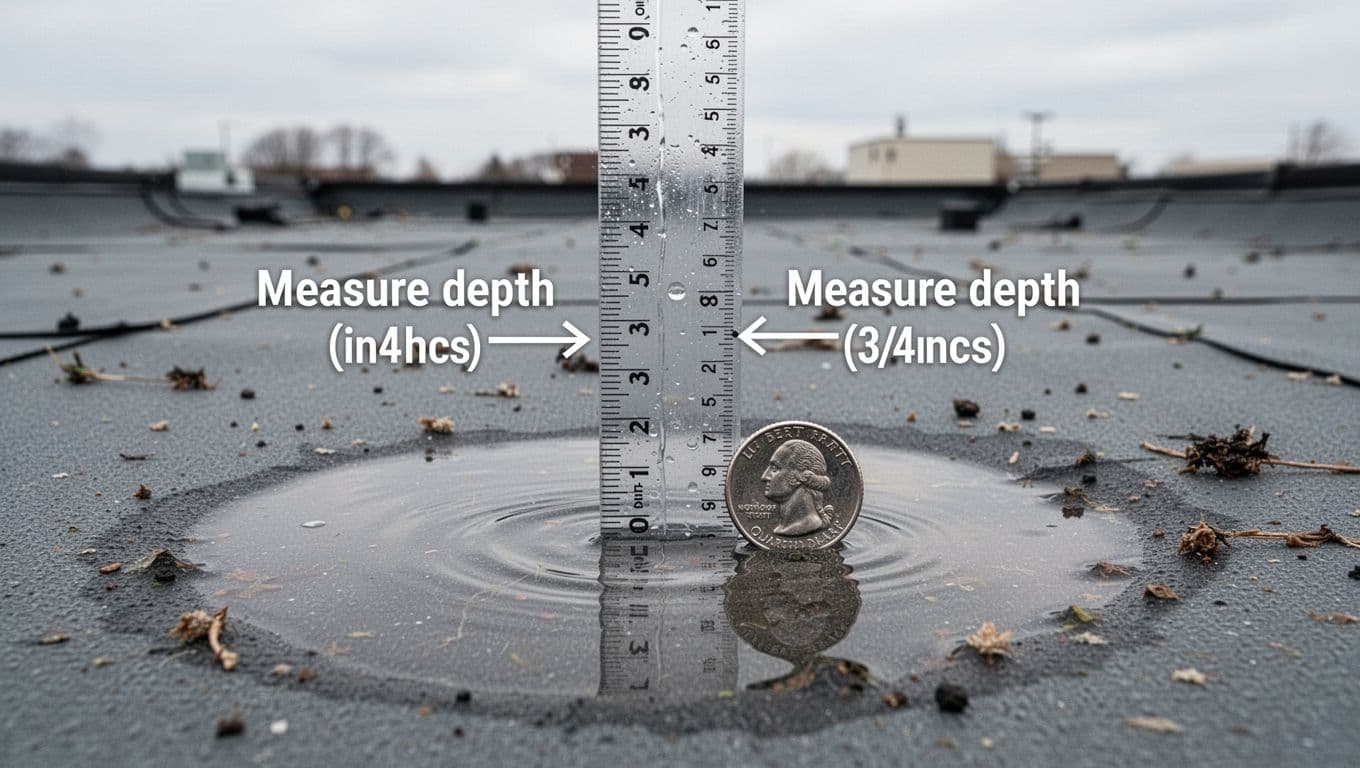
Do a quick depth test (the ruler check)
- Pick a safe access time, ideally after the roof surface is dry except for the puddle you’re evaluating.
- Choose the deepest point of the puddle on the roof membrane, not the edge.
- Stand a ruler straight down to the roof membrane and read the water depth in inches.
- Take one clear photo that shows the ruler reading and the surrounding context.
- Repeat in two more spots if the ponding area is large, then record the biggest depth.
- Use this photo example as your reference for what “measured” looks like:

A simple ruler test to document ponding depth, created with AI.
Check duration with a simple 24 to 48-hour mark
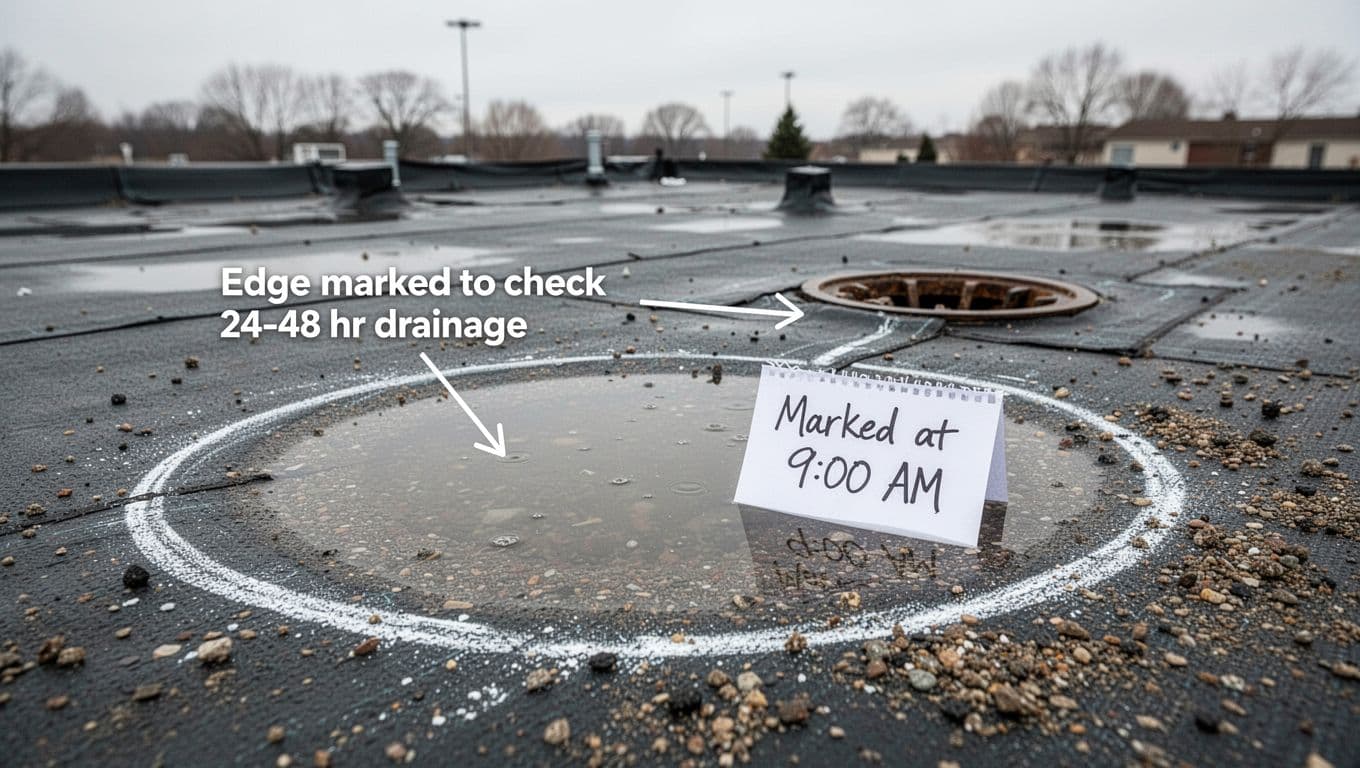
- After the rain stops (or after the roof clears from active snowmelt), outline the puddle edge with chalk.
- Write the time on a note card and photograph it next to the chalk line.
- Come back at 24 hours and compare the water edge to your chalk line.
- Check again at 48 hours, then take another photo from the same angle.
- If the water line doesn’t move much, note nearby conditions (blocked drain, leaf buildup, rooftop unit discharge).
- This is what the “mark and re-check” setup should look like:
A chalk outline and timestamp photo method to confirm drainage time, created with AI.
Decide what to do next (clean, repair, or escalate)
- Clear obvious debris at the drain basket, scupper, or roof scuppers if it’s safe and allowed by your roof policy.
- Re-check after the next normal rain. If the puddle returns in the same shape, it’s a roof geometry issue, not a one-time clog.
- Schedule a professional evaluation if water lasts beyond 48 hours, because it often ties to slope loss, deck deflection, or drain placement. Solutions may include tapered insulation or installing a roof cricket to correct roof slope.
- Escalate faster if you see wrinkles, open seams, soft spots, or wet insulation signs, because these indicate water infiltration and potential roof leaks, and the commercial roof needs repair even if the leak hasn’t reached the ceiling yet.
- Use targeted commercial flat roof repair when the issue is localized (drain repairs, seam work, re-flashing, minor insulation replacement).
- Consider commercial roof replacement when ponding is widespread and tied to systemic slope or aged materials.
- Practice preventive maintenance through regular cleaning and inspections to avoid ponding issues altogether.
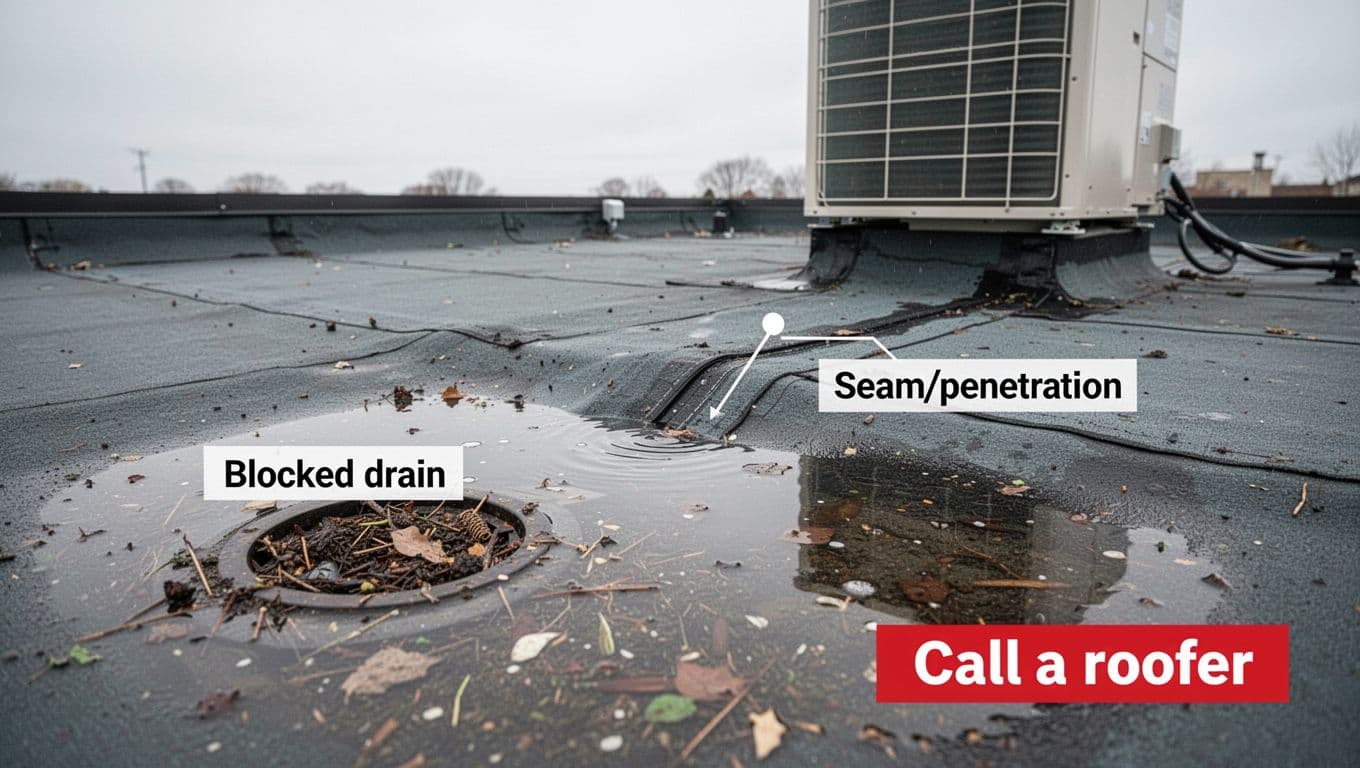
- Here’s a “call now” example with multiple red flags at once:
Deeper ponding near a seam and blocked drain, created with AI. - If your building has stains, odors, or recurring moisture, pair ponding documentation with commercial roof leak detection Saint Paul so you fix the true source, not just the symptom.
Photos plus a ruler reading beat opinions. If you can show depth, time, and location, you can speed up diagnosis and avoid paying for guesswork.
FAQ
Can ponding after snowmelt be “normal” in Minnesota?
Some short-term water is normal during rapid thaws, especially near HVAC equipment discharge. The concern starts when the same area holds water after multiple melt cycles, or when it lingers past 48 hours once daytime temps stay above freezing.
If it’s only 1/4 inch deep, do I still need to care?
When shallow water still becomes expensive
Yes, because shallow ponding can still stress seams, promote biological growth like algae and moss, and pick up grime that speeds roof membrane wear. If that 1/4 inch sits in the same place after every storm, treat it as a drainage pattern that needs attention.
Should my maintenance staff squeegee water off the roof?
Manual removal can help in the moment, but it can also hide the real cause. If staff moves standing water repeatedly, you lose the chance to document duration and depth. It’s better to clear drains, measure, photograph, then address slope or drain problems.
Can ponding water affect warranties or insurance claims?
Documentation that helps either way
It can. Some manufacturers and insurers expect functional drainage and routine upkeep. Keep dated photos, measurement notes, and service records. That paper trail supports you whether you’re pursuing repairs, a warranty discussion, or a storm claim.
What happens if we ignore ponding for another year?
Small low spots often grow because insulation becomes compressed and deck movement continues. Over time, this leads to structural integrity concerns, more leaks, more interior disruption, eventual structural damage, and a bigger scope when repairs finally happen.
Ponding water on a flat roof isn’t always an emergency, but it’s rarely “nothing.” Measure depth, mark the edge, and see if it clears within 48 hours. If it doesn’t, treat it as a drainage defect, not a cosmetic issue. Ponding water on a flat roof requires positive drainage to remain compliant with NRCA standards. The fastest path to protecting your building is clear documentation and the right repair plan before water reaches the inside.
Need a roof inspection in Saint Paul or the Twin Cities? Call Sellers Roofing Company at +1-651-703-2336 or schedule a free estimate. We are a black-owned, NMSDC-certified MBE roofing contractor with 9+ years experience.