Last updated: 2026-08-01 by Ted Sellers, Owner
Usually, your own insurance pays first if a neighbor’s healthy tree falls on your roof during a Minnesota storm. The answer changes if the tree was dead, rotted, or obviously dangerous and the owner ignored warnings. In that case, liability can shift, but you still start with your carrier, not your neighbor’s.
Key Takeaways
Quick summary
- A storm-dropped tree from next door usually becomes your property claim, not your neighbor’s.
- Negligence matters more than property lines if the tree was known to be unsafe.
- Debris removal often has a separate limit, commonly around $500 to $1,000, and yard-only cleanup may not be covered.
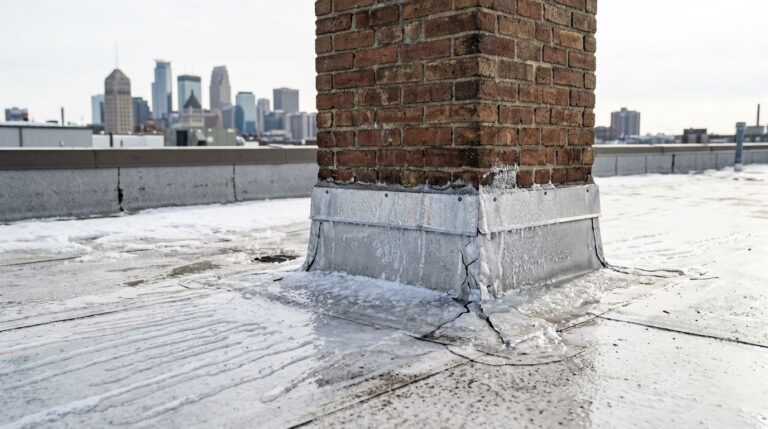
- On a home or commercial flat roof, the visible damage may be only part of the loss.
When This Applies
Healthy tree, sudden storm, damaged roof
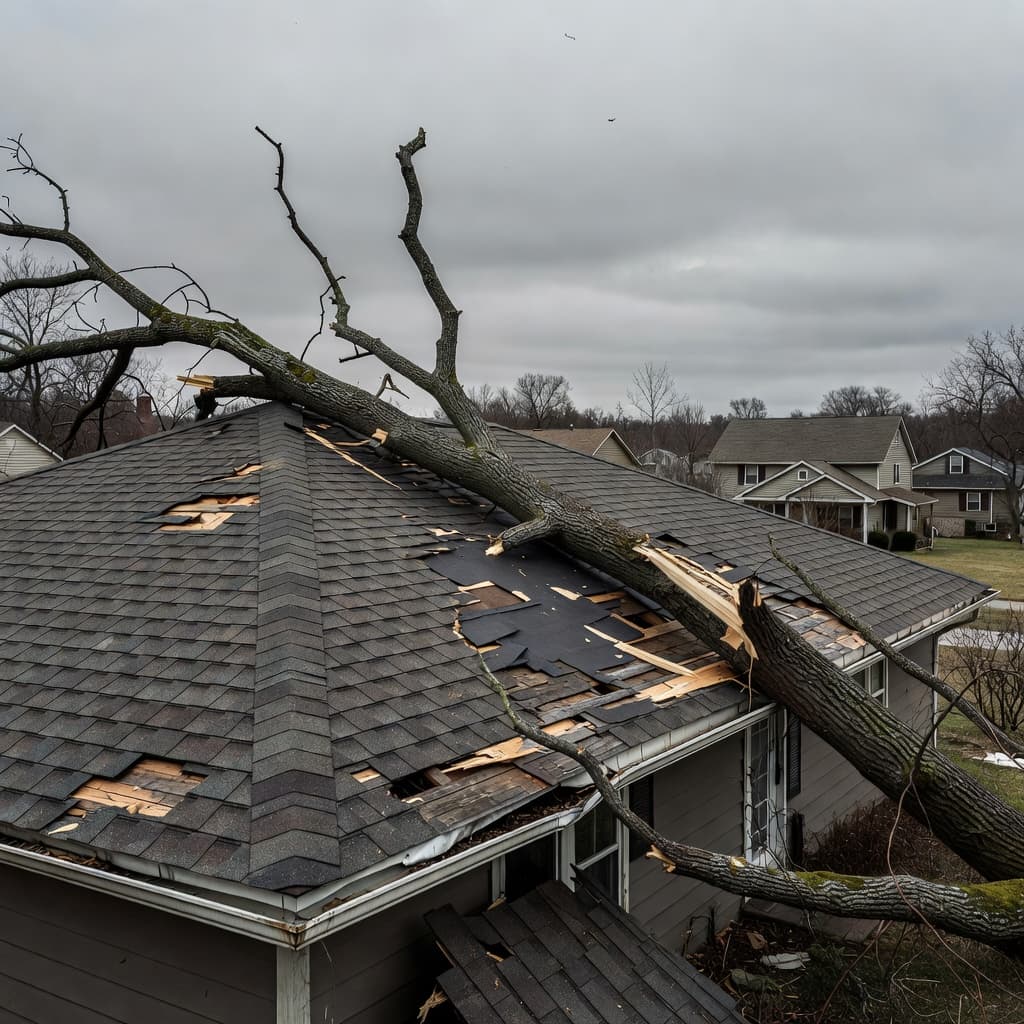
This is the standard Minnesota case. Wind, lightning, or wet snow drops a sound tree or large limb onto your house, garage, or business. If that is what happened, the neighbor usually does not pay out of pocket first. Your insurer handles the roof insurance claim, then decides whether anyone else belongs in the file.
Minnesota does not have one clean statute that answers every tree-fall dispute. Local summaries, including the North Oaks property-line tree guide, point back to nuisance and hazard-tree rules instead of a simple owner-always-pays formula.
Where owners get tripped up
Most people focus on whose yard the tree came from. Insurers focus on cause and condition. If weather caused the fall and the tree was healthy, the address of the trunk usually does not decide the bill.
When the rule changes
The answer can flip if the tree was already failing. Dead ash, hollow trunks, visible decay, repeated limb drops, or written complaints matter. If the owner knew, or should have known, the tree was dangerous and did nothing, your insurer may later pursue that owner or their insurer through subrogation.
A broader legal explainer from Super Lawyers on fallen tree liability makes the same split between storm loss and neglected trees.
Edge cases that change the claim
If the tree lands in your yard and misses every structure, you often pay for removal yourself. Shared boundary trees can get messy because ownership may be joint. If the same winter event also caused interior leaking, ice dam removal is a separate roof issue, not automatic proof the neighbor owes for all water damage.
Step-by-Step
Use this order after the tree hits
- Make the site safe first. Keep people off the roof. Move vehicles, cover interior contents, and shut off power near wet drywall or ceiling cavities if needed. If water is entering, do temporary dry-in only.
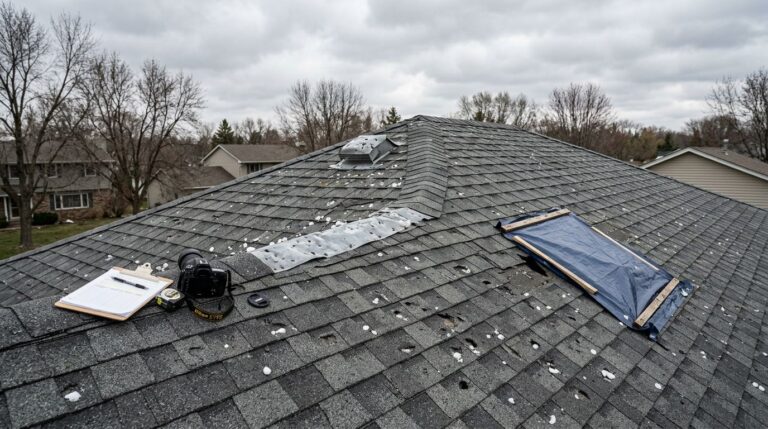
- Photograph before cleanup starts. Get wide shots and close-ups of the tree, stump, decay, broken limbs, gutters, flashing, and roof slopes. If you warned the neighbor before, save the texts, emails, or letters.
- Open the claim with your own carrier. For most neighbor tree roof damage in Minnesota, the first claim still goes through your policy. If the roof is actively leaking, Call 651-703-2336 for 24/7 Emergency Roofing and keep every receipt.
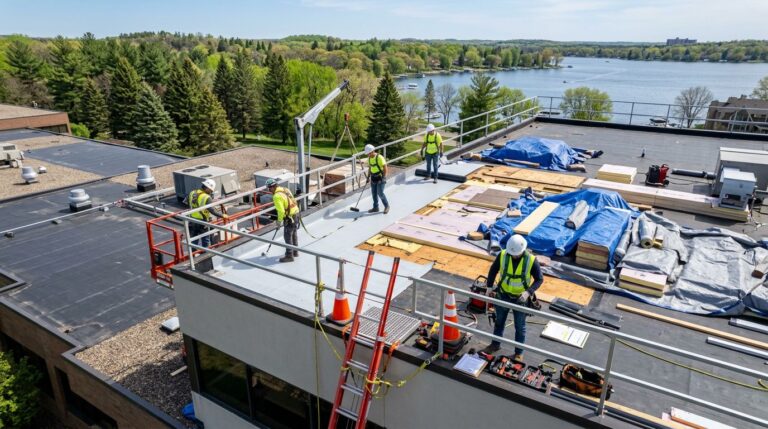
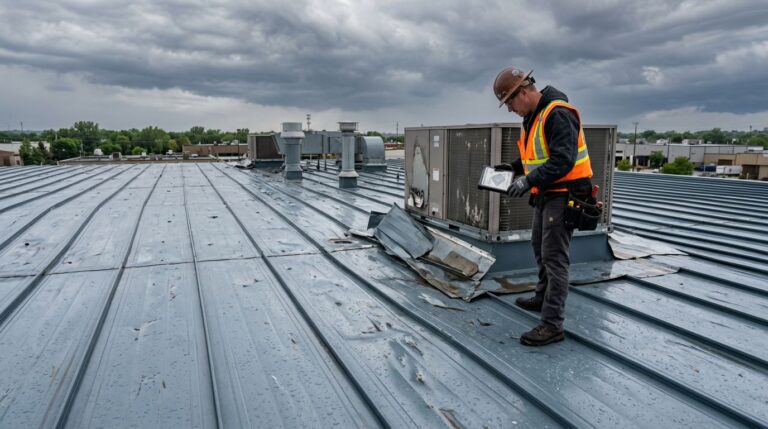
- Get a cause-based roof inspection. On houses, impact may break decking, tear underlayment, crack skylights, or damage asphalt shingles and metal roofing. On a commercial flat roof, a limb can puncture TPO roofing, EPDM, modified bitumen, or BUR, while the interior stain shows up far from the entry point.
- Keep repairs temporary until scope is clear. Tarping, interior protection, and emergency sealing help. Full patching too early can erase proof of fresh damage, wet insulation, or a broader storm damage roof claim.
- Separate old roof issues from new impact damage. A prior leak, an aging membrane, or an old patch does not erase a new loss. It does affect what part of the bill is insured and what part falls under maintenance.
- Match the contractor to the roof system. A tree strike on standing seam panels is not the same as one on shingles or membrane. The right scope may be residential roof repair, commercial roof repair, or a larger replacement, but only after the system is inspected as a whole.
How the insurance money usually works
Your policy first, subrogation second
This is the fast breakdown:
| Scenario | Who usually pays first | What changes the result |
|---|---|---|
| Healthy tree falls in a storm and hits your roof | Your insurer | Deductible and policy limits |
| Dead or rotting tree with prior notice | Your insurer first, then possible recovery from neighbor | Proof of notice and tree condition |
| Tree falls in your yard, no structure hit | Usually you | Many policies limit simple cleanup |
| Tree damages roof and interior | Your insurer | Scope grows if water spread is documented |
Most policies cover debris removal when the tree damages an insured structure, but the limit is often modest, commonly $500 to $1,000. That is not the same as unlimited tree-service money. If cleanup costs run past the limit, the extra can land on the owner unless liability is later shifted.
The tree’s address is not the first question. The first question is whether the fall was sudden and whether the tree owner ignored a known hazard.
Why documentation changes the payout
Tree impacts rarely damage only the visible spot. Water can travel under shingles, along framing, or across membrane layers before it drips inside. That is why a ceiling stain is often the exit point, not the entry point.
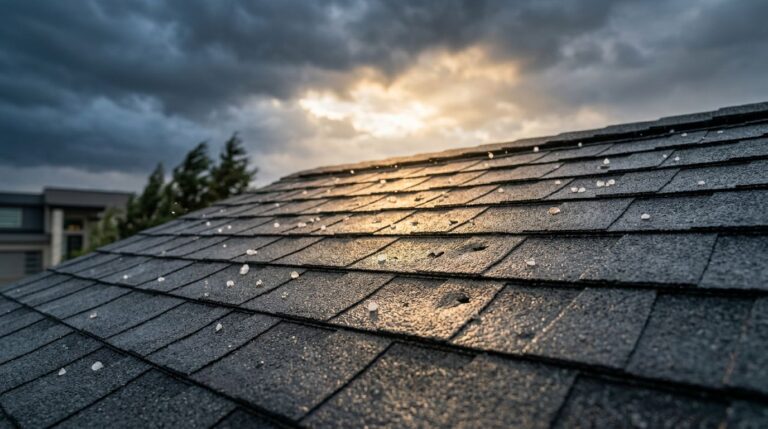
This matters even more on larger buildings. If the leak path is unclear, professional commercial roof leak detection can pinpoint breach locations instead of guessing from the wet ceiling tile. Treat the file the same way you would treat a hail damage roof claim: date the loss, keep damaged materials if possible, and do not let permanent work erase the evidence.
Match the repair to the roof, not the panic
Homes with shingles or metal
On houses, branch strikes often break more than the surface. A roof may need new decking, fascia, flashing, gutter sections, and ventilation repairs, not only a few tabs. In clean, limited cases, residential roof repair is enough. If the slope is badly torn, the decking is split, or matching materials are unavailable, residential roof replacement can be the better scope. For that kind of call, Get a Free Residential Roof Estimate fits the next step.
Commercial buildings need a tighter read
Commercial roofs hide damage better than houses do. A limb can bruise insulation, split a seam, or crush a cover board under membrane that still looks mostly intact. That is why a commercial roof inspection should happen before anyone decides between commercial roof repair and commercial roof replacement.
A puncture from a branch is not a commercial roof restoration project on day one, and commercial roof coatings do not fix torn membrane or saturated insulation. Those options may fit later if the roof field is still sound, but first you need the damage map. If you own a building in Saint Paul, Minneapolis, or the broader metro, Get a Free Commercial Roof Inspection is the practical move.
What to look for in a Minnesota contractor
In Saint Paul roofing and Minneapolis roofing markets, credentials matter because the weather is hard on every system. Good Minnesota roofing bids should show license status, insurance, and roof-type experience. Many owners also look for union-built roofing, GAF certified status, and local labor ties such as IUPAT Local 96. Sellers Roofing Company works under MN License 803862, which is the kind of license verification any Twin Cities roofing owner should check before signing.
Conclusion
The practical answer
If a neighbor’s tree damages your roof in Minnesota, start with your own insurer unless you already have proof the tree was a known hazard. That is the short answer, and it solves most claims faster than arguing across the fence.
The harder part is not who opens the claim. It is getting the scope right. A shingle tear, bent panel, or membrane puncture can turn into a much bigger repair if the first inspection misses hidden damage.
Common questions after a neighbor’s tree damages your roof
Does the neighbor have to pay my deductible?
Not usually. If the loss was a storm event and the tree was healthy, your deductible is still your deductible. You may recover more only if liability is later pinned on the neighbor.
What if I warned the neighbor in writing before the tree fell?
That helps a lot. Written notice can support a negligence argument if the tree was visibly dangerous.
What counts as notice?
Emails, texts, certified letters, photos, and even city complaints can help. Verbal warnings are harder to prove.
What if the tree hit my commercial building, not my house?
The same payment rule usually starts the claim, but the roof scope gets harder. On a membrane system, hidden moisture can push a small puncture toward commercial roof replacement instead of a simple patch.
Can I remove the tree before the adjuster arrives?
You can do what is needed to stop more damage and make the property safe. Do not throw away evidence first. Photograph everything, then keep work limited to temporary protection if possible.
What if the leak shows up far from the impact point?
That is common, especially after branch strikes on low-slope roofs. Water can travel under roofing layers before it drops inside.
Why that matters
If crews patch only the stain-side area, the real opening can stay active. The source has to be traced, not guessed.
Need a roof inspection in Saint Paul or the Twin Cities? Call Sellers Roofing Company at +1-651-703-2336 or schedule a free estimate. We are a black-owned, NMSDC-certified MBE roofing contractor with 9+ years experience.