Last updated: 2026-05-29 by Ted Sellers, Owner
If you live south of I-90, you already know May 2026 has not been kind to roofs in southern Minnesota. Two separate severe-weather episodes — one on May 15, another on May 17 — produced confirmed quarter-sized to ping-pong-sized hail across a wide swath of counties from Nobles in the southwest all the way east through Faribault, Martin, Freeborn, and Waseca. A third round on May 25–26 added scattered one-inch reports on top of an already saturated month.
This guide is written for one purpose: to help southern Minnesota homeowners — from Worthington and Adrian in the southwest, through Fulda, Wilmont, and Magnolia, across to Fairmont, Blue Earth, Wells, Winnebago, New Richland, Mapleton, and the towns east of Albert Lea — understand exactly what happened over their roofs this May, what 1.00″ to 1.50″ hail actually does to common Minnesota roofing systems, and what a calm, methodical next step looks like.
There is no pressure here, no urgency theater. Hail damage doesn’t disappear if you don’t look at it today. But it also doesn’t get smaller, and the longer you wait to know what’s actually on your roof, the harder it gets to tell a real storm hit from years of normal Minnesota weathering. The right move is simply to find out — and to find out from someone who isn’t standing on your driveway in an unmarked truck the day after the storm.
What Actually Happened: A Plain-English Recap of May 2026
May 15, 2026 — The Southern Belt
The first significant round moved through south-central Minnesota during the late afternoon and evening of Friday, May 15. The NWS Twin Cities (Chanhassen) Hazardous Weather Outlook issued earlier that day called out large hail and damaging wind gusts as the primary threats, with the greatest risk concentrated near Albert Lea and Rochester. Storms developed between 5 and 7 PM and tracked northeast.
By the time the line cleared, hail reports had stacked up across a long corridor of Minnesota towns, including:
- Faribault County: Blue Earth, Delavan, Easton, Elmore, Granada, Winnebago
- Martin County: Fairmont
- Freeborn County: the Conger / Albert Lea area
- Waseca County: New Richland, Waldorf, Wells
- Blue Earth County: Mapleton, Minnesota Lake
These towns appear on the Interactive Hail Maps record for the Minneapolis region, May 15, 2026. Hail sizes from this round were generally at or just above the severe threshold — roughly 1.00″ (a U.S. quarter) — which is exactly the size at which asphalt shingle damage typically begins.
May 17, 2026 — The Adrian–Worthington–Fulda Round
Two days later, on Sunday, May 17, a far more dangerous setup unfolded. The NWS Sioux Falls office documented a multi-state outbreak that tracked from southeast South Dakota into southwestern Minnesota, producing a combination of large hail, damaging straight-line winds, and brief tornadoes.
The Minnesota hail reports from that afternoon and evening read like a roll call of Nobles, Rock, and Murray counties:
| Time (CDT) | Location | Hail Size | County |
|---|---|---|---|
| 5:36 PM | 3 SW Magnolia | 1.25″ (half dollar) | Rock |
| 5:50 PM | 1 N Adrian | 1.50″ (ping-pong) | Nobles |
| 6:01 PM | Wilmont | 1.25″ (half dollar) | Nobles |
| 6:18 PM | 5 SW Worthington | 1.00″ (quarter) | Nobles |
| 6:22 PM | 2 S Fulda | 1.00″ (quarter) | Nobles |
| 6:24 PM | Fulda | 1.00″ (quarter) | Murray |
The 1.50″ ping-pong-sized stone confirmed by law enforcement just north of Adrian is the largest verified hail report in Minnesota for the entire May 2026 severe-weather sequence so far, per NWS Sioux Falls preliminary local storm reports.
That same afternoon, the NWS Twin Cities office confirmed two tornadoes in south-central Minnesota — a short rope tornado northwest of Fairmont along I-90 around 7:12 PM, and a second tornado roughly two miles southwest of Conger in Freeborn County around 10:18 PM, with estimated wind speeds of 80 to 90 mph (high-end EF0 to low-end EF1). Several other wind-damage reports across southern Minnesota suggested broader straight-line gusts in the 60 to 75 mph range.
May 25–26, 2026 — Scattered Round Three
The most recent activity came late on Monday, May 25 into Tuesday, May 26, when HailTrace’s national hail map for May 26 listed Minnesota among 14 states with severe hail, including scattered 1.00″ reports. The Iron Range and northeastern Minnesota took the brunt of the northern round, while southern Minnesota saw an overnight wave forecast to bring ping-pong-ball-sized hail (1.25″+) and 60-mph gusts per CBS Minnesota’s NEXT Weather coverage.
If you’re a homeowner anywhere in the corridor between Worthington and Wells, your roof has had at least one — and possibly two or three — opportunities to take damage this month.
Why 1.00″ to 1.50″ Hail Matters More Than People Think
There is a common misconception in Minnesota that you only need to worry about your roof after the “big” storms — the baseball-sized hail events that make the regional news for days. That isn’t how shingles fail.
The size of hail that begins to damage a typical Minnesota asphalt roof is right around 1.00 inches — the diameter of a U.S. quarter. That’s the very threshold the National Weather Service uses to classify a thunderstorm as severe, and it’s the lower edge of what your reference chart above calls the “severe hail zone.”
Here’s why the difference between, say, 1.00″ and 1.50″ hail is so much bigger than the math suggests:
- Kinetic energy scales with the cube of diameter. A 1.50″ stone carries roughly 3.4 times the impact energy of a 1.00″ stone of the same density, falling at a similar terminal velocity. A homeowner in Adrian who saw ping-pong-sized hail experienced impacts more than three times as energetic as a neighbor 30 miles east who only saw quarter-sized stones.
- Granule loss is the first failure mode. Asphalt shingles depend on their top layer of ceramic-coated granules to protect the asphalt mat from UV. A single 1.25″+ stone can knock granules off in a circular pattern about the size of a half-dollar, exposing black asphalt underneath. From the ground, this often looks like nothing.
- The bruise is the real damage. Underneath the granule loss, the asphalt mat itself can be fractured — what insurance adjusters and roofers call a “bruise.” Bruised shingles feel soft to the touch and will fail months or years later, long after the storm is forgotten and the claim window has closed.
- Wind multiplies the damage. The May 17 storms paired large hail with 60–90 mph wind gusts. Wind doesn’t just lift shingles; it drives hail at an angle, exposing the vulnerable side walls of shingle tabs and increasing the chance of broken seals.
For roofs older than about 12 years, even 1.00″ hail can be the event that takes a system already nearing the end of its service life and pushes it across the line into needing replacement. For newer roofs, the same storm might cause damage that’s entirely repairable — but only if it’s caught before the next 12 months of Minnesota weather start hiding the evidence.
What Different Hail Sizes Actually Do to a Minnesota Roof
The hail-size chart at the top of this article is a quick reference, but here is how each size actually behaves on the most common roof systems in southern Minnesota.
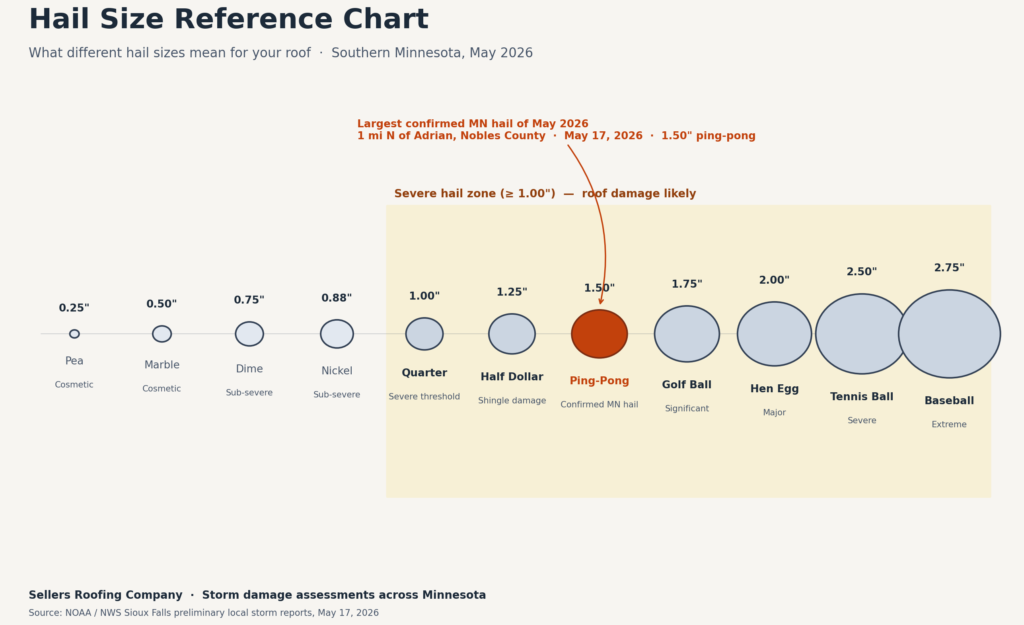
Sub-Severe Hail (Pea to Nickel, 0.25″–0.88″)
This is what most Minnesota thunderstorms produce. On a healthy asphalt roof, it’s essentially cosmetic. On a roof already past the 15-year mark with thin granule coverage, even small hail accelerates aging — but it almost never produces an insurance-claimable event on its own.
Quarter (1.00″) — The Threshold
This is where the National Weather Service draws the severe line for a reason. On a 3-tab asphalt roof older than about ten years, 1.00″ hail can produce scattered impact marks, soft spots, and granule loss in localized areas. On a newer architectural shingle, damage is usually minor and patchy. Soft metal — like aluminum gutters, downspouts, fascia wraps, vent stacks, and HVAC fins — almost always shows visible dents.
Half Dollar (1.25″) — Damage Is Likely
At this size, damage is consistent rather than scattered. Most roofs in the impact path show measurable granule loss, with visible round marks on shingles. Window screens often tear. Wood and composite siding shows pock-marks. Skylights begin to be at real risk.
Ping-Pong (1.50″) — The Adrian Round
This is the largest size confirmed in Minnesota in May 2026. On a typical 15-year-old asphalt roof, ping-pong-sized hail produces clear, claim-ready damage on most slopes that took direct hits. Soft metals are heavily dented. Vinyl siding can crack. Asphalt mat fractures (bruises) are common and require shingle replacement rather than just patching. The good news: damage is usually obvious enough during a careful inspection that there’s no ambiguity about what happened.
Golf Ball and Larger (1.75″+)
Not confirmed in Minnesota in May 2026 so far. At these sizes, even new, premium roofs sustain damage; gutters can crumple; skylights and windows break. If we see this in June or July, we’ll update this guide.
What This Means for Your Home, by Region
Worthington, Adrian, Wilmont, Fulda, Lismore, Magnolia (Nobles, Rock, Murray Counties)
You are in the highest-confidence damage zone in Minnesota right now. The May 17 storm track passed directly overhead, and the 1.25″–1.50″ hail confirmed near Adrian and Wilmont means that homes within roughly 10 miles of that path almost certainly took meaningful impacts. If your home is in this corridor and your roof is more than five years old, getting a professional set of eyes on it is the single most useful thing you can do this month — regardless of whether you see anything from the ground.
Fairmont, Blue Earth, Wells, Winnebago, New Richland, Mapleton, Waldorf (Faribault, Martin, Waseca, Blue Earth Counties)
The May 15 storm covered a wide footprint here, and the May 17 system added wind damage in the Fairmont and Conger areas. Hail sizes in this corridor were generally smaller than what hit Nobles County — closer to the 1.00″ severe threshold — but the geographic footprint is much larger, and the wind component means you may have a wind-and-hail combination rather than a pure hail event. Older roofs in this corridor are the highest priority for inspection.
Albert Lea and the I-90 Corridor East to Austin
The May 17 outbreak’s wind and tornado activity passed close to this corridor, with the Conger tornado just west of Albert Lea. Hail reports were lighter here than to the west, but wind damage — lifted shingles, broken seals, missing ridge caps — is the more likely concern. Wind damage is easy to miss from the ground because the shingle often falls back into place after the wind passes, sealing the visible evidence but leaving the underlying bond broken.
Twin Cities Metro, North into Stearns and Sherburne
The Twin Cities metro itself was largely spared significant hail in May 2026. If you live in the metro, this guide is mostly informational — but the season is young, and Minnesota’s peak hail months are historically June and July. Knowing what’s already on your roof now, before the next round arrives, is a perfectly reasonable thing to do.
How to Tell If Your Roof Was Hit (From the Ground)
You should not climb on your own roof to inspect it, especially after a storm. Wet shingles are slippery, hail damage can hide subtle structural issues, and you do not need to take that risk. There is, however, a lot you can learn from the ground.
Walk a full lap around your house and look for the following:
- Dents on soft metals. This is the single most reliable ground-level indicator. Look at your gutters (the top rail, where it’s easiest to see), downspouts, gutter caps, the metal flashing around your chimney, and especially the fins on your outdoor air conditioning condenser unit. Hail dents soft metal before it damages shingles. If your AC fins are bent and your gutter top rails look stippled, your roof has been hit.
- Window screens. Screens are surprisingly sensitive. After 1.25″+ hail, you will often see torn or punched-through screens on the storm-facing sides of the house.
- Painted wood and composite trim. Look at your garage door panels, painted wood trim, and fascia. Hail at 1.25″+ leaves visible round dents and chipped paint.
- Vinyl or steel siding. Cracks in vinyl siding, especially on the storm-facing wall, are a strong signal. Look at the corners and edges of panels first.
- Shingle granules in your gutters and downspout splash zones. A storm-related “shed” of granules will pile up at the bottom of your downspouts after the next rain. Some granule loss is normal for any roof; a sudden, large pile of new granules is not.
- Skylights and roof vents. From a safe vantage point — a second-floor window, the top of a ladder leaned against the gutter — look at any skylight bubbles and the plastic caps on your roof vents. Both crack at the same hail sizes that damage shingles.
- Outdoor furniture, grills, and trampolines. If your patio furniture is dented and your trampoline mat is torn, your roof almost certainly took the same impacts.
If you see two or more of these signs, that’s a strong indication that a professional inspection is worth your time.
What a Professional Roof Inspection Actually Looks Like
There is a lot of bad behavior in the roofing industry after storms, especially the unmarked-truck variety that shows up door-to-door the same week as the hail. A real professional inspection is calm, methodical, and ends with a clear written report. Here’s what you should expect when you call a reputable Minnesota roofing company:
- A scheduled appointment, not a knock on the door. A legitimate company sets a time, shows up in a marked truck, and brings ID. They do not pressure you to sign anything on the spot.
- Exterior walk-around first. The inspector starts on the ground, photographing the same soft-metal indicators listed above, plus all four sides of the home.
- Roof access using proper fall protection. Safety harnesses, anchors, and roof-appropriate footwear. If your inspector free-climbs your roof in sneakers, that’s a red flag.
- Slope-by-slope evaluation. A test square — typically a 10-foot by 10-foot area — is marked off on each major slope. The inspector counts hail strikes in each square, photographs representative impacts, and notes the directional pattern. This matters because real hail damage has a directional bias (the storm came from one direction); fake or aged damage doesn’t.
- Soft-metal verification. The inspector confirms the slope-by-slope shingle damage against the soft-metal damage on gutters, vents, and flashing. The two have to agree. If a contractor finds severe shingle damage but no soft-metal damage, that’s a problem.
- Attic check, when accessible. Active or recent leaks, daylight visible through the deck, or damaged underlayment all get noted.
- A written report with photos. You should walk away with a document that shows what was found and where, with photos keyed to the slopes. If there’s no damage worth claiming, the report should say that too.
A real inspection should leave you better informed regardless of the outcome — including the perfectly common outcome of “your roof is fine, see you in a few years.”
Roof Replacement vs. Roof Repair: How to Think About It
Not every hail-damaged roof needs to be replaced. Here is the general framework an honest inspector uses:
Repair is appropriate when:
- The damage is isolated to one or two slopes.
- The roof is less than about 12 years old.
- The shingle line is still in production (so a repair can be color-matched).
- The damage is on the leeward (back) side, away from view, and is functional rather than cosmetic.
Full replacement is usually the right call when:
- Damage is present on three or more slopes.
- The roof is more than about 15 years old, regardless of which shingle line.
- The shingle is discontinued — meaning any repair will visibly mismatch.
- Multiple roof components (shingles, ridge cap, flashing, vents, gutters) are all damaged together.
- The deck below the shingles shows soft spots or water intrusion.
For a southern Minnesota homeowner whose roof took direct ping-pong-sized hail in May 2026 and is on a roof installed before 2015 — replacement is usually the more honest answer than repair.
A Note on Storm-Chasing Contractors
It needs to be said plainly: any roofer who shows up at your door uninvited the week after a major storm is, at best, working on commission for a company you don’t know, and at worst, going to disappear with your deposit. Minnesota homeowners have been hit hard by out-of-state storm-chasing crews after every major hail event of the last decade.
The pattern is always the same: an aggressive door-knock, a promise that “your insurance will cover everything,” a contract signed on the porch, and a job that’s either never started, never finished, or finished poorly with no warranty that survives the first winter.
You are under no obligation to talk to anyone who knocks. You are under no obligation to sign anything on the day of the visit. A local, established Minnesota roofing company — one with a physical address you can drive to, a real business history, and references from neighbors who’ve had work done over multiple years — is the only safe path.
What to Do Next
If you live anywhere in the southern Minnesota corridor described above — from Worthington and Adrian in the southwest, through Fulda and Wilmont, across to Fairmont, Blue Earth, Wells, Winnebago, New Richland, Mapleton, and the towns east of Albert Lea — and your roof is more than a few years old, the next step is straightforward.
Schedule a free roof-replacement estimate from Sellers Roofing Company.
Here’s what that means in practice:
- We come out, inspect your roof using the methodology described above, and give you a written report with photos.
- If your roof doesn’t need to be replaced, we tell you that. We don’t sell repairs that don’t need to happen, and we don’t push replacements on roofs with years of service life left.
- If your roof does need replacement — whether because of confirmed May 2026 hail damage, accumulated wear, or both — you get a clear, line-item estimate with material options, timeline, and a fixed price.
- No high-pressure sales, no contract signed at the kitchen table on the first visit, no “today only” pricing nonsense.
You take the estimate, you think about it, you compare it with whoever else you want to compare it with, and you decide on your own timeline. That’s the only way a roof decision should be made.
Request your free roof-replacement estimate from Sellers Roofing Company. (Replace with your actual estimate-request URL on publish.)
Frequently Asked Questions
How long do I have to deal with hail damage to my roof?
Roof damage from May 2026 hail is not going to disappear, but it also doesn’t need to be addressed in 48 hours. The right window is “before the next storm hits the same roof” — which in Minnesota usually means before peak hail season closes in August. Earlier is better than later, but a calm, methodical timeline of getting an estimate in June and a job scheduled by July or August is entirely reasonable.
What if I don’t see anything from the ground?
That’s the most common situation, and it’s exactly why a ground-level inspection isn’t conclusive. About half of the homes we look at after named storm events have damage visible from the roof that isn’t visible from the driveway. The other half are genuinely fine — and finding that out is just as useful.
Is the damage worse on my back roof than my front?
Almost always, yes. Hail falls at an angle determined by the storm’s wind direction, so one or two slopes of your roof typically take the worst hits while others are spared entirely. This is why slope-by-slope inspection matters and why a “drive-by estimate” is meaningless.
My neighbor got their roof replaced. Does that mean I need to?
Not necessarily. Hail damage can be remarkably localized — sometimes a single block sees significant damage while houses one street over are untouched. The only way to know is to look at your roof specifically.
What if my roof is brand new — less than five years old?
You’re still not immune, but you’re much less likely to need full replacement. New shingles handle 1.00″–1.25″ hail much better than older shingles do. We’d still recommend a quick inspection if you’re in the direct path of the May 17 storm, but the most likely outcome is “you’re fine.”
What kind of roof material handles Minnesota hail best?
For asphalt roofs, Class 4 impact-rated shingles are dramatically more hail-resistant than standard architectural shingles, and many Minnesota insurance carriers offer premium discounts for installing them. For homeowners who’ve now been through one storm and are thinking about the long term, asking about Class 4 options on your replacement estimate is worth doing.
A Final Word
Severe weather in southern Minnesota is not unusual. What is unusual about May 2026 is the combination of three rounds of severe storms in eleven days, including the largest hail Minnesota has seen so far this year just north of Adrian.
If you’re reading this, odds are at least one of those rounds passed within a few miles of your home. You don’t need to panic. You don’t need to sign anything today. You need to find out what’s actually on your roof, get the answer in writing from someone you trust, and make a decision on your own timeline.
That’s exactly what we do. Request your free roof-replacement estimate from Sellers Roofing Company →
Sources
- NOAA / NWS Twin Cities (Chanhassen), Preliminary information from the May 17, 2026 Southern MN Tornadoes — weather.gov/mpx/17May2026_SouthernMNTornadoes
- NOAA / NWS Sioux Falls, Damaging Winds in the Region — May 17th, 2026 (Preliminary Local Storm Reports) — weather.gov/fsd/20260517-damagingwinds-northwestiowa
- NWS Twin Cities Hazardous Weather Outlook, May 15, 2026 — forecast.weather.gov
- Interactive Hail Maps, Hail Map for Minneapolis, MN — May 15, 2026 — maps.interactivehailmaps.com
- HailTrace, Hail Map on May 26, 2026 — hailtrace.com/hail-maps/05-26-2026
- CBS Minnesota NEXT Weather, Highs near 90 in Twin Cities Tuesday; evening storms possible (May 26, 2026) — cbsnews.com/minnesota
Need a roof inspection in Saint Paul or the Twin Cities? Call Sellers Roofing Company at +1-651-703-2336 or schedule a free estimate. We are a black-owned, NMSDC-certified MBE roofing contractor with 9+ years experience.