Last updated: 2026-08-01 by Ted Sellers, Owner
Usually, you must file a wind damage claim within the deadline written in your insurance policy, not by one single Minnesota rule. Many policies allow about 12 months from the date of loss. Some cut that to 60 to 90 days. File as soon as you suspect damage, because late notice can sink an otherwise valid claim.
Key Takeaways
At a glance
- Most wind-related roof claims are controlled by your policy deadline, often 12 months, sometimes much shorter.
- In Minnesota, wind and hail do not always follow the same timing rules.
- File first, then sort out scope, pricing, and repair options.
- On a commercial flat roof, hidden moisture can change a small claim into a larger one.
- Temporary dry-in helps; broad permanent repairs before inspection can hurt the file.
When This Applies
If your roof took wind damage and the date matters
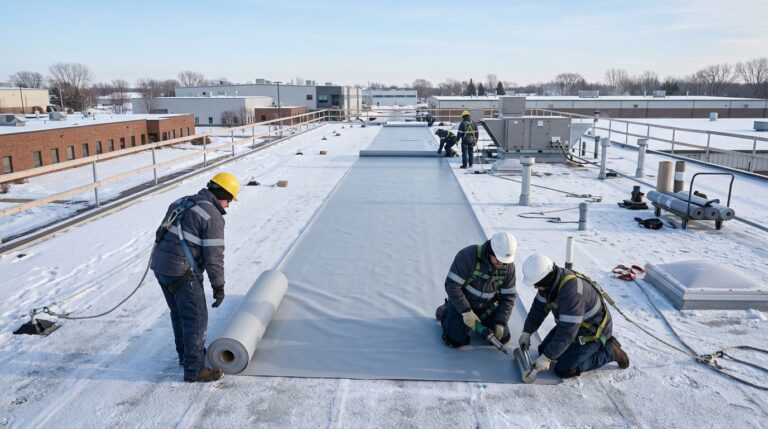
This applies to homeowners and commercial owners who think wind damaged the roof, flashing, edge metal, or rooftop equipment. It fits claims involving asphalt shingles, metal roofing, and low-slope systems such as TPO roofing, EPDM, modified bitumen, and BUR.
It also fits the messy cases. A tenant reports a leak in one suite. The actual opening sits uphill near a curb, parapet, or chimney. On a commercial flat roof, water can travel far before it shows inside. A ceiling stain is the exit point, not always the entry point.
If you have a storm damage roof in Saint Paul, Minneapolis, or anywhere in the Twin Cities, the clock matters right away. That is true whether the final scope becomes commercial roof repair, commercial roof replacement, residential roof repair, or residential roof replacement.
When this does not fit
This is not the right framework for old wear, chronic seepage, skipped maintenance, or a leak that has been active for months with no action. Wind damage is sudden. Long-term deterioration is not.
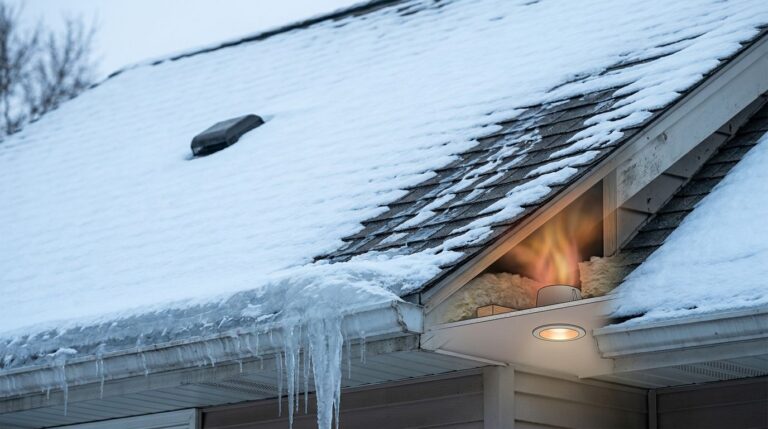
A bad seam on EPDM or open laps on modified bitumen may still be repairable, but that does not make them covered wind damage. The same goes for winter water backup where ice dam removal is the real first issue, not a wind claim.
Minnesota exceptions that confuse owners
Minnesota adds a layer of confusion because state law and policy language can point in different directions. A hail damage roof dispute may carry a different suit deadline than a wind-only loss.
Hail and wind are not always treated the same
For hail, Minnesota law often points to a one-year suit deadline. Wind claims usually get a longer statutory runway, but your policy may still require much faster notice. That is why you should read the policy first and guess never.
How long is the filing window for a wind damage claim?
The policy deadline usually controls first
There is no one-size-fits-all Minnesota filing deadline for reporting wind roof damage. Most policies land around 12 months. Some are tighter, especially after heavy storm years. Budget carriers sometimes use 60 to 90 days. A few policies have allowed longer windows, but counting on that is a bad bet.
This quick table keeps the timing straight.
| Issue | Common timing in Minnesota | Why it matters |
|---|---|---|
| Notice of claim | Often 12 months, sometimes 60 to 90 days | Miss it, and coverage can fail |
| Wind-related suit limit | Often up to 2 years under state law, subject to policy wording | Reporting and suing are not the same thing |
| Hail-related suit limit | Often 1 year to start suit | Do not assume hail and wind match |
| Insurer acknowledgement | 10 business days after claim receipt | Keep records if the carrier goes quiet |
The big mistake is waiting for a roofer to finish pricing before opening the file.
File first. Scope second. A repair estimate is not the ticket that starts your claim.
Where to find the real deadline
Look for phrases such as “prompt notice,” “notice of claim,” “time limit,” or “legal action against us.” Those sections are often buried in the property form or an endorsement. If the language is unclear, call the carrier or agent and ask for the exact deadline in writing.
State law still matters, but it is not your shortcut
Minnesota statutes can affect how long you have to bring legal action, and they matter in a dispute. They do not give you permission to sit on visible wind damage for months. If a tree hit the roof, panels lifted, or shingles creased, report it now.
State law also requires insurers to respond promptly. Under Minnesota’s unfair claims settlement rules, carriers generally must acknowledge and respond within 10 business days after receiving the claim. Keep names, dates, and claim numbers. Paper trails matter.
Step-by-Step
1. Pull the policy before you do anything else
Find the declarations page, the property form, and any roof endorsements. Confirm whether you are looking at replacement cost or actual cash value. Check the deductible, too, because a small first payment does not always mean the claim is wrong.
Words that matter most
Focus on notice, proof of loss, legal action, exclusions, and valuation. Those five areas control more of the file than most owners expect.
2. Report the claim as soon as wind damage is suspected
Do not wait for a final scope. Do not wait for bids. Use the insurer’s app, hotline, or agent and get a claim number the same day if you can.
If the roof is open and water is entering, Call 651-703-2336 for 24/7 Emergency Roofing. Emergency dry-in is smart. Broad permanent work before inspection is not.
3. Protect the building, but keep the evidence
Use tarps, interior protection, and water control to stop added damage. Save receipts. Take dated photos before materials go into a dumpster.
That point is huge on low-slope systems. A puncture in TPO roofing, a split in BUR, or wind-lifted edge metal on EPDM can let water move under the surface. Once wet insulation is discarded, the proof is gone.
4. Document the whole roof system, not only the leak spot
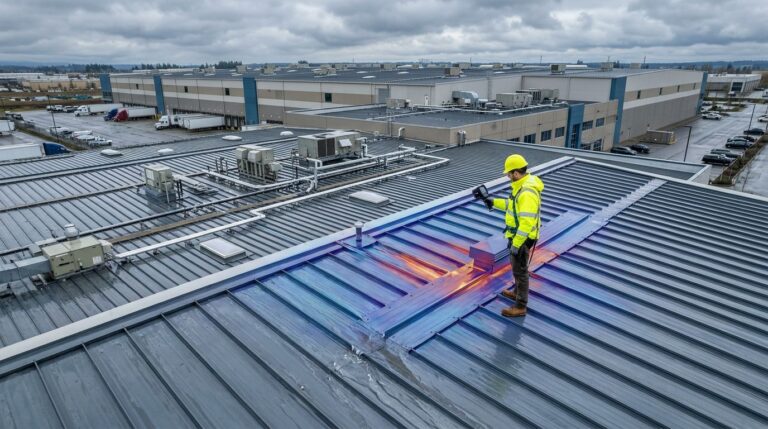
A good commercial roof inspection or residential inspection traces cause, path, and spread. On a commercial flat roof, a drip near one wall can start several feet away at a seam, curb, drain, or chimney detail.
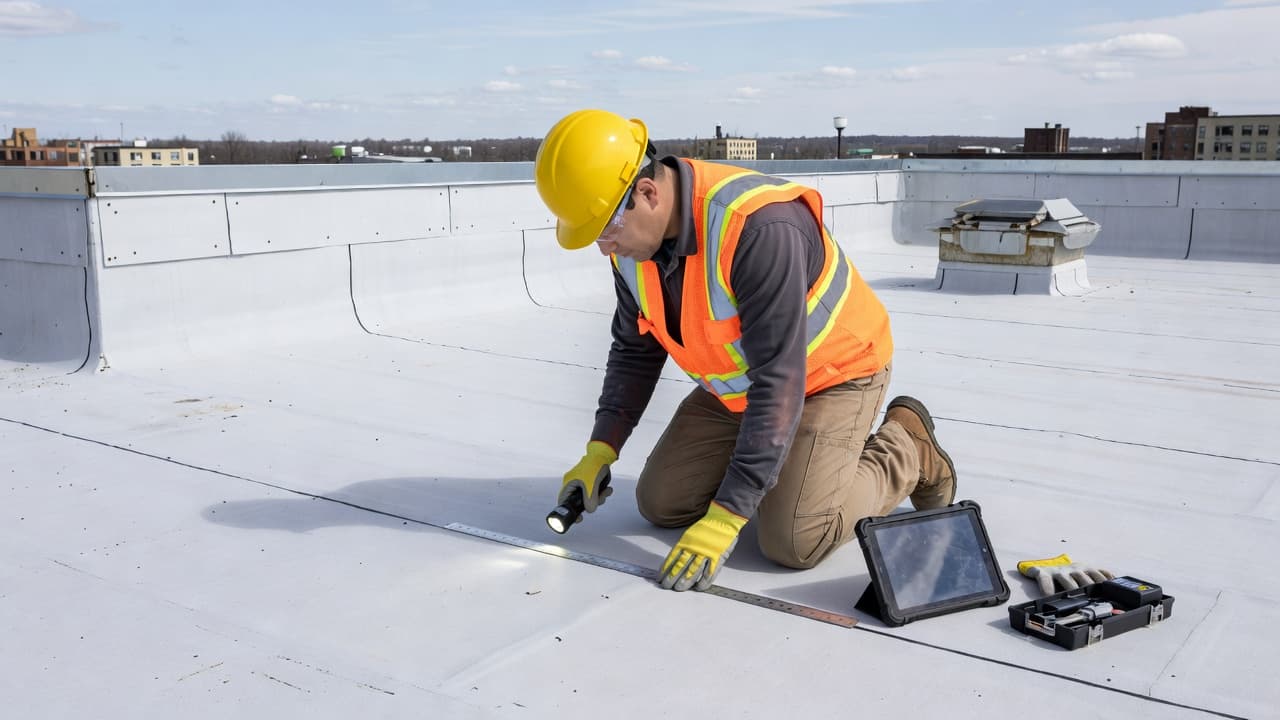
That is why identifying hidden roof damage for claim documentation matters so much. Moisture readings, infrared, test cuts, and marked photos can show whether the job is a patch, a section replacement, or a much larger failure.
5. Match the damage to the right scope
Small damage can stay small. A few torn asphalt shingles may support residential roof repair. A lifted metal panel or broken ridge detail may support targeted metal roofing repairs. But widespread seam failure, saturated insulation, or repeated leaks can move the file toward commercial roof replacement or residential roof replacement.
Do not let the claim drift into the wrong solution. Commercial roof restoration and commercial roof coatings can add life to some assemblies, but they do not fix a fresh wind-created opening by themselves. If the membrane is failing across connected areas, the real answer may be commercial roof repair across a wider section or full replacement. If you need eyes on a business property, Get a Free Commercial Roof Inspection.
6. Choose a contractor who can document cause, not guess at it
Claim files rise or fall on cause. In the Saint Paul roofing, Minneapolis roofing, and broader Twin Cities roofing market, that means using a Minnesota roofing contractor who can write a clean scope, preserve evidence, and meet the adjuster with photos.
Many owners look for union-built roofing crews, GAF certified status, and local labor ties such as IUPAT Local 96. License proof matters, too, including MN License 803862 where applicable. If the damage is on a house, Get a Free Residential Roof Estimate.
The deadline that matters is the one in your policy
The short version that keeps claims alive
If wind hit your roof, act like the clock is already running. Most Minnesota policies give about a year. Some give far less.
The safest move is simple. Report the claim fast, protect the property, and document the roof before evidence disappears. That is how a valid roof insurance claim stays valid.
FAQ
What if I do not know the exact storm date?
Use the best date you have and report the loss right away. Include the first day you noticed damage, interior leaking, or debris. If several storms are possible, let the carrier investigate. Waiting for certainty usually creates a worse problem.
Can I file after a temporary repair?
Yes, often you should. Temporary tarping, dry-in, and water control usually help the claim if they were reasonable and documented.
What hurts the file?
Permanent work that removes wet insulation, coats over damage, or replaces materials before inspection can blur cause and scope.
Does filing late always mean denial?
Not always, but it is risky. Some carriers still review late claims if the delay did not prejudice their investigation. Many do not. Missing a clear notice deadline is one of the easiest ways for a carrier to say no.
What if wind and hail happened in the same storm?
Report both. Wind and hail can damage the same roof in different ways, and Minnesota timing rules may not line up perfectly between the two. Keep the claim broad enough for the adjuster to inspect lifted seams, punctures, dents, flashing, and wet insulation.
Do flat roofs follow different claim rules than steep roofs?
The filing deadline usually comes from the policy, not the roof shape. The inspection method changes, though. A low-slope system like TPO roofing, EPDM, modified bitumen, or BUR often needs leak tracing because water travels before it appears inside.
Need a roof inspection in Saint Paul or the Twin Cities? Call Sellers Roofing Company at +1-651-703-2336 or schedule a free estimate. We are a black-owned, NMSDC-certified MBE roofing contractor with 9+ years experience.